61
TRIANGULATING SOME DISCOURSE-RELATED
ISSUES IN INDONESIAN EFL PRE-SERVICE
TEACHERS WRITTEN NARRATIVES
Joseph Ernest Mambu Satya Wacana Christian University, Indonesia
Abstract: This paper attempts to document how the notion of discourse was made sense of by EFL teachers from the U.S.A. and by me as an Indonesian who read and commented on 16 narratives written by four male and four fe-male pre-service/student teachers. While the Americans tended to focus on the superficial content and textual organizations, I have found it crucial to appreciate the themes, styles, and philosophies these pre-service teachers presented in their narratives. First, the themes were clustered, thus showing how one pedagogical story relates to or differs from another. Second, the styles of arranging thoughts indicate how Indonesian teachers in this study were overall more indirect so the American readers assumed more responsi-bility to decipher their implied meanings. From my perspective, however, the salient discourse style is that of philosophizing. In essence, the philoso-phies in several narratives reflect traces of the ongoing process of believing what these teachers did or practiced as prospective teachers or as colleagues.
Key words: pre-service teachers, narrative, discourse, philosophizing
A bulk of teachers narratives reflecting on the experiences of language teach-ing and learnteach-ing experiences has been documented (Johnson & Golombek, 2002). However, a lot more stories from the teaching practicum setting, espe-cially in response to Shi s (2002: 149) call for documenting ESL/EFL pre-service teachers narratives, will further enrich the variety of narratives in terms of lengths, themes or thematisation (cf. Brown & Yule, 1983: 133-152), and styles (how these narratives are structured by narrators).
TEFLIN Journal, Volume 20, Number 1, February 2009 62
is that of western vs. non-western writing style. According to Kaplan (1966), western authors are more straightforward in expressing their intentions than their non-western counterparts, including Indonesians. This tendency is concur-rent with Hinds (1987) who posits that western people require more responsi-bility from writers to make their writings as lucid as possible for readers. On the other hand, non-western writers tend to pass the responsibility to the read-ers to make sense of their (elusive) writings.
Comparing written or spoken narratives, in particular, styles have also been examined. Tannen (2007), citing her earlier study in 1982, asked her stu-dents to record informal conversations in which they were involved, then select a story from the conversations. After that the person who told the story orally to the student was asked to write it down. While the vast majority of the written stories typically belonged to the written expository prose style, one written story evinced the features (i.e., the involvement strategies ) that characterized a spoken/oral/conversational style (p. 29). Involvement indicates a joint pro-duction of meaning between an author/speaker and a listener/audience/reader (p. 28). She further explains that involvement strategies work on two levels: on the one hand, sound and rhythm, and on the other, meaning through mutual participation in sensemaking (p. 30). This study was limited to the meaning level.
Mambu, Triangulating Some Discourse-Related Issues 63
in some Indonesian students undergraduate theses in Makassar, South Su-lawesi; see Jubhari, 2008, for instance).
It will be too ambitious to trace all of the reviewed involvement strategies. Hence, of salience in this present study is, first, to chart the themes of the col-lected narratives. Second, it is important to know how the American readers view the teachers narrative discourse in general and the (in)directness of the narratives in particular. Third, teachers philosophizing capacity as an in-volvement strategy deserves to be appreciated in its own right; otherwise, the pedagogical values/beliefs/voices embedded in their narratives no matter how explicit they are will go unnoticed or undervalued, at worst.
METHOD
Data of eight (out of 18) English Department of Satya Wacana Christian University (SWCU) student (pre-service) teachers who had completed their teaching practicum were analyzed in the present study. Four male and four fe-male students TOEFL scores by the time of data collection were above 500. For the sake of anonymity, the male students were coded M1, M2, M3 and M4 and the female students F1, F2, F3, and F4. All other names (of schools, teach-ers, lecturteach-ers, and friends) in their stories were also pseudonyms. They were chosen due to their GPAs, TOEFL scores, previous stay in an English-speaking country, and the complexity of their narratives (which surpassed the other nar-ratives written by the other 10 students whose essays had initially been col-lected). The data show that, M2 s and M3 s scores were 600 plus. M3 was one of the best graduates. M4 used to live in the United States for some time as his father worked there. While the four female student teachers, M1 and M4 are Javanese by ethnicity, M2 and M3 are Indonesian-born Chinese. They were in their early twenties and were in their final year in the SWCU undergraduate program of TEFL. All of them had just completed their teaching practicum course in some secondary schools in Salatiga.
Based on the stories, it becomes apparent that they taught in four schools: W School (done by F3); X School (M1 and M4); Y School (F1, M2, and M3); and Z School (F2 and F4).
TEFLIN Journal, Volume 20, Number 1, February 2009 64
late twenties). The lengths of stay in Indonesia vary from more than 20 years (RK), seven years (AT), to three years (Vic) as of August 2008.
Sixteen narratives (eight good and eight bad stories) were elicited from eight students last January 2007. The students were asked to write their good and bad personal experiences during the teaching practicum s/he had just completed on a piece paper with time limit (maximum of 45 minutes). Each narrative was supposed to be written in at least 300 words in English. It turned out that the total number of words was 6,931 (with an average of 433.175 words per narrative per person). The pre-service teachers, however, were told that they could switch to Indonesian in their writing when they found it too difficult to express an idea in English.
Data were then triangulated by AT, RK, Vic, and myself. First, they were asked to pinpoint any interesting features in the narratives that were typically Indonesian with regards to discourse (e.g., the way the students organized the narratives). I did not specifically exemplify philosophizing as a way of structur-ing some thoughts in narrative discourse to my American colleagues. There was no time limitation for them to comment on the essays but they were re-turned in two weeks. Finally, I analyzed the narratives in light of Tannen s (1980, 2007) notion of involvement strategies in general and philosophizing in particular.
FINDINGS
There are nine themes, consisting of five good themes and four bad themes. The good themes are (1) an enjoyable teaching experience (M4 and F1), (2) an awful teaching preparation which turned into a positive experience (F3), and memorable experiences with (3) students (M1 and M2), (4) fellow student teachers (M3), and (5) a teacher or guru pamong at school (F2 and F4). The bad themes range from (1) unpleasant moments in the first teaching experience to conflicts with (2) teachers (M1 and F1), (3) fellow student teach-ers (M2, M3, F2, and F4), and (4) a student (F3).
Mambu, Triangulating Some Discourse-Related Issues 65
writers responsibility to be comprehensive (e.g., Vic s demand for F3 to ex-plain why everything changed ) and incoherence (e.g., AT s spotting an in-consistency in F1 s story).
Table 1. Praises on Contents
No Praises on Comments
Readers Commented student teachers Commented stories (G/B) 1 Introduction This is the standard intro taught
in Amer. composition.
Vic-M1-B
2 Conclusion Nice conclusion Vic-M1-G
Note: G = a good experience ; B = a bad experience
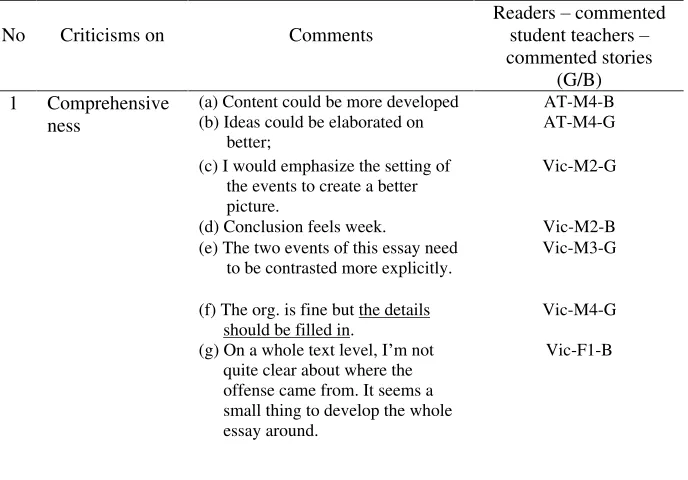
Table 2. Criticisms on Contents
No Criticisms on Comments
Readers commented student teachers commented stories
(G/B) (a) Content could be more developed AT-M4-B (b) Ideas could be elaborated on
better;
AT-M4-G (c) I would emphasize the setting of
the events to create a better picture.
Vic-M2-G
(d) Conclusion feels week. Vic-M2-B (e) The two events of this essay need
to be contrasted more explicitly.
Vic-M3-G 1 Comprehensive
ness
(f) The org. is fine but the details should be filled in.
(g) On a whole text level, I m not quite clear about where the offense came from. It seems a small thing to develop the whole essay around.
TEFLIN Journal, Volume 20, Number 1, February 2009 66
Table continued
(h) Whole text level: why is this the good experience? She says everything changed but doesn t explain.
Vic-F3-G
(a) This was already established in the previous paragraph.
AT-F2-G (b) same opening (as the bad
experience)
Vic-M4-G (c) I would cut the introduction for
both these essays.
Vic-F2-G (d) repetition (of the bad experience) Vic-M4-G (e) On a whole text level, I m not
quite clear about where the
Vic-F1-B 2 Verbosity
(a) making friends offers many chances isn t the lesson more about being diligent and self-motivated?
AT-F4-G
(b) F1: 30Then, I leaned lazily against the wall when I responsed to her questions. 31I didn t feel comfortable with this situation.
32
I felt that her question were out of border since she was my school teacher at this time.
33
Thus, since I was very curious to what she thought [ ] AT: the wall when I responsed to her questions. 31I didn t feel comfortable with this situation.
32
I felt that her question were out of border since she was my school teacher at this time.
33Thus, since I was very curious
to what she thought [ ] AT: [Sentence 33] conflicts with previous sentence.
Mambu, Triangulating Some Discourse-Related Issues 67
Table continued
(c) F1: 35In full of anger, I struggle to recall the motivation I had got from the students. 36Hence, I ended my last teaching with a success. AT: [There is some] missing information [between sentence 35 and 36]. Connect ideas.
AT-F1-B
(d) ending? AT-F3-B
(e) [The last four sentences don t] make sense.
RK-M2-G
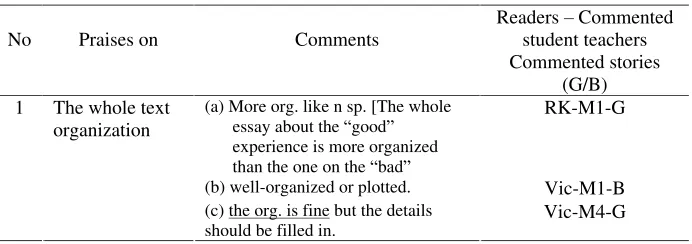
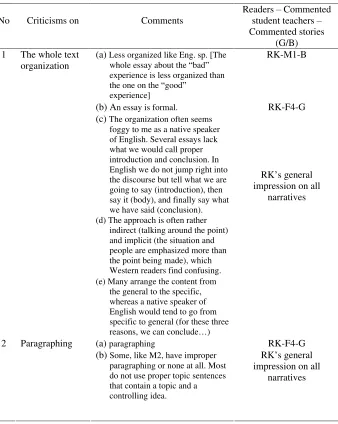
Similarly, the praises for the students textual organization were far outnum-bered by the criticisms (compare Table 3 and Table 4). The most salient issue for an American like RK was lucidity ( writer responsibility ). She considered that the Indonesians were typically elusive, especially due the absence of proper topic sentences (RK s comments on paragraphing). Such elusiveness seems to have supported the long-standing claim that non-Western people such as Indonesians are more indirect in their written essays (Kaplan, 1966). M1, however, seems to have been more direct as he did have some topic sentences, at least in the first sentences of his essays, e.g., Difference has been producing hells in Indonesia and Socialization is power (see the complete essays in the appendix).
Table 3. Praises on Textual Organizations
No Praises on Comments
Readers Commented student teachers Commented stories
(G/B) (a) More org. like n sp. [The whole
essay about the good experience is more organized than the one on the bad
RK-M1-G
(b) well-organized or plotted. Vic-M1-B 1 The whole text
organization
(c) the org. is fine but the details should be filled in.
TEFLIN Journal, Volume 20, Number 1, February 2009 68
Table 4. Criticisms on Textual Organizations
No Criticisms on Comments
Readers Commented student teachers Commented stories
(G/B) (a) Less organized like Eng. sp. [The
whole essay about the bad experience is less organized than
foggy to me as a native speaker of English. Several essays lack what we would call proper introduction and conclusion. In English we do not jump right into the discourse but tell what we are going to say (introduction), then say it (body), and finally say what we have said (conclusion). (d) The approach is often rather
indirect (talking around the point)
(e) Many arrange the content from the general to the specific, whereas a native speaker of English would tend to go from specific to general (for these three reasons, we can conclude )
(b) Some, like M2, have improper paragraphing or none at all. Most do not use proper topic sentences that contain a topic and a controlling idea.
RK s general impression on all
Mambu, Triangulating Some Discourse-Related Issues 69
Table continued
3 Punchlining 18No matter how smart and high your GPA if you don t want to open mind and learn from someone better than you, you ll be nothing Vic: I would save general conclusion for the end.
Vic-F4-G
Furthermore, the three Americans did not seem to agree with each other on individual cases, as far as their written comments on discourse are concerned. For instance, only Vic and AT who agreed that M4 should have elaborated on the details of his story about a good experience (see Table 2 concerning com-prehensiveness). What may be qualitatively implied, however, suggests another picture. From the written comments, it can be implied that at least Vic and RK considered that M1 s essays were relatively more well-written , and native-like 1, than those of other teachers (see Tables 1 and 3). Scrutinizing the indi-vidual cases again, however, Vic and RK did not entirely agree to each other. While Vic regarded M1 s introductory paragraph of his bad experience as the standard intro taught in Amer. composition (see table 1) and the whole para-graph as well-organized or plotted (see Table 3), RK thought that the same story was less organized (Table 4). Moreover, AT did not give as many comments on discourse as RK and Vic.
These differences suggest that a total dependence on American EFL teachers written feedback on essays by Indonesian teachers (will) distort the bigger picture: not only does the performed language (especially on the dis-course level) matter but also the substances these Indonesian teachers brought to the fore through their writings. In essence, the substances of these teachers narrative discourses are contextually, intertextually, and philosophically shaped. They are located within personal and social spaces. The personal space provides rooms for teachers to contest pedagogical ideas/theories/philosophies and feelings. The social space is where an EFL (pre-service) teacher interacts with school stakeholders and attempts to position her-/himself at a distance or
1
TEFLIN Journal, Volume 20, Number 1, February 2009 70
in concert with these stakeholders. Therefore, the ways an individual teacher positions her-/himself within a learning community as reflected in her/his theme of (narrative) discourse deserve much more attention, which is lacking in the three Americans feedbacks on discourse.
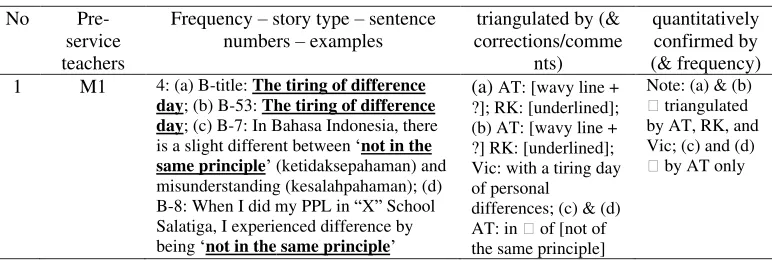
Apart from distinct involvement strategies (i.e., direct vs. indi-rect / elusive style) between the Americans and the Indonesians, the themes warrant further attentions. In this analysis, in particular, I am indebted to Tan-nen s (1980) notion of philosophizing as an evaluative device (cf. Labov, 1972) in a storytelling event. Some of the examples have been shown in Table 5 (see also the complete narrative in the appendix) where philosophical-sounding noun phrases were repeatedly used by M1 to highlight his philosophical theme that evinced his vehement opposition to his mentor: The tiring of difference day and not in the same principle . At the first mention of the phrase The tiring of difference day , both AT and RK underlined the phrase, indicating their confusion about its meaning. Vic seemed to suspend his judgment (by not underlying it) but then with his intersubjectivity (i.e., his attempt to make sense of M1 s implied intention or to understand where M1 was coming from; see Larsen-Freeman, 2003, p. 45), he polished the phrase in the 53rd sentence of the same narrative into with a tiring day of personal differences . A similar in-tersubjectivity was exhibited by AT who changed the preposition in into of in the phrase not in the same principle . This polishing act is, in my opinion, different from error correction as it is the Americans attempts to enhance the intelligibility of M1 s expressions.
Table 5. The Philosophical Tendency day; (c) B-7: In Bahasa Indonesia, there is a slight different between not in the same principle (ketidaksepahaman) and misunderstanding (kesalahpahaman); (d) B-8: When I did my PPL in X School Salatiga, I experienced difference by being not in the same principle
Mambu, Triangulating Some Discourse-Related Issues 71
In fact, M1 s introductory paragraph is full of philosophizing phenomena (see the complete narrative in the appendix). He started with a topic sentence with the topic being difference and the controlling idea being producing hells in Indonesia . This theme is intertextually linked to various current issues in In-donesia: GAM (Aceh Movement for Independence), riots in Poso (Sulawesi), and a war in Sampit (Kalimantan). The idea of literal killing in various places in Indonesia due to difference was then narrowed down to the figurative kill-ing toward M1 by his mentor. In fact, not only was Vic as an American im-pressed by this paragraph (see Table 1 above), but also M1 s discourse here confirms Becker s (1979) contention (as cited in Johnstone, 2003, p. 642) that the sense of coherence in Javanese shadow puppet is built up by way of spatial coincidence , not of a chronological order (as in the western writing style). In subsequent paragraphs M1 structured his narrative chronologically but in the first paragraph he expanded the space from that of his experience as a pre-service teacher in a school to other killings taking place in some areas in Indo-nesia.
M1 (A bad experience)
1Difference has been producing hells in Indonesia. 2aThe hells include sepa-ratism movement in Aceh, known as GAM (Gerakan Aceh Merdeka); 2bPoso riots in which three unguilty people were sentenced to death; 2cwar in Sampit in which human lost their humanity by killing other humans by cutting their heads; 2dand many other hells that need more than one book to write on. 3People say that difference is usual and needed. 4As for me, they are true, but actually difference has 2 sides. 5The positive side is when we can tolerate difference and, hereby, we can live together in perfect harmony. 6The nega-tive side is when we cannot tolerate difference. 7In Bahasa Indonesia, there is a slight different between not in the same principle (ketidaksepahaman) and misunderstanding (kesalahpahaman). 8When I did my PPL [teaching practicum] in X School Salatiga, I experienced difference by being not in the same principle , and, therefore, I faced the negative side of difference. 9This experience (being different from my guru pamong) is a really tiring job.
TEFLIN Journal, Volume 20, Number 1, February 2009 72
organized essay (see Table 3). The echoing voice of his father Socialization is power set the tone for the rest of M1 s story. The exact wording was even repeated (sentences 6, 17), rephrased as I found the meaning of socialization in sentence 43, and made more salient in other repetitive phrases make/made/ making [many] friends (sentence 2, 4, 9, 25, and 42). Thus, philosophizing is interweaved through alluding to another s (M1 s father s) voice that is intertex-tually shaped in the storytelling event as a new context which is then reinforced through repetition. As Becker (1995) puts it, as cited in Tannen (2007):
Languaging can be understood as taking old texts from memory and reshap-ing them into present contexts. (9) All languaging is what in Java is called jarwa dhosok, taking old language (jarwa) and pushing (dhosok) it in-to new contexts (185). (p. 11, italics original)
M1 s father s voice became the jarwa being pushed in a new context where M1 did his teaching practice. Concerning M1 s repetitive phrases, in particular, it may be the case that M1, either as a Javanese by ethnicity himself or as an individual irrespective of ethnicity, possesses a repeating strategy that coincides with Becker s (1984) observation as cited in Tannen (2007): repeat-ing strategies in a wayang drama are characteristic of a Javanese aesthetic of density (p. 85). M1 s story was indeed dense with the main theme: socializa-tion with students.
M1 s narrative is exemplary and yet he is not the only teacher with a philosophizing capacity. Here are some other examples from four more pre-service teachers that are relevant to language pedagogy and interpersonal rela-tionships among teachers (Notes: [a] words in square parentheses were sup-plied by the Americans to enhance clarity; [b] the underlined parts indicate my impression about their philosophizing capacity no matter how trivial they may seem):
F1 (A good experience)
mend-Mambu, Triangulating Some Discourse-Related Issues 73
ing a relationship [succeed in establishing a relationship] with the students. [ ]
F2 (A good experience)
[ ] 28She kept giving my suggestion about my teaching everytime I did the consultation. 29And she was different from other guru pamong. 30Bu Elly never gave suggestion like that. 31And the other guru pamong never gave the student teacher nice comments about the teaching. 32While bu betty, even she gave a bad comments, she always mengimbanginya [balanced them] with a nice comments that wont make her student teacher got down. 33In fact, her student teacher will be more semangat [motivated] to do the next teaching.
F4 (A bad experience)
[ ] 29Overall, she taught me something to sharpen my personality trait to become wiser and more patient. 30Thank you .
F4 (A good experience)
[ ] 31So, what I got from this story was making friends offers many chances. 32Chance for me to develop my capability, to enrich my creativity and to deal with something bad/wrong and good.
M3 (A bad experience)
[ ] 38That incident taught me something after all: that I have to be more pa-tient. 39Those unnecessary questions are meant to show kindness, to build the connection. 40They are not merely stupid things with no meanings. 41Thus, that bad incident with Robertreally gave me something to apply in my life.
M3 (A good experience)
TEFLIN Journal, Volume 20, Number 1, February 2009 74
than anyone else, vice versa. 34When I am in a group of that kind of people, I feel more comfortable to finish my works.
When it came to a real teaching experience, some pre-service teachers might not have remembered teaching theories they learned prior to or concurrently with the teaching practicum. Reflecting on her teaching experience, for in-stance, F1 came up with the idea of relating class activities to students back-ground knowledge.
The other stories (F2, F4, and M3) are more interpersonal than peda-gogical. This, however, does not make the themes trivial or absolutely non-pedagogical. Rather, the ways pre-service teachers philosophized the mentor s assessment style (in F2 s story) and built their relationships with fellow pre-service teachers (in F4 s and M3 s stories) are of equal importance to teachers decision to plan their lessons (as in F1 s story). As an old adage says experi-ence is a good teacher , these teachers pedagogical and personal experiexperi-ences affected their teaching practices as a whole. By reflecting on their practices through the written narratives, these teachers will inform such teacher-researchers like me of what have happened in language classrooms in a more systematic way no matter how subjective or anecdotal each story appears. I predict that, until a teacher s subjectivity in a story is triangulated by a lot of similar stories, a more objective inter-subjectivity will in turn be attained.
DISCUSSION
It is high time to offer a sound counter-standpoint toward the main-stream view in the EFL teaching that favors the native-like illusion, especially in regard to discourse style, (sub)consciously perpetuated by many EFL teach-ers. Such a mainstream view may especially be espoused by EFL teachers from
Mambu, Triangulating Some Discourse-Related Issues 75
Pennycook (2007) who contends that:
The crucial point here is not so much whether or not one is born in a par-ticular type of community but rather what one does with the language. It is in the performance that the identity is created. (p. 35)
Some traces of the pre-service teachers performances using Englishes are in-deed reflected in the way they make meaning and construct their thoughts through narrative essays. It may be misleading, therefore, to think that the dis-course style of a community (e.g. Indonesian pre-service teachers) is preemp-tively determined by where the members of community are born. A dichotomy on identity like western vs. non-western may be useful for an entry point of locating where a certain discourse style is typically used. In fact, this has been somewhat confirmed by the general trend that Indonesian writers in this study are more indirect. Nonetheless, as these writers might have been exposed to people from other countries or to academic writings, their performance that is, how they go about the language in their writings complicates the picture. M1, for instance, interweaved both indirectness (e.g., allusions to various cur-rent events in Indonesia in his first paragraph) and directness (e.g., the use of topic sentences in some of his paragraphs; see the appendix).
The nine themes generated in this study are certainly non-exhaustive. In essence, it can be projected that by collecting more stories from pre-service teachers, we will be in a better position to delve into pre-service teachers sense of achievement and failures in their teaching practicum more systematically. Embedded in the stories with various themes are how teachers not only made sense of events and characters with whom they interacted but also reflected specifically on their pedagogical beliefs (or philosophies).
These teachers philosophizing voices which are typically located near or at the end of their narratives may be overlooked if discourse analysts are too much concerned with grammatical accuracies at the morpho-syntactical level and broad textual organizations. Part of inquiring into at least these teach-ers discourse (in their pteach-ersonalized English[es]) is listening to their struggles and philosophically reflected solutions within their pedagogical and interper-sonal contexts in Indonesia, particularly in Salatiga.
TEFLIN Journal, Volume 20, Number 1, February 2009 76
ries that foster a nonroutine school culture where teachers can exchange their valuable teaching and interpersonal experiences and beliefs or philosophies (cf. Sato & Kleinsasser, 2004) significant for their professional development as prospective EFL teachers in Indonesia. A special attention has been paid to those stories told in Englishes which are pregnant with an array of elusive meanings to be deciphered by EFL teachers from Inner Circle and Expanding Circle countries (cf. McKay, 2002) alike.
CONCLUSION AND SUGGESTION
At the discourse level, I have the impression that on the whole the Ameri-cans (especially RK) with their writer-responsibility expectation and straight-forwardness imposed on the Indonesians have not sufficiently appreciated the Indonesian teachers philosophizing capacities as learners (and prospective EFL teachers) whose English has been personalized owing to (a) their Indone-sian as L1, (b) the contexts of the stories that revolve around experiences dur-ing teachdur-ing practicum in Indonesia, and (c) the storytelldur-ing event that was not framed in a gate-keeping encounter as they knew their narratives would not be influencing their grades. Inspired by Labov s (1972) notion of evaluation and Tannen s (1980) s observation on a philosophizing inclination as an evaluative device, I find the teachers some philosophical contributions to the professional development in the foreign language pedagogy in Indonesia. More importantly, the philosophizing capacity is a discourse style in its own right that EFL teach-ers should attend to more thoroughly. Hence, this study attempts to push our thinking beyond the direct - indirectness divide (as somewhat perpetuated by RK representing a horde of like-minded EFL teachers worldwide).
Mambu, Triangulating Some Discourse-Related Issues 77
is to accommodate and appreciate these teachers discourse styles (e.g., phi-losophizing) and their pedagogical voices (e.g., F1 s decision to relate class ac-tivities to students background knowledge).
REFERENCES
Brown, G., & Yule, G. 1983. Discourse Analysis. Cambridge: Cambridge Uni-versity Press.
Cameron, L., & Low, G. (Eds). 1999. Researching and Applying Metaphor. Cambridge: Cambridge University Press.
Hinds, J. 1987. Reader Versus Writer Responsibility: A New Typology. In U. Connor & R. Kaplan (Eds), Writing Across Languages: Analysis of L2 Text (pp. 141-152). Reading, MA: Addison-Wesley.
Johnson, K. E., & Golombek, P. R. (Eds). 2002. Teachers' Narrative Inquiry as Professional Development. Cambridge: Cambridge University Press. Johnstone, B. 2003. Discourse Analysis and Narrative. In D. Schiffrin, D.
Tan-nen & H. E. Hamilton (Eds), The Handbook of Discourse Analysis (pp. 635-649). Malden, MA: Blackwell Publishing.
Jubhari, R. 2008. Traces of Indonesian Oral Tradition in Skripsi. Paper pre-sented at the 6th AsiaTEFL International Conference, Sanur, Bali, Indonesia.
Kaplan, R. 1966. Cultural Thought Patterns in Inter-Cultural Education. Lan-guage Learning, 16, 1-20.
Kleinsasser, R. C. 1993. A Tale of Two Technical Cultures: Foreign Language Teaching. Teaching and Teacher Education an International Journal of Research and Studies, 9(4), 373-383.
Labov, W. 1972. The Transformation of Experience in Narrative Syntax. In W. Labov (Ed.), Language in the Inner City (pp. 352-396). Philadelphia, PA: University of Pennsylvania.
Larsen-Freeman, D. 2003. Teaching Language: From Grammar to
TEFLIN Journal, Volume 20, Number 1, February 2009 78
McKay, S. L. 2002. Teaching English as an International Language. Oxford: Oxford University Press.
Pennycook, A. 2007. Global Englishes and transcultural flows. London and New York: Routledge.
Sato, K., & Kleinsasser, R. C. 2004. Beliefs, Practices, and Interactions of Teachers in a Japanese High School English Department. Teaching and Teacher Education, 20(8):797-816.
Shi, L. 2002. A Tale of Names. In K. E. Johnson & P. R. Golombek (Eds),
Teachers' Narrative Inquiry as Professional Development (pp. 136-149). Cambridge: Cambridge University Press.
Tannen, D. 1980. A Comparative Analysis of Oral Narrative Strategies: Athe-nian Greek and American English. In W. L. Chafe (Ed), The Pear Stories: Cognitive, Cultural, and Linguistic Aspects of Narrative Production (pp. 51-88). Norwood, New Jersey: ABLEX Publishing Corporation.
Tannen, D. 1982. Oral and Literate Strategies in Spoken and Written Narra-tives. Language, 58(1):1-21.
Mambu, Triangulating Some Discourse-Related Issues 79
Appendix. M1 s narratives.
I. Bad Experience
THE TIRING OF DIFFERENCE DAY
1
Difference has been producing hells in Indonesia. 2aThe hells include separatism movement in Aceh, known as GAM (Gerakan Aceh Merdeka);
2b
Poso riots in which three unguilty people were sentenced to death; 2cwar in Sampit in which human lost their humanity by killing other humans by cutting their heads; 2dand many other hells that need more than one book to write on.
3
People say that difference is usual and needed. 4As for me, they are true, but actually difference has 2 sides. 5The positive side is when we can tolerate dif-ference and, hereby, we can live together in perfect harmony. 6The negative side is when we cannot tolerate difference. 7In Bahasa Indonesia, there is a slight different between not in the same principle (ketidaksepahaman) and misunderstanding (kesalahpahaman). 8When I did my PPL in X School Sala-tiga, I experienced difference by being not in the same principle , and, there-fore, I faced the negative side of difference. 9This experience (being different from my guru pamong) is a really tiring job.
10
On Monday, Mrs. Dinda (my guru pamong) told me that on Saturday (on the same week) I had to teach listening to grade III. 11 Oh, what a day! said I.
12
I have to be a speaker in PPL seminar also on that day. 13It means that I had to prepare 2 things: mentality and the materials of both jobs. 14I had to teach listening at 07.00 a.m to 08.30 am whereas I had to be the speaker at 08.45 a.m.. 15aMy guru pamong did not seem to be interested with my problem; 15bI had to teach.
16
Considering that problem, I decided to work on my listening materials on Thursday, so that on Friday, I could concentrate on seminar preparation.
17
Starting on Wednesday, I looked for materials, such as book and so on. 18I got a really well-planned and good idea about what I would teach. 19I would gave a recording (consisting of 3 paragraphs) about Bermuda Triangle , followed by 5 essay questions. 20One of the questions is that I asked students to look at America map that was provided and look for as well as draw the location of
TEFLIN Journal, Volume 20, Number 1, February 2009 80
21
This must be interesting for students, I talked to myself. 22I also pro-vided a recording of a song, titled Greatest love of all by Whitney Houston.
23
I planned to ask students to fill the missing words. 24After finding the materi-als, I worked on it. 25I made up the questions and lesson plan. 26All of these stuffs finished on Thursday at 07.00 p.m. 27I started to create the recording with my colleague, Doni, in my boarding house. 28I saved my work in computer and planned to record it into cassette on Friday at 10.00 a.m. because it had been 11.00 p.m.
29
On Friday morning at 08.00 a.m., I went to X School to consult my lesson plan to Mrs. Dinda. 30She looked unsatisfied while looking and reading my lesson plan. 31Her eyebrows went down with a scary eyes shinning unhappy look.
Why din t you tell me since Monday? 35bI talked to myself, because I did not dare to challenge her.
36
You can use your materials for grade II, but not for grade III because grade III are focused on Final Exam. 37Hereby, they have to be trained the same question type as Final Exam, she explained.
38
After saying that, she went away to class. 42I went to my boarding house and called Doni whether he could save me from this misery or not.
43
Finally, on Friday, I worked on the materials once more, from 01.00 p.m. to 05.00 p.m. 44Iwan came late to my boarding house, making me angry by let-ting me wait for a long time. 45While waiting for him, I created an outline of what I should say on PPL seminar held just 15 minutes after I finished listening class. 46Doni and I finished creating new recording at midnight.
47
I woke up at 06.00 a.m. on Saturday. 48I practised my PPL seminar out-line for a while and then went to X School by foot because the transportation was always full at that hour. 49I just taught my new materials (one question fol-lowed by four multiple choice answers) and went at 08.15 a.m. without telling
Mambu, Triangulating Some Discourse-Related Issues 81
51
After the seminar had finished, I took a deep breath and talked to myself, I will never ever want to do this kind of heck and work with the same person anymore. 52This is tiring. 53I prayed to God for helping me in the tiring of dif-ference day. 54 Deo Gratias (thank to God), said I.
II. Good experience
MAKING FRIENDS IS A VALUABLE ASSET
1
Socialization is power , this saying, said by my father, echoed on my ears when Mrs. Rani (dosen pembimbing PPL), my friends and I started PPL program in X School Salatiga. 2My father is a social person, successful on making many friends. 3My father says that neighbours, brothers who live far away, all people are to a valuable asset for us to succeed. 4As for me, according to my father, I am such a shy person. 5I do not think so because I think the mat-ter is my father has much more friends than I do. 6I admit that actually at that time I had not know what my father meant by socialization is power . 7At PPL, I found what he meant by proving it. 8I made friends with one student that introduced me to other ones and helps me in my teaching. 9By now, I admit that making friends is a valuable asset for me to succeed.
10
On Saturday, all PPL teachers including me, gathered in office for that was office day. 11I saw Prakoso shonning plain eyes and listening to music. 12I saw Dita, Puspita, and Yunus talking to each other. 13aI found myself thinking what I should do to make my PPL teaching successful whereas I was obliged to teach grade III; 13bthe grade which are mature enough to think critically to-wards what I teach and easy enough to get bored toto-wards how I teach and clev-er enough to play tricks on me.
14
Kriing , the bell rang, it was break time, students were coming out of the class to go to café. 15I saw my PPL friends still doing the same things. 16I stood up, looking at students gathering in café.
17
Socialization is power, this words came up to my mind. 18I encouraged myself to go to face and sat down in a table with 2 boy students. 19I introduced my name to them. 20They are Boy and Radit. 21aWe talked about our hobies, ac-tivities and many fun things; 21bexcept things that can lead to anger. 22After breaktime finished, I went back to the office. 23This time I found my friends looking at me with fury. 24 What were you doing? said one of them.
25
TEFLIN Journal, Volume 20, Number 1, February 2009 82
26
When it was time to leave school, Boy surprisingly appeared in front of me.
27
Mas, would you join OSIS having fun activity in Sekar Langit? Boy
offered me something that I wait. 28I agreed. 29That day, I went home accompa-nied by Boy with his motorcycle.
30
The day of OSIS activity came. 31Boy picked me up to X School. 32He introduced me to many other students and teachers who also participate in OSIS activity. 33I thought that it was the starting point of my success in PPL.
34
OSIS went to Sekar Langit waterfall, a place near Kopeng. 35The committee went there by motorcycle, including me and Boy. 36The leader of the commit-tee asked me to help the commitcommit-tee. 37Students and I had fun, and joy in togeth-erness.
38
On the next day, when it was time to do my first teaching, I noticed that I know some of my students and vice versa. 39We knew each other in OSIS ac-tivity. 40This made me more relaxed, confident and, hereby, enjoy my teaching.
41
At break time, we hang out together in café. 42I made friends with much more students.
43