Commitment, Procedural Fairness, and
Organizational Citizenship Behavior: A Multifoci
Analysis
Article in Journal of Organizational Behavior · April 2009
DOI: 10.1002/job.518
CITATIONS
84
READS
115
7 authors, including:
Aakash Taneja
Stockton University
15PUBLICATIONS 127CITATIONS
SEE PROFILE
Vishnu Vinekar
Fairfield University
12PUBLICATIONS 163CITATIONS
SEE PROFILE
All content following this page was uploaded by Vishnu Vinekar on 24 August 2014.
DigitalCommons@Fairield
Business Faculty Publications Charles F. Dolan School of Business
4-1-2009
Copyright (c) 2008 John Wiley & Sons, Ltd.
his is a post-print of an article subsequently published in the Journal of Organizational Behavior.
Peer Reviewed
Published Citation
Lavelle, J.J., Brockner, J., Konovsky, M.A., Price, K.H., Henley, A.B., Taneja, A., Vinekar, V. (2009). Commitment, procedural fairness, and organizational citizenship behavior: a multifoci analysis. Journal of Organizational Behavior, 30 (3) 337-357.
his Article is brought to you for free and open access by the Charles F. Dolan School of Business at DigitalCommons@Fairield. It has been accepted for inclusion in Business Faculty Publications by an authorized administrator of DigitalCommons@Fairield. For more information, please contact
Repository Citation
Vinekar, Vishnu; Lavelle, James J.; Brockner, Joel; Konovsky, Mary A.; Price, Kenneth H.; Henley, Amy B.; and Taneja, Aakash, "Commitment, procedural fairness, and organizational citizenship behavior: a multifoci analysis" (2009).Business Faculty Publications.
Paper 47.
Aakash Taneja
Running Head: A MULTIFOCI ANALYSIS
Commitment, Procedural Fairness, and Organizational Citizenship Behavior:
A Multifoci Analysis
Richard Stockton College of New Jersey
VISHNU VINEKAR Fairfield University
In Press: Journal of Organizational Behavior
Author Notes:
* The first two authors contributed equally to this manuscript.
Abstract
Research on commitment, procedural fairness, and organizational citizenship behavior (OCB)
suggests that employees maintain distinct beliefs about, and direct behaviors towards, multiple
targets in the workplace (e.g., the organization as a whole, their supervisor, and fellow
workgroup members). The present studies were designed to test for “target similarity effects,” in
which the relationships between commitment, procedural fairness, and OCB were expected to be
stronger when they referred to the same target than when they referred to different targets. As
predicted, we found that: (1) the positive relationship between commitment and OCB, and (2) the
mediating effect of commitment on the positive relationship between procedural fairness and
OCB, was particularly likely to emerge when the constructs were in reference to the same target.
Support for these target similarity effects was found among layoff survivors (Study 1) and student
project teams (Study 2). Theoretical and practical implications are discussed, as are limitations of
Commitment, Procedural Fairness, and Organizational Citizenship Behavior:
A Multifoci Analysis
The construct of employee commitment is of considerable importance to both scholars
(e.g., Mowday, Porter, & Steers, 1982) and practitioners (e.g., O’Malley, 2000) alike. In the face
of increased global competition organizations are more dependent upon the positive work
attitudes and behaviors that typically emanate from employee commitment. For example,
meta-analytic reviews show that organizational commitment is positively related to job performance,
and that the commitment-performance relationship is more pronounced on measures of extra-role
performance than on in-role performance (Mathieu & Zajac, 1990; Riketta, 2002). The
commitment literature distinguishes between different forms of commitment, such as affective,
continuance, and normative (Allen & Meyer, 1990). The focus of the present studies is on
affective commitment, which is perhaps the most widely studied form of commitment, and is
most similar to the way in which Mowday and colleagues (1982) conceptualized commitment in
their groundbreaking work.
Given the positive consequences of a highly committed workforce, it is somewhat ironic
that employees have been subjected to organizational downsizings and other changes in the
psychological contract between employers and employees that often have the effect of reducing
their commitment (Brockner, 1994). Consequently, there is an ongoing need to understand the
causes, consequences, and processes associated with employee commitment.
Towards that end, an important conceptual development in the commitment literature is
the multifoci perspective (e.g., Becker, 1992; Bishop & Scott, 2000; Coyle-Shapiro & Morrow,
2006; Liden, Wayne, Kraimer, & Sparrowe, 2003; Reichers, 1985). This framework suggests
attachment based on identification or affiliation; e.g., O’Reilly & Chatman, 1986) towards various
entities in the workplace, such as the organization, top management, their supervisor, and their
workgroup. The multifoci perspective also has emerged in the literature on organizational justice
(e.g., Blader & Tyler, 2003; Cropanzano, Byrne, Bobocel, & Rupp, 2001; Rupp & Cropanzano,
2002), in which, for example, employees may hold meaningfully different beliefs about the
fairness with which various decision-making agents go about planning or implementing
decisions.
The multifoci approach also has gained traction in the literature on organizational
citizenship behavior (OCB; e.g., Lepine, Erez, & Johnson, 2002; Skarlicki & Latham, 1996;
Williams & Anderson, 1991). For example, certain citizenship behaviors may be directed
towards the organization (OCBO), such as attending voluntary meetings or events pertaining to
the organization, whereas others may be directed towards specific individuals within the
organization (OCBI). Moreover, the “I” in OCBI may differ, such that sometimes people may do
extra work for their supervisor whereas on other occasions they may volunteer to help members
of their workgroups. Whereas it is theoretically possible for certain citizenship behaviors to
influence multiple targets (for example, helping co-workers may have an indirectly positive
effect on the organization as a whole), the key to the multifoci perspective is that people
meaningfully distinguish between targets (hence, in the above example the fact that helping
co-workers also happens to have a positive effect on the organization as a whole is not a driving
force for the focal actor exhibiting the citizenship behavior).
Previous research has employed a multifoci approach to test hypotheses associated with two
of the three constructs of employee commitment, procedural fairness, and organizational citizenship
employee commitment and OCB, whereas Rupp and Cropanzano (2002) studied relationships
between procedural fairness and OCB. These studies generally provided evidence of a “target
similarity effect,” in which the relationship between constructs tended to be stronger when the
constructs referred to the same target than when they referred to different targets.
The target similarity effect is noteworthy on both theoretical and practical grounds. At the
theoretical level, it provides an important extension to previously established relationships, such
as between procedural fairness and commitment (e.g., Brockner, 1994), between procedural
fairness and OCB (e.g., Moorman, 1991), and between commitment and OCB (e.g., Moorman,
Niehoff, & Organ, 1993), in that these relationships are stronger when the constructs refer to the
same target. At the practical level, managers sometimes may be more concerned with
heightening certain types of outcomes (e.g., OCBO) rather than others (e.g., OCBI). If so, then it
is important to delineate those factors that will be particularly likely to have an effect on the type
of outcome that they are seeking to foster. For example, if managers are concerned with how to
heighten OCBO, then the target similarity effect suggests that they should focus their efforts on
employees’ perceptions of the organization’s procedural fairness, rather than on, say, the
procedural fairness exhibited by members of their workgroup.
Given the significance of the target similarity effect, it is important that we deepen our
understanding of it. The present studies are designed to do so, in several respects. First, we provide a
theoretical justification for the target similarity effect, by grounding it in the broader social
psychological literature on the relationship between people’s beliefs/attitudes and their behaviors.
Whereas previous studies have taken a multifoci approach to the three constructs of procedural
fairness, commitment, and organizational citizenship behavior “two at a time” within a given study,
the second and third contributions of the present studies (stated below) show how further analyses
of the target similarity effect may enable us to contribute to several matters of importance in the
literature on organizational citizenship behavior.
Second, whereas previous research already has established that procedural fairness is
positively related to OCB (e.g., Rupp & Cropanzano, 2002), the present studies evaluate an
heretofore unexamined mediator of the relationship between procedural fairness and OCB:
commitment. The focus on multifoci commitment contributes to our understanding of why
perceptions of fairness associated with particular sources of justice may affect citizenship behaviors
directed toward those particular targets. We investigate whether organizational commitment
mediates the relationship between the organization’s procedural fairness and OCBO (in Study 1),
and whether commitment to the workgroup mediates the relationship between the workgroup’s
procedural fairness and OCBI (in Study 2). Third, whereas previous research has shown that OCB
varies along numerous dimensions, including the target towards which it is directed, an earlier
review was unable to delineate factors that are differentially predictive of the OCB that employees
direct towards different targets (LePine et al., 2002). The target similarity effect (which was not
considered in the LePine et al. review) may help us to differentially predict the degree of OCB that
employees direct towards various targets.
THEORETICAL GROUNDING
The conceptual foundation for the target similarity effect is provided by longstanding
theory and research on attitude-behavior relationships (e.g., Fishbein & Ajzen, 1975). An
intriguing problem that plagued attitude researchers for years was that attitudes often were found
to be weakly or not at all predictive of behaviors, even though the two appeared to be
researchers subsequently posited that the strength of the relationship between attitudes and
behaviors depends upon the extent to which the constructs are similar in their scope. In most
studies (i.e., the ones yielding little or no relationship between attitudes and behaviors), the two
were not similar in their scope (Ajzen & Fishbein, 1977). That is, researchers generally tried to
predict specific behaviors on the basis of global attitudes.
Further research showed that global attitudes may predict behaviors, but that the
behaviors needed to be global in scope, that is, the behaviors needed to reflect people’s actions
across a range of situations relevant to the attitude, rather than their action in a specific situation
only (Weigel & Newman, 1976). Moreover, specific behaviors could be predicted, but the
attitudes needed to be specific in scope, that is, the attitude needed to correspond to people’s
behavior in the particular instance, rather than reflect their attitudes in general. Fishbein and
Ajzen (1975; Ajzen & Fishbein, 1980) formalized the importance of target similarity in their
theory of reasoned action. According to the theory, maximal prediction of behavior by attitude
occurs when the attitude corresponds to behavior in terms of action, context, time, and target.
Thus, in the context of the present research, behavior towards co-workers (such as OCBI, in
which the “I” refers to workers) is more likely to be predicted by attitudes towards
co-workers (such as commitment to co-co-workers) than by attitudes towards the organization (such as
organizational commitment).
As the preceding example suggests, one basis of determining an attitude’s specificity is its
target (Fishbein & Ajzen, 1975). Attitudes directed towards a particular target are more specific
than are attitudes directed towards multiple targets or towards unspecified targets. Thus, when
the behavior refers to a specific target, and when the attitude and behavior have the same target,
behavior. In sum, the target similarity effects investigated in the present research are grounded in
attitude theory and research, which posit that attitudes are especially likely to predict behavior
when the two constructs are similar in their scope, for example, when they refer to the same
target. We test for two types of target similarity effects in the present studies: (1) employee
commitment as a predictor of OCB, and (2) employee commitment as a mediator of the
relationship between procedural fairness and OCB.
Employee Commitment as a Predictor of OCB
Organ (1988) defined organizational citizenship behavior as discretionary, voluntary
behaviors that are neither part of an employee’s role requirements nor formally rewarded by the
organization. Researchers have suggested that OCB contributes indirectly to organizational
effectiveness by enhancing the “social and psychological context that supports task
performance” (Organ 1997, p. 1). Moreover, OCB is likely to be increasingly important during
times of significant change, because organizations cannot consistently anticipate or specify all of
the employee behaviors that will contribute to organizational effectiveness under conditions of
uncertainty (Van Dyne & LePine, 1998).
Given the importance of the consequences of OCB, researchers have tried to identify its
antecedents or predictors (see LePine et al., 2002). A basic tenet of prior research and theory in
the OCB literature is that citizenship behaviors are motivated by positive job attitudes such as
commitment (Konovsky & Pugh, 1994; Organ & Ryan, 1995). Indeed, as Mowday et al. (1982)
implied in their seminal work, OCB is a behavioral expression or perhaps consequence of the
underlying attitude of organizational commitment.
Researchers also have suggested that commitment can be viewed as an attitudinal indicator
relationship with the organization (Cropanzano & Mitchell, 2005). In contrast to economic
exchange which refers to a quid pro quo exchange of tangible resources with a short-term focus,
social exchange relationships are often described as subjective, relationship-oriented contracts
between employers and employees characterized by a mutual exchange of socio-emotional benefits
(Blau, 1964; Van Dyne, Graham, & Dienesch, 1994). For example, in exchange for support from
the organization, an employee may demonstrate commitment to the organization (Eisenberger,
Huntington, Hutchison, & Sowa, 1986; Rhoades, Eisenberger, & Armeli, 2001). Researchers argue
that high-quality social exchange relationships (as indicated by commitment, for example) are likely
to prompt employees to engage in citizenship because employees are likely to feel a relational
obligation to engage in behaviors that have positive consequences for their relationship partners
(Cropanzano & Rupp, in press; Lavelle, Rupp, & Brockner, in press; Van Dyne et al., 1994).
One matter of considerable theoretical significance is whether OCBO (such as participating
in voluntary meetings or events regarding the organization) and OCBI (such as helping co-workers
with heavy workloads) are elicited by different factors (e.g., Williams & Anderson, 1991). OCB
researchers have speculated that there are a variety of ways in which employees may engage in
organizational citizenship behaviors. Empirical research is needed, however, to determine whether
meaningful differences in the nature of OCB exist. One way to test for such differences is to
evaluate whether the various forms of OCB are elicited by different factors.
Whereas the LePine et al. (2002) meta-analysis did not unearth factors that were
differentially predictive of OCBO and OCBI, recent studies taking a multifoci approach have been
somewhat more encouraging in their ability to predict OCBO and OCBI differentially (Becker &
Kernan, 2003; Rupp & Cropanzano, 2002). The present research further evaluated whether a
Becker and Kernan (2003) and Rupp and Cropanzano (2002) studies, the “I” in OCBI referred to
participants’ supervisors. However, with the flattening of organizational hierarchies and the advent
of teams in the workplace, it is increasingly important to examine how employees’ attitudes and
behaviors may be affected by their co-workers. Hence, the “I” in the present studies referred to the
people in participants’ workgroups. In Study 1, employees indicated their level of commitment to
the organization as well as to the members of their workgroup. Moreover, measures of OCBO and
OCBI were collected in Study 1.
Hypothesis 1a: Employees’ commitment to the organization will be more likely than their
commitment to their fellow workgroup members to be positively related to their OCBO.
Hypothesis 1b: Employees’ commitment to their fellow workgroup members will be more
likely than their commitment to the organization to be positively related to their OCBI.
Employee Commitment as a Mediator
Just as the multifoci perspective may provide further insight into the differential
prediction of OCBO and OCBI, it may shed light on a related matter that also has received a
great deal of conceptual and empirical scrutiny: how to explain the relationship between
procedural fairness and OCBO. Several recent meta-analyses have shown employees’
perceptions of organizational justice (distributive, procedural, and interactional) to be positively
related to their tendencies to engage in OCB (Cohen-Charash & Spector, 2001; Colquitt, Conlon,
Wesson, Porter, & Ng, 2001; LePine et al., 2002; Viswesvaran & Ones, 2002). Though not
explicitly labeled as such, procedural fairness typically refers to aspects of the organization’s
formal decision-making methods (Folger & Cropanzano, 1998). Consistent with the target
similarity effect, Cohen-Charash and Spector found that procedural fairness was much more
We posit that commitment (in particular, organizational commitment) will mediate the
relationship between procedural fairness (in particular, the organization’s procedural fairness)
and OCB (in particular, OCBO). Whereas Hypotheses 1a and 1b already have suggested that
commitment is likely to be predictive of OCB (particularly when the constructs were in reference
to the same target rather than different targets), the mediational hypothesis requires us to account
for the hypothesized relationship between procedural fairness and organizational commitment.
Relational models of organizational justice (e.g., Tyler & Lind, 1992) have posited that people
prefer to be treated with high procedural fairness because fair procedures symbolize that they are
respected and valued by the party enacting the procedures. Put differently, high procedural
fairness communicates to employees that the organization supports them and indicates they have
more of a social exchange relationship with their employer. In this mutual exchange, employees
may reciprocate being treated with high procedural fairness by showing positive attitudes such as
high organizational commitment (Cropanzano & Rupp, in press).
The relational model of justice has delineated a second mechanism (other than
reciprocity) through which procedural fairness may be positively related to organizational
commitment. High procedural fairness enacted by organizational authorities motivates
employees to make the organization part of their social identity. After all, high procedural
fairness is morally admirable, and most people would like to see themselves as morally
admirable. One way that they can achieve this valued self-conception is by psychologically
aligning themselves with the organization. By defining themselves based upon their
organizational membership, employees may attain valued self-conceptions to the extent that the
fairness. Of course, psychological alignment with an organization is part and parcel of being
committed to that organization (Mowday et al., 1982).
In summary, the reasoning set forth above as well as empirical evidence (e.g., Brockner,
1994) provide support for the notion that an organization’s procedural fairness will be positively
related to employees’ organizational commitment. Moreover, implicit in Hypothesis 1a is the
notion that organizational commitment is likely to be positively associated with OCBO. If an
organization’s procedural fairness leads to organizational commitment, and if organizational
commitment leads to OCB, then it stands to reason that organizational commitment will mediate
the relationship between an organization’s procedural fairness and employees’ OCBO.
Hypothesis 2a: The positive relationship between organizational procedural fairness and
OCBO will be mediated by employees’ organizational commitment.
Furthermore, the target similarity effect emanating from the multifoci perspective
suggests the following related prediction:
Hypothesis 2b: The positive relationship between organizational procedural fairness and
OCBO is more likely to be mediated by employee commitment directed towards the
organization than by employee commitment directed towards the workgroup.
The Context for Study 1: Survivors’ Reactions to Organizational Layoffs
All hypotheses in Study 1 were examined on a sample of employees who had survived an
organizational downsizing. This point is noteworthy for two reasons. First, the downsizing
context enabled us to contribute to theory and research on the determinants of survivors’
reactions to job layoffs (e.g., Brockner, 1994). Organizations downsize their workforces in the
hopes of improving their performance. However, the effect of layoffs on organizational
mixed findings is that the employees who remain following a downsizing (“layoff survivors”)
respond in very different ways, some showing reduced productivity and morale, others showing
improved productivity and morale, and still others showing no effects at all. Prior research has
sought to identify the factors that may account for the variance in survivors’ reactions. One such
factor is organizational justice. The more survivors believe that the layoffs were fair
(distributively, procedurally, and interactionally), the better they tend to respond (Brockner,
1994).
In none of the previous studies of survivors’ reactions, however, did OCB serve as the
dependent variable. Thus, Study 1 affords an opportunity to extend previous fairness effects
shown by layoff survivors to a new dependent variable. Furthermore, whereas how much
employees engage in OCB is generally likely to have important organizational consequences,
this may be particularly true following a downsizing, when the very survival of the organization
may well depend on how much employees are willing to “go the extra nine yards.”
Second, the layoff survivor context made it less feasible to test for the mediating effect of
employees’ commitment to the workgroup on the relationship between workgroup procedural
fairness and OCBI. After all, the downsizing was an event initiated by the organization rather
than by one’s co-workers. As a result, the workgroup’s procedural fairness (defined as the
justness or propriety of the formal methods used by the workgroup to make decisions or allocate
resources) was not likely to be a relevant construct. This shortcoming was redressed, however, in
Study 2, which was conducted in a context in which the workgroup’s procedural fairness was a
relevant construct. Thus, Study 2 evaluated whether commitment to the workgroup mediated the
Study 1
Method
Procedures
The data for Study 1 came from a larger study of employees of a medical clinic in the
United States that had laid off a little over 10 percent of its 450 employees. A survey packet was
sent to all 400 layoff survivors through the organization's internal mail system approximately two
weeks after the last day of employment for the layoff victims. Layoff victims had been notified
approximately four weeks prior to their final day of employment. The packet contained a letter
signed by the clinic's Chief Executive Officer and one of the authors requesting participation, a
business-reply envelope addressed to the university address of the same author, and the survey
instrument. Respondents were guaranteed confidentiality, and anonymity was achieved by
specifically instructing participants not to write their names anywhere on the survey.
Respondents
Of the 400 surveys distributed, 106 usable ones were returned within two weeks for an
overall response rate of 27 percent. The respondents were primarily female (91.4%) with an
average organizational tenure of 4.73 years. Their average age was 38.8 years. Approximately 80
percent of the respondents held an associate degree or higher educational degree. Whereas the
response rate was typical for organizational surveys administered using mail-in procedures
(Grandey, 2003), the relatively low return rate is a potential limitation. As a test of response bias,
we compared the demographics of our respondents along the dimensions of age, gender, and tenure
with that of the overall organization, based on information provided to us by management.
Somewhat reassuringly, no significant differences were found (the members of the organization
39.5 years and 5 years, respectively). Whereas we did not collect information on participants’
race/ethnicity, most organization members (approximately 85%) were Caucasian.
Survey Design Features
Due to constraints imposed by the participating organization, we used self-reports to
measure all of the variables reported in this study. As such, we took a number of steps in the survey
design to minimize the potential impact of common method variance (Podsakoff, MacKenzie, Lee,
& Podsakoff, 2003). For example, we separated the predictor and criterion measures on the survey,
and we placed objective demographic questions in between. We also protected the anonymity of
the respondents, in the hopes of making participants less likely to respond in a socially desirable,
acquiescent, or lenient manner. Furthermore, the key items were embedded in a longer survey that
included other measures not relevant to the purpose of the present research.
Measures
Types of Citizenship. McNeely and Meglino (1994) criticized prior measures of OCBI
and OCBO (e.g., Smith, Organ, & Near, 1983; Williams & Anderson, 1991) for containing items
that do not clearly differentiate citizenship behaviors according to the intended beneficiary. We
kept this concern in mind when selecting our measures. To assess citizenship toward co-workers,
we selected Podsakoff, MacKenzie, Moorman, and Fetter’s (1990) widely used altruism subscale
of OCB, because the items in that measure tap behaviors intended to help individuals who are
members of one’s workgroup.
Two of the five items in the Podsakoff et al. (1990) measure were discarded. One referred
to orienting new co-workers, which was not appropriate to the layoff context (in which people
were being let go rather than new people coming in), and the other was more of an attitudinal
were used to measure OCBI: “It is characteristic of me to help others who have heavy
workloads,” “It is characteristic of me to help others who have been absent,” and “I
characteristically give my time to help others with work problems.”
To measure citizenship toward the organization we selected Morrison’s (1994)
involvement subscale of OCB, because it contains items in which the organization is clearly the
intended beneficiary of the behavior. Although Williams and Anderson’s (1991) measure also
has been used to assess OCBO, Lee and Allen (2002) raised concerns about that measure
because it refers to behaviors that appear to overlap with measures of workplace deviance
behavior (e.g., Bennett & Robinson, 2000). Morrison’s (1994) scale does not contain any
obvious overlap with workplace deviance behavior, suggesting that it more exclusively taps
behaviors intended to benefit the organization itself.
One item in Morrison’s (1994) three-item scale refers to organizing departmental get
togethers. Given the potential ambiguity concerning the true beneficiary of this behavior, (i.e.,
the department, the workgroup, or the organization itself) we excluded this item. Consequently,
the following two items from the Morrison (1994) subscale were used to measure OCBO: “I
attend functions that are not required but help the company image,” and “I attend and participate
in voluntary meetings regarding the organization.” It is also worth mentioning that the items used
to measure both types of citizenship in Study 1 were rated as among the most likely to be judged
by employees to reflect extra-role rather than in-role behavior (Morrison, 1994).
Given the salience of the downsizing event, we wished to examine employees’ perceptions
of how the downsizing (and the procedural fairness with which it was handled) affected their
citizenship behavior. Consequently, participants were asked to report the extent to which their
measurement has been used in previous research on survivors' responses to layoffs (e.g., Brockner,
Tyler, & Cooper-Schneider, 1992). As in those prior studies, respondents were instructed to indicate
their opinion "now in comparison to how you felt one month prior to first hearing that there would
be layoffs." To assess the extent to which survivors' coworker-directed and
organizationally-directed citizenship had changed since the layoff, the endpoints for each item were "applied to me
more before the layoff than now” (1) and "applies to me more now than before the layoff" (11).
The middle point of the scale was "applies to me the same" (6). Coefficient alpha for these and all
scales used in Study 1 were acceptable (greater than .70) and are reported in Table 1.
Organizational Procedural Fairness. Measures of procedural fairness have taken several
forms in previous research. Sometimes, participants have evaluated specific procedural elements
that have been shown to influence fairness judgments, such as the consistency or the criteria with
which decisions are made (Leventhal, Karuza, & Fry, 1980). On other occasions, participants have
been asked to reflect on the procedures as a whole, and to rate their fairness (e.g., Lind & Tyler,
1988). Study 1 consisted primarily of the former type of items, whereas, as described later, Study 2
consisted of the latter type of items. The measure of procedural fairness used in Study 1 pertained to
the organization’s formal decision-making methods in implementing the downsizing. Three of the
four items used in the current study were taken from Greenberg (1993) and were re-worded slightly
to be appropriate to the layoff context. These items included: “The method used to determine who
would be laid off was consistent and unbiased,” “The method used to determine who would be laid
off was fair,” and “Proper rules and procedures were used to determine who would be laid off.”
The fourth item was previously used by Brockner et al. (1992) to measure layoff survivors’
perceptions of the fairness of the criteria used to determine who would be laid-off. The item was:
organizational procedural fairness scale were "Strongly disagree" (1) and "Strongly agree" (7).
Targets of Commitment. We measured identification-based affective commitment to the
organization and identification-based affective commitment to the workgroup using five-item scales
developed by Becker (1992). The following items were used to measure commitment to the
organization: (1) "When someone criticizes this organization it feels like a personal insult," (2)
“When I talk about this organization, I usually say 'we' rather than 'they,'" (3) "This organization’s
successes are my successes," (4) "When someone praises this organization it feels like a personal
compliment," and (5) "I feel a sense of ownership for this organization." Consistent with Becker
(1992) we used the same five items noted above to measure commitment to the workgroup by
replacing each organizational target with a workgroup target. For example, one of the items in the
workgroup commitment scale was, "When someone criticizes my workgroup it feels like a personal
insult." As in the case of OCB, we wished to examine employees’ perceptions of how the
downsizing (and the procedural fairness with which it was handled) affected their commitment.
Hence, to assess the extent to which organizational commitment and workgroup commitment had
changed since the layoff, the endpoints for each item were "applied to me more before the layoff
than now” (1) and "applies to me more now than before the layoff" (11). The middle point of the
scale was "applies to me the same" (6). Strictly speaking, then, Hypotheses 1a and 1b tested for
target similarity effects in evaluating whether layoff survivors’ perceived change in commitment
was related to perceived change in their citizenship behavior, relative to before the layoffs.
Hypotheses 2a and 2b examined whether perceived change in commitment mediated the
relationship between perceptions of the procedural fairness of layoff decision-making and
employees’ perceived change in their citizenship behaviors.
Convergent and Discriminant Validity Analysis
To evaluate the convergent and discriminant validity of our measures and further address
potential concerns associated with common method variance, we conducted a confirmatory factor
analysis (CFA). Following the approach recommended by Andersen and Gerbing (1988),
convergent validity can be established when the path loading from an item to its latent construct is
significant and discriminant validity can be established by comparing the fit (using chi-square
difference tests) of the unconstrained measurement model to alternative models in which two latent
constructs are constrained at a time by setting their correlations equal to one.
First, using the maximum likelihood method we estimated a five-factor measurement model
including all items measuring organizational procedural fairness, organizational commitment,
workgroup commitment, and organizationally- and individually-directed forms of citizenship
behavior. Fit statistics were within generally accepted ranges indicating that our model provided a
good fit to the data (X2 (143) = 260, p < .0001; CFI = .919; IFI = .922; RMSEA = .088). All
individual path loadings from an item to its specified latent construct were significant, providing
evidence of convergent validity. Next, following the procedure outlined above, we compared our
measurement model to each of the ten possible alternative models using chi-square difference tests.
In each case, the chi-square difference test was significant, p < .0001, indicating that our
measurement model fit the data better than any of these alternative models. Consequently, CFA
results support the convergent and discriminant validity of the five constructs.
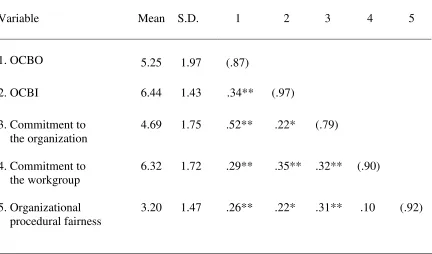
The means, standard deviations, scale reliabilities, and correlations among the study
variables are presented in Table 1.
Tests of Hypotheses
(see Table 2). OCBO and OCBI were regressed separately on organizational commitment,
workgroup commitment, and organizational procedural fairness. We predicted that employees’
commitment to the organization would be more predictive of their OCBO than would their
workgroup commitment (Hypothesis 1a). Moreover, we expected that employees’ commitment to
their fellow workgroup members would be more predictive of their OCBI than would their
organizational commitment (Hypothesis 1b). The results presented in Table 2 are consistent with
both predictions, showing that: (1) organizational commitment was significantly related to OCBO
whereas workgroup commitment was not, and (2) workgroup commitment was significantly related
to OCBI, whereas organizational commitment was not.
Moreover, the relationship between organizational commitment and OCBO (partialling out
the effects of workgroup commitment and procedural fairness) was significantly greater than the
relationship between workgroup commitment and OCBO (partialling out the effects of
organizational commitment and procedural fairness; rs = .43 and .16, respectively, z = 2.14, p < .02,
one-tailed). In addition, the relationship between workgroup commitment and OCBI (partialling out
the effects of organizational commitment and procedural fairness) was significantly greater than the
relationship between organizational commitment and OCBI (partialling out the effects of
workgroup commitment and procedural fairness; rs = .30 and .07, respectively, z = 1.75, p < .04,
one-tailed).
Hypotheses 2a and 2b. To evaluate Hypothesis 2a we drew on the principles set forth by
Baron and Kenny (1986) for testing mediation. From Table 1 it can be seen that: (1) organizational
procedural fairness was significantly related to the dependent variable of OCBO, (2) organizational
procedural fairness was significantly related to the hypothesized mediating variable of
Baron and Kenny further suggest that evidence of mediation is present when the relationship
between the independent variable and the dependent variable is lessened to a significant extent
when the presumed mediating variable is controlled, and furthermore, that the relationship between
the presumed mediator and the dependent variable remains significant. In fact, when OCBO was
regressed simultaneously on organizational procedural fairness and organizational commitment, the
effect of organizational procedural fairness became trivial (β = .10, p > .20) whereas the effect of
organizational commitment remained highly significant (β = .49, p < .001). Moreover, the results of
a Sobel test showed that the relationship between organizational procedural fairness and OCBO was
significantly lower when organizational commitment was controlled, relative to when it was not, z =
2.82, p < .01. In sum, organizational commitment fully mediated the relationship between
organizational procedural fairness and OCBO.
In contrast, commitment to the workgroup did not even partially mediate the relationship
between organizational procedural fairness and OCBO. For one thing, organizational procedural
fairness was unrelated to commitment to the workgroup, as can be seen in Table 1. Moreover, the
relationship between organizational procedural fairness and OCBO was virtually identical,
regardless of whether commitment to the workgroup was not controlled for (β = .26, p = .01), or
was controlled for (β = .23, p = .02). The above analyses provide support for both H2a and H2b.
Limitation
Whereas the dependent measure of OCB represents an important extension to the
literature on layoff survivors, it was measured with self-reports in Study 1. This raises the
question of whether similar results would emerge if other measures of OCB had been employed,
recent meta-analysis of the relationship between organizational commitment and job
performance provides evidence that is particularly relevant to this issue.
From the published version of Riketta’s (2002) meta-analysis, it is impossible to discern
the subset of studies in which the job performance measure consisted of extra-role performance
(OCB). Because those studies are particularly germane to the present research, we contacted
Riketta to see if he would perform a meta-analysis based only on those studies in which the job
performance measure was extra-role, i.e., consisted of OCB. In fact, Riketta (personal
communication) found that among those studies in which the performance measure consisted of
OCB, the relationship between organizational commitment and OCB did not vary to a significant
extent as a function of whether the OCB measure consisted of self-reports (mean corrected
correlation = .31) versus supervisors’ reports (mean corrected correlation = .24); z = 1.41, p >
.10. This finding strongly suggests that the results of Study 1 (for example, the target similarity
effects that emerged in support of Hypotheses 1a and 1b) were unlikely to be an artifact of the
use of self-reports to measure OCB.
Study 2
Study 2 was designed to build on the promising results of Study 1 in several ways. Whereas
Hypotheses 1a and 1b allowed for a complete test of the target similarity effect by having matching
targets for each of the commitment and OCB variables, the measures in Study 1 pertaining to
Hypotheses 2a and 2b only allowed us to examine the extent to which the commitment variables
mediated the relationship between organizational procedural fairness and citizenship directed
towards the organization. More specifically, the test of Hypothesis 2a showed that organizational
commitment mediated the relationship between two variables with an organizational target
not examined in Study 1 but is suggested by the target similarity framework is that employees’
commitment to their workgroups will mediate the relationship between the workgroup’s procedural
fairness and citizenship directed towards these co-workers. Accordingly, this hypothesis was tested
in Study 2.
It is also worth noting that relatively few, if any, studies have examined the effects of
workgroup procedural fairness on employees’ attitudes or behaviors, particularly when the
workgroup is conceptualized as the agent of the procedure. Instead, the vast majority of
organizational justice studies have looked at the effects of either the perceived fairness of one’s
manager, or the perceived fairness of the organization as a whole (i.e., entities perceived to have
greater formal authority). Workgroups however, are an increasingly important, yet under examined
source of procedural justice (Lavelle et al., in press). Hence, Study 2, in which the workgroup was
the target for all constructs, is one of the few to focus on the consequences of workgroup procedural
fairness.
Study 2 also was designed to provide some methodological enhancements over its
predecessor. As in Study 1, the measures of procedural fairness and commitment consisted of
participants’ self-reports. Unlike in Study 1, however, the measure of OCBI in Study 2 consisted of
the judgments of fellow workgroup members concerning how much each participant engaged in
citizenship behavior toward these co-workers. This enabled us to evaluate whether the relationships
between OCBI and each of workgroup procedural fairness and workgroup commitment generalize
to a situation in which the measure of citizenship comes from a source other than participants’
themselves. Given that the procedural fairness and commitment measures were based on
participants’ self-reports, the fact that the measure of citizenship behavior toward co-workers
explanation of the results of Study 2.
All participants in Study 2 worked in student project groups, similar to self-managing teams,
in which the team members themselves (as opposed to supervisors or managers) are primarily
accountable for making a number of decisions (e.g., task assignments, scheduling, and workloads)
pertaining to task completion. After working together, typically over a twelve-week period, group
members rated the fairness of their group’s decision-making procedures, they rated their
commitment to the group, and they rated one another’s tendencies to engage in citizenship behavior.
Hypothesis 3: The positive relationship between the perceived fairness of the workgroup’s
decision-making procedures and OCBI will be mediated by participants’ commitment to the
workgroup.
Method
Setting, Participants, and Procedure
The data for Study 2 were drawn from project teams at a large university in the United
States. Students enrolled in management, marketing, and information systems courses at both
the undergraduate and graduate levels worked together in teams to complete a research project
assigned and graded by their respective instructors as part of their regular course requirements.
These projects required students to work together inside and outside of class throughout the
semester, typically culminating with an oral presentation and written report. Team projects
typically lasted for 10-14 weeks of the 16-week semester; none of the authors taught any of these
courses.
Study participation was optional and involved the completion of a survey. To provide
an incentive to participate, some instructors offered extra-credit; all those completing surveys
restaurant. The survey was administered shortly after students had completed their projects but
before they had received their grades. Completed surveys were received from 635 of the 794
students enrolled in the courses, for a response rate of 80%. Hence, the likelihood of a
self-selection bias was considerably lower in Study 2 than in Study 1. Participants worked in teams
with a median size of five team members, with virtually all of them (96%) having team sizes
ranging from three to seven members. Approximately 17% of participants were graduate
students, 52% were male, 80% worked at least part-time, and their average age was 26 (SD =
6.5). Fifty-three percent of the participants were Caucasian, 15% were Asian, 10% were
African-American, 14% were Hispanic, and 8% described themselves as having “other”
ethnicities.
Consistent with our attempt to examine how individuals’ perceptions of fairness and
levels of commitment were related to their citizenship behaviors, tests of hypotheses were
conducted at the individual level of analysis. In addition, hypothesis testing was based only on
those participants who were rated by two or more of their peers, in an attempt to increase the
accuracy of the citizenship measure. This resulted in a useable sample of 594 participants
(approximately 94% of those completing the survey).When single-rater assessments of
citizenship behavior were also included in the data analysis, the results were highly similar to,
and the conclusions drawn did not change from, those reported here using only multiple-rater
assessments citizenship.
Measures
Procedural Fairness of the Workgroup. A three-item scale was used to measure
individuals’ perceptions of the fairness of the procedures used by their group to make important
deliverables, and goals as well as to the allocation of roles, responsibilities, and workload among
group members). Based on work by Lind and Tyler (1988), the items asked individuals to assess
the extent to which their group’s decision-making procedures were: unfair (1) to fair (7), unjust (1)
to just (7), and improper (1) to proper (7). Coefficient alphas for this and all multi-item scales
included in Study 2 were acceptable and are reported in Table 3.
Commitment to the Workgroup. We measured individuals’ commitment to their workgroup
with three items based on Allen and Meyer’s (1990) affective organizational commitment scale (to
fit the workgroup context, we replaced reference to the organization with reference to the team).
Example items include: “I feel a part of this team” and “I feel a sense of belongingness to this
team.” Endpoints for the seven-point Likert-type scale were "Strongly disagree" (1) and "Strongly
agree" (7).
OCBI. Peer ratings were used to measure the extent to which individual team members
engaged in organizational citizenship behavior beneficial to the workgroup. Based on prior research,
(e.g., Podsakoff et al., 1990) participants rated how characteristic (1 = very uncharacteristic and 7 =
very characteristic) it was for each one of their group members “to volunteer to help out, provide
assistance, and lend a helping hand when someone needs help.” To make these peer ratings,
participants were given a team roster listing the name of each person in their workgroup as part of
the survey materials. For these multi-rater assessments of an individual’s tendency to engage in
this type of citizenship, the level of inter-rater agreement was acceptable (median Rwg(i) = .77).
Consequently, we averaged the citizenship ratings across raters.
Results
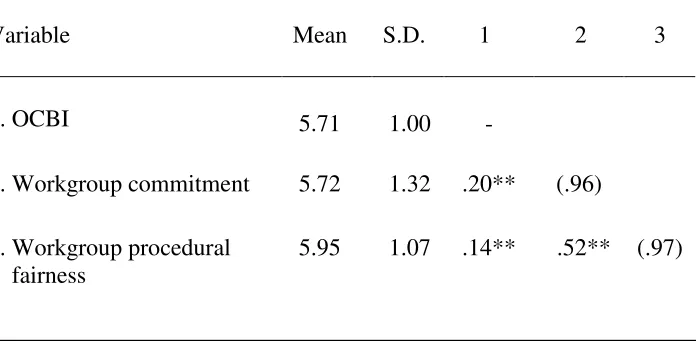
The means, standard deviations, scale reliabilities, and correlations among the Study 2
Hypothesis Testing
To test our mediation hypothesis, we followed the principles outlined by Baron and Kenny
(1986) and used in Study 1. From Table 3 it can be seen that: (1) participants’ perceptions of their
workgroup’s procedural fairness was significantly related to the dependent variable of OCBI, (2)
workgroup procedural fairness was significantly related to the hypothesized mediating variable of
participants’ workgroup commitment, and (3) workgroup commitment was significantly related to
OCBI. Given this pattern of results, we then regressed OCBI on workgroup procedural fairness and
workgroup commitment simultaneously, finding that the effect of workgroup procedural fairness
became trivial (β = .05, p > .25), whereas the effect of workgroup commitment remained highly
significant (β = .17, p < .001). Furthermore, the results of a Sobel test showed that the relationship
between workgroup procedural fairness and OCBI was significantly reduced when workgroup
commitment was controlled, relative to when it was not, z = 3.48, p < .001. These results show that
commitment to the workgroup fully mediated the relationship between workgroup procedural
fairness and OCBI.
General Discussion
In summary, all hypotheses received support. In Study 1 we found that OCBO was more
strongly predicted by commitment to the organization than by workgroup commitment, whereas
OCBI was more strongly predicted by workgroup commitment than by organizational commitment.
In addition, organizational commitment fully mediated the relationship between organizational
procedural justice and OCBO. Moreover, in Study 2, we found that commitment to the workgroup
fully mediated the relationship between workgroup procedural fairness and OCBI.
Theoretical Implications
meta-analysis concluded that additional research and theory were needed to assess whether or not
differentiating between types of citizenship behavior as a function of the intended target can provide
a meaningful way to clarify the nomological network of the citizenship construct. In response to
this call, our research finds that employees indeed differentiate between OCBO and OCBI, in that
these two types of citizenship behavior had unique predictors. In particular, our findings support the
logic of the target similarity model (Lavelle et al., in press), suggesting the importance of taking a
multifoci approach to both citizenship behavior and its predictors. That is, rather than positing that
procedural fairness influences commitment, which in turn influences OCB, we need to examine
how certain sources of procedural fairness influence commitment to certain targets, which in turn
influence citizenship behavior directed toward certain targets. Moreover, whereas previous reviews
have suggested that the corrected meta-analytic correlation between commitment and OCB (target
unspecified) is .25 (Riketta, 2002), in Study 1, we found that the correlation between organizational
commitment and OCBO increased in magnitude to .43 (when we controlled for both commitment to
the workgroup and procedural fairness).
Recent studies also lent some support to a target similarity effect, which showed that
relationships between employee commitment and OCB (Becker & Kernan, 2003), and between
procedural fairness and OCB (Rupp & Cropanzano, 2002) were generally stronger when the target
was similar rather than different. The present findings provide further evidence of a target similarity
effect but also extend the earlier results in a number of important respects. For instance, both
studies are the first to show that commitment mediates the relationship between procedural fairness
and citizenship behavior. In Study 1, organizational commitment (but not workgroup commitment)
mediated the relationship between organizational procedural fairness and OCBO, whereas Study 2
fairness and OCBI. Second, in both studies, target similarity effects emerged when the “I” in OCBI
consisted of workgroup members, extending the findings of previous studies (Becker & Kernan,
2003; Rupp & Cropanzano, 2002), in which the individuals referred to supervisors. Third, the
present findings go beyond previous empirical research that has shown the value of applying a
multifoci perspective to the constructs of procedural fairness, commitment, and OCB. Whereas
previous research has provided evidence of a target similarity effect when two of the three
constructs are considered at a time (i.e., commitment and OCB, justice and OCB), the present
studies illustrate show that the target similarity effect holds when all three constructs are considered
simultaneously, in particular, that commitment mediates the relationship between procedural
fairness and OCB.
Survivors’ Reactions to Layoffs. The results of Study 1 also contribute to theory and
research on survivors’ reactions to job layoffs. Although numerous studies have delineated factors
that may account for the variability in survivors’ reactions (e.g., Brockner, 1994), the present
research is the first to examine some of the determinants of a dependent variable of particular
importance in a downsizing context: OCB. Whether layoffs have their intended effects on
organizational performance is likely to depend upon the extent to which the employees who remain
are willing to go beyond the call of duty. The present findings show that: (1) survivors’ OCB
depends upon their level of commitment, and moreover, in a target-specific way, and (2) the
organization’s procedural fairness in implementing the layoffs predicts OCBO, mediated by
survivors’ commitment to the organization.
Future Research. An additional area for future research would be to identify boundary
conditions of the target similarity effect. The theory of reasoned action suggests that maximal
context, time, and target. Whereas we focused on the target dimension, the magnitude of the
relationships between constructs may also depend upon context and time. For example, Price,
Lavelle, Henley, Cochiarria, and Buchanan (2006) examined a multiple-stage decision making
process in which different authorities made successive recommendations to an ultimate
decision-making party. In a multiple-stage process the ultimate decision is affected by the procedures
used by the various parties at each stage of the process. Price et al. found that the intention to
volunteer for future committee work (a form of OCB) was jointly influenced by the procedures
used by the participant’s committee chair and by the procedures used by the authority at the
subsequent stage of decision making. That is, the positive relationship between the committee
chair’s fairness and participants’ future willingness to serve on the committee (a target similarity
effect) was weakened when the authority at the subsequent stage of decision making exhibited
lower procedural fairness.
To cite another example of a boundary condition on a target similarity effect, suppose that
employees’ religious beliefs led them to believe that it was particularly important to do extra for
others around the time of the holidays. In that case, a better predictor of whether they will perform
OCB towards a particular target is not the target, but rather the time of year, such that they may be
more likely to do OCB around the holidays than at other times. In this instance, the “time similarity
effect” may outweigh or otherwise reduce the target similarity effect.
Limitations
The present research also has a number of shortcomings. In calling attention to them, we are
simultaneously suggesting additional avenues for future research. First, given the cross-sectional
nature of the research designs in both studies, the causal impact of the independent variables on
whether and how their OCB had changed, relative to before the layoffs. It would have been more
desirable if OCB had been measured both before and after the layoffs, which would have enabled us
to compute the change in OCB directly, rather than leaving it to participants’ subjective estimates.
In a previous study examining the effect of procedural fairness, Brockner, Grover, Reed, DeWitt,
and O’Malley (1987) conducted an internally valid laboratory experiment in which participants’
reactions were measured both before and after the layoffs. (The dependent variable in that study was
work motivation, rather than OCB.) The results of the earlier study were conceptually analogous to
those found here, in that survivors responded more positively when procedural fairness was
relatively high. In other words, the results of Study 1 do not appear to be an artifact of the
cross-sectional nature of the research design, or of the fact that the dependent variable consisted of
participants’ self-reports of how their OCB had changed, relative to before the layoffs.
Furthermore, even with the use of self-reported change measures, we still found evidence of target
similarity effects. That is, change in commitment to the organization was a better predictor of
change in citizenship toward the organization than was change in commitment to the workgroup,
whereas change in commitment to the workgroup was a better predictor of change in citizenship
toward co-workers than was change in commitment to the organization. In addition, the measure of
OCB in Study 2 did not require raters to indicate how their OCB had changed over time, and still
yielded mediation results conceptually analogous to those found in Study 1.
Second, although the meta-analytic results presented earlier (e.g., Riketta, 2002) indicate
that the relationships between commitment and OCB in Study 1 were unlikely to be influenced by
the use of self-reports to measure OCB, it could still be argued that the findings of Study 1 were
tainted by common methods bias. Although this concern cannot be eliminated entirely, the
separable. Also, the common methods alternative explanation is hard-pressed to explain why
employees’ commitment was more strongly related to OCB when the target was similar rather than
different. Furthermore, note that common methods was not present in Study 2 (in that the measure
of citizenship was based on peers’ ratings rather than self-reports), and yet we still found evidence
consistent with the target similarity effect.
Third, although we obtained evidence that the respondents in Study 1 were demographically
similar to the overall organization, concerns of response bias may still be raised. For example, if
completing a survey is considered to be an OCB, it could be argued that respondents in Study 1 are
generally more likely to engage in OCB than non-respondents. However, this type of response bias
may have led to a restricted range on the measure of OCB, thereby making it less likely to find
support for the Study 1 hypotheses, in which OCB served as the dependent variable. Moreover,
response bias was much less likely to be present in Study 2, and yet we still found support for the
predicted mediating effect of commitment to the workgroup on the relationship between the
workgroup’s procedural fairness and citizenship directed towards the workgroup.
Fourth, concerns may arise due to the use of student project teams in Study 2. Note
however, that the majority of student participants (80%) were employed at least part-time and thus
were likely to have considerable experience working in organizational teams. Moreover, it is also
reassuring that the heretofore untested hypothesis that commitment would mediate the relationship
between procedural fairness and OCB was replicated in our research across two very different
settings (an organizational layoff and a student group project). In both instances, target-specific
commitment mediated the relationship between procedural fairness and citizenship behavior.
Fifth, the research contexts made it implausible for us to examine all target-specific
procedural fairness was not particularly meaningful in Study 1, and organizational procedural
fairness was not especially relevant in Study 2. Whereas it is reassuring that conceptually
analogous results emerged across studies, future research should be extended to different
contexts in which all target-specific constructs may be relevant.
Finally, whereas the measures of citizenship behavior in Study 1 were used because they
were based on previously validated scales, and because they clearly distinguished between
intended beneficiaries (i.e., the organization and the workgroup), the scales consisted of a
relatively small number of items. Thus, future research may consider using additional items to
measure citizenship, and thereby broaden the generality of the present findings. For that matter,
it would be worth examining the present findings with more expansive measures of the other
main constructs (procedural fairness and commitment), in order to verify that the present results
are not an artifact of or limited to the particular items used to assess the various constructs. Once
again, it is worth emphasizing that although the measures of citizenship toward the organization
and citizenship toward co-workers consisted of a small number of items, they were differentially
related to organizational and workgroup commitment as a function of target similarity.
Practical Implications
Given the potential significance of OCB in general and following layoffs in particular, the
present findings usefully identify factors that make citizenship behavior more versus less likely to
occur. Moreover, the multifoci perspective and resulting target similarity effects serve to remind
managers that the various forms of employee commitment are not equivalent in their consequences.
If managers’ aim is to promote organizationally-directed citizenship, then they need to foster
organizational commitment. If their aim is to promote citizenship toward individuals, then they
How might commitment to a particular target be built? One determining factor
suggested by the present findings is procedural fairness. More specifically, employee commitment
to a particular target depends upon the procedural fairness exhibited by that target. More generally,
considering the favorable reactions elicited by both organizational and workgroup procedural
fairness, it is reassuring to know that it is possible to train managers in how to be more procedurally
References
Ajzen, I., & Fishbein, M. (1977). Attitude-behavior relations. A theoretical analysis and review
of empirical research. Psychological Bulletin, 84: 888-918.
Ajzen, I. & Fishbein, M. (1980). Understanding attitudes and predicting social behavior.
Englewood Cliffs, NJ: Prentice-Hall, Inc.
Allen, N. J., & Meyer, J. P. (1990). The measurement and antecedents of affective, continuance,
and normative commitment to the organization. Journal of Occupational Psychology, 63:
1-18.
Andersen, J. C., & Gerbing, D. W. (1988). Structural equation modeling in practice: A review
and recommended two-step approach. Psychological Bulletin, 103: 411-423.
Baron, R. M., & Kenny, D. A. (1986). The moderator-mediator variable distinction in social
psychological research: Conceptual, strategic, and statistical considerations. Journal of
Personality and Social Psychology, 51: 1173-1182.
Becker, T. E. (1992). Foci and bases of commitment: Are they distinctions worth making? Academy
of Management Journal, 35: 232-244.
Becker, T. E., & Kernan, M. (2003). Matching commitment to supervisors and organizations to
in-role and extra-in-role performance. Human Performance, 16: 327-348.
Bennett, R. J., & Robinson, S. L. (2000). Development of a measure of workplace deviance.
Journal of Applied Psychology, 85: 349-360.
Bishop, J. W., & Scott, K. D. (2000). An examination of organizational and team commitment in a
self-directed team environment. Journal of Applied Psychology, 85: 439-450.
Blau, P. M. (1964). Exchange and power in social life. New York: John Wiley & Sons.
meaning of a “fair” process. Personality and Social Psychology Bulletin, 29: 747-758.
Brockner, J. (1994). Perceived fairness and survivors reactions to layoffs, or how downsizing
organizations can do well by doing good. Social Justice Research, 7: 345-363.
Brockner, J., Grover, S., Reed, T., DeWitt, R., & O’Malley, M. (1987). Survivors’ reactions to
layoffs: We get by with a little help from our friends. Administrative Science Quarterly, 32:
526-541.
Brockner, J., Tyler, T. R., & Cooper-Schneider, R. (1992). The influence of prior commitment to an
institution on reactions to perceived unfairness: The higher they are, the harder they fall.
Administrative Science Quarterly, 37: 241-261.
Cascio, W. F. (1993). Downsizing: What do we know? What have we learned? Academy of
Management Executive, 7: 95-105.
Cohen-Charash, Y., & Spector, P. E. (2001). The role of justice in organizations: A
meta-analysis. Organizational Behavior and Human Decision Processes, 86: 278-321.
Colquitt, J. A., Conlon, D. E., Wesson, M. J., Porter, C. O., & Ng, K. Y. (2001). Justice at the
millennium: A meta-analytic review of 25 years of organizational justice research. Journal
of AppliedPsychology, 86: 425-445.
Coyle-Shapiro, J. A-M., & Morrow, P.C. (2006). Organizational and client commitment among
contracted employees. Journal of Vocational Behavior, 68: 416-431.
Cropanzano, R., Byrne, Z. S., Bobocel, D. R., & Rupp, D. E. 2001. Moral virtues, fairness
heuristics, social entities, and other denizens of organizational justice. Journal of
Vocational Behavior, 58: 164-209.
Cropanzano, R., & Mitchell, M. (2005). Social exchange theory: An interdisciplinary review.