Original Article
Fitness participants perceived quality by age and practiced activity
FRANCISCO CAMPOS1, FERNANDO MARTINS12, VERA SIMÕES3, SUSANA FRANCO3
1 Polytechnic Institute of Coimbra, ESEC, IIA, RoboCorp, ASSERT, PORTUGAL 2 Instituto de Telecomunicações, Delegação da Covilhã, PORTUGAL
3 Sport Sciences School of Rio Maior, Polytechnic Institute of Santarém, PORTUGAL
Published online: June 30, 2017 (Accepted for publication June 15, 2017) DOI:10.7752/jpes.2017.02105
Abstract:
The fitness participants could have a specific and critical role in the service provision and, with that, contribute to the service quality improvement. The aim of this research is characterize and compare the quality indicators of the group exercise fitness instructor - through the participant’s perception, evaluated by QIF-AG questionnaire - considering their age and practiced activity. The data were collected from 622 group exercise participants (all from female gender, participants in fitness centers of Coimbra - Portugal, with 18 years old or more). After the application of the ANOVA one-way test is possible to conclude that, considering their age, there are statistical significant differences in 9 of the 11 items of the relational quality dimension and 9 of the 14 categories of the technical-pedagogical quality dimension. In accordance to the different dimensions [relational (F=11,820; p=0,001; ƞ2=0,037, small effect size); technical-pedagogical (F=8,029; p=0,001; ƞ2=0,025, small effect size)] and general construct (F=10,211; p=0,001; ƞ2=0,032, small effect size) is possible to conclude that are statistical significant differences considering the age of the fitness participants. In accordance to the activity, there are statistical significant differences in 8 of the 11 categories of the relational quality dimension and in 9 of the 14 categories of the technical-pedagogical quality dimension. Considering different dimensions [relational (F=6,106; p=0,001; ƞ2=0,038, small effect size); technical-pedagogical (F=4,207; p=0,006; ƞ2=0,027, small effect size)] and general construct (F=5,199; p=0,001; ƞ2=0,033, small effect size) also is possible to conclude that are statistical significant differences in the practiced activity.
Key words: age; fitness instructor; fitness participant; practiced activity; quality; service.
Introduction
The fitness sector is a growing industry in a global scale, which makes it an attractive and interesting market to study (García-Fernández, Gálvez-Ruiz, Velez-Colon, & Bernal-Garcia, 2016). The practice of physical activity in fitness centers in Europe, according to the Eurobarometer of Sport (European Commission, 2014), have an increment of two percent points between 2009 and 2013. With that global proliferation of the fitness centers, an increasing competition can be observed in this peculiar industry (Chiu, Cho, & Won, 2014). However, is important to understand that fitness service industry is distinctively different from other service industries (Chiu, Min-Seok, & Bae, 2015).
In the fitness centers the customers have usually a higher interaction with the frontline employees (physical trainers or instructors). Therefore, the customers could have a specific and critical role in the service provision and, with that, contribute to the service quality improvement (Chiu et al., 2015). Recently, an aspect that reveal the importance of the customers opinion, some researchers have conceptualized customers as “partial employees and human resources” of the organization and identified the customer behaviors that contribute to the service quality (Chiu et al., 2015).
The group exercise fitness instructor, responsible for providing the service, has an important role in the participants satisfaction and loyalty (Fernández, Carrion, & Ruiz, 2012; Nuviala, Pérez-Ordas, Osuna, Grao-Cruces, Nuviala, & Jurado, 2012; Pedragosa & Correia, 2009). Through the analysis of the fitness trends for 2016 (Thompson, 2015) and 2017 (Thompson, 2016), published by the American College of Sports Medicine, is possible to verify the importance of “educated, certified, and experienced fitness professionals” (Thompson, 2016, p. 12). In the last three analyses - in 2015 and 2016, and for 2017 - this trend (educated, certified, and experienced fitness professionals) appears in the first five places of that annual survey of worldwide fitness trends (Thompson, 2015; Thompson, 2016).
---instructor “teach, lead and motivate individuals”. In a summarized perspective this idea reflects the main role and extremely importance of the group exercise instructor.
The quality of the group exercise fitness instructor has been part of the scope of several studies that we have recently developed, in order to effectively understand what quality is in this peculiar context (fitness group exercise) and how it is understood according to different perspectives (Campos, Martins, Simões, & Franco, 2016; Campos, Simões, & Franco, 2015; Campos, Simões, & Franco, 2016a; Campos, Simões, & Franco, 2016b). Furthermore, with this and the previous researches, is intended to create theoretical and scientific
“grounds” that help fitness centers, gyms and health clubs managers to implement strategies to reduce participant’s exercise dropout and increase loyalty through high satisfaction and motivation levels of the participants (Franco, Pereira, & Simões, 2008).
Franco, Cordeiro and Cabeçeiras (2004) analyze the preferences of fitness participants to an ideal instructor in three different age groups (youth, young adults, adults) and verify that the most valorized quality
indicators were different considering their age, with statistical significant differences in some indicators. In
another investigation, Afthinos, Theodorakis and Nassis (2005), concluded that the preference of male participants is different from the preference of females on cordiality, knowledge and instruction quality indicators. In a general perspective about the fitness service, García-Fernández et al. (2016) verify that there are significant differences according to gender and age, among other studied variables, in service convenience, perceived value and satisfaction with the characteristics of low-cost fitness centers. García-Fernández et al. (2016) recommend that administrators and managers should work considering these results, in order to improve the quality of the provided service and, with that, the participants’ loyalty.
After the literature analysis, is possible to conclude that the preferred quality indicators of the group exercise fitness instructor are different considering the age (Franco et al., 2004) and the practiced activity (Campos et al., 2015) of the participants, or even considering different types of intervenient perspectives (Campos et al., 2016b) among other variables. In Campos et al. (2016b) a similar research was made, but in data analysis was used the content analysis statistical technique. In this investigation the data analysis is made using other statistical tests, after the application of "Fitness Instructor Quality - Group Activities" (QIF-AG) questionnaire (Campos et al., 2016a).
Considering the importance and the role of the group exercise instructor [educated, certified, and experienced fitness professionals (Thompson, 2016)] and the group training as one of the main fitness trends of 2017 (Thompson, 2016) - and the impact that the investigation of these topics could have in the quality of the service, participants satisfaction and consequent loyalty - the aim of this study is characterize and compare the quality indicators of the group exercise fitness instructor (through the participants perception, evaluated by QIF-AG questionnaire), considering the age and the practiced activity. These different perspectives, of several and diverse participants, will allow a greater and better understanding of the quality concept in this specific context (fitness group exercise).
Material & Methods Participants
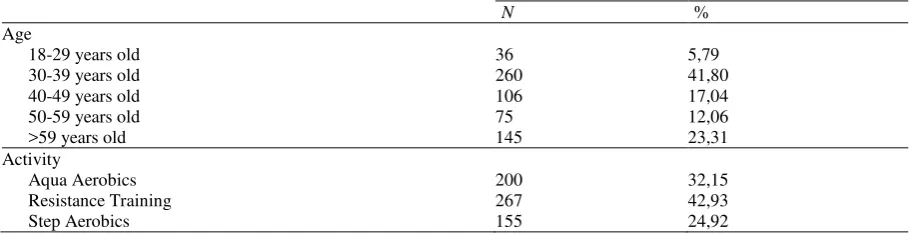
The sample was composed of 622 group exercise participants. To standardized the main characteristics of the studied group, all the participants were from female gender, participants in fitness centers of Coimbra (Portugal) and with 18 years old or more. In table 1 is presented the participants characterization, by age and practiced activity, the 2 (two) variables under study.
Table 1. Participants’ characterization
N %
Age
18-29 years old 36 5,79
30-39 years old 260 41,80
40-49 years old 106 17,04
50-59 years old 75 12,06
>59 years old 145 23,31
Activity
Aqua Aerobics 200 32,15
Resistance Training 267 42,93
Step Aerobics 155 24,92
Procedures
---assist the participants through thequestionnaire process, to remember the aim of the investigation and to clarify any questions and/or doubts. The data collection took place after the group exercise classes and was collected in a face-to-face way in the fitness centers. Each fitness participant take, approximately, 10 (ten) minutes to complete their own questionnaire.
Measurements
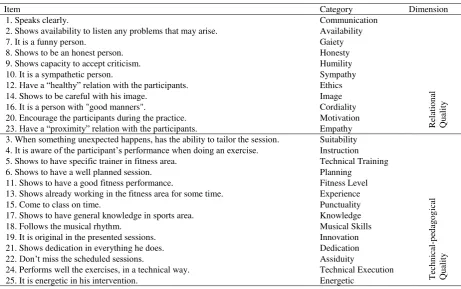
To understand the importance of some theoretical concepts, as the quality of the group exercise fitness instructor, for example, the questionnaire could be methodologically used as a source of information (Tuckman, 2005). Considering the previously it was applied the QIF-AG questionnaire, developed by Campos et al. (2016a), with 25 items grouped in 2 (two) dimensions: relational quality (11 items); technical-pedagogical quality (14 items). Each item is evaluated through a seven-point likert scale, where 1 refers to totally disagree and 7 to totally agree. In table 2 are presented the different items, the associated categories and the dimensions of the QIF-AG (Campos, 2016a).
Table 2. Items, categories and dimensions of the QIF-AG questionnaire
Item Category Dimension
2. Shows availability to listen any problems that may arise. Availability
7. It is a funny person. Gaiety
8. Shows to be an honest person. Honesty
9. Shows capacity to accept criticism. Humility
10. It is a sympathetic person. Sympathy
12. Have a “healthy” relation with the participants. Ethics
14. Shows to be careful with his image. Image
16. It is a person with "good manners". Cordiality 20. Encourage the participants during the practice. Motivation
23. Have a “proximity” relation with the participants. Empathy
3. When something unexpected happens, has the ability to tailor the session. Suitability
Tec
4. It is aware of the participant’s performance when doing an exercise. Instruction
5. Shows to have specific trainer in fitness area. Technical Training
6. Shows to have a well planned session. Planning
11. Shows to have a good fitness performance. Fitness Level 13. Shows already working in the fitness area for some time. Experience
15. Come to class on time. Punctuality
17. Shows to have general knowledge in sports area. Knowledge
18. Follows the musical rhythm. Musical Skills
19. It is original in the presented sessions. Innovation
21. Shows dedication in everything he does. Dedication
22. Don’t miss the scheduled sessions. Assiduity
24. Performs well the exercises, in a technical way. Technical Execution
25. It is energetic in his intervention. Energetic
Data analysis
In the first analysis, participant’s answers were characterized per item, dimension and general (quality of the group exercise fitness instructor). In the second analysis is intended to characterize and compare the participants answers in accordance to the age and practiced activity, confirming if there are statistically significant differences in each one of the 25 (twenty five) items, 2 (two) dimensions and in general construct evaluated through the QIF-AG questionnaire. In the first data analysis are presented the minimum, maximum, mean and standard deviation values. In the second, beyond the mean and standard deviation values for characterization purpose. The one-way ANOVA test was applied to compare the groups (age and practiced activity variables) used the items of the questionnaire. Preliminary analysis was performed to ensure no violation of the assumptions of normality and Levene’s test for equality of variances (Pallant, 2011). The assumption of normality of each of the univariate dependent variables was examined using univariate tests of Kolmogorov-Smirnov, since n≥30. Although the univariate normality of each dependent variable has not been verified, since n≥30 and using the Central Limit Theorem (CLT), this statement was assumed (Maroco, 2010). When the one-way ANOVA detected significant statistical differences between the groups were applied the Tukey HSD post hoc test or, when the homogeneity was not verified, the Games-Howell test (Maroco, 2010).
To complement the analysis, the following scale was used to classify the effect size (eta squared) of the one-way ANOVA test (Maroco, 2010): small effect size (ƞ2≤0,05),
moderate effect size (0,05<ƞ2≤0,25), large effect size (0,25<ƞ2≤0,50) and
very large effect size (0,50<ƞ2). Statistical analysis was performed using the Statistical Package for the Social Sciences software (version 21), for a 5% significance level.
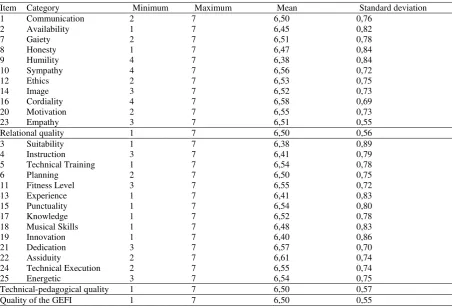
---In table 3 are presented the minimum, maximum, mean and standard deviation values in each 25 (twenty five) items (each one associated and linked to different categories), 2 (two) dimensions (relational quality, technical-pedagogical quality) and in the general construct [quality of the Group Exercise Fitness Instructor (GEFI)].
Table 3. Minimum, maximum, mean and standard deviation per item, dimension and construct
Item Category Minimum Maximum Mean Standard deviation
1 Communication 2 7 6,50 0,76
2 Availability 1 7 6,45 0,82
7 Gaiety 2 7 6,51 0,78
8 Honesty 1 7 6,47 0,84
9 Humility 4 7 6,38 0,84
10 Sympathy 4 7 6,56 0,72
12 Ethics 2 7 6,53 0,75
14 Image 3 7 6,52 0,73
16 Cordiality 4 7 6,58 0,69
20 Motivation 2 7 6,55 0,73
23 Empathy 3 7 6,51 0,55
Relational quality 1 7 6,50 0,56
3 Suitability 1 7 6,38 0,89
4 Instruction 3 7 6,41 0,79
5 Technical Training 1 7 6,54 0,78
6 Planning 2 7 6,50 0,75
11 Fitness Level 3 7 6,55 0,72
13 Experience 1 7 6,41 0,83
15 Punctuality 1 7 6,54 0,80
17 Knowledge 1 7 6,52 0,78
18 Musical Skills 1 7 6,48 0,83
19 Innovation 1 7 6,40 0,86
21 Dedication 3 7 6,57 0,70
22 Assiduity 2 7 6,61 0,74
24 Technical Execution 2 7 6,55 0,74
25 Energetic 3 7 6,54 0,75
Technical-pedagogical quality 1 7 6,50 0,57
Quality of the GEFI 1 7 6,50 0,55
By the analysis of the obtained results, considering minimum and maximum values, it is possible to verify that these values oscillate in most of the items between 1 (totally disagree) and 7 (totally agree). There are some items that the minimum value is 2 (strongly disagree) and in fewer is 3 (disagree) and 4 (agree). According to mean and standard deviation (M±SD), were obtained high answer results in all the items [above 6 (strongly agree)] and, consequently, in the 2 (two) associated dimensions [relational quality (6,50±0,56); technical-pedagogical quality (6,50±0,57)] and in the general construct [quality of the GEFI (6,50±0,55)].
Through the analysis in each dimension, in relational quality (6,50±0.56) it is important to highlight (in accordance to the above-mean answer values) the cordiality (6,58±0,69), sympathy (6,56±0,72) and motivation (6,55±0,73). In the other hand, the highlight in a non-positive perspective (considering the below-mean values) goes to humility (6,38±0,84), availability (6,45±0,82) and honesty (6,47±0,84). In the technical-pedagogical quality (6,50±0,57), and performing the same analysis as the previously performed, highlight to assiduity (6,61±0,74), dedication (6,57±0,70) and fitness level (6,55±0,72). The highlight, in a non-positive perspective,
goes to suitability (6,38±0,89), innovation (6,40±0,86) and instruction (6,41±0,79). Through these mean results
is possible to understand, according the fitness participants perception, which indicators (items and respective categories) of the group exercise fitness instructor presents higher and lower results and, by that, could be associated to a better or weaker instructor specific quality.
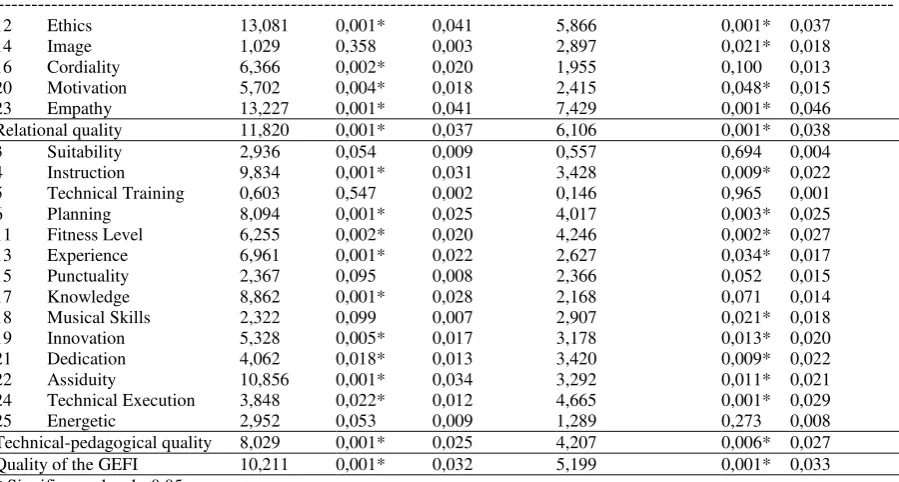
Next, to characterize and compare the quality indicators considering the age and practiced activity, are presented the F, significance level (p) and effect size [eta squared (ƞ2)] values (table 4).
Table 4. F, significance level (p) and effect size (ƞ2) values per item, dimension and construct
Age Practiced activity
Item Category F p ƞ2 F p ƞ2
1 Communication 6,568 0,002* 0,021 4,197 0,002* 0,026
2 Availability 2,745 0,065 0,009 1,336 0,255 0,009
7 Gaiety 8,311 0,001* 0,026 5,023 0,001* 0,032
8 Honesty 7,438 0,001* 0,023 2,115 0,077 0,014
9 Humility 8,839 0,001* 0,028 6,822 0,001* 0,042
---Technical-pedagogical quality 8,029 0,001* 0,025 4,207 0,006* 0,027
Quality of the GEFI 10,211 0,001* 0,032 5,199 0,001* 0,033
* Significance level <0,05
In the age there are statistical significant differences in 9 (nine) of the 11 (eleven) categories of the relational quality (communication, gaiety, honesty, humility, sympathy, ethics, cordiality, motivation and empathy) and 9 (nine) of the 14 (fourteen) categories of technical-pedagogical quality dimension (instruction, planning, fitness level, experience, knowledge, innovation, dedication, assiduity and technical execution). Considering different dimensions is possible to verify the following results: relational quality (F=11,820; p=0,001; ƞ2=0,037,
small effect size); technical-pedagogical quality (F=8,029; p=0,001; ƞ2=0,025,
small effect size). In the quality of the group exercise fitness instructor general construct the answer values (F=10,211; p=0,001; ƞ2=0,032, small effect size) shows that there are statistical significant differences considering the age (18-29 years old; 30-39 years old; 40-49 years old; 50-59 years old; >59 years old) of the fitness participants.
In the practiced activity there are statistical significant differences in 8 (eight) of the 11 (eleven) categories of the relational quality (communication, gaiety, humility, sympathy, ethics, image, motivation and empathy) and 9 (nine) of the 14 (fourteen) categories of the technical-pedagogical quality (instruction, planning, fitness level, experience, musical skills, innovation, dedication, assiduity and technical execution). By the analysis of the different dimensions, is possible to verify the following results: relational quality (F=6,106; p=0,001; ƞ2=0,038,
small effect size); technical-pedagogical quality (F=4,207; p=0,006; ƞ2=0,027,
small effect mean differences and the p value of the Tukey HSD post hoc test application. The analysis is made only in each dimension (relational quality; technical-pedagogical quality) and in general construct (quality of the GEFI). For a non exhaustive and more objective results presentation only are analyzed the groups were there are statistical significant differences (p<0,05).
Table 5. Tukey HSD post hoc test and mean difference, by dimension and general construct (age)
Age (A) Age (B) MD (A-B) p value
Relational quality > 59 years old 30-39 years old 0,264 0,001*
40-49 years old 0,195 0,048* Technical-pedagogical quality > 59 years old 30-39 years old 0,239 0,001*
Quality of the GEFI > 59 years old 30-39 years old 0,250 0,001*
* Significance level <0,05
By the analysis of the table 5 is possible to verify that the statistical significant differences occur in the >59 years old and the 30-39 years old groups [relational quality (p=0,001); technical-pedagogical quality (p=0,001); quality of the GEFI (p=0,001)] and in the >59 years old and the 40-49 years old groups [relational quality (p=0,048)]. The mean difference between the groups shows that the >59 years old group has higher quality perception in both dimensions and in the general construct. These results confirm in part - the quality perception is different considering the age of the fitness participants - the exposed and presented in the studies developed by Afthinos et al. (2005), Campos et al. (2016b), Franco et al. (2004) and García-Fernández et al. (2016).
---Activity (A) Activity (B) MD (A-B) p value
Relational quality Aqua Aerobics Resistance Training 0,134 0,027*
Step Aerobics 0,288 0,001* Technical-pedagogical quality Aqua Aerobics Step Aerobics 0,243 0,001*
Quality of the GEFI Aqua Aerobics Resistance Training 0,125 0,038*
Step Aerobics 0,263 0,001* * Significance level <0,05
Trough the analysis of the table 6, considering the practiced activity is possible to verify that the statistical significant differences are between Aqua Aerobics and Resistance Training participants [relational quality (p=0,027); quality of the GEFI (p=0,038)] and between the Aqua Aerobics and Step Aerobics participants [relational quality (p=0,001); technical-pedagogical quality (p=0,001); quality of the GEFI (p=0,038)]. The mean differences between the groups show that the Aqua Aerobics participants have a higher quality perception in the both dimensions and in the general construct. In the opposite appears the Step Aerobics with the lowest mean values, in comparison with Aqua Aerobics and Resistance Training participants’ quality perception. Like in the previous analysis (age), these results confirm the exposed and presented in Campos et al. (2015) - the quality perception is different considering the practiced activity.
Conclusions
The main ideas presented at the introduction chapter - fitness sector as a growing industry in a global scale (García-Fernández et al., 2016); fitness service industry as a distinctively service industry that is different from others (Chiu et al., 2015) - and so the responsibility and influence that the group exercise fitness instructor have in the participants quality perception, satisfaction and loyalty (Fernández et al., 2012; Nuviala et al., 2012; Pedragosa & Correia, 2009) support the importance of this investigation.
In accordance to the aim of this study - characterize and compare the quality indicators of the group exercise fitness instructor (through the participants’ perception), considering the age and the practiced activity - the main conclusions are:
1) The obtained answer mean values in all of the items, associated dimensions and in the general construct are very high [above 6 (strongly agree)] and, with that, faced as a very positively quality perception;
2) In the relational quality dimension (6,50±0.56), the quality indicators with higher mean values (greater and better understanding of the quality concept in this specific context - fitness group exercise) are the cordiality (6,58±0,69), sympathy (6,56±0,72) and motivation (6,55±0,73);
3) In other side, in the technical-pedagogical quality dimension (6,50±0.57), the quality indicators with higher mean values (greater and better understanding of the quality concept in this specific context) are the assiduity (6,61±0,74), dedication (6,57±0,70) and fitness level (6,55±0,72);
4) Considering the age, there are statistical significant differences in 9 (nine) of the 11 (eleven) items of the relational quality and 9 (nine) of the 14 (fourteen) categories of technical-pedagogical quality dimension. In accordance to the different dimensions [relational (F=11,820; p=0,001; ƞ2=0,037, small effect size); technical-pedagogical (F=8,029; p=0,001; ƞ2=0,025, small effect size)] and general construct (F=10,211; p=0,001;
ƞ2=0,032,
small effect size) is possible to conclude that are statistical significant differences considering the age of the participants, as presented in Campos et al. (2016b). The statistical significant differences occur essentially by influence of the >59 years old group, and the obtained mean differences between the groups shows that the >59 years old group has higher quality perception in both dimensions and general construct.
5) In accordance to the activity, there are statistical significant differences in 8 (eight) of the 11 (eleven) categories of the relational quality and in 9 (nine) of the 14 (fourteen) categories of the technical-pedagogical quality. Considering different dimensions [relational (F=6,106; p=0,001; ƞ2=0,038, small effect size); technical-pedagogical (F=4,207; p=0,006; ƞ2=0,027, small effect size)] and general construct (F=5,199; p=0,001;
ƞ2=0,033,
small effect size) is possible to conclude that are statistical significant differences in practiced activity, as previous presented by Campos et al. (2015). The statistical significant differences occur essentially by influence of the Aqua and Step Aerobics fitness participants, and the obtained mean differences shows that the Aqua Aerobics has higher quality perception in the both dimensions and the general construct.
Following the idea that in fitness centers the customers could have a specific and critical role in the service delivery and, with that, contribute to the service quality improvement (Chiu et al., 2015), the customers (fitness participants) perception and opinion is very important and must be considered when the service is prepared. “Educated, certified, and experienced fitness professionals” (Thompson, 2016, p. 12) are some of the general quality indicators that must characterized and be presented in a good professional of the fitness area. Indeed, with this investigation is possible to verify and conclude that the different participants, with different characteristics (e.g., age, practiced activity), have a different view and/or understanding of the fitness instructors. With this scientific information is possible to the group exercise fitness instructors adapt their own intervention in their classes considering the age of the participants and the practiced activity and, with that, increase the quality perception, satisfaction and loyalty of the group exercise fitness participants.
---Afthinos, Y., Theodorakis, N., & Nassis, P. (2005). Customers expectations of service in greek fitness centers.
Gender, age, type of sport center and motivation differences. Managing Service Quality, 15(3), 245-258.
Almeida, L,. & Freire, T. (2003). Metodologia da investigação em psicologia e educação (3a ed.). Braga: Psiquilíbrios.
Campos, F., Martins, F., Simões, V., & Franco, S. (2016). Qualidade dos instrutores de fitness em aulas de grupo. Journal of Sport Pedagogy & Research, Special Edition “6.º Congresso da SCPD, 47.
Campos, F., Simões, V., & Franco, S. (2015). Characterization and comparison of the participant's perception about the quality of the fitness group exercise instructor, considering the practiced activity. Arena - Journal of Physical Activities, 4, 85-104.
Campos, F., Simões, V., & Franco, S. (2016a). A qualidade em atividades de grupo de fitness: construção e validação do questionário “Qualidade do Instrutor de Fitness - Atividades de Grupo” (QIF-AG). Revista Psicologia, 30(1), 37-48.
Campos, F., Simões, V., & Franco, S. (2016b). Characterization and comparison of the quality indicators of the group exercise fitness instructor, considering the intervenient, gender and age. International Journal of Sports, Exercise and Training Science, 2(2), 50-59.
Chiu, W., Cho, N., & Won, D. (2014). The effects of internal marketing on job satisfaction and organizational commitment in Taipei sports centers. Journal of Global Scholars of Marketing Science, 24(2), 206-222. Chiu, W., Min-Seok, K., & Bae, J. (2015). Customers as partial employees: the influences of satisfaction and
commitment on customer citizenship behavior in fitness centers. Journal of Physical Education and Sport, 5(4), 627-633.
European Commission (2014). Special Eurobarometer 412. Sport and Physical Activity. Brussels: European Commission.
Fernandéz, J., Carrión, G., & Ruíz, D. (2012). La satisfacción de clientes y su relación con la percepción de calidad en centro de fitness: utilización de escala CALIDFIT. Revista de Psicología del Deporte, 21(2), 309-319.
Franco, S., Cordeiro, V., & Cabeceiras, M. (2004). Perception and preferences of participants about fitness
instructors’ profile. Comparison between age groups and different activities. Paper presented at the Congress of the European College of Sport Science, Clermont-Ferrand - France.
Franco, S., Pereira, L., & Simões, V. (2008). Dropout motives in exercise. Paper presented at the Congress of European College of Sport Science, Estoril - Portugal.
García-Fernández, J., Gálvez-Ruiz, P., Velez-Colon, L., & Bernal-Garcia, A. (2016). Service convenience, perceived value, satisfaction, and loyalty: a study of consumers from low-cost fitness centers in Spain. Journal of Physical Education and Sport, 16(4), 1146-1152.
Hopkins, K., Hopkins, B., & Glass, G. (1996). Basic statistics for the behavioral sciences. Boston: Allyn and Bacon.
Laureano, R. (2011). Testes de hipóteses com o SPSS. O meu manual de consulta rápida. Lisboa: Sílabo. Maroco, J. (2010). Análise estatística com PASW statistics. Lisboa: Report Number.
Maroco, J., & Bispo, R. (2003). Estatística aplicada às ciências sociais e humanas. Lisboa Climepsi.
Nuviala, A., Pérez-Ordás, R., Osuna, M., Grao-Cruces, A., Nuviala, R., & Jurado, J. (2012). Calidad, satisfacción y valor percibido de los usuarios de un servicio deportivo público. Revista Movimento, 18(4), 11-32.
Pallant, J. (2011). SPSS Survival Manual. A step by step guide to data analysis using SPSS (4th ed.). Crows Nest NSW: Allen & Unwin.
Pedragosa, V., & Correia, A. (2009). Expectations, satisfaction and loyalty in health and fitness clubs. International Journal of Sport Management and Marketing, 5(4), 450-464.
Thompson, W. (2015). Worldwide survey of fitness trends for 2016. ACSM’s Health & Fitness Journal, 19(6), 9-18.
Thompson, W. (2016). Worldwide survey of fitness trends for 2017. ACSM’s Health & Fitness Journal, 20(6), 8-17.