Building social protection
systems:
I nternational standards and
human rights instruments
Copyright © International Labour Organization 2017 First published 2017
Publications of the International Labour Office enjoy copyright under Protocol 2 of the Universal Copyright Convention. Nevertheless, short excerpts from them may be reproduced without authorization, on condi-tion that the source is indicated. For rights of reproduccondi-tion or translacondi-tion, applicacondi-tion should be made to ILO Publications (Rights and Licensing), International Labour Office, CH-1211 Geneva 22, Switzerland, or by email: [email protected]. The International Labour Office welcomes such applications.
Libraries, institutions and other users registered with a reproduction rights organization may make copies in accordance with the licences issued to them for this purpose. Visit www.ifrro.org to find the reproduc-tion rights organizareproduc-tion in your country.
Building social protection systems: International standards and human rights instruments
International Labour Office Geneva: ILO, 2017
ISBN 978-92-2-13094 3-7 (print) ISBN 978-92-2-13094 4-4 (web pdf)
International Labour Office
Social security / social protection / social security policy / ILO standards
02.03.1
ILO Cataloguing in Publication Data
The designations employed in ILO publications, which are in conformity with United Nations practice, and the presentation of material therein do not imply the expression of any opinion whatsoever on the part of the International Labour Office concerning the legal status of any country, area or territory or of its authorities, or concerning the delimitation of its frontiers.
The responsibility for opinions expressed in signed articles, studies and other contributions rests solely with their authors, and publication does not constitute an endorsement by the International Labour Office of the opinions expressed in them.
Reference to names of firms and commercial products and processes does not imply their endorsement by the International Labour Office, and any failure to mention a particular firm, commercial product or process is not a sign of disapproval.
Information on ILO publications and digital products can be found at: www.ilo.org/publns.
I ntroduction ... 1
I LO Conventions ... 1 9
C102 Social Security (Minimum Standards) Convention, 1952 ... 1 9
C118 Equality of Treatment (Social Security) Convention, 1962 ... 3 3
C121 Employment Injury Benefits Convention, 1964 ... 3 6
C128 Invalidity, Old-Age and Survivors' Benefits Convention, 1967 ... 4 4
C130 Medical Care and Sickness Benefits Convention, 1969 ... 5 5
C157 Maintenance of Social Security Rights Convention, 1982 ... 6 2
C168 Employment Promotion and Protection against Unemployment
Convention, 1988 ... 6 9
C183 Maternity Protection Convention, 2000 ... 7 5
I LO Recommendations ... 8 1
R67 Income Security Recommendation, 1944 ... 8 1
R69 Medical Care Recommendation, 1944 ... 9 1
R121 Employment Injury Benefits Recommendation, 1 964 ... 9 9
R131 Invalidity, Old-Age and Survivors' Benefits Recommendation,
1 9 6 7 ... 1 0 1
R134 Medical Care and Sickness Benefits Recommendation, 1969 ... 1 0 3
R167 Maintenance of Social Security Rights Recommendation, 1983 ... 1 0 5
R176 Employment Promotion and Protection against Unemployment
Recommendation, 1988 ... 1 2 0
R191 Maternity Protection Recommendation, 2000 ... 1 2 4
R202 Social Protection Floors Recommendation, 2012 ... 1 2 5
R204 Transition from the Informal to the Formal Economy
Recommendation, 2015 (No. 204) ... 1 2 9
I LO Constitution, Declarations and Resolutions ... 1 3 7
ILO Constitution, 1919 ... 1 3 7
Declaration concerning the aims and purposes of the International
Labour Organisation (Declaration of Philadelphia), 194 4 ... 1 4 6
ILO Declaration on Fundamental Principles and Rights at Work and its
Follow-up, 1998 ... 1 4 9
ILO Declaration on Social Justice for a Fair Globalization, 2008 ... 1 5 1
Resolution and conclusions concerning social security, International
Labour Conference, 89th Session, 2001 ... 1 6 0
Resolution and conclusions concerning the recurrent discussion on
social protection (social security), International Labour Conference,
100th Session, 2011 ... 1 6 4
Resolution concerning efforts to make social protection floors a
national reality worldwide, International Labour Conference, 101st
Session, 2012 ... 1 7 2
Relevant international human rights instruments ... 1 7 3
Universal Declaration of Human Rights, 1948 ... 1 7 3
International Covenant on Economic, Social and Cultural Rights, 1966 .... 1 7 5
Convention on the Elimination of All Forms of Discrimination against
Women, 1979 ... 1 8 1
Convention on the Rights of the Child, 1989 ... 1 8 9
Convention on the Rights of Persons with Disabilities, 2 006 ... 2 0 0
ANNEXES ... 2 1 7
Annex I: Minimum requirements in ILO social security standards:
Overview tables ... 2 1 7
Annex II: Table of ratification of ILO conventions ... 2 3 5
Annex III: List of other relevant instruments ... 2 4 3
List of Tables
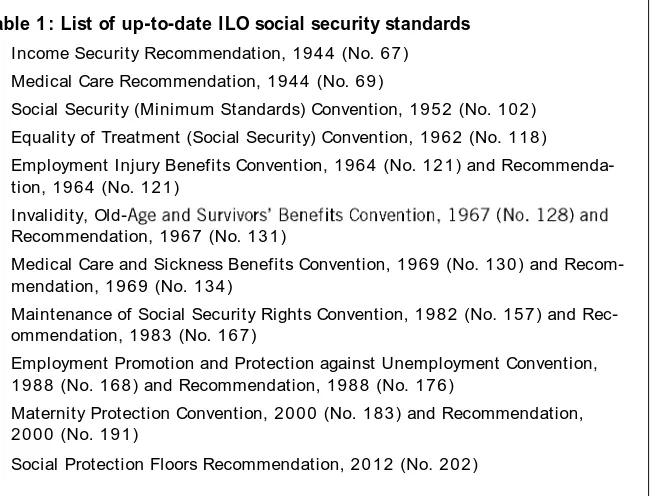
Table 1:
List of up-to-date ILO social security standards ... 8
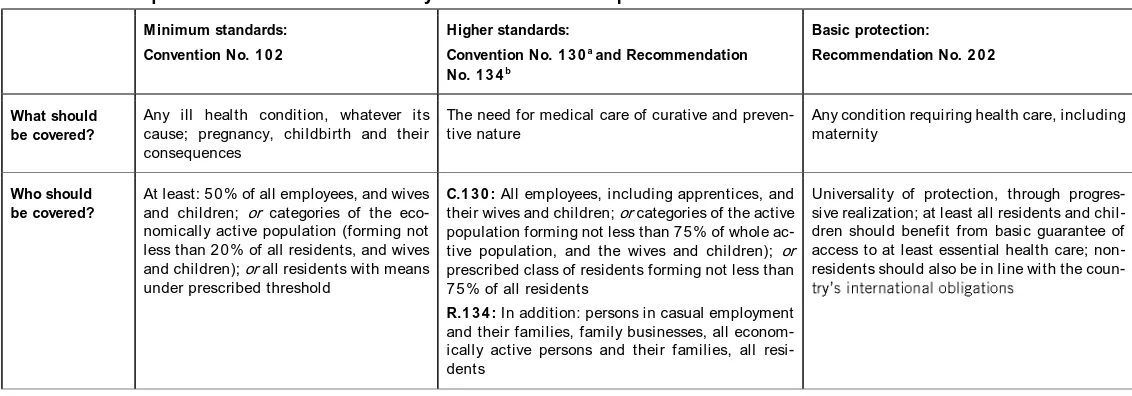
Table 2:
Main requirements in ILO social security standards on
health protection ...2 1 7
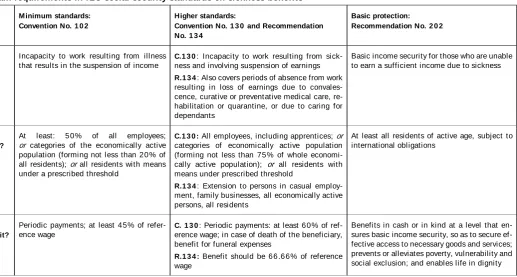
Table 3:
Main requirements in ILO social security standards on
sickness benefits ...2 1 9
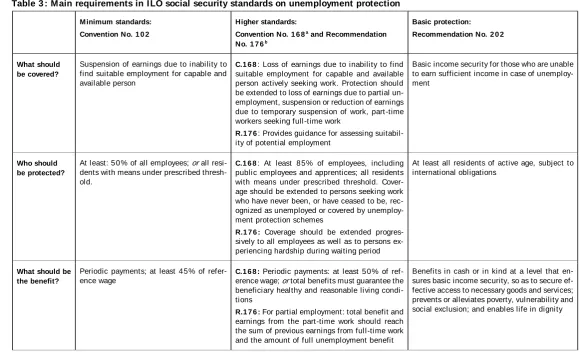
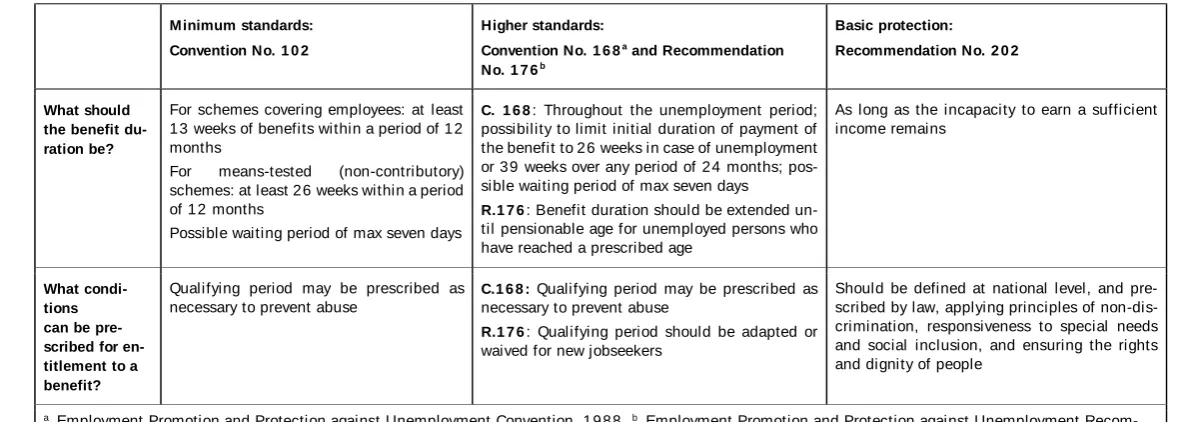
Table 4:
Main requirements in ILO social security standards on
unemployment protection ...2 2 1
Table 5:
Main requirements in ILO social security standards on
income security in old age (old-age pensions) ...2 2 2
Table 6:
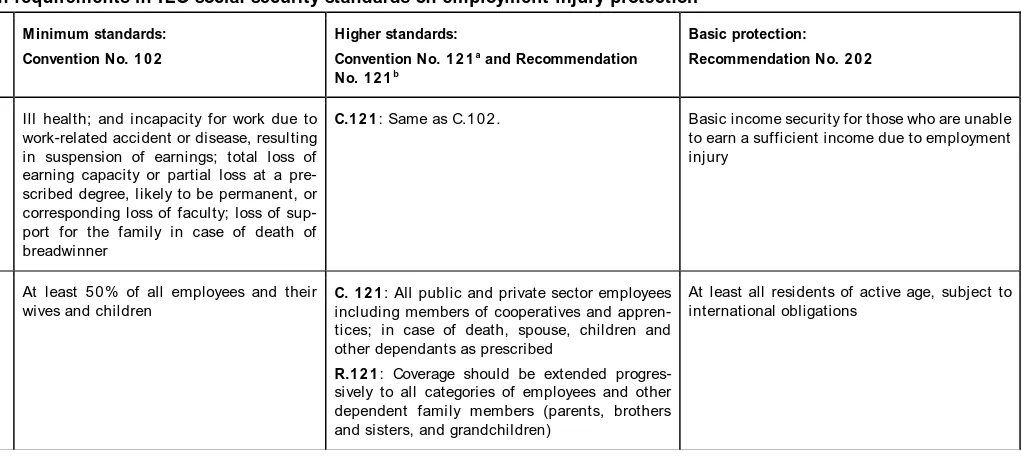
Main requirements in ILO social security standards on
employment injury protection ...2 2 5
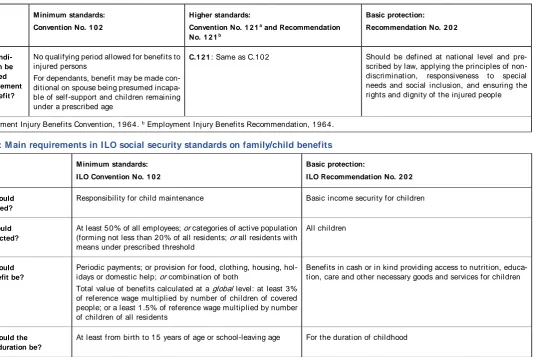
Table 7:
Main requirements in ILO social security standards on
family/child benefits ...2 2 7
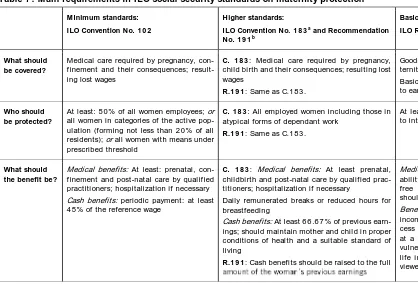
Table 8:
Main requirements in ILO social security standards on
maternity protection ...2 2 9
Table 9:
Main requirements in ILO social security standards on
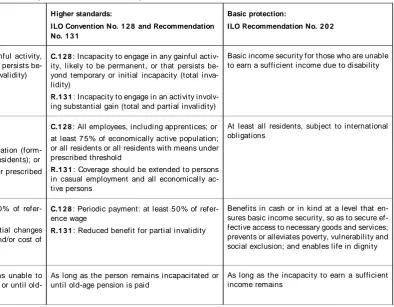
disability benefits ...2 3 1
Table 10:
Main requirements in ILO social security standards on
...2 3 3
Introduction
This compendium contains a selection of the most relevant international
in-struments that establish the human right to social security and provide
guid-ance for comprehensive social security systems
1at national level. These
in-clude the standards and conclusions adopted by the International Labour
Or-ganization (hereinafter referred to as ILO) in the field of social security and the
main human rights instruments spelling out the right to social security adopted
under the auspices of the United Nations.
The compendium is intended to serve as a reference for practitioners,
policy-makers and other stakeholders, as well as a guidebook for the general public.
Ultimately, it is hoped that it will contribute to a wider knowledge and use of
these instruments, thereby strengthening their impact.
Part I describes these instruments and of their contents, as well as explaining
their purpose and relevance for furthering social protection rights worldwide.
Part II reproduces the contents of the above-mentioned instruments. For ease
of reference, Annex I contains tables presenting the key requirements set out
in ILO social security standards. A table presenting the status of ratifications
of ILO social security Conventions is found in Annex II. Other relevant
instru-ments including regional social security instruinstru-ments, regional coordination
in-struments, and other relevant ILO standards covering specific categories of
workers are listed in Annex III, while Annex IV provides a li st of additional
references.
The international legal framework
Over the years, the standards adopted by the ILO to guide countries in the
establishment and maintenance of sound social security systems have played
a substantial role in furthering the implementation of the right to social
secu-rity, as laid down in international human rights instruments. Together, these
two sets of instruments, complemented by internationally negotiated policy
guidelines, provide a comprehensive framework for the concretization of a
rights-based approach to social security in national and regional law and
prac-tice.
1 This term is used interchangea . The ILO usually uses the
Declaration on Human Rights, 1948 (Art. 22), the International Covenant on Economic, Social and Cultural Rights, 1966 (Art. 9) and other UN human rights instruments. This term encompasses a broad variety of policy instruments, including social insurance, social assistance, universal ben-efits and other forms of cash transfers, as well as measures to ensure effective access to health care and other benefits in kind aiming at securing social protection. For more detail, see ILO:
The right to social security in international human rights instruments
From an international legal perspective, the recognition of the right to social
security has been developed through universally negotiated and accepted
in-struments that establish social security as a basic social right to which every
human being is entitled. In this way, the right to social security has been
en-shrined in several human rights instruments adopted by the United Nations,
and is expressly formulated as such in fundamental human rights instruments,
namely the Universal Declaration of Human Rights (UDHR)
2and the
Interna-tional Covenant on Economic, Social and Cultural Rights (ICESCR).
3Specifically, Article 22 of the UDHR lays down that:
Everyone, as a member of society, has the right to social security and is entitled to realization, through national effort and interna-tional cooperation and in accordance with the organization and resources of each state, of the economic, social and cultural rights indispensable for his dignity and the free development of his personality.
And states in its Article 25 that:
(1) Everyone has the right to a standard of living adequate for the health and well-being of himself and of his family, including food, clothing, housing and medical care and necessary social services, and the right to security in the event of unemployment, sickness, invalidity, widowhood, old age or other lack of livelihood in cir-cumstances beyond his control.
(2) Motherhood and childhood are entitled to special care and assistance. All children, whether born in or out of wedlock, shall enjoy the same social protection.
The ICESCR stipulates in its Article 9 that:
[t]he States Parties to the present Covenant recognize the right of everyone to social security, including social insurance.
The right to social security is also enshrined in UN legal instruments setting
out the rights of specific population groups, such as the
Convention on the
Elimination of All Forms of Discrimination Against Women (1979),
4the
Con-vention on the Rights of the Child (1989),
5, the Convention on the Elimination
of All Forms of Racial Discrimination, (1965),
6the
International Convention
on the Protection of the Rights of All Migrant Workers and Their Families
2 United Nations: Universal Declaration of Human Rights, General Assembly Resolution 217 A
(III), 1948 .
3 United Nations: International Covenant on Economic, Social and Cultural Rights, General
As-sembly Resolution 2200 A (XXI), 1966 .
(1990),
7and the
Convention on the Rights of Persons with Disabilities
(2006).
8While the UDHR constitutes an unchallenged statement of fundamental human
rights, the ICESCR and other specific UN Conventions have the quality of
trea-ties, which create binding obligations upon ratification. As for other rights
en-right to social security is one of progressive realization, as they undertake, upon
ratification, to take steps towards the full realization of this right, to the
maxi-mum of their available resources.
The Committee on Economic, Social and Cultural Rights (CESCR), which
mon-itors the implementation of the ICESCR, has progressively developed the
con-tent of the right to social security through its examination of country cases and
its interpretation of this right in the 2008 General Comment 19. 9 For such
purpose, reference is made to th
to the body of technical social security Conventions and Recommendations
adopted by the ILO, notably the Social Security (Minimum Standards)
Conven-tion, 1952 (No. 102) and more recently, the Social Protection Floors
Recom-mendation, 2012 (No. 202 ). Drawing from these instruments, the 2008
Gen-eral Comment 19 defines the right to social security as encompassing
the right to access and maintain benefits, whether in cash or in kind, without discrimination in order to secure protection, inter alia, from (a) lack of work-related income caused by sickness, disability, maternity, employment injury, unemployment, old age, or death of a family member; (b) unaffordable access to health care; (c) insufficient family support, particularly for children and adult dependents. (para. 2)
It further details the constitutive elements of this right, which consist mainly
in the following:
Availability of the social security system
: A sustainable social security system,
and constituting schemes, must be available and in place, established by law
and under the responsibility of public authorities, to ensure that benefits are
provided for the relevant social risks and contingencies for present and future
generations. (para. 11)
Comprehensive coverage of social risks and circumstances
: The social security
system should provide, in law and in practice, benefits for the nine principal
7 Articles 27 and 54. 8 Article 28.
9 General Comments are authoritative statements of the CESCR of its interpretation of the rights
branches of social security, namely: health care, sickness, old age,
unemploy-ment, employment injury, family and child support, maternity, disability,
sur-vivors and orphans. (paras. 12 2 1 )
Accessibility of social security benefits
: All persons must be covered by the
system, without discrimination and taking into account specific needs.
Quali-fying conditions for benefits must be reasonable, proportionate and
transpar-ent. Social security contributions and other costs of the system must be
afford-able for all. Beneficiaries must be afford-able to participate in the administration of
the system. Benefits should be provided in a timely manner and beneficiaries
should have physical access to the social security services; the special needs
of certain groups of the population should be duly considered to ensure they
too have access. (paras. 23 2 7 )
Social security for all, a
The promotion of the right to social security has been an important part of the
1 0
From then onwards, the ILO was
established as the authority in this field. To this effect, the Preamble of the
tions of labour through, among others,
orker against sickness, disease, and injury arising out of his employ-ment, the protection of children, young persons and women, pro-vision for old age and injury.
the first international legal instrument to stipulate the right to social security
commitment to the extension of social security to all. The Declaration, which
then became part of the ILO Constitu
the International Labour Organization to further among the nations of the world
rity measures to provide a basic income to all in need of such protection and
1 1
Over 50 years later, in 2001 , social security was reaffirmed by the International
Labour Conference (ILC) as a fundamental human right, and its extension to
challenge that needed to be addressed seriously and urgently by all member
States.
1 2Consequently, the ILO launched in 2003 the Global Campaign on
1 0 ILO: Constitution of the International Labour Organisation, 1 April 1919, Preamble and Article
1.
1 1 ILO: Declaration concerning the aims and purposes of the International Labour Organisation
(Declaration of Philadelphia), adopted by the International Labour Conference at its 26th Session, held in Philadelphia, on 10 May 1944, Articles III(f) and (h).
1 2 ILO: Social security: A new consensus, Resolution and Conclusions concerning social security,
Social Security and Coverage for All. The ILO Declaration on Social Justice for
a Fair Globalization, adopted by the International Labour Conference in 2008,
again reaffirmed the commitment to extend social security to all in need of
such protection in the framework of the Decent Work Agenda.
In 2009, the International Labour Conference recognized the crucial role of
social protection policies in crisis response, and the Global Jobs Pact called
In June 2011, the ILC adopted a Resolution and Conclusions which set out the
strategy of the ILO with regard to addressing the challenge of extending
cover-age and further developing social security systems.
1 3Based on the premise that
social security is a human right and a social and economic necessity, the ILC
noted that closing coverage gaps was of highest priority for equitable economic
growth, social cohesion and decent work for all women and men. It called for
the extension of social security coverage through a two-dimensional approach,
with a view to building comprehensive social security systems. The Social
Pro-tection Floors Recommendation, 2012 (No. 202), adopted by the ILC in June
2 0 1
security strategy.
According to the Recommendation, effective national strategies to extend
so-cial security, in line with national circumstances, should aim at achieving
uni-versal protection of the population by ensuring at least minimum levels of
in-come security and access to essential health care (horizontal dimension), as
well as progressively ensuring higher levels of protection guided by up-to-date
ILO social security standards (vertical dimension). In line with national
priori-ties, resources and circumstances, such two-dimensional strategies should aim
at building and maintaining comprehensive and adequate social security
sys-tems.
1 4I LO social security standards: A reference framework for national social
secu-rity systems
In pursuit of its mandate in the field of social security and in its capacity as
the responsible UN agency, the ILO has over the years adopted a range of
standards laying down concrete obligations and guidelines for States to
imple-ment the right to social security by developing and maintaining comprehensive
and sustainable social protection systems. ILO social security standards take
the form of either Conventions or Recommendations and lay down
internation-ally agreed standards in the field of social securi ty. Conventions are
interna-tional treaties, designed with a view to being ratified and thereby creating legal
1 3 ILO: Conclusions concerning the recurrent discussion on social protection (social security),
In-ternational Labour Conference, 100th Session, Geneva, 2011 , in Record of Proceedings (Geneva, 2011 ), No. 24: Report of the Committee for the Recurrent Discussion on Social Protection (Ge-neva), para. 31.
1 4 For a more detailed account see: ILO: Social security for all: Building social protection floors
obligations for States. While Recommendations are not open for ratification,
they provide general or technical guidelines and often supplement
correspond-ing Conventions.
These Conventions and Recommendations are elaborated and adopted by the
organizations representing all ILO member States at the International Labour
Conference. They are the main references guiding ILO policy and technical
advice in the field of social protection.
With a total of 31 Conventions adopted over the years, the ILO is the
interna-tional institution producing the largest number of binding instrument s in this
field. For this reason, ILO social security standards, and notably the landmark
Convention No. 102, have come to be recognized globally as key references for
the design of rights-based, sound and sustainable social protection schemes
and systems. Indeed, these are primarily tools for governments which, in
con-sultation with employers and workers, are seeking to draft and implement social
security law, establish administrative and financial governance frameworks,
and develop social protection polici es. More specifically, these standards serve
as key references for:
the elaboration of national social security extension strategies;
the development and maintenance of comprehensive national
so-cial security systems;
the design and parametric adjustments of social security schemes;
the establishment and implementation of effective recourse,
en-forcement and compliance mechanisms;
the good governance of social security and improvement of
admin-istrative and financial structures;
the realization of internati onal and regional obligations, and the
operationalization of Decent Work Country Programmes; and
working towards the achievement of Sustainable Development
Goals, particularly goals 1, 3, 5, 8, 10 and 16 .
Three generations of social security standards
Historically and conceptually, social security standards can be classified into
three different groups or generations of standards, according to the approach
of social security that they embodied at the time of their adoption.
The second generation of standards aimed at unifying and coordinating the
various social protection schemes within a single social security system
cover-ing all contcover-ingencies and extendcover-ing social security coverage to all workers. This
new conception is reflected in the flagship Convention No. 102.
The third generation of standards corresponds to the instruments adopted after
Convention No. 102. Modelled on the latter, they offer a higher level of
protec-tion in terms of populaprotec-tion covered and benefit levels, and revise
first-genera-tion standards.
The adoption of Recommendation No. 202 in 2012 marks the beginning of a
new phase in ILO social security standard-setting, which could be referred to
mendation No. 202 envisages the development of such systems extending
cov-erage, progressively, to all members of society, with a view to realizing the
human right to social security.
A unique and flexible set of tools to improve the outcomes of social
protec-tion systems
Today, eight Conventions and nine
Recommendations set up-to-date
interna-tional standards in the field of social protection. They are designed to ensure
the provision of adequate income and health protection to the population,
ad-dressing the lack or loss of earnings and the need to access medical care and
health services resulting from the occurrence of certain life risks or
circum-stances (see Table 1 ).
ILO social security standards are unique: they establish standards that States
set for themselves. These standards build on good practices and innovative
ways of providing enhanced and extended social protection in countries from
all regions of the world. At the same time, they are built on the notion that
there is no single perfect model for social security; on the contrary, it is for
each society to develop the best means of guaranteeing the protection required.
Accordingly, they offer a range of options and flexible routes for their
applica-tion, all directed at ensuring an overall level of protection which best responds
tributory and non-contributory benefits, general and occupational schemes,
compulsory and voluntary insurance, and different methods for the
administra-tion of benefits.
Furthermore, the ILO standards establish qualitative and quantitative
bench-marks which together determine the minimum standards of social security
pro-tection to be provided by social security schemes when life risks or
circum-stances occur, with regard to:
definition of the contingency (what risk or life circumstance must be
cov-ered?)
persons protected (who must be covered?)
entitlement conditions, including qualifying period (what should a person
do to get the right to a benefit?)
duration of benefit and waiting period (how long must the benefit be
paid/provided for?)
In addition, they set out common rules of collective organization, financing and
management of social security, as well as principles f or the good governance
of national systems. These include:
the general responsibility of the State for the due provision of benefits and
proper administration of social security systems;
solidarity, collective financing and risk-pooling;
participatory management of social security schemes;
guarantee of defined benefits;
adjustment of pensions in payment to maintain the purchasing power of
beneficiaries; and
the right to complain and appeal.
In this way, the ILO standards provide concrete guidance for countries to move
progressively towards the realization of the right to social security and the
ef-fective implementation of a rights-based approach to social protection. As
men-tioned earlier,
they have served as key references in the interpretation of the
right to social security under human rights international instruments by UN
gress and compliance with their obligations in this respect.
Table 1 : List of up-to-date ILO social security standards
Income Security Recommendation, 194 4 (No. 67 )
Medical Care Recommendation, 19 44 (No. 69 )
Social Security (Minimum Standards) Convention, 19 52 (No. 10 2)
Equality of Treatment (Social Security) Convention, 196 2 (No. 11 8)
Employment Injury Benefits Convention, 1964 (No. 12 1) and Recommenda-tion, 196 4 (No. 12 1)
Invalidity,Old-Recommendation, 196 7 (No. 13 1)
Medical Care and Sickness Benefits Convention, 19 69 (No. 13 0) and Recom-mendation, 1 96 9 (No. 13 4)
Maintenance of Social Security Rights Convention, 1 98 2 (No. 1 57 ) and Rec-ommendation, 19 83 (No. 16 7)
Employment Promotion and Protection against Unemployment Convention, 19 88 (No. 16 8) and Recommendation, 198 8 (No. 17 6)
Maternity Protection Convention, 20 00 (No. 183) and Recommendation, 20 00 (No. 19 1) [image:14.454.73.398.356.604.2]A worldwide reference framework to guide the development of social security
systems
Over the years, ILO social security standards, and in particular Convention No.
102, have had and continue to have substantial influence on the development
of social security and the extension of coverage in various regions of the world.
As noted by ILO constituents, more than 50 years after its adoption, Convention
No. 102 continues to serve as a benchmark and reference in the gradual
de-velopment of comprehensive social security coverage at the national level. In
upon the road to soci
1 5member States currently implementing successful and innovative social
secu-rity extension policies have recently ratified Convention No. 102 and others
1 6
The influence of ILO social security standards is also felt in regional and
sub-regional treaties. For instance, in Europe, Convention No. 102 has provided
the blueprint for the
European Code of Social Security (1964) and is
estab-lished as the standard to meet by the European Social Charter (1961). In
Af-rica, it has notably served for the elaboration of the Code on Social Security of
the Southern African Development Community (2008). In the Americas, it is
reflected in the CARICOM Agreement on Social Security (1996), and the
Ad-ditional Protocol to the American Convention on Human Rights in the Area of
Economic, Social and Cultural Rights (Protocol of San Salvador, 1988).
Main I LO social security standards: Key features
The most prominent standards, Convention No. 102 and Recommendation No.
202), are complemented by other Conventions and Recommendations that set
higher standards in respect of the different social security branches, or spell
out the social security rights of migrant workers. The social security rights of
other categories of workers such as fishers, domestic workers and maritime
labourers are further specified in other instruments applying to these specific
sectors.
The long-standing Convention No. 102 is a global reference in social security.
As a leading standard of the ILO in this field, it is deemed to embody an
inter-nationally accepted definition of the very principle of social security. It
re-groups nine social security contingencies (medical care, sickness,
unemploy-ment, old age, employment injury, family responsibilities, maternity, invalidity
and survivorship) and sets out in a single, comprehensive and legally binding
instrument the minimum parameters that States should commit to meeting for
each contingency. It further places them under principles for good and
sus-tainable governance. These standards are to be applied in law and in practice
for the provision of adequate benefits to a substantial part of the population.
1 5 ILO: Social security and the rule of law, Report III (1B), International Labour Conference, 100th
Session, Geneva, 2011 , para. 81.
1 6 ILO: Social protection floors for social justice and a fair globalization, Report IV (1), International
Convention No. 102 contains a number of clauses which allow member States
a certain degree of flexibility in reaching its objectives. This is done first by
allowing ratifying States to accept as a minimum three out of the nine branches
of social security, with at least one of those three branches covering a
long-term contingency or unemployment and with a view to extending coverage to
other contingencies at a further stage (Article 2). In addition, the scope of
personal coverage under Convention No. 102 provides alternatives that take
into account differences in the employment structure and in the
socio-eco-nomic situation of member States, as well as between the different categories
of residents within a State. Hence, for each branch accepted the Convention
gives member States the possibi lity to cover only a certain proportion of their
population. Furthermore, in the implementation of social security branches it
allows member States whose economy and medical facilities are insufficiently
developed to make use of temporary exceptions relati ng, for example, to the
proportion of people covered (Article 3). The Convention also provides for
flex-ibility as to the type of schemes member States may establish for
implemen-tation of the Convention and to reach its objectives. Such objectives can be
reached through non-contributory (universal or means-tested), or contributory
social insurance schemes (with earnings-related or flat -rate components or
both), or a combination of both.
As for
Recommendation No. 2 0 2 ,
it provides guidance on closing social
secu-rity gaps and achieving universal coverage through the establishment and
maintenance of comprehensive social security systems. It calls upon States to
achieve universal coverage with at least minimum levels of protection through
the implementation of social protection floors as a matter of priority; and to
progressively ensure higher levels of protection. National social protection
floors should comprise basic social security guarantees that ensure, as a
mini-mum, effective access to essential health care and basic income security at a
level that allows people to live in dignity throughout the life cycle. These should
include at least:
access to essential health care, including maternity care;
basic income security for children;
basic income security for persons of working age who are unable to earn
sufficient income, in particular in cases of sickness, unemployment,
ma-ternity and disability; and
basic income security for older persons.
national social security extension strategies seeking to close gaps in basic
pro-tection and raise levels of propro-tection, with explicit linkages to more advanced
ILO social security standards and notably Convention No. 102, which should
serve as a reference for such purposes. The Recommendation calls for systems
that are country-led, are aligned to national circumstances, are reviewed in the
light of population needs, and include the participation of all stakeholders. In
an innovative way, it contains guidance on monitoring to help countries assess
their progress in moving towards enhanced protection and improving the
per-formance of national social security systems.
Other social security standards and provisions include the following:
1 7The
Equality of Treatment (Social Security) Convention, 1 9 6 2 (No. 1 1 8 )
ad-dresses the issue of the social security of migrant workers in a global manner.
It provides that, for each social security branch accepted under the Convention,
a ratifying State undertakes to grant equality of treatment to nationals of other
ratifying States (and their dependants) with its own nationals (including
refu-gees and stateless persons, if specifically accepted) within its territory
(princi-ple of reciprocity). Convention No. 118 further lays down the princi(princi-ple of the
provision of benefits abroad and the need to endeavour to participate in
schemes for the maintenance of acquired rights, and rights in the course of
acquisition under the legislation of the nationals of the States for which the
Convention is also in force.
The
Maintenance of Social Security Rights Convention, 1 9 8 2 (No. 1 5 7 )
and
its accompanying
Recommendation, 1 9 8 3 (No. 1 6 7 )
specifically address the
issue of the maintenance of social security rights of migrant workers and
com-plement Convention No. 11 8, focusing on equality of treatment and
exporta-bility. Unlike the latter, however, Convention No. 157 applies to all branches
regardless of the type of scheme: general and special, contributory and
non-contributory, as well as schemes consisting of obligations imposed on
employ-ers by legislation. The objective of Convention No. 157 is to promote a flexible
and broad form of coordination between national security schemes, in
particu-lar through the conclusion of bilateral or multilateral social security
agree-ments, establishing a system based on the principle of the maintenance of
acquired rights and rights in the course of acquisition. Recommendation No.
167 proposes model provisions for the conclusion of bilateral or multilateral
social security agreements regarding all contingencies, and provides rules on
maintaining social security rights and exporting benefits, as well as a model
agreement for the coordination of bilateral or mul tilateral social security
instru-ments.
The
Employment I njury Benefits Convention, 1 9 6 4 (No. 1 2 1 )
addresses
pro-tection in case of a morbid condition, incapacity for work, invalidity or a loss
of faculty due to an industrial accident or a prescribed occupational disease,
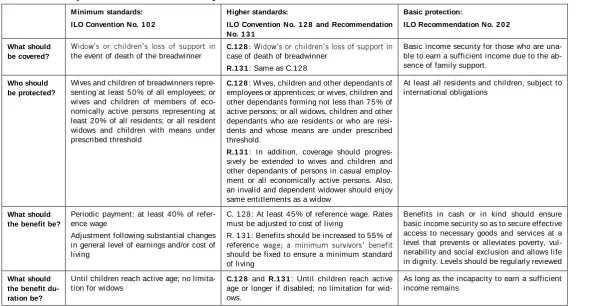
and the loss of support as a result of the death of the breadwinner following
emplo
1 7 For a more detailed overview of main requirements in ILO social security standards see the tables
conditions under which this notion applies to commuting accidents, is the
re-sponsibility of ratifying States. Convention No. 121 indicates the cases in
which accidents should be considered by national legislation as industrial
ac-cidents and under which conditions the occupational origin of the disease
should be presumed. The national list of employment -related diseases must
comprise at least the diseases enumerated in Schedule I to the Convention.
Convention No. 121 envisages that all employees, including apprentices in the
public and private sectors, and in cooperatives, are to be protected. The
Con-vention further lays down three types of benefits: medical care, cash benefits
in the event of incapacity for work and loss of earning capacity (invalidity), and
cash benefits in the event of the death of the breadwinner. Its accompanying
Recommendation No. 1 2 1
essentially recommends the extension of the scope
of persons protected in case of employment injury, and higher levels of cash
benefits.
The
I nvalidity,
Old-regroups all three long-term benefits (i.e. invalidity,
old-efits) branches into one instrument and extends coverage to all employees,
including apprentices, or not less than 75 per cent of the whole economically
active population, or all residents whose means during the contingency do not
exceed certain limits. It further sets the periodical payment rate for invalidity
benefit to at least 50 per cent of the reference wage and envisages the adoption
of measures for rehabilitation services. In the case of
old-benefit, the minimum amount should correspond to at least 4 5 per cent of the
reference wage. Its accompanying
Recommendation No. 1 3 1
broadens the
def-inition of the contingencies that should be covered under nati onal schemes
and recommends that higher benefits be paid, upon the fulfilment of less
strin-gent qualifying conditions.
The
Medical Care and Sickness Benefits Convention, 1 9 6 9 (No. 1 3 0 )
covers
both medical care benefits and cash sickness benefit, reflecting the trend to
establish comprehensive health insurance systems. All employees, including
apprentices, or at least 75 per cent of the economically active population, or
all residents whose means do not exceed certain limits should be covered for
both contingencies. In relation to medical care, wives and children of
employ-ees should also covered. Convention No. 130 further extends the medical care
required under Convention No. 102 to dental care and medical rehabilitation,
including the supply, maintenance and renewal of prosthetic and orthopaedic
appliances. It also provides for entitlement to benefit throughout the
contin-gency and restricts the possibility of limiting the duration of sickness benefits;
a limitation corresponding to 26 weeks is authorized only where the beneficiary
ceases to belong to the categories of persons protected and if the sickness
started while the beneficiary still belonged to such categories. Its
accompany-ing
Recommendation No. 1 3 4
extends the sickness contingency, the scope of
The main aim of the
Employment Promotion and Protection Against
Unemploy-ment Convention, 1 9 8 8 (No. 1 6 8 )
is twofold: the protection of unemployed
persons through the provision of benefits in the form of periodical payments,
and the promotion of employment. It therefore recognizes the value of linking
social security to broader social and economic policies directed at one priority
goal: the promotion of full, productive and freely chosen employment. In
addi-tion to providing benefits in case of unemployment at a minimum replacement
rate of 50 per cent of the reference wage, ratifying States are therefore also
called upon to adopt appropriate steps t o coordinate their system of protection
against unemployment and their employment policy. The system of protection
against unemployment should therefore be such as to encourage employers in
offering, and workers in seeking, productive employment. Persons protected
must comprise prescribed classes of employees, constituting not less than 85
per cent of all employees, including public employees and apprentices, or all
residents whose resources during the contingencies do not exceed prescribed
limits. Its accompanying
Recommendation No. 1 7 6
provides guidance on how
to assess the suitability of employment for those seeking it, taking into account
the age of unemployed persons, their length of service in their former
occupa-tion, their acquired experience, the length of their unemployment and the state
of the labour market. It further recommends the extension of the scope of the
contingency covered, that of the personal coverage, and of the benefit duration
Under the
Maternity Protection Convention, 2 0 0 0 (No. 1 8 3 )
, all employed
women, including those in atypical forms of dependent work, should be covered
for pregnancy, childbirth and their consequences. In particular, persons
pro-tected should be entitled to maternity benefits for a minimum period of 14
weeks (including six weeks of compulsory leave after childbirth) at not less
than two-thirds of their previous earnings. The medical benefits provided to
protected persons must include prenatal, childbirth and post -natal care.
Con-vention No. 183 also lays down the right to work breaks for breastfeedi ng, as
well as provisions relating to health protection, employment protection and
non-discrimination. Its accompanying
Recommendation No. 1 9 1
provides for
a higher benefit and a longer duration of paid maternity leave.
The
I ncome Security Recommendation, 1 9 4 4 (No. 6 7 )
and the
Medical Care
Recommendation, 1 9 4 4 (No. 6 9 )
are at the origin of the development of social
security in ILO instruments and can be considered the blueprint for
compre-hensive social security systems. Together, they establish a comprecompre-hensive
sys-tem of income security and medical care protection for each of the nine
clas-sical branches of social security in addition to
tution. Recommendations No. 67 and No. 69 are grounded on the guiding
principle of universal coverage, following which income security and medical
care services should be extended to the population as a whole through a
com-bination of social insurance and social assistance.
or sectors, including social security provisions
1 8. The latest in date, the
Tran-sition from the I nformal to the Formal Economy Recommendation, 2 0 1 5 (No.
2 0 4 )
recognizes the lack of protection of workers in the informal economy, and
provides guidance for improving their protection and facilitating transitions to
the formal economy. It also includes guidance on the extension of social
secu-rity coverage to workers in the informal economy, including through social
pro-tection floors, and on the role of such extension of coverage in facilitating
tran-sitions to the formal economy.
The importance of ratifying I LO social security Conventions
As mentioned earlier, Conventions are open to ratification, a formal procedure
through which a State, through its Government, accepts to be bound by the
Convention provisions. The act of ratification, signed by the Government and
deposited with the Director-General of the ILO, is in itself a declaration to such
effect. Ratifying a Convention thus creates a legal obligation for the State to
apply its provisions in law and in practice, and to report at regular intervals to
the ILO supervisory bodies on how this is done.
There are currently eight up-to-date Conventions open for ratification (listed in
box 1). Some of these, such as Conventions No. 102 and No. 128, contain
flexibility clauses which allow a State to ratify by accepting only parts of it.
These parts should be specified in the act of ratification. Other Conventions,
such as No. 183, require particular information to be specified in the act of
ratification. These elements are crucial for the ratification to become effective
and registered. The ratification takes effect one year following the date of
reg-istration of the act of ratification with the ILO.
In recent years, the ratification of Convention No. 102 has proven of particular
importance for countries undergoing political change or comprehensive labour
market reforms, or experiencing crises, by providing legal incentives to
main-tain some of the most crucial guarantees of the system.
1 9In others, ratification
has served as a catalyst for improvement of the social security system by
guid-ing parametric adjustments, the extension of coverage and, in some cases, a
systemic reform. The most recent ratifications include Brazil (2009),
Domini-can Republic (2016), Honduras (2 012), Jordan (2014), Romania (2009), St.
Vincent and the Grenadines (2015), Togo (2013) and Ukraine (2016).
The advantages for States in ratifying ILO social security Conventions can be
summarized as follows:
A path to decent work and poverty reduction.
Once ratified and applied in
law and practice, ILO social security Conventions can contribute to
foster-ing decent workfoster-ing conditions and reducfoster-ing poverty by providfoster-ing for
guar-anteed minimum levels of benefits.
1 8 See Annex III.
1 9 For a more detailed account of the role of the expansion of social protection coverage in crisis
A concrete and detailed guiding framework for operationalizing
constitu-tional rights and meeting internaconstitu-tional and regional obligations.
By
apply-ing ILO social securit y Conventions in law and in practice, as required by
their ratification, States move further towards the implementation of the
right to social security enhancing compliance with related treaty
obliga-tions under international human rights instruments and regional
agree-ments. In addition, ratification can provide for many countries the
oppor-tunity to develop their social security system further and to extend legal
and effective coverage, thereby giving effect to constitutional provisions
laying down the right to social security or social protection rights.
An international legal framework for fair and stable globalization and for
ensuring a level playing field
. Experience shows that ILO social security
Conventions, once ratified, can serve as a means of preventing the levelling
down of national social security systems in countries worldwide. The
min-imum requirements and benchmarks they set out contribute to the creation
of a global level playing field for social conditions. By ratifying these
stand-ards, a country thus contributes to preventing the downgrading of the
ap-leading to lower protection, below the minimum levels set out in these
Conventions.
Tools for policy and legal action, and a road map for the development of
social security systems
. ILO social security Conventions, and Convention
No. 102 more particularly, envisage social security as being provided
through an integrated, comprehensive and coherent system. This
norma-tive framework can thus serve as a road map for the development and
re-form of social security by providing guidelines and targets for progressively
building an integrated, wide-ranging and sustainable system that leaves no
one behind.
A guarantee that minimum levels of protection will be maintained in times
of crisis.
The social impact of financial and economic crises on workers
and their families can be mitigated by social security through its automatic
income replacement functions and measures. By ratifying ILO soci al
secu-rity Conventions, a country undertakes to implement minimum social
se-curity standards through a legal framework; this requires the maintenance
at all times of the minimum standards they set out. Conventions, once
ratified, can therefore act as powerful tools for the preservation of social
security guarantees and entitlements at the national level and thereby,
the preservation of decent standards of living and health. Ratification can
therefore prevent countries from backsliding, that is, from losing what has
already been achieved, and can mitigate the long-term social
conse-quences of crises.
Tools for the improvement of social security governance, administration
by the Convention; periodical actuarial review of contributions and benefit
schedule; and tripartite representation in administration). These
princi-ples, when taking a legal form, provide a solid basis for the establishment
or reform of social security institutions, and increase these institutio
accountability. This, in turn, increases public acceptance and perception
commitment to ILO social security Conventions and to these principles,
expressed by the act of ratification, translates into a commitment to ensure
the provision of regular and sustainable benefits and the sound governance
fidence in the social security system, in the national social security
admin-istration and in the political system of a country in general. In times of
reform, ratification can give a particular strong signal to society and social
rity standards, irrespective of the type of scheme chosen. A given
Conven-tion can thus facilitate the social dialogue process by becoming an integral
component (in terms of the standards, benchmarks and principles) of
so-cial security reform.
Concluding remarks
The international social security legal framework described above contains a
wealth of references for countries that wish to move forward with the
imple-mentation of the right to social security and the establishment of
comprehen-sive, sustainable and adequate social securi ty systems. From general
orienta-tion to technical requirements, the provisions contained in the instruments that
constitute this framework, and their interpretation by the respective supervisory
bodies, can play a fundamental role in guiding the development of sound legal
frameworks enabling all people to enjoy their rights.
promote human development, political stability and inclusive growth, and in
this way reduce and prevent poverty, redress inequalities and encourage the
fair redistribution of economic wealth in line with the Sustainable Development
Goals (SDGs).
2 0In fact, social protection occupies a central role in the 2030
Agenda for Sustainable Development, cutting across several SDGs and
empha-sizing the multidimensional nature of social protection policies, which have an
2 1
Most prominently, SDG 1 recognizes the
criti-cal contribution of social protection systems, including social protection floors,
tionally appropriate social protection systems and measures for all, i ncluding
This provides a bridge to the other goals, which explicitly or implicitly relate to
social protection, including goals on, health (particularly target 3.8), gender
2 0 ILO: World Social Protection Report 2014/15, op. cit.; see also M. Sepulveda, C. Nyst: The
Human Rights Approach to Social Protection. Ministry of Foreign Affairs of Finland, 2012 .
21 r Sustainable
equality (particularly target 5.4), decent work and economic growth
(particu-larly target 8.5), reduced inequalities (particu(particu-larly target 10.4), and peace,
justice and strong institutions (particularly targets 16.3 and 16.6). This is why
the strengthening of social protection systems plays such an essential role in
achieving the SDGs.
C1 0 2 Social Security (Minimum Standards) Convention, 1 9 5 2
The General Conference of the International La-bour Organisation,
Having been convened at Geneva by the Gov-erning Body of the International Labour Office, and having met in its Thirty-fifth Session on 4 June 1952, and
Having decided upon the adoption of certain proposals with regard to minimum standards of social security, which are included in the fifth item on the agenda of the session, and Having determined that these proposals shall take the form of an international Convention, adopts this twenty-eighth day of June of the year one thousand nine hundred and fifty-two the following Convention, which may be cited as the Social Security (Minimum Standards) Convention, 1952 :
PART I. GENERAL PROVISIONS Article 1
1. In this Convention--
(a) the term prescribed means determined by or in virtue of national laws or regulations; (b) the term residence means ordinary resi-dence in the territory of the Member and the term resident means a person ordinarily resi-dent in the territory of the Member;
(c) the term wife means a wife who is main-tained by her husband;
(d) the term widow means a woman who was maintained by her husband at the time of his death;
(e) the term child means a child under school -leaving age or under 15 years of age, as may be prescribed;
(f) the term qualifying period means a period of contribution, or a period of employment, or a period of residence, or any combination thereof, as may be prescribed.
2. In Articles 10, 34 and 49 the term benefit
means either direct benefit in the form of care or indirect benefit consisting of a reimburse-ment of the expenses borne by the person con-cerned.
Article 2
Each Member for which this Convention is in force--
(a) shall comply with--
(i) Part I;
(ii) at least three of Parts II, III, IV, V, VI, VII, VIII, IX and X, including at least one of Parts IV, V, VI, IX and X;
(iii) the relevant provisions of Parts XI, XII and XIII; and
(iv) Part XIV; and
(b) shall specify in its ratification in respect of which of Parts II to X it accepts the obligations of the Convention.
Article 3
1. A Member whose economy and medical fa-cilities are insufficiently developed may, if and for so long as the competent authority consid-ers necessary, avail itself, by a declaration ap-pended to its ratification, of the temporary ex-ceptions provided for in the following Articles: 9 (d) ; 12 (2); 15 (d); 18 (2); 21 (c); 27 (d) ; 33 (b); 34 (3); 41 (d); 48 (c); 55 (d); and 61 (d).
2. Each Member which has made a declaration under paragraph 1 of this Article shall include in the annual report upon the application of this Convention submitted under Article 22 of the Constitution of the International Labour Or-ganisation a statement, in respect of each ex-ception of which it avail s itself--
(a) that its reason for doing so subsists; or (b) that it renounces its right to avail itself of the exception in question as from a stated date. Article 4
1. Each Member which has ratified this Con-vention may subsequently notify the Director-General of the International Labour Office that it accepts the obligations of the Convention in respect of one or more of Parts II to X not al-ready specified in its ratification.
2. The undertakings referred to in paragraph 1 of this Article shall be deemed to be an integral part of the ratification and to have the force of ratification as from the date of notification. Article 5
shall satisfy itself, before undertaking to com-ply with any such Part, that the relevant per-centage is attained.
Article 6
For the purpose of compliance with Parts II, III, IV, V, VIII (in so far as it relates to medical care), IX or X of this Convention, a Member may take account of protection effected by means of insurance which, although not made com-pulsory by national laws or regulations for the persons to be protected--
(a) is supervised by the public authorities or ad-ministered, in accordance with prescribed standards, by joint operation of employers and workers;
(b) covers a substantial part of the persons whose earnings do not exceed those of the skilled manual male employee; and
(c) complies, in conjunction with other forms of protection, where appropriate, with the relevant provisions of the Convention.
PART II. MEDICAL CARE Article 7
Each Member for which this Part of this Con-vention is in force shall secure to the persons protected the provision of benefit in respect of a condition requiring medical care of a preven-tive or curapreven-tive nature in accordance with the following Articles of this Part.
Article 8
The contingencies covered shall include any morbid condition, whatever its cause, and preg-nancy and confinement and their conse-quences.
Article 9
The persons protected shall comprise-- (a) prescribed classes of employees, constitut-ing not less than 50 per cent. of all employees, and also their wives and children; or (b) prescribed classes of economically active population, constituting not less than 20 per cent. of all residents, and also their wives and children; or
(c) prescribed classes of residents, constituting not less than 50 per cent. of all residents; or (d) where a declaration made in virtue of Article 3 is in force, prescribed classes of employees constituting not less than 50 per cent. of all employees in industrial workplaces employing 20 persons or more, and also their wives and children.
Article 10
1. The benefit shall include at least-- (a) in case of a morbid condition--
(i) general practitioner care, including domicil-iary visiting;
(ii) specialist care at hospitals for in-patients and out-patients, and such specialist care as may be available outside hospitals;
(iii) the essential pharmaceutical supplies as prescribed by medical or other qualified practi-tioners; and
(iv) hospitalisation where necessary; and (b) in case of pregnancy and confinement and their consequences--
(i) pre-natal, confinement and post-natal care either by medical practitioners or by qualified midwives; and
(ii) hospitalisation where necessary.
2. The beneficiary or his breadwinner may be required to share in the cost of the medical care the beneficiary receives in respect of a morbid condition; the rules concerning such cost -shar-ing shall be so designed as to avoid hardship. 3. The benefit provided in accordance with this Article shall be afforded with a view to main-taining, restoring or improving the health of the person protected and his ability to work and to attend to his personal needs.
4. The institutions or Government departments administering the benefit shall, by such means as may be deemed appropriate, encourage the persons protected to avail themselves of the general health services placed at their disposal by the public authorities or by other bodies rec-ognised by the public authorities.
Article 1 1
The benefit specified in Article 10 shall, in a contingency covered, be secured at least to a person protected who has completed, or whose breadwinner has completed, such qualifying period as may be considered necessary to pre-clude abuse.
Article 12
1. The benefit specified in Article 10 shall be granted throughout the contingency covered, except that, in case of a morbid condition, its duration may be limited to 26 weeks in each case, but benefit shall not be suspended while a sickness benefit continues to be paid, and provision shall be made to enable the limit to be extended for prescribed diseases recognised as entailing prolonged care.
2. Where a declaration made in virtue of Article 3 is in force, the duration of the benefit may be limited to 13 weeks in each case.
PART III. SICKNESS BENEFIT Article 13
protected the provision of sickness benefit in accordance with the following Articles of this Part.
Article 14
The contingency covered shall include incapac-ity for work resulting from a morbid condition and involving suspension of earnings, as de-fined by national laws or regulations. Article 15
The persons protected shall comprise-- (a) prescribed classes of employees, constitut-ing not less than 50 per cent. of all employees; or
(b) prescribed classes of the economically ac-tive population, constituting not less than 20 per cent. of all residents; or
(c) all residents whose means during the con-tingency do not exceed limits prescribed in such a manner as to comply with the require-ments of Article 67; or
(d) where a declaration made in virtue of Article 3 is in force, prescribed classes of employees, constituting not less than 50 per cent. of all employees in industrial workplaces employing 20 persons or more.
Article 16
1. Where classes of employees or classes of the economically active population are protected, the benefit shall be a periodical payment cal-culated in such a manner as to comply either with the requirements of Article 65 or with the requirements of Article 66.
2. Where all residents whose means during the contingency do not exceed prescribed limits are protected, the benefit shall be a periodical pay-ment calculated in such a manner as to comply with the requirements of Article 67.
Article 17
The benefit specified in Article 16 shall, in a contingency covered, be secured at least to a person protected who has completed such qualifying period as may be considered neces-sary to preclude abuse.
Article 18
1. The benefit specified in Article 16 shall be granted throughout the contingency, except that the benefit may be limited to 26 weeks in each case of sickness, in which event it need not be paid for the first three days of suspen-sion of earnings.
2. Where a declaration made in virtue of Article 3 is in force, the duration of the benefit may be limited--
(a) to such period that the total number of days for which the sickness benefit is granted in any
year is not less than ten times the average num-ber of persons protected in that year; or (b) to 13 weeks in each case of sickness, in which event it need not be paid for the first three days of suspension of earnings. PART IV. UNEMPLOYMENT BENEFIT Article 19
Each Member for which this Part of this Con-vention is in force shall secure to the persons protected the provision of unemployment ben-efit in accordance with the following Articles of this Part.
Article 20
The contingency covered shall include suspen-sion of earnings, as defined by national laws or regulations, due to inability to obtain suitable employment in the case of a person protected who is capable of, and available for, work. Article 21
The persons protected shall comprise-- (a) prescribed classes of employees, constitut-ing not less than 50 per cent. of all employees; or
(b) all residents whose means during the con-tingency do not exceed limits prescribed in such a manner as to comply with the require-ments of Article 67; or
(c) where a declaration made in virtue of Article 3 is in force, prescribed classes of employees, constituting not less than 50 per cent. of all employees in industrial workplaces employing 20 persons or more.
Article 22
1. Where classes of employees are protected, the benefit shall be a periodical payment cal-culated in such manner as to comply either with the requirements of Article 65 or with the requirements of Article 66.
2. Where all residents whose means during the contingency do not exceed prescribed limits are protected, the benefit shall be a periodical pay-ment calculated in such a manner as to comply with the requirements of Article 67.
Article 23
The benefit specified in Article 22 shall, in a contingency covered, be secured at least to a person protected who has completed such qualifying period as may be considered neces-sary to preclude abuse.
Article 24
1. The benefit specified in Article 22 shall be granted throughout the contingency, except that its duration may be limited--
(b) where all residents whose means during the contingency do not exceed prescribed limits are protected, to 26 weeks within a period of 12 months.
2. Where national laws or regulations provide that the duration of the benefit shall vary wit h the length of the contribution period and/or the benefit previously received within a prescribed period, the provisions of subparagraph (a) of paragraph 1 shall be deemed to be fulfilled if the average duration of benefit is at least 13 weeks within a period of 12 months.
3. The benefit need not be paid for a waiting period of the first seven days in each case of suspension of earnings, counting days of unem-ployment before and after temporary employ-ment lasting not more than a prescribed period as part of the same case of suspension of earn-ings.
4. In the case of seasonal workers the duration of the benefit and the waiting period may be adapted to their conditions of employment. PART V. OLD-AGE BENEFIT
Article 25
Each Member for which this Part of this Con-vention is in force shall secure to the persons protected the provision of old-age benefit in ac-cordance with the following Articles of this Part.
Article 26
1. The contingency covered shall be survival beyond a prescribed age.
2. The prescribed age shall be not more than 65 years or such higher age as may be fixed by the competent authority with due regard to the working ability of elderly persons in the country concerned.
3. National laws or regulations may provide that the benefit of a person otherwise entitled to it may be suspended if such person is engaged in any prescribed gainful activity or that the ben-efit, if contributory, may be reduced where the earnings of the beneficiary exceed a prescribed amount and, if non-contributory, may be re-duced where the earnings of the beneficiary or his other means or the two taken together ex-ceed a prescribed amount.
Article 27
The persons protected shall comprise-- (a) prescribed classes of employees, constitut-ing not less than 50 per cent. of all employees; or
(b) prescribed classes of the economically ac-tive population, constituting not less than 20 per cent. of all residents; or
(c) all residents whose means during the con-tingency do not exceed limits prescribed in such a manner as to comply with the require-ments of Article 67; or
(d) where a declaration made in virtue of Article 3 is in force, prescribed classes of employees, constituting not less than 50 per cent. of all employees in industrial workplaces employi ng 20 persons or more.
Article 28
The benefit shall be a periodical payment cal-culated as follows:
(a) where classes of employees or classes of the economically active population are protected, in such a manner as to comply either with the requirements of Article 65 or with the require-ments of Article 66;
(b) where all residents whose means during the contingency do not exceed prescribed limits are protected, in such a manner as to comply with the requirements of Article 67.
Article 29
1. The benefit specified in Article 28 shall, in a contingency covered, be secured at least -- (a) to a person protected who has completed, prior to the contingency, in accordance with prescribed rules, a qualifying period which may be 30 years of contribution or employment, or 20 years of residence; or
(b) where, in principle, all economically active persons are protected, to a person