5
th
INTERNATIONAL JUNIOR
SCIENCE OLYMPIAD
Read carefully the following instructions:
1. The time available is 3 hours.
2.
The total number of the problems is 3. Check that you have a
complete set of the test problems and the answer sheets.
3. Use only the pen provided.
4.
Write down your name, code, country, and signature in the first page
of your answer sheet. Write down your name and code in the other
pages of your answer sheet.
5.
Read carefully each problem and write the correct answer in the
answer sheet.
6. All competitors are not allowed to bring any stationary and tools
provided from outside. After completing your answers, all of the
question and answer sheets should be put neatly on your desk.
EXAMINATION RULES
1. All competitors must be present at the front of examination room ten minutes
before the examination starts.
2. No competitors are allowed to bring any tools except his/her personal medicine or
any personal medical equipment.
3. Each competitor has to sit according to his or her designated desk.
4. Before the examination starts, each competitor has to check the stationary and any
tools (pen, ruler, calculator) provided by the organizer.
5. Each competitor has to check the question and answer sheets. Raise your hand, if
you find any missing sheets. Start after the bell.
6. During the examination, competitors are not allowed to leave the examination
room except for emergency case and for that the examination supervisor will
accompany them.
7. The competitors are not allowed to bother other competitor and disturb the
examination. In case any assistance is needed, a competitor may raise his/her hand
and the nearest supervisor will come to help.
8. There will be no question or discussion about the examination problems. The
competitor must stay at their desk until the time allocated for the examination is
over, although he/she has finished the examination earlier or does not want to
continue working.
9.
At the end of the examination time there will be a signal (the ringing of a bell).
Problem I
Pressure
In 1643, Torricelli created a 1 meter-long tube, sealed at the top end, filled it with mercury,
and set it vertically into a basin of mercury. The column of mercury fell to about 76 cm above the
level of the mercury basin, leaving a ‘Torricellian’ vacuum above. After this discovery, it has been
widely accepted that 1 atm (atmospheric pressure) is equivalent to 760 mmHg or 760 Torr. Pressure
is defined as ‘the force per unit area applied to an object in a direction perpendicular to the surface’.
Assume that the density of mercury is 13.6 times density of water and g is 9.80 m/s2.
I-1) Express the unit of the pressure in terms of kg, m, and s. (0.3 point)
I-2) How high does a water column go up when you use water instead of mercury at 1
atm? (0.5 point)
I-3) What is the value of 1 atm in SI units? (0.5 point)
Blood Pressure
Blood pressure refers to the force exerted by circulating blood on the walls of blood
vessels, and constitutes one of the principal vital signs. The pressure of the circulating blood
decreases as blood moves through arteries, arterioles, capillaries, and veins; the term blood pressure
generally refers to arterial pressure, i.e., the pressure in the larger arteries, the blood vessels that
take blood away from the heart. Arterial pressure is most commonly measured via a
‘sphygmomanometer’ (blood pressure meter), which historically used the height of a column of
mercury to reflect the circulating pressure.
The oldest type of sphygmomanometer consists of a mercury manometer attached on one
side of a closed bag, the cuff. The cuff is wrapped around the upper arm at the level of the heart and
is then pumped up with air. The manometer measures the gauge pressure of the air in the cuff. At
first the cuff pressure squeezes the artery. When the cuff pressure is above the systolic pressure,
which is the maximum pressure in the artery, blood no longer flows into the forearm. When the cuff
pressure decreases to just below the systolic pressure, a little squirt of blood starts to flow with each
heartbeat. The sound of turbulent blood flow can be heard through the stethoscope.
As air continues to escape from the cuff, the sound of turbulent blood flow continues to be
heard. When the cuff pressure reaches the diastolic pressure, which is the minimum pressure in the
artery, the pulsing sounds cease. The gauge pressures for a healthy heart are around 120 mmHg
I-4) If a fighter pilot who has a healthy heart is accelerating upward (in the direction of the
head), estimate the minimum acceleration for which blood supply to the pilot’s brain
stops?
(Assume the followings: 1. The blood pressure does not change. 2. The density of blood is the
same as that of water. 3. The brain is located 42 cm above the heart. 4. The atmospheric
pressure in the cockpit is 1 atm.) (1.2 points)
I-5) The heart pumps blood into the aorta (main artery), which has an inner radius of 1.2 cm.
The aorta feeds 32 major arteries. If blood in the aorta travels at a speed of 25 cm/s, at
approximately what speed does it travel in the arteries? (Assume that blood can be treated as an incompressible and nonviscous fluid and that each artery has an inner radius of 0.2 cm.)
(1.0 point)
Poiseuille’s law
In fact, blood is a viscous fluid. The volume flow rate for streamline flow of a viscous
fluid through a horizontal, cylindrical pipe is known to be
∆V/∆t ∝ ∆P r4,
where r and are the inner radius of the pipe and the pressure difference between the ends of
the pipe.
I-6) A cardiologist reported to his patient that the radius of the left anterior descending artery
of the heart decreased by 10.0%. What percent increase in the blood pressure drop across
the artery is required to maintain the normal blood flow through this artery? Assume that the blood flow is streamline flow. (1.0 point)
Analogy to electric circuits
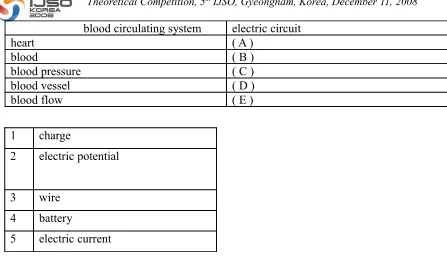
The blood circulatory system is similar to an electric circuit in certain ways; below is a table
of the corresponding elements in the analogy between the blood circulatory system and an electric
circuit.
blood circulating system electric circuit
By this analogy, we can easily understand Kirchhoff’s rules of circuits.
1. The sum of the currents that flow into a junction is equal to the sum of the currents that flow
out of the same junction.
2. If a closed path is followed in a circuit, the algebraic sum of the potential changes must be
zero.
Using Kirchhoff’s rules, solve the following problems.
The Wheatstone bridge is a circuit used to measure unknown resistances. The bridge in the
figure is balanced: no current flows through the galvanometer. (Assume the galvanometer is ideal:
internal resistance is negligible compared to other resistors)
I-8) What is the potential difference (voltage) between the points A and B? (0.5 point)
After changing the 8 resistor to 3 resistor, the current through the
galvanometer is 0.2 A. The current flows A to B.
I-10) What is the voltage between the points A and B? (0.5 point)
I-11) What is the voltage of the battery? (1.5 points)
I-12) If you disconnect the galvanometer, what is the voltage between the points A and B? And which point is higher? (1.5 points)
Problem II Various energy sources
Gasoline is the most commonly used hydrocarbon compound as a fuel of motor vehicles.
The major component of gasoline is octane. Liquefied petroleum gas (LPG) is a mixture of low
molecular weight hydrocarbons condensed into liquid under high pressure. A variety of LPG
mixtures are being sold; a mixture that is primarily propane, a mixture that is primarily butane, and
a mixture of propane and butane in different ratios. Liquefied natural gas (LNG) is natural gas
mainly consisting of methane. These compounds can be used as energy sources since they release
large amount of heat by combustion reactions with oxygen (O2). The following table provides
useful data about these fuels. (Assume that all gases are ideal gases and the volume of the liquid
does not change with temperature.)
Gasoline Octane C8H18 0.70 44000
LPG (liquefied
II-1) In some countries, the engine efficiency is represented by the amount of fuel consumed
for the vehicle to travel 100 km, while in other countries by the distance for the vehicle to
travel with 1 L of fuel. A car has a gasoline consumption of 13.0 L/100 km. If LPG can be
used as an alternative fuel for this car, calculate the distance that the car can travel with 1
L of liquid LPG. Assume that LPG consists of pure propane, and the engine efficiency of the
II-2) LNG is usually stored as a liquid at about -163 °℃. If 1 mL of liquid
LNG is completely vaporized to a gaseous state at 25 °℃ and 1 atm, what is the volume of
the resulting gaseous LNG? Assume that LNG is pure methane. (1.0 point)
II-3) LPG is commonly prepared as a mixture of propane and butane in different proportions.
A cylinder of LPG contains both propane and butane in the weight ratio of 3:2. What will be
the density of gas mixture when LPG in this cylinder is completely vaporized to a
gaseous state at 25 °℃ and 1 atm? (1.5 points)
II-4) Hydrocarbon fuels produce carbon dioxide (CO2) and water vapor when they undergo
complete combustion. Write the balanced chemical equation for the complete combustion
of octane. (1 point)
II-5) CO2 gas produced during combustion of fuels is one of the major greenhouse gases. If
the 1 kJ of energy is obtained by burning octane or methane, what is the weight of CO2
produced from each fuel? Assume that both fuels undergo complete combustion. (2.5 points)
II-6) Because fossil fuels will be exhausted and cause environmental problems, a great deal of
efforts has been made to utilize solar energy as a new clean energy source. The solar cell is a
device converting the light energy of the sun into electric energy. Suppose that we want to
obtain the same amount of energy from the solar cell in an hour as that produced from
combustion of 1 L of liquid gasoline. Assume that 1000 W solar power reaches 1 m2 area of
Earth surface. If the conversion efficiency of the solar cell is 20 %, what is the minimum
surface area of the solar cell? (1.5 points)
Reference data:
is triggered by photoperiod fall into two groups. One group, the short-day plants,
generally flowers during late summer, fall, or winter, when light periods are significantly shorter. In
contrast, flowers of long-day plants usually bloom in late spring or early summer, when light
periods are relatively longer. In the 1940s, researchers have discovered that photoperiodic response
of flowering is actually controlled by the length of night (length of darkness), not the length of day
(length of light). In fact, the so-called ‘short-day’ plants are actually ‘long-night’ plants.
To flower, short-day plants require a certain night length which is longer than a critical length to
flower. For instance, the common cocklebur (Xanthium strumarium), which is a typical short-day
plant, will flower when the night length is at least critical length of light or more. Long-day plants
only flower when the night length is shorter than their specific night length. Henbane (Hyoscyamus
niger), which is a example of long-day plant, will flower by 14 hours or shorter night. Plants detect
the night length very precisely; some short-day plants will not flower if night is even 10 minutes
shorter than the necessary critical length. Some plant species always flower on the same day each
year.
Flowers of some plants bloom after a single exposure to the photoperiod required for flowering.
Researchers found that if the nighttime part of the photoperiod is interrupted by even a few minutes
of dim light, short-day plant will not flower. Chrysanthemums are short-day plants that normally
flower in the fall, but their blooming can be stalled until the following May by interrupting each
long day with a flash of red light, thus, as a result, turning one long night into two short nights.
III-1~3. (1 point each)
as in Figure 1, does henbane flower?
III-2)When the following condition is given,does cocklebur flower?
III-4~6. (1 point each)
How does a plant actually measure photoperiod? Pigments called phytochromes are part of the
answer. Phytochrome is a photoreceptor that specifically detects red light. Researchers learned that
red light is the most effective light for interrupting the critical night length. The chromophore of
phytochrome is photoreversible, reverting back and forth between two isomers, depending on the
color of light provided. The Pr isomer form of phytochrome shows maximum absorption of red light
(wavelength, 660 nm), whereas the Pfr isomer mainly absorbs far-red light (wavelength, 730 nm).
This interconversion between two molecular isomers is a switching mechanism that controls
various light-induced events in the life of the plant, including flowering in short-day and long-day
plants.
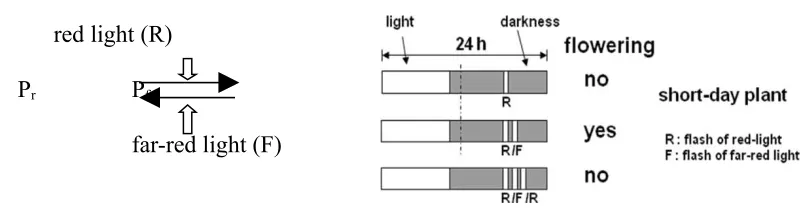
Figure 2.
red light (R)
Pr Pfr
far-red light (F)
If a flash of red light (R) during darkness is followed by a flash of far-red light (F), short-day plants
will flower as in Figure 2.
III-4) If a flash of red light (R) during darkness is followed by a flash of far-red light (F), do
you expect the long-day plant to flower in the same condition as in Figure 2?
The sequential R-F-R light treatment results in the same effect as in a single R treatment. Thus,
III-5) When the same sequencial R-F-R light treatments are given to the
long-day plant, do you expect the long-day plant to flower in the same condition as in Figure
2?
III-6, 7. Fill in the following blanks with either Pr or Pfr. (1 point each)
Each day, the conversion of the Pfr to the Pr isoform mainly occurs during the continuous darkness
that follows sunset, without any particular participation of far-red light. After sunrise, however,
much of the phytochrome is rapidly converted from the Pr isoform to the Pfr isoform because
sunlight is significantly richer in red light than far-red light.
Phytochrome helps the plant distinguish daytime and nighttime because phytochromes are mainly
III-8~10 (1 point each)
Although flowers are formed from apical or axillary bud meristems, it is the plant’s leaves that
detect changes in photoperiod and produce signaling molecules that cue buds to develop as flowers.
It is reported that the signaling molecules are able to move through the stem. When grown
individually under short-day conditions, a short-day plant will flower whereas a long-day plant will
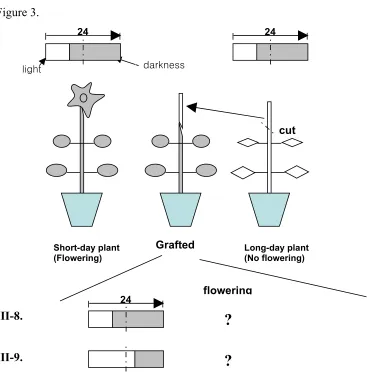
not. In the following classic experiment, a long-day plant is grafted to the short-day plant as in
III-8), 9) Do you expect the grafted plant to flower under the two conditions
shown in III-8 and III-9?
III-10) If a coverglass slide is placed in between the long-day stem and the short-day stem of
the grafted plant in Figure 3, and short-day photoperiod identical to III-8 is given to this
plant, do you expect this grafted plant will flower? (Hint: The size of the signaling molecule