II
CONTENTS
Editors‟ Note
PRESCRIPTIVE VERSUS DESCRIPTIVE LINGUISTICS FOR LANGUAGE MAINTENANCE: WHICH INDONESIAN SHOULD NON-NATIVE SPEAKERS
LEARN? 1 - 7
Peter Suwarno
PEMBINAAN DAN PENGEMBANGAN BAHASA DAERAH? 8 - 11
Agus Dharma
REDISCOVER AND REVITALIZE LANGUAGE DIVERSITY 12 - 21
Stephanus Djawanai
IF JAVANESE IS ENDANGERED, HOW SHOULD WE MAINTAIN IT? 22 - 30
Herudjati Purwoko
LANGUAGE VITALITY: A CASE ON SUNDANESE LANGUAGE AS A
SURVIVING INDIGENOUS LANGUAGE 31 - 35
Lia Maulia Indrayani
MAINTAINING VERNACULARS TO PROMOTE PEACE AND TOLERANCE IN
MULTILINGUAL COMMUNITY IN INDONESIA 36 - 40
Katharina Rustipa
FAMILY VALUES ON THE MAINTENANCE OF LOCAL/HOME LANGUAGE 41 - 45 Layli Hamida
LANGUAGE MAINTENANCE AND STABLE BILINGUALISM AMONG
SASAK-SUMBAWAN ETHNIC GROUP IN LOMBOK 46 - 50
Sudirman Wilian
NO WORRIES ABOUT JAVANESE: A STUDY OF PREVELANCE IN THE USE
OF JAVANESE IN TRADITIONAL MARKETS 51 - 54
Sugeng Purwanto
KEARIFAN LOKAL SEBAGAI BAHAN AJAR BAHASA INDONESIA BAGI
PENUTUR ASING 55 - 59
Susi Yuliawati dan Eva Tuckyta Sari Sujatna
MANDARIN AS OVERSEAS CHINESE‟S INDIGENOUS LANGUAGE 60 - 64
Swany Chiakrawati
BAHASA DAERAH DALAM PERSPEKTIF KEBUDAYAAN DAN
SOSIOLINGUISTIK: PERAN DAN PENGARUHNYA DALAM PERGESERAN DAN
PEMERTAHANAN BAHASA 65 - 69
Aan Setyawan
MENILIK NASIB BAHASA MELAYU PONTIANAK 70 - 74
III
PERGESERAN DAN PEMERTAHANAN BAHASA SERAWAI DI TENGAH HEGEMONI BAHASA MELAYU BENGKULU DI KOTA BENGKULU SERAWAI LANGUAGE SHIFT AND MAINTENANCE IN THE BENGKULU MALAY
HEGEMONY IN THE CITY OF BENGKULU 75 - 80
Irma Diani
KEPUNAHAN LEKSIKON PERTANIAN MASYARAKAT BIMA NTB DALAM
PERSPEKTIF EKOLINGUISTIK KRITIS 81 - 85
Mirsa Umiyati
PERAN MEDIA CETAK DAN ELEKTRONIK DALAM RANGKA MEREVITALISASI DAN MEMELIHARA EKSISTENSI BAHASA INDONESIA DI NEGARA
MULTIKULTURAL 86 - 90
Muhammad Rohmadi
BAHASA IBU DI TENGAH ANCAMAN KEHIDUPAN MONDIAL YANG
KAPITALISTIK 91 - 95
Riko
TEKS LITURGI: MEDIA KONSERVASI BAHASA JAWA 96 - 101
Sudartomo Macaryus
PEMILIHAN BAHASA PADA SEJUMLAH RANAH OLEH MASYARAKAT TUTUR
JAWA DAN IMPLIKASINYA TERHADAP PEMERTAHANAN BAHASA JAWA 102 - 107 Suharyo
BAHASA IMPRESI SEBAGAI BASIS PENGUATAN BUDAYA DALAM
PEMERTAHANAN BAHASA 108 - 112
Zurmailis
THE SHRINKAGE OF JAVANESE VOCABULARY 113 - 117
Ari Nurweni
LANGUAGE CHANGE: UNDERSTANDING ITS NATURE AND MAINTENANCE
EFFORTS 118 - 123
Condro Nur Alim
A PORTRAIT OF LANGUAGE SHIFT IN A JAVANESE FAMILY 124 - 128
Dian Rivia Himmawati
LANGUAGE SHIFT IN SURABAYA AND STRATEGIES FOR INDIGENOUS
LANGUAGE MAINTENANCE 129 - 133
Erlita Rusnaningtias
LANGUAGE VARIETIES MAINTAINED IN SEVERAL SOCIAL CONTEXTS IN
SEMARANG CITY 134 - 138
Sri Mulatsih
FACTORS DETERMINING THE DOMINANT LANGUAGE OF JAVANESE-INDONESIAN CHILDREN IN THE VILLAGES OF BANCARKEMBAR
(BANYUMAS REGENCY) AND SIDANEGARA (CILACAP REGENCY) 139 - 143
Syaifur Rochman
PERSONAL NAMES AND LANGUAGE SHIFT IN EAST JAVA 144 - 146
IV
REGISTER BAHASA LISAN PARA KOKI PADA ACARA MEMASAK DI STASIUN
TV: SEBUAH STUDI MENGENAI PERGESERAN BAHASA 147 - 151
Andi Indah Yulianti
PERUBAHAN BAHASA SUMBAWA DI PULAU LOMBOK: KAJIAN ASPEK LINGUISTIK DIAKRONIS (CHANGE OF SUMBAWA LANGUAGE IN LOMBOK
ISLAND: STUDY OF THE ASPEK OF DIACRONIC LINGUISTICS) 152 - 156
Burhanuddin dan Nur Ahmadi
PERGESERAN PENGGUNAAN BAHASA INDONESIA AKIBAT PENGARUH SHUUJOSHI (PARTIKEL DI AKHIR KALIMAT) DALAM BAHASA JEPANG, SEBUAH PENGAMATAN TERHADAP PENGGUNAAN BAHASA INDONESIA OLEH KARYAWAN LOKAL DAN KARYAWAN ASING(JEPANG) DI PT. KDS
INDONESIA 157 - 162
Elisa Carolina Marion
PENGGUNAAN BAHASA DALAM SITUASI KEANEKABAHASAAN 163 - 167
Fatchul Mu’in
PENGEKALAN BAHASA DALAM KALANGAN PENUTUR DIALEK NEGEI
SEMBILAN BERDASARKAN PENDEKATAN DIALEKTOLOGI SOSIAL BANDAR 168 - 172 Mohammad Fadzeli Jaafar, Norsimah Mat Awal, dan Idris Aman
KONSEP DASAR STANDARISASI BAHASA SASAK: KE ARAH KEBIJAKAN
PEMBELAJARAN DAN PEMERTAHANAN BAHASA SASAK DI LOMBOK 173 - 177
Ahmad Sirulhaq
PEMBELAJARAN BAHASA INDONESIA TERPADU (KOHERENS) 178 - 182
Marida Gahara Siregar
HARI BERBAHASA JAWA DI LINGKUNGAN PENDIDIKAN 183 - 185
Yasmina Septiani
JAVANESE-INDONESIAN RIVALRY IN AKAD NIKAH AMONG YOGYAKARTA
JAVANESE SPEECH COMMUNITY 186 - 191
Aris Munandar
PENGKAJIAN BAHASA MADURA DAHULU, KINI DAN DI MASA YANG AKAN
DATANG 192 - 197
Iqbal Nurul Azhar
BAHASA INDONESIA ATAU BAHASA JAWA PILIHAN ORANG TUA DALAM
BERINTERAKSI DENGAN ANAK DI RUMAH 198 - 202
Miftah Nugroho
PILIHAN BAHASA DALAM MASYARAKAT MULTIBAHASA DI KAMPUNG
DURIAN KOTA PONTIANAK (PENDEKATAN SOSIOLINGUISTIK) 203 - 207
Nindwihapsari
PEMAKAIAN BAHASA JAWA OLEH PENUTUR BAHASA JAWA DI KOTA
BONTANG KALIMANTAN TIMUR 208 - 212
Yulia Mutmainnah
INSERTING JAVANESE ACRONYMS FOR TEACHING GRAMMAR RULES: A
THEORETICAL ASSUMPTION 213 - 217
V
THE JUNIOR SCHOOL STUDENTS‟ ATTITUDES TOWARDS SUNDANESE LANGUAGE LEARNING (A CASE STUDY AT 2 JUNIOR SCHOOLS AT
BANDUNG, WEST JAVA, INDONESIA) 218 - 221
Maria Yosephin Widarti Lestari
THE JUNIOR SCHOOL STUDENTS‟ ATTITUDES TOWARDS SUNDANESE LANGUAGE LEARNING (A CASE STUDY AT 2 JUNIOR SCHOOLS AT
BANDUNG, WEST JAVA, INDONESIA) 222 - 225
Tri Pramesti dan Susie C. Garnida
KEARIFAN LOKAL SEBAGAI BAHAN AJAR BAHASA INDONESIA BAGI
PENUTUR ASING 226 - 230
Hidayat Widiyanto
BAHASA, SASTRA, DAN PERANANNYA DALAM PEMBENTUKAN
KECERDASAN EMOSI PADA ANAK (SEBUAH STUDI KASUS PELAKSANAAN PEMBELAJARAN BAHASA DAN SASTRA PADA KELAS SASTRA ANAK DAN SASTRA MADYA DI LEMBAGA PENDIDIKAN “BINTANG INDONESIA”
KABUPATEN PACITAN) 231 - 236
Sri Pamungkas
COMMUNICATION MODEL ON LEARNING INDONESIAN
FOR FOREIGNER THROUGH LOCAL CULTURE 237 - 239
Rendra Widyatama
VARIASI BAHASA RAGAM BAHASA HUMOR DENGAN MENGGUNAKAN UNSUR PERILAKU SEIKSIS DI DESA LETEH, REMBANG KAJIAN BAHASA
DAN JENDER 240 - 245
Evi Rusriana Herlianti
EKSPRESI KEBAHASAAN PEREMPUAN KLOPO DUWUR TERHADAP PERANNYA DALAM KELUARGA DAN MASYARAKAT (SEBUAH ANALISIS
BAHASA DAN JENDER) 246 - 250
Yesika Maya Oktarani
BELETER FOR TRANFERING MALAY LANGUAGE AND CULTURAL MORAL
VALUES TO YOUNG MALAYS AT PONTIANAK, KALIMANTAN BARAT 251 - 255
Syarifah Lubna
METAPHORS AS A DYNAMIC ARTEFACT OF SOCIAL VALUES EXPRESSED
IN LETTERS TO EDITORS 256 - 260
Deli Nirmala
THE EXPRESSION OF THE CONCEPTUAL METAPHORS “FRONT IS GOOD;
BACK IS BAD” IN THE INDONESIAN LANGUAGE 261 - 266
Nurhayati
PEMERTAHANAN BAHASA: PERSPEKTIF LINGUISTIK KOGNITIF 267 - 270
Luita Aribowo
KAJIAN LEKSIKAL KHAS KOMUNITAS SAMIN SEBUAH TELISIK BUDAYA
SAMIN DESA KLOPO DUWUR, BANJAREJO, BLORA, JAWA TENGAH 271 - 276
VI
MANIPULATING SUNDANESES‟ PERCEPTIONS AND THOUGHTS IN
POLITICAL DISCOURSE THROUGH INDIGENIOUS LANGUAGE 277 - 280
Retno Purwani Sari dan Nenden Rikma Dewi
THE POSITIONING OF BANYUMASAN AND ITS IDEOLOGY „CABLAKA‟ AS
REFLECTED IN LINGUISTIC FEATURES 281 - 284
Chusni Hadiati
WHAT PEOPLE REVEALED THROUGH GREETINGS 285 - 289
Dwi Wulandari
THE ROLE OF INDIGENOUS LANGUAGES IN CONSTRUCTING IDENTITY IN
MULTICULTURAL INTERACTIONS 290 - 292
Eliana Candrawati
THE LOGICAL INTERPRETATION AND MORAL VALUES OF CULTURE-BOUND JAVANESE UTTERANCES USING THE WORD “OJO” SEEN FROM
ANTHROPOLOGICAL LINGUISTIC POINT OF VIEW 293 - 297
Muhamad Ahsanu
PENGUNGKAPAN IDEOLOGI PATRIARKI PADA TEKS TATA WICARA
PERNIKAHAN DALAM BUDAYA JAWA 298 - 302
Indah Arvianti
PEPINDHAN: BENTUK UNGKAPAN ETIKA MASYARAKAT JAWA 303 - 310
Mas Sukardi
BAGAIMANA BAGIAN PENDAHULUAN ARTIKEL PENELITIAN DISUSUN? 311 - 316 Jurianto
STYLISTIC IN JAVANESE URBAN LEGEND STORIES: A CASE STUDY IN
RUBRIC ALAMING LELEMBUT IN PANJEBAR SEMANGAT MAGAZINE 317 - 320
Valentina Widya Suryaningtyas
MAINTAINING SOURCE LANGUAGE IN TRANSLATING HOLY BOOK: A CASE
OF TRANLSTAING AL-QUR‟AN INTO INDONESIAN 321 - 325
Baharuddin
TRANSLATING A MOTHER TONGUE 326 - 329
Nurenzia Yannuar
TRANSLATION IGNORANCE: A CASE STUDY OF BILINGUAL SIGNS 330 - 334 Retno Wulandari Setyaningsih
TERJEMAHAN UNGKAPAN IDIOMATIS DALAM PERGESERAN KOHESIF DAN
KOHERENSI 335 - 338
Frans I Made Brata
VARIASI FONOLOGIS DAN MORFOLOGIS BAHASA JAWA DI KABUPATEN
PATI 339 - 342
Ahdi Riyono
VARIASI FONOLOGIS DAN MORFOLOGIS BAHASA JAWA DI KABUPATEN
PATI 343 - 347
VII
PROSES FONOLOGIS BAHASA KAUR YANG DIPICU FAKTOR EKSTERNAL
LINGUISTIK 348 - 352
Wisman Hadi
WORLD PLAY IN CALAOUMN OF CATATAN PLESETAN KELIK (CAPEK) 353 - 357 Oktiva Herry Chandra
ANALYTIC CAUSATIVE IN JAVANESE : A LEXICAL-FUNCTIONAL APPROACH 358 - 362 Agus Subiyanto
A SYSTEMIC FUNCTIONAL ANALYSIS ON JAVANESE POLITENESS: TAKING
SPEECH LEVEL INTO MOOD STRUCTURE 363 - 367
Hero Patrianto
PERGESERAN PENEMPATAN LEKSIKAL DASAR DALAM DERET
SINTAGMATIK PADA TUTURAN JAWA PESISIR 368 - 372
M. Suryadi
JAVANESE LANGUAGE MODALITY IN BLENCONG ARTICLES OF SUARA
MERDEKA NEWSPAPER 373 - 377
Nina Setyaningsih
POLISEMI DALAM TERMINOLOGI KOMPUTER (SEBUAH UPAYA APLIKASI
PENGEMBANGAN DAN PEMELIHARAAN BAHASA) 378 - 384
Juanda Nungki Heriyati
STRUKTUR FRASE NAMA-NAMA MENU MAKANAN BERBAHASA INGGRIS DI
TABLOID CEMPAKA MINGGU INI (CMI) 385 - 389
113
THE SHRINKAGE OF JAVANESE VOCABULARY
Ari Nurweni
Language and Art Department, Teacher Training Faculty, Lampung University
Abstract
Previous studies show that Javanese shrinks in terms of its form, function and accuracy due to Indonesian and the attitude of the Javanese speakers towards Indonesian and Javanese (Poedjosoedarmo,1991; Gunarwan, 2006). In regard to the causes of the shrinkage of Javanese, there is at least one more thing that leads to the shrinkage. This paper presents the results of an observation to the Javanese vocabulary items used in the daily life of Javanese speakers. The study aims at describing some Javanese words which are likely to fade away due to a technological advance, and explaining the impact to the existence of the local virtues. The description is based on the observation toward the things around the Javanese people in an area of Jawa Tengah to fulfill their daily needs and the words to express them at present, and then compared them with those noticed in 1970s and recalled by the writer. The results showed that though the vocabulary items of the Javanese language were enriched by the vocabulary items of other languages, at the same time some Javanese words commonly used in the daily life are likely to disappear from the daily use. The disappearance of the Javanese words also means the vanishing of the things associated with the words and the related local virtues.
1. Introduction
Javanese, a major regional language in Indonesia, stays side by side with the national language, Indonesian. Accordingly Javanese has a low status while Indonesian holds a high status. Javanese is used in a certain domain, such as in a Javanese family interaction, a Javanese wedding ceremony, daily communication among those who are able to speak Javanese, etc; while the national language is used in the other domain, such as in the governmental business administration, in a teaching learning process, communication among Indonesian people. However, nowadays Javanese is experiencing some changes or shift in its linguistic form as well as in its function.
In regards to the changes in the linguistic form, Poedjosoedarmo (1991, 21-23) states that some Javanese vocabulary has faded away, Javanese forms have become less differentiated, and the language has become less standardized. Javanese words, such as, pecahan memet ‗minute fraction‘, gunggung
‗addition‘, para gapit ‗division‘, ‗ilmu wangun ‗geometry‘, pepe ‗demonstration, layang kekancing
‗appointment letter‘ have been forgotten since there is an Indonesian equivalence for each of the words,
and the Javanese people tend to use the Indonesian words when speaking in Javanese. The loss of differentiation in Javanese can be seen in the following examples, Javanese has function words, such as dening ‗by‘, lan ‗and‘, sinambi ‗while‘, marang ‗on‘, sarta ‗and also‘, karo ‗together with‘. The Javanese people, especially the younger generation use a single word karo for all of them in their daily speech. The use of karo in this way also means that the Javanese people are not aware of what is correct and incorrect. This leads to destandardization of the Javanese use. In addition, Poedjosoedarmo states that in Indonesia, people are proud of being able to speak Indonesian, but they are not necessarily proud of their regional language. For example, many Javanese housewives now prefer to use the more prestigious Indonesian terms to name parts of their homes and their activities: Indonesian dapur for Javanese pawon ‗kitchen‘, Indonesian kamar mandi for Javanese jedhing or pekiwan ‗bathroom‘, kamar tidur for Javanese sentong
‗bedroom‘, sayuran for Javanese janganan ‗vegetable‘, masak for Javanese olah-olah ‗cook‘.
Gunarwan (2006) elaborates the shift of Javanese functions. The function of Javanese is being shifted, that is, the use of Indonesian penetrates the domains which were previously only occupied by Javanese. In other words the use of Javanese is more limited. In his survey towards 103 respondents from Yogyakarta and 93 respondents from Surabaya, Gunarwan found that the younger the people are, the less Javanese they use in the household domain. Conversely, the older the people are, the nearer perfect number of people use the Javanese. Gunarwan further explains that this happens mostly due to the fact that the Javanese people are in fact bilingual, who can speak Javanese and also Indonesian.
114
will influence one language in some ways, such as borrowing linguistic items from one language in contact (Weinreich, 1968). The low-status language will usually suffer a lot. In addition, I notice that there is still one thing that affects Javanese, that is, a technological advance. A technological advance will certainly create new things, and at the same time it creates names, new words (referents) to refer to the new things (referred). The new-developed things which have a similar function seem to replace the old ones. Therefore, this paper identifies Javanese words of the necessities in the daily life that are likely to fade away due to a technological advance, and describes the impacts of the disappearance towards the related things and the associated local virtues contained in the words.
2. Methodology
This study was carried out by recalling the Javanese people‘ daily needs and the words to refer to them that were noticed by the researcher around 1970s in an area of Jawa Tengah, that is, Purworejo. It was also done by observing the development of the things to fulfill daily needs of the people, and the words to refer to the things at present. Then the things and the words to refer to the things found at present were compared with those noticed by the writer in 1970s. The different things found in the range of the time indicate that there is a technological advance. This study identifies the words used to refer to the things which develop over the time, and the possibility of the words to fade away.
3 Research Results and Discussion
3.1 The disappearance of Javanese vocabulary of daily-needed items.
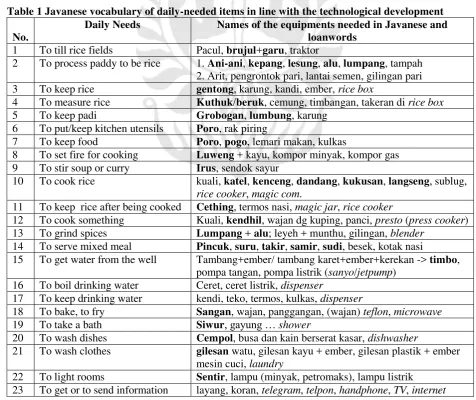
The technologies to fulfill people‘ daily needs, such as needs of food, drink, clothes, transportation, a place to stay etc., develop over time. The development yields new things to fulfill the needs. The new things will have different referents (words) to differentiate them with the old ones. Table 1 displays words to refer to the development of the equipments needed to fulfill the daily needs. The equipments are written in order of development.
Table 1 Javanese vocabulary of daily-needed items in line with the technological development
No.
Daily Needs Names of the equipments needed in Javanese and loanwords
1 To till rice fields Pacul, brujul+garu, traktor
2 To process paddy to be rice 1. Ani-ani, kepang, lesung, alu, lumpang, tampah 2. Arit, pengrontok pari, lantai semen, gilingan pari 3 To keep rice gentong, karung, kandi, ember, rice box
4 To measure rice Kuthuk/beruk, cemung, timbangan, takeran di rice box
5 To keep padi Grobogan, lumbung, karung
6 To put/keep kitchen utensils Poro, rak piring
7 To keep food Poro, pogo, lemari makan, kulkas
8 To set fire for cooking Luweng + kayu, kompor minyak, kompor gas 9 To stir soup or curry Irus, sendok sayur
10 To cook rice kuali, katel, kenceng, dandang, kukusan, langseng, sublug, rice cooker, magic com.
11 To keep rice after being cooked Cething, termos nasi, magic jar, rice cooker
12 To cook something Kuali, kendhil, wajan dg kuping, panci, presto (press cooker) 13 To grind spices Lumpang + alu; leyeh + munthu, gilingan, blender
14 To serve mixed meal Pincuk, suru, takir, samir, sudi, besek, kotak nasi
15 To get water from the well Tambang+ember/ tambang karet+ember+kerekan -> timbo, pompa tangan, pompa listrik (sanyo/jetpump)
16 To boil drinking water Ceret, ceret listrik, dispenser
17 To keep drinking water kendi, teko, termos, kulkas, dispenser
18 To bake, to fry Sangan, wajan, panggangan, (wajan) teflon, microwave 19 To take a bath Siwur, gayung … shower
20 To wash dishes Cempol, busa dan kain berserat kasar, dishwasher
21 To wash clothes gilesan watu, gilesan kayu + ember, gilesan plastik + ember mesin cuci, laundry
115 No.
Daily Needs Names of the equipments needed in Javanese and loanwords
24 To carry/ transport things/travel embat/pikulan, gerobak, sepeda, becak, sepeda motor, mobil 25 To take a nap/ to sleep Amben--plupuh, kloso, dipan, kasur, spring bed + bed cover 26 To sit Cingkrik, kloso, bangku, kursi, mebel, karpet, sofa
27 To stay Omah atep, gendheng; omah betepe, gedhek, kayu, tembok Note: The bold words are likely to fade away.
Table 1 shows equipments needed to fulfill the peoples‘ daily needs that change to some forms in
certain period of time. For example, to process paddy to become beras, the people used to use alu, lesung,
and lumpang as well as tampah but now they use gilingan pari. Another example, to measure rice before
cooking, at the beginning the people used kuthuk or beruk but now the people use cemung, a measuring cup, or a measure on the rice box, Further example, the people used to use some equipments, namely, kuali/katel, kendil/dandang, kukusan, leyeh to cover the kukusan and luweng, a fireplace to cook rice. But now, the people use an equipment called rice cooker, just putting clean rice and water in a rice cooker, insert the electric cord into the electric socket for some time, and the rice will be ready.
Table 1 also shows that some words for the referents of the equipments are English loanwords, such as, rice box, rice cooker, magic jar, microwave, laundry, handphone, etc. This confirms what Rusydi, et all (1985) found that English is a foreign language whose vocabulary is borrowed by Javanese much, that is, 1.44% of the total Javanese vocabulary, and those borrowed are mostly nouns. Some others are loanwords which have already been assimilated into Indonesian, such as traktor, karpet, telpon, etc., while some words, such as, sepeda, kompor, kursi, are Indonesian.
When old equipments are replaced by the new ones which are simpler and more efficient, the old ones, such as, alu, lesung, lumpang, kuthuk/beruk, dandang/kendil, kukusan, etc. are likely to fade away. Accordingly, the words to refer to the equipments will also fade away from a daily language use.
3.2 The Disappearance of Javanese Words of Activities Pertinent to the Equipments Used
When the technology used to fulfill the daily needs changes, the activities to fulfill the needs will also change. For example, The farmers used to till rice fields by using pacul (a hoe) and brujul (a plough) and garu. Therefore, the farmers‘ activities were macul, mbrujul and nggaru by using a hoe, a plough and a harrow respectively. However, when the equipments of tilling land are changed into traktor, the
farmers‘ activity is ntraktor. As brujul and garu is replaced by traktor, the activity of mbrujul is likely to disappear from the daily life, and so are the word mbrujul and nggaru.
Another example, the activities of processing paddy into beras (hulled paddy grains) were ntlusuhi, nutu, nginter, kotekan, nyosoh, and napeni before there is gilingan pari (huller). With the coming of gilingan pari all of the activities are not necessary anymore. Moreover with a new technology of producing padi whose grains are easily separated from their stalks, paddy is not necessary to be picked by using ani-ani. Now paddy is picked by using a sickle although Lombard (1990: 57) stated that from the pre-historic time to the modern time, the modern time, the Javanese farmers never used any sickles to harvest paddy. The use of sickles to harvest paddy was a result of the fact that the landowners and technocrats saw the old-fashioned technique of ani-ani which was done by the woman laborers harvesting paddy and getting repayment in a form of a small amount of the harvest gathered (bawon). Ani-ani is a small knife which is hold and will only enable to cut a limited number of stalks. In the old way to process paddy to become beras is started by ntlusuhi, that is, separating paddy grains from their stalks in a lesung by using alu, which were usually done by four to six women in one lesung. During this stage, the women could entertain themselves by interrupting this activity with musical hits (kotekan) made by the women using lesung and each of their alus. The paddy grains were separated from the waste in such a way by using tampah. This activity is called napeni. The paddy grains are then put into a lumpang to be hulled by using alu. This step is called nutu. The next step is napeni, and then nginter, that is, moving the hulled paddy with some unhulled paddy grains in a circular movement by using tampah to make the unhulled paddy grains centered in the middle of the tampah so that it is easy to take them out. The last step is
nyosoh, that is, nutu the hulled paddy grains to make them cleaner and whiter. The coming of gilingan
pari (a paddy huller) makes the activities of ntlusuhi, nutu, kotekan, nginter, and nyosoh fade away from the Javanese daily life, and so do the words to refer to the activities, and the only word phrase frequently mentioned is nggiling beras, hulling rice.
116
bricks which are coated by thick mud, and firewood to make the fire. They did not buy the firewood but they look for the dried trees, bamboo, branches and twigs in their garden as the firewood. The activities of looking for these dried wood is called repek. As luweng used for cooking has changed into kompor, the activity of repek is likely to fade away, and so are the words luweng and repek.
3.3 The Disappearance of Words Referring to the Results of the Equipments used
Different equipments used to fulfill daily need will result in something different. For example, when people use ani-ani, lesung, alu, lumpang ,and tampah to process paddy, they will get oman, merang, beras, menir, katul. On the other hand, when people us a huller to process paddy, they will get rice and merang. Thus, oman, menir, and katul will fade away, and so will the words to refer them. Another example, when katel is used for cooking rice, this will result in sego (cooked rice) and intip (cooked hard rice stuck on the bottom of the cattle) but when a more modern equipment, rice cooker, is used for cooking rice, this will only result sego.
Javanese people used to put rice in cething, a colander, and this does not allow the rice remain warm in the following day. The cold rice left in the following day is called sego wadhang or wadhang. The word wadhang is likely to fade away with the use of a magic jar or rice cooker as the rice in this container remains warm and in a good condition.
Ceret, dispenser, and blender are equipments to provide drinks. Ceret is used to boil water and the result is jarang (boiled water) that can be used for any purposes. For drinking, the hot boiled water is called wedang panas, and when it is left cold, it is called wedang or wedang putih. When the boiled water is used to brew, for example, tea, it results in wedang teh. On the other hand, what is produced by a dispenser is not usually called jarang, but it is wedang that can be hot or cold drinks. This means that jarang is likely to disappear. Of course, there is a new technology that adds a kind of drink, that is, blender or juicer, that results in juice.
3.4 The Impact of the Disappearance of the Javanese Words of Daily Needs
Some Javanese wise words and idioms employ things in their surroundings. The disappearance of the items that have been used to compose the wise words or idioms, that lead to the words referring to them to fade away, makes it difficult for the younger generations to understand them. Pintamu ning poro,
ngangsu kaweruh, rai gedek, kuping wajan and wis ngintip are some examples of the Javanese wise
words and idioms that use things in their surroundings. Pintamu ning poro (Your part is in poro.)— pintamu comes from the word pinto meaning some food being kept for someone; poro is a kind of shelves made of bamboo. This furniture was usually used to keep kitchen utensils and foods. In Javanese culture, mother used to keep some food (minto) for the family members who had not been at home yet in separate containers and put it in the poro. While Pintamu ning poro is an expression expressed by sick parents to their children, meaning that they should understand what their parents are experiencing because they will also experience similar things when they get older.
Ngangsu kaweruh comes from two words, that is, ngangsu and kaweruh. Ngangsu means taking water from the well or from water source that may be far away from their house. In the past time, many Javanese people did not have their own wells in their house. To fulfill the need of water they took water
from their neighbours‘ wells or from other water sources that might be far away from their house.
Kaweruh means knowledge. So as a whole ngangsu kaweruh means looking for some knowledge in any places and from anyone that has much better knowledge so that when coming back, the person looking for the knowledge is able to get much knowledge and becomes a person who is knowledgeable. When ngangsu is not commonly done nor seen anymore, it is difficult for younger generations to understand expression ngangsu kaweruh.
Rai gedek comes from two words, rai—meaning the face of our body, and gedhek meaning a wall
made of bamboo plaits. When rai and gedek form a phrase, it describes someone who does not have any sense of being ashame. Another phrase is kuping wajan, kuping meaning ears and wajan refers to a kitchen equipment which has an ear-like holder in each of the two sides. When kuping and wajan forms a phrase kuping wajan it describes someone who does not use his/her ears well; he/she does not listen to what the other has just said. The phrase wis ngintip comes from wis, meaning already and ngintip meaning to become intip. In addition to the literal meaning, wis ngintip has a non-literal meaning, that is, referring to being difficult to change as, for example, the habit has long been built in someone‘s life.
117 4. Conclusions and Recommendations
4.1 Conclusions
All of the Javanese words which are likely to fade away due to the technological advance are the words of the daily-needed equipments containing specific concepts of meanings, such as, brujul, garu,
alu, lesung, lumpang, beruk, poro,wajan (berkuping), kendil, cempol, cething, sudi, takir, samir, timbo,
siwur, plupuh, amben, atep, sentir of daily activities pertinent to the equipments, such as, mbrujul,
nggaru, ntlusuhi, nutu, kotekan, nginter, nyosoh, nimbo, ngangsu, repek, and words referring to the
results of using the old-fashioned equipments, such as, oman, katul, intip, sego wadhang. On the other hand, Javanese vocabulary is enriched with borrowing words referring to the daily-needed things, some of which are still in the English system, for examples, blender, juicer, juice, mixer, rice cooker, magic jar, magic com, and handphone.
The disappearance of the daily-needed equipments, activities, and the results pertinent to the equipments causes some difficulties in understanding the Javanese special expressions, such as Pintamu ning poro, kuping wajan dan rai gedek. This will lead to the disappearance of the special expressions, which are a form of Javanese local virtues, that is, saying something indirectly, especially those which
will make other people‘s face threatened and which is intended to emphasize.
4. 2 Recommendations
To maintain the available Javanese vocabulary which is likely to fade away, we can also follow what has happened to some English vocabulary, that is, by adding a new concept of meaning to the vocabulary. In English, mouse has a concept of meaning: an small four-leg animal, having fur, a like-phone-cable tail, moving quickly and vividly, but now mouse has another concept of meaning, that is, a small equipment that looks like a mouse attached to a computer.
Daftar Pustaka
Gunarwan, A. Ň006. ‖Kasus-kasus pergeseran bahasa daerah: Akibat persaingan dengan bahasa
Indonesia?‖ Linguistik Indonesia: Jurnal Ilmiah Masyarakat Linguistik Indonesia. 24, 1: 95-113.
Lombard, D. 1990. Nusa Jawa: Silang Budaya. Warisan Kerajaan-Kerajaan Konsentris. (dialihbahasakan oleh Winarsih Partaningrat Arifin, dkk.). Jakarta: PT Gramedia Pustaka.
Poedjosoedarmo, S. 1991. ―The Behaviour of Languages Used in a Bilingual Society: The Case of Javanese and Indonesian in Java‖. Dalam Jones, G. and C. Ozog (Eds.). Band 91, Papers Presented at a Conference on Bilingualism and National Development, Brunai Darussalam, Vol. 11.
Rusydi, Mulyanto, R.J., Sutadi W., Suranto, Supardiman, dan Bengat. 1985. Kosa Kata Bahasa Jawa. Jakarta: Pusat Pembinaan Bahasa.