31
L1 – Educational Studies in Language and Literature (2006) 6 (1), p. 31-62 © International Association for the Improvement of Mother Tongue Education Correspondence concerning this article should be directed to Martine A. H. Braaksma, Graduate School of Teaching and Learning, University of Amsterdam, Wibautstraat 2-4, 1091 GM Amsterdam, the Netherlands. Electronic mail may be sent to [email protected]
WHAT OBSERVATIONAL LEARNING ENTAILS:
A MULTIPLE CASE STUDY
MARTINE A. H. BRAAKSMA
*, GERT RIJLAARSDAM
*/**,
HUUB VAN DEN BERGH
**,
AND BERNADETTE H. A. M. VAN HOUT-WOLTERS
**
Graduate School of Teaching and Learning, University of Amsterdam,
**
Utrecht Institute of Linguistics, Utrecht University
Abstract Observational learning has proved to be effective with learners of various ages and in various
school subjects, including writing. However, little is known about the actual behavior of learners while carrying out observation tasks. In this case study, students’ learning activities when processing observa-tion tasks are closely analyzed: six students thought aloud while observing sets of writers as peer models, and were interviewed afterwards. Results suggest that observers carried out many (meta)cognitive activi-ties, especially activities based on the internalization and development of criteria for effective writing (observing, comparing, evaluating, and reflecting activities). These are precisely the activities assumed to play a central role in learning to write. Observational learning seems to stimulate these activities natu-rally, albeit they are not very evident in typical school writing tasks and exercises.
French L’apprentissage par observation (ou apprentissage vicariant) s'est avéré efficace pour des
analyse détaillée de l’activité cognitive des apprenants lors de la tâche d’observation : six lycéens ont raisonné à haute voix tout en observant différents modèles d’écriture mis en œuvre par des pairs, ils ont ensuite été interrogés. Les résultats montrent que ces observateurs ont effectué de nombreuses activités meta-cognitives, en particulier des activités basées sur l’élaboration et l’internalisation des critères d’une écriture efficace (observation, comparaison, évaluation et réflexion). Il s’agit précisément des activités supposées jouer un rôle central dans l’apprentissage de l’écriture. Celles-ci semblent naturellement stimulées par l’apprentissage par observation, alors qu’elles n’apparaissent pas de façon très évidente dans des tâches et des exercices d’écriture plus habituels.
Chinese 研究发现,观察学习对不同年纪及不同科目的学习,包括写作都是有效的 然而,研究
员对学习者在观察学习中的实际行为所知不多 是次的个案研究,仔细分析了学习者在观察学习
中的学习活动 六位学生边观察其它同学写作,边用大声想的方法说出自己的想法 其后,再接
受研究员的访问
研究结果发现,观察者作出大量原认知活动,尤其是那些内化及发展有效写作条件 观察 比较
评估及反映活动 的活动,这些都是对学习写作有效的特定活动 观察学习似乎能够自然地刺
激这些活动,但在学生完成写作课业和练习时并不明显
Dutch Observerend leren is effectief gebleken voor leerders van verschillende leeftijden en in ver-schillende schoolvakken en vaardigheden zoals schrijfvaardigheid. Er is echter weinig bekend over wat er nu precies gebeurt als leerders observatietaken uitvoeren. In deze case studie worden de leeractiviteiten van leerlingen die observatietaken uitvoeren nauwkeurig geanalyseerd. Zes leerlingen dachten hardop terwijl ze medeleerlingen die schrijftaken uitvoerden, aan het observeren waren. Bovendien werden de observerende leerlingen na het observeren geïnterviewd over hun observatiegedrag.
De resultaten lieten zien dat de observerende leerlingen veel verschillende (meta)cognitieve activiteiten uitvoerden, vooral activiteiten (observeren, vergelijken, evalueren en reflecteren) die zijn gericht op de internalisatie en de ontwikkeling van criteria voor goed schrijven. Dit zijn precies de activiteiten waarvan verondersteld wordt dat ze een centrale rol spelen bij het leren schrijven. Observerend leren lijkt deze activiteiten op een natuurlijke wijze te stimuleren terwijl dat niet zo voor de hand ligt bij de meer gebrui-kelijke schrijftaken.
Key words: Observational learning, argumentative writing, (meta)cognitive activities, learning to write,
learning activities.
Accepted for publication on July 10th, 2005
1. WRITING AND LEARNING TO WRITE
The most striking problem in writing is cognitive overload. This phenomenon has been identified in many studies, and different terms have been used to describe it. Flower and Hayes (1980), for instance, refer to ‘juggling with constraints’, Van den Bergh and Rijlaarsdam (1999) label this phenomenon as ‘coordination problems’, while others use the term ‘cognitive overload’ or ‘limited memory capacities’ (Bereiter & Scardamalia, 1987; Kellogg, 1994; Alamargot & Chanquoy, 2001). All researchers refer to the fact that writers must simultaneously carry out many proc-esses, choose from several possible activities to continue the writing process or at-tend to many different textual characteristics, and hence, lose track of their own thoughts as a result.
perform reflective activities in order to distinguish writing from learning. This re-flection can thereby allow for the application of cognitive resources to writing and learning successively.
One approach is to add a phase of peer feedback and revision into the instruc-tional process (Hillocks, 1986; Rijlaarsdam, 1986, 1987; Rijlaarsdam & Couzijn, 2000a). In general, this approach stimulates writers to step back and to act as a reader of, and commentator on, texts written by peers. The assumption is that com-menting on others’ texts transfers to the revision phase of students’ own texts and to their subsequent writing (Hillocks, 1986). Another approach to promote the use of reflective strategies is the Self-Regulated Strategy Development approach (SRSD) developed by Graham and his colleagues (Graham & Harris, 1994; Graham, Harris, MacArthur & Schwartz, 1998; Graham, Harris & Troia, 1998; Harris, Graham & Mason, 2003). With SRSD, students are supported to master higher level cognitive processes associated with successful writing. The purpose is to promote reflective self-regulation of writing performances and to develop positive attitudes towards both the writing process and themselves as writers. In one of the seven stages of an instructional metascript, for instance, the teacher models how to use a certain strat-egy, and learners observe, analyze and discuss the effectiveness and efficiency of the modeled strategy.
Although peer review is a relatively promising method, as appears from Hill-ocks’ (1986) meta-analysis, the research results are equivocal (Hillocks, 1986, 219-220). In some studies, positive effects have been found whereas in others no effects or even negative effects for the manipulations have been found. Furthermore, results are not always clearly attributable to the relevant manipulations. That is to say, it is not always clear whether the effects of peer review are due to giving comments, reading comments, or rewriting. Likewise, in the SRSD studies, it is far from clear to which of the manipulations (e.g., pre skill development, discussion of the strat-egy, modeling of the stratstrat-egy, memorization of the stratstrat-egy, collaborative practice) the reported effects can be attributed.
A method that explicitly allows for a distinction between writing and learning to write, supports reflective activities, and permits a direct link between writing proc-esses and the resulting writing product is observational learning (i.e., learning by observing others who execute tasks). This method has at least one feature in com-mon with the two approaches mentioned above: the key learning activities are ob-servation, analysis, evaluation, and reflection. However, in this approach learners do not write. Instead, they observe the writing processes of a (peer) model, and the re-sulting texts of that (peer) model. The cognitive effort is shifted from executing writ-ing tasks to learnwrit-ing to write (Braaksma, Van den Bergh, Rijlaarsdam & Couzijn, 2001; Braaksma, Rijlaarsdam, Van den Bergh & Van Hout-Wolters, 2004; Couzijn, 1999; Rijlaarsdam & Couzijn, 2000a, 2000b).
2. RESEARCH ON OBSERVATIONAL LEARNING
1991, 1995, 1998). Observational learning, with either teachers, adults or students as models, has proven to be effective with students of various ages and in various school subjects, such as mathematics (Schunk & Hanson, 1985, 1989a, 1989b; Schunk, Hanson & Cox, 1987), reading (Couzijn, 1995, 1999), writing (Braaksma, Rijlaarsdam & Van den Bergh, 2002; Braaksma, et al., 2004; Couzijn, 1995, 1999; Zimmerman & Kitsantas, 2002), and speaking and listening (Sonnenschein & Whitehurst, 1984). Observation of models can also raise observers’ self-efficacy, or personal beliefs about their capabilities to learn or perform behaviors at designated levels (Bandura, 1986, 1997). Schunk and his colleagues (Schunk & Hanson, 1985, 1989a; Schunk et al., 1987; see also Schunk, 1998, p. 148) reported effects of (vari-ous) models on students’ self-efficacy, which in turn influenced learning and achievement.
The effectiveness of observational learning depends on a number of instructional factors, for example, the pupil’s age, competence, and the number of models in-volved (Schunk, 1991). In general, for students, peer models are preferred to teacher models because peer models can give the observers an impression that the observed behavior is within reach (“If she can do it, so can I”).
Two types of peer models can be implemented: coping models and mastery models. Coping models initially demonstrate the typical fears and deficiencies of observers but gradually improve their performances and gain confidence in their capabilities. The models illustrate how directed effort and positive self-reflections may overcome difficulties. Mastery models, on the other hand, demonstrate rapid learning and allow no errors. The pupils may verbalize statements reflecting positive attitudes and high levels of confidence and ability. In general, multiple models are preferred because, compared with a single model, they seem to increase the prob-ability that observers will perceive themselves as similar to at least one of the mod-els (Schunk, 1987, 1991).
However, not only the instructional factors are important, but the personal char-acteristics of pupil observers (e.g., age, sex, competence) may also influence the effectiveness of observational learning. For instance, the effectiveness of peer mod-eling is hypothesized to depend in part on the perceived similarity between model and observer (Braaksma et al., 2002; Schunk, 1987, 1998).
2.1 The Effectiveness of Observational Learning in Written Composition
play a key role in the feedback loop in which one learns from the consequences of one’s actions (Zimmerman, 1989, 2000; Zimmerman & Schunk, 1989). For in-stance, students who observed and evaluated their own or others’ writing by using criteria (e.g., in the form of questions) appeared to internalize some of these criteria, and this new knowledge was then used to guide the production of future composi-tions (Hillocks, 1986).
Thus, by using metacognitive strategies, self-regulated writers gain information that changes what they know and do (Graham & Harris, 1994, p. 209). A require-ment for this self-regulated learning is “that learners have reached developrequire-mental levels sufficient to be able to step back and consider their own cognitive processes as objects of thought and reflection” (Brown, 1987, p. 68). We expect that observa-tional learning stimulates the use of metacognitive strategies and enables writers to step back. In observational learning, students are stimulated to use and address metacognitive strategies explicitly, because the observation of the performance of others involves a “natural” step back and thus a natural type of monitoring, evalua-tion, and reflection on task execution processes (Rijlaarsdam & Couzijn, 2000a). Furthermore, as we stated earlier, in observational learning students can step back and use metacognitive strategies more easily than in more traditional ways of in-struction, where cognitive effort is directed to writing instead of learning to write. When students learn to write by observation, cognitive effort shifts from executing writing tasks to learning (Couzijn, 1999; Rijlaarsdam & Couzijn, 2000a, 2000b). They can focus on the learning task, creating an opportunity to enlarge their knowl-edge about writing.
Various studies show that observational learning has been effective in writing education. Because the present study gives a closer look at learning from models in writing, we will present an overview of the main results of these studies.
2.1.1 Effects on writing processes
con-trol condition, indicating more heterogeneous processes. Finally, it was found that the orchestration of processes showed by the students who learned by observation (more goal-orientation and analysis in the beginning of the writing process) was positively related with the quality of the products. Students who performed more goal-orientation and analyzing activities at the start of the writing processes wrote texts of a better quality.
2.1.2 Effects on writing products
Zimmerman and Kitsantas (2002) studied the influences of modeling and social feedback on revisions of writing using complex sentence combining. Three condi-tions were distinguished in the modeling phase: no model, a mastery model and a
coping model. In the no model-condition, students were confronted with nine
prob-lems on an overhead projector, and invited to study them. In the mastery model-condition, the participants observed an experimenter solving the nine problems without errors on the overhead projector. In the coping model-condition, the partici-pants observed an experimenter solving the same nine problems, making errors in the beginning but gradually reducing the number of errors. In the feedback phase, the students had to solve twelve problems individually. Half of the participants got feedback after each item, half of them got no feedback. Feedback was focused on the strategies and steps they performed properly (positive feedback). The results showed that observing a model resulted in better scores, while students who ob-served a coping model outperformed the students who obob-served a mastery model. The effect of feedback in the practice phase was significant as well.
Couzijn (1995, 1999) also reported effects of observational learning on writing products. Two conditions were distinguished: a control condition in which students applied theory about argumentative writing in writing tasks, and a observational learning condition in which students applied the theory in observation tasks. They observed peer-models performing the same writing tasks as the students in the con-trol condition performed. Results showed that observing other writers was more ef-fective than writing itself.
Because in observation tasks several mental activities play a role simultaneously, Braaksma et al. (2001) set out a post hoc study to identify the effective elements of observation tasks, focusing on two elements of observation. Both elements of obser-vation aimed at stimulation of monitoring and reflecting activities: evaluation of the models' performances and elaboration on this evaluation. Results showed that evaluation and elaboration activities are important for the effectiveness of observa-tional learning. Students who correctly evaluated peer models and commented cor-rectly on the products the models produced were better in writing argumentative texts.
tasks. Students focused respectively on the weak model or on the good model. The control group performed the writing tasks themselves. Results showed that model-observer similarity plays an important role in observational learning: weak students (low aptitude score) learned more when focusing their observations on weak models, whereas good students (high aptitude score) profited more from focusing on good models. For students with a medium aptitude score no differences were found be-tween the three conditions. They learned as much from observational learning (both conditions) as from performing writing tasks themselves (control condition).
2.2 Processes in Observational Learning
The studies described earlier suggest that observational learning is effective in writ-ing education. However, these studies do not tell us what exactly happens when stu-dents learn by observation. Bandura (1986, p. 51-70; see also Schunk, 1991, p. 106-108) provided a detailed description of factors that operate within and influence ob-servational learning. He showed that four constituent processes govern obob-servational learning: attention, retention, production, and motivation. Attention to relevant events in the learning environment is necessary for the events to be meaningfully perceived. Retention requires coding and transforming the modeled information in memory, as well as cognitively organizing and rehearsing information. Production involves translating mental conceptions of modeled events into actual behaviors.
Motivation influences observational learning, because if students believe that models
demonstrate useful or interesting behavior they are likely to attend to such models closely and to retain what they learn.
Bandura focused on natural conditions in which observational learning occurred, not on the actual behavior of learners induced by observing in an educational con-text. The present study aims to fill in this gap. Its purpose is to contribute to the theoretical foundations of observational learning. By analyzing students’ learning
activities when performing observation tasks, we will gain detailed information
about how students actually perform observation tasks. Three main questions are addressed in our study.
First, we search for indications that support or refute our theoretical assumptions about the effectiveness of observational learning. We will investigate whether and how observers use metacognitive strategies, internalize and develop criteria for ef-fective writing and pay attention to learning to write. Second, we pay special atten-tion to evaluaatten-tion and elaboraatten-tion processes that stimulate the use of metacognitive processes and the internalization and application of criteria (Braaksma et al. 2001). Third, because it was found that weak learners learned more from focusing their observations on weak models while better learners learned more from focusing on good models (Braaksma et al., 2002), we investigate whether and how different
3. THE PRESENT STUDY
We designed a case study in which students thought aloud while observing sets of writers as models. Participants followed a short course on argumentative writing. They read theory about persuasive writing and applied the theory in observation tasks, observing sets of peer-writers. Performing these tasks, participants were asked to focus respectively on the weak model (condition weak focus) or on the good model (condition good focus). Immediately afterwards, the observers were inter-viewed about the way they had carried out the observation tasks.
3.1 Method
3.1.1 Participants
Six students (ninth grade, higher streams) of three secondary schools in the Nether-lands took part in the study voluntarily. They received a small financial reward. Par-ticipants were semi-randomly assigned to the conditions: we selected two girls and one boy for each condition, each from a different school. The average age of the participants was 14.8 years.
3.1.2 Procedure and Materials
The students attended one individual session for approximately two hours. The ses-sion consisted of three major parts: (a) an introduction to the study, (b) a writing assignment with observation tasks, and, (c) an interview.
Introduction to the study. In the first part (25 minutes) the participants received a
written explanation about the aim and method of the study:
“[…] To find out how our materials work, we would like to know what students are thinking when they are reading theory and performing exercises. Therefore, we ask you to think aloud. Everything you say will be audio taped in order to know how you worked. We are interested in the manner in which you read the theory and how you ap-proached the exercises. […]”.
It was emphasized that the participants remained anonymous. Next, they received an instruction for the thinking aloud procedure which was based on Ericsson and Simon (1993). The instruction to think aloud was as follows:
“We want you to say aloud everything you think. Thus, say everything you read, think, and write aloud. Give as much information as possible about what is going on in your head.”
Writing assignment with observation tasks. The second part of the session (65
min-utes), took place under think-aloud conditions. The participants individually partici-pated in a assignment on an essential aspect of writing persuasive texts, namely how to transform argumentation structures into short linear persuasive texts. This learn-ing task was new for all participants. The assignment, adapted with permission from Couzijn (1995, 1999), was based on the pragma-dialectic perspective on argument developed by Van Eemeren and Grootendorst (1992). Materials consisted of a workbook and a CD-ROM displayed on a computer. Participants received instruc-tions by means of on-screen message – to complete tasks such as reading theory in the workbook, answering a mastery question, or observing models. An on-screen timer indicated the time left for each activity. Participants were alerted by short beeps when time was almost over.
The participants' workbooks consisted of four main sequences. In the first se-quence, participants had to study theoretical sections about some key concepts in argument (standpoint, argument, singular and compound argumentation, and argu-ment connectives). To stimulate active reading of the theory, mastery questions were provided.
In the second sequence, participants applied the theory in four observation tasks (see Figure 1 for an example). In these tasks, after noting the writing assignment for the models, participants were informed of two questions they had to answer after observing two models. Then, participants observed sets of videotaped peer models executing the same writing task: writing a short argumentative text based on an ar-gumentation structure. These models were thinking aloud while they were writing. One of the models was a relatively good model (i.e., produced a text that reflected the argumentation structure correctly and clearly); the other was a relatively weak model (i.e., produced a text that reflected the argumentation structure incorrectly or less clearly). See Appendix A for an overview of performances of the models (writ-ing processes and result(writ-ing products).
The expertise level of the models was similar to the observers’ expertise level because the video tape recordings were from students of the same age and the same level as the observers. The recordings were made at another school. The models were not aware that their processes were exposed to other students; protocols did not include instructions or explanations, but concurrent verbalizations of the models’ activities during writing.
It was not difficult for the participants to distinguish the weaker model from the better model. From an earlier study containing the same observation tasks and mod-els, we established that in 98.8 % of the cases, students (N = 30) identified the weaker model correctly (Braaksma & Rijlaarsdam, 1997).
performed better?” In the weak-focus condition, the elaboration question was: “Ex-plain briefly what the other (less good) model did less good or worse”. In the good-focus condition this question was: “Explain briefly what this (good) model did well.”
After completing the observation tasks, the participants went on to the third se-quence, which contained theory and mastery questions about subordinate argument, argument structures, and argument connectives.
Finally, in the fourth sequence, they performed a fifth observation task related to the theory presented to them.
The theory sections and the exercises in the course book were strongly directed to the identification of the elements of persuasive texts (standpoint and [subordinate] arguments), and to a clear signal of the relation between the ingredients and the way the elements were ordered and indicated by connectives. Students learned how con-nectives could help identify standpoint and (subordinate) arguments: “[…] If you want to ‘show’ that standpoint and argument belong to each other, you could use ‘because’ and ‘thus’. You should use ‘because’ when you write the standpoint first and then the argument. And you use ‘thus’ when you write the argument first and then the standpoint’. […]”.
The use of videotaped models on CD-ROM ensured standardized presentation across participants. The five observation tasks ranged from relatively easy to more difficult tasks, starting with singular argument (task 1) to both compound and subor-dinate arguments in task 5.
To clarify the content of the observation tasks and the behavior of the models, we describe one of the observation tasks in more detail. Figure 1 presents observa-tion task 5, the most complex task.
In a little while, you are going to watch videotape recordings on a CD-ROM.
You will see two models writing a short argumentative text based on the following argumentation structure. The models had to make sure that the reader would understand the standpoint and arguments in their text. Below, you will find the argumentation structure the models received.
(1) It is better to live in a city than in a village
(1.1) In a city, you can choose from different shops, schools, and swimming pools
(1.2) You can better develop yourself in a city
(1.3) The opportunity for finding a job is better in a city
(1.2.1) You can meet more different people (1.2.2) There are more cul-tural events
(1.3.1) There are a lot of companies close to each other
After watching the models, you have to answer the following questions: 1. Which model performed better?
2. Explain briefly what the other (less good) model did less good or worse When you have observed both models, you may advance to the next page Make your notes here, when you observe the models:
……… ...… (next page)
Model 1 Model 2
Is is better to live in a city than in a village because in a city you can choose from different shops, schools, and swimming pools, you can better develop yourself in a city and the oppor-tunity for finding a job is better in a city.
Since you can meet more different people and there are more cultural events, you can better develop yourself. The opportu-nity for finding a job is better because there are a lot of com-panies close to each other. Therefore it is better to live in a city.
It is better to live in a city than in a village firstly in a city you can choose from different shops, schools, and swimming pools. Secondly you can better develop yourself in a city because you can meet more different people and there are more cultural events. Moreover, the opportunity for finding a job for finding a job is better in a city as there are a lot of companies close to each other.
Which model performed better? Model ...
Explain briefly what the other (less good) model did less good or worse ……… ………... ... ...
Interview. During the last 15 minutes of the session, the participants were
viewed about how they performed the observation tasks. The purpose of the view was to gain inside background information to be used in the analysis and inter-pretation of the think-aloud protocols. The interview consisted of four open-ended questions. If an answer was unclear, the interviewer asked for an explanation. The questions were about (1) the observer’s behavior when (s)he took notice of the ar-gumentation structure the models received, (2) the observer’s attention during the observation of the models, (3) whether the observer took the questions into account which (s)he had to answer after observing the models, and (4) the way of answering these questions.
3.2 Data Sources and Analyses
We transcribed each student’s activities during the observation tasks. Multiple data sources were used: (a) think-aloud protocols from participants performing observa-tion tasks (in total 30 protocols: six participants each executing five tasks), (b) par-ticipants’ workbooks, containing notes and answers on the evaluation and elabora-tion queselabora-tions, and (c) researchers’ observaelabora-tions of the participants’ behavior (for instance, “participant shakes his head when observing the first model”). We chose the think-aloud method because think-aloud protocols yield meaningful information about the internal structure of cognitive processes (Smagorinsky, 1989, p. 465). The addition of the other sources of data, especially the notes in the participants’ work-books, were essential because of the complexity of both thinking aloud and observ-ing two writers who are thinkobserv-ing aloud.
Second, we analyzed the participants’ answers to the interview questions about the way they had carried out the observation tasks. Their answers were an additional source of data for answering our three main questions.
4. RESULTS
In this section, we will first describe the observers’ behavior in observation tasks. Then, we will address our research questions with regards to: (a) indications in sup-port of theoretical assumptions, (b) evaluation and elaboration processes and (c) influences of different instructions.
4.1 Behavior in Observation Tasks
To provide a detailed picture of students’ observation processes, we follow one par-ticipant more closely during her performance on an observation task. Next, we com-pare her to the other participants.
Claudia’s observation tasks. Claudia,1
a small, fair-haired, fourteen-year-old girl, comes from a school in a large city in the Netherlands (ninth grade, high level
1
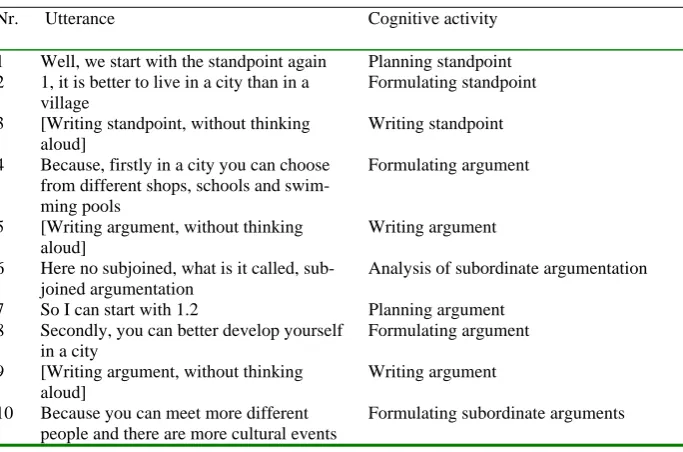
stream). She was assigned to condition “weak” focus. She was enthusiastic and per-formed her task very seriously, often re-reading parts of the theory. Sometimes she formulated parts of the theory in her own words. We will follow Claudia during her performance in observation task 5, the most complex task (see Figure 1).
To structure the descriptions of Claudia’s and the other observers’ performance, we distinguished three phases in the observation tasks: a preparatory phase (taking notice of the argumentation structure the peer models received), an observing phase (observing two peer models writing argumentative texts), and a post-observing phase (taking notice of the texts the peer models wrote, and answering the evalua-tion and elaboraevalua-tion quesevalua-tions).
In the preparatory phase, Claudia took notice of the argumentation structure the models received. First, she analyzed the structure by reading the elements of the structure and directly naming their argumentative functions (see protocol fragment below). For reasons of clarity, in protocol fragments, the reading and formulating of text are printed in italics and other activities (e.g., planning and analyzing activities) in regular font.
“It is better to live in a city than in a village, and then you have here in a city you can choose from different shops, schools and swimming pools, according to me this is sin-gular argumentation, and then the opportunity for finding a job is better in the city, there are a lot of companies close to each other, that is subordinate […].”
This protocol fragment shows that she did not first read the structure “as structure” and then analyze it, but rather, combined the two activities.
After analyzing the structure, she (mentally) formulated (parts of) the text by planning the argumentative connectives between some elements:
“[…] You can meet more different people, there you can place and: and you meet more different people and there are more cultural events […]”
By performing these analyzing and formulating activities, Claudia showed that she is not a passive observer but instead actively formed a mental image of a possible task outcome solution before being confronted with the solution in the model.
In the observing phase, Claudia observed two models on video. During this ob-servation, she paid attention to both models, as the notes in her textbook made clear. She compared the two models and commented on the models’ argumentation (i.e., an analysis of the argumentation in the models’ writing) and on the models’ ap-proach to the task. She also judged the performance. She wrote in her notes:
“Model 1 does not take after the argument the two subordinate arguments, and does not write the subordinate argument after the third argument but it is still logical and it is correct. He writes everything double for a long time. Model 2 does it correctly and eve-rything at one time.”
model 1 as correct and logical. Next, she judged the performance of model 2 as be-ing correct, connectbe-ing the arguments directly with the subordinate arguments.
From these observations, it can be inferred that Claudia has criteria for a correct task performance to compare the two models, evaluate the performance of the mod-els, and elaborate on that evaluation. Furthermore, the writing of the models invited Claudia to evaluate the performance of the models and to elaborate on that evalua-tion. The observation of the models’ writing was enough for Claudia to comment on their performance. She did not need to read the results of these writing processes (the models’ written texts) to judge their performance and to explain that judgment. This conclusion is supported by her activities in the next phase.
In the post-observing phase (taking notice of the texts the models wrote and an-swering the evaluation and elaboration question) Claudia started to write down her answers on the evaluation and elaboration questions before reading the texts:
“I think model 2 performed better because she, because model 1 he mentioned all sen-tences, no, some sensen-tences, a couple of times. According to me, the ordering was not very logical and model 2 was clearer. Let me read both texts.”
These utterances demonstrate that Claudia did not need to read the produced texts to answer the questions. For her, observing the models at work was enough to answer the evaluation and elaboration question. Still (to check her answer?), she planned to read both texts. She commented on both models and used a “general” description, “the ordering was not very logical”. She did not analyze the argumentation in the models’ texts as she did in the observing phase.
After reading both texts, she looked back at her answer on the elaboration ques-tion. She added:
“Although model 2 performed better, model 1 also performed well.”
Next, she read both texts again and thought once more about the performance of model 2 by saying:
“Maybe, it is not right, that she [model 2] says firstly, that that is more important than secondly but I still think, according to me model 2 is still clearer.”
This (spoken) addition shows that Claudia was earnestly involved with judging the performance of the models. Here, she had some doubts about model 2's use of “firstly”, and “secondly”. She was not sure whether argument 1 would be more im-portant than argument 2.
When we review Claudia’s behavior during observation task 5, we can conclude that Claudia was involved in many different activities. Especially in the post-observing phase, she was very actively checking and improving her elaboration of the evaluation of the models’ performance. Furthermore, the analysis of the argu-mentation structure, the (mental) formulations of a possible task outcome solution, and the evaluation and elaboration activities in all phases show that Claudia had a standard of good task performance which enabled her to compare, evaluate, and ex-plain the performance of the models.
All participants’ observation tasks. When we compare Claudia’s behavior during
the other participants, we find similarities and differences. The Tables 1, 2, and 3 present for each participant his/her activities while performing the five observation tasks. From the Tables a “main pattern” of activities emerges (i.e., a lot of filled boxes in the rows), as well as more “individual” activities (i.e., some filled boxes in the rows). We will illustrate this with some examples.
Table 1. Activities of participants Claudia (1), Yvonne (2), Robert (3) (all three in condition weak focus), Dorien (4), Karin (5), and Joost (6) (all three in condition good focus) during
the preparatory phase
Activities in preparatory phase
Task 1 Task 2 Task 3 Task 4 Task 5 Participant number
123 456 123 456 123 456 123 456 123 456
When taking notice of the argumentation structure for the models:
1 Reading the structure “as structure”
]]] ]]] ]]G ]]] G]G ]]] ]]] ]]] G]G ]]]
2 Analyzing the structure GGG GGG GGG GGG ]GG GGG GGG G]G ]GG GGG 3 Formulating the text2 GGG GGG ]GG GGG ]GG GGG ]GG GGG ]GG GGG
4 Formulating the text while reading the structure
GGG GGG GG] GGG GG] GGG GGG GGG GG] GGG
Note. Filled boxes (]) represent that an activity was performed by the participant,
and open boxes (G) represent that an activity was not performed by the participant.
In Table 1, one can observe a lot of filled boxes in the (first) row ‘Reading the struc-ture “as strucstruc-ture”’. This means that almost all participants in almost all observation tasks performed this activity. On the other hand, the activity ‘Formulating the text while reading the structure’ (in the last row) shows ‘only’ three filled boxes. This means that this activity was performed ‘only’ three times. To be more precise: par-ticipant number 3 performed this activity three times: in task 2, task 3, and in task 5. In the preparatory phase (see Table 1), the participants mostly read the argumen-tation structure “as structure” (i.e., “only” reading the elements of the argumenargumen-tation structure, without analyzing and formulating activities). Sometimes this reading was followed by an analyzing the structure and/or formulating the text. Robert (3) some-times used a different strategy: immediately formulating the text, instead of first reading the structure.
In the observing phase (see Table 2), the participants mostly paid attention to both models. During this observation, the participants often judged the performance of the models:
2
“Model 1: good, model 2: does not sound nice.”(Robert (3), task 3).
Furthermore, in the observing phase, the participants commented on the models’ writing (see Table 2). While commenting, they focused occasionally on the writing approach of the models:
“The first model was busy improving his text.” (Robert (3), task 5).
Most often, they focused on the outcomes of the writing processes, commenting on different objects in the models’ texts. Frequently, they commented on argumenta-tion, analyzing the argumentation in the models’ writing:
“Model 1: uses because and writes the argument first and then standpoint. Model 2: also uses because and writes standpoint first and then argument.” (Robert (3), task 1) .
Mostly, they commented on argumentative connectives:
“Model 2: argument, and + because.” (Dorien (4), task 2).
Sometimes, they commented on language aspects:
“Model 2: absolutely not a nice sequence of sentences.” (Yvonne (2), task 3).
During the observations of the models, Karin (5) and Robert (3) compared the per-formance of the models explicitly with their own perper-formance. Robert (3), task 5:
“Model 1: starts with the standpoint, he likes that more. I also like to start with the standpoint.”
Table 2. Activities of participants Claudia (1), Yvonne (2), Robert (3) (all three in condition weak focus), Dorien (4), Karin (5), and Joost (6) (all three in condition good focus) during
the observing phase
Activities in observing phase Task 1 Task 2 Task 3 Task 4 Task 5 Participant number
123 456 123 456 123 456 123 456 123 456 When observing the models:
1 Paying attention to models mentioned in question3
GGGGGG GGGGG] GGG]GG GGGGGG GGGGGG
2 Paying attention to both models ]]]]GG ]G]]]G G]]G]G ]]]]]G ]]]]]G
3 Paying attention to model not mentioned in question3
GGGG]G G]GGGG GGGGGG GGGGGG GGGGGG
4 Giving a judgment ]]G]GG ]]GG]G G]]GGG ]G]G]G ]]]G]G 5 Commenting on argumentation GG]]]G GG]]G] GG]GGG ]GG]GG ]GG]]G
6 Commenting on argumentative connectives ]]]]]G ]]]]G] GGG]]G ]]]]]G G]GGGG
7 Commenting on language aspects GGGGGG GGGG]G G]]GGG GG]G]G GGGGGG 8 Commenting on writing approach GGGGGG GG]GGG GGGGGG GGGGGG ]G]G]G 9 Comparing the models with own
execution (explicit)
GGGGGG GGGGGG GGGGGG GGGGGG GG]G]G
3
In the post-observing phase (see Table 3), the participants mostly read the texts the models wrote. When they did not read the texts, they indicated that their process observation was enough to evaluate the performance of the models and to elaborate on that evaluation. Robert (3), task 5:
“Oh, I know the answers already.”
When the participants answered the evaluation question, they sometimes commented on their evaluation. Joost (6), task 4:
“Who performed better? Model 1, although he also performed not totally correctly.”
When they had to answer the elaboration question, the participants sometimes fo-cused only on the model that was mentioned in the question and sometimes they focused on both models. Occasionally, they focused only on the model who was not mentioned in the question. Thus, not all observers paid sole attention to the model on which they had to focus.
Table 3. Activities of participants Claudia (1), Yvonne (2), Robert (3) (all three in condition weak focus), Dorien (4), Karin (5), and Joost (6) (all three in condition good focus) during
the post-observing phase
Activities in post-observing phase Task 1 Task 2 Task 3 Task 4 Task 5 Participant number
123 456 123 456 123 456 123 456 123 456
1 Writing answers before reading the texts GGG GGG GGG GGG GGG GGG GGG GGG ]GG GGG Noticing the texts written by the models:
2 Reading both texts ]]G ]]] ]]] ]]] ]]] ]]] ]]] ]]] ]]G G]] 3 Giving a judgment after reading text(s) ]]] GGG G]G GGG G]G GGG ]]G GGG G]G GGG 4 Giving a revision proposal G]G GGG GGG GGG GGG GGG GGG GGG GGG GGG 5 Not reading one text or both texts GG] GGG GGG GGG GGG GGG GGG GGG GG] ]GG When answering the evaluation question:
6 Evaluating without comments G]] ]]] ]]] ]]] G]] ]]] G]] ]]G ]]] ]]G 7 Evaluating with comments ]GG GGG GGG GGG ]GG GGG ]GG GG] GGG GG] When answering the elaboration question:
8 Paying attention to target model ]]] GGG ]G] GGG ]]] GGG ]]G G]G G]G G]G 9 Paying attention to both models4 GGG ]G] G]G ]]] GGG ]]] GGG ]GG ]G] ]G] 10 Paying attention to non-target model 4 GGG G]G GGG GGG GGG GGG GG] GG] GGG GGG 11 Commenting on argumentation ]]] ]G] GG] ]]] GG] ]]] ]]] ]G] GGG ]]] 12 Idem on argumentative connectives ]]G ]]G ]]G ]]G ]]G ]GG ]]G ]]] GGG GGG 13 Commenting on language aspects GG] GGG G]G GGG ]]] G]] GGG GGG ]]] GGG 14 Giving a revision proposal ]]G ]]G ]GG ]]G ]GG GGG GGG GGG GGG GGG 15 Comparing models’ answer with own
answer
GGG GGG GGG GGG GGG GGG ]GG GGG GGG GGG
16 Looking back in notes GGG GGG GG] GGG GG] GGG GGG GGG GG] GGG 17 Looking back in theory ]GG GGG GGG GGG GGG GGG GGG GGG GGG GGG
4 Participant number 3 was conscious of his “mistake”. After elaborating, he apologized for
Answering the elaboration question, observers commented on different objects in the models’ text (see Table 3). Mostly, the students made comments on the argu-mentation, analyzing the argumentation in the models’ writing:
“The text of model 2 is not correct because model 2 creates a second standpoint.” (Joost (6), task 3).
“The text of model 1 is wrong because the argument is being used as a standpoint.” (Claudia (1), task 1).
Often, the students commented on the argumentative connectives:
“The text of model 1 is correct. Model 1 mentions the arguments with namely, besides and and.” (Dorien (4), task 3).
Occasionally, the students paid attention to aspects of language in the models’ text:
“Model 1 changes a lot in the text, he writes I think Frans is originally from Limburg instead of It is certain that Frans is originally from Limburg.” (Claudia (1), task 3).
Sometimes, students commented on how to revise the text of the weaker model in the form of a revision proposal. Such a revision proposal was usually directed to the argumentative connectors:
“Model 1 should have written thus instead of because.” (Karin (5), task 1).
We concluded that the observers were generally consistent in their observing proc-esses. The observers’ processes were largely task-content-independent and resem-bled each other. Students mostly read the argumentation structure “as structure”, sometimes followed by analyzing the structure or by formulating the text. When they observed the models, they generally paid attention to both models and most times, they judged the models. Elaborations on the judgment were repeatedly fo-cused on argumentation and argumentative connectives in the models’ writing. In the third phase, the observers mostly read both texts and elaborated on their evalua-tion, frequently by commenting on the argumentation and the argumentative connec-tors the models used.
Now that we have some insight into the observers’ processes, we turn to the in-terpretation of these processes. Our inin-terpretation is guided by the three main ques-tions, introduced in the first section of this article, concerning: (a) indications in support of theoretical assumptions, (b) evaluation and elaboration processes and (c) the influences of different instructions.
4.2 Indications in Support of Theoretical Assumptions
We assumed that observational learning could be effective because students would be stimulated to use metacognitive strategies, to internalize and to develop criteria for effective writing, and to pay more attention to learning-to-write.
they identified and conceptualized the writing strategies of the models in different ways (e.g., commenting on argumentation, commenting on argumentative connec-tives) and added negative and/or positive evaluations of these strategies.
Furthermore, the observers’ comparisons, evaluations, and elaborations in the observing and post-observing phases show that criteria for effective writing were internalized, applied and developed. For evaluating the models’ writing, the observ-ers used criteria. These criteria were made explicit when observobserv-ers elaborated on their evaluation. Note, for example, the elaboration from Claudia (1) in observation task 5 when she explained why the writing of model 1 was not as good as the writ-ing of model 2. By arguwrit-ing that model 1 did not directly connect the subordinate arguments to the arguments, she applied the criterion “arguments and subordinate arguments are connected directly”. This criterion could have been provided by the performance of the good model. See also the elaboration of Robert (3) in observa-tion task 2. He applied the criterion “argument supports standpoint” that could have been derived from the performance of the better model:
“Model 2 is not right; the argument is supported by the standpoint instead of the other way.”
In the introduction to this article, we argued that observers did not have to juggle with a dual task because they were not writing, and thus could focus on learning processes. However, the observers’ behavior showed that, in a sense, observers also wrote. Nevertheless, these processes differed from the executional processes the models performed, in that they were not engaged in actual, physical writing. They did not have to give cognitive effort to the “physical aspects of handwriting” or to spelling and grammar.
Instead, the observers placed their (mental) performance of the writing task of the observation task. They compared their (covert) performance with the (overt) performance of the models. This is demonstrated through observers’ activities in all three phases of the observation task. During the preparatory phase, students ana-lyzed the structure and formulated the text verbally. For instance, Claudia (1):
“I should say: I don’t like the last book of Roald Dahl, because I don’t understand the story and it doesn’t contain nice illustrations any longer. Or I don’t understand the story thus… all right.”
In the observing phase, some observers compared their own performance explicitly with the performance of the models. For instance, Karin (5):
“Model 1: good structure, but I would put the subordinate arguments immediately be-low (or after) the arguments.”
In the post-observing phase, Claudia (1) explicitly compared the models’ perform-ance with her own performperform-ance. After she answered the elaboration question, she formulated her own task outcome solution in two possibilities (“standpoint, because, argument” and “argument, thus, standpoint”) that are literally the same as she for-mulated in the preparatory phase. Then, she added:
Furthermore, from the interviews it appears that all six observers knew how the text should be written:
“Before I saw the video, I thought of what I would do. I already knew the answer, but of course there are more possibilities.” (Joost (6)).
“Before I saw the video, I composed the text in my head and compared it with the solu-tions of the models.” (Robert (3)).
4.3 Evaluation and Elaboration Processes
Because evaluation and elaboration activities contribute explicitly to the effective-ness of observational learning (Braaksma et al., 2001), it seems worthwhile to have a closer look at these processes.
Our data show that the observers often started to evaluate the models as soon as they observed them. They judged (in total 15 times) the performance of the model(s), for instance by writing “correct” or “incorrect” in their notes. Further-more, the observers nodded or shook their heads (in approval or disapproval) when observing the model(s).
These judgments were very stable, as appears from a comparison of evaluations in the observing and the post-observing phase. The choice for a better model in the observing phase corresponded all 15 times with the choice for the better model in the evaluation question in the post-observing phase.
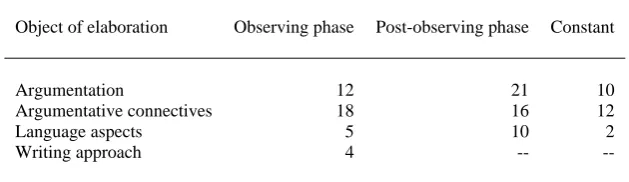
Furthermore, the observers’ behavior shows that elaborations on the evaluations were already given in the observing phase. Table 4 shows the frequencies of differ-ent objects of these elaborations during the observing and post-observing phases.
Table 4. Frequencies of objects of elaboration during observing and post-observing phase and number of constant objects
Object of elaboration Observing phase Post-observing phase Constant
Argumentation 12 21 10
Argumentative connectives 18 16 12
Language aspects 5 10 2
Writing approach 4 -- --
“I watched carefully whether they used the word because or thus between standpoint and argumentation. I saw whether a model was good or less good when they used, for instance, because instead of thus and that is wrong and thus less good.”
Dorien (4) answered:
“I paid attention to because, thus and other connectives. I also paid attention to the order of standpoint and arguments, whether this was correct. If the first model was wrong, then the second model had to be correct but still I controlled that.”
After reading the models’ written texts in the post-observing phase, most comments were directed towards the argumentation in the text of the models, followed by commenting on argumentative connectives and language aspects (see Table 4). All comments in the post-observing phase were thus directed to aspects of the written texts. No comments on writing approach were made. This is in contrast to the ob-serving phase in which observers commented four times on the writing approach of the models. Apparently, the appearance of the written texts in the post-observing phase was so absorbing that no comments on approach were made.
The column “constant” in Table 4 shows that the types of comments are roughly stable between the two phases, especially the category “commenting on argumenta-tive connecargumenta-tives”. Participants commented 18 times in the observing phase in a par-ticular observation task on argumentative connectives. Of these, 12 were repeated in the post-observing phase in the relevant observation task. Many times comments made in the observing phase were literally repeated in the post-observing phase. Participants also referred to their notes. Robert (3), for instance, referred to his notes three times, connecting his comments on the quality of the models’ writing to the elaboration question (“Let’s look what I have written in my notes”).
Concerning the development of evaluation and elaboration processes it can be concluded that the participants already started evaluating and elaborating during the observation of the models and that these evaluations and elaborations were used for answering the questions in the post-observing phase.
Moreover, the participants indicated that they already knew the answers to the questions in the post-observing phase after they observed the models. Sometimes they skipped the reading of the models’ texts (cf. the utterance of Robert (3): “Oh, I know the answers already”). In the interviews, all six observers indicated that they already knew the answers. The written texts were used:
“To find an exact word.” (Joost (6)).
“To re-read if you have forgotten a detail.” (Dorien (4)).
“For sure, to check my answer.” (Karin (5)).
“For sure, to look if I had forgotten anything.” (Robert (3)).
4.4 Influences of Instructions
imple-mented, (weak-focus condition and good-focus condition) we could explore whether observers who were asked to focus on weak models employed a different strategy from observers who were asked to focus on good models. However, our study is a case study. Thus, it is not our intention to make comparative claims or large gener-alizations about possible differences due to instructions. We are only interested in whether our students’ behavior differed as a result of the different observational learning conditions.
The Tables 1, 2, and 3 show no differences in behavior between observers who focused on weak models and observers who focused on good models, with the ex-ception being one cluster of activities concerning the focus on the models when an-swering the elaboration question in the post-observing phase. Remembering that not all observers limited their attention to their designated model, it is not surprising to note that observers in both conditions went off-task. However, the degree of “off-task behavior” varied in both conditions.
Table 3 clearly shows differences between conditions in the degree of “off-task behavior” in the cluster “focus on model when answering the elaboration question”.
Observers in the weak-focus condition attended specifically to the model men-tioned in the question much more often (11 times) than observers in the good-focus condition (2 times). Conversely, observers in the good-focus condition paid more attention to both models (11 times) than observers in the weak-focus condition (3 times).
Perhaps observers in the good-focus condition would have liked to focus on the weak model as well. This assumption is confirmed by answers from the participants in the interviews. Two observers in the good-focus condition indicated that they found it difficult to comment on the good model. Joost (6) (paying attention to both models four times and one time to the [unintended] weak model) said:
“I found it difficult to say what the good model did well. It seems easier to me to ex-plain what the other did wrong.”
Karin (5) (paying attention to both models twice, and once to the [unintended] weak model and two times to the [intended] good model) reacted in the same manner:
“It seems easier for me to say what the weak model did wrong.”
5. DISCUSSION
This study examined students’ actual behavior when performing observation tasks. In our interpretation of observers’ processes we focused on three issues: (a) indica-tions in support of theoretical assumpindica-tions, (b) evaluation and elaboration processes and (c) the influences of different instructions.
We found that during the performance of observation tasks, observers applied multiple (meta)cognitive activities including: reading and analyzing the argumenta-tion structure, (mentally) formulating a possible task-outcome soluargumenta-tion, observing, comparing, evaluating and judging the models, and commenting on the models’ writing.
Results supported our assumptions about the effectiveness of observational learning. Observers were strongly engaged in metacognitive activities. They ob-served the models’ writing, identified and conceptualized the writing strategies, evaluated the performance of the models and reflected explicitly on the observed performances. The performance of these activities suggests that observers internal-ized, applied, and developed criteria for effective writing. Furthermore, observers also performed (mental) executional processes and during the observations they compared their own (covert) performance with the models’ actual performances. However, the difference from the models’ (overt) writing is that the mental writing of the observers should be seen as a means: they “write” in the context of the obser-vation task, which is a learning task. They do not write in the context of a (short term) exercise task.
This study provided detailed information about evaluation and elaboration activi-ties. In a previous study, these activities were identified as important for the effec-tiveness of observational learning (Braaksma, et al., 2001). The current study re-vealed that observers already started to evaluate and elaborate during the observa-tion of the models and that these evaluaobserva-tions and elaboraobserva-tions were used for answer-ing the evaluation and elaboration questions in the post-observanswer-ing phase. Moreover, it appeared that the observing of models’ writing was sufficient to evaluate the per-formance of the models and to elaborate on that evaluation. For observers there was no need to read the models’ written texts to answer the evaluation and elaboration questions.
Finally, this study showed differences in behavior due to differences in instruc-tions. Observers in the good-focus condition went off-task more often than observers in the weak-focus condition when they had to elaborate their evaluation. Observers in the good-focus condition often commented on both models. We assume that it was more difficult for these observers to comment on the good model only because explaining why a model performed well required well-developed conscious knowl-edge about “good writing” and an explicit set of criteria which could be applied to this explanation. Indeed, some observers in the good-focus condition indicated that it may have been easier to comment on the weaker model because the performance of the better model could then be used as a reference.
There-fore, the Tables 1, 2, and 3 are key features in this article because these Tables show which activities were performed in many observation tasks by many observers and which activities were seldom performed.
Furthermore, we consider the writing tasks the students observed as key ele-ments in persuasive writing. However, the tasks are also constrained, as well: requir-ing the models and participants to order and connect given ideas. It was not neces-sary to generate new ideas and compose thoughts by themselves. This made the tasks less natural and certainly less communicative. For future studies, we propose to study the effects of observational learning for more extensive, less structured and more communicative writing tasks as they occur in the Dutch language curriculum in the higher years of secondary education - for instance, the writing of extensive “real” texts such as newspaper opinion articles or book reviews
The findings in this study underline the importance of multiple indications of ob-served processes (Afflerbach & Johnston, 1984, p. 319; Smagorinsky, 1994, p. 15). It appeared that few observers were capable of thinking aloud while observing mod-els that were thinking aloud. But by analyzing the observers’ notes, we obtained information about the observers’ activities during the observing phase. In addition, the interview of the observers’ behavior appeared to be a useful addition. For in-stance, from students’ answers to interview questions we know that the students had an idea of the task-outcome solution and were comparing this solution to the solu-tion given by the models. This behavior was not always derived from the think-aloud protocols.
activities by comparing the observational processes of different learners in a “sim-pler”, more unguided, natural environment.
ACKNOWLEDGMENT
The authors wish to thank Dr Tanja Janssen (Graduate School of Teaching and Learning, University of Amsterdam) for her thoughtful comments on earlier ver-sions of this article.
REFERENCES
Afflerbach, P., & Johnston, P. (1984). Research methodology on the use of verbal reports in reading research. Journal of Reading behavior, 16, 307-322.
Alamargot, D., & Chanquoy, L. (2001). Nature and control of processing. In G. Rijlaarsdam (Series Ed.) & D. Alamargot & L. Chanquoy (Vol. Eds.), Studies in writing: Vol. 9. Through the models of writ-ing (pp. 125-154). Dordrecht: Kluwer Academic Publishers.
Bandura, A. (1986). Social foundations of thought and action: A social cognitive theory. Englewood Cliffs, NJ: Prentice Hall.
Bandura, A. (1997). Self-efficacy. The exercise of control. New York: W.H. Freeman and Company. Bereiter, C., & Scardamalia, M. (1987). The psychology of written composition. Hillsdale, NJ: Lawrence
Erlbaum.
Braaksma, M. A. H., & Rijlaarsdam, G. (1997, August). Learning to write and read argumentative texts by observation. An explorative study on effective learning activities in observation tasks. Paper pre-sented at the 7th European Conference for Research on Learning and Instruction, Athens, Greece.
Braaksma, M. A. H., Rijlaarsdam, G., & Van den Bergh, H. (2002). Observational learning and the ef-fects of model-observer similarity. Journal of Educational Psychology, 94, 405-415.
Braaksma, M. A. H., Rijlaarsdam, G., Van den Bergh, H., & Van Hout Wolters, B. H. A. M. (2004). Observational learning and its effects on the orchestration of writing processes. Cognition and In-struction, 22(1), 1-36.
Braaksma, M. A. H., Van den Bergh, H., Rijlaarsdam, G., & Couzijn, M. (2001). Effective learning ac-tivities in observation tasks when learning to write and read argumentative texts. European Journal of Psychology of Education, 16(1), 33-48.
Brown, A. L. (1987). Metacognition, executive control, self-regulation, and other more mysterious mechanisms. In F. E. Weinert, & R. H. Kluwe (Eds.), Metacognition, motivation and understanding (pp. 65-116). Hillsdale, NJ: Erlbaum.
Couzijn, M. J. (1995). Observation of writing and reading activities. Effects on learning and transfer. Unpublished dissertation. University of Amsterdam.
Couzijn, M. (1999). Learning to write by observation of writing and reading processes; effects on learn-ing and transfer. Learnlearn-ing and Instruction, 9(2), 109-142.
Ericsson, K. A., & Simon, H. A. (1993). Protocol analysis. Verbal reports as data. revised edition. Cam-bridge: The MIT Press
Flower, L. S., & Hayes, J. R. (1980). The dynamics of composing: Making plans and juggling constraints. In L. W. Gregg & E. R. Steinberg (Eds.), Cognitive processes in writing: An interdisciplinary ap-proach (pp. 31-50). Hillsdale, NJ: Lawrence Erlbaum.
Graham S., & Harris, K. R. (1994). The role and development of self-regulation in the writing process. In D. H. Schunk & B. J. Zimmerman. (Eds.), Self-regulation of learning and performance: Issues and educational applications (pp. 203-228). Hillsdale, N.J.: Erlbaum.
Graham, S., Harris, K. R., MacArthur, C., & Schwartz, S. (1998). Writing Instruction. In B. Y. L. Wong (Ed.), Learning about learning disabilities (2nd ed., pp. 391-421). San Diego, CA: Academic Press Graham, S., Harris, K. R., & Troia, G. A. (1998). Writing and regulation: cases from the
Harris, K. R., Graham, S., & Mason, L. H. (2003). Self-regulated strategy development in the classroom: Part of a balanced approach to writing instruction for students with disabilities. Focus on Exceptional Children, 35 (7), 1-16.
Hayes, J. R. (1996). Cognition and affect in writing. In C.M. Levy & S. Ransdell (Eds.), The science of writing: Theories, methods, individual differences and applications (pp. 1-27). Hillsdale, N.J.: Erl-baum.
Hillocks, G. (1986). Research on written composition: new directions for teaching. Urbana, Ill.: ERIC Clearinghouse on Reading and Communication Skills, National Institute of Education.
Kellogg, R. T. (1994). Psychology of writing. New York: Oxford University Press.
Rijlaarsdam, G. (1986). Effecten van leerlingenrespons op aspecten van stelvaardigheid. [Effects of peer response on aspects of writing proficiency and processes.] Unpublished dissertation. University of Amsterdam.
Rijlaarsdam, G. (1987, March). Effects of peer evaluation on writing performance, writing processes, and psychological variables. Paper presented at the Annual Meeting of the Conference on College Com-position and Communication, Atlanta.
Rijlaarsdam, G., & Couzijn, M. (2000a). Stimulating awareness of learning in the writing curriculum. In G. Rijlaarsdam & E. Espéret (Serie Eds.) & A. Camps, & M. Milian (Vol. Eds.), Studies in Writing: Vol. 6. Metalinguistic Activity in Learning to Write (pp. 167-202). Amsterdam: Amsterdam Univer-sity Press.
Rijlaarsdam, G., & Couzijn, M. (2000b). Writing and learning to write: a double challenge. In R. J. Si-mons, J. van der Linden, & T. Duffy. (Eds.), New Learning. (pp. 157-189). Dordrecht: Kluwer Aca-demic Publishers.
Rosenthal, T. L., & Zimmerman, B. J. (1978). Social learning and cognition. New York: Academic Press. Schunk, D. H. (1987). Peer models and children’s behavioral change. Review of Educational Research,
57, 149-174.
Schunk, D. H. (1991). Learning theories: An educational perspective. New York: Merill.
Schunk, D. H. (1995, March, April). Social origins of self-regulatory competence: The role of observa-tional learning through peer modeling. Paper presented at the Biennial Meeting of the Society for Research in Child Development. Indianapolis, IN.
Schunk, D. H. (1998). Teaching elementary students to self-regulate practice of mathematical skills with modeling. In D. H. Schunk & B. J. Zimmerman (Eds.), Self-regulated learning, from teaching to self-reflective practice (pp. 137-159). New York: The Guilford Press.
Schunk, D. H., & Hanson, A. R. (1985). Peer models: Influence on children’s self-efficacy and achieve-ment. Journal of Educational Psychology, 77, 313-322.
Schunk, D. H., & Hanson, A. R., (1989a). Influence of peer-model attributes on children’s beliefs and learning. Journal of Educational Psychology, 81, 431-434.
Schunk, D. H., & Hanson, A. R., (1989b). Self-modeling and children’s cognitive skill learning. Journal of Educational Psychology, 81, 155-163.
Schunk, D. H., Hanson, A. R., & Cox, P. D. (1987). Peer model attributes and children’s achievements behaviors. Journal of Educational Psychology, 79, 54-61.
Smagorinsky, P. (1989). The reliability and validity of protocol analysis. Written Communication, 6(4), 463-479.
Smagorinsky, P. (1994). Think-aloud protocol analysis: beyond the black box. In P. Smagorinsky (Ed.), Speaking about writing. Reflections on research methodology (pp. 3-19). Londen: Thousand Oaks. Sonnenschein, S., & Whitehurst, G. J. (1984). Developing referential communication: A hierarchy of
skills. Child Development, 55, 1936-1945.
Van den Bergh, H., & Rijlaarsdam, G. (1999). The dynamics of idea generation during writing: An online study. In G. Rijlaarsdam & E. Espéret (Series Eds.) & M. Torrance & D. Galbraith (Vol. Eds.), Stud-ies in Writing: Vol. 3. Knowing what to write: Cognitive perspectives on conceptual processes in text production (pp. 99-120). Amsterdam: Amsterdam University Press.
Van Eemeren, F. H., & Grootendorst, R. (1992). Argumentation, communication, and fallacies. Hillsdale, N.J.: Erlbaum.
Zimmerman, B. J. (1989). A social cognitive view of self-regulated academic learning. Journal of Educa-tional Psychology, 81, 329-339.
Zimmerman, B. J. & Kitsantas, A. (2002). Acquiring writing revision and self-regulatory skill through observation and emulation. Journal of Educational Psychology, 94, 660-667.
APPENDIX A. DESCRIPTION OF WRITING PROCESSES5
AND RESULTING PRODUCTS FOR WEAK AND GOOD MODELS IN FIVE OBSERVATION
TASKS
Task6 Weak model Good model
Writing process Resulting product Writing process Resulting product 1 Goal-orientation,
The coding of the models’ writing processes is based on a coding scheme described in Bra-aksma, et al. (2004).
6 The sequence of the models was as follows: in two instances (task 1 and task 5), first the
(correct) text,
Incorrect text7. Text
starts with
stand-7 In contrast to the other products of the weak models, this product is not really incorrect. No