R E S E A R C H A R T I C L E
Application of manure to no-till soils: phosphorus losses
by sub-surface and surface pathways
Peter J. A. KleinmanÆ Andrew N. SharpleyÆ
Lou S. SaporitoÆAnthony R. BudaÆ
Ray B. Bryant
Received: 19 August 2008 / Accepted: 2 December 2008 / Published online: 24 December 2008
ÓUS Government 2008
Abstract The acceleration of surface water
eutro-phication attributed to agricultural runoff has focused attention on manure management in no-till. We evaluated losses of phosphorus (P) in sub-surface and surface flow as a function of dairy manure application to no-till soils in north-central Pennsyl-vania. Monitoring of a perennial spring over 36 months revealed that dissolved reactive P (DRP) concentrations increased 3- to 28-fold above back-ground levels whenever manure was broadcast to nearby field soils. A study conducted with 30-cm deep intact soil cores indicated that incorporation of manure by tillage lowered P loss in leachate relative to broadcast application, presumably due to the destruction of preferential flow pathways. More P was leached from a sandy loam than a clay loam soil, although differences between soils were not as great as differences between application methods. In con-trast, rainfall simulations on 2-m2 field runoff plots
showed that total P (TP) losses in surface runoff differed significantly by soil but not by application method. Forms of P in surface runoff did change with application method, with DRP accounting for 87 and 24% of TP from broadcast and tilled treatments, respectively. Losses of TP in leachate from manured columns over 7 weeks (0.22–0.38 kg P ha-1
) were considerably lower than losses in surface runoff from manured plots subjected to a single simulated rainfall event (0.31–2.07 kg TP ha-1
). Results confirm the near-term benefits of incorporating manure by tillage to protect groundwater quality, but suggest that for surface water quality, avoiding soils prone to runoff is more important.
Keywords PhosphorusRunoff
LeachingNo-tillDairy manure Abbreviations
DRP Dissolved reactive P DOP Dissolved organic P
EDI Effective depth of interaction TDP Total dissolved P
TP Total P
Introduction
Freshwater eutrophication, the biological enrichment of surface waters accelerated by anthropogenic inputs of phosphorus (P), remains one of the most pervasive
P. J. A. Kleinman (&)
L. S. Saporito A. R. BudaR. B. Bryant
USDA, Agricultural Research Service, Pasture Systems and Watershed Management Research Unit, University Park, PA 16802, USA
e-mail: [email protected]
A. N. Sharpley
Department of Crop, Soil and Environmental Sciences, Division of Agriculture, University of Arkansas, Fayetteville, AR 72701, USA
surface water quality problems in the US (Environ-mental Defense 2007). Surveys of water quality in the US have pointed to agriculture as a key source of P in watersheds where eutrophication is a concern (Carpenter et al.1998; U.S. Geological Survey1999). Nearly all states now require that certain categories of livestock agriculture, particularly concentrated animal feeding operations, develop nutrient manage-ment strategies that target P-based managemanage-ment toward fields identified as vulnerable to non-point source P pollution by site risk assessment indices (Sharpley et al.2003).
Historically, the loss of P from agricultural lands was primarily attributed to erosion of P-rich soil particles (Daniel et al. 1994). Control of non-point source P pollution was addressed by implementing practices that decreased soil erosion and sediment-bound P losses (Sims and Kleinman2005). A variety of studies have shown that no-till practices decrease both erosion and sediment-bound P losses relative to conventional tillage (McDowell and McGregor1980; Sharpley and Smith 1994). As farming systems become more specialized and intensive, the control of dissolved P losses from agricultural soils receiving regular applications of livestock manure has been elevated as a water quality concern (Sharpley et al.
2005; U.S. Environmental Protection Agency 2004). Therefore, no-till practices that conserve soil have been re-examined in light of their effect on dissolved P losses in runoff. It is now well documented that no-till can exacerbate losses of dissolved P in surface runoff relative to conventional tillage (Mueller et al.
1984; Sharpley and Smith1994).
Several related processes contribute to the poten-tial for no-till soils to release dissolved P to surface runoff. First, surface application of fertilizers and manures to no-till soils promotes stratification of P with depth, with most P concentrated in the upper few centimeters (Guertal et al.1991; Andraski et al.2003; Butler and Coale 2005). Runoff interacts primarily with P in the surface soil. For instance, Sharpley (1985) determined the effective depth of interaction (EDI) between soil P and runoff water to be in the upper 0.1–3.7 cm. As P levels increase in the surface of no-till soils, so too does the potential for soil P release to surface runoff (Vadas et al.2005).
The second major process leading to the enrich-ment of surface runoff with P is the direct contribution of manure P to runoff water, referred
networks (e.g., Djodjic et al. 1999; van Es et al.
2004). Therefore, tillage practices that disturb soil macropores may impede P leaching through soils. For instance, Shipitalo and Gibbs (2000) identified earthworm burrows as a primary conduit for swine slurry found in tile drain effluent. In that study, tilling the soil above the tile drain curtailed subsequent contamination of the tile drain when slurry was applied, presumably by destroying the continuity of the burrows between the surface soil and the tile drain.
Given the trade-offs in managing tillage and manure related to dissolved and sediment-bound P in surface runoff and leachate, we sought to examine differences in P transport related to P application method on contrasting, no-till soils. This study provides evidence of P leaching to groundwater following broadcast application of dairy manure to no-till field soils and quantifies the near-term effects of broadcasting or incorporating manure by tillage on P loss from two well-structured no-till soils via leaching and surface runoff.
Materials and methods
Site description
The study was conducted on a 172-ha dairy farm (100 head of milking cattle) located on the Eastern Allegheny Plateau and Mountains region (Major Land Resource Area 127) of Pennsylvania (Fig.1). Average rainfall in the area is 110 cm and average monthly temperatures range from-5°C in January to
21°C in July. A typical crop rotation on the farm
consists of 4 years of corn (Zea maysL.) followed by 4 years of alfalfa (Medicago sativa)—orchardgrass [Dactylis L. (Poaceae)] hay. All crops are no-till planted. The first year of corn is planted into a sod burned down the previous fall with a combination of glyphosate and 2,4-D. Succeeding years of corn are treated with a glyphosate, s-metolachlor, mesotrine and atrazine mix1 Soils are occasionally chisel plowed to break up corn stalks in the year of hay establishment. During years of corn production, soils receive*34 m3ha
-1
liquid dairy manure by surface application with a broadcast spreader, resulting in a total P (TP) application rate of roughly 20–30 kg ha-1 (Table1 for manure nutrient concentrations from this study). During years of alfalfa-grass production, soils receive *19 m3ha-1manure if it
is available after all the corn fields on the farm have been amended. In addition to dairy manure, 250–287 kg ha-1
starter fertilizer (% N–P2O5– K2O=29.2–0–18.2) is applied at corn planting.
A 1.3 ha strip-cropped field in the final (fourth) year of corn production was selected for the study (Fig.1). The field was dominated by Wharton clay loam (fine-loamy, mixed, active, mesic Aquic Hap-ludult) and Clymer sandy loam (coarse-loamy, siliceous, active, mesic Typic Hapludult) soils and was located at the summit position of a Rayne– Gilpin–Ernst catena, separated from a forested lot by another field of similar dimensions and soil
spring
Wharton Clymer
Clymer
research field
0 100m
(a) (b)
Rayne Fig. 1 Map of northeastern
US showing location of research site within Allegheny Plateau of central Pennsylvania (a), as well as soil map units, field layout and location of spring that served as a groundwater sampling point (b). Runoff and leaching studies were conducted within the Clymer and Wharton soil portions of the
highlightedfield
1 Mention of trade names does not imply endorsement by
distribution. The finer-textured Wharton was located within a broad swale bisecting the field. Within the forest, approximately 80-m downslope of the exper-imental field, was a spring that had formerly served as a source of drinking water for the farm house. A concrete box surrounded the spring, which remained unfrozen over the entire period of the study. There was no apparent overland flow connection between the spring and the fields located upslope, and the near constant temperature indicated that it derived its water from subsurface sources.
Phosphorus leaching studies
Groundwater monitoring
The improved spring located downslope of the experimental field was periodically sampled from May 2001 to May 2004, to monitor dissolved P in emerging groundwater. Approximately 500 ml of water was obtained in a plastic sampling container and stored at 4°C until analyzed. During the
moni-toring period, the date and location of broadcast manure application to fields surrounding the improved spring were recorded for all fields sur-rounding the forest.
Column leaching experiments
To assess P leaching related to manure application method, 18 intact soil columns were collected from the experimental field: 12 of Clymer soil; six of Wharton soils by the method of Kleinman et al. (2005b). A 30950-cm (internal diameter9depth) PVC cylinder was pushed into the soil by a 2-Mg drop weight. To prevent surface compaction, the drop weight was not allowed to contact the soil surface and no visual evidence of compaction was observed following cylinder insertion into the soil. Columns were removed by excavating the soil adjacent to the
submerged cylinder and then tilting the cylinder to cleanly break contact between the soil column and the underlying subsoil.
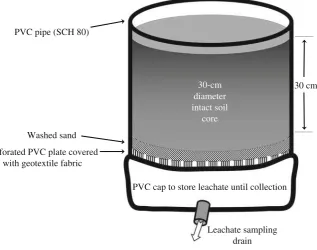
To prepare columns for leaching experiments, columns were inverted and washed sand poured into the voids created by the separation of the peds at the column bottom Fig.2). A layer of nylon drain fabric was placed over the sand as a retainer, followed by a 30-cm diameter PVC disk, perforated with roughly 60, 0.2-cm perforations. The disk, in turn, was held in place by a PVC cap sealed to the cylinder with silicone. With cap in place, the columns were returned to their original upright position. To allow drainage, a hole was drilled into the cap and fitted with a 1-cm PVC nipple that could be inserted into a plastic collection container. This design ensured that drainage did not become reductive during the leach-ing experiments. Soil columns were transported to a greenhouse where they were subjected to leaching experiments.
Columns were irrigated with deionized water (2.0 cm) once per week for 14 weeks: seven before manure application; seven after application of dairy manure. The irrigation rate corresponds roughly to average weekly rainfall depths at the study site (2.1 cm). Leachate was collected 24-h after the columns were irrigated.
Two manure application methods were simulated, broadcasting by hand and incorporation (to 10 cm) using a three-tined garden claw. Two manure appli-cation rates were evaluated, fixed on the basis of TP. A manure application rate of 30 kg TP ha-1
, roughly equivalent to the average rate applied to corn each year on the farm, was evaluated on six of the 12 Clymer soil columns and all six Wharton soil columns. In addition, manure was applied at a rate of 100 kg TP ha-1
to the remaining six Clymer soil columns. Treatment combinations (soil9application method9application rate) were replicated on three columns.
Table 1 Properties of dairy
manures used in study Experiment Collection
date
Dry matter (%)
Total N (g kg-1, dry weight basis)
Total P (g kg-1, dry weight basis)
Water extractable P 200:1 (solution: solid) (g kg-1, dry weight basis)
Runoff study June 2002 10.5 37.8 8.6 NA
Surface runoff experiments
Rainfall simulation experiments were conducted to compare losses of P in runoff related to manure application method on the Clymer and Wharton soils. A total of eight runoff plots, each consisting of two pairs of abutting 192 m plots, were installed in the two soils. Rainfall-runoff experiments were carried out following a modified protocol of the National Phosphorus Research Project (2007) and are described in greater detail by Garcia et al. (2008). Briefly, rainfall was delivered at*75 mm h-1until
30 min of runoff was collected. Rainfall simulations were conducted on soils before and after manure application. The first rainfall simulation was con-ducted on unamended soils on June 18, 2002. A single, composite runoff sample was obtained for each event, and both filtered (0.45lm) and unfiltered
sub-samples were obtained. At this point, soil sam-ples (2-cm diameter) were collected from 0–2, 4–6, 14–16 cm depths adjacent to each plot. After the first rainfall simulation, manure was broadcast by hand to all plots at a rate of 30 kg TP ha-1
. Manure was from the same source as that used in the leaching experiment, but was collected at a different date so the two manures differed somewhat their properties (Table1). A hand-operated rototiller was used to
incorporate manure (*20-cm mixing depth) into
half of the plots so that two manure application treatments, surface applied and incorporated, were evaluated. The final rainfall simulation was con-ducted on all plots (broadcast and incorporated) on June 25, 2002, 24 h after manure had been incorporated.
Laboratory analyses
All soils were air dried, sieved (2-mm) and analyzed for Mehlich-3 P by shaking 2.5 g of soil with 25 ml of Mehlich-3 solution (0.2 M CH3COOH?0.25 M NH4NO3?0.015 M NH4F?0.013 M HNO3? 0.001 M EDTA) for 5 min (Mehlich 1984). Phos-phorus in the Mehlich-3 extracts was measured colorimetrically by a modified method of Murphy and Riley (1962), with a spectrophotometer wave-length of 712 nm.
Manure was analyzed for TP by modified semi-micro-Kjeldahl procedure (Bremner 1996). One g dry-weight equivalent fresh manure was shaken with 200 ml of distilled water on an end-over-end shaker for 60 min. The mixture was then centrifuged (about 2,900g for 20 min to facilitate filtration) and filtered through a Whatman No. 1 filter paper. Filtrate P was determined colorimetrically. Dry matter content of all
30-cm diameter intact soil
core
Perforated PVC plate covered with geotextile fabric
Washed sand PVC pipe (SCH 80)
30 cm
Leachate sampling drain
PVC cap to store leachate until collection
manures was determined gravimetrically after oven-drying manures at 70°C for 48 h.
Dissolved reactive P (DRP) was determined on 0.45-lm filtered runoff and leachate water by the
colorimetric method described for soil extracts. Unfiltered water samples were digested by modified semimicro-Kjeldahl procedure and P determined by colorimetry to quantify TP. In addition, for column leachate only, filtered samples were subjected to the semimicro-Kjeldahl digestion to quantify total dis-solved P (TDP). The difference between TDP and DRP, sometimes termed dissolved unreactive P, was assumed to represent dissolved organic P (DOP). Runoff water was also analyzed for total solids content by evaporating 200 ml of unfiltered runoff water in an oven at 70°C and weighing the remaining
material.
Statistical analyses
Data were evaluated for normality to confirm the use of parametric statistics. Treatment effects (manure application rate and method, soil type) were evalu-ated by Student’s t-test or by general linear model using Tukey’s test to compare individual means. Associations between variables were evaluated with Pearson’s correlation analysis. Treatment differences discussed in the text were significant atPB0.05. All analyses were performed using SAS’s statistical software, version 9.1 (SAS Institute Inc.2002).
Results and discussion
Soil properties
The two soils included in the study differed in a variety of properties that would be expected to affect
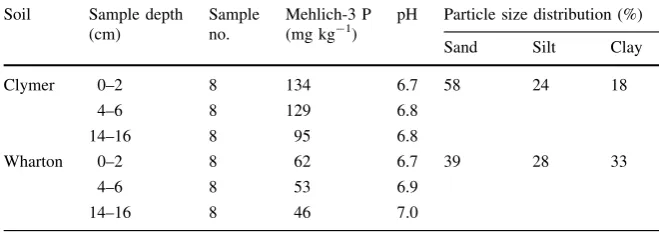
their susceptibility to environmental P losses (Table 2). The Wharton soil occurred in a swale that bisected the research field, and had a slightly steeper slope gradient (7.5%) than did the adjacent Clymer soil (5.3%). Permeability of the finer textured Whar-ton clay loam (33% clay) was expected to be lower than the Clymer sandy loam (18% clay), contributing to greater potential for surface runoff and erosion and lesser source of groundwater recharge (Hillel 1998). In contrast, Mehlich-3 P in the Clymer soil was roughly twice that found in the Wharton soil, with Mehlich-3 P of the Wharton and Clymer soils rating ‘‘optimum’’ and ‘‘high’’, respectively, from an agro-nomic stand point (Beegle2007). Soils also exhibited evidence of P stratification within the surface horizon as a result of the recent history of no-till management and surface application of manure: Mehlich-3 P at a 15-cm depth was roughly 25% lower than at the soil surface (Table2).
Phosphorus losses to groundwater
Phosphorus in spring water
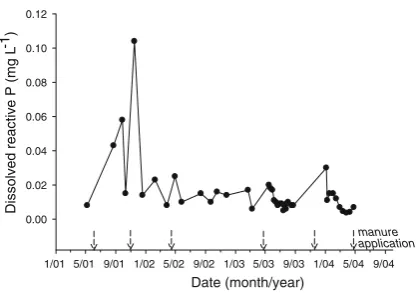
Although P losses to groundwater are often not considered of environmental importance unless soils are coarse textured or subject to artificial drainage (Sims et al.1998), monitoring of the spring below the experimental field revealed significant spikes in DRP concentration of emerging groundwater after manure was applied to the fields upslope of the spring (Fig.3). Application of manure to these fields was followed by an average fourfold increase in DRP concentrations in spring water relative to background concentrations, despite considerable variability in background DRP concentrations before manure was applied (coefficient of variation=0.54), and after manure was applied (coefficient of variation=0.75). Table 2 Properties of
Clymer and Wharton soils prior to rainfall simulation studies and manure
Soil Sample depth
(cm)
Sample no.
Mehlich-3 P (mg kg-1)
pH Particle size distribution (%)
Sand Silt Clay
Clymer 0–2 8 134 6.7 58 24 18
4–6 8 129 6.8
14–16 8 95 6.8
Wharton 0–2 8 62 6.7 39 28 33
4–6 8 53 6.9
Following a manure application event in late 2001, DRP concentrations reached 0.10 mg l-1
, an approx-imate 28-fold increase over the previous sample obtained before manure application. In contrast, an April application in 2003 resulted in only a threefold increase in DRP concentration above the previous sample. Variability was also observed in the duration that DRP concentrations remained elevated after manure, although the infrequent nature of spring water sampling likely contributed to some of the observed variability. Other sources of variability include nature and timing of precipitation events relative to manure application, antecedent soil mois-ture and crop management conditions at time of manure application, and differences in leaching susceptibility of soils receiving manure (Sims et al.
1998; Kleinman et al.2003; van Es et al.2004). The apparent rapid response of DRP in spring water samples to manure application suggests the existence of preferential flow pathways that connect the surface soils to which the manure was applied with the groundwater. Fields upslope of the ground-water spring were in no-till production during the study period, which would sustain continuous macropores within the regolith, approximately 120–170 cm for Clymer and Wharton soils. Fractures within the underlying sedimentary bedrock favor high saturated conductivities that could enable the rapid transfer of DRP to the groundwater seep (Gburek and Folmar 1999). Although P enrichment of shallow groundwater has been observed (Sims 1998; Vadas et al. 2007), studies documenting elevated DRP concentrations below the vadose zone remain rela-tively rare, particularly with regard to agricultural
sources of P (Nolan and Stoner 2000). Even so, concentrations in the current study fell within the range reported by Burkart et al. (2004) who surveyed 103 groundwater wells in unconsolidated geologic strata of Iowa agricultural watersheds. They observed concentrations of TDP of up to 1.0 mg l-1, with mean values ranging from 0.07 to 0.21 mg l-1
.
Phosphorus leaching from soil columns
Given the fluctuations in DRP concentrations of water samples obtained from the spring, we expected field soils to transmit significant concentrations of manure P in leachate. Concentrations of P in leachate from the soil columns were higher than in water samples obtained from the spring, consistent with the dilution of DRP away from the manure source in groundwater samples (Table 3). Surprisingly, DRP represented a relatively minor fraction of TP in soil column leachate, averaging 25% of TP before manure application and 37% after manure application. Dis-solved organic P contributions to TP in leachate were comparable to DRP, such that TDP in leachate (DRP?DOP) was equivalent to 51% of TP before application and 63% of TP after manure was applied. Thus, nearly half of TP in leachate from the soil columns was in sediment-bound form, even after manure application. Findings of sediment-bound P transport in subsurface flow have been reported elsewhere (e.g., Sharpley and Syers 1979; Dils and Heathwaite 1999). In studies of well-structured soils amended with liquid cattle manure, Schelde et al. (2006) observed that up to 80% of P in tile drain effluent was associated with sediment, while Toor et al. (2004) observed that over 70% of leachate P from soil columns amended with dairy slurry was in sediment-bound form. Clearly, such substantial contributions of sediment-bound P con-firm the importance of bypass flow via macropores as a dominant transport mechanism of P transport in such soils.
Despite considerable variability in flow between soil columns (coefficient of variation=0.29), P losses (kg ha-1
), which reflect leachate volumes, and P concentrations (mg l-1
) were strongly corre-lated (r=0.92–0.97 for DRP, TDP and TP). Therefore, the temporal trends in P losses depicted in Fig.4 were similar for P concentrations. Both concentrations and losses of P in leachate increased
1/01 5/01 9/01 1/02 5/02 9/02 1/03 5/03 9/03 1/04 5/04 9/04
Dissolv
ed reactiv
e
P (mg L
-1)
0.00 0.02 0.04 0.06 0.08 0.10 0.12
manure application
Date (month/year)
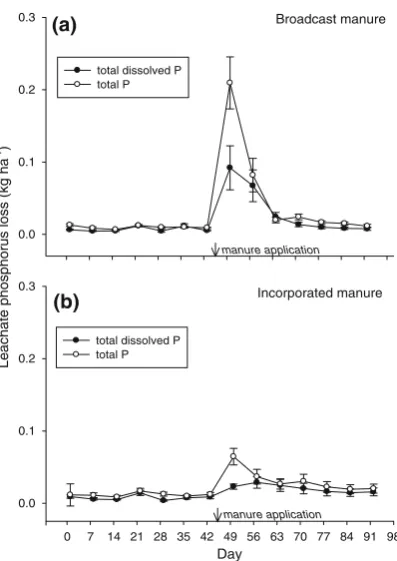
after manure was applied to the soil columns, identifying applied manure as a significant source of P in leachate. Total dissolved P and TP in leachate increased significantly with the first leaching events after manure application, but declined rapidly, stabi-lizing within three to four events. Such a flashy
response of P in leachate to manure application is consistent with other studies (e.g., Geohring et al.
2001; van Es et al. 2004) as well as with the fluctuations in P observed in the spring water samples (Fig.3). Notably, TDP and TP losses and concentra-tions remained significantly elevated above pre-manure levels for the duration of the experiment, revealing an enduring impact of manure P on column leachate P not apparent in spring water samples.
Phosphorus losses in leachate differed significantly between manure application methods (Fig.4), with TDP and TP losses roughly 4.0 and 3.2 times greater, respectively, from the broadcast treatment in the first event after application than in corresponding leachate from the incorporated treatment. Results clearly support the hypothesis that tillage curtails P translo-cation from the soil surface to lower in the solum. Consistent with this, Geohring et al. (2001) observed that light disking of dairy slurry after broadcasting resulted in greater P transfers to tile drains than did moldboard plowing, attributing the differences to a greater degree of incorporation of the slurry with plowing than disking. The incorporation method used in the current study would represent a severe form of tillage, more akin to several tillage passes than light disking. Even so, both TDP and TP losses in leachate from the incorporated manure columns remained significantly elevated above pre-manure application levels for the duration of the leaching study (Fig.4). Over the 7 week period after manure application, cumulative losses of TDP and TP in leachate from broadcast were 1.5 and 1.7 times greater, respec-tively, than from incorporated manure.
Table 3 Average leachate depth and flow weighted phosphorus concentrations from Clymer and Wharton soil columns
Soil Manure application (kg TP ha-1) Leaching period (weeks)
N Leachate depth (cm)
Dissolved fraction (\0.45lm) mg l-1 Total P
(mg l-1)
Rate Method DRP DOP
Clymer 0 Pre-application 7 12 7.02 (1.60)a 0.04 (0.04) 0.04 (0.02) 0.17 (0.12)
Clymer 30 Broadcast 7 3 8.81 (2.87) 0.08 (0.02) 0.05 (0.0) 0.25 (0.13)
Clymer 30 Incorporated 7 3 10.72 (1.35) 0.17 (0.15) 0.04 (0.02) 0.17 (0.21)
Clymer 100 Broadcast 7 3 9.48 (2.63) 0.21 (0.04) 0.17 (0.07) 0.5 (0.15)
Clymer 100 Incorporated 7 3 11.3 (0.33) 0.05 (0.37) 0.05 (0.01) 0.18 (0.07)
Wharton 0 Pre-application 7 6 7.11 (1.37) 0.03 (0.01) 0.05 (0.01) 0.15 (0.13)
Wharton 30 Broadcast 7 3 7.77 (3.6) 0.06 (0.04) 0.05 (0.03) 0.29 (0.18)
Wharton 30 Incorporated 7 3 7.47 (4.6) 0.02 (0.01) 0.05 (0.04) 0.12 (0.03)
a Standard deviations presented in parentheses
0.0 0.1 0.2 0.3
total dissolved P total P
0 7 14 21 28 35 42 49 56 63 70 77 84 91 98 0.0
0.1 0.2 0.3
total dissolved P total P
Day
Incorporated manure Broadcast manure
Leachate phosphorus loss (kg ha
-1)
manure application
manure application (b)
(a)
Manure application rate (30 vs. 100 kg TP ha-1 ) and soil (Clymer vs. Wharton) interacted significantly with application method in affecting P leaching losses from manure, but the effect of these factors tended to be less than the effect of manure application method. Manure application rate differences in leachate P (both TDP and TP) from Clymer soil columns were statistically significant in the first two rainfall events after manure was applied (Fig.5). Cumulative differ-ences in leachate P loss over the 7 weeks after manure application were 1.3-fold for TDP and 1.1-fold for TP, with maximum differences in the second week after manure application (Fig.5). In contrast, differences in leachate P related to the two soils did not become apparent until the second week after manure applica-tion (30 kg TP ha-1
rate only), but persisted for the remainder of the study (Fig. 6). Consequently, on a cumulative basis, leachate TDP losses from the Clymer soil were 2.3 times greater than from the Wharton soil and cumulative TP losses from the Clymer soil were 1.3 times greater than from the Wharton soil. The principal cause of the differences in
P leaching losses from the two soils was the volume of leachate (expressed as depth by factoring out area of soil column), which was significantly less from the finer-textured Wharton soil columns than from the Clymer soil columns (Table 3).
Phosphorus losses in surface runoff
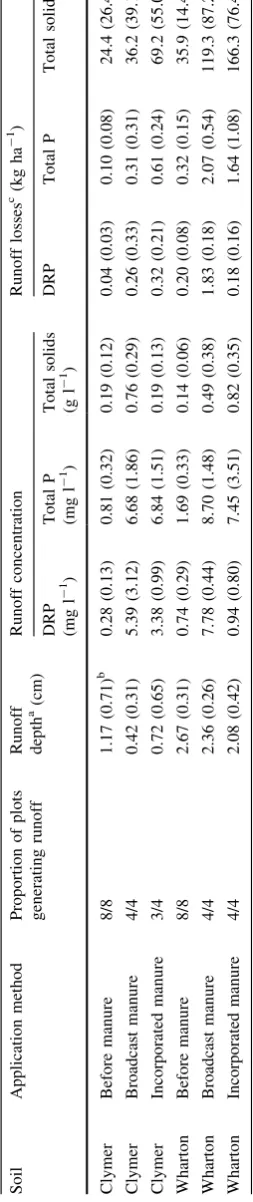
Surface runoff results prior to manure application revealed significant differences between the two soils (Table 4). Without manure, losses of P were rela-tively low, with DRP accounting for 39% (Clymer) to 67% (Wharton) of TP in runoff. Losses of DRP and TP were significantly greater from the Wharton soil. As anticipated, surface runoff volumes (expressed as depths by factoring out the area of the runoff plot) were significantly greater from the finer textured Wharton soil than from the Clymer soil, correspond-ing to 57 and 21% of applied rainfall, respectively (Table 4).
0.0 0.1 0.2 0.3
30 kg TP ha-1
100 kg TP ha-1
0 7 14 21 28 35 42 49 56 63 70 77 84 91 98 0.0
0.1 0.2 0.3
30 kg TP ha-1
100 kg TP ha-1
Day
Total P Total dissolved P
Leachate phosphorus loss (kg ha
-1)
manure application
manure application (b)
(a)
Fig. 5 Average losses and standard error of total dissolved P (a) and total P (b) in leachate from Clymer soil columns before and after dairy manure application at 30 and 100 kg TP ha-1
0.0 0.1 0.2 0.3
Clymer Wharton
0 7 14 21 28 35 42 49 56 63 70 77 84 91 98 0.0
0.1 0.2 0.3
Clymer Wharton
Day
Total P Total dissolved P
Leachate phospho
rus loss (kg ha
-1)
manure application
manure application (a)
(b)
Application of dairy manure (30 kg TP ha-1 ) increased TP losses in runoff an average of fourfold. No significant differences in TP losses between broadcast and incorporated treatments were observed (Table 4). However, processes of P loss clearly differed between the two application methods. Rapid incidental transfers of readily soluble P in the applied dairy manure were likely the primary source of P in runoff from the broadcast treatment, whereas erosion of both soil and manure solids was most likely responsible for P losses from the tilled soils. Dissolved reactive P accounted for 81–89% of TP in runoff following broadcasting without incorpora-tion, but only contributed 12–49% of TP in runoff from the tilled soil.
In dairy manures, a high proportion of TP in the manure is readily water soluble. As reported above, water extractable P accounted for 66% of TP in the manure used in the leaching experiments (Table1), identical to the proportion reported in the survey of Kleinman et al. (2005a) for dairy manures obtained from above-ground storage tanks. Notably, a consid-erable amount of manure dry matter was observed to erode from the broadcast treatment, accounting for the high total solids concentration in surface runoff from that treatment (Table 4). The light organic matter fraction of broadcast manure is readily floated by runoff and has been implicated as a source of sediment in other runoff studies of this type (McDowell and Sharpley2002; Kleinman et al.2004).
The absence of differences in TP losses between manure application methods corresponds with previ-ous studies of manure incorporation by conventional (moldboard) tillage involving multiple runoff events over longer periods of observation. For instance, Mueller et al. (1984) repeated rainfall simulations on manured plots over a 2 year period. They observed similar losses of TP in runoff from no-till soils receiving broadcast dairy manure and soils in which the dairy manure was incorporated by conventional tillage. As in the current study, Mueller et al. (1984) observed losses of TP from the no-till soils that were predominantly in the form of DRP whereas DRP accounted for a minor fraction of TP losses from the conventionally tilled soils. In that study and elsewhere (e.g., Daverede et al. 2004), however, incorporation of manure by conservation tillage (chisel plowing), as opposed to conventional tillage, resulted in significant reductions in TP losses relative
to broadcasting manure by limiting the erosion associated with conventional tillage. Such findings point to the potential to limit tillage impacts on sediment-bound P losses not evaluated in the current study, which simulated aggressive tillage.
Although manure application methods did not differ in their relative effect on TP losses in runoff, TP losses from the Wharton soil were three to seven times greater than those observed from the Clymer soil (Table4). These differences derive primarily from greater runoff depths produced by the Wharton soil. In addition, manure incorporation did not significantly impact DRP in runoff from the Clymer soil, but did significantly lower DRP concentrations and losses from the Wharton soil. Differences in DRP trends between soils suggest a greater propensity for the fine-textured Wharton soil to adsorb soluble manure P, and may indicate better mixing of manure into the Wharton soil with the rototiller. Soil-specific differ-ences clearly highlight the importance of edaphic variability in manure management and point to the potential for critical sources of runoff P to occur at scales finer than those typically managed by farmers. In this case, the Wharton soil occupied a 0.29-ha swale, representing only 22% of the total area of a small field, and was sufficiently small to be imprac-tical to delineate as a separate management unit.
Conclusions
The fate of manure P in no-till soils is affected by a variety of factors. In the current study, application of manure to no-till soils clearly increased P losses in leachate and surface runoff relative to losses before manure was applied, regardless of application method and soil properties. The most acute risk of manure P loss by leaching and surface runoff was immediately after manure was applied, consistent with the concept of rapid incidental transfer that has been established with surface runoff. Although environmentally signif-icant concentrations of TP were observed in leachate samples after manure application ([0.12 mg l-1), TP
losses in leachate from manured columns (0.22– 0.38 kg P ha-1
) over 7 weeks were considerably lower than TP losses in surface runoff from manured plots subjected to a single simulated rainfall event (0.31–2.07 kg TP ha-1
). Even so, when normalized by the different depths of precipitation applied to the
lysimeters and runoff plots, the first leaching event after manure application resulted in an average TP loss of 0.07 kg ha-1cm-1rainfall, compared with 0.17 kg ha-1
cm-1
rainfall in surface runoff.
This study points to the potential to manage manure P losses from no-till soils. Tilling soils that were broadcast with manure significantly lowered P losses in leachate relative to broadcasting manure, support-ing the hypothesis that tillage destroys macropores that serve as the dominant pathway for subsurface P transport. However, tillage did not significantly lower the loss of TP in surface runoff, as tillage increased sediment-bound P loss in surface runoff relative to broadcasting, shifting the mechanism of P loss from rapid incidental transfer of soluble P in manure to erosion. Notably, the role of erosion in P transport would likely be even greater under natural conditions, as our surface runoff experiments favored rapid incidental transfers associated with the brief window of time after manure was applied. Tillage impacts would be expected to persist well beyond this brief period (Garcia et al.2008).
This study also highlights the differential response of soils to manure application. Differences in manure P loss in leachate from the Clymer and Wharton soils were significant, although not as great as those induced by manure application method. In contrast, soil related differences in TP loss via surface runoff were not only significant when application method had no effect, but were also dramatic (threefold to sevenfold). There-fore, results of this study support the critical source area concept of managing manure application to soils by limiting application to soils, such as the Wharton, that are relatively prone to runoff. The difficulty in implementing such an approach is also illustrated by this study; such precision manure management may require that small, but environmentally significant, areas of field be treated as separate management units. In the case of the Wharton soil, manure application would have to be curtailed on a 130-m wide zone within the center of an already small (1.3 ha), strip cropped field.
impacts to the zone of injection. At the same time, however, manure injection may also exacerbate nutrient leaching losses. Clearly, a systematic assess-ment of the trade-offs of alternative manure incorporation methods is needed to provide a com-plete perspective on the potential for optimizing manure management in no-till soils.
Acknowledgments The authors thank Ms. Sarah Orner for her work in sampling spring water and maintaining field management records. In addition, we thank the staff of the USDA—ARS Pasture Systems and Watershed Management Laboratory for their contributions to this study. Rain simulation experiments were conducted by Jenn Logan, Joe Quatrini, Zach Smith and Benjamin Thonus. Soil columns were collected by David Otto and Terry Troutman. Laboratory analyses were conducted by Jaime Davis, Bart Moyer and Joan Weaver.
References
Akhtar MS, Richards BK, Medrano PA, deGroot M, Steenhuis TS (2003) Dissolved phosphorus from undisturbed soil cores: related to adsorption strength, flow rate or soil structure? Soil Sci Soc Am J 67:458–470
Andraski TW, Bundy LG, Kilian KC (2003) Manure history and long-term tillage effects on soil properties and phos-phorus losses in runoff. J Environ Qual 32:1782–1789 Beegle DB (2007) Soil fertility management. In: Pennsylvania
State University agronomy guide, 2007–2008. Avail-able athttp://agguide.agronomy.psu.edu/cm/sec2/sec21.cfm
(verified 20 May 2008)
Bremner JM (1996) Nitrogen—Total. In Sparks DL (ed.) Methods of soil analysis. Part 3. Chemical methods. SSSA Book Ser 5. SSSA, Madison, WI, pp 1085–1121 Burkart MR, Simpkins WW, Morrow AJ, Gannon JM (2004)
Occurrence of total dissolved phosphorus in unconsolidated aquifers and aquitards in Iowa. J Am Water Resour Assoc 40:827–834. doi:10.1111/j.1752-1688.2004.tb04461.x
Butler JS, Coale FJ (2005) Phosphorus leaching in manure-amended Atlantic coastal plain soils. J Environ Qual 34:370–381
Carpenter SR, Caraco NF, Correll DL, Howarth RW, Sharpley AN, Smith VH (1998) Nonpoint pollution of surface waters with phosphorus and nitrogen. Ecol Appl 8:559– 568. doi:10.1890/1051-0761(1998)008[0559:NPOSWW]2.0. CO;2
Chardon WJ, van Faassen HG (1999) Soil indicators for critical source areas of phosphorus leaching. Rapporten Programma Geintegreerd Bodemonderzoek, vol 22. Netherlands Inte-grated Soil Research Program, Wageningen
Chardon WJ, Aalderink GH, van der Salm C (2007) Phos-phorus leaching from cow manure patches on soil columns. J Environ Qual 36:17–22. doi:10.2134/jeq2006. 0182
Daniel TC, Sharpley AN, Edwards DR, Wedepohl R, Lemunyon JL (1994) Minimizing surface water eutrophication from agriculture by phosphorus management. J Soil Water Conserv 49:30–38
Daverede IC, Kravchenko AN, Hoeft RG, Nafziger ED, Bullock DG, Warren JJ, Gonzini LC (2004) Phosphorus runoff from incorporated and surface-applied liquid swine manure and phosphorus fertilizer. J Environ Qual 33:1535–1544 Environmental Defense (2007) Farming for clean water:
inno-vative solutions to reduce Chesapeake Bay farm runoff. Environmental Defense, New York. Available at http: //www.edf.org/documents/7373_ChesapeakeBayReport_ FarmingForCleanWater.pdf(verified 20 May 2008). 95 p Dils RM, Heathwaite AL (1999) The controversial role of tile
drainage in phosphorus export from agricultural land. Water Sci Technol 39:55–61. doi:10.1016/S0273-1223 (99)00318-2
Djodjic F, Bergstrom L, Ulen B, Shirmohammadi A (1999) Mode of transport of surface-applied phosphorus-33 through a clay and sandy soil. J Environ Qual 28:1273–1282 Garcia AM, Veith TL, Kleinman PJA, Rotz CA, Saporito LS (2008) Comparing small plot research with whole-farm simulations to assess manure management strategies. J Soil Water Conserv 63:204–211. doi:10.2489/jswc.63.4.204
Gburek WJ, Folmar GJ (1999) Patterns of contaminant trans-port in a layered fractured aquifer. J Contam Hydrol 37:87–109. doi:10.1016/S0169-7722(98)00158-2
Geohring LD, McHugh OV, Walter MT, Steenhuis TS, Akhtar MS, Walter MF (2001) Phosphorus transport into subsurface drains by macropores after manure applications: implica-tions for best manure management practices. Soil Sci 166:896–909. doi:10.1097/00010694-200112000-00004
Guertal EA, Eckert DJ, Traina SJ, Logan TJ (1991) Differential phosphorus retention in soil profiles under no-till crop production. Soil Sci Soc Am J 55:410–413
Hillel D (1998) Environmental soil physics. Academic Press, San Diego
Jensen MB, Jorgensen PR, Hansen HCB, Nielsen NE (1998) Biopore mediated subsurface transport of dissolved orthophosphate. J Environ Qual 27:1130–1137
Kleinman PJA, Sharpley AN (2003) Effect of broadcast man-ure on runoff phosphorus concentrations over successive rainfall events. J Environ Qual 32:1072–1081
Kleinman PJA, Needelman BA, Sharpley AN, McDowell RW (2003) Using soil profile data to assess phosphorus leaching potential in manured soils. Soil Sci Soc Am J 67:215–224
Kleinman PJA, Sharpley AN, Veith TL, Maguire RO, Vadas PA (2004) Evaluation of phosphorus transport in surface runoff from packed soil boxes. J Environ Qual 33: 1413–1423
Kleinman PJA, Wolf AM, Sharpley AN, Beegle DB, Saporito LS (2005a) Survey of water extractable phosphorus in manures. Soil Sci Soc Am J 67:701–708. doi:10.2136/ sssaj2004.0099
Kleinman PJA, Srinivasan MS, Sharpley AN, Gburek WJ (2005b) Phosphorus leaching through intact soil columns before and after poultry manure applications. Soil Sci 170: 153–166. doi:10.1097/00010694-200503000-00001
McDowell LL, McGregor KC (1980) Nitrogen and phosphorus losses in runoff from no-till soybeans. Trans ASAE 23:643–648
Mehlich A (1984) Mehlich 3 soil test extractant: a modification of Mehlich 2 extractant. Commun Soil Sci Plant Anal 15:1409–1416. doi:10.1080/00103628409367568
Mueller DH, Wendt RC, Daniel TC (1984) Phosphorus losses as affected by tillage and manure application. Soil Sci Soc Am J 48:901–905
Murphy J, Riley JP (1962) A modified single solution method for the determination of phosphate in natural waters. Anal Chim Acta 27:31–36. doi:10.1016/S0003-2670(00)88444-5
National Phosphorus Research Project (2007) National research project for simulated rainfall—surface runoff studies. Southern Ext. Res. Activity Inf. Ex. Group 17.http://www. sera17.ext.vt.edu/Documents/National_P_protocol.pdf
(verified 20 May 2008)
Nolan BT, Stoner JD (2000) Nutrients in groundwaters of the conterminous United States 1992–1995. Environ Sci Technol 34:1156–1165. doi:10.1021/es9907663
Preedy N, McTiernan K, Matthews R, Heathwaite L, Haygarth P (2001) Rapid incidental phosphorus transfers from grassland. J Environ Qual 30:2105–2112
SAS Institute Inc. (2002) SAS OnlineDocÒ, version 9.1, Cary Schelde K, de Jonge LW, Kjaergaard C, Laegdsmand M, Rubæk GH (2006) Effects of manure application and plowing on transport of colloids and phosphorus to tile drains. Vadose Zone J 5:445–458. doi:10.2136/vzj2005. 0051
Sharpley AN (1985) Depth of surface soil-runoff interaction as affected by rainfall, soil slope, and management. Soil Sci Soc Am J 49:1010–1015
Sharpley AN (2003) Soil mixing to decrease surface stratifi-cation of phosphorus in manured soils. J Environ Qual 32:1375–1384
Sharpley AN, Smith SJ (1994) Wheat tillage and water quality in the southern plains. Soil Tillage Res 30:33–38. doi:
10.1016/0167-1987(94)90149-X
Sharpley AN, Syers JK (1979) Loss of nitrogen and phos-phorus in tile drainage as influenced by urea application and grazing animals. N Z J Agric Res 22:127–131 Sharpley AN, Weld JL, Beegle DB, Kleinman PJA, Gburek
WJ, Moore PA Jr, Mullins G (2003) Development of phosphorus indices for nutrient management planning strategies in the United States. J Soil Water Conserv 58:137–152
Sharpley AN, Weld JL, Kleinman PJA (2005) Assessment of best management practices to minimize the runoff of manure-bourne phosphorus in the United States. N Z J Agric Res 47:461–477
Shipitalo MJ, Gibbs F (2000) Potential of earthworm burrows to transmit injected animal wastes to tile drains. Soil Sci Soc Am J 64:2103–2109
Shipitalo MJ, Dick WA, Edwards WM (2000) Conservation tillage and macropore factors that affect water movement and the fate of chemicals. Soil Tillage Res 53:167–183. doi:10.1016/S0167-1987(99)00104-X
Simard RR, Beauchemin S, Haygarth PM (2000) Potential for preferential pathways of phosphorus transport. J Environ Qual 29:97–105
Sims JT, Kleinman PJA (2005) Managing agricultural phos-phorus for environmental protection. In: Sims JT, Sharpley AN (eds) Phosphorus, agriculture and the environment. Monograph no 46, Amer Society Agron, Crop Sci Soc Am, Soil Sci Soc Am, Madison, WI, pp 1021–1068
Sims JT, Simard RR, Joern BC (1998) Phosphorus loss in agricultural drainage: historical perspective and current research. J Environ Qual 27:277–293
Stamm C, Fluhler H, Gachter R, Leuenberger J, Wunderli H (1998) Preferential transport of phosphorus in drained grassland soils. J Environ Qual 27:515–522
Toor GS, Condron LM, Cade-Menun BJ, Di HJ, Cameron KC (2004) Preferential phosphorus leaching from an irrigated grassland soil. Eur J Soil Sci 56:155–168
Trojan MD, Linden DR (1998) Macroporosity and hydraulic properties of earthworm-affected soils as influenced by tillage and residue management. Soil Sci Soc Am J 62:1687–1692
U.S. Environmental Protection Agency (2004) Managing manure nutrients at concentrated animal feeding opera-tions. EPA-821-B-04-006. U.S. Environmental Protection Agency, Office of Water (4303T), Washington, DC. Available on-line athttp://www.epa.gov/guide/cafo/ (ver-ified 20 May 2008)
U.S. Geological Survey (1999) The quality of our nation’s waters: nutrients and pesticides. U.S. Geological Survey circular 1225. USGS Information Services, Denver, CO, 82 pp Vadas PA, Kleinman PJA, Sharpley AN (2004) A simple
method to predict dissolved phosphorus in runoff from surface applied manures. J Environ Qual 33:749–756 Vadas PA, Kleinman PJA, Sharpley AN, Turner BL (2005)
Relating soil phosphorus to dissolved phosphorus in run-off: a single extraction coefficient. J Environ Qual 34:572–580. doi:10.2134/jeq2004.0424
Vadas PA, Gburek WJ, Sharpley AN, Kleinman PJA, Moore PA Jr, Cabrera ML, Harmel RD (2007) A model for phosphorus transformation and runoff loss for surface-applied manures. J Environ Qual 36:324–332. doi:
10.2134/jeq2006.0213