Airport Factor in Flight Delays in Indonesia
Indra Setiawan
Universitas Muhammadiyah Jakarta
Suharto Abdul Majid
STMT Trisakti [email protected]
Yuliantini
STMT Trisakti [email protected]
ABSTRACT
Airport is a vital subsystem in the air transport system which has an important and strategic
role in smoothening air trafic, so that an airport must be designed to be always ready in all situations and conditions to serve airline lights securely, orderly, smoothly, and quickly. The frequent delay faced by Indonesian domestic scheduled airlines is not fully caused by internal factor of the companies. Instead, it can be caused by the airport factor. The problems faced by airports in Indonesia which have impacts on the performance of light
punctuality among other things are capacity, slot time, quality of light navigation devices, accessibility, professionalism of airport and ATC human resources, infrastructure, facilities, equipment, and the human resources handling security and safety of lights in airport. This article recommends that an in-depth study should be carried out to map the
interrelations between the airport factor in the light delay related to facilities integration and the airport authority in the light activities in Indonesia.
Introduction
The factor of technique becomes
the dominant cause of the domestic
scheduled light delay in Indonesia, in
addition to the factors of airport and weather. Serious improvement is needed in the technical aspects consisting of improvement in aircraft reliability or
performance, improvement in aircratf
management through a tighter and more
effective control, and enhancement of leet availability or suficiency. The aspect of
regulations related to technical-operational matters needs to be rediscussed to clarify
the deinition of technical, operational, and airport factors (Majid, 2011).
In the perspective of main aviation players, i.e. air transport operators as the core players in the airline business, the causes of light delay comprise ive
factors or reasons: technical (teknik), operational (operasional), commercial (komersial), airport (bandar udara), and weather (cuaca)—abbreviated as tokbanca
in Indonesian language. The ive factors can be classiied into two: internal factors (technical, operational, commercial) which
are known as avoidable delays and external
factors (airport, weather) which are known
as unavoidable delays or light delays that can not be controlled by the airline company.
Indeed, we can add another factor to be six factors, namely other factors beyond the ive such as, turmoil, demonstration by employees (pilot, airport workers), airport
closing due to security reasons (hijacking
or terrorism, etc.). Most of experts call
these factors force majeure. For example,
the strike done by Garuda Indonesia pilots in the end of July 2011 had an impact on
the postponement or delay for a number
of Garuda Indonesia lights, both which
departed from Jakarta and which arrived at Jakarta. Another example is when the electricity at Soekarno-Hatta airport broken
off for several seconds (around 10 to 20 seconds) in the end of 2010 that made the
departure and arrival schedules of a number
of lights confusing. Another more extreme
example is when a massive demontration disabled Svarnabhumi airport in Bangkok city in Thailand causing the airport closing and the postponement or cancelation of
many lights. That event happened in 2009
during the clash between the government supporters and the supporters of Thaksin
Sinawatra, the former overthrown Prime
Minister.
The discussion on the light delay
tends to see from the airline company side (internal factors or avoidable delays) instead of from the outside of airline
company, such as from the airport aspect. In fact, if we want to trace it further, it is
possible that airport factor contributes
signiicantly to the light delay. In this
article the writer tries to review the role and
contribution of an airport to the light delay.
This article is resulted from a literature-based research and an observation on some
Results And Discussions
1. Role of Airport in The Flight
In the aviation industry there is an inseparable triumvirate, in which the three are mutually illing, completing, and
needing, namely aircraft industry, airlines
industry, and airport industry (Laurensius
Manurung, 2011). Air transport operators need the supply of leet much from aircraft
manufacturers as well as the support of
suficient airports for the activities of loading and unloading passengers and cargo,
including taking off and landing guidance services by reliable and professional ATC or ATS.
Referring to the Act No. 1 Year
2009 concerning Aviation, the deinition
of airport is a region in land and/or water with speciic boundaries used as a place for aircrafts to land and take off, to load and unload passengers, to load and unload cargo, and a transit place for intra and intermodes of transportation equipped with facilities for light safety and security as well as other main and supporting facilities.
It is stated in the explanation
section that in order to assure the airport organization as the center for air transport service activities and as the effective and
eficient business unit that can actuate regional economy, thus it determines the requirements, procedures, and standard of an airport, national airport order, location, operationalization, airport facilities and personnel, work environment control, and light operation safety area surrounding the airport for the sake of light safety
and security, as well as environment
long-lasting.
It is also stated that in the airport
organization there is a clear separation between the regulator and the airport operator with the establishment of Airport Authority and the opportunity for private institutions and regional government to take part in the airport organization.
Referring to the abovementioned
Act, there are two things the witer wants
to emphasize. First, the existence of an airport should be able to assure itself as the center of air transport service and as an
effective, eficient business unit that can
actuate regional economy. Second, there is a clear separation between the regulator
and the airport operator as the consequence
of the presence of airport authority. The second is in line with the aviation development carried out by the government
which includes the aspects of regulation, control, and supervision. The presence of
airport authority shows the government’s seriousness as the regulator i.e. regulations
and policy maker, which must be followed
by the functions of supervision and law enforcement.
Decree of Transportation Minister
No. 11 Year 2010 concerning National
Airport Tatanan states that an airport plays
activities, and (f) vehicle to strengthen
Wawasan Nusantara (the Archipelago
concept of Indonesian maritime territory
which includes all the water between the
islands).
The management of airport as one of the air transport subsystems is committed to the principles of airport organization with
the main duties comprising (1) delivering service to service users, and (2) maintaining
the existing facilities so that the service level can be maintained or ready to operate
(Suharno, 2009).
In the context of positioning an
airline company as the core player in the aviation industry or in the air transport
system, an airport must be able to play its
role as the main supporting institution in the
meaning that it becomes service provider,
facilities provider for the smoothness of
light operation. Suharno (2009) thinks
that one of the basic philosophies for the existence of an airport is that the aiport service should be customer/user
satosfaction oriented, provide security, orderliness, smoothness and comfort and
it has added-value for the economy players
through effective and eficient transport
service delivery. The supporting function is the further explanation on the airport position as infrastructure together with
the guiding function for air/aiplane trafic service (ATC/ATS). Thus, an airport must have complete, suficient and reliable facilities to smoothen the process of a light operation. In another word, an airport must
be designed to be always ready in any situation and condition to be able to serve
the ight securely, orderly, smoothly, and quickly.
Airport operator should be able
to serve airport users, especially airlines, passengers, and cargo senders as well as
possible. The main focus of service is
oriented to air transport operators (airlines)
with the basic asset in the form of aircraft
and light schedule that has been published. Meanwhile, the airlines themselves have promised to the users to ly securely/safely and punctually, and to deliver the best service. It is a problem when airlines in
practice can not fulill their promise, in this case the light punctuality, due to airport factor. Therefore, readiness, cooperation, and good and harmonious coordination, and especially support from the airport, are necessary for realizing the light
punctuality.
2. Delays Due to Airport Factor
Many international airlines identify
other factors that inluence the light delays beyond technical factor, operational factor, commercial factor, and weather, namely airport factor and the formality of CIQ
clearance as follows.
Airport:
a. ATC is late to give guidances to the aircraft.
c. The computer devices or systems such
as X-Ray equipment etc. are out of
order.
d. The airport runway or all light
activities are temporarily closed or restricted due to politic situation or
security of a nation, clearance of ice-snow, water, and sand (as well as dust)
including foreign on damage (FOD) on the runway which are considered
dangerous for light safety.
CIQ Clearance:
a. The departure requirements and
procedures comprising the matter of cargo examination along with supporting documents; the matter of investigation on warehouse rent and export permit.
b. The matter of export and import cargo examination for custom clearance.
c. The examination process and
quarantine permission against
perishable goods, live animal, etc.
d. The examination process against heavy cargo, over size cargo, and dangerous goods.
Airport factor has signiicant role or contribution to the light delays of which, in the writer’s opinion, there are at least
three things to keep on guard against. First, the professionalism of airport human
resources. Secondly, the readiness of
airport equipment and facilities including
computer system or IT support. And thirdly,
the capacity of airport both the capacity of runway and apron and the capacity of terminal building.
The problem of over capacity at
the airport in Indonesia has become a priority to quickly overcome regarding its negative impact on the light smoothness. Alexander T. Wells (2004) deines capacity
as follows: Capacity, in general is deined as the practical maximum number of operators that a system can serve within a given period of time. Capacity is in fact, a rate, similar to velocity. An automobile for example, might travel at a rate of 50 miles per hour, meaning that over an hour, traveling at this rate, the automobile will travel 50 miles. Traveling this rate for 30 minutes, the automobile will travel 25 miles, and so forth. Airport Capacity is measured in aircraft operations per hour. A single runway at an airport, might have an operating capacity of 60 operations per hour, meaning, over the course of an hour, the airport will be able to serve approximately 60 aircraft take offs and landings; in 30 minutes, the airport can serve 30 such operations, and so forth.
The experience of Garuda Indonesia
shows that the target of on time performance
(OTP) in 2008 as many as 85% can not
be achieved to the full. From ive service
areas owned by Domestic, Asian,
achieve the target: Domestic area (83.14%), Australian area (82.30%), and Midle East area (58.71%) (Indra Setiawan, 2009).
In the case exempliied by Garuda Indonesia in 2008, the dominant factors
causing light delays other than previous
delay factor (delay due to late arrival of the
aircraft) are respectively as follows: Airport facilities (24%), Technical delay (21%), Flight operation (20%), Station handling
(11%), Commercial (11%), Weather (7%),
System (3%), and Others (3%).
Regarding that Garuda’s case, it
is clear that the factors causing delays or
making OTP target unachieved highly varied. However, the factor of activity rate or density of an airport which IATA
Delays Code identiies as airport facility
(in this case is in Midle East area, such as King Abdul Aziz airport in Jeddah) also contributes to Garuda Indonesia’s light
delays.
Likewise, the experience of Garuda Indonesia in the pilgrimage (hajj) lights during 2008 and 2009 shows there are still some problems related to the frequency of not achieving OTP due to technical factors, aircraft rotation, slot time, late arrival, and
others. The main root of delay problem
in the pilgrimage lights faced by Garuda Indonesia which refer to the airport factor
are slot time (the availability of gate/
runway and schedule), and late arrival
(airport speciication, airport facilities, and airport density).
The airport factor identiied by
Garuda using the terminology of slot
time and late arrival in the experience of
hajj pilgrimage lights during 2008 and 2009 can be explained as follows (Damar Bramantyo, 2010).
In 2008 there were three times of
delay due to slot time. It was because of changes in depature and arrival time which were arranged fully by the airport authority
of Saudi Arabia. In 2009 there were four lights of which schedules were changed. In the problem of late arrival, a mistake
happened due to changes in the departure schedule from Jeddah and Madinah
airports, so that the arrival at the destined
embarkation missed the plan/schedule.
In 2009 pilgrimage light of Garuda
experienced some obstacles as follows:
a. Gate congestion (King Abdul Azis
airport, Jeddah)
It is a classic problem. This can happen especially on the irst ten days
in the second phase because of the over-crowded aircraft movement and limited parking space.
b. Frequency limitation for pilgrim lights.
The renovation of King Abdul Azis
pilgrimage terminal has not inished yet, thus making the available gates
become just ten. This has an impact on the policy of airport authority to reduce
the frequency of pilgrimage lights per day. For Indonesia, especially Garuda Indonesia, from the need of 13 lights per day, the frequency was limited to
c. Finger print and eye scan
These obstacles are because of a very long imigration process. These are the
impact of the implementation of inger
print and eye scan policy for every pilgrim.
d. Fuel illing problem
The construction of King Abdul Azis airport which does not pay attention
to the hydrant system for illing fuel
to aircraft has caused certain parking areas can not use the hydrant system
for fuel illing. Therefore, the fuel illing should use a fuel truck, causing
delay up to two hours.
e. Limited number of buses at Jeddah airport
Limited means of bus transportation to the aircraft is still an obstacle. Only 17 buses available are not enough.
In essentials, there is a problem of pilgrimage light delay faced by Garuda Indonesia that is contributed by airport
factor (airport facility), which in this case includes: the effectiveness of schedule provided by Jeddah and Madinah (slot time), the availability of gate both in Jeddah
airport and Madinah airport (slot time),
insuficient facilities at Jeddah airport and
Madinah airport (late arrival), quickness of Jeddah airport and Madinah airport in handling the density/activity at Jeddah and Madinah airports (late arrival), and the
unsuficient speciication of Jeddah and
Madinah airports (late arrival).
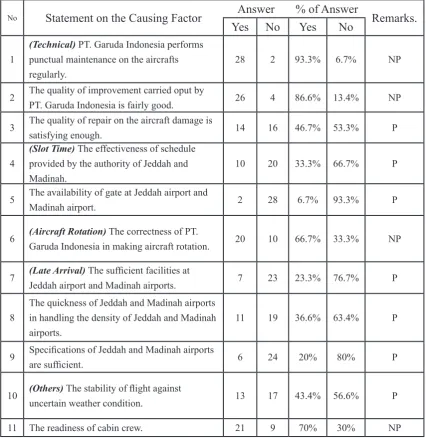
See table 1 in attachment regarding the types of problem causes in relation to
the delay of Garuda Indonesia pilgrimage lights in 2009.
3. Condition of Airports in Indonesia and Issue of Development
Since the implementation of
national aviation deregulation in 2000, the growth of light in Indonesia has increased signiicantly. As an illustration, the growth
of domestic passengers is very high on
average 15% to 20% with the number of
aircrafts operated and ordered by national airlines is predicted to increase sharply
from 697 units in 2010 to 923 units in 2015 (Budihadianto, 2011). INACA (2011)
mentioned that the number of passengers
transported by scheduled airlines in 2009 was as many as 43,808,033 people and increased sharply in 2010 to become 51,775,656 people. The volume of cargo transported was 350,222 tons (2009) increasing to be 749,203 tons (2010), with the seat load factor 82% (2009) and 81.73% (2010). The number of aircraft departure was 390,554 (2009), increasing to be 417,717 (2010). The condition is much
different compared with the condition in
2000/2001 in which the number was still below 20 million passengers per year.
Likewise, for international light,
the number of passengers transported was
(2010), and the number of aircraft departure was 42,870 in 2009 and 50,793 in 2010.
The “booming” growth of passengers and air cargo of course can not be separated from the role and support of airport which should be able to counterbalance that “speed” and “boom”.
In another word, the high growth of light
should be followed with the readiness/
availaibilty of supporting infrastructures,
such as an airport.
Today the number of airports in
Indonesia is 233, other than 20 special
airports that are in operation. Referring to the Decree of Transportation Minister
No. 11 Year 2010, airports in Indonesia are classiied into general airport, special airport, government-managed airport, and
airport managed by a state-owned company
in the form of limited company. Of the 233 existing airports, 164 airports are managed
by service agencies under Directorate General Air Transportation Ministry of
Transportation, 13 airports are managed by PT Angkasa Pura I, 12 airports are managed by PT Angkasa Pura II, and 44 new airports (30 location determinations, 8 relocated, 4 special airports for public, and 2 civil enclaves) (Directorate Aiport, Directorate General Air Transportation, Ministry of Transportation, 2011).
Of the 233 Indonesian airports,
attention is paid more on commercial
airports managed by PT Angkasa Pura I and PT Angkasa Pura II as many as 25 airports,
with the major international airports
comprising Jakarta (Soekarno-Hatta),
Surabaya (Juanda), Denpasar (Ngurah Rai), Makassar (Sultan Hasanuddin), Batam (Hang Nadim), Medan (Polonia), Balikpapan (Sepinggan), Palembang (Sultan Mahmud Badaruddin II), Padang (Minang Kabau), Pekanbaru (Sultan Syarif Kasim II), Pontianak (Supadio), and Manado (Sam Ratulangi).
There are three airports in
Indonesia with the most passengers,
namely Soekarno-Hatta Jakarta (more than
20 million passengers per year), Juanda
Surabaya and Ngurah Rai Denpasar (5 to
20 million passengers per year). While
the other nine major airports have 1 to 5 million passengers (Directorate General
Air Transportation, 2009).
In quantity, the number of airports in Indonesia is relatively enough, although
there is still possibility to build new
airports as the consequence of strong dynamic of regional autonomy, such as the plan to build an airport in Karawang, West Java, Kertajati Airport in Majalengka, West Java, and Labuhan Airport in Banten.
The biggest problems related to airport as a vital subsystem in the air transport system
that have been identiied for the last ive
Table 2 Capacity vs Realization of 13 Airports Managed by PT Angkasa Pura I
Year Capacity (Pax) Realization (Pax)
2008 30,700,440 36,403,511
2009 30,700,440 40,673,172
2010 30,700,440 49,237,437
Source: Directorate General Air
Transportation, 10 March 2011
According to the writer’s experience
in various seminars, discussions, and
interview with air transport business
players, especially airlines, they are generally complaining about slot time, capacity of aircraft park, capacity of waiting room/terminal, up to the readiness of airport equipment/facilities, in this
case Soekarno-Hatta airport and Juanda Airport in Surabaya. The facts show that airlines with LCC business orientation are competing to get departure schedule early in
the morning (at 5 or 6) or known as “golden time”, causing passenger congestion at
the departure terminal and congestion of vehicle coming in and out the parking area.
Why do many airlines like to ly
early in the morning? The information received by the writer say that the airlines get incentive or discount from airport
management, and the second reason is
related to the strategy of LCC airlines who offer low tariff to passengers provided that passengers are willing to go to airport early in the morning. Ticket price using subclasses
system has unique characteristics and trend, i.e. quota per class limited by relatively
short time. The later day the higher the price and otherwise the earlier day the lower the price. Buying a ticket today or this hour will be more expensive than buying it several days before. Ticket regulations are more
rigid, and less information with minimum
level of service.
In the round table discussion held
by Research and Development Body on
Transportation on 4 August 2011, there was information that PT Angkasa Pura I and PT Angkasa Pura II had planned to develop
an airport they would manage in response
to any complain from users, especially airlines and passengers. For example, some airports managed by PT Angkasa Pura I in its program year 2011-2013 and 2012-2014 have been scheduled to be developed,
among others are:
a. Ngurah Rai Airport in Bali will be
developed to become 129,000 M2 targeting 24.6 million passengers per year (up to 2025), as well as a
highway to/from Ngurah Rai airport in
cooperation with Jasa Marga, BTDC and Pelindo.
b. Sepinggan Airport in Balikpapan will
be developed to become 100,000 M2 with capacity for 10 million passengers per year (2025)
c. Terminal 2 of Juanda Airport will be
built on the south side of runway as
wide as 29,000 M2, with capacity for 14 million passengers per year, as well
d. Terminal extension will be carried out at Adi Sutjipto Airport in Yogyakarta: international terminal is used for domestic terminal
extension, administration ofice will
be demolished to become international
terminal, and there is a plan to build a new airport in Kulon Progo.
e. At Syamsuddin Noor Airport,
expansions of terminal and parking area will be done by demolishing the
administration ofice, a new terminal
and supporting facilities are planned to be built in the north side of new apron
to become 36,600 M2, with capacity for 4.3 million passengers per year.
f. At Achmad Yani Airport in Semarang,
there will be a new terminal and supporting facilities built on the north
side of runway to become 21,500 M2
with capacity for 3 million passengers
per year, an apron constructed by DJU, and access road constructed by the Provincial Government of Central
Java.
g. Facilities development for light safety, such as procurement of MSSR radar in Ambon (2011-2012), Manado (2012), and Kendari (2012); VHF-ER installation in Pangkalan Bun (2012), Tarakan, and Luwu (2012); ATC
System installation in Balikpapan
(2011), Surabaya, and Bali (2009);
tower set installation at Frans Kaisiepo
Airport (2011), Adi Sutjipto Airport (2010), and Adi Sumarmo Airport (2011); VOR/ILS installation for Adi Sutjipto Airport (2011); runway sweeper procurement at UPG, BIK, and SRG (2011); salvage procurement
for Juanda and Sultan Hasanuddin
airports (2011); procurement of 12 units of crash car for BDJ, SUB, BPN, DPS, SOC, JOG, SRG, UPG, MDC, KOE, BIK, and BIL airports.
h. Development of light security facilities, such as: procurement of X-Ray for all airports (2011);
installation of hold baggage screening
for Ngurah Rai airport (2013);
Table 3 Capacity vs Realization of 8 Airports Managed by PT Angkasa Pura II in 2010
No. Airport Terminal Capacity Realization
1. Soekarno-Hatta, CGK 15,332,000 44,355,998
2. Polonia, MES 900,000 6,189,575
3. Minang Kabau, PDG 1,000,000 2,054,141
4. SSK II, Riau 700,000 2,280,567
5. PLM, Sumsel 1,000,000 2,108,413 6. PNK, Kalimantan Barat 900,000 1,825,827 7. PGK, Bangka Belitung 350,000 1,096,530
8. DJB, Jambi 250,000 936,286
procurement of electricity power
(generator) for JOG and BDJ airports (2011); UPS installation for DPS airport and other airports (2015).
i. Manpower in aviation is of crucial
problems faced by PT Angkasa Pura I, because to fulill it will need not
just a little time and there are limited
manpower providers. In terms of quantity, the number of personnel
assigned in the following units is still
far below the ideal need: ATS, AMC, Aviation Security, PK-PPK oficers, and light technician. The total personnel existing now is only 1,908 people, while the ideal number needed is 5,083, thus there is a shortcoming as many as 1,885 people in total.
The problem faced by PT Angkasa Pura I is basically faced by PT Angkasa Pura II as well. The difference is that PT Angkasa Pura II has Soekarno-Hatta
airport which is the biggest and busiest
airport in Indonesia, so that attention
from public and international world is
paid more to Soekarno-Hatta airport. PT Angkasa Pura II as the management of
commercial airports in the west region of
Indonesia has had “re-grand design”of
Soekarno-Hatta international airport which in its grand launching is mentioned as new
airport city, an airport with a new concept, to be constructed in 2012 and targeted to complete in 2015.
Capacity expansion, accessibility,
and modernization of Soekarno-Hatta airport are of urgent things regarding
the airport capacity is designed to
accommodate 18 to 25 million passengers per year. Meanwhile, the number of passengers in 2010 had achieved 44 million
people. As well as for ATC management
which will become ATC single provider,
it should be improved soon in terms of
quality, quantity, professionalism of the oficers, and navigation devices. Electricity
infrastructure and telecommunication network at Soekarno-Hatta airport should
also be prepared and ixed properly in order
to improve the reliability and preparedness of Soekarno-Hatta airport to face the global
aviation era 2015 (ASEAN Open Skies).
Some problems faced by PT Angkasa Pura II related to light security
devices are:
a. Some facilities of X-Ray baggage, cabin, and cargo are still single view, with the condition/quality of X-Ray averagely 70%; some are vulnerable to
heat causing hang; many monitors are
blurred making the oficers dificult
to distinguish organic substance from inorganic one.
b. The existing walk through metal
detectors (WTMD) comprise various brands, and generally the position of light emiting diode (LED) is on the
gate (the ideal position of LED is in
the right/left side of the gate); the sensitivity level is still good enough,
but some can not be set maximally anymore.
3. Hand held metal detectors (HHMD)
brands, with the condition/quality around 70%; only two units of
explosives metal detectors existing at
Soekarno-Hatta and Polonia airports.
The development program or modernization for the airports managed by
PT Angkasa Pura II from 2010 up to 2014
among others are:
a. Soekarno-Hatta international airport;
it has achieved around 44.3 million passengers per year (2010) while the capacity is to accommodate 22
million passengers per year; Terminal 3 ultimate will be developed as wide
as 180,000 up to 200,000 M2, so that the total width will be 540,758 M2;
runway 3 will be developed as wide as
3.600 X 60 M (1014); the apron will be able to accommodate 112 aircrafts
with additional apron T3 as wide as
57,600 M2, so that the total width of apron will be 945,290 M2
b. Polonia Airport Medan; so far the
capacity is just for 1 million passengers
per year, while the realization has achieved 6.2 million passengers per
year. The future development is to
remove it out of Medan city, namely Kuala Namu (New Medan Airport)
which is designed to accommodate
10 million passengers supported by a terminal as wide as 115,000 M2, runway as wide as 3.750 X 60 M, so that it can be used for A.380 aircrafts to land, apron as wide as 300,000 M2 with capacity to accommodate
33 aircrafts. The progress of its
development has achieved 72%. Master Plan of Kuala Namu airport
is designed to have airport area as
wide as 1,365 Ha, terminal as wide as 224,298 M2 (ultimate), paralel runway as wide as 3.750 X 60 (2 locations), apron as wide as 664,000 M2.
c. SSK II PKU airport will be developed to be able to serve 2.5 million
passengers per year with terminal as
wide as 16,000 M2, can be used for
B.737 aircrafts to land with runaway as
wide as 2,240 X 45 M, apron as wide 82,500 M2 which can accommodate 14
aircrafts. The progress of development
has achieved 88%.
d. SMB II-PLM airport will be developed to be able to serve 2.5 million
passengers per year with effective
terminal as wide as 16,500 M2.
e. Sultan Thaha-DJB airport; the existing
terminal will be enlarged to be 13,015 M2 so that it can accommodate 1.5 million passengers per year, runway will be expanded to be 2,250 X 30 M
so that it can be used for B.737 aircrafts
to land, apron will be enlarged to be 39,273 M2 so that it can accommodate
8 aircrafts.
f. RHF-TNJ; terminal will be developed
g. Depati Amir-PGK airport; terminal will be enlarged to be 12,170 M2 to serve 1.3 million passengers per year, runway will be expanded to be 2,250 X 30 M, apron will be enlarged to becoma 37,720 M2 (7 aircrafts).
h. Husein Sastranegara-BDO airport; terminal will be enlarged to be
8,650 M2 to accommodate 1 million passengers per year, the strength of
runway construction will be enhanced.
i. Supadio-PNK airport; terminal will be enlarged to be 25,000 M2 to be able to serve 2.5 million passengers per year, terminal special for cargo will be built, runway will be expanded to be 2,250 X 45 M.
j. BIM-PDG airport; terminal will be enlarged to be 19,500 M2 to be able to accommodate 2.5 million passengers per year, runway will be expanded to be 3,000 X 45 M.
4. Strategic Issues
An airport has fairly signiicant contributions to light delays, thus the
airport authorities should always improve their performance in serving national airlines. Airport and airlines should make a synergy to provide the users (in this case
passengers and cargo senders), with the best product/service i.e. safety, punctuality, and
service in general. The synergy between the two parties should be supported by
the government as the aviation authority, especially in the aspects of regulation, control, and supervision. The government
as regulator should periodically carry out audits and other kinds of supervision/ evaluation on the the performance of
airlines and airports. It is necessary to carry
out these activities to assure that the process runs appropriately and results in the best product oriented to customer satisfaction.
In line with the thoughts above, airport management, airport authority,
and airlines should pay attention to various strategic issues or ongoing market
trend, such as safety and security issue, growth in number, capacity building (terminal/airport), low cost carriers, low cost terminals, including ASEAN Single Aviation Market 2015 that can not be
avoided.
The construction and development of the existing airports are not only a local
prestige nor instant response, but they
should be intended to develop and increase the airport capacity both infrastructures and facilities that support the development of hub system for a good network of national aviation either based on LCC or on full
service carriers, include the development of main hub, secondary hub, and pioneer routes, anticipate the increasing growth of national aviation industry. In addition, the
airlines and airport should always improve
the quality of human resource and develop a
national education institution to encourage the rise of wordclass airlines and airports.
Those issues should be well paid
attention, especially by the airports,
national aviation. Facts in the ield show (Manurung, 2010) that there have been no
alignment and synergy of strategic planning between airlines and airport industry in
Indonesia; business innovations by airlines
are not fully supported with infrastructure development and capital for airport
business; the high growth of air trafic (aircraft movement, passenger and cargo)
has not been supported by the growth of
airports, especially their capacity.
Rediscussion and agreement are needed to position airport as a factor that
has contribution to light delays with a clear deinition or criteria which is not ambiguous with technical matters and light operation.
To this end, it can be concluded
that the airport factor comprising land side and air side is an external factor in the perspective of air transport operator which
IATA Delay Code gives a code of number 8 called Used for Air Trafic Control (ATC)
Restrictions and Airport or Governmental Authorities Caused Delays. This code is used to illustrate the delay caused by limitation/policy of ATC and airport or the
government (airport) authority. Another
name is airport facility. This is to show the support from the airport management or authority in the form of readiness and
facilities in order to smoothen the air trafic or light operation. Included in airport
facility are readiness and ability of ATC.
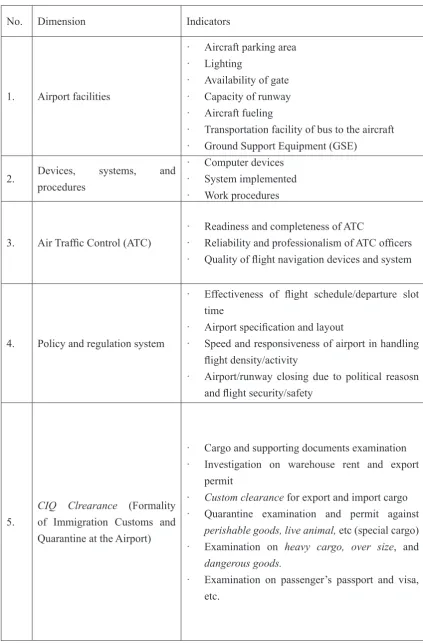
(see table 4 in attachment)
Conclusion
The performance of light
punctuality is determined by many factors comprising internal factor of the airline
companies such as technical, operational and commercial factors, as well as external factors such as airport and wheather factors,
and so forth.
Airport factor has fairly signiicant contribution to the light delays or to the
unachieved on time performance (OTP).
Therefore, airport (management and authority) should understand this problem
as a part of performing the role and function
of an airport to smoothen the air trafic.
A secure, smooth, and on time light relects a collective success of the parties involved in light operation, including the role, support, and readiness of airport.
The biggest problems related to
airport as a vital subsystem of Indonesian
air transport system that have been
identiied during the last ive years are
capacity, slot time, quality of light
navigation devices, accessibility to and from airport, professionalis of airport and ATC human resources, including the most crucial problem concerning infrastructures, facilities, devices and human resources for light security and safety at the airport.
In order to overcome those problems, willingness and ability of the
airport management and airport authority
are needed to anticipate and act quickly and properly, and make a harmonious
problems do not happen again in the future. The most important is the willingness of airport management and authority to well practice good corporate governance such as strengthening the aspects of transparency and accountability.
In-depth study and research are necessary to ascertain the deinition of airport factor, airport performance,
including airport evaluation and audit related to the service function of airport
toward airlines, especially in the case of light delay.
Bibliography
Act of the Republic of Indonesia No. 1 Year 2009 concerning Transportation
Bramantyo, Damar. 2010. Analisis Faktor-faktor Penyebab Delay pada Penerbangan Haji PT. Garuda Indonesia Tahun 2009. Undergraduate (Strata 1) on
Air Transport Management
(unpublished) [Thesis]. Jakarta:
STMT Trisakti
Budihadianto, Richard. 2011. Makalah
Memberdayakan Peran Perusahaan Penerbangan dalam Mendukung Enam Koridor Pembangunan Ekonomi Nasional. Seminar
and General Meeting of INACA Members at Hotel Borobudur 28 July 2011. Jakarta: INACA
Directorate General Air Transportation,
2011. Makalah Kebijakan
Pengembangan Prasarana, Sarana,
Peralatan, dan SDM Keamanan dan Keselamatan Penerbangan di Seluruh Bandar Udara di Indonesia. Round Table Discussion held by Research and Development
Body on Transportation 4 August 2011. Jakarta: Badan Litbang Perhubungan
Directorate General Air Transportation,
2011. Makalah Arah Kebijakan
Pengembangan Bandar Udara pada Masa Mendatang Pasca Penetapan UU No. 1/2009. Round Table Discussion held by Research and Development
Body on Transportation 10 March 2011. Jakarta: Badan Litbang Perhubungan
Indonesia National Air Carriers Association
(INACA). 2010. Annual Report
2010. Jakarta: INACA
Manurung, Laurensius. 2010. Strategi dan
Inovasi Model Bisnis Meningkatkan Kinerja Usaha Studi Empiris Industri Penerbangan. Jakarta: Elex Media Komputindo
Decree of Transportation Minister of the
Republic of Indonesia No. 11 Year 2010 concerning National Airport
Organization
Majid, S.A. 2011. Ada Apa dengan Faktor
Teknik Studi Kasus Faktor Penyebab Keterlambatan Penerbangan Nasional. TRANSPOR Magazine Volume 29 No. 1. Jakarta: STMT
Majid, S.A. 2010. Mengenal Faktor-faktor Penyebab Keterlambatan suatu Penerbangan. TRANSPOR Magazine Volume 28 No. 1. Jakarta:
STMT Trisakti
PT. Angkasa Pura II, 2011. Makalah
Rencana Pengembangan Bandar Udara pada Masa Mendatang untuk Peningkatan Pelayanan Jasa bandar Udara. Round Table Discussion held by Research and Development
Body on Transportation 10 March 2011. Jakarta: Badan Litbang Perhubungan
PT. Angkasa Pura I, 2011. Makalah Rencana
Pengembangan Prasarana, Sarana, dan SDM Keamanan dan Keselamatan Penerbangan di Bandar Udara yang Dikelola oleh PT. Angkasa Pura I s.d. Tahun 2025. Round Table Discussion held by Research and Development
Body on Transportation 4 August 2011. Jakarta: Badan Litbang Perhubungan
PT. Angkasa Pura II, 2011. Makalah Rencana
Pengembangan Prasarana, Sarana, Peralatan, dan SDM Keselamatan dan keamanan Penerbangan. Round Table Discussion held by Research and Development
Body on Transportation 4 August 2011. Jakarta: Badan Litbang Perhubungan
Rai, Salahudin. 2011. Makalah Bandar
Udara yang Aman dan Nyaman untuk Semua. One-Day Seminar on Airport and Airport Accessibility 18
May 2011. Jakarta: STMT Trisakti
Setiawan, Indra. 2009. Laporan Penelitian Analisis OTP dan Faktor-faktor Penyebab Keterlambatan Pesawat PT. Garuda Indonesia Tahun 2008. Unpublished. Jakarta: P3M STMT
Trisakti
Suharno, Hadi. 2009. Manajemen
Perencanaan Bandar Udara.
Jakarta: Raja Graindo Persada
T. Wells, Alexander, young, Seth. 2004. Airport Planning & Management
Table 1 Types of Problem-Causing Factors in Garuda Indonesia Pilgrimage Flights
No Statement on the Causing Factor Answer % of Answer Remarks.
Yes No Yes No
1
(Technical) PT. Garuda Indonesia performs
punctual maintenance on the aircrafts regularly.
28 2 93.3% 6.7% NP
2 The quality of improvement carried oput by
PT. Garuda Indonesia is fairly good. 26 4 86.6% 13.4% NP
3 The quality of repair on the aircraft damage is
satisfying enough. 14 16 46.7% 53.3% P
4
(Slot Time)The effectiveness of schedule
provided by the authority of Jeddah and Madinah.
10 20 33.3% 66.7% P
5 The availability of gate at Jeddah airport and
Madinah airport. 2 28 6.7% 93.3% P
6 (Aircraft Rotation) The correctness of PT.
Garuda Indonesia in making aircraft rotation. 20 10 66.7% 33.3% NP
7 (Late Arrival)Thesuficient facilities at
Jeddah airport and Madinah airports. 7 23 23.3% 76.7% P
8
The quickness of Jeddah and Madinah airports
in handling the density of Jeddah and Madinah airports.
11 19 36.6% 63.4% P
9 Speciications of Jeddah and Madinah airports
are suficient. 6 24 20% 80% P
10 (Others)The stability of light against
uncertain weather condition. 13 17 43.4% 56.6% P
11 The readiness of cabin crew. 21 9 70% 30% NP
Note: NP (No problem), P (Problem)
Source: Damar Bramantyo, 2010
Table 4 Details of Airport Factor
No. Dimension Indicators
1. Airport facilities
· Aircraft parking area
· Lighting
· Availability of gate
· Capacity of runway
· Aircraft fueling
· Transportation facility of bus to the aircraft
· Ground Support Equipment (GSE)
2. Devices, systems, and
procedures
· Computer devices
· System implemented
· Work procedures
3. Air Trafic Control (ATC)
· Readiness and completeness of ATC
· Reliability and professionalism of ATC oficers · Quality of light navigation devices and system
4. Policy and regulation system
· Effectiveness of light schedule/departure slot
time
· Airport speciication and layout
· Speed and responsiveness of airport in handling
light density/activity
· Airport/runway closing due to political reasosn
and light security/safety
5.
CIQ Clrearance (Formality
of Immigration Customs and Quarantine at the Airport)
· Cargo and supporting documents examination
· Investigation on warehouse rent and export
permit
· Custom clearance for export and import cargo
· Quarantine examination and permit against
perishable goods, live animal, etc (special cargo)
· Examination on heavy cargo, over size, and
dangerous goods.
· Examination on passenger’s passport and visa,
etc.
Source: Directorate General Air Transport, 10 March 2011
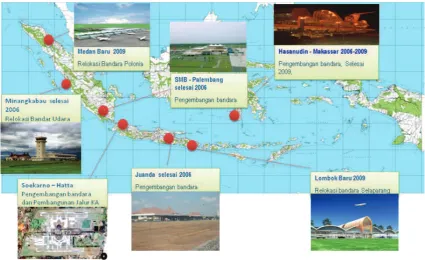
Figure 2. Construction and Development of Strategic Airports which have been running Source: PT. Angkasa Pura II, 10 March 2011