
Computing Curricula 2001
Computer Science
— Final Report —
(December 15, 2001)
The Joint Task Force on Computing Curricula
IEEE Computer Society
Association for Computing Machinery
Vice-President, IEEE-CS Education Activities Board Carl Chang
Chair, ACM Education Board Peter J. Denning
IEEE-CS delegation
James H. Cross II (co-chair) Gerald Engel (co-chair and editor) Robert Sloan (secretary)
Doris Carver Richard Eckhouse Willis King Francis Lau Susan Mengel Pradip Srimani
ACM delegation
Eric Roberts (co-chair and editor) Russell Shackelford (co-chair) Richard Austing
C. Fay Cover Gordon Davies Andrew McGettrick G. Michael Schneider Ursula Wolz
Endorsed by the ACM Council, November 2001
This document represents the final report of the Computing Curricula 2001 project (CC2001)—a joint undertaking of the Computer Society of the Institute for Electrical and Electronic Engineers (IEEE-CS) and the Association for Computing Machinery (ACM) to develop curricular guidelines for undergraduate programs in computing. The report continues a long tradition of recommendations for academic programs in computing-related fields dating back to 1965, as described in Chapter 2 of the report.
This volume of the report outlines a set of recommendations for undergraduate programs in computer science. As described in Chapter 1, the CC2001 report will eventually consist of several volumes containing separate recommendations for other computing disciplines, including computer engineering, software engineering, and information systems. Those reports are each under the control of separate committees and will be published as they are completed.
Highlights of this report include the following:
• The CS body of knowledge. We have identified a body of knowledge appropriate to undergraduate computer science programs. Drawing on the structure of earlier curriculum reports, we have arranged that body of knowledge hierarchically, subdividing the field into areas, which are then broken down further into units and individual topics. An overview of the body of knowledge appears in Chapter 5.
• The CS undergraduate core. From the 132 units in the body of knowledge, we have selected 64 that represent core material, accounting for approximately 280 hours of instruction. As noted in our statement of principles in Chapter 4, we defined the core as the set of units for which there is a broad consensus that the material is essential to an undergraduate degree in computer science. The philosophy behind the definition of the core is described in more detail in Chapter 5.
• Learning objectives. For each of the units in the body of knowledge, we have developed a set of learning objectives designed to promote assessment of student achievement. These learning objectives appear as part of the detailed description of the body of knowledge in Appendix A. In addition to the individual learning objectives, Chapter 11 of the report outlines a more general set of objectives that all computer science graduates should be able to meet.
• Curriculum models. The report identifies six approaches to introductory computer science that have proven successful in practice, as described in Chapter 7. Building on that foundation, Chapter 8 offers a set of four thematic approaches for presenting the core material in intermediate-level courses. The discussion of curricular models continues in Chapter 9, which offers several models for the curriculum as a whole. • Course descriptions. Appendix B contains detailed course descriptions for 47 courses
that are part of the various curriculum models. In addition, we have identified over 80 additional advanced courses that would be appropriate for undergraduate programs.
Chapter 1. Introduction ...1
Chapter 2. Lessons from Past Reports ...6
Chapter 3. Changes in the Computer Science Discipline ...9
Chapter 4. Principles ...12
Chapter 5. Overview of the CS Body of Knowledge...14
Chapter 6. Overview of the Curricular Models...18
Chapter 7. Introductory Courses ...22
Chapter 8. Intermediate Courses...35
Chapter 9. Completing the Curriculum...40
Chapter 10. Professional Practice ...55
Chapter 11. Characteristics of CS Graduates...62
Chapter 12. Computing across the Curriculum...67
Chapter 13. Institutional Challenges...74
Acknowledgments...78
Bibliography...79
Appendix A. The CS Body of Knowledge ...83
Chapter 1
Introduction
In the fall of 1998, the Computer Society of the Institute for Electrical and Electronic Engineers (IEEE-CS) and the Association for Computing Machinery (ACM) established the Joint Task Force on Computing Curricula 2001 (or CC2001 for short) to undertake a major review of curriculum guidelines for undergraduate programs in computing. The charter of the task force was expressed as follows:
To review the Joint ACM and IEEE/CS Computing Curricula 1991 and develop a revised and enhanced version for the year 2001 that will match the latest developments of computing technologies in the past decade and endure through the next decade.
As indicated in our charter, the goal of the CC2001 effort is to revise Computing Curricula 1991 so that it incorporates the developments of the past decade. That task has proved much more daunting than we had originally realized. Computing has changed dramatically over that time in ways that have a profound effect on curriculum design and pedagogy. Moreover, the scope of what we call computing has broadened to the point that it is difficult to define it as a single discipline. Past curriculum reports have attempted to merge such disciplines as computer science, computer engineering, and software engineering into a single report about computing education. While such an approach may have seemed reasonable ten years ago, there is no question that computing in the 21st century encompasses many vital disciplines with their own integrity and pedagogical traditions.
1.1 Overall structure of the CC2001 series
In light of the broadening scope of computing—and because the feedback we received on our initial draft strongly encouraged us to move in this direction—we have chosen to divide the CC2001 report into several volumes. This volume focuses specifically on computer science. To encompass the many other disciplines that are part of the overall scope of computing and information technology, however, IEEE-CS and ACM have created additional committees to undertake similar efforts in other areas, including computer engineering, software engineering, and information systems.
Once the individual reports have been completed, representatives from all the disciplines will come together to produce an overview volume that links the series together. That overview volume will contain definitions of the various computing disciplines along with an assessment of the commonalities that exist in the curricular approaches. The structure of the series as a whole is illustrated in Figure 1-1.
1.2 Overview of the CC2001 process
– 2 –
Computing Curricula 2001
Overview
The Joint Task Force on Computing Curricula
IEEE Computer Society Association for Computing Machinery The overview document will be produced by
representatives of the various disciplines after the individual reports are complete. It will focus on computing education as a whole.
This report (which you are reading now in draft) will be published in 2001 by the CC2001 Task Force.
These reports—perhaps with additional volumes for other disciplines—will be prepared in consultation with existing curriculum committees in these areas. In many cases, these committees have already published curriculum guidelines that can easily be incorporated into the CC2001 structure.
Note: This diagram represents our vision of the eventual structure of the CC2001 report. No official organizational endorsements have yet been obtained.
Computing Curricula 2001
Computer Science
The Joint Task Force on Computing Curricula
IEEE Computer Society Association for Computing Machinery
Computing Curricula 2001
Computer Engineering
The Joint Task Force on Computing Curricula
IEEE Computer Society Association for Computing Machinery
Computing Curricula 2001
Software Engineering
The Joint Task Force on Software Engineering Education
Project (SWEEP)
Computing Curricula 2001
Information Systems
Association for Computing Machinery Association for Information Systems
Association of Information Technology Professionals A separate committee has been
[image:6.612.75.738.82.510.2]1.2.1 Knowledge focus groups (KFGs)
Early in its history, the CC2001 Task Force identified a set of 14 areas that together represented the body of knowledge for computer science at the undergraduate level, as shown in Figure 1-2. For each of these areas, the task force appointed a knowledge focus group composed of people with expertise and teaching experience in that domain. The charge to each KFG was to prepare a report on the area from which the task force could assemble the complete CS body of knowledge. Additional details on this aspect of the process appear in Chapter 5 and Appendix A.
1.2.2 Pedagogy focus groups
Although the knowledge area focus groups are essential in terms of defining the body of knowledge in each subdiscipline, they are not in themselves sufficient. Because each group looks at the field of computer science through a lens that reflects a particular specialty area, the KFG structure does not encourage the development of a broad vision of the curriculum that focuses on crosscutting themes common throughout the discipline. To develop that more holistic perspective and to address a variety of questions that transcend the boundaries of the individual subdisciplines, the CC2001 Task Force established six pedagogy focus groups to consider curricular issues across computer science as a whole. These groups are listed, along with their specific charges, in Figure 1-3.
The pedagogy focus groups were formed later in the process than the counterpart focus groups examining the knowledge areas. The work of the pedagogy focus groups, moreover, proved more difficult to carry out solely through electronic communication. With the support of a generous grant from the National Science Foundation, the CC2001 Task Force was able to convene a face-to-face meeting of the pedagogy focus groups in June 2000, which proved extremely valuable in developing the final reports.
1.2.3 Two-Year College Task Force
Following the release in early 2001 of a draft version of CC2001, the ACM Two-Year College Education Committee formed a joint ACM/IEEE-CS task force whose purpose was to formulate a parallel curriculum report for the two-year college setting. This task force undertook a very detailed examination of the draft CC2001 guidelines, focusing on the introductory computer science topics and associated learning objectives, the mathematics content, and electives at the introductory level. The CC2001 report was subsequently influenced by the work of the two-year college task force, and that work provided the basis for parallel introductory course sequences that foster greater compatibility between two-year and four-year curricula, thereby facilitating the transfer process.
1.3 Structure of the CC2001 computer science report
This volume of the CC2001 report looks specifically at computer science. The main body of the report consists of 13 chapters. Chapter 2 begins with a survey and analysis of
Figure 1-2. The 14 knowledge focus groups
Discrete Structures (DS) Human-Computer Interaction (HC)
Programming Fundamentals (PF) Graphics and Visual Computing (GV)
Algorithms and Complexity (AL) Intelligent Systems (IS)
Architecture and Organization (AR) Information Management (IM)
Operating Systems (OS) Social and Professional Issues (SP)
Net-Centric Computing (NC) Software Engineering (SE)
Figure 1-3. The six pedagogy focus groups and their charges
PFG1. Introductory topics and courses a. Identify the goals of the first year of study.
b. Report on the strengths and weaknesses of the traditional programming-first approach.
c. Provide a short list of alternative approaches which have credibility in terms of meeting those goals. d. Identify and/or develop one or more introductory course sequences that address the problem of dissimilar
preparation of incoming students, do not rely on terminal service courses to discriminate among the various needs and backgrounds of students who are just beginning their undergraduate careers, and introduce computer science as a mainstream discipline that forms part of the academic core for a broad population of undergraduate students.
e. Present syllabi for a short list of options for the first year of computer science study that satisfy the goals in point (a) and that can serve as models for colleges and publishers.
PFG2. Supporting topics and courses
a. Specify a set of educational goals outside of traditional computer science that support undergraduate computer science education, such as mathematics, engineering, science, technical writing, public speaking, economics, project management, and so forth.
b. Identify a minimal list of supporting topics deemed essential to any undergraduate computer science curriculum regardless of the nature of the institution.
c. Present suggestions for additional supporting topics beyond that minimum that may vary depending on the type of institution, the populations an institution serves, and the number of courses which the institution is allowed to include in a program.
d. Develop specifications for one or more sets of non-CS courses that satisfy these goals.
e. Develop one or more models for satisfying some or all of these goals by integrating them into computing courses.
PFG3. The computing core
a. Given the specification of the CS core as input, develop a small number of curricular models that satisfy the core requirements. Each model should consist of a short list of courses (four or five courses beyond the introductory year of study), which would be required of every computer science graduate and which would be manageable by virtually every type of undergraduate program.
b. Develop at least one curricular model that is an alternative to the traditional approach of organizing programs around artifacts (e.g., courses in compilers, operating systems, and the like). Such models will consist of cross-cutting courses focused on fundamental concepts, principles, and skills.
c. Develop at least one curricular model that has the Internet as its unifying theme.
PFG4. Professional practices
a. Report on those aspects of professional practices that our graduates have (or should have) assimilated as a result of current curricula.
b. Report on what we do and do not know about supporting effective education in those professional practices. c. Report on how these needs can be integrated into courses in the curriculum.
d. Report on industrial and internship work and its relationship to the development of professional practices. e. Report on other aspects of professionalism (including ethical, social, legal and moral issues) and their
relationship to the computer science curriculum.
PFG5. Advanced study and undergraduate research
a. Given the definition of the CS core, develop a specification of computer science education beyond the core that is necessary and sufficient for a undergraduate degree in computer science.
b. Develop a specification of the characteristics of graduates who have earned a four-year undergraduate degree.
c. Include a specification of courses in both traditional and nontraditional areas that may be important for modern undergraduate CS curricula.
d. Report on undergraduate research, including an evaluation of various existing models.
PFG6. Computing across the curriculum
a. Articulate “the core of the core” relevant to all citizens and to various families of academic disciplines. b. Plan and develop a proper curriculum development effort that will address rigorously the challenge of
computing curricula for non-CS majors, be appropriate to institutions other than traditional four-year universities (such as two-year community colleges in the United States), appeal to those from other computing-related disciplines, appeal to those academic disciplines that make significant use of computing. c. Acknowledge that this is a crucial area but one for which we cannot unilaterally develop an adequate
solution.
past reports, focusing most closely on Computing Curricula 1991. Chapter 3 outlines the changes that have occurred in computer science since the publication of the CC1991 report and the implications that those changes have for curriculum design and pedagogy. In Chapter 4, we articulate a set of principles that have guided the development of CC2001 as we attempt to build on the strengths of our predecessors while avoiding some of the problems observed in the earlier reports. Chapters 5 and 6 present overviews of the computer science body of knowledge and the curriculum recommendations that are examined in detail in the appendices. Chapters 7 and 8 describe the courses and approaches we recommend at the introductory and intermediate levels of the curriculum, respectively. Because these courses alone do not constitute a complete undergraduate curriculum, Chapter 9 summarizes additional courses and topics that must be included as part of the academic program. One important aspect of the complete curriculum involves the study of professional practice, which is discussed in Chapter 10. In Chapter 11, we outline a set of characteristics that define the successful computer science graduate. Chapter 12 looks at the problem of teaching computer science and computing-related skills to students in other disciplines. Finally, Chapter 13 offers strategic and tactical suggestions for addressing the institutional challenges that affect the implementation of this report.
Chapter 2
Lessons from Past Reports
In developing this report, the CC2001 Task Force did not have to start from scratch. We have benefited tremendously from past curriculum studies and are indebted to the authors of those studies for their dedicated efforts. As part of our early work on Computing Curricula 2001, we looked carefully at the most recent curriculum studies—particulary Computing Curricula 1991—to get a sense of how those studies have influenced computer science education. By identifying which aspects of the previous reports have been successful and which have not, we hoped to structure the CC2001 report to maximize its impact. This chapter offers an overview of the earlier reports and the lessons we have taken from them.
2.1 Historical background
Efforts to design model curricula for programs in computer science and computer engineering began in 1960s, shortly after the first departments in these areas were established. In 1968, following on a series of earlier studies [ACM65, COSINE67, SAC67], the Association for Computing Machinery (ACM) published Curriculum ’68 [ACM68], which offered detailed recommendations for academic programs in computer science, along with a set of course descriptions and extensive bibliographies for each topic area.
Over the next decade, computer science developed rapidly, to the point that the recommendations in Curriculum ’68 became largely obsolete. During the 1970s, both the ACM and the Computer Society of the Institute of Electrical and Electronics Engineers (IEEE-CS) appointed committees to develop revised computer science curricula. In 1977, the Education Committee of the IEEE-CS published a report for programs in computer science and engineering [EC77]. The Computer Society’s report was significant in that it took a broader view of the discipline, incorporating more engineering into the curriculum and bridging the gap between software- and hardware-oriented programs. Responding to the pressures generated by the rapid development of the field, the Computer Society updated its computer science and engineering curriculum in 1983 [EAB83]. The ACM Curriculum ’68 report was superseded by a much more comprehensive Curriculum ’78, which had a substantial impact on computer science education. Among its contributions, Curriculum ’78 proposed a standard syllabus for a set of courses that encompassed the core knowledge of computer science as a discipline.
2.2 Evaluation of previous curriculum efforts
The decision to produce a new curriculum report was driven primarily by the enormous changes that have occurred in computer science over the past decade. At the same time, there was also a perception among some computer science educators that CC1991 was not as influential as some of its predecessors. Although CC1991 is certainly more detailed, institutions have sometimes found it harder to adopt than Curriculum ’78 and the IEEE-CS model curriculum in computer science and engineering.
In order to understand both the strengths and the limitations of CC1991, the task force undertook an informal survey of computer science educators. We developed a short questionnaire, which we then mailed to the chairs of all computer science departments in the United States and Canada. We also made the questionnaire available more generally through the World Wide Web, although the vast majority of the responses still came from North America. A copy of the questionnaire appears in Figure 2-1.
Over 98 percent of the respondents—we received 124 responses through the web and about 30 responses through regular mail—supported the concept of updating the CC1991 report. The survey responses also revealed the following general reactions:
• Knowledge units are often not as useful as course or curriculum designs. Although many respondents indicated that they liked the concept of knowledge units as a resource, there was strong sentiment for a greater emphasis on course design along with the knowledge units. Our survey revealed that many institutions continue to work with the curriculum models outlined in Curriculum ’78, largely because it included specific course designs.
• There is strong support for a more concrete definition of a minimal core. CC1991 argues that all undergraduate programs in computer science should incorporate the entire collection of knowledge units in the nine areas that comprise the common requirements. If the area encompassing Introduction to a Programming Language is included, the knowledge units in the common requirements account for 283 hours of classroom time. As our discipline evolves, it is tempting to add new material to the required set, thereby increasing the number of hours mandated by the curriculum. Our survey revealed considerable support for the idea of identifying a smaller set of core topics that would serve as a foundation for more advanced study. The areas and
Figure 2-1. Questionnaire to assess the impact of Computing Curricula 1991
1. Did you use CC1991 in any way in the past?
2. If you are a college or university teacher, do you know if your department ever looked at or used CC1991?
3. If you answered yes to either question, how was it used, and what features of it were helpful?
4. Do you think there is a need to create CC2001? Why?
5. CC1991 had 10 main content areas. Do you think any new areas should be added? Any existing area deleted? Any existing area updated?
6. Do you believe CC2001 should provide guidelines about a minimal core? If so, what would that core include?
7. Do you have any suggestion about the format? CC1991 was designed in terms of knowledge units along with possible model curricula in terms of those knowledge units.
structure of the more advanced courses could vary markedly depending on the nature of the institution, the academic program, and the needs and interests of individual students.
Chapter 3
Changes in the Computer Science Discipline
As we enter the new millennium, computer science is an enormously vibrant field. From its inception just half a century ago, computing has become the defining technology of our age. Computers are integral to modern culture and are the primary engine behind much of the world’s economic growth. The field, moreover, continues to evolve at an astonishing pace. New technologies are introduced continually, and existing ones become obsolete almost as soon as they appear.
The rapid evolution of the discipline has a profound effect on computer science education, affecting both content and pedagogy. When CC1991 was published, for example, networking was not seen as a major topic area, accounting for only six hours in the common requirements. The lack of emphasis on networking is not particularly surprising. After all, networking was not yet a mass-market phenomenon, and the World Wide Web was little more than an idea in the minds of its creators. Today, networking and the web have become the underpinning for much of our economy. They have become critical foundations of computer science, and it is impossible to imagine that undergraduate programs would not devote significantly more time to this topic. At the same time, the existence of the web has changed the nature of the educational process itself. Modern networking technology enhances everyone’s ability to communicate and gives people throughout the world unprecedented access to information. In most academic programs today—not only in computer science but in other fields as well— networking technology has become an essential pedagogical tool.
The charter of the CC2001 Task Force requires us to “review the Joint ACM and IEEE/CS Computing Curricula 1991 and develop a revised and enhanced version for the year 2001 that will match the latest developments of computing technologies.” To do so, we felt it was important to spend part of our effort getting a sense of what aspects of computer science had changed over the last decade. We believe that these changes fall into two categories—technical and cultural—each of which have a significant effect on computer science education. The major changes in each of these categories are described in the individual sections that follow.
3.1 Technical changes
Much of the change that affects computer science comes from advances in technology. Many of these advances are part of a ongoing evolutionary process that has continued for many years. Moore’s Law—the 1965 prediction by Intel founder Gordon Moore that microprocessor chip density would double every eighteen months—continues to hold true. As a result, we have seen exponential increases in available computing power that have made it possible to solve problems that would have been out of reach just a few short years ago. Other changes in the discipline, such as the rapid growth of networking after the appearance of the World Wide Web, are more dramatic, suggesting that change also occurs in revolutionary steps. Both evolutionary and revolutionary change affects the body of knowledge required for computer science and the educational process.
Technical advances over the past decade has increased the importance of many curricular topics, such as the following:
• The World Wide Web and its applications
• Graphics and multimedia • Embedded systems • Relational databases • Interoperability
• Object-oriented programming
• The use of sophisticated application programmer interfaces (APIs) • Human-computer interaction
• Software safety
• Security and cryptography • Application domains
As these topics increase in prominence, it is tempting to include them as undergraduate requirements. Unfortunately, the restrictions of most degree programs make it difficult to add new topics without taking others away. It is often impossible to cover new areas without reducing the amount of time devoted to more traditional topics whose importance has arguably faded with time. The CC2001 Task Force has therefore sought to reduce the required level of coverage in most areas so as to make room for new areas. This point is discussed further in Chapter 4.
3.2 Cultural changes
Computing education is also affected by changes in the cultural and sociological context in which it occurs. The following changes, for example, have all had an influence on the nature of the educational process:
• Changes in pedagogy enabled by new technologies. The technical changes that have driven the recent expansion of computing have direct implications on the culture of education. Computer networks, for example, make distance education much more feasible, leading to enormous growth in this area. Those networks also make it much easier to share curricular resources among widely distributed institutions. Technology also affects the nature of pedagogy. Demonstration software, computer projection, and individual laboratory stations have made a significant difference in the way computer science is taught. The design of computer science curricula must take into account those changing technologies.
• The dramatic growth of computing throughout the world. Computing has expanded enormously over the last decade. For example, in 1990, few households—even in the United States—were connected to the Internet. A U.S. Department of Commerce study [NTIA99] revealed that by 1999 over a third of all Americans had Internet access from some location. Similar growth patterns have occurred in most other countries as well. The explosion in the access to computing brings with it many changes that affect education, including a general increase in the familiarity of students with computing and its applications along with a widening gap between the skill levels of those that have had access and those who have not.
• Greater acceptance of computer science as an academic discipline. In its early years, computer science had to struggle for legitimacy in many institutions. It was, after all, a new discipline without the historical foundations that support most academic fields. To some extent, this problem persisted through the creation of CC1991, which was closely associated with the Computing as a Discipline report [Denning89]. Partly as a result of the entry of computing technology into the cultural and economic mainstream, the battle for legitimacy has largely been won. On many campuses, computer science has become one of the largest and most active disciplines. There is no longer any need to defend the inclusion of computer science education within the academy. The problem today is to find ways to meet the demand.
Chapter 4
Principles
Based on our analysis of past curriculum reports and the changes in our discipline outlined in the preceding chapters, the CC2001 Task Force has articulated the following principles to guide our work:
1. Computing is a broad field that extends well beyond the boundaries of computer science. A single report that covers only computer science cannot address the full range of issue that colleges and universities must consider as they seek to address their computing curricula. Additional reports in this series will be required to cover other computing disciplines.
2. Computer science draws its foundations from a wide variety of disciplines. Undergraduate study of computer science requires students to utilize concepts from many different fields. All computer science students must learn to integrate theory and practice, to recognize the importance of abstraction, and to appreciate the value of good engineering design.
3. The rapid evolution of computer science requires an ongoing review of the corresponding curriculum. Given the pace of change in our discipline, the process of updating the curriculum once a decade has become unworkable. The professional associations in this discipline must establish an ongoing review process that allows individual components of the curriculum recommendations to be updated on a recurring basis.
4. Development of a computer science curriculum must be sensitive to changes in technology, new developments in pedagogy, and the importance of lifelong learning. In a field that evolves as rapidly as computer science, educational institutions must adopt explicit strategies for responding to change. Institutions, for example, must recognize the importance of remaining abreast of progress in both technology and pedagogy, subject to the constraints of available resources. Computer science education, moreover, must seek to prepare students for lifelong learning that will enable them to move beyond today’s technology to meet the challenges of the future.
5. CC2001 must go beyond knowledge units to offer significant guidance in terms of individual course design. Although the knowledge-unit structure used in CC1991 can serve as a useful framework, most institutions need more detailed guidance. For such institutions, CC2001 will be effective only to the extent that it defines a small set of alternative models—preferably between two and four—that assemble the knowledge units into reasonable, easily implemented courses. Articulating a set of well-defined models will make it easier for institutions to share pedagogical strategies and tools. It will also provide a framework for publishers who provide the textbooks and other materials for those courses.
6. CC2001 should seek to identify the fundamental skills and knowledge that all computing students must possess. Despite the enormous breadth of computer science, there are nonetheless concepts and skills that are common to computing as a whole. CC2001 must attempt to define the common themes of the discipline and make sure that all undergraduate programs include this material.
away. We believe that the best strategic approach is to reduce the number of topics in the required core so that it consists only of those topics for which there is a broad consensus that the topic is essential to undergraduate degrees. Coverage of the core is not limited to introductory courses, but will extend throughout the curriculum. At the same time, it is important to recognize that this core does not constitute a complete undergraduate curriculum, but must be supplemented by additional courses that may vary by institution, degree program, or individual student.
8. CC2001 must strive to be international in scope. Despite the fact that curricular requirements differ from country to country, CC2001 is intended to be useful to computing educators throughout the world. Although it will be strongly influenced by educational practice in the United States, we will make every effort to ensure that the curriculum recommendations are sensitive to national and cultural differences so that they will be widely applicable throughout the world.
9. The development of CC2001 must be broadly based. To be successful, the process of creating the CC2001 recommendations must include participation from many different constituencies including industry, government, and the full range of higher educational institutions involved in computer science education.
10. CC2001 must include professional practice as an integral component of the undergraduate curriculum. These practices encompass a wide range of activites including management, ethics and values, written and oral communication, working as part of a team, and remaining current in a rapidly changing discipline. We further endorse the position articulated in the CC1991 report that “mastery of the discipline includes not only an understanding of basic subject matter, but also an understanding of the applicability of the concepts to real-world problems.”
11. CC2001 must include discussions of strategies and tactics for implementation along with high-level recommendations. Although it is important for Computing Curricula 2001 to articulate a broad vision of computing education, the success of any curriculum depends heavily on implementation details. CC2001 must provide institutions with advice on the practical concerns of setting up a curriculum by including sections on strategy and tactics along with technical descriptions of the curricular material.
As one would expect in any project of this scale, it is clear in retrospect that the CC2001 Task Force has been more successful in implementing some of these principles than we have in others. We have, for example, been less successful in terms of producing an international document than we had hoped. The structure of undergraduate degrees varies enormously around the world, to the point that it is impossible to articulate a single set of recommendations that would work throughout the world. Although we have included in Chapter 9 examples of curricular implementations designed for use in other countries, the structure of computing education in the United States has had a profound impact on the report. Similarly, we were unable to get as much feedback and involvement as we would like from industry. We do, however, see curriculum development as an ongoing process and hope that companies can become more engaged in the curriculum-development process with individual institutions.
Chapter 5
Overview of the CS Body of Knowledge
In developing a curriculum for undergraduate study in computer science, one of the first steps is to identify and organize the material that would be appropriate for that level. As noted in Chapter 1, the CC2001 Task Force sought to accomplish this goal by convening a set of knowledge focus groups, assigning to each one the responsibility of defining the body of knowledge associated with one of the following areas:
Discrete Structures (DS)
Programming Fundamentals (PF) Algorithms and Complexity (AL) Architecture and Organization (AR) Operating Systems (OS)
Net-Centric Computing (NC) Programming Languages (PL) Human-Computer Interaction (HC) Graphics and Visual Computing (GV) Intelligent Systems (IS)
Information Management (IM) Social and Professional Issues (SP) Software Engineering (SE)
Computational Science and Numerical Methods (CN)
Each of the knowledge focus groups submitted a report to the CC2001 Task Force, which reviewed those reports to determine whether the recommendations made by that group was appropriate in the context of the curriculum as a whole.
5.1 Structure of the body of knowledge
The CS body of knowledge is organized hierarchically into three levels. The highest level of the hierarchy is the area, which represents a particular disciplinary subfield. Each area is identified by a two-letter abbreviation, such as OS for operating systems or PL for programming languages. The areas are broken down into smaller divisions called
units, which represent individual thematic modules within an area. Each unit is
identified by adding a numeric suffix to the area name; as an example, OS3 is a unit on concurrency. Each unit is further subdivided into a set of topics, which are the lowest level of the hierarchy.
5.1.1 Core and elective units
As discussed in Chapter 4, one of our goals in proposing curricular recommendations is to keep the required component of the body of knowledge as small as possible. To implement this principle, the CC2001 Task Force has defined a minimal core consisting of those units for which there is a broad consensus that the corresponding material is essential to anyone obtaining an undergraduate degree in this field. Units that are taught as part of an undergraduate program but which fall outside the core are considered to be
In discussing the CC2001 recommendations during their development, we have found that it helps to emphasize the following points:
• The core refers to those units required of all students in all computer science degree programs. Several topics that are important in the education of many students are not included in the core. This lack of inclusion in the core does not imply a negative judgment about the value, importance, or relevance of those topics. Rather, it simply means that there was not a broad consensus that the topic should be required of every student in every computer science degree program.
• The core is not a complete curriculum. Because the core is defined as minimal, it does not, by itself, constitute a complete undergraduate curriculum.
• The core must be supplemented by additional material. Every undergraduate program must include additional elective topics from the body of knowledge. The CC2001 report does not define what those topics must be, as this additional work can and should vary based on institutional mission, the areas of concentration offered by a given institution, and individual student choice.
• Core units are not necessarily those taken in a set of introductory courses early in the undergraduate curriculum. Although many of the units defined as core are indeed introductory, there are also some core units that clearly must be covered only after students have developed significant background in the field. For example, the task force believes that all students must develop a significant application as some point during their undergraduate program. The material that is essential to successful management of projects at this scale is therefore part of the core, since it is required of all students. At the same time, the project course experience is very likely to come toward the end of a student’s undergraduate program. Similarly, introductory courses may include elective units alongside the coverage of core material. The designation core simply means required and says nothing about the level of the course in which it appears.
5.1.2 Assessing the time required to cover a unit
To give readers a sense of the time required to cover a particular unit, the CC2001 report must define a metric that establishes a standard of measurement. Choosing such a metric has proven difficult, because no standard measure is recognized throughout the world. For consistency with the earlier curriculum reports, the task force has chosen to express time in hours, corresponding to the in-class time required to present the material in a traditional lecture-oriented format. To dispel any potential confusion, however, it is important to underscore the following observations about the use of lecture hours as a measure:
• The task force does not seek to endorse the lecture format. Even though we have used a metric with its roots in a classical, lecture-oriented form, the task force believes that there are other styles—particularly given recent improvements in educational technology—that can be at least as effective. For some of these styles, the notion of hours may be difficult to apply. Even so, the time specifications should at least serve as a comparative measure, in the sense that a 5-hour unit will presumably take roughly five times as much time to cover as a 1-hour unit, independent of the teaching style. • The hours specified do not include time spent outside of class. The time assigned to a
• The hours listed for a unit represent a minumum level of coverage. The time measurements we have assigned for each unit should be interpreted as the minimum amount of time necessary to enable a student to achieve the learning objectives for that unit. It is always appropriate to spend more time on a unit than the mandated minimum.
5.1.3 Packaging units into courses
The structure and format of courses vary significantly from institution to institution and from country to country. Even within the United States, some colleges and universities use a semester system while others follow a shorter quarter system. Under either system, there can be differences in the number of weeks in a semester, the number of lectures in a week, and the number of minutes in a lecture.
For the purposes of this report, we assume that a course meets three times a week over the course of a 15-week semester and that the individual class meetings run somewhere between 50 minutes and an hour. This schedule is typical for a 3-credit semester course in the United States. Given that some of the available time will be taken up with examinations and other activities, we have assumed that 40 hours of lecture are available over the semester. In addition, students are expected to devote three hours of time outside of class for each in-class hour, which means that the total time that each student is expected to invest 160 hours in each course. Other countries use different metrics for expressing the expected level of work. In the United Kingdom, for example, a course described in this report would correspond to 15-16 points under the Credit Accumulation and Transfer Scheme (CATS).
5.2 Summary of the CS body of knowledge
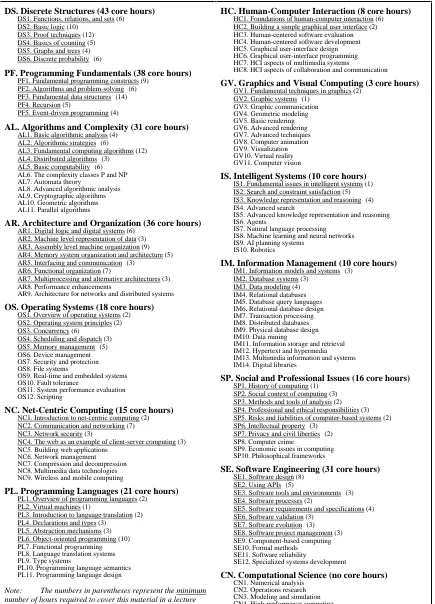
Figure 5-1. Computer science body of knowledge with core topics underlined
DS. Discrete Structures (43 core hours)
DS1. Functions, relations, and sets (6) DS2. Basic logic (10)
DS3. Proof techniques (12) DS4. Basics of counting (5) DS5. Graphs and trees (4) DS6. Discrete probability (6)
PF. Programming Fundamentals (38 core hours)
PF1. Fundamental programming constructs (9) PF2. Algorithms and problem-solving (6) PF3. Fundamental data structures (14) PF4. Recursion (5)
PF5. Event-driven programming (4)
AL. Algorithms and Complexity (31 core hours)
AL1. Basic algorithmic analysis (4) AL2. Algorithmic strategies (6)
AL3. Fundamental computing algorithms (12) AL4. Distributed algorithms (3)
AL5. Basic computability (6) AL6. The complexity classes P and NP AL7. Automata theory
AL8. Advanced algorithmic analysis AL9. Cryptographic algorithms AL10. Geometric algorithms AL11. Parallel algorithms
AR. Architecture and Organization (36 core hours)
AR1. Digital logic and digital systems (6) AR2. Machine level representation of data (3) AR3. Assembly level machine organization (9) AR4. Memory system organization and architecture (5) AR5. Interfacing and communication (3)
AR6. Functional organization (7)
AR7. Multiprocessing and alternative architectures (3) AR8. Performance enhancements
AR9. Architecture for networks and distributed systems
OS. Operating Systems (18 core hours)
OS1. Overview of operating systems (2) OS2. Operating system principles (2) OS3. Concurrency (6)
OS4. Scheduling and dispatch (3) OS5. Memory management (5) OS6. Device management OS7. Security and protection OS8. File systems
OS9. Real-time and embedded systems OS10. Fault tolerance
OS11. System performance evaluation OS12. Scripting
NC. Net-Centric Computing (15 core hours)
NC1. Introduction to net-centric computing (2) NC2. Communication and networking (7) NC3. Network security (3)
NC4. The web as an example of client-server computing (3) NC5. Building web applications
NC6. Network management NC7. Compression and decompression NC8. Multimedia data technologies NC9. Wireless and mobile computing
PL. Programming Languages (21 core hours)
PL1. Overview of programming languages (2) PL2. Virtual machines (1)
PL3. Introduction to language translation (2) PL4. Declarations and types (3)
PL5. Abstraction mechanisms (3) PL6. Object-oriented programming (10) PL7. Functional programming PL8. Language translation systems PL9. Type systems
PL10. Programming language semantics PL11. Programming language design
Note: The numbers in parentheses represent the minimum number of hours required to cover this material in a lecture format. It is always appropriate to include more.
HC. Human-Computer Interaction (8 core hours)
HC1. Foundations of human-computer interaction (6) HC2. Building a simple graphical user interface (2) HC3. Human-centered software evaluation HC4. Human-centered software development HC5. Graphical user-interface design HC6. Graphical user-interface programming HC7. HCI aspects of multimedia systems
HC8. HCI aspects of collaboration and communication
GV. Graphics and Visual Computing (3 core hours)
GV1. Fundamental techniques in graphics (2) GV2. Graphic systems (1)
GV3. Graphic communication GV4. Geometric modeling GV5. Basic rendering GV6. Advanced rendering GV7. Advanced techniques GV8. Computer animation GV9. Visualization GV10. Virtual reality GV11. Computer vision
IS. Intelligent Systems (10 core hours)
IS1. Fundamental issues in intelligent systems (1) IS2. Search and constraint satisfaction (5) IS3. Knowledge representation and reasoning (4) IS4. Advanced search
IS5. Advanced knowledge representation and reasoning IS6. Agents
IS7. Natural language processing IS8. Machine learning and neural networks IS9. AI planning systems
IS10. Robotics
IM. Information Management (10 core hours)
IM1. Information models and systems (3) IM2. Database systems (3)
IM3. Data modeling (4) IM4. Relational databases IM5. Database query languages IM6. Relational database design IM7. Transaction processing IM8. Distributed databases IM9. Physical database design IM10. Data mining
IM11. Information storage and retrieval IM12. Hypertext and hypermedia IM13. Multimedia information and systems IM14. Digital libraries
SP. Social and Professional Issues (16 core hours)
SP1. History of computing (1) SP2. Social context of computing (3) SP3. Methods and tools of analysis (2) SP4. Professional and ethical responsibilities (3) SP5. Risks and liabilities of computer-based systems (2) SP6. Intellectual property (3)
SP7. Privacy and civil liberties (2) SP8. Computer crime
SP9. Economic issues in computing SP10. Philosophical frameworks
SE. Software Engineering (31 core hours)
SE1. Software design (8) SE2. Using APIs (5)
SE3. Software tools and environments (3) SE4. Software processes (2)
SE5. Software requirements and specifications (4) SE6. Software validation (3)
SE7. Software evolution (3) SE8. Software project management (3) SE9. Component-based computing SE10. Formal methods SE11. Software reliability
SE12. Specialized systems development
CN. Computational Science (no core hours)
Chapter 6
Overview of the Curricular Models
The body of knowledge presented in Chapter 5 does not by itself constitute a curriculum. To be useful, the CC2001 report must also define detailed course implementations and strategies for assembling the individual courses into a complete undergraduate curriculum. This chapter presents a brief description of the overall philosophy behind the proposed curricular models. The descriptions of the courses themselves appear in Appendix B.
6.1 Overall structure of the model curricula
The courses described in this report are divided into three categories according to the level at which they occur in the curriculum. Courses designated as introductory are typically entry-level courses offered in the first or second year of a college or university curriculum. Courses listed as intermediate are usually second- or third-year courses and build a foundation for further study in the field. Courses designated as advanced are taken in later years and focus on those topics that require significant preparation in terms of earlier coursework.
While these distinctions are easy to understand in their own right, it is important to recognize that there is no necessary relationship between the level of the course and the notions of core and elective, which apply only to units in the body of knowledge. Although introductory and intermediate courses will certainly concentrate on core material, it is perfectly reasonable to include some elective material even in the earliest courses. Similarly, advanced courses will sometimes include some core material. These designations are independent and should not be confused.
6.2 Overview of the implementation strategies
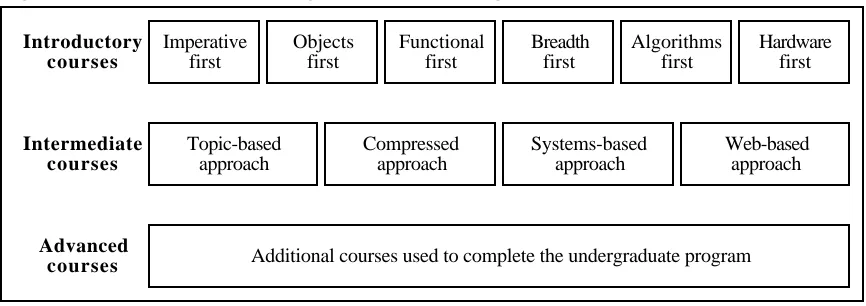
[image:22.612.90.523.561.714.2]The point of establishing the distinction among introductory, intermediate, and advanced courses is to provide natural boundaries for selecting implementation strategies. This report, for example, defines six distinct instantiations of the introductory curriculum and four thematic approaches to the intermediate courses. These implementations and their relationship in the structure of the curriculum as a whole are illustrated in Figure 6-1. The idea behind this structure is to offer greater flexibility by making it possible to start with any of the introductory approaches and then follow up that introduction with any of the intermediate approaches.
Figure 6-1. Course levels and implementation strategies
Additional courses used to complete the undergraduate program Algorithms
Objects Functional Breadth Hardware
Introductory
Intermediate
Advanced courses
courses
courses
first first first first first
Imperative first
approach
Compressed approach
Systems-based approach
6.3 Managing the transition between different strategies
Given that the implementation strategies adopt different approaches and cover different material, it is difficult to make the various tracks directly interchangeable. To offer institutions as much flexibility as possible, we have tried to eliminate significant transition problems by adopting the following policies:
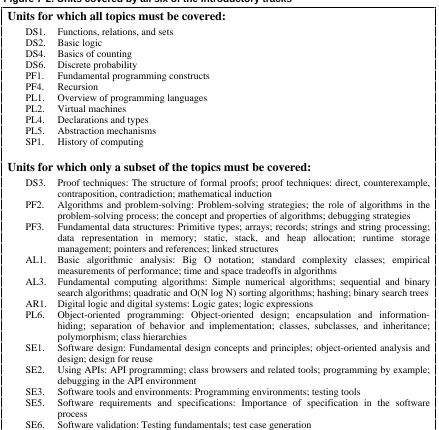
• We have established a set of expectations for the introductory approaches in the form of a set of units and topics that each of those approaches must cover. The details of this coverage are outlined in Chapter 7. Given these guidelines for the introductory coverage, intermediate courses can always depend on a certain level of preparation for students emerging from any of the introductory tracks. This definition of a common background at the end of a student’s introductory work should also make it easier for institutions to meet the needs of students transferring from other programs.
• Where possible, we have left unscheduled time in each course syllabus, both to give instructors flexibility and to allow for the inclusion of transitional material.
• We have allowed the material covered at the various levels of the curriculum to overlap to a certain extent. If an intermediate or advanced course depends on material that is covered by some but not all of the introductory tracks, we have included explicit coverage of that material in the follow-on course to ensure that all possible combinations of strategies can be made to work.
6.4 Covering the core
As illustrated in Figure 6-1, a complete undergraduate curriculum consists of an introductory phase to establish basic foundations for further study, an intermediate phase to cover most of the core units in the body of knowledge, and additional advanced courses to round out the curriculum. Institutions that adopt the CC2001 model will typically begin by choosing an implementation for the introductory phase and an implementation for the intermediate phase. In most cases, institutions will then adapt each of these implementations to fit the particular characteristics of the institution, the preferences of the faculty, and the needs of the students. In doing so, it is important to ensure that the curriculum that results includes at least the minimum coverage specified in the core of the body of knowledge. If specific core units are not included in the introductory and intermediate phase, the institution must then ensure that students acquire this material in advanced courses and set the requirements for graduation accordingly. Beyond the coverage of the computer science core, institutions must ensure that students acquire the necessary background in other areas, as described in Chapter 9.
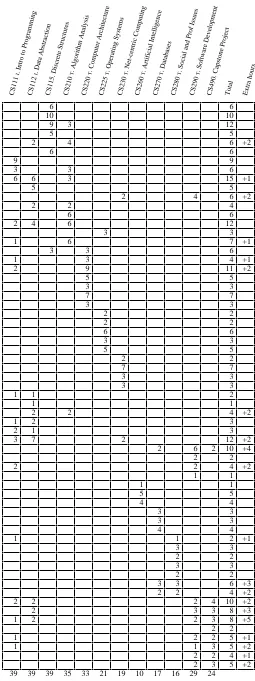
Figures 6-2 and 6-3 show two examples of how to combine the courses from Appendix B so that they cover the computer science core. The model in Figure 6-2 uses the imperative-first implementation for the introductory phase and a traditional topics-based model for the intermediate courses; the model in Figure 6-3 uses an objects-first introductory strategy and the compressed approach for the intermediate level. Other combinations will work as well. To help potential adopters determine whether a set of courses covers the core, the CC2001 web site includes a curriculum worksheet implemented as a Java applet.
The tables shown in Figures 6-2 and 6-3 also illustrate the importance of redundant coverage in ensuring that the individual models are interchangeable. The final column in each table shows the number of additional hours allocated to the various units under that combination. The entry for PL3 (Introduction to language translation) in Figure 6-2, for example, indicates that the two core hours assigned to this unit are included in both CS112I and CS210T. Adopters choosing this pair of strategies could either leave the
Figure 6-2. Coverage of core units Imperative-first introduction Traditional topic-based approach
CS111
I
. Intro to Programming
CS112
I. Data Abstraction
CS115. Discrete StructuresCS210
T. Algorithm Analysis
CS220
T. Computer Architecture
CS225
T. Operating Systems
CS230
T. Net-centric Computing
CS260
T. Artificial Intelligence
CS270
T. Databases
CS280
T. Social and Prof Issues
CS290
T. Software Development
CS490. Capstone ProjectTotal Extra hours
DS1. Functions, relations, and sets 6 6
DS2. Basic logic 10 10
DS3. Proof techniques 9 3 12
DS4. Basics of counting 5 5
DS5. Graphs and trees 2 4 6 +2
DS6. Discrete probability 6 6
PF1. Fundamental programming constructs 9 9
PF2. Algorithms and problem-solving 3 3 6
PF3. Fundamental data structures 6 6 3 15 +1
PF4. Recursion 5 5
PF5. Event-driven programming 2 4 6 +2
AL1. Basic algorithmic analysis 2 2 4
AL2. Algorithmic strategies 6 6
AL3. Fundamental computing algorithms 2 4 6 12
AL4. Distributed algorithms 3 3
AL5. Basic computability 1 6 7 +1
AR1. Digital logic and digital systems 3 3 6
AR2. Machine level representation of data 1 3 4 +1
AR3. Assembly level machine organization 2 9 11 +2
AR4. Memory system organization and architecture 5 5
AR5. Interfacing and communication 3 3
AR6. Functional organization 7 7
AR7. Multiprocessing and alternative architectures 3 3
OS1. Overview of operating systems 2 2
OS2. Operating system principles 2 2
OS3. Concurrency 6 6
OS4. Scheduling and dispatch 3 3
OS5. Memory management 5 5
NC1. Introduction to net-centric computing 2 2
NC2. Communication and networking 7 7
NC3. Network security 3 3
NC4. The web as an example of client-server computing 3 3
PL1. Overview of programming languages 1 1 2
PL2. Virtual machines 1 1
PL3. Introduction to language translation 2 2 4 +2
PL4. Declarations and types 1 2 3
PL5. Abstraction mechanisms 2 1 3
PL6. Object-oriented programming 3 7 2 12 +2
HC1. Foundations of human-computer interaction 2 6 2 10 +4 HC2. Building a simple graphical user interface 2 2
GV1. Fundamental techniques in graphics 2 2 4 +2
GV2. Graphic systems 1 1
IS1. Fundamental issues in intelligent systems 1 1
IS2. Search and constraint satisfaction 5 5
IS3. Knowledge representation and reasoning 4 4
IM1. Information models and systems 3 3
IM2. Database systems 3 3
IM3. Data modeling 4 4
SP1. History of computing 1 1 2 +1
SP2. Social context of computing 3 3
SP3. Methods and tools of analysis 2 2
SP4. Professional and ethical responsibilities 3 3
SP5. Risks and liabilities of computer-based systems 2 2
SP6. Intellectual property 3 3 6 +3
SP7. Privacy and civil liberties 2 2 4 +2
SE1. Software design 2 2 2 4 10 +2
SE2. Using APIs 2 3 3 8 +3
SE3. Software tools and environments 1 2 2 3 8 +5
SE4. Software processes 2 2
SE5. Software requirements and specifications 1 2 2 5 +1
SE6. Software validation 1 1 3 5 +2
SE7. Software evolution 2 2 4 +1
SE8. Software project management 2 3 5 +2
Figure 6-3. Coverage of core units Objects-first introduction Compressed approach
CS111
O. OO Programming
CS210
C. Algorithm Analysis
CS220
C. Computer Architecture
CS226
C. OS and Networking
CS262
C. Info+Knowledge Mgmt
CS292
C. Software Dev and Practice
Total CS112
O. OO Design
CS115. Discrete Structures Extra hours
DS1. Functions, relations, and sets 6 6
DS2. Basic logic 10 10
DS3. Proof techniques 9 3 12
DS4. Basics of counting 5 5
DS5. Graphs and trees 4 4
DS6. Discrete probability 6 6
PF1. Fundamental programming constructs 7 2 9 PF2. Algorithms and problem-solving 2 2 3 7 +1
PF3. Fundamental data structures 3 8 3 14
PF4. Recursion 2 3 5
PF5. Event-driven programming 2 2 2 6 +2
AL1. Basic algorithmic analysis 2 2 4
AL2. Algorithmic strategies 2 6 8 +2
AL3. Fundamental computing algorithms 3 3 6 12
AL4. Distributed algorithms 3 3
AL5. Basic computability 1 6 7 +1
AR1. Digital logic and digital systems 3 3 6 AR2. Machine level representation of data 3 3 AR3. Assembly level machine organization 9 9 AR4. Memory system organization and architecture 5 5
AR5. Interfacing and communication 3 3
AR6. Functional organization 7 7
AR7. Multiprocessing and alternative architectures 3 3
OS1. Overview of operating systems 2 2
OS2. Operating system principles 2 2
OS3. Concurrency 6 6
OS4. Scheduling and dispatch 3 3
OS5. Memory management 5 5
NC1. Introduction to net-centric computing 2 2
NC2. Communication and networking 7 7
NC3. Network security 3 3
NC4. The web as an example of client-server computing 3 3
PL1. Overview of programming languages 2 2
PL2. Virtual machines 1 1
PL3. Introduction to language translation 2 2
PL4. Declarations and types 2 1 3
PL5. Abstraction mechanisms 1 2 3
PL6. Object-oriented programming 8 4 2 14 +4
HC1. Foundations of human-computer interaction 1 4 2 7 +1 HC2. Building a simple graphical user interface 2 2 GV1. Fundamental techniques in graphics 2 2 4 +2
GV2. Graphic systems 1 1
IS1. Fundamental issues in intelligent systems 1 1 IS2. Search and constraint satisfaction 5 5 IS3. Knowledge representation and reasoning 4 4
IM1. Information models and systems 3 3
IM2. Database systems 3 3
IM3. Data modeling 4 4
SP1. History of computing 1 1
SP2. Social context of computing 3 3
SP3. Methods and tools of analysis 2 2
SP4. Professional and ethical responsibilities 3 3 SP5. Risks and liabilities of computer-based systems 1 2 3 +1
SP6. Intellectual property 3 3
SP7. Privacy and civil liberties 2 2
SE1. Software design 2 2 4 8
SE2. Using APIs 1 1 3 5
SE3. Software tools and environments 2 1 3
SE4. Software processes 2 2
SE5. Software requirements and specifications 1 3 4
SE6. Software validation 1 2 3
SE7. Software evolution 3 3
SE8. Software project management 3 3
Chapter 7
Introductory Courses
This chapter looks at the introductory phase of the undergraduate curriculum, when students receive their first college-level exposure to computer science. Section 7.1 outlines our overall philosophy concerning the introductory curriculum. Sections 7.2, 7.3, and 7.4 then look at three topics that are central to the design of introductory courses: the role of programming, the length of the introductory sequence, and strategies for integrating discrete mathematics. Section 7.5 goes on to enumerate the set of concepts, knowledge, and skills that we believe should be part of an ideal introductory sequence. Finally, section 7.6 enumerates a set of six introductory strategies that have proven successful in practice. This section also provides critiques of each approach as an aid to help faculty make informed decisions about which of the alternatives best address the needs of their students, their department, their institution, and their community.
7.1 Overall philosophy
Throughout the history of computer science education, the structure of the introductory computer science course has been the subject of intense debate. Many strategies have been proposed over the years, most of which have strong proponents and equally strong detractors. Like the problem of selecting an implementation language, recommending a strategy for the introductory year of a computer science curriculum all too often takes on the character of a religious war that generates far more heat than light.
In the interest of promoting peace among the warring factions, the CC2001 Task Force has chosen not to recommend any single approach. The truth is that no ideal strategy has yet been found, and that every approach has strengths and weaknesses. Given the current state of the art in this area, we are convinced that no one-size-fits-all approach will succeed at all institutions. Because introductory programs differ so dramatically in their goals, structure, resources, and intended audience, we need a range of strategies that have been validated by practice. Moreover, we must encourage institutions and individual faculty members to continue experimentation in this area. Given a field that changes as rapidly as computer science, pedagogical innovation is necessary for continued success.
7.2 Where does programming fit in the introductory curriculum
One of the most hotly debated questions in computer science education is the role of programming in the introductory curriculum. Throughout the history of the discipline, most introductory computer science courses have focused primarily on the development of programming skills. The adoption of a programming-first introduction arises from a number of practical and historical factors, including the following:
• Programming is an essential skill that must be mastered by anyone studying computer science. Placing it early in the curriculum ensures that students have the necessary facility with programming when they enroll in intermediate and advanced courses. • Computer science did not become an academic discipline until after most institutions
• The programming-first model was implicitly endorsed by the early curriculum reports through the design of their recommended courses. Curriculum ’68 [ACM68], for example, begins with a course entitled “Introduction to Computing” in which the overwhelming majority of the topics are programming-related. The centrality of programming in introductory courses was further reinforced by the definitions of CS1 and CS2 in Curriculum ’78 [ACM78], which defined these courses as an “Introduction to Programming” sequence.
The programming-first approach, however, has several shortcomings. The most commonly cited objections to this approach are the following:
• Focusing on programming to the exclusion of other topics gives students a limited sense of the discipline, thereby reinforcing the common misperception that “computer science equals programming.”
• Theoretical topics that would enhance the students’ understanding of the practical material are deferred to later points in the curriculum, when they no longer have the same immediate relevance. This limitation has implications for both majors and nonmajors. Nonmajors who take only introductory courses are deprived of any exposure to the conceptual and intellectual foundations that underlie the revolutionary technological developments driving change throughout society. For majors, the fact that theory is not introduced in the early courses fuels the bias of many students who conclude that theory is irrelevant their educational and professional needs.
• Programming courses often focus on syntax and the particular characteristics of a programming language, leading students to concentrate on these relatively unimportant details rather than the underlying algorithmic skills. This focus on details means that many students fail to comprehend the essential algorithmic model that transcends particular programming languages. Moreover, concentrating on the mechanistic details of programming constructs often leaves students to figure out the essential character of programming through an ad hoc process of trial and error. Such courses thus risk leaving students who are at the very beginning of their academic careers to flounder on their own with respect to the complex activity of programming.
• Introductory programming courses often oversimplify the programming process to make it accessible to beginning students, giving too little weight to design, analysis, and testing relative to the conceptually simpler process of coding. Thus, the superficial impression students take from their mastery of programming skills masks fundamental shortcomings that will limit their ability to adapt to different kinds of problems and problem-solving contexts in the future.
• Programming-intensive courses disadvantage students who have no prior exposure to computers while giving the illusion to those who have previously used computers that they know more than they really do. As a result, students who are new to computing are often overwhelmed, while students who have a prior background often simply continue bad habits.
• Programming-first approaches can lead students to believe that writing a program is the only viable approach to solving problems using a computer. The power and versatility of application programs have increased substantially in recent years, and it is important for students to recognize that such applications can be extremely effective as a problem-solving tool without the need for classical programming. This concern is particularly relevant to nonmajors, whose problem-solving abilities and sense of empowerment can be significantly increased through a knowledge of modern applications.
strongly for a broader introduction to the discipline, the majority of institutions continue to focus on programming in their introductory sequence. It is important to recognize that the programming-first model has some strengths that have led to its longevity. Of these, the most important are the following:
• In most institutions (at least in the United States), the primary audience of the introductory computer science course consists of students outside of computer science who are seeking to acquire programming skills. Departments that adopt a programming-first strategy can use a single course for computer science majors and nonmajors alike. If an institution adopts an alternative strategy that serves only its majors—even if it is arguably superior pedagogically—that institution may then need to offer additional programming courses to satisfy the demand from other departments. • Programming is a prerequisite for many advanced courses in computer science. Curricular strategies that delay mastery of fundamental programming skills make it harder for students to take as many advanced courses as they would like, since they do not have the necessary background until a later point in their studies.
• Students often like programming more than other aspects of the field. Programming-based courses therefore tend to attract more students to computer science.
• Programming courses offer skills and training that meets many of the needs expressed by students, their near-term employers, and non-CS faculty.
The members of the CC2001 Task Force believe that the programming-first model is likely to remain dominant for the foreseeable future. It is therefore incumbent on the task force to provide guidance as to how to make that structure work. In addition, we acknowledge that there appear to be serious problems inherent in that approach. To date, no adequate resolution has emerged. Thus, it is imperative that we encourage continued innovation and experimentation with alternative models aimed at addressing these problems. Alternative approaches that seek to challenge the dominance of the programming-first model, however, will have to take into account the pragmatic demands for applicable computing skills.
In section 7.6, we offer three implementations of a programming-first model and three that adopt an alternative paradigm. The programming-first implementations are an imperative-first approach that uses the traditional imperative paradigm, an objects-first approach that emphasizes early use of objects and object-oriented design, and a functional-first approach that introduces algorithmic concepts in a language with a simple functional syntax, such as Scheme. In each case, we have sought to identify curricular models that minimize the weaknesses of the programming-first approach by focusing on algorithmic and problem-solving concepts rather than the vagaries of language syntax. The three alternative models are a breadth-first approach that begins with a general overview of the discipline, an algorithms-first strategy that focuses on algorithms over syntax, and a hardware-first model that begins with circuits and then builds up through increasingly sophisticated layers in the abstract machine hierarchy.
7.3 The length of the introductory sequence
Gambar

Dokumen terkait
the earlier work in [Leh99], which has been extended to the non-projective case above, and [LQW02], which can similarly be extended. Thus the proof in [LS03] also works in
Again, using the ordinary enumerative relationship “connected – disconnected”, one can easily count semi-strong digraphs in any class for which the number of strongly connected ones
In [20] we announced that the functoriality results proved for relative centralizing extensions could be generalized to ring morphisms, which are only assumed to be strongly
In this paper, we apply a combined Monte Carlo and Quasi-Monte Carlo method, which we proposed in an earlier paper [32], to the evaluation of an European Call option and of an
The identified list of knowledge areas and subdivisions serves as a foundation from which to continue developing appropriate biotechnology curriculum for students at the
I believe we have to rethink especially the technical content aspect of technology teacher education programs. Curriculum research in industry could help here. We need teachers who
identities (of degrees 4 and 6) are deduced from it and they are recognized and recommended for cryptography in a similar spirit in which the cross inverse property (of degree 2)
school, faculty have developed medical curricula that attempt to provide early clinical experiences in hopes of engendering relevance to basic science study and have initiated
