Sumardi1
ABSTRACT
A 27 year old clonal seed orchard of teak (Tectona grandis L.f ) in Padangan, East Java comprising 24 clones, was evaluated for fertility, ofspring diversity, and genetic drit. Flower and fruit productions were used to assess clone fertility in the orchard. Fertility variation measured as ‘sibling coeicient’ was found to be 1,62, having high genetic diversity (0,97) and low coancestry (0,03). he clones varied in fertility in which, 25 % of the most fertile clones in the orchard contributed to 47,5 % of lower and fruit yields. Efective population size in the orchard was 15, indicating that 15 of the clones contributed efectively to seed yield. Separating on the amounts of seeds that can be collected, individual collection, and proportional mixing of seed per clone might be useful in restricting over representation of highly reproductive clones thereby increasing genetic diversity in the seed crop. Another way to improve seed yield in the orchard is by increasing the efective population size. hinning or prunning on highly reproductive clones might be useful in increasing efective population size.
Keywords : Tectona grandis, clonal seed orchard, fertility variation, coancestry, population size
I. INTRODUCTION
Teak (Tectona grandis L.f.) is a native species in Southeast Asia, and distributes naturally only in the Indian Peninsula, Myanmar, Northern hailand and Northwestern Laos along the northern hai border (Troup, 1921), and Burma (Laskar, et al., 1985). It grows at latitude 9o S (in Myanmar) to 25o N (in India), and longitude 70º - 100º E (Rachmawati, et al., 2002). In Indonesia, teak has been planted in Java Kangean, Bali, Muna, Buton, Wetar, Sumbawa and Lampung (Sumarto and Suhaendi, 1985). It is not clear whether teak is native species in Indonesia or introduced from India (Hedegart, 1976 in Soeseno, et al., 1993; Simatupang, 2001). It has been reported that Indonesian has the largest teak plantation in the world, where most of the area is managed by Perum Perhutani a state owned enterprise (Soeseno, et al., 1993).
In 2005, the Indonesian teak demand was around of 2.4 million m3. However, Perum Perhutani could only supply for 400,000 m3 (Iskak, 2005). Althought some can now be provided by community forest such or Java, South and South East Celebes, and East Nusa Tenggara) (Hardiyanto and Prayitno, 2008). Perum Perhutani has endeavored
1 Forestry Research Institute of Kupang
to improve teak productivity by replanting program on the selected site. To support the program adequate, good quality and timely available seeds are needed in 2010, Perum Perhutani has a target to produce 18,817,916 seedlings (equal to 21,880 kg seeds) from clonal seed orchards (CSOs), while the seed harvesting was targeted at 17.000 kg only. here is still a lack of 4,880 kg of teak seeds (Perum Perhutani, 2010). he main source of teak seeds in Indonesia is seed production areas (SPAs). he fruit production from CSOs has also been used to supply the demand since 1991, but an adequate fruit supply is still lacking (Palupi and Owens, 1998). he productivity of seeds in CSOs is categorized very low in Indonesia, only 0,1 – 0,5 kg per tree (Palupi and Owens, 1998).
The low fruit to flower ratio is generally found in plants which exhibit self-incompatibility. Teak is primarily an out-crossing species, but self-pollination is possible. he extent of self-incompatibility in teak varies from 96 to 100 %, and commonly less than 1 % of self-pollinated lowers develop into fruits (Hedegart, 1976 in Tangmitcharoen and Owens, 1997). In teak, pollination success was 78 %, but there was low fruit set, only 3 – 5 % (Tangmitcharoen and Owens, 1997). Another cause of low fruit set was position of fruit and lower within the inlorescence making them easy to abortion (Bawa and Webb, 1984). he papillate stigma is receptive from 11.00 to 13.00 hr with a high temperature causing it dry earlier, and of lowering teak occurs in the rainy season with low pollinators activity (Tangmitcharoen and Owens, 1997).
Despite several problems in fruit production, seedling continues to be used as major planting material in hailand, Indonesia and India (Kjaer, et al., 2000). It is thereby needed enough quantity of seeds for operational teak plantation. In addition, CSOs manager need to consider the status of seed genetic diversity to maintain suicient level of ofspring genetic diversity and reduce genetic drit impact.
It is cear that, we need to increase the CSOs seed production, with maintaining ofspring genetic diversity. he eforts can be done with presciently of fertility, efective population size and genetic diversity of the parent trees. For this reason this study was carried out with aims to (1) quantify the production of fruits and lowers, fertility variation among clones, efective population size and (2) estimate parent trees genetic diversity of teak CSOs in Padangan.
II. MATERIALS AND METHODS
A. Data Collection
the number of fruits and lowers per tree were obtained by extrapolating the number of lowers and fruits bearing inlorescences per tree.
B. Fertility Variaton
he male and female fertility of a tree is considered to be proportional to the number of male and female gametes produced by the tree (Gregorius, 1989). Gender fertilities were assumed to be equal to the number of reproductive structures (male fertility as the number of lowers and female fertility as the number of fruits) expressed as a proportion of all trees. Total fertility of a tree (or a clone, parent or genotype) (pi) was taken as the average of the male (mi) and female (i) fertilities of each tree. When equal number of fruits is collected from each tree, the female fertility is assumed to be constant, equal to 1/N, where N is the census number of trees in the orchard (Varghese et al., 2006).
Sibling coeicient (Ψ) is the probability that two genes randomly drawn from
the gamete gene pool originating from the same parent compared to the probability if the parents having equal representation (Kang and Lindgren, 1999). hus, Ψ=1 means that there is an equal contribution of individual to gamete gene pool in the population. Sibling coeicient, which is used to describe fertility variation, is calculated from the number of clones in the orchard (N) and individual fertility (pi) of each clone (Kang and Lindgren, 1998; 1999):
A maternal sibling coeicient (Ψ
f) and a paternal sibling coeicient (Ψm) can be given as
0.5 and the group coancestry is calculated using the methods from Lindgren and Mullin
he efective population size (Np) is independent of how parents are related or inbred, the status number depends on the relatedness of the parent. It is practical to have a unique term for efective number based on fertility variation among parents only. Np
is equivalent to the status number (Ns) of a seed orchard where clones are unrelated and non-inbred (Lindgren and Mullin, 1998 in Varghese, et al., 2006). Np is calculated as follows (Kang and Lindgren, 1999):
ψ
N
N
p=
... (5)he efective number of parent is divided into the efective number of female parent (Np( f )) and that of male parent (Np(m)). he efective number of female (Np(f)) and male (Np(m)) parents can be estimated from eq (5) by substituting female (ψf) and male (ψm) sibling coeicients in place of total fertility variation (Ψ) (Kang and
El-Kassaby, 2002).
he relative population size (Nr) can be used to relate the equally contributing trees to the actual number of trees in the sampled population (Kang, et al., 2001). If all trees are fertile and equally fecund (Ψ = 1) the relative population size of the parents
becomes equal to one.
Variance efective population size (Ne(v)) is the size of an ideal population with
the same sampling variance of allelic frequencies per generation as between the parent genotypes and their ofspring. It is calculated as follows (Kang and Lindgren, 1998).
he value was also used to express the rate of changes in predicted gene frequencies between the parent trees and their seed crop (Kang et al., 2001).
D. Genetic Diversity
Expected gene diversity (GD) is a function of the group coancestry and can be calculated in the orchard relative to a reference population. he reference population, which is a teak clonal seed orchard where that the plus trees were selected from, is considered to have very low group coancestry as it has an ininite number of unrelated individuals in its calculation. (Varghese et al., 2006):
Θ
−
=
1
G
D
GD ... (8)
Group coancestry can be seen as the fraction of gene diversity lost since tree breeding was initiated.
III. RESULTS AND DISCUSSION
A. Results
1. Reproduction and growth
he average dbh of the teak CSOs in Padangan was 42.4 cm, with the biggest value was 55.1 cm (clone 18) and the smallest value was 35 cm (clone 2) (Tabel 1). he value, however, did not difer signiicantly among clones.
he number of inlorescences, lowers and fruits produced varied among clones. he average inlorescences per clone varied from 10 (clone 7) to 53 (clone 2). he number of lowers varied from 17.725 (clone 7) to 165.053 (clone 2). he number of fruits produced varied from 4 (clone 5) to 783 (clone 3). he number of inlorescences, lowers, and fruits produced difered signiicantly (p<0,0001) among clones. Fruitset difered signiicantly (p<0.0001) among clone and varied from 0.02 % (clone 5) to 1.66 % (clone 3) (Tabel 1). Observation on the number of inlorescences, lowers and fruits produced was exploited at the same time, so the result could not show early and later lowering clones.
2. Fertility variation
one clone contributed to 13 % of the fruit production). Fruitset difered signiicantly (p<0.001) among clones. It was because the lowers producted difered signiicantly, and the fruits producted from the lowers is generally low.
Table 1. he average dbh, the number of inlorescences, lowers, fruits and fruit-set
Nomor
Klon he average dbh (cm)
Inlores-cences per tree
Flower
per tree per treeFruits Fruitset (%)
1 38.1 39 159.179 323 0.26
2 35.0 53 165.053 46 0.03
3 45.8 42 43.544 783 1.66
4 39.5 18 35.279 462 1.06
5 39.2 11 24.891 4 0.02
6 47.9 12 46.042 13 0.03
7 45.4 10 17.726 24 0.12
8 37.2 24 47.770 385 0.73
9 41.8 21 60.902 332 0.48
10 41.2 15 47.602 269 0.57
11 43.2 18 40.597 336 0.75
12 38.9 20 78.936 433 0.55
13 40.8 45 151.020 416 0.28
14 40.5 21 74.912 165 0.22
15 47.8 19 67.676 335 0.50
16 44.4 17 45.337 348 0.63
17 39.1 10 23.135 79 0.35
18 55.1 31 56.125 146 0.21
19 41.5 20 51.222 196 0.32
20 46.5 15 59.539 27 0.32
21 37.6 18 46.069 156 0.35
22 42.1 16 34.551 307 0.86
23 43.3 10 26.149 103 0.36
24 48.5 21 63.505 265 0.37
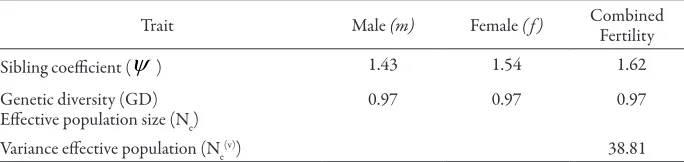
Fertility variation of the teak CSOs in Padangan as indicated by the sibling coeicient value (
ψ
) was 1.62. Male fertility variation (ψ
m) was 1.43 and female3. Efective population size and genetic diversity
Relative population size (Nr) of teak CSOs in Padangan was 0.58 and variance efective population (Ne(v)) was 38.8 (Table 2). he high fertility variation of male as indicated by the male sibling coeicient caused low value of Nr and (Ne(v)) was low.
Table 2. Fertility variation, genetic diversity and variance efective population size
Trait Male (m) Female ( f ) CombinedFertility
Sibling coeicient (
ψ
) 1.43 1.54 1.62 Genetic diversity (GD)Efective population size (Ne)
0.97 0.97 0.97
Variance efective population (Ne
(v)) 38.81
Coancestry (
Θ
), efective population size (Np), and genetic diversity (GD) of teak clonal seed orchard in Padangan were 0.03, 15 and 0.97 respectively (Table 2).B. Discussion
1. Fertility
A general lack of lowering in CSOs resulted in considerable fertility variation between clones (Kjaer, 1996 in Varghese, et al., 2006). Although site has a marked efect on lowering habit (early lowering is observed in dry sites) of trees, fertility is reported to be strongly inherited (Kaosard, 1996 in Varghese, et al., 2006) and the proportion of non-lowering clones may be high during low lowering years (Nikkanen and Ruotsalainen, 2000). he lowering season occurred in the long time when the research conducted in Padangan. It was because higher number of clones produced lowers, but only few clones produced fruits.
Low fruitset in nature may be large due to a high incidence of self-pollination and a high level of self-incompatibility, but several other factors, such as resource limitation and position of fruit within inlorescence may also cause (Bawa and Webb, 1984). Self-incompatibility and abortion of selfed seed oten result in 1–2% seedset (Kaosard 1996) under natural conditions. An average fruitset of teak CSOs in Padangan was 0,43%, that is lower than under natural conditions (1–2%).
of a few clones would lead to diferences in genetic constitution of seed crop. Few of the fertile clones largely contributed to the lower and fruit productionwith about 25% of clones producing almost 47.5% in lowers and fruits production. As a comparison, research at the Namaacha Arboretum in the south of Mozambique, reported 55% gamete contribution from 20% of the most fertile trees in a teak stand (Bila et al., 1999). he
Pinus koraiensis seed orchard at Walayar showed an unbalanced representation of clones in seed production as indicated by the sibling coeicient (Kang and Lindgren, 1999). An unbalanced representation of clones in seed production may not only be caused by fertility variation but olso misslabelling the clones. Relatively high levels of errors were observed showing that 16% ramets and 40% clones analysed were mislabelled with Glutamate Oxalacetate Transaminase (GOT) (Iskandar et al., 2003).
he average sibling coeicient value (
ψ
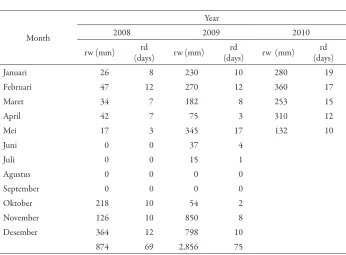
) at the teak CSOs in Padangan was 1.62, indicating that there was a deviation of 1.62 times from random mating to inbreeding, when all clones would have contributed equally. Relative population size (Nr) of teak CSOs in Padangan was 0.58 and variance efective population (Ne(v)) was 38.8. Relatively higher Ne(v) in Padangan than in the teak CSOs-I and CSOs-II in Western Ghats region of peninsular India (20.99 and 2.73, respectively). Which caused relatively lower genetic drit in Padangan than in Western Ghats region of peninsular India. Plantation established from high fertility variation seed source would have high coancestry and relatedness.If all clones of teak CSOs in Padangan contributed equally, each clone would have contributed about 4.17 % of the total fruits produced. he actual contribution difered signiicantly between clones in ranges from 0.06 % to 13.16 %, indicating diferences in fertility pattern of the orchards. he low fruit production of teak CSOs in Padangan was not only caused by fertility variation between clones but also by natural factor likes rainfall.
2. Genetic diversity and population size
Table 3. he average rainfall in a teak clonal seed orchards in Padangan (2008 - May 2011)
Month
Year
2008 2009 2010
rw (mm) (days)rd rw (mm) (days)rd rw (mm) (days)rd
Januari 26 8 230 10 280 19
Februari 47 12 270 12 360 17
Maret 34 7 182 8 253 15
April 42 7 75 3 310 12
Mei 17 3 345 17 132 10
Juni 0 0 37 4
Juli 0 0 15 1
Agustus 0 0 0 0
September 0 0 0 0
Oktober 218 10 54 2
November 126 10 850 8
Desember 364 12 798 10
874 69 2,856 75
Note: rw : rainwater; rd : rainy day
Establishment of vast area of seed source from the teak CSOs in Padangan with low fruits production would result in bad plantation, if no treatment applied the seed harvesting. Limiting the number of seeds harvested from individual clones is the option to improve diversity of orchard progeny (Kang et al., 2003 in Varghese, et al., 2006). Genetic diversity of the teak CSOs in Padangan would remained when seeds harvested from individual clones. However could only be done in productive clones, and mix of the same number of seeds from each clone. Teak CSOs would be better when more number of efective clones (20 – 25 clones) used for starting establishment (Zobel and Talbert, 1984).
3. Implications of gene diversity in Teak CSOs
production. Even in production orchards, maintaining adequate efective population size would be important for reducing seling and production of out crossed seed.
As a reduction in the efective population size is inevitable in a domestication process, eforts should be made to start with desirable levels of diversity in the irst generation. High variability in parental or each clone contribution would mean substantial loss of diversity in the irst generation. Suicient diversity (efective contribution of clones) and synchrony in lowering would be essential for production of vigorous out crossed seed with reduced pollen contamination from inferior sources to obtain anticipated gain from orchards. In ideal conditions, a good clonal seed orchard of teak is expected to provide 25% gain (ater progeny testing and genetic thinning) over the local planting stock (Kjaer et al., 1999). Teak has an inherent problem of lower abortion and low fruitset, Hence, it is important to make that the number of contributing parent trees is high. his is best achieved with low input techniques like seed production areas (Lindgren, 2000
in Varghese et al., 2006).
4. Considerations for orchard management
Occurrence of inbreeding depression from self-pollination is low in teak because of adaptations like self-incompatibility (Hedegart, 1976 in Varghese et al., 2006). his would also lead to poor fruitset due to inadequate pollen supply, sexual asymmetry and unbalanced parental contribution. he orchard manager can adopt corrective measures to reduce the magnitude of undesirable efects of fertility variation. Making collections with ramet and clone identity and mixing them in an equal proportion would keep the coancestry in low level. If improvement in diversity level were inadequate as in case of teak CSOs in Padangan, intentional adjustment of ramet numbers of each clone would be the next measure (Kang et al., 2001). his step can modify the total fertility status of a clone as in case of teak CSOs in Padangan. It could be achieved either by total removal of some ramets of the clone if the fertility status is highly skewed or by just retaining them as pollen producers (Varghese et al., 2006).
Another measure that can be adopted to increase gene diversity is to mix seeds from diferent seed orchards (Chaisurisri and El-Kassaby, 1993). hese measures can help to reduce the loss of gene diversity during domestication. As fertility variation can be high in poor lowering years, seed collection may even be avoided during those years to avoid genetic drit (Kjaer, 1996).
Selection of suitable sites and clones for an orchard assume great importance. Locating orchards on hill slopes under dense forest areas may afect light availability, and heavy stocking with close spacing would not be conducive for lowering in teak.
1984), would give more opportunity in outcrossing, and reduce low fruits producing of self-incompatibility impact, and also keep the genetic gain. As large variation in lowering is observed at population and individual tree levels, fertility is one of the most important traits assessed in provenance, progeny and clonal trials (Keiding et al., 1986
in Varghese, et al., 2006). It would be ideal to plan an orchard in terms of its efective clone number based on fertility status of the trees selected for a location.
5. Seed orchards for domestication
As genetic diversity is an important requirement for successful regeneration of teak, reduction in diversity with each generation would be a major factor that has to be managed efectively. Moreover, since plantation rotation period is long, the impact of selections made in one generation is felt only ater a long period, by which time the options for further phenotypic improvement would be limited. hus, a low input strategy with emphasis on diversity during selection would be ideal to carry forward a new generation. In the other site, CSOs, established with intensively selected trees oten employ improvement techniques to maximise gain but clones oten vary in fertility (Varghese et al., 2006), and the individual contribution and resultant genetic drit would afect the quality of seed crops and subsequent plantations.
he proportion of non-lowering clones may be high during low lowering years (Nikkanen and Routsalainen, 2000). Maintaining a status number of 70% of the number of orchard clones or approximately 2/3 of the census number would keep levels of coancestry low and promote out crossing in orchards (Varghese et al., 2006). Selection of clones can be restricted to locations within the same geographical region, as shiting clones across latitudes can afect the synchrony in lowering. Nikkanen and Ruotsalainen (2000) reported a decrease in male fertility with increasing latitude of origin of clone in Picea abies.
Establishment of vast areas of teak clonal seed orchards without considering fertility and fecundity status of the clones has proved futile (Nicodemus et al., 2000), as fertility is seen to be quite erratic and inluenced by site and provenance efects. If, however, bud grating selected in good trees are used for establishing clonal seed orchards in similar environments the gain and diversity obtained can be improved with considering fertility and fecundity status of the clones. Increasing seed production in teak clonal seed orchars in Padangan assuming constant fertility status can be done by reducing the number of ramet of high fertility clones. If not possible then thinning canopy (prunning) ahead of the spring on a ramet of clone which has a high fertility should be undertaken. his action is important to avoid the risk of decresing genetic variation in the generation.
IV. CONCLUSION
coeicient value (
ψ
) of teak CSOs in Padangan was 1.62. hat was caused by the genetic drit (but only a few (0.03)) with the genetic diversity of 0.97. he 15 unrelatedness clones contributed uniformly on the gamete pool (in maximum of 24 clones). Which indicated the efective population size of 15. he efective clone number of 20 - 25 clones would give more opportunity in outcrossing, and reduce low fruits producing self-incompatibility impact. Making collection of seed from clones and mixing them in an equal proportion would keep the coancestry levels low and also keep the genetic gain.ACKNOWLEDGEMENTS
he author is very grateful to Prof. Moh. Na’iem, Dr. Eko Bhakti Hardiyanto for their invaluable comments and supports. hanks also due to Hermawan, S.Hut., Maksum, Waras, Suyitno, Muntolib, Karmin, Wakhid and Dodik for their help and support on the ield.
REFERENCES
Bawa, K.S., and Webb, C.J. 1984. Flower, Fruit and Seed Abortion in Tropical Forest Trees: Implications for he Evolution of Paternal and Maternal Reproductive Patterns. American Journal of Botany 71 (5):736-751.
Bila, A.D., D. Lindgren, and T.J. Mullin 1999. Fertility Variation and Its Efect on Diversity Over Generations in A Teak Plantation (Tectona grandis L.f.). Silvae Genetica 48:109-114.
Chaisurisri K. and Y.A. El-Kassaby 1993. Estimation of Clonal Contribution to Cone and Seed Crops in Sitka Spruce Seed Orchard. Annuals of Forest Science 50: 461–467.
Cockerham, C.C. 1967. Group Inbreeding and Coancestry. Genetics 56:89-104. Gregorius, H.R. 1989. Characterization and Analysis of Mating Systems. Ekopan Verlag,
Germany, pp 158.
Hardiyanto, E.B. and T.A. Prayitno 2008. Present Utilization of Small-Diameter Teak Log from Community Teak Plantations in Java and Eastern Indonesia. Technical Report. ITTO Project PPD 121/06 Rev. 2(I). 45pp.
Iskak, M. 2005. Produktiitas Tegakan Jati JPP Intensif sampai Umur 20 Tahun ke Depan. Seperempat Abad Pemuliaan Jati Perum Perhutani. Pusat Pengembangan Sumber Daya Hutan Perum Perhutani:143-153.
Kang, K.-S., Y.A. El-Kasabi 2002. Considerations of Correlated Fertility Between Genders on Genetic Diversity: he Pinus Densilora Seed Orchard as A Model. heori Application Genetica 105:1183-1189
Kang, K.S., and D. Lindgren 1998. Fertility Variation and Its Efect on he Relatedness of Seeds in Pinus densilora, Pinus thunbergii and Pinus koraiensis Clonal Seed Orchards. Silvae Genetica 47:196-201.
Kang, K.S., and D. Lindgren 1999. Fertility Variation Among Clones of Korean Pine (Pinus koraiensis S. et Z.) and Its Implications on Seed Orchard Management. Forest Genetics 6(3):191-200.
Kang, K.S., A.M. Harju, D. Lindgren, T. Nikkanen, C. Almqvist, and G.U. Suh 2001. Variation in Efective Number of Clones in Seed Orchards. New Forest 21:17-33. Kaosard, A. 1996. Teak (Tectona grandis Linn. F.) Domestication and Breeding. UNDP/
FAO. Los Banos, Phillipines. RAS/91/004.
Kjaer E.D. 1996. Estimation of Efective Population Number in a Piceaabies (karst.) Seed Orchard Based on Flower Assessment. Scand. J. For. Res. 11: 111–121. Kjaer, E.D., A. Kaosa-ard, and V. Suangtho 2000. Domestication of Teak hrough
Tree Improvement. Options, Possible Gains and Critical Factors. In: Enters, T. and Nair, C.T.S (eds.). Site, Technology and Productivity of Teak Plantations. FORSPA Publication No. 24/2000, TEAKNET Publication No.3. pp.161-190. Laskar, S., S.G. Majumdar, and B. Basak 1985. Isolation and Chemical Investigation of
Teak (Tectona grandis Linn.) Seed Proteins. JAOCS 62 No.8:1266-1268.
Nicodemus A, B. Nagarajan, C. Narayanan, M. Varghese, K. Subramanian (2005) Genetic variation in Indian teak (Tectona grandis L.F.) populations assayed through RAPD markers. Indian For 131(9):1121–1131
Nikkanen T. and S. Routsalainen. 2000. Variation in Flowering Abundance and Its Impact on he Genetic Diversity of he Seed Crop in Norway Spruce Seed Orchard. Silva Fenn. 34(3):205-222.
Palupi, E.R., and J.N. Owens 1998. Reproductive Phenology and Reproductive Success of Teak (Tectona grandis L.f.). International Journal of Plant Sciences 159:833-842. Perum Perhutani. 2010. Distribusi Benih KBK dan Bibit JPP Tahun 2010. Surat Direktur Perncanaan dan Pengelolaan Hutan Perum Perhutani Nomor. 322/052.1/SDH/ Dir, tanggal 28 Juli 2010.
Rachmawati, H., D. Irianto, dan C.P. Hansen 2002. Tectona grandis Linn. Informasi Singkat Benih. Direktorat Perbenihan Tanaman Hutan. Departemen Kehutanan. Jakarta. No.15 Januari 2002.
hird Regional Seminar on Teak, 31 July-5 August 2000. Yogyakarta, Indonesia. Perhutani, TEAKNET and Faculty of Forestry Gadjah Mada University. pp.91-98. Siregar, U. J. Siregar and S. Siswamartana. 2003. Early Detection of Mislabelled
Teak Clones Using Glutamate Oxaloacetate Transaminase (GOT) Marker. In International Conference Quality Timber Products of Teak from Sustainable Forest Management. India.
Soeseno, U.H., Hardiyanto, E.B., Na'iem, M., Winarni, W.W., Suginingsih. 1993. Strategi Pemuliaan Pohon Beberapa Spesies di Perum Perhutani. Tim Konsultan Pemuliaan Pohon Fakultas Kehutanan UGM.
Sumarto, S., dan Suhaendi, H. 1985. Tinjauan Mengenai Program Pemuliaan Jati (Tectona grandis L.f.). Pusat Penelitian Perlindungan Hutan Badan Litbang Departemen Kehutanan. Bogor.
Tangmitcharoen, S., and Owens, J.N. 1997. Floral Biology, Pollination, Pistil Receptivity, and Pollen Tube Growth of Teak (Tectona grandis Linn. f.). Annals of Botany 79:227-241.
Troup, R.S. 1921. he Silviculture of Indian Trees. Oxford Press.
Varghese, M., Nicodemus, A., Nagarajan, B., and Lindgren, D. 2006. Impact of Fertility Variation on Gene Diversity and Drit in Two Clonal Seed Orchards of Teak (Tectona grandis Linn. f.). New Forest 31:497-512.
Varghese, M., Kamalakannan, R., Nicodemus, A., Lindgren, D. 2008. Fertility Variation and Its Impact on Seed Crops in Seed Production Areas and A Natural Stand of Teak in Southern India. Euphytica 160:131-141.