“Study on Urban Environmental Management of Indonesian Cities Considering
Applicability of ‘Kitakyushu Model’ as Japanese Advanced Eco
-
model City”
Kitakyushu, Japan, 5th June 2015
Proceedings of International Seminar on Collaboration Research
Instructional Development Media of Environmental Education
(EE) Learning for Visual Impairment Primary Students in
Indonesia: A Baseline Analysis for Adopted Priorities Plan
Preparation
Djadja Rahardja
*, Arif Hidayat, Imas Diana Aprilia, Neny Widyana
Indonesia University of Education, Bandung 40154 INDONESIA
Abstract
Learning process for visual impairment students have been spread out in Asia since tens year ago, however particular learning subject or school situation which focused on EE learning seems less heard and examined. At visual impairment school, the present of children with various level of vision should be facilitated not only by adjustment treatment, but also instructional development media as a wider definition i.e.: covering curriculum interpretation, school cultures, learning method and its didactic situation to shape environmental awareness of learners. Kitakyushu of Japan as eco-model city has been widely known succeeded to develop eco-society due to last 30 years to meet society awareness. However, some best practices on how to equip the awareness on primary school students based on city cases, especially for visual impairment students was missed to be frequently investigated. The paper aimed to gain instructional media of EE learning for a visual impairment school in Bandung - Indonesia as adoption and further development of “Kitakyushu Eco Model/KEM” on education and society awareness sector at primary school level. A baseline study of visual impairment school at Bandung is essentially needed in order to gain initial picture, while adoption messages from similar school at Kitakyushu is important to produce adopted priority plan. Set questionnaires and interview of annual school program, school cultures, learning methods and its didactical situation for teachers and principal in a particular blind school at Bandung are analysed to gain preliminary image of instructional media. Similar instrument with certain adjustment at Kitakyushu visual impairment schools are also produced and analysed to gain adopted priorities plan as starting point to arrange instructional media of EE learning. Similarities and findings from both schools are discussed, while adoption result produced from Kitakyushu eco-model is prepared to investigate deeply with particular didactical situation at Indonesian school at further research.
Keywords: Instructional media, environemtnal educatioin, visual impairment school
1.Introduction
education takes its cue from children's natural curiosity about animals, plants and other elements of nature, and even more from its challenges or success stories of cities related with environmental issues.
Kitakyushu of Japan as eco-model city has been widely known succeeded to develop eco-society due to last 30 years to meet society awareness. Using society movement since 1950 on each damages of environment situation, Kitakyushu of eco-model waves have been reduced various environmental damages; from air pollution until radioactive tsunami debris, it changes the city about 30 years from a grey city to a green city [2]. The success of the eco-model also inspiring thousands people and countries [3]. One of the challenges for their green growth occurred on education aspect, sustaining the growth to next generation through school activities investment, which seems less to be investigated [4]. Furthermore, some best practices on how to equip the awareness on primary school, especially for special students also less frequently to be examined [5].
Adoption the success of the green growth of Kitakyushu Model into instructional media development of EE learning for visual impairment students necessarily should involve the real eco-model adoption and adaptation in classroom. Previous research of Rachman (2013) [6] which adopted eco-model on the learning process on teachers in Kalimantan of Indonesia through green notes from Kitakyushu eco-model are able to improve teachers capability to make students’ learning. Moreover, the research focusing on certain aspect of learning in regular school, i.e.: teachers’ capability on a workshop session. However, the adoption of Kitakyushu Model as school approach for EE learning which involve wide instructional media at visual impairment students in primary level have not investigated yet.
The paper aimed to gain baseline study and priorities plan on order to prepare instructional media of EE learning for blind school in Bandung-Indonesia as adoption and further development of “Kitakyushu Eco Model/KEM” on education and society awareness sector at visual school in the primary level
1.1.Kitakyushu-Model: A Society Shift
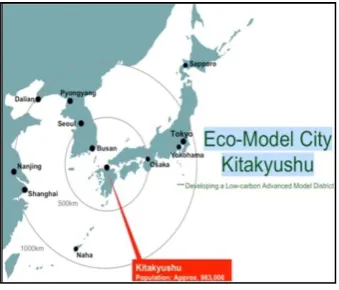
Kitakyushu is home to just under one million residents, making it the 11th most populous city in Japan. It positions itself as a commercial gateway to Asia. Over the last thirty years the city has also worked tirelessly to shed its image as a rust belt steel town, rebranding itself as Eco-Model City Kitakyushu, a center for environmental technology and protection measures. This hard work threatens to be undone by decisions being taken right now.
Figure 1. Kitakyushu Eco-City, Japan
Kitakyushu was one of the first cities in Japan to stage environmental protests when in 1950 local women began petitioning local authorities over air pollution. Their success was acknowledged at the 1992 United Nations Earth Summit in Rio when Kitakyushu was one of twelve cities in the world honored for its environmental management. The city has become renowned within Japan as a leading force in recycling and anti-pollution measures. In addition to reinventing itself as Eco-Model City Kitakyushu, it has even been developing as a domestic tourist destination, being blessed with several scenic and diverse areas of natural beauty within the city limits. Smoke stacks do remain, however, and they are what many casual visitors to the city will first notice.
instead. Kokura was also the secondary target of the first atomic bomb that was dropped on Hiroshima three days earlier. The rampant development of heavy and chemical industries in Japan after 1945 was powered by industrial centers such as Kitakyushu, but the environmental costs became ever greater. Beginning in the 1960s, the local authorities took concrete steps to tackle the issue, and a 1985 report by the Organization for Economic Co-operation and Development (OECD) noted that Kitakyushu had transformed itself “from a grey city to a green city”.
More recently, in July 2011 the OECD selected Kitakyushu as a Model City for Green Growth. The city was only the fourth to be selected under the organization’s Green City Programmed, following Paris, Chicago and Stockholm. This scheme promotes cities which priorities research and development into renewable energies. Kitakyushu Eco-Town in Wakamatsu ward hosts some 29 recycling businesses, not far from a wind farm operation on reclaimed coastal land. Research into offshore wind power generation also began last year. Another notable project that commenced last year was the world’s first pilot scheme to power homes and businesses from recycled hydrogen generated as a by-product at steel plants.
Recently, the plan to disperse and incinerate tsunami debris around Japan has polarized families and communities across the archipelago, including those of the author. Since one major aim of the plan is to promote national unity, in this respect the policy has already failed. For those who accept the need to disperse the debris nationwide, the credibility of government safety assurances is not questioned. A further is that it is Eco-Model City Kitakyushu, of all places, which will be the first place in western Japan under this plan to chase short-term financial gain by endangering the health of its residents. Once a large city such as Kitakyushu sets a precedent, it is likely many other local municipalities will follow suit and start accepting tsunami debris. Residents of Kitakyushu, and other cities where radioactive debris burning is scheduled to take place, have the right to ask what benefits the incineration will bring them and their children, and governments have an obligation to openly discuss the risks and rewards. Local governments should also reverse course in the face of public opposition to dangerous policies. In other places, such as Tsukumi in neighborhood Oita prefecture, local resistance has stymied plans to incinerate the debris. Regardless of how much radiation is released into the atmosphere, seeps into the ground and leeches into water sources—and the amounts remain controversial—it needlessly threatens livelihoods and perhaps lives across Japan. In contrast to Kitakyushu, Fukuoka city has refused to receive any of the disaster debris, citing residents’ concerns over its safety.
Instead of transporting radioactive material around the country, the debris should remain in the affected prefectures where much of it could be used for land reclamation projects and constructing greater coastal defenses. Indeed, well-developed plans are in place to re-use much of the debris within the prefectures themselves to protect against future tsunami and to re-generate the natural environment of the devastated coast. These will be forests planted along the coastline to help protect communities from future tsunami. This plan calls for debris to be mixed with soil and buried in the ground, whereby the debris forms a raised platform that enables trees to be grown higher than sea level. Similar landfill techniques were employed in 1923, when much of Tokyo was razed by the Great Kanto Earthquake, and in the aftermath of the 1995 Great Hanshin Earthquake in Kobe. It therefore seems incomprehensible that the Noda administration is providing financial incentives to far-flung reaches of the archipelago to transport and incinerate the debris when less risky options are available locally.
1.2.The lesson learnt for educational purposes
Along with all those history and its growth, society awareness and continued efforts seem played important role in order to create and maintain the changes from grey to green city. Another task to transform the values, body of knowledge and its society wisdom are through society engineering especially for younger generation through public education.
Furthermore, with the same case of how Kitakyushu society movement from grey to green city, some lesson learnt are defines as follow: (1) Strong communication is also regarded as another essential aspect for society elements on the common effort to educate their own, (2) Baseline assessment on their own family, local surrounding as continue activities, (3) Setting environmental priorities plan on a complex situation, (3) On-going case analysis to produce improvement of the program, (4) Disseminate to every single part of society elements on what was done and was not, and (5) Learning community among citizen.
These lesson learnt are taken from literature study, site visit and focus group discussion with school elements, city government officer, public service officer, and other stakeholders including Kitakyushu researcher which focusing on environment field. The lesson learnt are generally for education as a general application. However, for this research emphasize on visual impairment student which the complexity is certainly higher than for regular students.
1.3.Learning Environmental Education (EE) for Visual Impairment Students
Even though particular learning process for blind school have been spread out in Asia since tens years ago, particular learning subject or school situation which focused on EE learning seems less heard and examined. EE learning seems more abstract for blind student since many particular learning experiences will be limited on the visual disability and its interpretation. Visually impaired students were reported to have the same range of cognitive abilities as sighted students [7] and with accommodations can master higher-order science concepts as well as sighted students [8]. Stefanich and Norman (1996) [9] in a national survey found that most science teachers and college science educators “have had little or no direct experience in teaching disabled students, they do not expose the students in methods classes to instructional strategies best suited for participation by all students, and often hold stereotypical views of what students with disabilities can and cannot do” (p. 51). Over the years, studies in child development, sociology, and special education have led enlightened educators to the conclusion that blind children grow, flourish, and achieve greater self and social fulfilment by being nurtured in the least restrictive environment. The challenge then comes up to produce least restrictive environment on the EE learning.
Basically, a curriculum for blind children is never less than the curriculum for sighted children; on the contrary it is more comprehensive. In addition, for every skill expectation of the sighted child, blind children must do more. Apart from academic subjects, integration becomes effective when the blind child is well trained in compensatory skills such as Braille reading methods, use of slate and stylus, use of audio equipment, development of visual perceptual activities, speed and accuracy in the use of the abacus, skills of daily living and orientation and mobility. In order to enable the blind child to follow the general curriculum without any difficulty, the resource teacher, in consultation with the regular teacher, can make changes in the presentation of materials, if necessary [10] .Designing learning for visual impairment student according to least restrictive environment based is a focus of the research.
1.4.Instructional Media
In contrast to traditional view that learning for visual impairment students can be done through classroom approach, reductionist view of teaching and learning, which results in an additive model of curriculum and classroom change, Pugach (1995) suggests that a generative model of change would be much more likely to produce successful classrooms. This approach demands that the general education curriculum be redesigned, based upon the tenets that underlie much of the curriculum reform being undertaken in general education in the fields of literacy, mathematics, science, and social studies. This curriculum reform movement rejects more traditional notions of teaching and learning and embraces a constructivist approach to learning and teaching.
At visual impairment school with equipped by EE, the present of children with various level of blind should be facilitated not only by adjustment treatment, but also instructional development media ,as a wider definition is covering curriculum change, school cultures, learning method and its didactic situation to shape environmental awareness of learners. This integrated and wider approach for EE learning could not be defined by school as a single entity of EE learning. Duplication, modification and adoption from real environmental cases should be needed to define and to refine would be unavoidable not only at classroom learning scale, but also school as instructional media environment.
2.Methodology
impairment school elements. Having studied critical aspect for EE learning at visual impairment students, conceptual framework for instrument draft is another step
2.1.Conceptual framework of the instrument
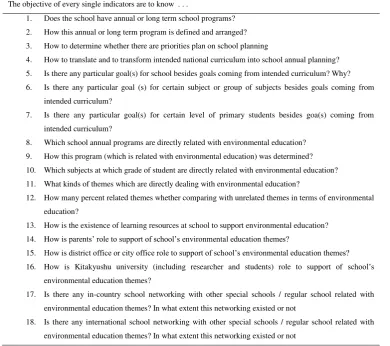
The conceptual framework is developed under the view that successful EE learning for visual impairment students involves an whole approach in which school, communities, parents and children cooperate to identify and remove the barriers to participation, enjoyment which covers integrated of practice, cultures and policy [11]. Additionally, learning EE is successful only when the learner is able to identify conditions for the use of knowledge in new situations. These conditions, however, are not present in the algorithms itself and cannot be carried over by teachers to their learners. This is one of the didactical contract paradoxes: “The more the teacher gives in to her demands and reveals whatever the student wants, and the more she tells her precisely what she must do, the more she risks losing her chance of obtaining the learning which she is in fact aiming for.” [12]. So, we added didactical situation as last part of conceptual framework for the instruments. Technically the frameworks translated into indicators is recognized as (1) School Annual Activities, (2) School Cultures, (3) Teacher practices, and (4) Didactical Situation. The conceptual frameworks which translated into indicators of the questionnaire are presented as follow:
Table 1. Instrument indicators for School Annual Activities.
Indicators
The objective of every single indicators are to know . . .
1. Does the school have annual or long term school programs? 2. How this annual or long term program is defined and arranged? 3. How to determine whether there are priorities plan on school planning
4. How to translate and to transform intended national curriculum into school annual planning? 5. Is there any particular goal(s) for school besides goals coming from intended curriculum? Why? 6. Is there any particular goal (s) for certain subject or group of subjects besides goals coming from
intended curriculum?
7. Is there any particular goal(s) for certain level of primary students besides goa(s) coming from intended curriculum?
8. Which school annual programs are directly related with environmental education? 9. How this program (which is related with environmental education) was determined? 10. Which subjects at which grade of student are directly related with environmental education? 11. What kinds of themes which are directly dealing with environmental education?
12. How many percent related themes whether comparing with unrelated themes in terms of environmental education?
13. How is the existence of learning resources at school to support environmental education?
14. How is parents’ role to support of school’s environmental education themes?
15. How is district office or city office role to support of school’s environmental education themes?
16. How is Kitakyushu university (including researcher and students) role to support of school’s environmental education themes?
17. Is there any in-country school networking with other special schools / regular school related with environmental education themes? In what extent this networking existed or not
Table 2. Instrument indicators for School Cultures.
Indicators
The objective of every single indicators are to know . . .
1. How schools effort so that every single of people at school made to feel welcome in building of community
2. How is school effort to make staffs collaborate with each other
3. How is school campaign so that staff and students treat one another with respect 4. How is school effort to encourage a partnership between staff and parents
5. How is school effort to facilitate school supervisor or educational board work well together 6. How are school effort so that all local communities are involved together in the school 7. How school strategies to ensure there are high expectation for all students?
8. How is school effort so that staff, educational board, students and parents share philosophy of inclusion
9. How is school strive to minimize all form of discrimination?
Table 3. Instrument indicators for Teacher Practices
Indicators
The objective of every single indicators are to know . . . 1. How is lesson planned with the learning of all students in mind 2. How is lesson arranged to encourage participation of all students 3. How is lesson developed an understanding of difference
4. How is lesson developed students actively involved in their own learning 5. How is lesson arranged to make students learn collaboratively
6. How is assessment is arranged to contribute to the achievement of students 7. How to manage classroom discipline based on mutual respect
8. How are teachers plan, teach and review occurred in the partnership 9. How is teaching assistant support the learning and participation of all students 10. How is homework contribute to the learning of all
11. How all students can take part actively in the outside classroom activities 12. How students difference is used as resources for teaching and learning
13. How staffs’ expertise are fully utilised
14. How staffs develop resources to support learning and participation 15. How are resources distributed fairly so that they support inclusion
Table 4. Instrument indicators for Didactical Situation
Indicators
The objective of every single indicators are to know . . . 1. How is teacher perceived about environmental education?
2. How themes of environmental education topics are adopted from intended curriculum 3. How themes of environmental education topics are defined from outside of intended curriculum 4. How is arrangement of learning resources for environmental education topics themes 5. How are students learning obstacles in the classroom
6. How are students learning styles
7. How are dealing with problems of students confidence and self-esteem
8. How teachers effort so that environmental education learning activities has contributed to the healthiness of students
9. How are issue of environment in the city becomes learning inspiration in the classroom
2.2.Subjects
School elements were recruited from two visual impairment schools (engineering, liberal arts, social sciences, marine sciences, science, and management) of Kitakyushu – Japan and Bandung – Indonesia, respectively. The interview covered school teachers and principals in the state primary school level. The interview at Kitakyushu was conducted in Japanese while the interview at Bandung was applied in Bahasa. Sound recorder is used during interview. Transliteration from those language to English are done using literally words and also reconfirmation the points from secondary data. Because missing responses for any items in a subscale could produce biases in the parameter estimates, in this research the secondary data are person who can speak Japanese and Bahasa and attended the interview. The second method is applied to minimize translation bias which sometimes occurred especially related with the context of the language.
3.Findings: A Comparison
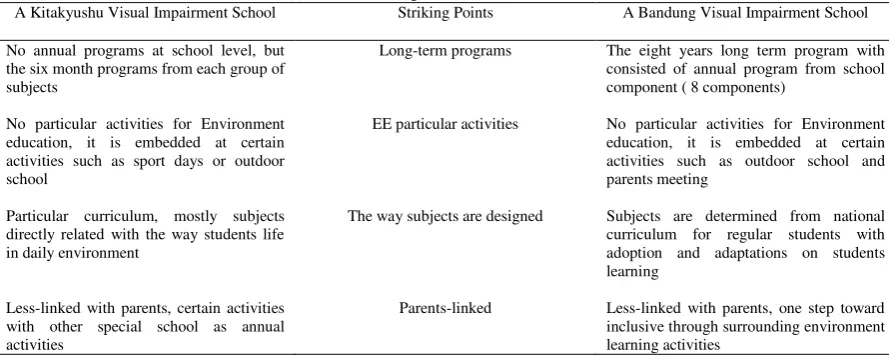
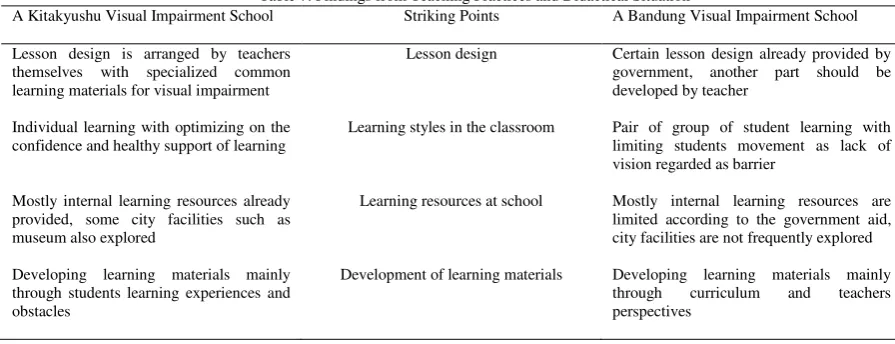
Since the data gained through interview without restrict time of answers, some comments of respondents while dealing with certain item of questionnaire frequently at the same time already answering other items. Furthermore, number of respondents at those school are not equal, so statistically analysis is not applied. We decided to use descriptive analysis according transcript data from sound-recorder, verification to native speaker who coming along with us while gained data, and focus group discussion after hearing result of sound recorder. In order to sharpen analysis from two consecutive schools, we agreed to use comparative at each different result from every aspect of questionnaire items rather than similarities found. We considered this choice since it would be a critical point for the next step of the research, i.e: determining adoption of Kitakyushu visit to re-design priorities plan and instructional media at visual impairment school at Bandung. From its difference, it is expected would give striking point to design school priorities plan. Since some small differences in certain points are found in other points of the questionnaire items, we also decided to classify those to be certain number main differences according to the four conceptual framework, but we combined Teaching Practice and Didactical Situation since its result has strong similarities. The result of finding classification are presented as follow
Table 5. Findings from School Annual Activities
A Kitakyushu Visual Impairment School Striking Points A Bandung Visual Impairment School
No annual programs at school level, but the six month programs from each group of subjects
Long-term programs The eight years long term program with consisted of annual program from school component ( 8 components)
No particular activities for Environment education, it is embedded at certain activities such as sport days or outdoor school
EE particular activities No particular activities for Environment education, it is embedded at certain
The way subjects are designed Subjects are determined from national curriculum for regular students with adoption and adaptations on students learning
Less-linked with parents, certain activities with other special school as annual activities
Parents-linked Less-linked with parents, one step toward inclusive through surrounding environment learning activities
Table 6. Findings from School Cultures A Kitakyushu Visual Impairment School
Striking Points A Bandung Visual Impairment School Initial Screening with school visit and
integrated data from health division and city government
Initial screening of students Initial screening from Admission, parents interview and child performance, lack of data from city and health division
Fully adjustment of school facilities, classroom setting, and supporting learning media
Adjustment facilities Limited adjustment on the learning media, almost similar type for normal school at classroom setting, less adjustment of school facilities
Focusing on individual approach since limited number of student; barriers should
be optimized from sport activities observation
from principal point of view
No insert – exit program to regular school after graduate from certain level of school
Linked with regular school There is insert-exit program to the inclusive school especially for high academic or certain performance excellences of students
Table 7. Findings from Teaching Practices and Didactical Situation
A Kitakyushu Visual Impairment School Striking Points A Bandung Visual Impairment School
Lesson design is arranged by teachers themselves with specialized common learning materials for visual impairment
Lesson design Certain lesson design already provided by government, another part should be developed by teacher
Individual learning with optimizing on the confidence and healthy support of learning
Learning styles in the classroom Pair of group of student learning with limiting students movement as lack of vision regarded as barrier
Mostly internal learning resources already provided, some city facilities such as museum also explored
Learning resources at school Mostly internal learning resources are limited according to the government aid, city facilities are not frequently explored
Developing learning materials mainly through students learning experiences and obstacles
Development of learning materials Developing learning materials mainly through curriculum and teachers perspectives
4.Conclusion
A baseline study of visual impairment school at Bandung and Kitakyushu has been done descriptively using set of questionnaire according to the four conceptual framework for environmental learning. Through data analysis, some findings and comparison are gained and classified which is essentially needed in order to describe initial picture. Set questionnaires and interview of annual school program, school cultures, learning methods and its didactical situation for teachers and principal should be continued for next step preparation of instructional media for Environment Education learning for visual impairment for primary school. The findings comparison from two visual impairment school not only can be used as part of priorities plan for school but also can be a wider picture to design lesson plan at visual impairment school at Bandung.
Acknowledgements
Appendix A. School Annual Activities related with Environmental Education Questionnaires
Questionairre items
1. Does school has annual program or long-term program periodically (more than 6 months)? 2. Does school has termin program related with the annual or long term program?
3. How is the classification of each activities in the long term program? 4. How these program are planned en every single term / year?
5. How are school teachers, parents, and educational board involvement on annual program arrangement? 6. Is there any priorities segregation in the annual / long term school program?
7. If it is so, what is the reason?
8. How intended curriculum (national curriculum) taking place to the school annual program?
9. Is there particular objective from intended curriuclum which adopted as main priority in the annual program? 10. Is there any particular goals from school which is not accommocated by intended curriculum goals? 11. If it is so, why school defined these particular goals?
12. Does the school particular goals declared in the annual school program?
13. Is there any particular goals from certain subjects group which is not accommocated by intended curriculum goals?
14. If it is so, why certain subjects group defined these particular goals?
15. Does the certain subjects group particular goals declared in the annual school program?
16. Is there any particular goals on certain student levels which is not accommodated by intended curriculum goals?
17. If it is so, why school defined certain student level goals?
18. Does goals of certain student level declared in the school annual program?
19. From all of school program elements. Which program directly related with Environmental Education (EE) 20. If it so, How is the backgound of these arrangement programs come up to the surface?
21. From annual activities which is directly related with EE, at what subject it is directly dealing with EE? 22. From that mentioned subject, at what grade the subject is taught?
23. What topics (themes) at every single grades which are directly related with EE
24. Roughly, comparing with all topics, how many percent topics at school which directly related with EE? 25. How is presence of learning recources inside school to support EE?
26. From school program which is directly related with EE, how are parents participation?
27. From school program which is directly related with EE, how are district government participation? 28. From school program which is directly related with EE, how are university lecturer nearby (kitakyushu
university and others) participation?
29. Spesifically related with EE, Is there any networking with other school (including with regular schools)? 30. If there is so, explain the latest networking formed (underplanning or ongoing)?
31. If there is no networking with other schools, why ?
32. Is there any networking with other stakeholders outside of country related with EE at school? 33. If there is so, explain the latest networking formed (underplanning or ongoing)?
Appendix B. School Cultures related with Environmental Education Questionnaires
Questionairre items
1. What kind of impression while students, parents, and educational board firstly come to the school? Why? 2. How are access at school have been adjusted with visual impairment students?
3. How school effort to celebrate local communities activities which is motivated by culture or religion? 4. Is there any positive ritual at school to welcoming or farewell students and staffs? If it is so, please shortly
explain.
5. Do studetns, parents, and government have sense of belonging to the school? If it is, please expkain shortly the example.
6. Do students asking help for their friends while facing problems? Does the other friend give help as requested? 7. Is there any kind of display at school which particularly describe students achievement individually and as a
group?
8. How are teachers effort to enggage friendship among students?
9. How is learning tendency of students? Do they tend to compete each other?
10. Do students calling each other with nickname nuanced by gender, religion, race or their disabilities? 11. How teachers effort to handle conflict among students?
12. Is there any proof that students are respecting each other regardless race, religion and disabilities backrgound? 13. How is teacher involvement to arrange school curriculum?
14. How is discussion among teachers related with student development at school? 15. How are teachers activities to form learning community at school?
16. How are techers effort in order to hear students’ voice?
17. How is a proof that school and teachers are listeing students’ voice?
18. How is a proof that students and teachers are helping each other?
19. How is formal communication among teachers and students and parents as well related with school acitivities? 20. How teacher and school facilitating parent participation at learning activities both of in the class and out of the
class?
21. How school effort to convice parents that every single students are treated equally? 22. Do school principal and teacher understand about school supervisor?
23. Does school supervisor willilngly accepting suggestion from teacher and principal? 24. What is the most significance contribution of school supervisor for teacher and school?
25. Do school supervisor and teacher discuss each other about students’ learning obstacles? If it is, when it was
lastly happened?
26. Is there any particular school activities which involving all school elements from diverse ages? If it is so, please shortly explain about the event
27. How school contribution at ceremony at local surrounding? 28. What is influence from surrounding society to the school policy?
29. How are continuing effort from school and teacher in order to motivate students to achoeve their highest desire?
30. How are school and teachers effort so that students are able to apprecitae their classmate achievement, confidence and optimize their potential?
31. How are school and teachers opinion about individual and collaboration activities of students ? 32. What are principal and teachers understand about inclusive?
33. How are school and teachers effort technically on one step toward inclusive ? 34. How school efforts to handle discriminative cases among students?
Appendix C. Teacher Teaching Method related with Environmental Education Questionnaires
Questionairre items
1. How to adopt are particular learning strategy for visual impairment students?
2. How does teacher choose an appropriate learning method for student development in the classroom?
3. What kind of student way of thinking which desirely achieved by teacher’s teaching?
4. How are student participatory problems in the classroom?
5. How teachers effort to ensure student are actively involved in the calssroom?
6. Is there any significance difference among student in the classroom? If it so, please shortly explain 7. How are students behaviour while some of their classmate have certain difference with them? 8. How are teachers effort so that student are understand well about uniqueness among students? 9. Does any student less active in the classroom? Why ?
10. How other students reaction toward this less ctive student?
11. How is teachers effort so that all students are engaged in the classroom? 12. Does any student tend to learn individually or grouping?
13. What kind of teacher’s effort so that students are able to learn collaboratively?
14. How does teacher performed assessment of learning?
15. Is there any obstacles for teachers to apply certain learning assessment in the classroom? 16. Do students have a challenge to apply school discipline?
17. How are teachers effort to handle discipline problems? 18. How does teacher method to arrange a lesson plan?
19. What kind of challenges mainly occurred while arranging lesson plan? 20. Is there any discussion among teachers related with lesson plan arrangament? 21. If it so, how frequent this discussion occurred? And how is the menchanism? 22. If there is not, why?
23. Is there any teacher assisstance in the classroom? 24. If it so,what is the role of this teacher assisstance? 25. How often teachers give homework to the students?
26. How are homework sample can cotribute to the students learning? 27. How often outdoor learning occurred?
28. How teachers effort to engage students while conducting outdoor learning? 29. Does any students inside the classrom with special talent?
30. If it so, how are teacher manage this student among their classmate? 31. What kind of learning resources frequently used by teachers at school? 32. How teachers optimize these learning resources to support students learning? 33. What kind of learning resources ouside school frequently used by teachers? 34. How teachers optimize these external learning resources to support students learning? 35. Do surrounding people can access internal school learning resources
Appendix D. Didactical Situation related with Environmental Education Questionnaires
Questionairre items
1. What do teachers understand about EE?
2. What kind of particular goal for visual impairment students related with EE in the school? 3. According to the intended curriculum, what kind of topics directly related with EE? 4. From that topics (themes), which topic / theme is the most interesting for students? Why?
5. Is there any particular topic besides topics from intended curriculum which desired to be achieved? Why? 6. If it is so, How is relation the particular topic with EE?
7. Which inside school learning resources used frequently by teacher related with EE? 8. Which outside school learning resources used frequently by teacher related with EE? 9. How are teacher adjustment concerned with utilize those learning resources? 10. What are students learning obstacles in the classroom?
11. Which learning obestacles are mainly occurred in the classroom? Why? 12. How teachers effort to tackle those learning obstacles?
13. How is general tendecy of students learning in the classroom? 14. How is individual learning tendency in the classroom
15. Does any students experienced with lack od confidence in learning? 16. How is generally student self-esteem in the classroom?
17. How is teachers effort to improve students confidence and student self-esteem as well ? please explain the experienced cases
18. Is there any EE topic besides topics listed by intended curriculum which contribute to the student’s health?
19. What are challenges to deliver topic which suport student’s health?
20. Does City government policy emphasize strongly with EE?
21. Does the city problem related with environtment adopted as learning topic in the classroom? 22. If it is so, please explain briefly
23. If it is not, why??
24. Is there any topic of EE which has intersection with regular students or society? 25. If it is so, what are challenges while conducting this learning topic?
26. Please explain the most interesting learning topic related with EE? Please support with lesson plan 27. From the lesson plan, what are learning goals in term of knowledge, attitude and competences? 28. How teachers strategy to handle students learning obstacles?
29. Is there any section in those lesson plan which introduce one step toward inclusion?
References
[1] Mani, G. The Role of Integrated Education for Blind Children Community Eye Health. 1998; 11(27): 41–42. [2] OECD, 1985. Report on Green City, Paris.
[3] OECD, 2011. World Green Growth Report, Paris
[4] Hashi, Toru. Asia-Pacific Journal Feature, "Eco-Model City Kitakyushu and Japan's Disposal of Radioactive Tsunami Debris. The Asia-Pacific Journal, Vol 10, Issue 24, No 6, June 11, 2012.
[5] Kitahashi, Kenji (2013). Kitakyushu’s Challenge to Promote the Development of Green Industry. International Conference on Future of Cities, Japan.
[6] Rachman, Indriyani (2013). Can environmental education workshop upgrade teachers capability in a study of the test of environmental education worksheet for 4th grade students of primary school in East Kalimantan, Indonesia. Master Thesis of Kitakyushu University
[7] Kumar, D., Ramasamy, R. & Stefanich, G. (2001). Science for students with visual impairments: Teaching suggestions and policy implications for secondary educators. Electronic Journal of Science Education, 5(3).
[8] Jones, M. G., Minogue, J., Oppewal, T., Cook, M. P. & Broadwell, B. (2006). Visualizing without vision at the microscale: Students with visual impairments explore cells with touch. Journal of Science Education and Technology, 15(5), 345-351.
[9] Stefanich, G. P. & Norman, K. I. (1996). Teaching science to students with disabilities: Experiences and perceptions of classroom teachers and science educators. A special publication of the Association for the Education of Teachers in Science
[10] Cohen, 2011. The Role of instruction and a brushing device on the oral hygine of blind children. Clin Prev Dent23 (4) 8-12
[11] Booth and Ainscow. (2011) Understanding the Development of Inclusive School. Falmer Press-Taylor and Francis Group – New York