II
CONTENTS
Editors‟ Note
PRESCRIPTIVE VERSUS DESCRIPTIVE LINGUISTICS FOR LANGUAGE MAINTENANCE: WHICH INDONESIAN SHOULD NON-NATIVE SPEAKERS
LEARN? 1 - 7
Peter Suwarno
PEMBINAAN DAN PENGEMBANGAN BAHASA DAERAH? 8 - 11
Agus Dharma
REDISCOVER AND REVITALIZE LANGUAGE DIVERSITY 12 - 21
Stephanus Djawanai
IF JAVANESE IS ENDANGERED, HOW SHOULD WE MAINTAIN IT? 22 - 30
Herudjati Purwoko
LANGUAGE VITALITY: A CASE ON SUNDANESE LANGUAGE AS A
SURVIVING INDIGENOUS LANGUAGE 31 - 35
Lia Maulia Indrayani
MAINTAINING VERNACULARS TO PROMOTE PEACE AND TOLERANCE IN
MULTILINGUAL COMMUNITY IN INDONESIA 36 - 40
Katharina Rustipa
FAMILY VALUES ON THE MAINTENANCE OF LOCAL/HOME LANGUAGE 41 - 45
Layli Hamida
LANGUAGE MAINTENANCE AND STABLE BILINGUALISM AMONG
SASAK-SUMBAWAN ETHNIC GROUP IN LOMBOK 46 - 50
Sudirman Wilian
NO WORRIES ABOUT JAVANESE: A STUDY OF PREVELANCE IN THE USE
OF JAVANESE IN TRADITIONAL MARKETS 51 - 54
Sugeng Purwanto
KEARIFAN LOKAL SEBAGAI BAHAN AJAR BAHASA INDONESIA BAGI
PENUTUR ASING 55 - 59
Susi Yuliawati dan Eva Tuckyta Sari Sujatna
MANDARIN AS OVERSEAS CHINESE‟S INDIGENOUS LANGUAGE 60 - 64
Swany Chiakrawati
BAHASA DAERAH DALAM PERSPEKTIF KEBUDAYAAN DAN
SOSIOLINGUISTIK: PERAN DAN PENGARUHNYA DALAM PERGESERAN DAN
PEMERTAHANAN BAHASA 65 - 69
Aan Setyawan
MENILIK NASIB BAHASA MELAYU PONTIANAK 70 - 74
III
PERGESERAN DAN PEMERTAHANAN BAHASA SERAWAI DI TENGAH HEGEMONI BAHASA MELAYU BENGKULU DI KOTA BENGKULU SERAWAI LANGUAGE SHIFT AND MAINTENANCE IN THE BENGKULU MALAY
HEGEMONY IN THE CITY OF BENGKULU 75 - 80
Irma Diani
KEPUNAHAN LEKSIKON PERTANIAN MASYARAKAT BIMA NTB DALAM
PERSPEKTIF EKOLINGUISTIK KRITIS 81 - 85
Mirsa Umiyati
PERAN MEDIA CETAK DAN ELEKTRONIK DALAM RANGKA MEREVITALISASI DAN MEMELIHARA EKSISTENSI BAHASA INDONESIA DI NEGARA
MULTIKULTURAL 86 - 90
Muhammad Rohmadi
BAHASA IBU DI TENGAH ANCAMAN KEHIDUPAN MONDIAL YANG
KAPITALISTIK 91 - 95
Riko
TEKS LITURGI: MEDIA KONSERVASI BAHASA JAWA 96 - 101
Sudartomo Macaryus
PEMILIHAN BAHASA PADA SEJUMLAH RANAH OLEH MASYARAKAT TUTUR
JAWA DAN IMPLIKASINYA TERHADAP PEMERTAHANAN BAHASA JAWA 102 - 107
Suharyo
BAHASA IMPRESI SEBAGAI BASIS PENGUATAN BUDAYA DALAM
PEMERTAHANAN BAHASA 108 - 112
Zurmailis
THE SHRINKAGE OF JAVANESE VOCABULARY 113 - 117
Ari Nurweni
LANGUAGE CHANGE: UNDERSTANDING ITS NATURE AND MAINTENANCE
EFFORTS 118 - 123
Condro Nur Alim
A PORTRAIT OF LANGUAGE SHIFT IN A JAVANESE FAMILY 124 - 128
Dian Rivia Himmawati
LANGUAGE SHIFT IN SURABAYA AND STRATEGIES FOR INDIGENOUS
LANGUAGE MAINTENANCE 129 - 133
Erlita Rusnaningtias
LANGUAGE VARIETIES MAINTAINED IN SEVERAL SOCIAL CONTEXTS IN
SEMARANG CITY 134 - 138
Sri Mulatsih
FACTORS DETERMINING THE DOMINANT LANGUAGE OF JAVANESE-INDONESIAN CHILDREN IN THE VILLAGES OF BANCARKEMBAR
(BANYUMAS REGENCY) AND SIDANEGARA (CILACAP REGENCY) 139 - 143
Syaifur Rochman
PERSONAL NAMES AND LANGUAGE SHIFT IN EAST JAVA 144 - 146
IV
REGISTER BAHASA LISAN PARA KOKI PADA ACARA MEMASAK DI STASIUN
TV: SEBUAH STUDI MENGENAI PERGESERAN BAHASA 147 - 151
Andi Indah Yulianti
PERUBAHAN BAHASA SUMBAWA DI PULAU LOMBOK: KAJIAN ASPEK LINGUISTIK DIAKRONIS (CHANGE OF SUMBAWA LANGUAGE IN LOMBOK
ISLAND: STUDY OF THE ASPEK OF DIACRONIC LINGUISTICS) 152 - 156
Burhanuddin dan Nur Ahmadi
PERGESERAN PENGGUNAAN BAHASA INDONESIA AKIBAT PENGARUH SHUUJOSHI (PARTIKEL DI AKHIR KALIMAT) DALAM BAHASA JEPANG, SEBUAH PENGAMATAN TERHADAP PENGGUNAAN BAHASA INDONESIA OLEH KARYAWAN LOKAL DAN KARYAWAN ASING(JEPANG) DI PT. KDS
INDONESIA 157 - 162
Elisa Carolina Marion
PENGGUNAAN BAHASA DALAM SITUASI KEANEKABAHASAAN 163 - 167
Fatchul Mu’in
PENGEKALAN BAHASA DALAM KALANGAN PENUTUR DIALEK NEGEI
SEMBILAN BERDASARKAN PENDEKATAN DIALEKTOLOGI SOSIAL BANDAR 168 - 172
Mohammad Fadzeli Jaafar, Norsimah Mat Awal, dan Idris Aman
KONSEP DASAR STANDARISASI BAHASA SASAK: KE ARAH KEBIJAKAN
PEMBELAJARAN DAN PEMERTAHANAN BAHASA SASAK DI LOMBOK 173 - 177
Ahmad Sirulhaq
PEMBELAJARAN BAHASA INDONESIA TERPADU (KOHERENS) 178 - 182
Marida Gahara Siregar
HARI BERBAHASA JAWA DI LINGKUNGAN PENDIDIKAN 183 - 185
Yasmina Septiani
JAVANESE-INDONESIAN RIVALRY IN AKAD NIKAH AMONG YOGYAKARTA
JAVANESE SPEECH COMMUNITY 186 - 191
Aris Munandar
PENGKAJIAN BAHASA MADURA DAHULU, KINI DAN DI MASA YANG AKAN
DATANG 192 - 197
Iqbal Nurul Azhar
BAHASA INDONESIA ATAU BAHASA JAWA PILIHAN ORANG TUA DALAM
BERINTERAKSI DENGAN ANAK DI RUMAH 198 - 202
Miftah Nugroho
PILIHAN BAHASA DALAM MASYARAKAT MULTIBAHASA DI KAMPUNG
DURIAN KOTA PONTIANAK (PENDEKATAN SOSIOLINGUISTIK) 203 - 207
Nindwihapsari
PEMAKAIAN BAHASA JAWA OLEH PENUTUR BAHASA JAWA DI KOTA
BONTANG KALIMANTAN TIMUR 208 - 212
Yulia Mutmainnah
INSERTING JAVANESE ACRONYMS FOR TEACHING GRAMMAR RULES: A
THEORETICAL ASSUMPTION 213 - 217
V
THE JUNIOR SCHOOL STUDENTS‟ ATTITUDES TOWARDS SUNDANESE LANGUAGE LEARNING (A CASE STUDY AT 2 JUNIOR SCHOOLS AT
BANDUNG, WEST JAVA, INDONESIA) 218 - 221
Maria Yosephin Widarti Lestari
THE JUNIOR SCHOOL STUDENTS‟ ATTITUDES TOWARDS SUNDANESE LANGUAGE LEARNING (A CASE STUDY AT 2 JUNIOR SCHOOLS AT
BANDUNG, WEST JAVA, INDONESIA) 222 - 225
Tri Pramesti dan Susie C. Garnida
KEARIFAN LOKAL SEBAGAI BAHAN AJAR BAHASA INDONESIA BAGI
PENUTUR ASING 226 - 230
Hidayat Widiyanto
BAHASA, SASTRA, DAN PERANANNYA DALAM PEMBENTUKAN
KECERDASAN EMOSI PADA ANAK (SEBUAH STUDI KASUS PELAKSANAAN PEMBELAJARAN BAHASA DAN SASTRA PADA KELAS SASTRA ANAK DAN SASTRA MADYA DI LEMBAGA PENDIDIKAN “BINTANG INDONESIA”
KABUPATEN PACITAN) 231 - 236
Sri Pamungkas
COMMUNICATION MODEL ON LEARNING INDONESIAN
FOR FOREIGNER THROUGH LOCAL CULTURE 237 - 239
Rendra Widyatama
VARIASI BAHASA RAGAM BAHASA HUMOR DENGAN MENGGUNAKAN UNSUR PERILAKU SEIKSIS DI DESA LETEH, REMBANG KAJIAN BAHASA
DAN JENDER 240 - 245
Evi Rusriana Herlianti
EKSPRESI KEBAHASAAN PEREMPUAN KLOPO DUWUR TERHADAP PERANNYA DALAM KELUARGA DAN MASYARAKAT (SEBUAH ANALISIS
BAHASA DAN JENDER) 246 - 250
Yesika Maya Oktarani
BELETER FOR TRANFERING MALAY LANGUAGE AND CULTURAL MORAL
VALUES TO YOUNG MALAYS AT PONTIANAK, KALIMANTAN BARAT 251 - 255
Syarifah Lubna
METAPHORS AS A DYNAMIC ARTEFACT OF SOCIAL VALUES EXPRESSED
IN LETTERS TO EDITORS 256 - 260
Deli Nirmala
THE EXPRESSION OF THE CONCEPTUAL METAPHORS “FRONT IS GOOD;
BACK IS BAD” IN THE INDONESIAN LANGUAGE 261 - 266
Nurhayati
PEMERTAHANAN BAHASA: PERSPEKTIF LINGUISTIK KOGNITIF 267 - 270
Luita Aribowo
KAJIAN LEKSIKAL KHAS KOMUNITAS SAMIN SEBUAH TELISIK BUDAYA
SAMIN DESA KLOPO DUWUR, BANJAREJO, BLORA, JAWA TENGAH 271 - 276
VI
MANIPULATING SUNDANESES‟ PERCEPTIONS AND THOUGHTS IN
POLITICAL DISCOURSE THROUGH INDIGENIOUS LANGUAGE 277 - 280
Retno Purwani Sari dan Nenden Rikma Dewi
THE POSITIONING OF BANYUMASAN AND ITS IDEOLOGY „CABLAKA‟ AS
REFLECTED IN LINGUISTIC FEATURES 281 - 284
Chusni Hadiati
WHAT PEOPLE REVEALED THROUGH GREETINGS 285 - 289
Dwi Wulandari
THE ROLE OF INDIGENOUS LANGUAGES IN CONSTRUCTING IDENTITY IN
MULTICULTURAL INTERACTIONS 290 - 292
Eliana Candrawati
THE LOGICAL INTERPRETATION AND MORAL VALUES OF CULTURE-BOUND JAVANESE UTTERANCES USING THE WORD “OJO” SEEN FROM
ANTHROPOLOGICAL LINGUISTIC POINT OF VIEW 293 - 297
Muhamad Ahsanu
PENGUNGKAPAN IDEOLOGI PATRIARKI PADA TEKS TATA WICARA
PERNIKAHAN DALAM BUDAYA JAWA 298 - 302
Indah Arvianti
PEPINDHAN: BENTUK UNGKAPAN ETIKA MASYARAKAT JAWA 303 - 310
Mas Sukardi
BAGAIMANA BAGIAN PENDAHULUAN ARTIKEL PENELITIAN DISUSUN? 311 - 316
Jurianto
STYLISTIC IN JAVANESE URBAN LEGEND STORIES: A CASE STUDY IN
RUBRIC ALAMING LELEMBUT IN PANJEBAR SEMANGAT MAGAZINE 317 - 320
Valentina Widya Suryaningtyas
MAINTAINING SOURCE LANGUAGE IN TRANSLATING HOLY BOOK: A CASE
OF TRANLSTAING AL-QUR‟AN INTO INDONESIAN 321 - 325
Baharuddin
TRANSLATING A MOTHER TONGUE 326 - 329
Nurenzia Yannuar
TRANSLATION IGNORANCE: A CASE STUDY OF BILINGUAL SIGNS 330 - 334
Retno Wulandari Setyaningsih
TERJEMAHAN UNGKAPAN IDIOMATIS DALAM PERGESERAN KOHESIF DAN
KOHERENSI 335 - 338
Frans I Made Brata
VARIASI FONOLOGIS DAN MORFOLOGIS BAHASA JAWA DI KABUPATEN
PATI 339 - 342
Ahdi Riyono
VARIASI FONOLOGIS DAN MORFOLOGIS BAHASA JAWA DI KABUPATEN
PATI 343 - 347
VII
PROSES FONOLOGIS BAHASA KAUR YANG DIPICU FAKTOR EKSTERNAL
LINGUISTIK 348 - 352
Wisman Hadi
WORLD PLAY IN CALAOUMN OF CATATAN PLESETAN KELIK (CAPEK) 353 - 357
Oktiva Herry Chandra
ANALYTIC CAUSATIVE IN JAVANESE : A LEXICAL-FUNCTIONAL APPROACH 358 - 362
Agus Subiyanto
A SYSTEMIC FUNCTIONAL ANALYSIS ON JAVANESE POLITENESS: TAKING
SPEECH LEVEL INTO MOOD STRUCTURE 363 - 367
Hero Patrianto
PERGESERAN PENEMPATAN LEKSIKAL DASAR DALAM DERET
SINTAGMATIK PADA TUTURAN JAWA PESISIR 368 - 372
M. Suryadi
JAVANESE LANGUAGE MODALITY IN BLENCONG ARTICLES OF SUARA
MERDEKA NEWSPAPER 373 - 377
Nina Setyaningsih
POLISEMI DALAM TERMINOLOGI KOMPUTER (SEBUAH UPAYA APLIKASI
PENGEMBANGAN DAN PEMELIHARAAN BAHASA) 378 - 384
Juanda Nungki Heriyati
STRUKTUR FRASE NAMA-NAMA MENU MAKANAN BERBAHASA INGGRIS DI
TABLOID CEMPAKA MINGGU INI (CMI) 385 - 389
251
BÉLETER FOR TRANSFERRING LANGUAGE AND CULTURAL MORAL VALUES TO YOUNG MALAY AT PONTIANAK, KALIMANTAN BARAT.
Syarifah Lubna
Balai Bahasa Provinsi Kalimantan Barat
Abstract
Bahasa adalah alat komunikasi yang menyampaikan setiap perasaan penuturnya. Ia bisa menyampaikan perasaan sayang, cinta, suka, benci, kecewa, bahkan marah. Sebagai penutur multibahasa, orang Indonesia cenderung memilih untuk menyampaikan rasa marahnya dalam bahasa ibu atau bahasa pertama mereka. Hal ini bisa jadi disebabkan bahwa marah adalah rasa pribadi yang umumnya ditampakkan pada lingkungan pribadi. Pada lingkungan ini, marah adalah rasa yang kompleks karena tak melulu memperlihatkan ketidaksukaan dan ketidaksetujuaan, melainkan juga kepedulian serta rasa sayang, termasuk rasa sayang ibu kepada anggota keluarganya. Marah bisa berbentuk tindakan apa saja, ada diam tanpa kata, atau sebaliknya merepet dengan seribu kata. Merepet ini bisa dalam bentuk beleter. Beleter merupakan cara marah yang lazim pada masyarakat Melayu Kalimantan Barat dan umumnya dilakukan oleh para ibu. Beleter bisa dimulai dengan banyak berbicara secara terus menerus sampai mengomel untuk menyampaikan rasa ketidaksukaan dan kekesalan terhadap sesuatu. Ibu beleter biasanya disebabkan oleh kekecewaannya terhadap anggota keluarga, khususnya anak. Anak yang kurang disiplin, kurang sigap, kurang peduli atau kurang kemauan untuk terus maju dan berkembang bisa menjadi bahan leteran. Bahan leteran yang disebabkan ketidaksamaan persepsi antara ibu dan anak menjadi media sebagai upaya dalam penyamaan dan pembentukan nilai moral. Nilai moral warisan orangtua ibu diteruskan kepada anak yang akan meneruskan kebiasaan suku dan mewariskan kembali nilai yang sama pada anaknya kelak. Pengalihan nilai budaya ini sejatinya juga dilakukan dengan bahasa yang sama sebagai wujud pemertahanan bahasa asli ditengah kegerusan bahasa ibu yang mestinya lebih dikuasai oleh anak dibandingkan bahasa gaul yang hanya bersifat sementara.
Key Words: béleter, Malay language, transferring language, transferring local moral values, idioms, proverbs, local moral values.
1. Introduction
Language is one of the most distinctive characteristic, which distinguishes humans from other living creatures. Language has been used as a systematic means of communicating ideas and expressing feeling, emotion and thought. Language is used for interacting with fellow humans. As we know, human beings cannot live alone, they interacts with fellow humans in their environment with language. Humans make friends, make family and have children to continue their life in earth. Moreover, Keraf (1994:3) stated that language serves to express self-expression, as a communication tool, as a tool to conduct integration and social adaptation, as well as a tool to hold social control.
Social control in form of shared cultural moral values exists in human environment. One can recognize customary habits, behavior, manners, arts, and other elements of social local culture through the language of the region. Therefore, the existence of local cultures and language depending on language function in the region. Regional language will remain alive for the people in the region still want to use it as communication tool, and as a means of artistic expression and culture.
In this view, languages, understood as the particular set of speech norms of a particular community, are also a part of the larger culture of the community that speaks them. Humans use language as a way of signaling identity with one cultural group and difference from others. Even among speakers of one language have several different ways of using the language, they speak vary between speech communities and each is used to signal affiliation with particular subgroups or ethnics.
In addition, the relationship between language and emotions can be viewed as being done or
performed that is called ―emotive‖. Taking this angle, it is commonly assumed that people, at least on
252
terms of linguistic (lexical and syntactic) forms. (Caffi & Janney 1994; see also Fiehler 1990). Besnier (1994) also notions of what emotions are and how they function in private and public settings. In this view, language and emotion are two concurrent, parallel systems in use, and their relationship exists in that one system (emotions) impacts on the performance of the other (language). Both of them share their functionality in the communicative process between people.
In addition, →ierzbicka is able to document that ―every language imposes its own classification upon
human emotional experiences, and English words such as anger or sadness are cultural artifacts of the English language, not culture-free analytical tools‖ (199Ň: 456). Her analyses are good (and clear) examples for exactly this point, and her main argument is forcefully directed against most psychological theorizing within the James-Lange-tradition that starts from the assumption that emotions are bodily experienced feeling states, each categorically distinct, and built up in a clearly ordered sequence of events (see for recent critiques of this kind of theorizing from within psychology, though from quite different directions, Campos, Mumme, Kermoian & Campos 1994, Ellsworth 1994, Sarbin 1995).
Moreover, while at first sight Harré (1994) suggested to study emotion terms as part of a
(decontextualized) lexicon sounds very much like →ierzbicka‘s study of word reference, his proposal to
study the emotion vocabulary of a certain group of people promises a whole lot more. If references to emotions - in the realm of texts - position people with regard to one another (morally, aesthetically, and prudentially), they function as indexes to how emotions in discourse situations are displayed, that is, what emotions mean as discursive acts. Thus, employing emotionologies for the study of emotions as discursive acts orients us toward the study of language use in discourse situations. Stearns (1994, 1995) in
coining the term ―emotional styles‖.
An interesting point for venturing into the acquisition or the learning of emotionologies lies in Harrés affinity and flirtation with anthropological approaches to emotions which traditionally place emphasis on the cognitive and/or conceptual aspects of emotions (cf. Lutz & White, 1986; Lutz, 1988). In an apparent parallel with Wierzbicka, Lutz claims that ―emotion can be viewed as a cultural and interpersonal process
of naming, justifying, and persuading by people in relationship to each other‖ (Lutz 1988: 5). However, in
contra- distinction to the former, the anthropology of emotions does not seem to claim psychological reality for the kind of conceptual analysis that is employed in the process of explicating the experiential, expressive, and regulative aspects of emotion displays. However, this leaves the question open, as Oatley formulated in his review of Lutz's works, ―of what emotions might be constructed from‖ (Oatley 1991: 77), and how much this construction process can (and needs to) be described in conceptual/cognitive terms, and what role language and other symbolic systems might play in this construction process.
2. Béleter for Transferring Language
Mother tongue as the foundation of the development of regional culture is the first language that controlled and used in everyday communication within the family environment. Since childhood, we have been communicating with our mother language. We delivered all the thoughts, feelings and desires with our mother tongue. William (1998: 36-44) stated that when using the second or foreign language, the emotional component often gets lost; as a matter of course, writers (or speakers) feel more detached and relate to the language as a tool rather than as a means of cultural identification. Those however who have an equal command of both languages can benefit from the situation of bilingualism. They can choose either language according to specific purpose or feeling.
For these reason, mother tongue used to express the private feeling in family. It grows within the family environment. Members of the family with their role and commitment using their mother tongue can be a very strong foundation for the development of mother tongue. Since mother tongue is the first language that is learned by a person, a child learns the basics first language of parents and next of kin. Mother has a very important role in the acquisition and retention of language. Mother is the first teacher to their children. The mother who first taught his son or daughter to speak is also determines the first language will be taught to their children. First language obtained by the children is what is called the mother tongue. Mother tongue is considered as a basic way of thinking. Skill someone in his/her first language or mother tongue is very important for the subsequent learning process. Its application will be longer and have made an impression for the child.
253
béleter. Béleter is talking too much, being fussy, or speaking incessantly about displeasure. Mostly,
béleter is in Malay language that is the first language for Malay people in Pontianak, Kalimantan Barat.
There are many things to do in béleter, such as: commenting others‘ habit to sampling children to do or not to do, besides teaching children how to do something in order to share same moral values of life.
Based on the author‘s personal experience that is Malay and since childhood has been taught communicating in Malay Pontianak, her mother also taught the mother tongue in many condition. She taught to express feeling in sad, happy, likes, pleasure, even displeasure and angry condition. She became a model of Malay speaker including how to act and response. When mother was angry, usually she
béleter, a way of showing her dislikes, advice, and moral values‘ taught. She used Malay expression to be
angry, that was recorded and acquired by her children in this case the author. Since that time, author or other young Malay in their own family whom being leter by their mother have imitated dictions or vocabularies of Malay that were used for angry, afterward, when the author or young Malay are getting older and become angry later, he/she will use the same language to express his/her emotion.
3. Béleter for Transferring Cultural Moral Values
Béleter is not only about expressing anger in Malay, but more than that, béleter shares the Malay moral values to the person who is being leter that is young Malay in this case. Young Malay needs to learn many things and aspects of life. They need samples and guidance how to do something or what should they do in this life. When mother got angry to her children since they are not doing in the right way or based on Malay tradition, she gives sample of that guidance. Ideally she does not use the words
which will hurt the children‘s feeling. She will motivate the children by using idioms and proverb in
Malay through béleter. Even mother speaks the truth, when it is done through béleter, she repeats it again and again, incessantly, continuously, in the morning and afternoon or when she meets the reasons of being her béleter. Those make the children learn, and likes or dislikes, follow her mother‘s taught, then follow the same shared moral values.
Idioms and proverb are two things that are repeated in béleter. According to Webster Dictionary, idioms are the language peculiar to a people or to a district, community, or class. It is also defined as a style or form of artistic expression that is characteristic of an individual. Webster defined proverb as a brief popular epigram or maxim. Epigram is a concise poem dealing pointedly and often satirically with a single thought or event and often ending with an ingenious turn of thought, while maxim is a general truth, fundamental principle, or rule of conduct; a proverbial saying.
Those definitions are harmonious in Malay tradition. Béleter which is full of idioms and proverbs reflects a peculiar of Malay tradition and fundamental principles of life in Malay culture in Pontianak, Kalimantan Barat.
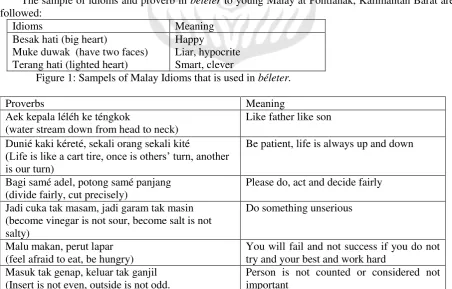
The sample of idioms and proverb in béleter to young Malay at Pontianak, Kalimantan Barat are as followed:
Idioms Meaning
Besak hati (big heart)
Muke duwak (have two faces) Terang hati (lighted heart)
Happy
Liar, hypocrite Smart, clever
Figure 1: Sampels of Malay Idioms that is used in béleter.
Proverbs Meaning
Aek kepala léléh ke téngkok
(water stream down from head to neck)
Like father like son
Dunié kaki kéreté, sekali orang sekali kité
(Life is like a cart tire, once is others‘ turn, another
is our turn)
Be patient, life is always up and down
Bagi samé adel, potong samé panjang (divide fairly, cut precisely)
Please do, act and decide fairly
Jadi cuka tak masam, jadi garam tak masin (become vinegar is not sour, become salt is not salty)
Do something unserious
Malu makan, perut lapar (feel afraid to eat, be hungry)
You will fail and not success if you do not try and your best and work hard
Masuk tak genap, keluar tak ganjil (Insert is not even, outside is not odd.
254 Basé tak mahal
(Politeness is not expensive)
Behave because you do not need to pay for becoming polite and nice
Figure 2: Sampels of Malay Proverbs that is used in béleter.
The idioms and proverbs above as shown in figure 1 and 2 as samples of leteran when a mother béleter. The idioms are used by a mother when she béleter to ask the children or young Malay to be besak
hati (big heart) or happy and do not become muke duwak (have two faces) or hypocrite. She also hopes
the young Malay as her children become terang hati (lighted heart) or smart and clever in acquiring and learning many values for his/her life or studying at school.
Moreover, the proverbs samples also teach the children about the quality of Malay life about
people‘s judge about us as human. Mother béleter to ask the children always do the right thing. Since it also indicates the goodness of their selves, it is preventing family from shame because of the bad manner or habit of the children. That is shown in proverb Aek kepala léléh ke tengkok (water stream down from head to neck) which means if you are good and nice, others will consider that your parents are good, and vice versa if your characters are bad, those indicates your parents have bad characters also. In English this
proverb popular with ‗like father like son‘ translation. The demand of keeping ‗good name‘ of the family
also becomes a reason why the children should always be polite Basé tak mahal (politeness is not expensive) that teaches the young Malay to behave since it is free. They do not need to pay for their politeness.
In addition, if the young Malay is appointed or selected becoming a leader, mother will béleter to remain her/him to do and lead well. He/she always should be fair when he/she solve or judge a problem, to bagi samé adel, potong samé panjang (divide fairly, cut precisely). The young Malay should always do something serious, do not jadi cuka tak masam, jadi garam tak masin (become vinegar is not sour, become salt is not salty). When the young Malay is down, mother béleter to remain her/him that dunié kaki kéreté, sekali orang sekali kité (life is like a cart tire, once is others‘ turn, another is our turn), so they will always be patient and not easy to be down, since life is always up and down naturally. Mother also encourage young Malay through béleter, for example with this proverb malu makan, perut lapar (feel afraid to eat, be hungry) so they will not become masuk tak genap, keluar tak ganjil (insert is not even, outside is not odd). That means the young Malay should work hard and always try their best in order to meet their success and not considered as unimportant person that is counted to make a change.
The teaching of local moral values that are shown in idioms and proverbs which is taught incessantly through béleter is very important part of a person‘s identity. Children as young Malay need to learn the
leteran as ―rules‖ of their culture and the language. It will help young Malay preserve a Malay identity
and language that enriching national (Indonesia) identity and culture. This gives them a feeling of
personal worth and self esteem, as UNESCO stated that ‗The Mother tongue is the foundation of building
a person‘s identity‘ (from UNESCO Education Today newsletter, July - September, 2003- The mother-tongue dilemma.)
4. Conclusion
Language is a communication tool that conveys every feeling of speakers. It can convey a feeling of affection, love, like, dislike, hate, disappointment, even anger. As multilingual speakers, Indonesian people tend to choose to express his anger in the mother tongue or first language. This could be due anger as personal feeling that is generally revealed in a private environment. In this environment, anger is a complex feeling due not merely to show displeasure and dislike, but also caring and compassion.
255 Reference:
Besnier, N. 1994. Involvement in linguistic practice: An ethnographic appraisal. Journal of Pragmatics, 22.
Caffi, C. & Janney, R.W. (Eds.) 1994. Involvement in language. Special issue of Journal of Pragmatics, 22.
Campos, J. J., Mumme, D. L., Kermoian, R., and Campos, R. G. 1994. A functionalist perspective on the nature of emotion. In N. A. Fox (Ed.), The Development of Emotion Regulation: Biological and Behavioral Considerations. Monographs of the Society for Research in Child Development, 59, (Nos 2-3).
Ellsworth, P. C. 1994. William James and emotion: Is a century of fame worth a century of misunderstanding? Psychological Review, 101.
Fiehler, R. 1990. Kommunikation und Emotion. Berlin: De Gruyter.
Harré, R. 1993. Universals yet again: A test of the‘Wierzbicka thesis‘. Language Sciences, 3. Harré, R., and Gillett, G. 1994. The Discursive Mind. Thousand Oaks, CA: Sage Publications. http://www.merriam-webster.com/dictionary/
Keraf, G. 1994. Komposisi. Flores: Nusa Indah.
Lutz, C.A. 1988. Unnatural Emotions: Everyday Sentiments on a Micronesian Atoll and their Challenge to Western Theory. Chicago: Chicago University Press.
Lutz, C. & White, G.M. 1986. The anthropology of emotions. Annual Review of Anthropology, 15. Oatley, K. 1991. Living together. A review of 'Unnatural Emotions', by Catherine A. Lutz. Cognition and
Emotion, 5.
Sarbin, T. R. 1995. Emotional life, rhetoric, and roles. Journal of Narrative and Life History, 5. Stearns, P.N. 1994. American Cool: Developing a Twentieth-Century Emotional Style. New York:
University Press.
Stearns, P.N. 1995. Emotion. In R. Harré & P. Stearns (Eds.), Discursive Psychology in Practice. London, England: Sage Publications
UNESCO Education Today newsletter, July - September, 2003- The mother-tongue dilemma. Wierzbicka, A. 1992. Defining emotion concepts. Cognitive Science, 16.