1
Antioxidant Activity of The Waste Water of Boiled Zea mays (Sweet Corn) on The Cob
Diah Dhianawaty D, Ramdan Panigoro
Biochemistry Department Faculty of Medicine of Universitas Padjadjaran, Bandung, Indonesia
ABSTRACT
Zea mays or corn is one of the important foodstuffs in Indonesia. Harvested area was 33 Provence,
which in many cities is commonly sold on the street by hawkers as boiled or burned corn. The
objective of the research is to study antioxidant activity of the waste water boiled. Sweet corn on
the cob was boiled in 20 minutes. The waste water boiled was dried with freeze dryer equipment.
Dried extract was screened of phytochemical constituents, and antioxidant activity was determined
with 2,2-diphenyl-1-picrylhydrazyl (DPPH) assay. Screening of phytochemicals showed positive
results for the presence of flavonoid, alkaloid, saponin, and quinon. Antioxidant activity EC50 was
189.8µg/ml. In conclusion the waste water of boiled sweet corn on the cob has antioxidant activity,
and maybe the waste water can be used as antioxidant supplement.
Key word: Antioxidant activity, antioxidant supplement, corn on the cob, DPPH assay.
INTRODUCTION
Zea mays (corn) is an important field crop beside paddy as human food energy. It always was
monitored by the Indonesian Ministry of Agriculture. The Indonesian Ministry of Agriculture has
some programs in place to assist farmers to have better access to high yielding corn and paddy seed
since 2007. Harvested area were 33 Provence: Aceh, North Sumatera, Riau, Jambi, South
Sumatera, Lampung, Babel, Kepri, Jakarta, West Java, Central Java, Yogyakarta, East Java,
Banten, Bali, West Nusa Tenggara, East Nusa Tenggara, West Kalimantan, Central Kalimantan,
South Kalimantan, East Kalimantan, Gorontalo, West Sulawesi, Maluku, North Maluku, West
Papua, and Papua (Anggoro, 2012).
Corn was cooked as vegetable or as snack. Boiled and burned corns in many cities are commonly
sold on the streets by hawkers. Before boiling, top and part the husks of the corn on the cob will be
cut, be pulled and discard. The water used again and again for boiled corn on the cob. The boiled
water was waste water, and was thrown away.
Free radicals and other ROS are derived either from the endogenous metabolic processes in the
2
metabolism, phagocyte activity, arachidonate pathways, inflammation, ischemia, exercise and
reactions involving iron and other transition metals. External sources include exposure to radiation,
ozone, cigarette smoke, air pollutant and industrial chemicals. Excess free radicals can accumulate,
resulting in oxidative stress, and it condition was associated with a number of diseases including
atherosclerosis, Alzheimer's disease, cancer, ocular disease, diabetes, rheumatoid arthritis and
motor neuron disease (Hajhashemi, 2010).
Antioxidants are used by aerobic organisms to prevent oxidation that can damage the cells during
oxygen metabolism. Oxidation can cause a number of diseases including atheroscleorosis,
neurodegenerative disorder, cancer, diabetes, inflammatory and aging. Natural antioxidants extract
from fruits, teas, vegetables, cereals and medicinal plants have been investigated extensively due to
their effectiveness in eliminating free radical and claimed to be less toxic than synthetic
antioxidants such as butylated hydroxyanisole (BHA) and butylated hydroxytoluene (BHT). There
are many classes of natural antioxidants and they include vitamins such as tocopherols and vitamin
C; and phytochemicals such as flavonoids and phenolic acids which are common to all plant
sources (Hasanudin, 2012).
The multifaceted aspects of antioxidants and the basic kinetic models of inhibited autoxidation and
analyzes the chemical principles of antioxidant capacity assays. Depending upon the reactions
involved, these assays can roughly be classified into two types: assays based on hydrogen atom
transfer (HAT) reactions and assays based on electron transfer (ET). One of the HAT is
2,2-diphenyl-1-picrylhydrazyl radical scavenging capacity assay (DPPH) (Huang, 2005).
Traditionally corn used to increase the production of breast-milk, kidney stone, fever, heart disease,
and diuretic (Hutapea, 2000).
Nowadays, more researches about corn were done. The pharmacological effects as antioxidant
activities were tested: in the study of free radical scavenging activity and total antioxidant activity
of corn silk extracts in benzene, chloroform, ethanol, ethyl acetate, methanol and petroleum ether,
3
with 100 μg concentration gives higher percentage (95.6%) of free radicals scavenging activity than
the other extracts. The free radical scavenging activity increases with increase in concentration. At
a concentration of 10 μg/ml, methanolic extract obtained 2.5% of free radical scavenging activity
and got increased to 95.6% in 100μg/ml of concentration. About total antioxidant activity,
methanolic extract exhibited the strongest antioxidant activity (85.2 mg/ml) among all the other
extracts (Bhaigyabati, 2011). In evaluation of polyphenol content and antioxidant activities of
cornsilk extracts in some selected organic and aqueous by -carotene bleaching method,
2,2-diphenyl-2-picrylhydrazyl (DPPH.) radical scavenging, superoxide anion (O2-) radical scavenging
and ferric reducing power activity (FRAP). DPPH test showed methanol extract was the strongest
electron or hydrogen donor due to the highest DPPH scavenging activity. The IC50 of DPPH
scavenging activity of the methanol, ethanol, water and ethyl acetate extracts were 140.89 μg/ml,
143.55 μg/ml, 195.21 μg/ml and 411.69 μg/ml respectively (Nurhanan, 2012). A significant amount
of phenol and flavonoids content of ethanol-water extract from corn silk (CS extract) were
measured by Folin Ciocalteu and AlCl3 assays. The antioxidant properties were estimated by
different methods. The percentage of DPPH radical scavenged by CS extract was 92.6 at a
concentration of 1.6 mg/ml. IC50 of the extract and the standard compounds butylated
hydroxytoluene (BHA) and quercetin was 0.59, 0.053, and 0.025 mg/ml, respectively. Iron
chelating activity of the extract was less than the standard compounds. CS extract showed nitric
oxide-scavenging effect less than the reference agent (quercetin). The extract showed a high
reducing ability. According to ferric thiocyanate (FTC) method, the extract showed more than 88%
inhibition of linoleic acid peroxidation. It might be concluded that some of the properties of CS in
traditional medicine is due to its antioxidant ability (Ebrahimzadeh et al., 2008, Hasanudin et al.,
2012). Methanolic and aqueous extracts of Malaysian corn silk contained flavonoids, saponin,
tannins, phlobatannins, phenols, alkaloids and cardiac glycosides, and the total phenolic content in
aqueous extract was significantly higher (42.71 + 0.87 μg/g of tannic acid equivalent (TAE))
4
The other pharmacological effects were found, water extract of corn silk treatment markedly
reduced hyperglycemia in alloxan-induced diabetic mice. The action of corn silk extract on
glycaemic metabolism is not via increasing glycogen and inhibiting gluconeogenesis but through
increasing insulin level as well as recovering the injured β-cells (Guo et al., 2009, Hasanudin et al.,
2012). Two flavonoid glycosides were isolated from n-butanol fraction of methanol extract of corn
silk, and were elucidated as by means of different analytical methods such as UV, IR, NMR and
MS (ESI) analyses and by comparison with those reported literature for the compounds, as maysin
(I) (2′′-O-α-L-rhamnosyl-6-C-(6-deoxyxylo- hexos-4-ulosyl)-luteolin) and maysin-3′-methyl ether
(II) (2′′-O-α-L-rhamnosyl- 6-C-(6-deoxy-xylo-hexos-4-ulosyl)-luteolin-3′-methyl ether). The
antimicrobial studies of maysin (I) and maysin-3′-methyl ether (II) were studied against twelve
bacteria and one yeast. The sensitivity of the compounds (2.0 mg/mL) towards bacteria was
compared with that of standard gentamycin (50 μg/mL). Flavonoid glycosides showed wider range
of activity towards gram-positive and gram-negative bacteria. Comparatively, compound I exerted
highest antibacterial activity towards gram positive bacteria than II. In comparison with
gentamycin, compound I showed significantly (p<0.05) higher activity against the tested bacteria
except towards Ent. aerogenes, S. paratyphi and P. mirabilis where it exerted statistically (p<0.05)
similar activity with gentamycin. Towards P. aeruginosa, it showed lower activity than gentamycin
(Nessa, 2012). Methanol cornsilk extract has protective effects on nephrotoxicity in rat that was
induced by gentamycin (GM) i.p. administration. At the dose 200 and 300 mg/kg of extract gave
significantly decreased serum creatinine, but not urea, levels compared with GM group.
Co-treatment of corn silk with GM considerably decreased the interstitial nephritis, but not acute
tubular necrosis and hyaline casts formation, compared with the GM group. Also, high dose of corn
silk caused hyaline cast formation, apoptosis, congestion, and swelling of renal tubules (Sepehri et
al., 2011, Hasanudin et al., 2012). The methanolic extract of corn silk at 200, 300 and 400 mg/kg
concentrations were tested to the hyperthyroid condition in Swiss albino rats that were induced
5
profile before and during the experiment and were confirmed with the histopathological study of
the thyroid gland. The highest effectiveness concentration is 400 mg/kg which is equal to that of
standard drug 0.04% of methimazole (Bhaigyabati, 2012).
METHOD
Material:
Sample : fresh sweet Zea mays (corn) on the cob from Lembang (Bandung) (West Java), has
length 18–19 cm, diameter 5–6 cm. was harvested in Desember 2012.
Cut off 5 cm the top portion of the cob, and the husks were pulled off of the corn (left the
last husk that coat around the corn and did not remove silk).
Reagent : DPPH (Sigma Aldrich), methanol (E.Merck). Demineralization water
Equipment : Freeze dryer Eyela FD-81, Spectrophotometer Jenway 6305 UV-Vis single beam
Experimental Details: Boiling corn on the cob:
25 corns divided to 5 groups, each group was boiled with 1800 ml boiled water in 20 minutes, and
removed the cooked corns from the hot water. The water waste boiled was collected and was dried
by freeze dryer: Eyela FD-81.
Phytochemical screening of dried boiled water extract:
The dried extract was analyzed for the presence of phytochemicals such as flavonoid, alkaloid,
saponin, quinon, tannin, and steroid/terpenoid using standard procedure (Harbone, 1973).
Preparation of DPPH stock solution:
6 Preparation of dried corn extract:
The dried corn extract was dissolved in methanol, and were made in 5 different concentrations:
0.669, 0.446, 0.223, 0.111, 0.056 g/ml.
Assay of antioxidant activity with 1, 1-diphenyl-2-picryl hydrazyl radical (DPPH):
Each of the samples was mixed with 1 ml DPPH stock solution, kept in dark for 30 min and optical
density was measured at 517 nm using Spectrophotometer Jenway 6305 UV-Vis single beam. The
absorbance was recorded. The result is % effective inhibition, and was calculated by the equation
below:
EC % =
RESULT AND DISCUSSION
The weight of dried extract of waste water of boiled corn on the cob = 35.6585 g.
Table 1: Phytochemical Constituents of Waste Water Dried Extract of Boiled Corn on the Cob
No. Constituents Results
1. Alkaloid +
2. Flavonoid –
3. Saponin +
4. Quinon +
5. Tannin –
6. Steroid/Triterfenoid – + = Present; – = Absent
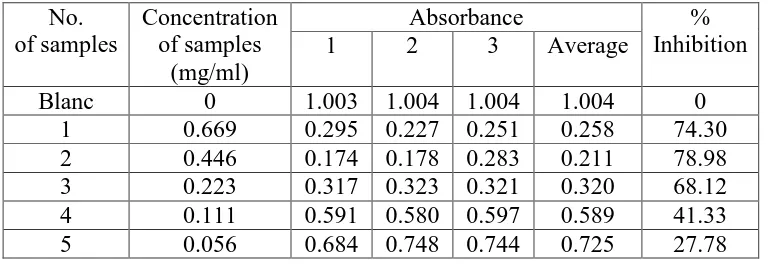
Table 2: Percent inhibition of Waste Water Dried Extract of Boiled Corn on the Cob on DPPH
No. of samples
Concentration of samples
(mg/ml)
Absorbance %
Inhibition 1 2 3 Average
7
Figure 1: Percent inhibition of Waste Water Dried Extract of Boiled Corn on the Cob on DPPH
The linier regression is y = 72.76x + 36.19
Note : y is % inhibition and x is sample concentration
y = 72.76x + 36.19
50 = 72.76x + 36.19
EC50 = 0,1898 mg/ml
The effective concentration of waste water of boiled corn on the cob is 0,1898 mg/ml.
CONCLUSION
The waste water of boiled corn on the cob has antioxidant activity, EC50 is 0,1898 mg/ml.
Therefore, maybe the waste water can be used as antioxidant supplement.
ACKNOWLEDGEMENTS
The authors would like to thank to Prof. Dr. Andreanus A Soemardji, School of Pharmacy Institute
Technology of Bandung and the authorities of Chemistry Department of Faculty of Mathematics
and Natural Sciences, Universitas Padjadjaran for supporting this research project. y = 72.769x + 36.198
R² = 0.6851
0 10 20 30 40 50 60 70 80 90
0 0.1 0.2 0.3 0.4 0.5 0.6 0.7 0.8
%
I
n
h
ib
ti
o
n
8 REFERENCE
General Director of Field Crop of Ministry of Agriculture of Indonesia, The integrity of the
development program of paddy, corn, and soy in the 2013 year, Jakarta: Ministry of Agriculture
of Indonesia Publication, 2012.
Hajhashemi V, Vaseghi G, Pourfarzam M, Abdollahi A. ‘Are antioxidants helpful for disease
prevention?’, Res Pharm Sci., vol. 5, no. 1, Januari-June, 2010 pp. 1-8.
Huang D, Ou B, Prior RL. ‘The Chemistry behind antioxidant capacity assays’, J. Agric. Food
Chem., vol. 53, no. 6, February, 2005 pp. 1841-1856.
Hutapea JR, Djumidi, Sutjipto, Indonesia medicinal plants inventory: Curcuma domestica Val.
1st edition, Jakarta: Ministry of Health Republic of Indonesia, 2000.
Bhaigyabati T, Kirithika T, Ramya J, Usha K. ‘Phytochemical constituents and antioxidant activity
of various extracts of corn silk (Zea mays. L),. J. Pharm Biol Chem Sci., vol. 2, no. 4, October,
2011 pp. 986-993.
Nurhanan A R, Wan RWI. ‘Evaluation of polyphenol content and antioxidant activities of some
selected organic and aqueous extracts of cornsilk (Zea Mays hairs)’, J. Med Biol Eng., vol. 1,
no. 1, September, 2012 pp. 48-51.
Ebrahimzadeh MA, Pourmorad F, Hafezi S. ‘Antioxidant activities of Iranian corn silk’, Turk J
Bio., vol. 32, no. 1, February, 2008 pp. 43-49.
Solihah, MA, Wan RWI, Nurhanan AR.’Phytochemicals screening and total phenolic content of
Malaysian Zea mays hair extracts’, Int. Food Research J., vol. 19, no. 4, December, 2012 pp.
1533-1538.
Guo J, Liu T, Han L, Liu Y. ‘The effects of corn silk on glycaemic metabolism’, Nutr Metab.,
vol. 6, no. 47, November, 2009 pp. 1-6.
Nessa F, Ismail Z, Mohamed N. ‘Antimicrobial activities of extracts and flavonoid glycosides of
corn silk (Zea mays L)’, Int. J. Biotech for Wellness Industries, vol. 1, Maret, 2012 pp. 115-121.
9
gentamicin-induced nephrotoxicity in rat’. J. Comp Clin Pathol., vol. 20, no. 1, February, 2011
pp. 89-94.
Bhaigyabati T, Ramya J, Usha K. ‘Effect of methanolic extract of sweet corn silk on
experimentally induced hyperthyroidism in Swiss albino rats’, Int. Res J Pharm., vol. 3, no. 3,
March, 2012 pp. 241-245.
Hasanudin K, Hashim P, Mustafa S. ‘Corn silk (Stigma Maydis) in healthcare: A phytochemical
and pharmacological review’, Molecules, vol. 17, no. 8, August, 2012 pp. 9697-9715.
Harborne JB. Phytochemical methods: A guide to Modern Technique of Plant Analysis. London:
Chapman and Hall Ltd., 1973.