Review of Household use of Septic Tanks
and Fecal Sludge Management in Rural
India
Prathibha Ganesan
CLTS Knowledge Hub Institute of Development Studies
Contents
Abstract ... 1
Introduction ... 2
Indian Standards for construction of a Septic Tank ... 3
Methodology ... 4
People’s choice a d experie ce of Septic Ta ks ... 6
Other observations from the grassroots level ... 13
Conclusion ... 13
Policy Suggestions ... 14
1
Abstract
2
Introduction
Septic Tank is a sanitation technology with a clear design which is promoted in areas where a sewerage system is absent. It helps in the primary treatment of liquid waste with solid content. Bureau of Indian Standards (BIS) provides standards for construction of septic tanks and the secondary treatment of fecal sludge matter from the septic tanks. However, at the grassroots level construction of septic tanks seldom follow the required standards. Similarly, waste from septic tank needs a secondary treatment, and there is no proper system for emptying the Fecal Sludge Matter which is considerate of the environmental impacts in India currently. Unscientific septic tanks and careless disposal of fecal sludge affect the environmental and sanitation goals of the country. The BIS document cautions that
u satisfa to desig , o st u tio , a d ai te a e of septi ta ks o stitute a health haza d'
(Bureau of Indian Standards, 1993). Any policy towards sanitation in India should, thus, be considerate about such issues. Therefore, as part of a larger scheme of knowledge accumulation for Swachh Bharat Mission- Gramin (SBM-G), this study attempts to investigate the household use of septic tanks and fecal sludge management (FSM) in Indian villages and provide policy suggestions. The report has six main sections of which the first being the introduction. The second section discusses the design of a septic tank and the Indian standards for construction of one. The third section explains the methodology of the study. The fourth section provides insights on the actual usage of septic tanks in rural India. The fifth section discusses the findings, and the sixth section provides the policy suggestions.
3
Indian Standards for construction of a Septic Tank
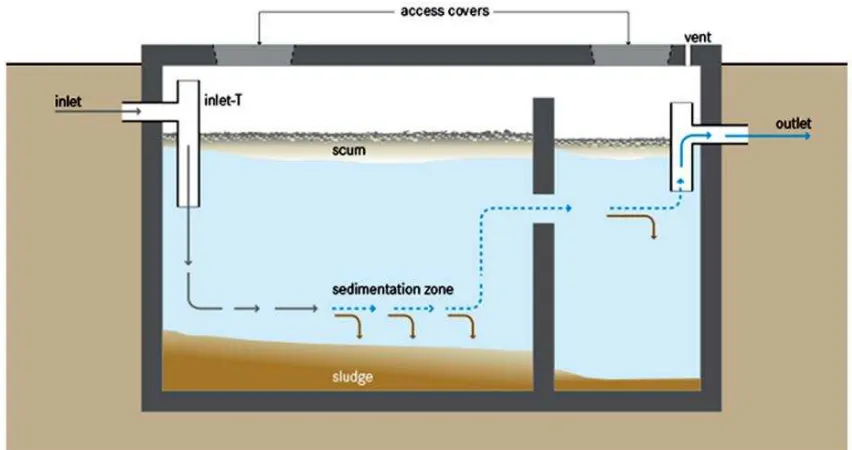
A septic tank is a rectangular watertight structure used to treat liquid waste with high settleable solids. According to the available literature, a scientifically designed septic tank involves two chambers with an inlet to collect the liquid waste from the pour flush cistern and an outlet to expel the effluent to soakage pit or a sewer. As the black water flows through ST, the solids settle at the bottom of the first chamber and scum moves to the top. The first chamber of the septic tank should be two third of the total length of the septic tank. Over time, due to anaerobic digestion, the sludge reduces, and a portion of the solid turns into liquids and gas which rise to the surface in the form of bubbles. At the top of the septic tank, a vent is built to expel the gases produced due to anaerobic digestion of the solid waste (Kumar, 2010). Table 1: Parameters of septic tank construction ( Source: BIS,1993)
Size of the tank: The Septic tank shall have a minimum width of 750mm and depth of one metre below the outlet with a liquid capacity of 1000 litres. For rectangular septic tanks, the length of the tank shall be 2 to 4 times the width. For circular tanks, the minimum diameter shall not be less than 1.35 metre, and operating depth shall not be less than 1.0 m.
Inlet and outlet: For the tanks not more than 1200mm wide, the inlet and outlet are T shaped dip-pipe. The inlet pipe shall be fixed inside the tanks with top limb rising above scum level and the bottom limb extending about 300 mm below the top water level. Outlet pipe should be fixed inside the tank with top limb rising above scum level and the bottom limb extending to about 1/3rd of the liquid depth below top water level.
Partitions: Where the capacity of the septic tank exceeds 2000 litres, the tank may be divided into two chambers using a fixed durable barrier. The partition shall be located so that the capacity of the first chamber is twice that of the second chamber.
Ventilating pipe: Every septic tank should be provided with a ventilating pipe of at least 50 mm diameter. The top of the pipe shall be provided with a suitable cage of mosquito proof mesh.
Floor: It is essential that the floor of the tank be watertight and adequate strength to resist earth movement and to support the weight of the tank walls and contents. The floor may be of concrete of minimum M15 grade and a minimum slope of 1:10 may be provided towards the sludge outlet to facilitate desludging.
Walls: walls should be thick enough to provide adequate strength and water tightness. Walls built of bricks should not be less than 200 mm thick and should be plastered to a minimum thickness of 12 mm inside and outside.
Desludging: Small domestic tanks for economic reasons may be cleaned at least once in 2 years provided the tank is not overloaded due to use by more than the number for which it is designed. A portion of the sludge not less than 25 mm in depth should be left behind in the tank bottom which acts as the seeding material for the fresh deposits.
Commissioning the tank: The sewerage system should be complete and ready for operation before connected to the building. The tank should be filled with water to its outlet level before the first time the tank is used. It should preferably be seeded with small quantities of well-digested sludge obtained from the septic tank or sludge digestion tanks.
4
In 1993, Bureau of Indian Standards (BIS) came up with the Indian standard code of practice for installation of septic tanks and disposal of septic tank effluent. The standards are not very different from that of the specifications mentioned in the literature on sanitation technologies. However, having an understanding of the government standards is essential to examine the deviations in its usage at the g ass oots le el. The sta da d ode e tio that i u se e ed a eas se age should e t eated i a septic tank which should be given a secondary treatment either in a biological filter, upflow anaerobic filter, on the land or in a subsurface disposal system.' The document also suggests that the septic tank
should e lo ated at a pla e ope to the sk …a d should not be located in swampy areas or areas prone
to flooding' (BIS, 1993). The parameters of installation of a septic tank are given in Table 1.
In India, a sewerage system is present mostly in metropolitan cities. Rural areas with no sewerage system are expected to have more septic tanks. It is observed that the rural regions predominantly go for leach pits instead of septic tanks. Availability of land and nonavailability of fecal sludge emptying services are considered to be the reasons for this choice. However, a substantial number of the septic tank is observed in the villages of states like Kerala, Punjab, and Haryana. In 2017, the organization Water Aid conducted a primary survey of the sanitation technologies commissioned by Ministry of Drinking Water and Sanitation. Four types of septic tanks are found in India based on the number of chambers and the location of septic tanks in relation to the toilet superstructure. The four types of septic tanks popular among the masses according to the report are
1. Septic tank (single-chambered) off set
2. Septic tank (single-chambered) below the toilet 3. Septic tanks( chambered) off set information is found on the adoption of septic tanks by people, and it's sustainability factors which are vital for a better sanitation policy. What are the factors that lead to the adoption of septic tanks by people? What is people s pe eptio of a septi tank? How environmentally sustainable the septic tanks are? How do the people treat fecal sludge matter? What are the environmental impacts of disposal of fecal sludge? Do septic tanks preserve the social inequality through the promotion of manual scavenging? These are some of the questions addressed in this report.
Methodology
5
therefore qualitative data collection was preferred. The Universe was rural India. The country was divided into four regions: East, West, North, and South India.
Table 1 Region and districts of data collection from the select districts of each state. Information was gathered from three types of respondents. 1) Local masons who construct septic tanks for villagers, 2) few households (septic tank users), and 3) the nongovernmental organizations working on sanitation, local government representative using a semi-structured interview. Non Governmental Organizations working with sanitation which has been contacted include WaterAid (UP, Telangana, and Madhya Pradesh), Gramalaya (Tamil Nadu), and saciWATERS (Telangana), Kisansabha (Karnataka). The Masons from Kerala and Tamil Nadu were telephonically interviewed. In all other places personal interview of masons was carried out, and households e e isited to dis uss people s e pe ie e ith septi ta ks. I additio to these, the agencies that provide fecal sludge management services were identified and were contacted to understand about the secondary waste treatment processes. The qualitative data thus collected was then thematically arranged and analyzed to derive at the conclusion.
6
People’s choice and experience of Septic Tanks
Almost all the villages visited had toilet technologies that are either twin pits or single pits (because of lack of money). What people described as septic tanks were not scientifically designed septic tanks that followed all the guidelines. Some variation could be found in all the systems. This section explores the types of septic tanks used in Indian villages in comparison to the given standards and examines fecal sludge management.
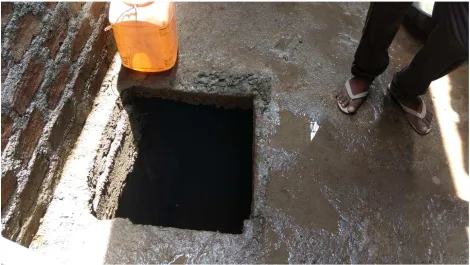
Figure 2 construction of a septic tank inside the house
a. Septic Tanks according to the respondents
7 drinking water source is nearby 3) and when they have enough money to afford a septic tank. At least, two broad types of septic tanks are observed from the field.
1. Single chambered septic tanks
2. Double/triple chambered septic tanks
1. Single chambered septic tanks
They are either rectangular or cylindrical. Cylindrical structures are made of concrete rings placed one over the other with a vent pipe, inlet, and outlet. Single chambered box type structure is usually made when there is lack of space. The length, height, and width are 6:6:6 in such cases. These structures are built either below the toilet (Tamil Nadu) or inside the house below the floor (Madhya Pradesh) or as offset structures with vent pipes, but without soak pits. BIS standards say that only tanks with more than 2000 litres have to be partitioned. In all the states smaller tanks are without partition. The most modest rectangular tank found in the field is of 6000 litres with height, width, the length ratio of 6:6:6 feet. People who went for smaller single chambered septic tanks reiterated that constraint of the space was the reason to go for a smaller tank.
2. Double or Triple chambered septic tanks:
8
clear. It seems normal to the people to open the effluent to the open space or drainage. Stones, bricks, cement are used for the construction of the septic tanks.
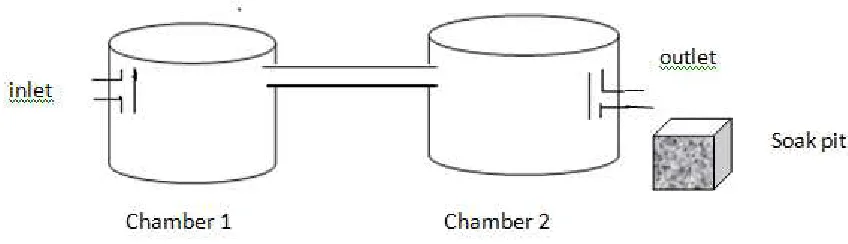
The cylindrical septic tanks are of two types. One is the structure in which there are two adjacent cylindrical trenches which are connected by a pipe in the middle (Fig.3). Such septic tanks have an inlet pipe, an outlet, a vent pipe and a soak pit. In Kerala and Telangana it has been observed that such tanks are standard. However, the floor of the tank is either cemented or not, as per the interest of the household. The second type of cylindrical septic tank is found in Telangana. Here the diameter of the septic tank is big, and there is a partition inside the cylindrical structure (Fig.4). Usually, the tank is 8-12 feet height and 5-6 feet diameter. Large tanks are built in the expectation that it will take more time to fill. These structures have an inlet, outlet, and a vent pipe. The outlet is usually connected to open drainage.
Figure 3 Cylindrical septic tank with two chambers
9
c. Cost of septic tank
Cost of a proper septic tank is approximately INR 50000 in Kerala. Masons from other states mentioned that the cost of a septic tank construction varies from 25000-40000 INR. Septic tanks that are available in the market are cheaper and therefore in places like Kerala, Mason's advice for using septic tanks made of high-quality plastic. However, households are apprehensive believing that such tanks may be filled faster. A 1000L plastic septic tank cost around INR 8000, while that of 5000L cost INR 30000. On an average construction of septic tank in India is INR 38000 and that of a readymade septic tank is INR 19000.
d. Factors that lead to adoption of septic tank
Water Aid study regarding the category of people adopting septic tanks reported that people belonging to general class chose to construct septic tanks most often. This information seems to be right from the field study. In all the selected states except Kerala, it is found that wealthy families who fall in general category go for septic tanks. In the villages in UP, Telangana, Odisha the number of households using a septic tank is 5-10%, and those families are upper castes, landowning class. The reasons cited for the adoption of septic tank include the acceptability of the technology among the communities, belief that more massive structures can contain the waste for a more extended period, availability of more space for tank construction in the vicinity and financial capability to bear the cost. One of the primary reasons for a toilet construction and use the afflue t fa ilies is that the did t a t thei o e to go outside. In Kerala, however, such variations in the community of people using septic tanks are not found.
e. Status of septic ta k co structio i villages a d aso ’s i flue ce
Census data 2011 show that states like Kerala, Punjab, and Haryana had a substantial number of septic tanks in each district. The trend is continuing in Kerala. In all the other states among the total households that had latrine facility according to the census; septic tanks were concentrated in some of the districts while in others pit latrine was predominant. For example, the states and districts with higher proportion of septic tanks were East Godavari district in Andhra Pradesh 39.2%), Kodagu in Karnataka (54%), Kanyakumari in Tamil Nadu (43%), Churu in Rajasthan (25%), Navsari in Gujarat (37.1%), Rohtas in Bihar (16.4%), Darjeeling in West Bengal (21.1%) etc.
10
when septic tanks are constructed, they have more pay and work compared to the pits. To be precise, they get an additional work of 2-3 days for a septic tank.
f. Potential environmental impacts due to unscientific construction of septic tank
Environmental costs from a septic tank arise from the careless construction of the septic tanks to the fecal sludge management. Septic tanks which are cemented entirely without a soak pit hold the water inside the tank leading to a faster filling of the tank. Therefore fecal sludge removal will have to be frequent leading to recurring cost for the people who use them. Similarly, there are cases where soak pit is absent and the wastewater is opened to the drainage nearby. In such cases, the freshwater sources will be polluted. For example, in a village in UP, the scholars including Prof. Chambers observed that the septic tanks are built without soak pits and people use at least 4-5 buckets of water after each defecation followed by the same amount of water after all the members of that family have used the toilet. Around 200 litres of water thus reach the septic tank every day in such a case. The effluent pipe is opened to the open drainage that leads to a pond in the village. Frequent disturbance of the fecal sludge in the septic tank by flushing may lead to its escape through the overflow pipe instead of settling in the tank. Untreated sludge has the potential to pollute the surrounding environment. While the opening of effluent to the open drainage cannot be considered as open defecation per se, its impacts are severe for
the e i o e t a d hu a health. As Withe s puts it he “Ts fail to o k effe ti el , ea
groundwater and surface waters can become contaminated with polluted leachate or surface runoff, which may have direct consequences for human and environmental health. Such impacts may include Nitrate enrichment of aquifers, fecal contamination of water supplies, disease outbreaks, antibiotic resistance in aquatic microorganisms, eutrophication of surface water, loss of biodiversity and a decline in the ecosystem services by aquatic resources (p.125).
Similarly, it has been observed that septic tanks are also constructed without flooring allowing the water to seep through the earth. This arrangement has the potential to contaminate the drinking water source. In a state like Kerala, where population density is high and people resort to well water as drinking water source, the fecal coliform bacteria is detected above the permissible limit. The nitrate level of the groundwater was also high (Boominathan et al. 2012). The unscientific construction of septic tanks has a major role to play in this. One interesting thing that has been observed in Kerala is that households go for the lining of the wall which faces the drinking water source with cement and leaves the rest of the tank as such for the water to leach out. People seldom remember that wastewater seepage has the potential to damage drinking water sources in many ways.
g. Fecal Sludge Management
11
highways, rivers, drainage, municipal waste dumps, etc. Such cases are reported across the country. Waste is also used for agricultural purposes in some cases. Farmers make demands in areas like Tamil Nadu, Haryana, and Punjab. However, use of septic waste for agriculture can be dangerous because risks accompany the dumping of undigested waste and are not recommended for crops. Also, fa e s demands are dependent on the seasons. Mostly the farmers demand sludge only during the Kharif crop season and post-monsoon. In some states, the private emptying agencies bribe the officials so that they can use the urban sewage line for transferring the collected waste. The problem here is that it may be overload for the sewage treatment plant because every sewage treatment plant has a certain capacity (Respondent 3, NGO representative). It is observed that the frequency of desludging is 5-8 years for smaller structures and 25-30 years for larger tanks.
The technologies for FSM are usually owned by private agencies or the local Governments. The cost of fecal sludge emptying service for a tank is INR 2500-3000 in states like Odisha, Telangana, Karnataka, and Kerala. Some of the local governments have the tankers for fecal sludge emptying services. The tankers owned by local governments usually collect the waste from the septic tanks and dump it in the landfill sites/dumping sites. For example, Maddur taluka of Karnataka state has 42 Gram Panchayat and 1 Municipality. Fecal sludge service to all these areas is provided by the tanker owned by the Municipality. The fecal sludge is collected and dumped in the dumping site of the Municipality. Since there is a limitation on the availability of this one tank when needed, people use the service of local men for collection and removal of fecal sludge.
12 Figure 5 Tanker for fecal sludge collection and disposal
In Kerala, Masons help in fecal sludge removal. Usually, hired labour manually collect the fecal sludge and bury in the nearby land. In some cases, fecal sludge collected by the private agencies are openly dumped. In Wayanad district of Kerala, use of a chemical to reduce the fecal sludge is found to be common. In the coastal areas of Tamil Nadu, like Coimbatore, the fecal matter is disposed into the sea. In Telangana, no public vehicles are available for fecal sludge management. Therefore, people depend on the regular private services or take help of manual scavengers. People prefer manual scavengers
e ause the ost is ea a le. A a s la ou osts o l IN‘ pe da o pa ed to IN‘ a ta ke .
In Himachal Pradesh, however, it is reported that the labourers charge up to INR 1500 for a service. In Odisha, the manual scavengers collect fecal sludge in barrels and dispose it in the nearby fields.
The people ho u the usi ess of fe al sludge a age e t o plai ed that the go e e t s
insistence for twin pits is ruining their livelihood.
In general, it can be observed that there are some variations in the use of septic tank as sanitation technology in different states and the way the fecal sludge is managed. In most places, the septic tank is
13
not scientifically designed and it does not conform to the existing standards. People trust the masons in the locality for septic tank constructions. The general trend is that Mason looks at the availability of space in the household and designs a structure accordingly.
Other observations from the grassroots level
a. In Tamil Nadu, a proper septic tank is not constructed by villagers in Lallappetty. Most of them have a leach pit. However, people use toilets only to urinate and treat grey water. In another village in Madurai, septic tanks are not promoted because it is believed to be costly and it requires constant maintenance which leads to recurring costs. In Bihar, a preference for the septic tank is observed in some villages. However, the cost of a septic tank dissuades them from constructing one.
b. The practice of open defecation is common in Tamil Nadu even after possessing toilets due to the fear of filling up of the tank. In Madhya Pradesh, people go in groups for open defecation even when they have working toilets because the village has a shortage of water for daily chores. In Odisha,women and men form groups, decide a convenient time for defecation and go together to the fields. This activity is considered to be a common platform for sharing the village news. Sites of open defecation are meeting points as they have no other common activities and women are forced to remain at home most of the time. In Bihar, the men prefer open defecation over the use of toilets because they think fresh air is available outside when compared to the toilets. This partial usage of the toilets is also triggered by the fear that the septic tanks will be filled soon. The Sanitation, Quality, Use and Access Survey (SQUAT) by Research Institute for Compassionate Economics mention that at least one 48% of households with working toilet prefer open defecation (Coffey et al. 2014, Chambers and Myers,2016). soil strikes the water at the bottom of the pit. When one borehole is filled, another borehole is dug by the household. It is observed that in villages of Haryana, such filled boreholes are left uncovered and unattended which is an unhealthy trend.
Conclusion
14
sole criteria for the design of a septic tank. For both households and Masons, the environmental and health impacts are least of their concerns. The general trend across the country is that after the implementation of Swachh Bharat Mission Gramin the demand for septic tanks has gone down and that of twin pits have gone up except in few states like Kerala. However, a substantial number of households across the country use septic tanks and therefore the nation should be prepared for the repercussions due to the unscientific construction of septic tanks and the second generation issues like fecal sludge management. For a better policy, all necessary information should be available. Given below are some research gaps and policy suggestions to improve the quality of sanitation in India with particular reference to use of STs.
Policy Suggestions
a. In the states where STs are predominant a survey of the unscientifically designed STs should be carried out with an aim to retrofit. Soak pit should be made mandatory for all the septic tanks whether old or new. UP has some initiative in this line. Where possible the tanks should be infrastructure for its treatment. Every district should have sewage cum fecal sludge treatment plant for effective secondary treatment of septic tank waste.
c. Agencies that do fecal sludge management should be mapped and further research should be carried out to understand the FSM disposal practices and patterns. Strict monitoring of the agencies carrying out FSM is advised.
d. Awareness generation among the masons for construction of environmental friendly sanitation technologies is needed.
e. Not all the technologies are suitable for different geographies of India. Area-specific sanitation technologies should be promoted.
References
1. Bureau of Indian Standards, (1993), Indian Standard Code of Practice for Installation of Septic Tanks: Design Criteria and Construction. Available at
http://www.indiawaterportal.org/sites/indiawaterportal.org/files/Code of practice for installation of septic tanks _ Part 1 _ Design criteria and construction _ Bureau of Indian Standards _ 1986.PDF. Accessed on 16 September 2017.
2. Bureau of Indian Standards (1993), Indian Standard Code of Practice for Installation of Septic Tanks: Secondary Treatment and Disposal of Septic Tank Effluents. Available at
15
osal%20of%20septic%20tank%20effluentent%20_%20Bureau%20of%20Indian%20Standards%2 0_%201985.PDF . Accessed on 16 September 2017.
3. Kumar, A (2010), Squatting with Dignity: Lessons from India. New Delhi: Sage. pp174-176
4. WaterAid (2017), The State of India's Toilet Report: Rapid Assessment of Toilet Technology under Swachh Bharat Mission-Grameen[unpublished document]
5. Census of India (2011), Census 2011: Percentage of Households to Total Households by Amenities and Assets (India & States/UTs-Village and Ward Level)
6. Ludwig, H F (1950). Septic Tanks: Design and Performance, Sewage and industrial wastes 22(1):55-60.
7. Withers, P J., Philip J., Linda M., Hele P J. a d Na E D . Do septi ta k s ste s pose a
hidde th eat to ate ualit ? The Frontiers in ecological environment. 12(2):123-130.
8. Boominathan. M, Karthick. B, Sameer Ali and Ramachandra. T.V., 2012. Spatial Assessment of Groundwater Quality in Kerala, India., The IUP Journal of Soil and Water Sciences, 5(1).
9. Coffey, D., Gupta, A., Hathi, P., Khurana, N., Spears, D., Srivastav, N and Vyas, S. (2014). Revealed Preference for Open Defecation: evidence from a New Survey in Rural North India, SQUAT working paper 1, Rice institute. Available at http://riceinstitute.org/wordpress/wp-content/uploads/downloads/2014/09/SQUAT-paper-for-mailing-and-website_062414.pdf 10. Chambers, R, and Myers, J (2016). Norms, Knowledge, and Usage, Frontiers of CLTS: Innovations