Quality Assurance
in
Bacteriology and I mmunology
SEARO Regional Publication No. 47© World Health Organization 2012 All rights reserved.
Requests for publications, or for permission to reproduce or translate WHO publications – whether for sale or for noncommercial distribution – can be obtained from Publishing and Sales, World Health Organization, Regional Office for South-East Asia, Indraprastha Estate, Mahatma Gandhi Marg, New Delhi 110 002, India (fax: +91 11 23370197; e-mail: publications@searo. who.int).
The designations employed and the presentation of the material in this publication do not imply the expression of any opinion whatsoever on the part of the World Health Organization concerning the legal status of any country, territory, city or area or of its authorities, or concerning the delimitation of its frontiers or boundaries. Dotted lines on maps represent approximate border lines for which there may not yet be full agreement.
The mention of specific companies or of certain manufacturers’ products does not imply that they are endorsed or recommended by the World Health Organization in preference to others of a similar nature that are not mentioned. Errors and omissions excepted, the names of proprietary products are distinguished by initial capital letters.
All reasonable precautions have been taken by the World Health Organization to verify the information contained in this publication. However, the published material is being distributed without warranty of any kind, either expressed or implied. The responsibility for the interpretation and use of the material lies with the reader. In no event shall the World Health Organization be liable for damages arising from its use.
This publication does not necessarily represent the decisions or policies of the World Health Organization.
WHO Library Cataloguing-in-Publication data
World Health Organization, Regional Office for South-East Asia. Quality assurance in bacteriology and immunology. - 3rd ed. (SEARO Regional Publication No. 47)
1. Quality Assurance, Health Care. 2. Laboratory Techniques and Procedures-methods. 3. Laboratories – organization and administration. 4. Waste Management. 5. Quality Control. 6. Bacteriological Techniques – Standards.
Contents
Acknowledgements ...v
Foreword ...vii
Abbreviations ...ix
Glossary ...xi
Introduction 1. ... 1
Factors influencing quality 2. ... 10
Overview of quality assurance 3. ... 15
Quality management system 4. ... 19
Organization and functions of laboratories 5. ... 25
Documentation in the laboratory 6. ... 33
Standard operating procedures 7. ... 47
Validation 8. ... 52
Assessment of quality 9. ... 54
Quality audit and accreditation 10. ... 67
Safety in the laboratory 11. ... 77
Practice of quality assurance in clinical laboratory 12. ... 98
Quality control of laboratory materials 13. ... 106
Quality control of media and stains 14. ... 111
Quality control of bacteriological techniques 15. ... 117
Quality assurance in antibiotic susceptibility testing
17. ... 123
Quality control in serology
18. ... 137
Quality control in sterilization and disinfection
19. ... 144
Quality control for equipment
20. ... 153
Suggested further reading
21. ... 160
Annex 1: Contributors ... 162
Acknowledgements
Foreword
Health services are using laboratories for clinical purposes as well as public health more than ever before. The demand for quality results from laboratories has been echoed by all health care professionals as unreliable results can have serious consequences for the health of the individual as well as the community. The main objective of quality assurance is to provide reliable laboratory data for all health care activities and to ensure inter-laboratory comparability of results, particularly in epidemiological investigations, health surveys, environmental monitoring, medical research and other public health activities.
The importance of quality in the functioning of health care laboratories, particularly in developing countries, has been universally recognized. Laboratories practising the principles of quality assurance generate relevant, reliable and cost-effective results, delivered timely and in the best interest of the patient.
the right technique with suitable controls; and data processing, such as the reporting, recording and interpretation of results as well as their timely feedback to the right user.
The quality of laboratories can be improved by the application of good clinical laboratory practices and commitment. Quality is never an accident, it is the result of concerted planned activity. Constraints include lack of awareness, inadequate financial resources, low level of information about the positive impact of improved laboratory quality, as well as the nonavailability of comprehensive and practical guidelines, especially in peripheral and intermediate laboratories. Laboratories of good quality must be prepared for accreditation so as to achieve a healthier world through quality laboratory services.
This manual has been designed to ensure quality assurance, including biosafety, in the field of bacteriology and immunology in health laboratories. I am sure the laboratories for which these guidelines have been developed will find these appropriate and useful.
Abbreviations
AFB acid fast bacilli AR analytical reagent ASO antistreptolysin O
ATCC American type culture collection CAMP Christie Atkins Munch-Peterson
cm centimetre
CSF cerebrospinal fluid EIA enzyme immunoassay
ELISA enzyme-linked immunosorbent assay EMB Eosin Methylene Blue (agar)
EPEC enteropathogenic Escherichia coli EQA external quality assessment
EQAS external quality assessment scheme FAT fluorescent antibody test
GLP good laboratory practices H2S Hydrogen Sulphide HA haemagglutination
IgG Immunoglobulin G IgM Immunoglobulin M IQC internal quality control ml millilitre
mm millimetre
CLSI Clinical and Laboratory Standards Institute, USA oC degree celsius
ONPG O-nitrophenyl-®-D-galactopyranoside OPD outdoor patient department
PA pro analysis
PHA passive haemagglutination PPA purissimum pro analysis QA quality assurance QC quality control RBCs red blood cells RPR rapid plasma reagin
SOP standard operating procedure STA Standard Tube Agglutination Test TQM total quality management
Glossary
Accuracy
The degree to which a measurement or an estimate based on measurements, represents the true value of the attribute that is being measured.
Accession List
This list records all specimens that are received in the laboratory for processing.
Accreditation
This is the process by which an authoritative body gives formal recognition that a body or person is competent to carry out specific tasks.
Analytical Phase
Activities and steps related to performing a laboratory test.
Audit
An examination or review that establishes the extent to which a condition, process or performance conforms to predetermined standards or criteria.
Auditor
A person with demonstrated personal attributes and competence to conduct an audit.
Auditee
The organization being audited.
Bias
Deviation of results or inferences from the truth, or processes leading to such deviation.
Biohazard
An infectious agent, or part thereof, that presents a real or potential risk to the well-being of man, animals or plants and environment.
Biological Reference Interval
Biosafety
The application of knowledge, techniques and equipment to prevent personal, laboratory and environmental exposure to potentially infectious agents or biohazards. Biosafety defines the containment conditions under which infectious agents can be safely handled.
Competency
A demonstrated ability to apply knowledge and skills.
Coefficient of Variation
The standard deviation expressed as a percentage of the mean.
Control Serum
Serum with known concentration used to measure the accuracy and precision, sensitivity and specificity of a procedure. It is used to determine, verify and document performance.
Continual Quality Improvement (CQI)
This is part of a quality management system focused on increasing the ability to fulfill quality requirements. It is a philosophy and attitude for analyzing capabilities and processes and constantly improving them to achieve quality test results. This is possible through small, incremental changes using scientific methods.
Corrective Action
The implementation of solutions resulting in the reduction or elimination of an identified problem.
Dilution
The ratio of the volume of serum or other medium of the total volume produced by combining it with diluent. The dilution 1:10 denotes one part serum plus nine parts diluent for a total volume of 10 parts. A dilution of 1:1 indicates no dilution. The same notation is used in areas other than serology to indicate volume of material to volume of diluent. So the two methods must be carefully differentiated.
Document
Information and its supporting medium (may be paper-based or electronic). ISO identifies five types of documents: specifications, quality manuals, quality plans, records, and procedure documents.
Document Control
A system for maintaining and ensuring the proper use of time or version-sensitive documents.
Efficiency
The ability of a test to give a positive result on positives and negative results on negatives.
True Positive + True Negative
Efficiency = ———————————————— x 100. True Positive + False Positive +
Error
The difference between an observed or measured value and the best obtainable estimates of its true value.
External Controls
Controls not included in test kits and used in addition to internal controls.
External Quality Assessment (EQA)
EQA is a system of objectively assessing laboratory performance by a designated laboratory (organizing laboratory).
False Negative
A negative test result for a person who is actually infected.
False Positive
A positive test result for a person who is actually not infected.
Form
A paper or electronic document on which information or results are captured. Once completed, a form becomes a record.
Internal Audit
Internal quality audits are audits carried-out by laboratory personnel (first party audit) who examine the elements of a quality management system in their laboratory in order to evaluate how well these elements comply with quality system requirements.
Internal Quality Control
Internal quality control is a set of procedures undertaken by the staff of a laboratory to ensure quality from the collection of specimens, the performance of the test as well as the analysis of results, with the procedure being planned, ordered and followed up by the staff itself.
Inter-laboratory Comparison
The organization, performance and evaluation of tests for the same analyte by two or more laboratories in accordance with predetermined conditions. Laboratories may participate in inter-laboratory comparison for testing of those analytes where formal EQAS is not easily accessible.
Limit of Detection
The limit of detection is the lowest level of analyte that can be detected, but not necessarily determined in a quantitative fashion, using a specific method under required experimental conditions. The limit of detection is usually defined as 3 s.d. of the mean of results obtained from the measurement of specimens that do not contain the analyte under investigation.
Measuring Equipment
An instrument that shows the extent or amount or quantity or degree of something.
Medical Laboratory
information for the diagnosis, prevention and treatment of disease, or assessment of the health of human beings, which may provide a consultant advisory service covering all aspects of laboratory investigation including the interpretation of results and advice on further appropriate investigation.
Pre-analytical Phase
In chronological order, steps that begin with the clinician’s request, examination requisition, preparation of the patient, collection of the primary sample, transportation to and within the laboratory, and ends with the beginning of the examination phase.
Analytical Phase
The term used to describe everything that happens during the handling and analysis of the sample in the laboratory.
Post-analytical Phase
The processes following the examination phase, including systematic review, formatting and interpretation, authorization for release, reporting and transmission of the results, and storage of samples for examinations.
Precision
The ability of a measurement to be consistently reproduced as well as the number of significant digits to which a value has been reliably measured.
Predictive Values
The predictive value of a positive test result is defined as the percentage of positive results that are true positives in a given situation. It indicates the probability that a patient with a positive test result has, in fact, the disease in question. The predictive value of a negative test result is the percentage of negative results that are truly negative for the same given situation. The predictive value of test results is directly dependent on the prevalence of the condition in the population being tested. This also implies that predictive values are not constant but change with the prevalence of the situation.
Predictive value
= True positive / True positive + False positive x 100 of a positive test
Predictive value
= True negative / True negative + False negative x 100 of a negative test
Probability
The quantitative measure of chance; the ratio of the number of outcomes that produce a given event to the total number of possible outcomes.
Preventive Action
Proactive actions taken to remove or improve a process to prevent potential future occurrences of non-conformity.
Preventive Maintenance
Procedure
A detailed procedure which defines the work that should be done, explains how it should be done, who should do it, and under what circumstances.
Quality
The degree to which a set of inherent characteristics fulfills requirements.
Quality Assurance
A planned and systematic set of quality activities focused on providing confidence that quality requirements will be fulfilled.
Quality Control
A set of activities or techniques to ensure that all quality requirements are being met. Simply put, it examines “control” materials of known substances along with patient samples to monitor the accuracy and precision of the complete examination process.
Quality Management System (QMS)
A system which establishes a quality policy and quality objectives and which achieves those objectives.
Range
The difference between the maximum and minimum of a set of values.
Record
A document stating the results achieved or providing evidence of activities performed.
Reference Material
A material of a substance with values of measurable quantities sufficiently well established to be used for calibration of a measurement system, the assessment of measurement procedures, and for assigning values to materials (ISO Guide 30:1981, 2.1).
Root Cause Analysis (RCA)
A tool designed to help identify not only what and how an event occurred, but also why it happened.
Sample
A subset or group of objects or things selected from a larger set or population. Usually information obtained from samples is used to make inferences about the populations in question.
Sensitivity
Diagnostic sensitivity: The incidence of true positive results obtained when a test is used for patients known to have the disease or condition.
Sensitivity = True Positive / True Positive + False Negative x 100
Specificity
A measure of the ability of a test to indicate the absence of a component in a specimen when it is truly negative for that component, or a measure of the ability of a test to measure accurately one component in a specimen without interference by other components.
(1) A measure of a ability of a test to give a negative result in the absence of a disease.
(2) Specificity = True Negative / True Negative + False Positive x 100
Standard Material (calibration standard or calibrator)
A substance of known concentration (usually determined by comparison to a reference material) used as a basis for determining the concentration of a substance in unknown specimens. (WHO LAB/81.3 )
Standard Operating Procedure (SOP)
A document which describes the regularly recurring operations relevant to the quality of the investigation. The purpose of a SOP is to carry out the operations correctly and always in the same manner.
Test
A technical operation that consists of the determination of one or more characteristics of a given product, process or service according to a specified procedure.
Titer
The reciprocal of the highest dilution of a constituent which leads to a positive reaction. For example, if a serum produces a positive reaction in the tube which contains 1:80 dilution but not in the next higher dilution, then it has a titer of the reciprocal of 1:80, or 80. The dilution is 1:80; the titer is 80. A titer of 80 means that the serum is positive in a 1:80 dilution.
Total Quality Management
The management approach of an organization centered on quality, based on the participation of all its staff and aiming at long-term success through customer satisfaction and benefits to staff and society.
Traceability
The ability to trace the history, application or location of that which is under consideration.
Validation
The confirmation by examination and provision of evidence that specific requirements for specific intended use are met.
Work Environment
1
Introduction
Quality is the degree of congruence between expectation and realization. In other words, it is the matching of what you want with what you get. The simplest definition is:
Quality is the meeting of pre-determined user requirement for a particular substance or service.
In recent times, the concept of quality has been further elaborated and international consensus obtained through the efforts of the International Organization for Standards (ISO).
According to ISO, quality is defined as the totality of characteristics of an entity that bear on its ability to satisfy stated and implied needs.
It has been rightly described as the characteristics of a product or service that makes it suitable for the purpose for which it is intended (fitness of purpose).
It has also been associated with consistency. This means providing the same product or service time after time, thereby making the outcome more predictable.
1.1 Benefits of quality
There are many benefits of a good quality assurance (QA) programme. Some of these are listed in Table 1.1.
Table 1.1: Benefits of a quality assurance programme
Delivering a quality product or generation of a reliable service •
Helping the physician establish proper and rapid diagnosis, thus generating •
confidence and better health care for the patient Creation of a good reputation for the laboratory •
Motivation factor for staff to work better •
Mandatory requirement for accreditation •
Prevention of legal suits and associated complications •
Efficient utilisation of resources •
Cost-saving on account of wrong/over/under treatment •
Assuring safety of patients, staff, visitors, community and environment •
Doing things in a similar manner, time after time ensures consistency.
Doing things right first time means reduced rework and product failure, resulting in cost savings.
Various measuring tools can be used for monitoring operational, customer or product problems. Once problems are identified action can be taken for improving either the service or product. This action should prevent further problems from re-occurring in the future.
1.2 Continual quality improvement
The Deming cycle illustrates the important principle of continuous improvement. Quality is not a static thing. The cycle of continuously planning (P), doing (D), checking (C) and acting (A) is essential to ensure that the quality cycle keeps turning and quality improves.
forward, the pressure is to fall backwards -- down the slope – with consequent loss of quality. The only way to prevent backward movement is to continually support the cycle. This is the function of the quality system that has been put in place.
Continuous quality improvement, therefore, comprises a set of activities that organizations should routinely carry out in order to enhance quality. It emphasizes the need for continuous improvement rather than only error correction All aspects of laboratory operations are explicitly targeted for improvement in a sequential manner.
Continual quality improvement can be achieved by :
Monitoring of quality indicators & analyzing data •
Identification and control of nonconformities •
Undertaking root cause analysis, corrective and preventive actions •
and improvement processes
Assessment of customer satisfaction and complaints •
Carrying out internal audits •
Performing management reviews •
up the product. From there a broader view of quality developed and concepts such as good clinical laboratory practices (GCLP) and customer satisfaction came into being. Now we talk of total quality management which focusses on the satisfaction of customers, suppliers, staff and society, as well as the consideration of environmental issues.
Quality indicators
Quality must be measured if it has to be managed. Quality indicators (QI) help the health laboratory to define and measure progress. The measurement of quality indicators leads to early detection of system failure which includes all aspects of service – pre-analytic, analytic and post-analytic – so that remedial actions can be taken promptly.
Table: Examples of indicators
Pre-analytic indicators:
Accuracy of sample accessioning •
Specimen transport times •
Analytic indicators:
Internal and External Control failures •
Performance in EQAS •
Frequency of unscheduled service and repairs of equipment •
On-time performance – Calibration and Maintenance of equipment •
Vendor evaluation (supplier performance – Backorders, delays, •
incorrect or damaged supplies)
Inventory – emergency orders, Outdating •
Misinterpretations of results •
Post-analytic indicators:
Compliance to turnaround times (TAT) •
Errors/ Incomplete test reports •
Availability of archived samples •
Other Quality Indicators:
Number and type of laboratory accidents (Needle sticks) •
Training and competency evaluation of personnel •
Document problems discovered – outdated, incomplete, incorrect •
Customer feedback and complaints – physicians, other health care •
staff, patients.
Numbers and types of non-conformances •
Physician satisfaction with report format and content •
Bench-level staff must be engaged in the development of quality indicators as they are key players in laboratories. Fewer staff are better than too many, as tracking becomes difficult. Moreover, quality indicators should only be used as long as they provide useful information. Once they indicate a stable and error-free operation, select a new quality indicator.
1.3 Users’ perception of health laboratory
services
Table 1.2: Users’ perceptions of quality in laboratory services
Courteous personnel who are readily available, cooperative and willing to
•
help
Test results are consistent; repeats usually confirm the first test
•
Sample mix-ups are rare and reports reach the right persons
•
Results are available according to the requirements of the individual
•
Health care workers are well aware of the kind of specimens to collect and how
•
to resolve problems
Needs are understood, met and exceeded
•
Complaints and problems are swiftly addressed, resolved and rarely repeated.
•
Though users’ perception of quality is important, it is only a small part of a comprehensive quality assurance programme. Better assessments are obtained by getting active feedback from customers.
1.4 Good clinical laboratory practices
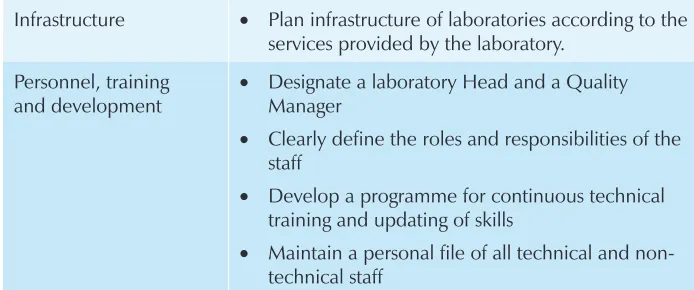
Good Clinical Laboratory Practices (GCLP) deal with the organization, process and conditions under which laboratory studies are planned, performed, monitored, recorded and reported. GCLP practices are intended to promote the quality and validity of test data. They point towards the best laboratory activities that deliver the most accurate results. The components of the GCLP are given in Table 1.3.
Table 1.3 Major components of GCLP
Infrastructure • Plan infrastructure of laboratories according to the services provided by the laboratory.
Personnel, training and development
Designate a laboratory Head and a Quality
•
Manager
Clearly define the roles and responsibilities of the
•
staff
Develop a programme for continuous technical
•
training and updating of skills
Maintain a personal file of all technical and
non-•
Equipment • Prepare a list of equipment required according to scope
Place equipment suitably and ensure that it is in
•
good working condition
Calibrate and validate equipment before putting it
•
to use and regularly thereafter
Train staff in the correct use and calibration of
•
equipment Reagents and
Materials
Use certified standard quality reagents.
•
Validate quality of newly purchased reagents prior
•
to use.
Store reagents, chemicals and consumables
•
under appropriate environmental conditions with appropriate labels
Specimen collection
Use the "primary specimen collection manual"
•
which contains information on how to prepare the patient before specimen collection, the exact methodology of collection, labeling the specimen as well as its handling, transportation and storage. Requisition Form • Use the requisition form delineating the patient's
identity, age, gender, location, date, time of specimen collection and its receipt as well as the investigations requested along with relevant clinical and treatment history.
Accession list • Develop an accession list recording all the specimens received along with patient’s identity Specimen rejection
log
Prepare specimen rejection criteria
•
Maintain a record of specimens which were
•
rejected prior to analysis
Use specimen rejection statistics to identify training
•
needs for technical staff
Reporting test results
Ensure that authorized signatory has verified test
•
results
Report results clearly, without any errors, specifying
•
measurement procedures where appropriate and units of measurement signed by authorized signatory
Ensure predetermined turnaround times
•
Ensure release of results to authorized persons only
•
Data Management • Record laboratory data including patient details, findings of analyses, reporting of results
Archive the data for future reference.
•
Standard Operating Procedures (SOP)
Prepare and use SOP containing detailed, written
•
instructions which describe the step-wise process and technique of performing a test or procedure in the laboratory. Perform test as per the SOP
Laboratory safety • Document and practice laboratory safety policies and procedures.
Train all laboratory personnel about laboratory
•
safety policies and procedures.
Ethical • Comply with the ethical codes of the laboratory/ institution
Quality Management System (QMS)
Develop and implement QMS encompassing
•
preanalytic, analytic and post analytic components of testing
Involve higher management at each step of QMS
•
Countries which have built up national programmes for quality assurance have shown promising results as judged by international organizations.
1.5 International Organization for Standardization
ISO No Refers to
ISO 9000 series
(9000, 9001, 9002, 9003, 9004, etc)
Design/development, production, installation, servicing, final inspection and testing as applied to manufacturing processes
ISO Guide 25 (ISO Guide 17025) Performance of objective measurements, use of reference material and calibration as well as test methodology
ISO Guide 43 Design and operation of external quality assessment scheme
ISO Guidelines 15189 Quality management of medical laboratories
ISO Guidelines 15190 Medical laboratories — Requirements for safety
1.6 Traceability
Measurement traceability is the result of a measurement or the value of a standard whereby it can be related to stated references, usually national or international standards, through an unbroken chain of comparisons all having stated uncertainties.
Specimen traceability is an important concept in quality assurance programmes. An effective QA procedure should allow an audit trail to be followed back from the laboratory report. This should allow access to a complete documented history, from receipt of the specimen to the issue of the report.
2
Factors influencing quality
The reliability of laboratory results depends on many para-analytic factors as well as analytical procedures. Traditionally, concern has been expressed regarding various intra-laboratory technical aspects that may affect the analytical process. The analytical cycle, however, is more complex and includes pre-analytical and post-analytical elements, which may include sources of error that are beyond the control of laboratory staff. Laboratory personnel and clinicians should bear this important fact in mind, that quality assurance is a mutual responsibility which cannot be achieved only through improving and controlling the analytical process without simultaneous improvement and control of pre-analytical and post-analytical factors.
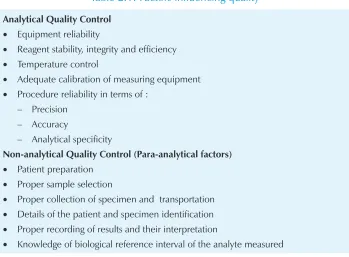
The factors affecting analytical and para-analytical quality control are summarized in Table 2.1.
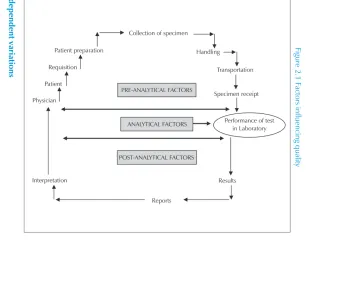
The analyses performed by health laboratories are subject to biological and technical influences, professional skills and environmental effects. Pre-analytical, analytical and post-analytical factors influencing the quality of the laboratory results are discussed in Table 2.2 and Figure 2.1.
2.1 Pre-analytical factors
Table 2.1: Factors influencing quality
Analytical Quality Control
Equipment reliability •
Reagent stability, integrity and efficiency •
Temperature control •
Adequate calibration of measuring equipment •
Procedure reliability in terms of : •
Non-analytical Quality Control (Para-analytical factors)
Patient preparation •
Proper sample selection •
Proper collection of specimen and transportation •
Details of the patient and specimen identification •
Proper recording of results and their interpretation •
Knowledge of biological reference interval of the analyte measured •
Table 2.2 Factors influencing quality
Analytical Para-Analytical
Pre-Analytical Post-Analytical
Equipment reliability Right investigation Accurate recording
Reagents stability, integrity and efficiency
Right sample Biological reference intervals
Adequate calibration Right collection Age and sex-related variations
Correct interpretation Right technique Turnaround time
Procedural reliability using SOP Right laboratory Availability of guidance
Proficiency of personnel Right background milieu Authorized release of results
Right technique for available reagents
Right transportation Archiving of specimen
Internal quality control Right quantity Transcribing results from worksheet to report forms
Quality Assurance in Bacteriology and Immunology
12
Figure 2.1 F
actors influencing quality
Age
-dependent variations
Age dependent changes
of concentration
or activities occur in a number of
hematological and chemical analytes. Normal bacteriological flora also changes
with age. Hence laboratory results should be interpreted keeping in view the
age of the patient.
Collection of specimen
Patient preparation Handling
Transportation
Specimen receipt Requisition
Patient
Physician
Interpretation
Performance of test in Laboratory
Results
Reports
PRE-ANALYTICAL FACTORS
ANALYTICAL FACTORS
Incorrect specimen identification
An incomplete specimen identification will obviously give wrong information despite all precautions taken for a proper analytical procedure.
Prolonged transportation and storage
Prolonged and improper storage prior to processing of the specimen can affect results, especially since many organisms do not survive for long periods unless they are sub-cultured or kept in a rapidly changing environment. Urethral discharge containing gonococci, specimens for anaerobic bacteriology, etc are some examples where improper storage and transportation can give false results.
Selection of appropriate samples
An appropriate sample should be collected in an appropriate way. For example, for diagnosing acute intestinal amoebiasis, it is essential to examine the freshly passed stool sample within 30-60 minutes, since trophozoites only survive for that period. Similarly, stool examination for the eggs of Enterobius vermicularis is not as effective as a perianal swab. While, blood samples for microfilaria showing nocturnal periodicity should be sampled at night only.
Selection of right test method
Selecting the right test method is of paramount importance. For example, serodiagnosis of dracunculiasis or filariasis is not well established, so attempting such techniques will be of little use.
Sending the sample to the right laboratory
The sample for analysing a particular analyte should only be sent to the laboratory which undertakes that investigation. Failure to do so will only mean delays as well as a decline in sample quality.
Collecting the right specimen
2.2 Analytical factors
Analytical quality control depends upon the following factors:
Equipment reliability through periodic, scheduled maintenance, both •
routine and preventive
Reagent stability, integrity and efficiency •
Adequate calibration of measuring instruments •
Procedure reliability using standard operating procedures •
Specificity, precision and accuracy of the test of high order •
Proficiency of personnel and continuous updation of their •
knowledge
Selecting the right technique for which reliable reagents are •
available
Good internal quality control •
Participation in external quality assessment programmes •
All the above factors are discussed in greater detail in the chapters below.
2.3 Post-analytical factors
After the proper analytical process is over, it is important to record the findings on the right report form in a clear way. Any possible remarks on the results obtained should also be entered, as well as the biological reference interval of the results. The significance of the results obtained should be highlighted wherever required. There should be frequent dialogue between laboratory personnel and physicians so that laboratory facilities are correctly used and the right interpretation of results obtained.
3
Overview of quality assurance
Health care laboratories are being utilized more often now than in the past. Unreliable laboratory results are likely to have serious consequences for individual as well as community health. The main objective of quality assurance is to provide reliable laboratory results in all health care activities and to ensure inter-laboratory comparability of results in clinical laboratories, epidemiological investigations, health surveys, environmental monitoring, medical research and other public health activities.
The objectives for patients in direct clinical care are to improve the accuracy of clinical diagnosis, to reduce health care costs (through the avoidance of repeat tests and needless or inappropriate investigations and treatment) as well as to provide a basis for the continuing education of physicians and laboratory scientists in scientific methods of investigations, laboratory organization and management and analytical techniques.
3.1 Quality assurance
Quality assurance encompasses all planned and systemic actions and programmes that are developed and practiced and provide the confidence that a product or service meets customer expectations. It denotes a system for continuously improving reliability, efficiency and utilization of products and services.
Quality assurance (QA) in bacteriology and immunology spans the wide spectrum from monitoring to evaluation of various aspects of services or facilities to ensure that standards of quality are met.
QA is cost-effective •
QA is a means of getting it right the first time and every time •
QA is good management sense and its responsibility is shared by •
all.
3.2 Quality assurance programme
A quality assurance programme is concerned with sampling, specifications and testing as well as with organization, documentation and release procedures that ensure that necessary and relevant steps have been taken to ensure satisfactory quality.
The bacteriology and immunology laboratory is supposed to provide accurate and relevant information that is useful in the clinical diagnosis of a patient or in support of a public health activity. The accuracy and clinical value of the laboratory analysis and microbial isolates are dependent upon a QA programme that
assesses the quality of the specimen •
documents the validity of the test method •
monitors the performance of test procedures, reagents, media, •
instruments and personnel
and reviews test results for errors and clinical relevance •
3.2 Objectives of quality assurance
Murphy’s law states that if anything can go wrong, it will. This law also applies to laboratories where every part of the process could give erratic results. The purpose of quality assurance is to prevent as many errors as possible and to detect those that do occur.
capitalizes on the involvement of management, workforce, suppliers, and even customers, in order to meet or exceed customer expectations.
Even if an ideal situation is not possible, a level of quality assurance that controls most factors affecting test results should be the aim. Determining the kind of controls to be used, how often, how may and how control results are to be used
requires knowledge and experience.
3.3 Components of a quality assurance
programme
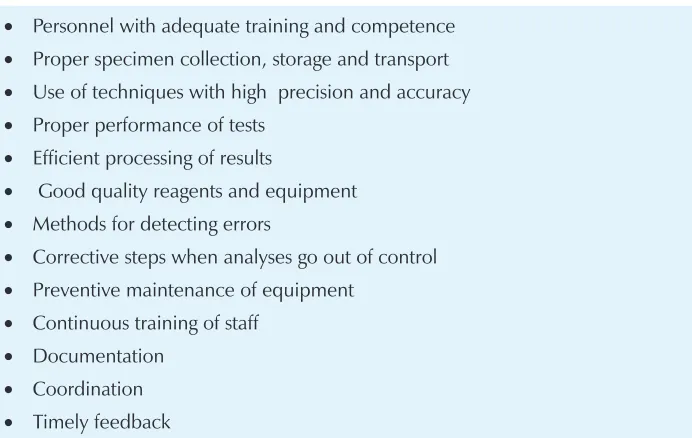
An effective quality assurance programme should cover all aspects of the laboratory. (Table 3.1.)
Table 3.1: Components of a quality assurance programme
Personnel with adequate training and competence
•
Proper specimen collection, storage and transport
•
Use of techniques with high precision and accuracy
•
Proper performance of tests
•
Efficient processing of results
•
Good quality reagents and equipment
•
Methods for detecting errors
•
Corrective steps when analyses go out of control
•
Preventive maintenance of equipment
•
Continuous training of staff
•
3.4 Computers in quality assurance
Computers and information technology processes are being utillised in a big way in microbiology laboratories as well. Many laboratories utilize a laboratory information management system (LIMS) to improve the efficiency of the laboratory and to assure quality of its services (Table 3.2).
Table 3.2: Role of computers in improving efficiency of laboratory
Report generation
•
Data analysis
•
Traceability
•
Validation checks
•
Mandatory data checks
•
Code checks
•
Data entry devices
•
Detection of abnormal/unusual results
•
Test controls
•
Appropriate interpretation of test results
•
Quality assessment of specimens
•
Inventory management
•
Maintenance and calibration schedules
•
Monitoring trends and providing early warning signals during outbreaks
Quality Management System (QMS) is a management approach which requires the management as well as the laboratory administration to be fully on board so that the entire testing process, including its technical aspects, meet quality requirements. The development of QMS in all aspects of a laboratory’s working and organization, such as quality planning (QP), quality assurance (QA), quality control (QC), as well as continual quality improvement (CQI) processes requires total focus.
Quality planning ensures the control of quality. It ensures that policies, infrastructure, equipment, environment and personnel requirements are met before a testing procedure is undertaken.
Quality assurance stresses on the anticipation and detection of errors before a test report is released. Two key principles characterize QA: “Fit for purpose” (the test is suitable for intended purpose) and “right first time and right every time” (errors are eliminated before they occur).
It incorporates all three phases – works that need to be done before testing (pre-analytical), during testing (analytical) and after completion of a test procedure (post-analytical). In all three phases, QA should be planned and implemented without any deviation. In the pre-analytical phase, collection, transportation and storage of specimens ; In the analytical phase, the quality of diagnostic kits and reagents, maintenance and calibration of laboratory equipment, environmental control, testing procedures and technical skill; and in the post-analytical phase, the correct interpretation of results, their transcription and communication to the appropriate person within a stipulated time (turnaround time).
It is generally seen that maximum effort is applied on the analytical phase of quality assurance, even though it is well known that most errors occur during the pre and post-analytical phases. Nevertheless, QA alone cannot guarantee the quality of test results. It can be best summarized as the right result, at the right time, on the right specimen, from the right patient, with the right result interpretation based on correct reference data, and delivered at the right cost.
Quality control refers to the institution of appropriate checks during the testing procedures and constant monitoring of testing processes. While QA is process-oriented and focuses on error prevention, QC is test-oriented and focuses on error identification. It primarily concerns the control of errors in the performance of tests and verification of test results, that is, the analytical phase of QA. Internal quality control (IQC) and external quality assessment (EQA) are the two key pillars of QC. They enable the laboratory to evaluate itself with both internal and external resources and expertise. IQC is performed with both internal controls provided by the manufacturer of test kits, as well as external controls procured or prepared by the laboratory. The results of the tests performed on patient specimens are validated on the basis of the results of these controls. EQA provides validation of test results between laboratories. It allows a comprehensive analysis of results and discrepancies. Root cause analysis of discordant results ensures that errors are corrected.
Continual quality improvement is aimed at the creation of an attitude which continuously analyses capabilities and processes with the objective of delivering quality test results. It is based on the premise that it is possible to achieve continual improvement through small, incremental changes using scientific methods. Documentation at all levels is the essence of a good QMS. If the procedure or process is not documented; it is presumed to have not been performed.
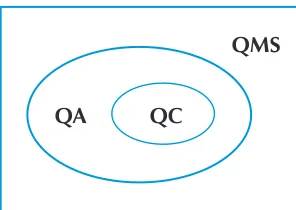
A diagrammatic representation (Figure 4.1) explains the relationship between QC, QA and QMS.
Figure 4.1: Relationship between QC, QA and QMS
QMS
4.1 Quality system
In an industrial unit, raw materials (input) are processed and transformed into a product (output). A process is defined as the sum total of activities which use resources to transform inputs into outputs. The process may consist of a number of procedures. A procedure is a specified way to carry out an activity. Each procedure is undertaken in such a way that it delivers the desired result through a systems approach. Quality is ensured through a well defined quality system.
Input Processing Output
(Raw material) (Product)
Health laboratories also work on similar principles. The clinical (or environmental) material constitutes the raw material (inputs) which is processed in the laboratory to generate an output in the form of a report. Health laboratories also strive to assure quality of their product (report). However, quality does not just happen on its own. Systematic efforts in the organizational structure and efficient utilization of resources are needed to implement all the steps that will assure generation of quality reports by the laboratories. Quality System is a part of overall quality management that aims at ensuring consistency, reproducibility, traceability and efficaciousness of the products or services.
Accordingly, quality system is defined as the organizational structure and resources needed to implement quality requirements. ISO defines quality system as the organizational structure, responsibilities, procedures, processes, and resources needed for implementing quality management.
4.2 Key elements
Quality system consists of the following five key elements: Organizational management and structure •
Referential (quality) standards and validation •
Documentation •
Assessment (Monitoring and evaluation) •
Organizational management and structure
The overall responsibility for the design, implementation, maintenance and improvements in the quality system rests with the laboratory management. Quality is the responsibility of all the staff members of the organization. However, the top management needs to make a firm commitment to ensure quality and allocate adequate resources. Quality policy reflects the intention and commitment of the organization to attain quality. The policy can be translated into implementation through a quality plan which, along with policy, needs to be documented in the form of a quality manual.
Laboratory management delegates responsibility and authority to appropriate individuals who are directly responsible for implementing the quality policy and quality system and makes available adequate resources to efficiently discharge their duties.
The management also makes all decisions and strategies with quality as the overarching theme. Resources and size of the organization permitting, a Quality Manager can be appointed to supervise and guide all activities related to implementation of quality. In smaller laboratories a staff member can be given the additional responsibility of a “quality manager”.
Referential (quality) standards and validation
Referential standards are an integral part of the quality system. They are aimed at ensuring safety and consistency. These need to be followed to meet regulatory requirements as well as monitoring the functioning of the laboratory.
Both management and technical standards need to be followed to ensure quality. These must also conform to local laws.
Validation is that part of a quality system that evaluates in advance the steps involved in operational procedures or product preparation to ensure quality, effectiveness and reliability.
Documentation
The quality system of the laboratory shall define, document and maintain procedures to control all documents and information (from internal and external resources). The current version of relevant documents shall be available at all locations where operations needed for effective functioning of the quality system are performed. Records should be archived for the chosen period following national and specific regulations and must be easily retrievable.
Assessment, monitoring and evaluation
The laboratory management shall develop and implement quality indicators to systematically monitor and evaluate the laboratory’s contribution to patient care. When the programme identifies opportunities for improvement within the system, the laboratory management shall take appropriate steps to address them. Error management shall be vigorously implemented.
Assessment of quality through audits (internal or external) and participation in external quality assessment schemes are other tools, the results of which should guide the management in further improving the quality.
Training
The quality system is only as good as the staff who actually work with it. No matter how good the quality system is on paper, if the theory cannot be translated into practice, quality cannot be achieved. Training must also include an understanding of why quality is important. Training should be competency-based and must be followed by post-training support. The objective of training is to close the gap between theory and practice.
Existence of a quality system demonstrates that the laboratory has:
commitment to quality •
a definite programme for quality and its continuous improvement •
methods for processing laboratory specimens in the form of approved •
written SOP
evidence-based control systems •
appropriate documentation •
trained human resource •
mechanism for error management to detect how, when and where •
4.3 Development of a quality system
The development of a quality system can be done in a step-wise approach as shown in the figure below.
Quality policy
Mission statementQuality plan
Implementation of policyQuality manual
Policy, plan and application of standardsProcedures
Development and application of SOPsWork instructions
Methodology to carry out specific tasksTraining of staff
Implementation of quality system and use of SOPsMonitoring and
evaluation
Organization and
functions of laboratories
5
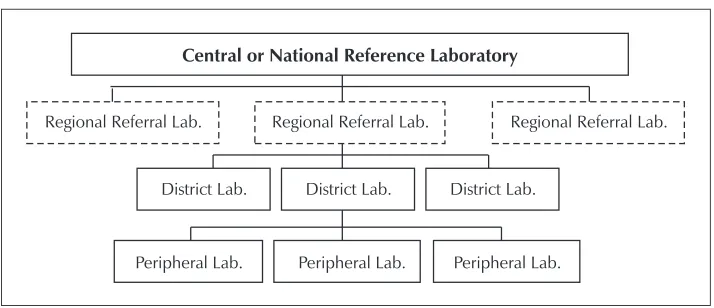
The organization of laboratories in any country is usually a three or four-tier system with various possible functional linkages between them. One possible way of networking of laboratories is shown in Figure 5.1.
5.1 Peripheral laboratory services
Peripheral laboratories are located at the point of first contact of patients with health care services. In most developing countries these are available only at the level of primary health centres or community health centres (upgraded primary health centre). These laboratories provide technical support for preventive, curative and promotive services for the individual as well as the community.
Figure 5.1: Networking of laboraotries
Central or National Reference Laboratory
Regional Referral Lab. Regional Referral Lab. Regional Referral Lab.
District Lab. District Lab. District Lab.
Staff
The staff in peripheral laboratories should include at least one technician and one laboratory assistant/attendant.
Space
There should be enough space in peripheral laboratories for at least one laboratory-cum-office/record room (approx. 5 metres x 3 metres ) and one store-room which can also be used for other services (approx. 5 metres x 3 metres).
Other facilities
Other necessary facilities include:
supply of safe water •
reliable source of energy (battery, electricity, solar or kerosene) •
sterilization/disinfection facilities •
waste disposal facilities •
Besides, clinical sample collection and transport facilities must also exist, along with communication facilities between peripheral and intermediate laboratories for the referral of samples and patients, procurement of supplies and personal discussions.
Equipment and supplies
Necessary equipment and supplies include good microscopes, centrifuges, autoclaves, refrigerators, balances, pH meters, incubators, water bath, transport media, glassware, sterile swabs, and reagents for staining (e.g. Gram, Albert, Ziehl Neelsen, Romanowsky’s), reagents for chemical examination of urine, kits and reagents for rapid diagnostic tests, sterilized syringes and needles, micropipettes and tips as well as sterile collection bottles for blood/serum and water analysis.
Tests to be performed
serological tests which may be useful in studying the epidemiological patterns of important diseases can also be performed at peripheral laboratories.
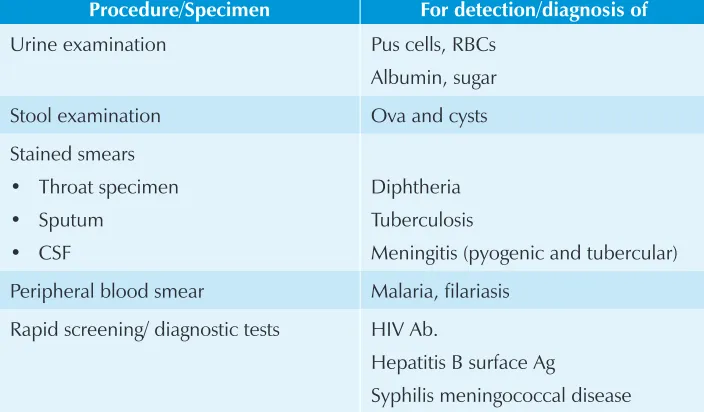
Tests at peripheral laboratories are subject to resources, manpower, technology and prevalence of various diseases in the area catered to by the laboratory. A suggested list is provided in Table 5.1.
Table 5.1: Suggested tests to be performed at peripheral laboratories
Procedure/Specimen For detection/diagnosis of
Urine examination Pus cells, RBCs Albumin, sugar Stool examination Ova and cysts Stained smears
Throat specimen
•
Sputum
•
CSF
•
Diphtheria Tuberculosis
Meningitis (pyogenic and tubercular) Peripheral blood smear Malaria, filariasis
Rapid screening/ diagnostic tests HIV Ab.
Hepatitis B surface Ag
Syphilis meningococcal disease
As far as possible, these tests should be reliable, sensitive, specific, rapid, easy to perform and cost effective. Tests such as dip-stick ELISA, latex agglutination, etc. are useful in this kind of situation. However, before these tests are introduced in peripheral laboratories, a central or regional laboratory must evaluate and assess their efficacy and feasibility.
5.2 Intermediate laboratory services
In most developing countries, intermediate laboratories are located at district or regional headquarters and may act as clinical as well as public health laboratories. The following functions are expected to be performed by these laboratories:
Laboratory support to clinical diagnosis/public health
• EQAS
Logistic and technical support to peripheral laboratories •
Training of staff for peripheral laboratories •
Intermediate laboratories help in the diagnosis and treatment of the individual patient and as well as for the epidemiological surveillance and control of diseases in the community. These laboratories also serve as links between peripheral laboratories and the state/central laboratory for the following:
Collection, storage and analysis of data •
Distribution of reagents, media, laboratory manuals •
Guidelines for purchase of equipment •
Supervision of peripheral laboratories •
Organization of EQAS for peripheral laboratories •
Participation in EQAS organized by the state/central laboratories •
Referral to higher/reference laboratories for characterization of isolate/ •
confirmation of diagnosis
Staff
Qualified pathologist/ microbiologist (Doctor of Medicine/ diploma in clinical pathology)
1
Technicians - DMLT (Diploma in Medical Laboratory Technology) with experience
2
Laboratory Assistants (DMLT) 1
Laboratory attendants 2
Cleaner 1
Clerk-cum-storekeeper 1
Space
Microbiology/Serology laboratory (approx. 8 meters x 5 meters) 1 Sterilization, media preparation laboratory
(approx. 6 meters x 4 meters)
1
Store-room (approx. 3 meters x 5 meters) 1 Office (approx. 5 meters x 3 meters) 1
Equipment
Binocular microscope 2
Dark-field microscope 1
Innoculating chamber 2
Centrifuge 2
Autoclave 2
Incubator 2
Hot air oven 1
Water bath 2
VDRL shaker 1
Colorimeter 1
Refrigerator 1
Balance 2
pH meter 1
Inspissator 1
Elisa Reader 1
Distilled water apparatus 1
Micropipettes as per workload
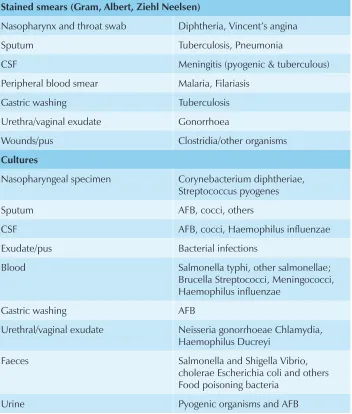
The tests expected to be performed at the intermediate laboratories are listed in Table 5.2.
Table 5.2: Suggested microbiological tests to beperformed at an intermediate laboratory
Procedure/Specimen For detection/diagnosis of
Unstained wet preparations
Urine deposit, Dark-field illumination Pus cells, RBCs Treponema pallidum
Stained smears (Gram, Albert, Ziehl Neelsen)
Nasopharynx and throat swab Diphtheria, Vincent’s angina Sputum Tuberculosis, Pneumonia
CSF Meningitis (pyogenic & tuberculous) Peripheral blood smear Malaria, Filariasis
Gastric washing Tuberculosis Urethra/vaginal exudate Gonorrhoea
Wounds/pus Clostridia/other organisms
Cultures
Nasopharyngeal specimen Corynebacterium diphtheriae, Streptococcus pyogenes Sputum AFB, cocci, others
CSF AFB, cocci, Haemophilus influenzae Exudate/pus Bacterial infections
Blood Salmonella typhi, other salmonellae; Brucella Streptococci, Meningococci, Haemophilus influenzae
Gastric washing AFB
Urethral/vaginal exudate Neisseria gonorrhoeae Chlamydia, Haemophilus Ducreyi
Faeces Salmonella and Shigella Vibrio, cholerae Escherichia coli and others Food poisoning bacteria
Procedure/Specimen For detection/diagnosis of
Antibiotic sensitivity For various pathogens
Serological tests
Widal Enteric fever
Tube agglutination Brucellosis
ASO Rheumatic fever
VDRL/RPR Syphilis
Rapid diagnostic tests for Detection of HBsAg for hepatitis B, HIV antibody, Meningococcal antigen
KOH preparation of skin/nail/hair Fungi
Environmental samples Bacteriology of water and food
5.3 Rapid diagnostic tests at peripheral and
intermediate laboratories
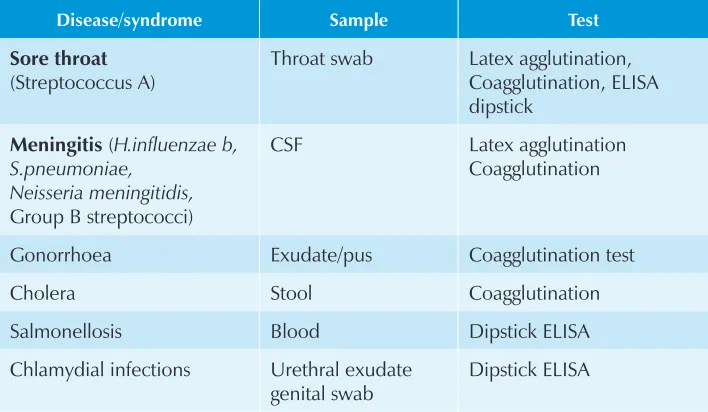
Since rapid tests for the detection of antigens and antibodies are now available, relevant tests that can be considered for use in peripheral laboratories are listed in Tables 5.3.
Table 5.3: Bacterial infections Antigen detection
Disease/syndrome Sample Test
Sore throat
(Streptococcus A)
Throat swab Latex agglutination, Coagglutination, ELISA dipstick
Meningitis (H.influenzae b, S.pneumoniae,
Neisseria meningitidis,
Group B streptococci)
CSF Latex agglutination Coagglutination
Gonorrhoea Exudate/pus Coagglutination test Cholera Stool Coagglutination Salmonellosis Blood Dipstick ELISA Chlamydial infections Urethral exudate
genital swab
Antibody detection
Typhoid fever Serum Slide agglutination
Syphilis Serum RPR
Documentation in the laboratory
6
A document refers to any information that provides direction. This may be internal documents, such as policies, quality manuals, processes, procedures, or external documents, such as specifications, plans, regulations and standards.
Documentation includes the maintenance of records. A record refers to any information that produces evidence, such as requisitions, examination results and reports, quality control and EQA records, incident/accident reports. laboratory forms, when filled, become records. These may be available on various media, both hard copy or electronic.
Maintenance of detailed records for all kinds of laboratory activities is absolutely necessary for validating any activity. In the absence of such records it can very well be surmised that no work has been done. If it is not recorded, it has not been done.
6.1 Value of documentation
Documentation is valuable because it:Defines responsibilities and authorities and inter-relationships •
Ensures processes and outcomes are traceable e.g. a process may refer •
to the addition of a reagent to complete the laboratory test, while outcome refers to the report meeting the product specifications
Proves that the job was done according to referential standards •
Facilitates training and makes it easier to train staff to approved •
procedures than to ad hoc information
Reminds one what needs to be done next •
Assists in making decisions •
Helps in the investigation of problems •
Helps in improving efficiency •
6.2 Types of documentation
Various types of documents are used in the quality system of the laboratories. These include:
6.3 Layers of documentation
organization. The specific SOP are categorized in Level 3 and work instructions are classified under Level 4, along with forms, records and reports which may be annexed with the specific SOP. Under ISO 10013 (1995), Layer 2 and 3 have been combined to form Level B. Level 4 of ISO 9000, 1994, corresponds to Level C of ISO 10013, 1995.
Quality manual
Quality Manual describes the QMS and the structure of documentation used in the laboratory. It is the first level document describing the laboratory, its legal identity and purpose of work.
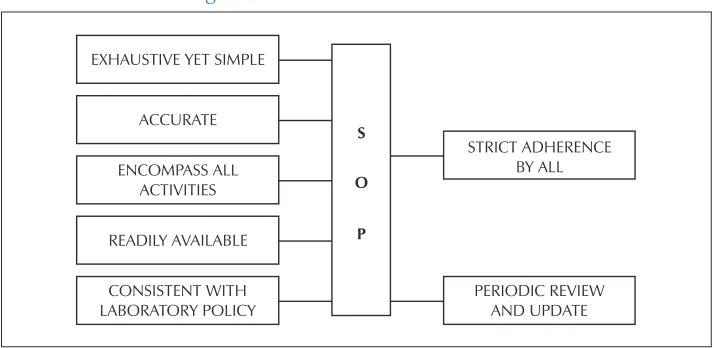
Procedural documents specify details of processes and procedures. Quality System Procedure (QSP) describes major processes undertaken by the laboratory to implement quality measures. Standard Operating Procedure (SOP) is a document that describes how a particular activity is to be performed.
Work instructions are a set of detailed, sequential, step-wise instructions for performing a task. These are specified for each activity and should be clear, understood and implemented by the staff.
Worksheet, form record Manual
Policy/Plan
SOP
1
2
3
Forms are used to record data arising from all activities, e.g. test requisition forms, report forms, indent forms, etc. Procedures and instructions should relate forms with the relevant activity for which they are to used and annexed to them.
Records preserve specific information in a form arising from procedures and tasks that the laboratory performs and needs to maintain.
6.4 Documentation structure
There is no universal rule for creating a documentation structure. Guidelines for preparing SOPs are, however, available to ensure uniformity and ease of understanding. The laboratory management must decide. The structure includes format, style, document number and distribution list.
6.5 Review and revision
Most documents need periodic review, usually one year long. The review may lead to the revision of the document to reflect current practices. Revisions have to be authorized by the laboratory’s top management and the document’s new number should show revision number and date.
6.6 Document control
Document control is a system to regulate the handling and management of documents, including the archiving, storing and destruction of obsolete documents. The quality system of the laboratory shall define, document and maintain procedures to control all documents and information (from internal and external resources).
The laboratory management must ensure that only current versions of relevant documents are available at all locations so as to ensure effective functioning of the quality system.
The basic objectives of document control are threefold:
The latest version of the document at the work place ensures that (1)
The previous version of the same procedure must be destroyed to (2)
prevent staff from having access to old procedures which may have a negative effect on the quality of the results. However, a copy of the same must be archived.
No unauthorized changes are permitted on controlled documents. (3)
The controlled documents are issued to specific members of staff who are responsible for ensuring that the staff at the workplace has access to them, that they do not disappear and that no copies are made. Accordingly, the distribution list of the controlled documents is also part of a distribution register which can trace the individuals who were issued the document. Proof of issuing and evidence of receipt are also documented, as is the destruction and removal of its previous version.
To identify controlled copies of the document, each must have a unique ID number, title, date of issue, edition and/or current revision date and/or revision number, page numbering, including total pages, and issuing authorities. These documents should be superscribed with the word, “CONTROLLED”, or printed on paper with different colours.
6.7 Key points about documentation
All documents should be legible and uniquely identifiable •
All new documents should be prepared, created, reviewed and •
approved by authorized personnel prior to issue
A document control log is a document register or master index of •
documentation.
Only currently authorized versions of appropriate documents should •
be available for active use at relevant locations
Review and approval of changes to approved documents and periodic •
review of unchanged documents should be carried out by authorized personnel. The purpose of regularly reviewing documents is to ensure that they remain updated for their intended purpose
Invalid or obsolete documents should be promptly removed from all •
Archiving, storage, and retention of obsolete documents for a fixed •
duration must be appropriately identified to prevent their inadvertent use
The laboratory’s documentation control system should allow for the •
amendment of documents by hand, and pending the re-issue of documents, the procedures and authorities for such amendments should be defined
All amendments should be clearly marked, initialled and dated, and •
a revised document formally re-issued as soon as possible
Procedures should be established to delineate how changes •
to documents in computerized systems are to be maintained and controlled so that they are protected against unauthorized access or amendments. Electronic records should be backed-up periodically.
6.8 Dangers of overdocumentation
Documentation should be carried out only to the extent necessary to ensure quality of results. Quality is not measured by the number of documents, but by their quality and utility in continuous quality improvement. Staffs have to use, produce and manage documents to achieve the overall goals of the organization, and not document only for its own sake or to satisfy the auditors.
6.9 Laboratory records
Laboratory records serve a large number of purposes, the important amongst them being:
Documentation of whatever has occurred helps establish points of •
reference for any incidents that may take place
Serve as an aid in the recognition of trends and resolution of •
problems