The 1957 Jamestown Festival was held to celebrate the 350th anniversary of the British landing at Jamestown. The Colonial Revival style essentially commodifies American history, allowing anyone of sufficient means to appropriate a piece of the (idealized) past. The basis of the Colonial Revival aesthetic, which echoes the ideology of an idealized past, has been better documented than the continued application of this aesthetic.
The Colonial Revival aesthetic, best known in Colonial Kitchens at the 1876 Centennial Exhibition, grew out of a combination of the famous 19th century sentimentality and an eclectic collection of antiques, heirlooms and reproductions from different eras. In the United States, national mythmaking consists primarily of founding myths, such as the story of the Pilgrims' First Thanksgiving, George Washington and the Cherry Tree, Betsy Ross, Molly Pitcher, and the story of Pocahontas and John Smith. The Colonial Revival expresses this glorified view of the American past stylistically and morally.
Since it is impossible to understand the importance of the Festival Planners' attempt to rewrite the origin myth without understanding how fully colonial revival imagery was absorbed into middle-class culture and there has been little research. Tilton's Pocahontas: The Evolution of an American Narrative, this article will only briefly address the debate and the development of the images.
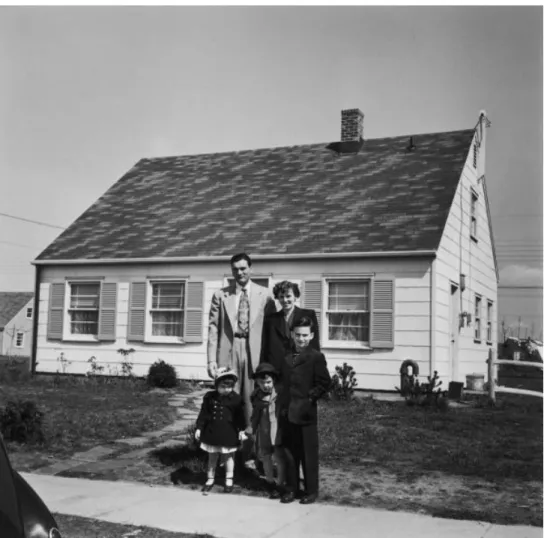
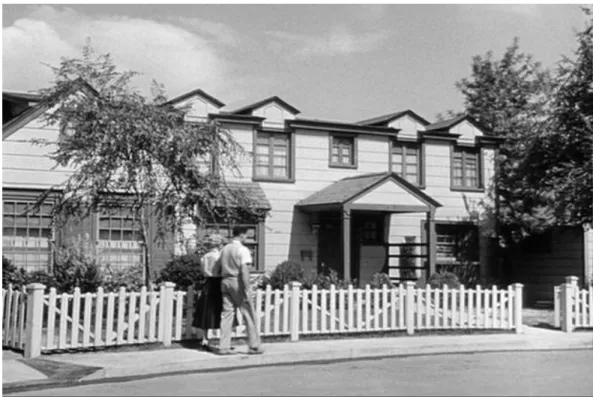
Suburban Living and the Colonial Revival in Post-War America
But along with innovation, the 1950s saw a revival in the popularity of the Colonial Revival aesthetic. Just as Colonial Revival was the preferred style for the exterior of the home, advertisers and designers marketing household goods conjured up Early America to appeal to the Colonial Revival sensibilities of the middle class. An image of Kenmore, surrounded by an oval, appears at the top left of the image, with the.
The consistency of the limited range of methods used to express an early American connection and/or appeal to the Colonial Revival sensibility is shown in advertisements published in the December 1948 issue of Life Magazine. Despite the cabriole legs on one and console feet on the other, the hint of the colonial/early American character of these items lies in the ad's text and images. The association is first made through the names and descriptions of the furniture - one is called "Monticello", the other described as "18th century style".
Again, the font used in the ad is reminiscent of the Caslon font and the lighter is juxtaposed with another object representing colonial wares - in this case an elaborate silver. By 1954, however, about half of the homes in the United States had a television and print advertising.
Planning & Marketing
The use of the seal would allow manufacturers to infer that their goods have been officially approved by the festival committee, increasing the "authenticity" of their products or souvenirs. The reconstruction of the Jamestown Glasshouse, which was financed entirely by the glass industry, was the first completed festival building. Promotional materials for the Jamestown Festival highlighted Jamestown as the seat of the country's first industry - glassmaking.
The footage of Jamestown can be attributed in part to the glass industry's participation in the construction of the Jamestown Greenhouse. The Revolution, which in any way referred to the North - the windows were an expression of pride in the history of the South and the role of the South in the formation of America. The United States Colored Association took an interest in the festival—an interest the Jamestown-Williamsburg-Yorktown Commission attributes to the association's president being a Virginian.41 Estelle M.
Tennis, the association's executive secretary, and Mary Gwathmey selected a palette and the association funded a brochure with color samples and information about the festival. The 1957 Jamestown Festival is sure to inspire members of the color world, such as paint manufacturers, men's and women's fashion, and the automotive industry.
Symbolism Manifested
Smith described the greenhouse as “a place in the woods about a mile from Jamestown.”46 The specific location was not identified until 1931, when Jesse Dimmick, then owner of the property, found the remains of a glass furnace. However, archaeological excavations have still not turned up any specific objects made in Jamestown – most of the fragments found have been traced to Europe. Given that Carl Gustkey, president of the Imperial Glass Corporation, founded the Jamestown Glasshouse Foundation responsible for building the festival's glasshouse, it's no surprise that Imperial Glass.
Typical of colonial revival goods, the idea of the colonial, applied to items that would appeal to consumers, took precedence over actual authenticity. Jamestown Blue, the catalog claims, is "the brilliant peacock color favored by the earliest American glassmakers."54 While blue glass was made in the United States after the Revolution, no evidence has been found at Jamestown to indicate that glass in any color is not made. other than "general green" - the Jamestown label was applied entirely to forge an association with the colonial past and to link the items to the Jamestown commemoration. Jamestown label would fit their design into "the [current] strong trend toward traditional decor".55 Again, however, the pieces were more suggestive of 19th-century design, resembling free-form items made in the United States. during the first half of that century (figures 39 & 40).
The connection to Jamestown was purely through advertising, as was true with so many products associated with the Festival. However, apart from the application of the name "Jamestown" to these items, the shapes and advertisements were not at all different from other Colonial Revival glass marketed at the same time. Neither model was modeled on historical forms, but the advertising scene positions them, in the consumer's mind, as representing or, in the case of the American Antiques line, depicting American history (figures 42 and 43).
An undated mid-20th century advertisement for the New Blue Chateau dinner service begins with the headline "The Charm of 18th Century Dinner Service". The remaining text, next to a drawing of a woman clearly transported by the joy her cutlery evoked in her, relates the pattern to "rare old porcelain" with "all the sophisticated dignity and grace of Georgian culture ." As in the advertisements, many of the manuals emphasized the appropriateness of tableware with Colonial Revival styling. Romance of your Dinnerware, published by the Home Economics Department of The Salem China Company is an undated instruction booklet that was probably issued in the late 1940s - 1950s.
For "lunch", the Mount Vernon and Lansdowne models, the latter described as "adapted from an 18th-century floral print" are considered "informal". The model is an excellent example of the periodic revival of the Colonial Revival aesthetic. His forebears graced the tables of the great—from the classic Federalist mansions of the Old Bay Colony to the stately belles.
Jamestown Iconography
Clockwise from the top, the fields contain images of "The Ships that Brought the Founders of the Nation", "Princess Pocahontas", "Blair Tomb", and. In the Jamestown version of the origin myth, divine right plays just as much, if not more heavily, than hereditary right. However, souvenir plates, rather than practical tableware, were the most common canvas for expression of the Jamestown iconography, although not as much in combination with traditional Colonial Revival imagery as in other object types.
Consistent with the limited Jamestown-specific iconography used in Festival-related. merchandise, many of the souvenir talkies are almost identical to each other. Inside the festival grounds, activities, speeches, and exhibits continued to combine Jamestown imagery with traditional Colonial Revival symbols, reinforcing Jamestown's role as the birthplace of the nation. Speeches given at the festival and accompanying events expressed the same sentiment as advertisements, material goods and performances, namely that Jamestown should be recognized as the birthplace of the nation.
Other speeches made were in a similar vein – reiterating that the Jamestown colonists came to the New World closely associated with British rule, and carrying with them the ideals set forth in the Magna Carta and the religion of the King James Bible. Typical of colonial revival goods was that the colonial association these objects were intended to evoke arose more often from the advertising of the objects than from the objects themselves. The establishment of Colonial Revival as the appropriate style for suburban housing predated World War II and during the postwar white migration to the suburbs, and the Colonial Revival aesthetic, which was strongly advocated as a means to that end.
However, it does appear that a new manifestation of the colonial revival is taking place in the United States today. As mentioned above, little research has been done on the absorption of the colonial revival aesthetic into popular culture, another possibility for further. 1 Paul Schackel, ed., Myth, Memory, and the Making of the American Landscape (University Press of Florida, 2001), 3.
31 Jamestown 350th Anniversary Final Report to the Chairman and Congress of the Jamestown-Williamsburg-Yorktown Celebration Commission, Washington, D.C., 1958, 6. 32 Jamestown 350th Anniversary Final Report to the Chairman and Congress of the Jamestown-Williamsburg-Yorktown Celebration Commission, Washington, D.C. , 1958, 33. 38 Jamestown 350th Anniversary Final Report to the President and Congress Jamestown-Williamsburg-Yorktown Celebration Commission, Washington, D.C.
48 The 350th Anniversary of Jamestown Final Report to the President and Congress of the Jamestown-Williamsburg-Yorktown Celebration Commission, Washington, D.C., 1958, 62. Commission/President of the Virginia Historical Society, at the naming of the three ships, December 20 , 1956, Norfolk, VA. 34; A Beautiful Failure: Ceramic Souvenirs from the 1907 Jamestown Tercentennial Exposition." In Ceramics in America, edited by Robert Hunter.
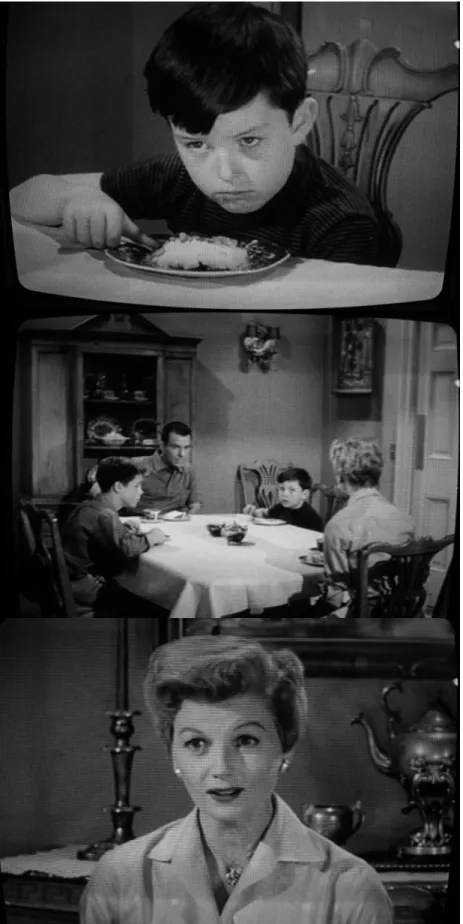
In addition to the swivel chairs and rustic construction, notice the Colonial Revival coffee pot in the background of the bottom image.