Moderate, and Severe Intellectual Disability
For the most optimal reading experience we recommend using our website.
A free-to-view version of this content is available by clicking on this link, which includes an easy-to-navigate-and-search-entry, and may also include videos, embedded datasets, downloadable datasets, interactive questions, audio content, and downloadable tables and resources.
Author: Richard M. Gargiulo, Emily C. Bouck Pub. Date: 2020
Product: Sage Academic Books
DOI: https://doi.org/10.4135/9781506369785 Keywords: intellectual disability, disabled people
Disciplines: Education, Special & Inclusive Education, Cognitive Impairments, Dyslexia or Specific Learning Difficulties (SpLD), Learning Disabilities
Access Date: January 19, 2024
Publishing Company: SAGE Publications, Inc.
City: Thousand Oaks
Online ISBN: 9781506369785
© 2020 SAGE Publications, Inc. All Rights Reserved.
Richard M. Gargiulo Emily C. Bouck
Learning Objectives
After reading Chapter 1, you should be able to:
• Discuss society’s changing views of individuals with intellectual disability.
• Describe how intellectual ability and adaptive behavior are assessed.
• Summarize the key elements of the AAIDD definitions of intellectual disability from 1961 to 2010.
• List four ways of classifying individuals with intellectual disability.
• Explain why the number of individuals with intellectual disability has decreased over the years.
Intellectual disability is a very powerful term. It is also an emotionally laden label, one that conjures up various images of people with intellectual disability. What do you think of when someone says “intellectual disabili- ty”? Do you immediately think of the character from the movie Radio, The Other Sister, or I Am Sam? Maybe you recall meeting a young girl with Down syndrome when you volunteered to help during last year’s Special Olympics, or perhaps you recollect how you felt when a group of adults with intellectual disability sat by you in a restaurant. Often our images of individuals with an intellectual disability are based on stereotypes resulting from limited contact and exposure. Consequently, many of us are susceptible to inaccuracies, misconcep- tions, and erroneous beliefs about this population. As a result, people with intellectual disability frequently encounter prejudice, ignorance, and, in some instances, outright discrimination simply because society has identified them as “different.” Yet despite the diversity represented by this group, we firmly believe that chil- dren and adults with intellectual disability are first and foremost people who are more like their typically devel- oping peers than they are different. In fact, very few ever fit the images and stereotypes commonly portrayed by the media.
Until very recently, individuals with an intellectual disability were often identified as mentally retarded—a pejo- rative, stigmatizing, and highly offensive label (commonly referred to in some circles as the “R” word). Today, the terminology of choice is intellectual disability. The acceptance of this new terminology has been cham- pioned by the premier professional organization in the field—the American Association on Intellectual and
The “R” Word—What’s the Big Deal?
Point
As young children, we were taught that “sticks and stones may break my bones but words will never hurt me.” We repeated this saying to ourselves whenever we were teased by other kids. As we grew older, though, some of us started to realize the truth. Words are powerful; they can and often do hurt.
Many times, they leave emotional scars that, unlike broken bones, don’t always heal with the passage of time. Sometimes, words that aren’t necessarily meant to offend can cause great pain. In fact, many words used by some children, as well as adults, perpetuate stereotypes and hurt the feelings of the recipient. One of these words is the “R” word. As the mother of a child with Down syndrome, I cannot bring myself to use this word. It is way too painful. The term in question begins with R and rhymes with yard. On any given school day, students carelessly toss this word around without giving it a second thought. For many individuals, it is just an expression; yet there are significant negative connotations associated with it. Have you ever said, “That’s so ‘R’ worded,”or “you’re such an ‘R’ word?”Many peo- ple don’t realize that this word sends a message that it’s all right to make fun of individuals with disabil- ities or, worse yet, to disregard them completely. Next time, remember another phrase: “Think before you speak.”
Counterpoint
How does a word such as retarded take on such a negative connotation? If we stopped using the word, wouldn’t it just be replaced by another inappropriate term such as stupid, dumb, idiot, or imbecile? Us- ing words to label people for good or bad is part of who we are as a society and is done extensively by the government, in our schools, and throughout our communities. So if using a word like retarded to label a person has such negative connotations, why do we keep doing it? The reason is simple. The problem isn’t with the word per se, or any other controversial term for that matter; it is the intent behind the use of the word. Sure, you can eliminate retarded from your vocabulary, but it will most likely just be replaced by another word with equally negative values unless we eliminate the intent. In fact, this
has been the case throughout history. The chronology of the word retarded began with feebleminded and then evolved to idiot, imbecile, and moron. These are all words that are now considered pejora- tive and inappropriate in today’s society. So, what will be the next term to replace retarded? Or will we finally realize that it isn’t the word that hurts? It’s the power we give the word.
Reflection
What do you think? Is it just the word, or is it the meaning and value associated with the term retarded?
If we didn’t use this term, would it simply be replaced by another (possibly less offensive) word?
SOURCE: Adapted from M. Hardman, C. Drew, and M. Egan, Human Exceptionality, 11th ed. (Bel- mont, CA: Wadsworth/Cengage Learning, 2014), p. 213.
The term intellectual disability is currently preferred by many policy makers, advocates, parents, service providers, teachers, and scholars. It is generally seen as less offensive to persons with this disability and is also consistent with contemporary Canadian and European terminology. The United States recently adopted this position. In October 2010, legislation was enacted (PL 111–256, commonly known as Rosa’s law) that re- moved the terms mental retardation and mentally retarded from federal health, education, and labor statutes.
In their place, we now find the designation intellectual disability to be the preferred language.
The goal of this chapter is to examine basic issues and concepts necessary for understanding intellectual disability and individuals with this disability. In this chapter, we will examine historical foundations, evolving definitions, identification, and assessment procedures along with classification models and the prevalence of intellectual disability.
Historical Perspectives on Intellectual Disability
It is generally believed that individuals with intellectual disability have been present in all societies throughout the ages. Historically speaking, the field of intellectual disability resembles an ever-changing mosaic influ-
tual disability have also affected the treatment of people with intellectual disability. Intellectual disability is a field that is continually evolving—from the ignorance of antiquity to the highly scientific and legal foundations of the early twenty-first century. Along this pathway, people with intellectual disability have had to endure and battle myths, fear, superstition, attempts at extermination, and educational and social segregation before ar- riving at today’s policy of normalization and inclusion (Richards, Brady, & Taylor, 2015).
Early Civilizations
Early written records from the era of the Greek and Roman empires make reference to citizens with intel- lectual disability. In some instances, these accounts date back to almost 1550 b.c. (Lindman & McIntyre, 1961). In many ways, the Greek and Roman societies were highly advanced and civilized, but the treatment of infants with disabilities would be judged cruel and barbaric by today’s standards. Scheerenberger’s (1983) detailed account of the history of intellectual disability reveals, for example, that in the city-state of Sparta, which placed a premium on physical strength and intellectual ability, eugenics and infanticide were common, everyday occurrences. Only the brightest and strongest of citizens were encouraged to have children. New- borns were examined by a council of inspectors, and babies thought to be defective or inferior were thrown from a cliff to die on the rocks below.
The early days of the Roman Republic mirrored the practices of the Greeks. Deformed infants were routinely allowed to perish—but only during the first eight days of life. Fathers held complete control over their children and could do whatever they wished, including selling or killing them. This doctrine of patria potestas is unpar- alleled in any other society.
The Middle Ages
From the fall of the Roman Empire in a.d. 476 to the beginning of the Renaissance in the 1300s, religion be- came a dominant social force, heralding a period of more humane treatment of individuals with disabilities.
Churches established monasteries and asylums as sanctuaries for persons with intellectual disability. Chil- dren with intellectual disability were often called les enfants du bon Dieu (“the children of God”). Infanticide was rarely practiced because the largely agrarian societies required many workers in the fields. In some in- stances, individuals thought to have an intellectual disability found their way into castles where, though pro-
tected and shown favor, they served as buffoons and court jesters entertaining the nobility (Gargiulo, 1985).
King Henry II of England enacted a policy in the twelfth century, de praerogativa regis (“of the king’s preroga- tive”), whereby “natural fools” became the king’s wards (Drew & Hardman, 2007).
At the same time, it was an era in which fear and superstition ran rampant. People with intellectual disability were frequently thought to be “filled with Satan” and to possess demonic powers, which often led to torture and death for practicing witchcraft. It was not uncommon for individuals with intellectual disability to be sent to prison and kept in chains because they were perceived to be a danger to society and their behavior was seen as unalterable.
It is important to note that when scholars and researchers talk about individuals with intellectual disability at this point in history, they are generally referring to those with more severe intellectual disability. Many persons with milder forms of intellectual disability could function adequately in the simple agrarian economies of that day and thus were not recognized or labeled as intellectually disabled. Their behavior was not viewed as dif- ferent from that of their peers, many of whom were also illiterate yet capable of manual labor.
According to Hickson, Blackman, and Reis (1995), conditions and services for persons with intellectual dis- ability did not greatly improve during the Renaissance (1350–1550). However, the social climate of the Re- naissance set the stage for later events that would directly affect individuals with intellectual disability. A spirit of inquiry and openness took hold, along with a philosophy of humanism; Europe was on the verge of change.
Early Optimism
The “modern” period in the history of intellectual disability traces its roots to the early nineteenth century.
Scientific advances of this era helped to more clearly define the field of intellectual disability. Jean-Étienne Dominique Esquirol (1782–1840), for example, differentiated between mental illness, which he termed de- mentia, and intellectual disability, which he called amentia. He also proposed a two-level classification system of intellectual disability: imbeciles and idiots. Imbeciles, in contemporary terminology, were persons with mild intellectual disability and higher-functioning individuals with moderate intellectual disability. Those identified by Esquirol as idiots would likely be characterized today as individuals with severe or profound intellectual disability (Scheerenberger, 1983).
It was during this period that the groundbreaking work of Jean-Marc Gaspard Itard (1774–1838) occurred.
His pioneering efforts with Victor, the so-called homme sauvage or “wild man,” earned him the title Father of Special Education. Itard’s systematic attempts at educating Victor, whom he believed to be a victim of social/
educational deprivation, signals the start of the notion that individuals with intellectual disability are capable of learning—however limited it may be.
Edouard Seguin (1812–1880) was inspired by the work of his mentor, Itard. Based on his religious convic- tions, Seguin was a fervent advocate for the education of children with intellectual disability. He was firmly convinced that highly structured and systematic sensorimotor instruction involving positive reinforcement and modeling would lead to improvement. His educational model, which he believed applicable to all children with intellectual disability regardless of severity, stressed physiological and moral education. In 1837, Seguin es- tablished the first school in Paris for the education of children with intellectual disability.
Because of the political turmoil in France in the mid-1800s, Seguin immigrated in 1848 to the United States, where he played a principal role in helping to establish residential facilities for persons with intellectual dis- ability in several states. In 1876, the Association of Medical Officers of American Institutions for Idiotic and Feeble-Minded Persons was established, with Seguin serving as its first president. This association was the forerunner of today’s American Association on Intellectual and Developmental Disabilities.
Beginning in the mid-nineteenth century, residential institutions began to dot the American landscape. In 1848, Samuel Gridley Howe (1801–1876) successfully lobbied the Massachusetts legislature and secured funding to establish the first residential facility for individuals with intellectual disability. Howe, a physician who was serving as the director of the Perkins Institution for the Blind, located this residential school in a wing of the institution and initially offered services to ten “idiot” children (Scheerenberger, 1983). Howe believed that institutions should be kept small. Along with other advocates and social activists of his time, he was optimistic the persons with intellectual disability could be rehabilitated and eventually reintegrated into the mainstream of community life. For various reasons, however, this did not occur, and enthusiasm was eventually replaced with pessimism.
Protection and Pessimism
The late nineteenth and early twentieth centuries witnessed the development of large, geographically isolated
institutions for individuals with intellectual disability. The focus of these facilities changed as the invigorating optimism of the early 1800s generally gave way to disillusionment, fear, and pessimism (Morrison & Polloway, 1995). Institutions were overcrowded and understaffed. Their mission shifted from one of education and re- habilitation, as espoused by Seguin and others, to a new custodial role. Caring concern was slowly replaced by an unjustified concern with protecting society from individuals with intellectual disability.
The public’s regressive attitude toward persons with intellectual disability was fueled by two publications: “The Jukes”: A Study in Crime, Pauperism, Disease and Heredity (Dugdale, 1877) and The Kallikak Family: A Study in the Heredity of Feeblemindedness (Goddard, 1912). The underlying thesis of these two books is that intellectual disability—or feeblemindedness, as it was then called—is inherited. It was generally believed that crime, poverty, and a host of other social ailments were directly due to the overpopulation of individuals with intellectual disability. Decades later, Goddard’s questionable research into the descendants of a Revolution- ary War soldier known by the pseudonym Martin Kallikak also supported the erroneous belief that intellectual disability results solely from heredity. Collectively, such publications reinforced the hypothesis that intellectual disability and social problems are correlated, thereby justifying the removal of these individuals from society and their sterilization. In the early 1900s, many states enacted legislation enforcing sterilization of citizens with intellectual disability. In 1927, the U.S. Supreme Court in Buck v. Bell upheld the constitutionality of these enactments.
One of the unfortunate consequences of this shift in societal attitude was that institutions became permanent residences for people with intellectual disability; thus, they were no longer prepared for their eventual return to society (Drew & Hardman, 2007). Education and training functions virtually disappeared, and only the most rudimentary care was provided. Over time, these institutions deteriorated, becoming warehouses for society’s unwanted citizens. Living conditions were harsh and often deplorable. This situation was poignantly captured by Blatt and Kaplan (1966) in their classic photographic essay on institutional life, Christmas in Purgatory.
Beginning in the 1960s, a highly visible call for more humane and normalized living arrangements for people with intellectual disability was issued. Initiated in Sweden by Bengt Nirje (1969), the principle of normaliza- tion emphasizes “making available to the mentally retarded [intellectually disabled] patterns and conditions of everyday life which are as close as possible to the norms and patterns of the mainstream of society” (p.
181). In the United States, the idea that persons with intellectual disability have a right to culturally normative experiences was championed by Wolfensberger (1972). This concept, coupled with a renaissance of soci-
etal concern for individuals with intellectual disability, helped to facilitate a movement, beginning in the 1970s, toward deinstitutionalization and more community-based services for individuals with intellectual disability.
Today, legislative as well as legal action has resulted in more normalized lifestyles and greater access to all aspects of society for our fellow citizens with intellectual disability.
The Emergence of Public Education for Students With Intellectual Disability
Although institutions were firmly established as part of the American social fabric in the late 1800s, public ed- ucation for children with intellectual disability was virtually nonexistent. The first public school class for “slow learning” youngsters was formed in Providence, Rhode Island, at the very end of the nineteenth century.
These programs were largely segregated or self-contained classes and would remain so for the better part of the twentieth century. Classes for higher-functioning pupils with intellectual disability began to grow, in part as a result of the popularizing of intelligence testing. Scheerenberger (1983) reports that by 1930, sixteen states had enacted either mandatory or permissive legislation regarding special classes for children with intel- lectual disability. By 1952, forty-six of the forty-eight states provided an education to children with intellectual disability. Students with severe or profound intellectual disability, however, were largely excluded from public education. This pattern was to change beginning in the late 1950s and 1960s, thanks in part to the advocacy and initiatives of well-organized parent groups. The National Association of Parents and Friends of Mentally Retarded Children, formed in 1950, was especially influential in securing rights for children with intellectual disability (Hickson et al., 1995). This group was the forerunner of today’s very active and politically powerful association known simply as The Arc.
The 1960s and 1970s marked the beginning of an era of national concern for the rights of individuals, a focus that continues today. People with intellectual disability would benefit from this attention. Aided by the actions of President John F. Kennedy, who had a sister with intellectual disability, enlightened social policies, new ed- ucational programs, and a national research agenda were all forthcoming. At the same time, advances in the field of psychology and education demonstrated that, to some degree, all individuals with intellectual disability are capable of learning. Professionals also began a movement toward less restrictive and more integrated educational placements for students with intellectual disability—an emphasis with a very contemporary flavor.
But perhaps the principal legacy of this era, which is foundational to today’s educational programming, is a greater acceptance of persons with intellectual disability and their right, as fellow citizens, to live their lives in
the most normalized fashion.
Identification and Assessment of Intellectual Disability
The constructs of intelligence and adaptive behavior play key roles in our understanding of the concept of intellectual disability. Yet both of these terms are somewhat difficult to define and assess. For the sake of clar- ity, we will discuss each concept separately; but remember they are intricately interrelated and provide the foundation for contemporary thinking about intellectual disability.
Intellectual Ability
The question of what constitutes intelligence and how to describe it has challenged educators, psychologists, and thinkers throughout the years. Even today, there is disagreement among professionals as to the meaning of this term and the best way of measuring intelligence. Intelligence is perhaps best thought of as a construct or theoretical abstraction; it is not a visible entity but rather a human trait whose existence is inferred based on a person’s performance on certain types of cognitive tasks. Because no one has ever seen intelligence and we have only deduced its presence, professionals have come to the realization that they are “attempting to explain one of the most complex and elusive components of human functioning” (Beirne-Smith, Patton, &
Kim, 2006, p. 95).
These difficulties notwithstanding, a great amount of effort has been expended on trying to accurately assess intellectual functioning. The most common way of determining an individual’s cognitive ability is through an IQ or intelligence test. Two of the more widely used individually administered IQ measures are the Wechsler In- telligence Scale for Children (5th ed.), or WISC-V (Wechsler, 2014), and the fifth edition of the original work of Binet and Simon from the early twentieth century, the Stanford-Binet Intelligence Scales (Roid, 2003). Some psychologists and psychometrists rely on the Kaufman Assessment Battery for Children (Kaufman & Kauf- man, 2004), especially when evaluating youngsters from culturally and linguistically diverse backgrounds.
Data gleaned from the WISC-V, the Stanford-Binet V, and similar measures are thought to represent a sample of an individual’s intellectual skills and abilities. These data are usually summarized as an IQ score. Originally,
an IQ was defined as a ratio between the person’s mental age (MA or developmental level) and chronological age (CA) multiplied by 100. For instance, a student whose chronological age is 10 but who performs on an IQ test like a typical 5-year-old would have an IQ of 50; if accompanied by deficits in adaptive behavior, this individual would very likely be identified as having an intellectual disability. Today, deviation IQs or standard scores have replaced intelligence quotients in most professional circles. A standard score is nothing more than an expression of how far a particular raw score deviates from a specific reference point such as the test mean. Standard scores are often expressed as standard deviations. One standard deviation on both the Stanford-Binet V and the WISC-V is equivalent to 15 IQ points. Both tests have a mean IQ of 100.
Although IQ testing is very common in schools, the issue of assessing someone’s intelligence, especially if a special education placement may result, is somewhat controversial. Cautionary flags and reasons for concern tend to focus on these issues:
• Potential for cultural bias. Intellectual assessments are often criticized because of their highly verbal nature and reflection of middle-class Anglo standards.
• Stability of IQ. An IQ test only reports a person’s performance at a particular point in time; intelligence is not static but capable of changing, and in some cases, the change can be significant.
• Overemphasis on IQ scores. An IQ score is not the sole indicator of an individual’s ability, nor is it a measure of the person’s worth; yet IQ is often stressed at the expense of other factors such as motivation or adaptive skills.
Adaptive Behavior
The notion of adaptive behavior was first introduced in the 1973 AAIDD definition of intellectual disability. It was retained in the 1983 description and is the underpinning of the most recent AAIDD definitions. Adaptive behavior is seen as “the degree to which, and the efficiency with which, the individual meets the standards of maturation, learning, personal independence, and/or social responsibility that are expected for his or her age level and cultural group” (Grossman, 1983, p. 11). In continuing this thinking, Luckasson et al. (2002) de- scribe adaptive behavior as “the collection of conceptual, social, and practical skills that have been learned by people in order to function in their everyday society” (p. 73). Stated another way, it is how well a person copes with the everyday demands and requirements of his or her environment. According to Luckasson and her col- leagues, adaptive behavior is seen as significant limitations in the expression or performance of conceptual
(for example, reading and writing, money concepts), social (for example, obeying laws, following rules), and practical (for example, eating, dressing oneself, meal preparation, occupational abilities) adaptive skills. (See Table 1.1.)
The idea of context is also important for understanding the concept of adaptive behavior. Because behavior is strongly influenced by cultural factors, age and situation appropriateness must always be considered within the setting in which it occurs. For example, a teenage girl who uses her fingers while eating might be viewed as exhibiting inappropriate behavior; however, this behavior is only maladaptive when considered within the context of Western cultures.
It is not always easy to assess adaptive behavior. It is usually measured via direct observation, structured interviews, or standardized scales. Information may be obtained from family members, teachers, caregivers, or other professionals. AAIDD is currently developing the Diagnostic Adaptive Behavior Scale (DABS) as a standardized measure of adaptive behavior. Based on the three adaptive skill areas (conceptual, social, and practical), this new instrument is being normed on individuals in the chronological age range of 4–21 years old with and without intellectual disability. Designed as a diagnostic test, the DABS seeks to provide a precise cutoff point for persons deemed to have “significant limitations” in adaptive behavior (American Association on Intellectual and Developmental Disabilities, 2015). As you will now learn, these limitations represent key components of the most recent AAIDD definitions of intellectual disability.
Table 1.1 2002 AAIDD Adaptive Skill Areas
SKILL AREA EXAMPLES OF BEHAVIOR
Conceptual
• Language (receptive and expressive)
• Reading and writing
• Money concepts
• Self-direction
Social
• Interpersonal
• Responsibility
• Self-esteem
SOURCE: Adapted from Mental Retardation: Definition, Classification, and Systems of Supports, 10th ed.
(Washington, DC: American Association on Mental Retardation, 2002), p. 42.
Evolving Definitions of Intellectual Disability
Intellectual disability is a complex and multifaceted concept. It has been studied by psychologists, sociolo- gists, educators, physicians, and many other professionals. This multidisciplinary interest in and investigation of intellectual disability, while beneficial, has significantly contributed to problems of conceptual and definition- al clarity (Drew & Hardman, 2007). Yet, by its very nature, intellectual disability cannot be studied indepen- dently of other disciplines. We fully agree with Drew and his colleague that there is considerable merit in a multidisciplinary approach; however, we must not lose sight of what should be our central focus, the individual
• Gullibility (likelihood of being tricked or manipulated)
• Naiveté
• Follows rules
• Obeys laws
• Avoids victimization
Practical
• Activities of daily living:
• Eating
• Transfer/mobility
• Toileting
• Dressing
• Instrumental activities of daily living:
• Meal preparation
• Housekeeping
• Transportation
• Taking medication
• Money management
• Telephone use
• Occupational skills
• Maintains safe environments
Historical Interpretations
Over the years, the American Association on Intellectual and Developmental Disabilities (AAIDD) has put forth several different interpretations of intellectual disability. We will briefly examine some of these early def- initions to gain a better appreciation of how our understanding of this disability has evolved.
1961 AAIDD Definition. AAIDD’s sixth definition appeared in 1961 and was widely accepted by professionals.
At this point in time, intellectual disability was described as “subaverage general intellectual functioning which originates during the developmental period and is associated with impairments in adaptive behavior” (Heber, 1961, p. 3). Let us analyze the meaning of these phrases. Subaverage general intellectual functioning is de- fined as an intelligence quotient (IQ) greater than one standard deviation (SD) (a statistic describing vari- ance from the mean or average score of a particular group) below the mean for a given age group. In 1961, this was interpreted to be an IQ below 85 or 84 depending on which standardized IQ test was used. The developmental period extended from birth to approximately age 16. The criterion of impairments in adaptive behavior is a critical and unique aspect of this definition. The inclusion of this factor establishes dual criteria for identifying someone as having an intellectual disability (Scheerenberger, 1987). Adaptive behavior, which Heber introduced, refers to an individual’s ability to meet the social requirements of his or her community that are appropriate for his or her chronological age; it is an indication of independence and social competency.
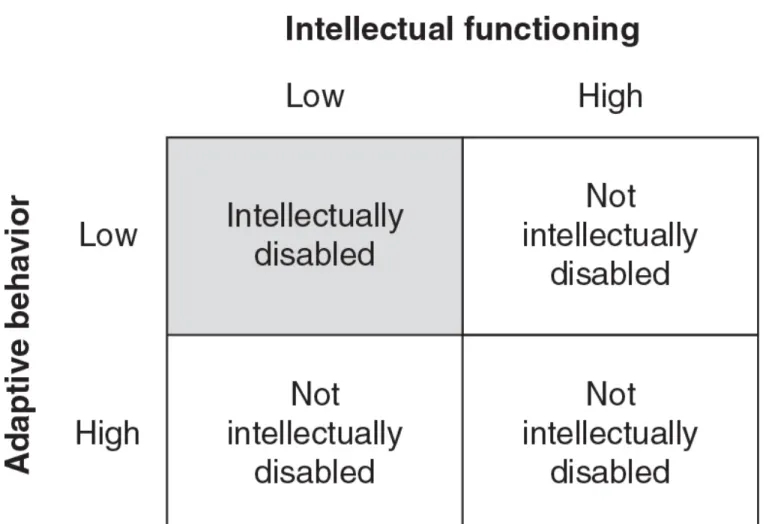
Thus, according to Heber’s definition, a person with an IQ of 79 who did not exhibit a significant impairment in adaptive behavior could not be identified as having an intellectual disability. (See Figure 1.1.)
Figure 1.1 Relationship Between Intellectual Functioning and Adaptive Behavior
NOTE: Classification of an individual as intellectually disabled requires both low intellectual functioning and deficits in adaptive behavior.
1973 AAIDD Definition. Herbert Grossman chaired a committee charged with revising the 1961 AAIDD de- finition. Grossman’s (1973) definition viewed intellectual disability as “significantly subaverage general intel- lectual functioning existing concurrently with deficits in adaptive behavior, and manifested during the devel- opmental period” (p. 11). Though paralleling its predecessor, the Grossman definition is conceptually distinct.
First, the 1973 definition refers to significantly subaverage intellectual ability. Operationally, intellectual dis- ability was psychometrically redefined as performance at least two standard deviations below the mean. This more conservative approach considered the upper IQ limit to be 70 or 68 (again, depending on whether the Stanford-Binet Intelligence Scales [SD = 16 points] or the Wechsler Intelligence Scale for Children [SD = 15 points] was used). Statistically speaking, this represents the lower 2.27 percent of the population instead of
the approximately 16 percent included in the Heber definition. (See Figure 1.2.) Adopting this standard elimi- nated the classification of “borderline” intellectual disability incorporated in Heber’s conceptual scheme.
Figure 1.2 The Normal Curve: A Theoretical Distribution of Intelligence
NOTE: The 1961 AAIDD definition defines mental intellectual disability as an IQ lower than 85 (84) on a stan- dardized measure of intelligence. The 1973 AAIDD definition defines intellectual disability as an IQ lower than 70 (68). Later versions allow for professional judgment when considering intellectual performance.
The Grossman definition also sought to clarify the relationship between adaptive behavior and intellectual functioning. This definition attempted to focus greater attention on adaptive behavior and described it as the ability of an individual to meet “the standards of personal independence and social responsibility expected of his [or her] age and cultural group” (Grossman, 1973, p. 11). Adaptive behavior was to be considered within the context of the person’s age and sociocultural group. Grossman’s work attempted to strengthen the link be- tween IQ and adaptive behavior in an effort to reduce the number of pupils identified with intellectual disability solely on the basis of their IQ. The 1973 definition also extended the concept of the developmental period to age 18 to more accurately reflect when most people complete their education. Although this definition forms the foundation for the current federal definition of intellectual disability, some educators were concerned that lowering the IQ threshold to 68 (70) could possibly deny a special education to students who otherwise would have been eligible. It was feared that these children would be misclassified and inappropriately placed and thus “drown in the mainstream” (Scheerenberger, 1987).
1983 AAIDD Definition. In 1983, AAIDD published yet another revision to its manual on terminology and clas- sification. Once again, Grossman led the organization’s efforts. The eighth edition mirrors its 1973 prede- cessor. Though very similar in wording to the 1973 definition, this version contains some important changes.
The 1983 Grossman edition suggests using a range of 70–75 when describing the upper limits of intellectual performance on a standardized measure of intelligence rather than a strict cutoff of 70. An IQ score of 70 is intended only as a guideline.
Flexibility is the key to understanding the operation of this definition. The clinical judgment of the professional now plays an important role when making a diagnosis of intellectual disability.
1992 AAIDD Definition. In May 1992, Ruth Luckasson and her colleagues crafted a new definition of intellec- tual disability, which was published in Mental Retardation: Definition, Classification, and Systems of Supports.
According to this manual,
Mental retardation [intellectual disability] refers to substantial limitations in present functioning. It is characterized by significantly subaverage intellectual functioning existing concurrently with related limitations in two or more of the following applicable adaptive skill areas: communication, self-care, home living, social skills, community use, self-direction, health and safety, functional academics, leisure, and work. Mental retardation [intellectual disability] manifests before age 18. (p. 5)
Application of this definition requires careful consideration of the following four essential assumptions:
1. Valid assessment considers cultural and linguistic diversity as well as differences in communication and behavioral factors.
2. The existence of limitations in adaptive skills occurs within the context of community environments typical of the individual’s age peers and is indexed to the person’s individualized needs for supports.
3. Specific adaptive limitations often coexist with strengths in other adaptive skills or other personal ca- pabilities.
4. With appropriate supports over a sustained period, the life functioning of the person with mental re- tardation [intellectual disability] will generally improve. (Luckasson et al., 1992, p. 5)
The 1992 AAIDD definition is a highly functional definition. It portrays intellectual disability as a relationship among three key elements: the individual, the environment, and the type of support required for maximum functioning in various settings. It essentially reflects the “fit” between the person’s capabilities and the struc-
ture and expectations of the environment. This ninth version also represents a conceptual shift away from viewing intellectual disability as an inherent trait to a perspective that considers the person’s present level of functioning and the supports needed to improve it. The interaction among the individual, the environment, and support is perhaps best conceptualized as an equilateral triangle because it shows the equality among the three elements or sides.
The 1992 AAIDD description of intellectual disability stresses functioning in one’s community rather than just focusing on the clinical aspect of the individual such as IQ or adaptive behavior (Smith, Polloway, Patton, &
Dowdy, 2008). This definition is an optimistic one; it assumes that a person’s performance will improve over time when appropriate supports are provided. Though certainly a unique portrayal of intellectual disability, this definition, like its predecessors, retains an emphasis on intellectual performance coupled with impairments in adaptive skills.
Contemporary Viewpoints
2002 AAIDD Definition. As times have changed, so has our understanding of the construct of intellectual dis- ability. The 2002 AAIDD definition represents another effort in our evolving understanding of intellectual dis- ability. The purpose of the tenth edition was to “create a contemporary system of diagnosis, classification, and systems of support for the disability currently known as mental retardation [intellectual disability]” (Luckasson et al., 2002, p. xii).
This definition states that “mental retardation [intellectual disability] is a disability characterized by significant limitations both in intellectual functioning and in adaptive behavior as expressed in conceptual, social, and practical adaptive skills. This disability originates before age 18” (Luckasson et al., 2002, p. 1).
Accompanying this description are five assumptions considered essential when applying this definition:
• Limitations in present functioning must be considered within the context of community environments typical of the individual’s age, peers, and culture.
• Valid assessment considers cultural and linguistic diversity as well as differences in communication and sensory, motor, and behavioral factors.
• Within an individual, limitations often coexist with strengths.
• An important purpose of describing limitations is to develop a profile of needed supports.
• With appropriate personalized supports over a sustained period, the life functioning of the person with mental retardation [intellectual disability] will generally improve. (Luckasson et al., 2002, p. 1)
Like its predecessor, the 2002 AAIDD definition retains a positive perspective toward individuals with intellec- tual disability while continuing to acknowledge the significance of adaptive behavior and systems of support.
It also preserves the idea that intellectual disability is a “function of the relationship among individual function- ing, supports, and contexts” (Wehmeyer, 2003, p. 276). This conceptualization of intellectual disability, while not flawless, represents a logical step in the continuing challenge of advancing our understanding of the con- cept of intellectual disability.
2010 AAIDD Definition. The eleventh AAIDD definition (Schalock et al., 2010) both reiterates and strengthens key concepts found in the 2002 definition of intellectual disability. Developed by a committee of eighteen med- ical and legal scholars as well as policy makers, educators, and other professionals, the 2010 definition em- phasizes the abilities and assets of individuals with intellectual disability rather than their deficits or limitations.
Intellectual disability is viewed as a state of functioning rather than an inherent trait. As in earlier definitions, one of the goals of the 2010 definition is to maximize support services so as to allow persons with intellectual disability to participate fully in all aspects of daily life.
The description of intellectual disability in the 2010 manual mirrors the wording found in the tenth edition, as do the five accompanying assumptions. The eleventh edition also retains the emphasis on adaptive behavior while stressing systems of support. The term mental retardation, however, is replaced by the more contem- porary label intellectual disability. This term is less pejorative while also reflecting a social–ecological under- standing of disability (Schalock, 2015). The committee notes, however, that despite the change in terminolo- gy, the term intellectual disability refers to the same population of individuals who were recognized previously as being mentally retarded (Schalock et al., 2010).
The latest AAIDD definition reflects best practices and new thinking about classifying individuals with intellec- tual disability. Rather than using intellectual functioning as a basis for classifying persons with cognitive limi- tations, the 2010 definition encourages professionals and service providers to classify on the basis of various dimensions of human functioning—intellectual abilities, adaptive behavior, health, participation, and context.
Human functioning is essentially viewed as “an umbrella term for all life activities and encompasses body structures and functions, personal activities, and participation, which in turn are influenced by one’s health
and environmental or contextual factors” (Schalock et al., 2010, p. 15). This multidimensional perspective al- lows one to classify depending on the questions being asked (for example, “Is this person competent to be a self-advocate, maintain a bank account, or have sexual relations?”) and the specific purpose of the classi- fication system. Classification is then linked to personalized systems of support for that individual (Schalock, 2015).
Classification of Individuals With Intellectual Disability
A classification system is a convenient way for differentiating among individuals who share a common char- acteristic—in this instance, intellectual disability. Of course, we must remember that there is a great degree of variability among members of this population despite the fact that they share a common label. Because intellectual disability exists along a continuum, there have been numerous proposals on how to classify peo- ple with this disability. Like definitions of intellectual disability, classification models tend to vary according to a particular focus. We will examine several systems—some vintage ones along with the most contemporary thinking in this area.
An Etiological Perspective
Traditionally, individuals with intellectual disability have been classified based on known or presumed medical/
biological causes. This etiological orientation assumes that intellectual disability is a consequence of a dis- ease process or biological defect. Examples include intellectual disability that is due to infections such as rubella (German measles) or maternal syphilis, chromosomal abnormalities such as Down syndrome, or metabolic disorders such as phenylketonuria (PKU). (These examples and others will be more fully explored in Chapter 2.) Although useful for physicians and other health care workers, this classification scheme has limited applicability for nonmedical practitioners.
Intellectual Deficits
A long-standing and popular classification scheme among psychologists and educators is one based on the
severity of intellectual impairment as determined by an IQ test. This model is one of the most widely cited in the professional literature and, until recently, reflected the position of AAIDD dating back to the 1973 Gross- man definition of intellectual disability. According to this system, deficits in intellectual functioning and related impairments in adaptive behavior result in individuals being classified into one of four levels of intellectual disability—mild, moderate, severe, or profound—with mild representing the highest level of performance for persons thought to have an intellectual disability and profound the lowest. Intellectual competency is often the primary variable used in constructing these discriminations; Table 1.2 presents the IQ ranges typically used.
An Educational Perspective
Another classification system popular with educators since the 1960s is to classify students with intellectual disability on the basis of expected or anticipated educational accomplishments. Generally speaking, special education teachers classified learners into two groups: educable mentally retarded (EMR) or trainable mentally retarded (TMR). These designations are roughly equivalent to the AAIDD labels of mild and moder- ate intellectual disability, with IQs ranging from about 50–55 to 70–75 and 35–40 to 50–55, respectively. (Be- fore the enactment of PL 94–142, public schools rarely served individuals with IQs lower than 35; therefore, these students were not labeled according to this system.) As you might expect, the term educable implies that a pupil has some, albeit limited, academic potential; trainable implies that a child is incapable of learning but possibly could be trained in nonacademic areas. Over the years, professionals have learned that these prognostic labels, which represent an “educability quotient,” are inaccurate and present a false dichotomy;
we affirm that all children are capable of learning when presented with the appropriate circumstances. The notion of presumed academic achievement has slowly fallen out of favor in professional circles. These terms are currently considered pejorative and tend to perpetuate stereotypical and prejudicial attitudes.
Table 1.2 Classification of Intellectual Disability According to Measured Intelligence
CLASSIFICATION LEVEL MEASURED IQ SD BELOW MEAN
Mild intellectual disability 55–70 2 to 3
NOTE: IQ scores are approximate.
SD = standard deviation.
Levels of Support
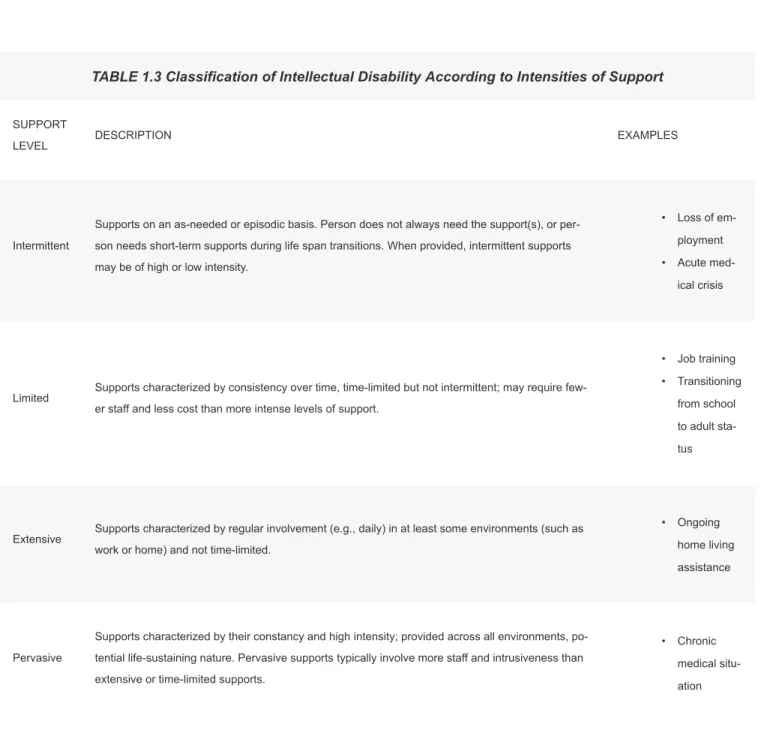
In the early nineties, AAIDD (Luckasson et al., 1992), in a dramatic and controversial maneuver, shifted from a classification model based on severity of intellectual impairment to one based on the type and extent of needed supports. This scheme, retained in the 2002 definition by Luckasson et al., classifies individuals with intellectual disability according to the level of support—intermittent, limited, extensive, or pervasive—need- ed to effectively function across adaptive skill areas in various natural settings, rather than according to their deficits. In fact, AAIDD recommends abandoning references to severity. Table 1.3 describes the four classifi- cation levels endorsed by AAIDD.
The aim of this approach is to explain an individual’s functional (rather than intellectual) limitations in terms of the amount of support he or she requires to achieve optimal growth and development at home, at school, at the workplace, and in other community settings (Beirne-Smith et al., 2006). This model, which represents more than a mere substitution for the previous AAIDD IQ-based classification scheme, extends the concept of support beyond the intensity of needed support to include the type of support system required. Natural supports typically include family members, friends, teachers, and co-workers. Formal supports are usual- ly thought of as government-funded social programs like Social Security payments or health care programs, habilitation services, and even the efforts of groups like the Council for Exceptional Children or The Arc, a na- tional advocacy organization on intellectual disability. It is difficult to say how professionals, school systems, and other groups will respond to this new way of thinking about classifying people with intellectual disability.
Moderate intellectual disability 40–55 3 to 4
Severe intellectual disability 25–40 4 to 5
Profound intellectual disability Under 25 More than 5
SOURCE: Adapted from Mental Retardation: Definition, Classification, and Systems of Supports, 10th ed.
(Washington, DC: American Association on Mental Retardation, 2002), p. 152.
Prevalence of Intellectual Disability
How many students in the United States have an intellectual disability? Answering this question first requires that we define the term prevalence. Prevalence refers to the total number of individuals with a particular dis-
TABLE 1.3 Classification of Intellectual Disability According to Intensities of Support
SUPPORT
LEVEL DESCRIPTION EXAMPLES
Intermittent
Supports on an as-needed or episodic basis. Person does not always need the support(s), or per- son needs short-term supports during life span transitions. When provided, intermittent supports may be of high or low intensity.
• Loss of em- ployment
• Acute med- ical crisis
Limited Supports characterized by consistency over time, time-limited but not intermittent; may require few- er staff and less cost than more intense levels of support.
• Job training
• Transitioning from school to adult sta- tus
Extensive Supports characterized by regular involvement (e.g., daily) in at least some environments (such as work or home) and not time-limited.
• Ongoing home living assistance
Pervasive
Supports characterized by their constancy and high intensity; provided across all environments, po- tential life-sustaining nature. Pervasive supports typically involve more staff and intrusiveness than extensive or time-limited supports.
• Chronic medical situ- ation
population exhibiting this specific disability—in this instance, the percentage of pupils with intellectual disabil- ity enrolled in special education classes. According to data from the U.S. Department of Education (2015), 415,200 children between the ages of 6 and 21 were identified as intellectually disabled and receiving a spe- cial education during the 2013–2014 school year. These students represent approximately 7.1 percent of all pupils with disabilities but less than 1 percent of the total school-age population. Although a figure of approx- imately 415,000 may seem large, over the years the number of students classified as having an intellectu- al disability has decreased significantly for a variety of reasons ranging from the benefits of prevention and early intervention, to changing definitions, to improved referral tactics (see Figure 1.3). The reasons for this decrease are likely due to the benefits of prevention and early intervention, to changing definitions, and to improved referral tactics, as well as the impact of litigation (discussed in Chapter 3) and the placement of higher-functioning individuals with intellectual disability into programs for pupils with learning disabilities. Per- haps the most compelling reason for fewer students being identified as intellectually disabled is a reluctance among professionals to identify (or misidentify) someone as having an intellectual disability if he or she is from a culturally or linguistically diverse group (Gargiulo, 2012).
The federal government also reports data on the number of preschoolers receiving a special education. Ac- cording to the U.S. Department of Education (2015), approximately 14,200 preschoolers (youngsters ages 3–5) are recognized as intellectually disabled. This figure represents 1.9 percent of all young children with a disability.
abled in Representative Years
NOTE: Enrollment figures represent pupils ages 6–21 served under Part B and Chapter 1.
SOURCE: Various U.S. Department of Education Annual Reports to Congress on the Implementation of the Individuals with Disabilities Education Act.
Within the population of individuals identified as having an intellectual disability, persons with a mild intel- lectual disability, to use a familiar or common term, constitute the largest proportion. It is estimated that ap- proximately 90 percent of students with intellectual disability function at the mild level (IQ between 50 and 70–75). The remaining 10 percent are classified as exhibiting moderate, severe, or profound intellectual dis- ability (Hardman, Drew, & Egan, 2014).
Chapter Summary
• Our understanding of intellectual disability reflects changing attitudes toward persons with intellectual disability as well as the prevailing economic and sociopolitical climate of the times.
• Intelligence is a theoretical construct whose existence can only be inferred on the basis of a person’s performance on certain types of cognitive tests that only represent a sample of the person’s intellec-
tual skills and abilities.
• Contemporary practice considers intellectual disability to be the result of interactions among the per- son, the environment, and those supports required to maximize the individual’s performance in par- ticular settings or environments.
• Some models group persons with intellectual disability according to the etiology or cause of the dis- ability; others label persons according to the severity of their cognitive impairment, such as mildly or severely intellectually disabled.
• Educators sometimes identify students with intellectual disability as educable mentally retarded (EMR) or trainable mentally retarded (TMR), terms now considered pejorative.
• The 2002 AAIDD definition classifies individuals with intellectual disability on the basis of the extent or levels of support they require to function effectively across adaptive skill areas in various natural settings, such as home, school, or job.
• Currently, approximately 7 percent of all students with disabilities, or about 1 percent of the total school-age population, are recognized as being intellectually disabled.
• The vast majority of persons with intellectual disability have an IQ between 50 and 70–75.
Review Questions
1. How has society’s view and understanding of persons with intellectual disability changed over the centuries?
2. Why is the assessment of intelligence such a controversial issue?
3. What is adaptive behavior, and how is it assessed?
4. How has the definition of intellectual disability changed over the past several decades?
5. Identify the three key elements of the 1992 AAIDD definition of intellectual disability. How are they conceptually interrelated?
6. List four different strategies for classifying individuals with intellectual disability.
7. What factors have contributed to the gradual reduction in the number of students classified as intel- lectually disabled?
Key Terms
eugenics (page 6) infanticide (page 6) normalization (page 10) deinstitutionalization (page 10) adaptive behavior (page 13) standard deviation (SD) (page 15)
educable mentally retarded (EMR) (page 23) trainable mentally retarded (TMR) (page 23) level of support (page 23)
natural supports (page 23) formal supports (page 23) prevalence (page 24)
Organizations Concerned With Intellectual Disability
American Association on Intellectual and Developmental Disabilities https://aaidd.org/
The Arc (formerly the Association for Retarded Citizens of the United States) www.thearc.org
Division on Autism and Developmental Disabilities, Council for Exceptional Children www.daddcec.org
National Down Syndrome Congress www.ndsccenter.org
National Down Syndrome Society http://ndss.org
• intellectual disability
• disabled people
https://doi.org/10.4135/9781506369785