Patient safety culture refers to the beliefs, values, and norms shared by physicians and staff throughout the organization that influence their actions and behaviors. Patient safety culture can be measured by determining what is important and what attitudes and behaviors are rewarded, supported, expected and accepted regarding patient safety. Surveys on Patient Safety Culture™ (SOPS™) Hospital Survey Version 2.0 (SOPS Hospital Survey 2.0) is intended to help hospitals assess patient safety culture.
This survey is an update of the original SOPS Hospital Survey (1.0) that AHRQ released in 2004. One survey item asking how many patient safety events the respondent reported – One survey item asking respondents to provide an overall rating on patient safety. Thirty-two survey items grouped into 10 composite measures that are groupings of two or more survey items that assess the same areas of patient safety culture (Table 1 describes the composite measures).
Reporting Patient Safety Events The following types of errors are reported: (1) errors caught and corrected before they reached the patient, and (2) errors that could have harmed the patient but did not. Leader Support for Patient Safety Clinical supervisors, managers, or leaders consider staff suggestions for improving patient safety, discourage short-cuts, and take action to address patient safety concerns.

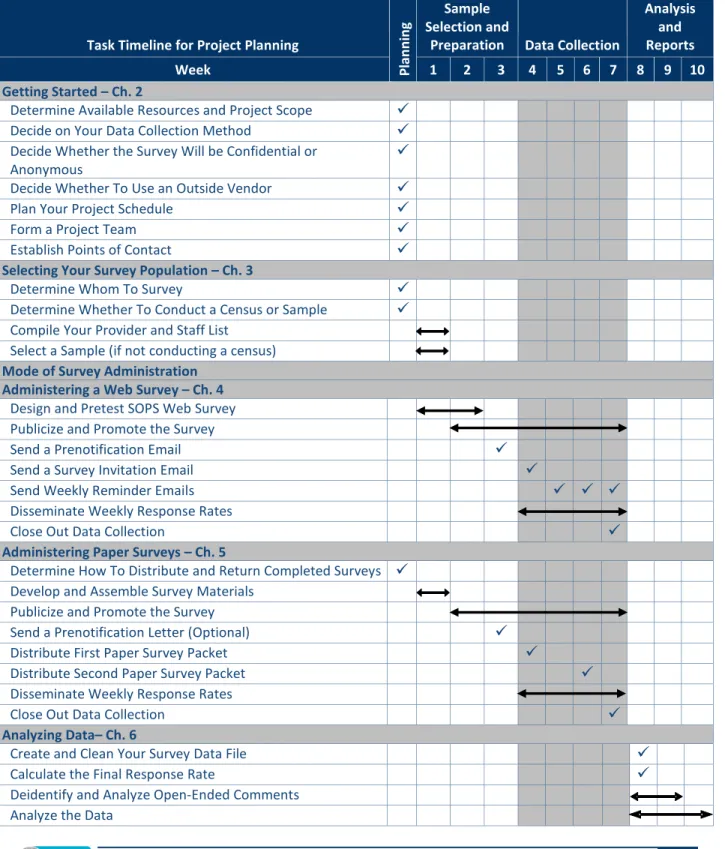
Getting Started 4
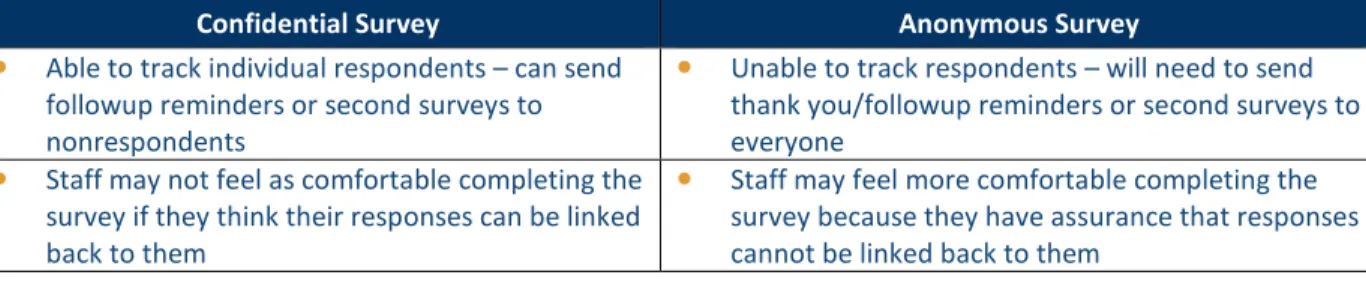
Staff may not feel as comfortable completing a survey if they think their responses can be linked to them. Staff may feel more comfortable completing the survey because they have the assurance that the responses cannot be linked to them. Whether you conduct the research in-house or through an outside vendor, you will need to establish a project team responsible for planning and managing the project.
Prepare publicity materials—Create flyers, posters, and email and intranet messages to announce and promote the survey in the hospital. Email survey invitation and reminders to staff (if conducting a web survey)—Distribute email survey invitations and reminder emails during the data collection period. You will need to identify people in the hospital to serve as points of contact (POCs) for the survey.
We recommend including contact information for the main hospital's POC in all survey materials if respondents have questions about the survey. If you plan to administer the study at multiple hospitals within a health system, establish a POC at the main system level to coordinate data collection across hospitals. When administering the survey at multiple hospitals, you may need to adjust the timeline to complete the tasks for a larger sample.
When you administer the survey in multiple hospitals, you must identify each hospital as a separate site so that each site can receive its own results in addition to overall results across sites. Or you can print a hospital identifier on the survey by giving each hospital a unique form number (eg Form 1, Form 2, Form 3) to identify different hospitals. You can print the identifier on the recording (eg, lower left corner of the back cover).
For web surveys, you can include a hospital ID as part of the survey programming so that the link used to access the survey is unique to each hospital.
Selecting Your Survey Population 10
Exclude staff who only work in outpatient clinics but not in a hospital setting; and. If you inventory all providers and staff, sampling is not necessary; your list is complete. If you decide to conduct a sample, you should choose a group of people that accurately represents the population of your hospital so that you can generalize the results of the sample to the wider population.
The size of your sample depends on who you want to interview and your available resources. Because not everyone will respond, you can expect about 30 to 50 percent of your sample to receive completed surveys. If you select a subgroup or sample of providers and staff from all hospital units/work areas or staff positions, you should use a method such as simple random sampling or systematic sampling.
To begin, sort your provider and staff list by unit/work area and then by staff position. If you have a list of 1,200 names and need to select 600 to be included in the sample, you start at a random point on the list and then select every other name on the list. So if you start with the first person on the list, you pick the 2nd, 4th, 6th, 8th, etc. member of staff, making your sample list a total of 600 names.
You have a population of 1,200 nurses, so according to Table 3, your minimum sample size should be 600 nurses. Using systematic sampling from a random starting point on the list, every other nurse on the list was selected into the sample until 600 names were selected (a total of 1,200 nurses divided by the 600 nurses needed = every second nurse). When you verify the contact information for the initial sample of 1,000 caregivers and staff, you see that 25 staff members no longer work for the hospital and should be removed from the list.
To replace names, randomly select additional staff from the same positions or staff units as the personnel who left.

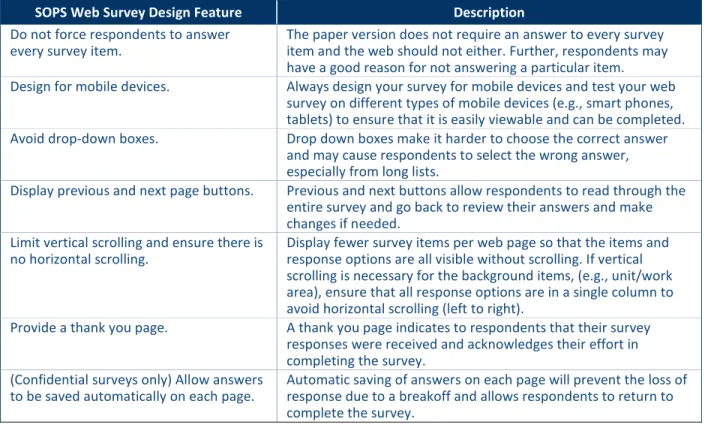
Administering a Web Survey 13
Posting flyers or posters in your hospital, emailing staff and posting survey information on your hospital's intranet;. Information about the survey vendor, if you have chosen to use a vendor, so that the staff knows that the vendor will be collecting data; and. 15 For each POC, describe the purpose of the survey and explain his or her role in the research.
A statement about the purpose and intended use of the survey and the importance of responding;. Assurance that the survey is voluntary and can be completed during work hours, to emphasize that hospital administration supports the data collection effort;. Contact information for the hospital POC (and system-level POC, if applicable) for questions or assistance with accessing the survey.
The survey will take approximately 10 to 15 minutes to complete, and you can complete it during business hours. If your response rate is too low with the second survey reminder email, add another week or two to the survey. Be creative and think about what would motivate your providers and staff to complete the survey.
Allow staff to complete the survey during business hours to emphasize that hospital administration supports data collection. If staff will be returning their surveys by mail, weigh the survey and return envelope to ensure proper postage on the return envelopes. Information about the survey vendor, if you have chosen to use a vendor, so that the staff knows that the vendor will be collecting data; and.
For each contact person at the unit level, describe the purposes of the survey and explain their role in the survey. Contact information for hospital POCs (and system-level POCs, if applicable) for questions or assistance accessing the survey. Be creative and think about what would motivate your providers and staff to complete the survey.
Analyzing the Data 24
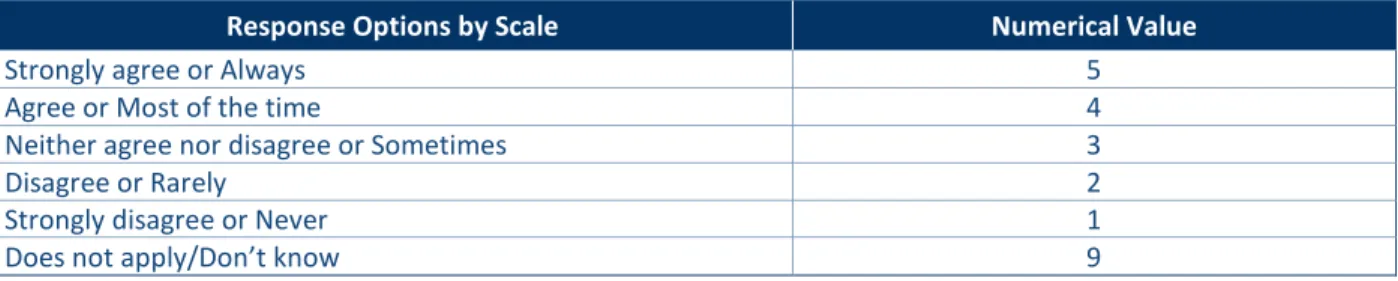
If you use the SOPS Hospital Survey 2.0 Data Entry and Analysis Tool, you can enter paper survey responses directly into the tool, but each hospital's data must be entered into a separate Data Entry and Analysis Tool file to generate separate results for each hospital. If you are conducting a confidential survey, you may enter the survey identification number into the electronic data file and then destroy any information linking the identifiers to individual names. Most items in the survey require a response between 1 and 5 with a 9 coded as Not Applicable/Don't Know.
If you use the SOPS Hospital Survey 2.0 Data Entry and Analysis Tool, you will not have out-of-range values because the tool will not allow invalid responses to be entered. Contains the exact same answer to all the items in the survey (since some survey items are negatively worded, the same exact response to all items indicates that the respondent probably did not pay close attention and the answers are probably not valid) . Respondents are given the opportunity to provide written comments at the end of the survey.
If you administer the survey at more than one hospital, you can create an overall feedback report that includes data from all of your hospitals, but you must also prepare a separate report for each hospital. The more widely the results are disseminated, the more useful the information is likely to become and the more likely respondents will feel that taking the survey was worthwhile. Background characteristics of all respondents—their unit/work area, staffing position, hospital stay, in-unit stay, weekly hours, etc.—to help others understand who responded to the survey.
To protect the confidentiality of individual respondents, do not provide a survey feedback report for a hospital if fewer than ten respondents complete the survey. In addition, each survey item is likely to contain some missing data from respondents who simply did not answer the survey item. Not Applicable/Don't Know and missing responses are excluded when displaying response rates to the survey items.
The survey includes both positively worded items (eg, "In this unit we work together as an effective team") and negatively worded items (eg, "We have patient safety problems in this unit"). AHRQ also established the Hospital Survey on Patient Safety Culture Database, a central repository for survey data from hospitals that administered the survey. Distribute survey packets (cover letter, survey, return envelope) to all staff members on the survey distribution list.