EDUCATION DEPARTMENT
BY
RAHAYU NENGSI SIN. 11714202649
FACULTY OF EDUCATION AND TEACHER TRAINING STATE ISLAMIC UNIVERSITY OF SULTAN SYARIF KASIM RIAU
PEKANBARU 1444 H / 2022 M
EDUCATION DEPARTMENT
BY
RAHAYU NENGSI SIN. 11714202649
A Thesis
Submitted as partial fulfillment of the Requirements For Bachelor Degree of English Education
(S. Pd)
DEPARTMENT OF ENGLISH EDUCATION
FACULTY OF EDUCATION AND TEACHER TRAINING STATE ISLAMIC UNIVERSITY OF SULTAN SYARIF KASIM RIAU
PEKANBARU
1444 H / 2022 M
iii
In the name of Allah, the most Gracious and Merciful, praise belongs to Allah Almighty. By his guidance and blessing, the researcher has accomplished the final research paper entitled “An Analysis of Written Gratitude Expression of Whatsapp Group Students of Sixth Semester At English Education Department”. It is a scientific writing to fulfill one of the academic requirements to finish the bachelor degree (S. Pd) at Department of English Education Faculty of Education and Teacher Training State Islamic University of Sultan Syarif Kasim Riau. Then, shalawat and salam always be presented to the last mesengger of Allah, Prophet Muhammad SAW who has inspired and lightened many people up all around the world.
Appreciation and sincere thanks to my beloved parents, H. Ahmad Sail and Hj.
Samsidar (almh), who has devoted all love and affection as well as moral and material attention. May Allah SWT always bestow grace, health, and hlessings in the world and in the hereafter for the kindness that has given to the researcher. Thank you so much Dad, Mom. Please keep becoming my inspiration.
The researcher would like to show her gratitude to all beloved people that have encouraged. Motivated even helped the researcher in finishing the paper. They are:
1. Prof. Dr. Hairunas, M. Ag., the Rector of State Islamic University of Sultan Syarif Kasim Riau. Prof. Dr. Hj, Helmiati, M. Ag., as Vice Rector I, Dr. H. Mas‟ud Zein, M.
Pd., as Vice Rector II, Prof. Edi Erwan, S. Pt., M. Sc., Ph. D, as Vice Rector III, and all staff. Thanks for the kindness and the encouragement.
2. Dr. H. Kadar, M. Ag., the Dean of Faculty of Education and Teacher Training, State Islamic University of Sultan Syarif Kasim Riau. Dr. H. Zarkasih, M. Ag., as the Vice Dean I, Dr. Zubaidah Amir, MZ, M. Pd., as the Vice Dean II, Dr. Amirah Diniaty, M.
Pd. Kons., as the Vice Dean III, and all the staff. Thanks for the kindness and the encouragement.
3. Dr. Faurina Anastasia, S.S., M. Hum., the Head of Department of English Education, who has given me correction, suggestion, support, advice, and guidance in completing the thesis.
iv
5. Zelly Putriani, M.Pd, the Academic Supervisor for his guidance to the students.
6. Cut Raudhatul Miski, M.Pd, my beloved supervisors who has given me correction, suggestions, support, advice, and guidance in accomplishing this thesis.
7. My belovedn siblings Zubaida, Risna Susanti, Irwan Budiana, Sutrisno, Yuni Rahmadani Safitri, Darmawan SH and beloved younger Brother Roni Saputra as my mood booster in my life time.
8. My beloved all of my family, thank you so much for always giving support.
9. My best friend “Pejuang S. pd ” Thoybatul Aisyah S.Pd, Wiji Astuti S.Pd, Asmarani Saefiya, Melinda Puspita, Pristia, Nindy Indah Pratiwi S.Pd and Felia Winerdha S. Pd, who always give love, affection, care, time, kindness and everything. Thank you for accepting the researcher as she is. Who teach the meaning of a warm friendship in reaching dreams and love. Thank you for the unforgettable memory. Wish you all the best.
10. My best partner around thesis Reza Ramadhani S.Pd, Yeni Efriyanti S.Pd, Azwinatul Hikma S.Pd, Yustika Pratiwi S.Pd thank you who became a place for sharing and discussion about the research
11. My beloved sister in law Khusnul Khatimah S.Pd and Syarifah Nur Wahidah S. Pd. Thank you for being a good second Supervisor after mam Cut Raudhatul Miski, M.Pd.
12. My beloved partner in SD IT Nurul Ilmi. Thank you so much who has given me, suggestions, support, advice, and guidance in accomplishing this thesis.
13. Last but not least, I wanna thank me, because had fought the depression, stress, laziness, crying, overthinking and had finished all the obligation in university
Finally, the researcher realize that this thesis is still far from perfections. Therefore, constructive comments, critiques and suggestions are appreciated very much.
Pekanbaru, May 11th, 2022 The Reseacher
Rahayu Nengsi SIN. 11714202649
v
Rahayu Nengsi (2022): An Analysis of Written Gratitude Expression of Whatsapp Group Students Of English Education Department
This research aimed to found out what kind of gratitude expressions were used by the students at the sixth semester English Education Department. This research focused on the gratitude expression used by the students. This reasearch was qualitative research. Design of the research was descriptive research. The populations of this research were 107 students.
The samples were selected by using purposive sampling technique. The number of informants in this research were ten (10) students.The techniques of data collection used were documentation and interview. The techniques that have been used to analyze data through data collection, data reduction, data display, conclution. The results of this reasearch found thet the students‟ had various gratitude expressions different gratitude situations. The expression of “thank you” was the most frequently used by the students toward gratitude situations. “thank you” included in the first strategy that was explicit and the students also used formal gratitude expression and the students has the politeness gratitude expression to the lecturer.
vi
Rahayu Nengsi (2022): Analisis Ungkapan Terimakasih Mahasiswa pada Group Whatsapp Semester Enam Jurusan Pendidikan Bahasa
Inggris
Penelitian ini bertujuan untuk menemukan apa jenis kata terimakasih yang yang digunakan oleh mahasiswa semester enam di Pendidikan Bahasa Inggris. Penelitian ini fokus pada ekspresi terima kasih yang di gunakan oleh mahasiswa. Penelitian ini menggunakan metode kualitatif. Disen penelitian ini adalah deskriptif. Populasi dalam penelitian ini sebanyak 107 mahasiswa. Sampel dalam penelitian ini menggunakan teknik purposive sampling. Sampel dalam penelitian ini berjumlah sepuluh (10) mahasiswa. Teknik pengumpulan data dalam penelitian ini menggunakan dokumentasi dan interview. Teknik untuk menganalisa data melalui pengumpulan data, pengelompokan data, penyusunan data, kesimpulan. Hasil dari penelitian ini menemukan bahwasanya mahasiswa bervariasi dalam menggunakan kata terima kasih. Kata terima kasih “thank you” adalah expresi yang sering di gunakan oleh mahasiswa.
“thank you” termasuk dalam strategi pertama dalam explicit. Mahasiswa juga menggunakan formal ekspresi terima kasih dan mahasiswa menggunakan kata terima kasih yang sopan kepada dosen.
vii
يسارذلا لصفلل باستاو ةغللا ميلعت مسق نم سداسلا
ةيزيلجنلإا
زٍبؼتيى اهٍاذختصا ِنٌَ ًتىا تاَينىا ٍِ ذٌذؼىا كاْه ،ةٌزٍيجّلإا ةغيىا ًف
،ِتٍَ اّأ ،اًزنش ، ًلًٌزج اًزنش ،لى اًزنش وثٍ ،زنشىا ِػ يزنش وٌزج لى
ًّاْتٍاو ،
لٍْ فطى اذه ًف ُىفيتخٌ ٌيؼتىاو ٌٍيؼتىا ذْػ ذٍٍلًتىا .اذج وَهٍ اّأ ،
ىا عاىّأ ةفزؼٍ ثحبىا اذه ٍِ ضزغىا .ًىاحىا فقىَيى اقفو زنشىا ِػ زٍبؼت ثحبىا اذه ًذختصا .ٌيؼتىاو ٌٍيؼتىا ةٍيَػ ًف ذٍٍلًتىا اهٍذختصا ًتىا زنشىا تاَيم
شطضغأ ٍِ هتاّاٍب ءازجإ ٌت .ًػىْىا ًفصىىا وخذَىا 0202
ىٌاٍ ىىإ 0200
ًف
ُاطيضىا ةؼٍاجب ةٌزٍيجّلإا ةغيىا ٌٍيؼت ٌضق ةٍٍىنحىا ةٍٍلًصلإا ٌصاق فٌزشىا
ةٌزٍيجّلإا ةغيىا ٌٍيؼت ٌضق ًف سداضىا ًصارذىا وصفىا بلًط هٍف غَتجَىا .واٌر ٍِ ُىّىنتٌ ٌِذىا واٌر ةٍٍىنحىا ةٍٍلًصلإا ٌصاق فٌزشىا ُاطيضىا ةؼٍاجب 4
ًىاَجإب هىصف 221
ةٍْؼىاو ،ابلًط 22
ةٍْؼىا ذخأ هلًخ ٍِ ٌهذخأ ٌت ابلًط
ىا ةٍئاىشؼىا قٍثىتىا اَهو ٍِتقٌزط ثحبىا ًذختصا ،تاّاٍبىا غَج ًف .ةطٍضب
ًف زنشىا تاَيم ًاذختصا ًف ُىفيتخٌ ذٍٍلًتىا ُأ ًه ثحبىا اذه جئاتّ .ةيباقَىاو
اهّلأ ُاٍحلأا ٍِ زٍثم ًف لى اًزنش ةَيم ٌهَظؼٍ ًذختضٌ .ٌيؼتىاو ٌٍيؼتىا ةٍيَػ
.ًاذختصلاا ًف وهصأ
viii
SUPERVISOR APPROVAL ... i
EXAMINER APPROVAL ... ii
ACKNOWLEDGEMENT ... iii
ABSTRACT ... v
ABSTRAK………. vi
صخلم
………... viiLIST OF CONTENTS ... viii
LIST OF TABLES ... xii
LIST OF CHARTS ... xviii
LIST OF APPENDICES ... xix
CHAPTER I INTRODUCTION A. Background of the Problem ... 1
B. Problem of the Research ... 4
1. Identification of problem ... 4
2. Limitation of the problem ... 4
3. Formulation of the problem ... 5
C. Objective and Significant of the Research ... 5
1. Objective ... 5
2. Significant of the research ... 5
D. Definition of Key Terms ... 6
ix
3. Whatsapp Group ... 6
CHAPTER II REVIEW OF RELATED LITERATURE A. Theoretical Framework ... 7
1. The Nature of English Expression ... 7
2. Concept of Expression ... 8
3. Expression of Thanking ... 12
4. Whatsapp Group ... 15
5. Teaching Learning Process ... 17
a. Preliminary ... 17
b. Core... 18
c. Closing ... 19
B. Politeness Expression in Teaching Learning Process ... 22
C. Relevan Research ... 25
D. Conceptual Framwork ... 27
CHAPTER III METHOD OF THE RESEARCH A. Research Design ... 28
B. Location and the Time of Research ... 29
C. Subject and Object of Research ... 29
D. Population and Sample of Research ... 29
1. Participants ... 29
2. Sample ... 30
x
2. Interview ... 32
F. Technique of Data Analysis ... 33
CHAPTER IV FINDINGS AND DISCUSSION A. Findings ... 35
1. Whatsapp Chat Group Documentation ... 35
2. Interview ... 38
B. Discussion ... 57
CHAPTER V CONCLUSION AND SUGGESTION A. Conclusion ... 60
B. Suggestion ... 60 REFERENCES
APPENDICES
CURRICULUM VITAE
xi
Table III.1 The Participants of the Research ... 29 Table III.2 The Sample of the Research ... 30 Table III.3 The the Blue Print ... 32
xii Appendix 1 The Instrument of Interview Appendix2 The Trascript interview Appendix 3 The documantation Appendix4 Recorder students voice Appendix 5 Supervisor Letter
Appendix6 Recommendation Letters
1 CHAPTER I INTRODUCTION A. Background of the Research
Examining the way in which we communicate has always been important. Whether it‟s verbal or nonverbal communication, conveying a message to other individuals is necessary for human understanding and interaction. It not only helps us understand what they are saying, but it also helps us to express our feelings, emotions, and needs. (Muhamad Sham Shahkat Ali dan Ammaarah Kootbodien, 2017). Therefore, examining communication is very important in our life, becouse from god communication we can show our feeling, emotions, and needs to other people.
According to Hornby (1995 ) gratitude is the feeling of being grateful or the desire to express thankful feeling. (Hornby, Oxford Dictionary for Advanced Learner, 2004) Eisenstein and Bodman (1993) asserted that when this function is expressed appropriately, it can create feelings of warmth and solidarity among interactions, maintaining and enhancing social cohesion and social bonding in the society. (M. Eisenstein and J. Bodmon, 1993) Gratitude have many benefits for individuals, including better physical and psychological health, increased happiness and life satisfaction, decreased materialism, and more. gratitude inspires people to be more generous, kind, and helpful (or “prosocial”); strengthens relationships, including romantic relationships; and may improve the climate in workplaces.
However, in communication we needed gratitude exression in our
communication, becouse gratitude make physical and psychological health and generous in our self.
Most of the expressions of gratitude in English involve the word thank, thank you so much, thank you, thank you very much, thanks, thanks a lot (Dalilan, 2012) . But the roles for where and when thank you and other expressions of gratitude or appreciation can be used vary across cultures. When one compares English with other languages, and Indonesian is no exception, there are differences concerning whom one says thank you to, when, and the settings in which an expression of gratitude was expected or not.
As stated before, every culture has its own way in conveying gratitude. The custom of Indonesians expressing their gratitude may not be as obvious as that of American.
From the most word of gratitude expression in English there are several purposes of expression gratitude. As pointed out by Siregar (2011), the expressi on thank serves the following purposes. (1) To express the feeling of generosity at an act accepted by a speaker. (2) As a courtesy to maintain a relationship. (3) To praise. (4) To end a conversation. (5) To reject a gift or a present given by someone in apolite.
Thas, the actuality of this research is determined by the need to explore the gratitude expression in EFL learnes. Actuality of the research work is also determined by the active development of communication in EFL learners.
Haverkate (1984) cited in Aijmer (1996) divided gratitude expressions into two major categories, namely explicit and implicit strategies, in which each of them consists of more detailed thanking strategies. (Aijmer, 1996) Explicit means a thanking strategy that is fully and clearly expressed or leaving nothing implied. People express their gratitude openly, clearly and exactly. Implicit is something that is implied and not expressed directly.
In this era communication not only face to face but also in social media. Social media is one of the products of technological development that cannot be separated from people‟s lives, Such as whatsapp. Base on steela (2014) stated that, whatsapp is a social media applicationwhich involves direct messaging as well as sharing media include voice messages, videos, and photos. ( sham and kootbodien, 2017) From previous research on the use social media and the youth‟s experience of gratitude found, there are many gratitude use by youth‟s in different situation and that show the attitude from the youth‟s. The next research about the peculiarities of gratitude expression use in the foreighn language (on the example of English) found, male and female people differ in expression gratitude. That is female learners felt the necessity to thanks and appreciate interlocutors more than males did. Becouse of that, English Education Department there is no research about gratitude expression.
So, there is no research on gratitude. That's why I am interested to researching gratitude expression in English Education department.
However based on observation in a preliminary research from students the sixth semester, found students differ in using exressions of gratitude
depending on the situation they faced. For example when students say gratitude expression to the lecturer, they usually use thank you and thank you very much.
And when they say gratitude expression to their friends, they mostly just say thanks.
Based on the explanation before, the researcher was interested in conducting the research entitled: “An Analysis of Written Gratitude Expression of Whatsapp Group Students of sixth Semester at English Education Department”
B. Problem of the Research
1. Identification of the Problem
a. Why do the students more using thank you, thank you very much in gratitude expression?
b. What make the students differences in using gratitude expression?
c. Are there students who use non-emotional explicit to the lecture?
2. Limitation of the Research
By the considering time, facilities, and finding needed, it is a necessary to limit a problem. The research will be conducted at English Education Department UIN SUSKA RIAU, The focus on the research is finding out kind of gratitude expression in teaching learning process. The students become the participants of this research are sixth semester in English Education Department.
3. Formulation of this Research
a. What kinds of gratitude expressions used by the students in teaching learning process?
b. Which kind politeness of gratitude expression used by the students in teaching learning process?
C. Objective and Significant of the Research 1. Objective
a. To find out what kinds of gratitude expressions were used by the students in teaching learning process.
b. To find out the politeness of gratitude expression used by the students in teaching learning process.
2. Significance of The Research
The researcher hoped this research has some significance, especially for English students.
a. For the students of English Education Department, it is hope this research can help the student to research more about English gratitude Expression.
b. For the researchers, this research give some information about the gratitude expression commited by students in their written. The most important things, the researcher wanted to give some information about the most common gratitude expression commited by the students to the next researchers.
c. For the readers, this study will give some knowledge and understanding on how to product and understand the gratitude exptession.
d. For the other researchers who conduct research studies on the relevant topic, this research study can be a source.
D. Definitions of Key Terms 1. Analysis
Analysis is a research about something by examining its part. It is the detailed research or examination of sentence in order to understand more about it. (Hornby, Oxford Dictionary for Advanced Learner, 2004) In this research, analysis means that analyze about what the problems of English expression in term of appreciation, positive feeling, repayment, apology, imposition, other.
2. Gratitude Expression
Expressing gratitude is a feeling or response based on a past act performed by the hearers. “Thank you” is the most common phrase to express gratitude. (Quirk, 1993) In this research the expression of gratitude is the main research focus to be analyzed by the reesearcher.
3. Whatsapp Group
Base on steela (2014) stated that, whatsapp is a social media application which involves direct messaging as well as sharing media include voice messages, videos, and photos. ( sham and kootbodien, 2017).
In this research the whatsapp is very important for students communication in this era.
7 CHAPTER II
REVIEW OF RELATED LITERATURE A. Theoritical Framwork
1. The Nature of English Expression
According to Quirk (1993) and Searle (1969) they said, Expressing gratitude is a feeling or response based on a past act performed by the hearers. In general, “thank you” is the most common phrase to express gratitude. However, not all gratitude is expressed with saying “thank you” or “thank you so much.” According to Nofsinger, gratitude is a speech act, specifically classified under expressive, which are “expressions of the speaker‟s psychological state about something (an event, an object, a behavior, or whatever)”. (Nofsinger, 1999)
Based on Yule (1996) and Peccei (1999) state that, Thanking or expressing gratitude is one of the acts under the category of expressive speech act. Expressive speech act primarily focuses on representing the speaker‟ feelings. In other words, speakers use expressive speech act to express their feelings by making their words fit their internal psychological world. (Dalilan, 2012)
However, the expression of gratitude is an expression that shows or expresses the speaker's feelings for a past act performed, so that someone says a gratitude expression to represent his feelings and from the psychological state about something (an event, an object, a behavior, or
whatever) . words that are often used to express such as thanks and thank you so much.
2. Concept of Expression
Haverkate (1984, cited in Aijmer, 1996) divided gratitude expressions into two major categories, namely explicit and implicit strategies, in which each of them consists of more detailed thanking strategies. A more systematic classification of thanking strategies is illustrated as follows:
Figure II.1 Gratitude Expression Gratitude Expression
Explicit Implicit
Emotional Non-Emotional Emotional Non-Emotional
A B C D E F G H Notes:
A. Thanking somebody explicitly B. Expressing gratitude
C. Acknowledging a debt of gratitude D. Expressing appreciation of the addressee
E. Expressing appreciation of the act F. Stressing one‟s gratitude G. Expressing emotion
H. Commenting on one‟s own role by suppressing one‟s own importance (self-denigration)
The following section will elaborate the abovementioned strategies:
1) Explicit
Explicit means a thanking strategy that is fully and clearly expressed or leaving nothing implied. People express their gratitude openly, clearly and exactly. Explicit consists of two sub-categories, emotional and non-emotional.
a) Emotional
There are two strategies included in explicit – emotional.
i. The first strategy is thanking somebody explicitly. It is one of the most direct strategies as it is expressed through certain words directly in informal setting in incomplete sentence. This gratitude expression is a simple thanking commonly used by people. Some phrases to illustrate this following strategy are
“thank you” and “thanks”.
ii. The second strategy is expressing gratitude. It is also another direct strategy, but it is more formal than the first strategy.
This strategy is considered more polite because it is used in a complete sentence. Thanking strategy is expressed through
certain words or ideas to represent thankfulness. This expression consists of thanking and stating favor. Some phrase to illustrate this following strategy is “I‟m grateful for your invitation”.
b) Non – Emotional
There is only one strategy in this sub-category.
i. The strategy in non-emotional explicit sub-category is acknowledging a debt of gratitude. Here, the recipient realizes the existence of a debt and feels that he or she has to thank someone. It is sometimes found in writing and some situations such as thanking one‟s teacher or family in the preface of academic works. Some phrase to illustrate this following strategy is “I owe a debt of gratitude to…”
2) Implicit
Implicit is something that is implied and not expressed directly. In implicit, there are two sub-categories, emotional and non-emotional.
Those two sub-categories are also divided into several strategies. . a) Emotional
In this category, there are four strategies of thanking.
i. First of all, the strategy included here is expressing appreciation of the addressee. It does not express gratitude directly; however, it refers to the felicity conditions or
rules for thanking. The person who has received a favor feels grateful and expresses his appreciation of the benefactor. The examples of this strategy are "that‟s kind of you” and “that‟s nice (of you)”.
ii. The next strategy is expressing appreciation of the act. It is also an indirect strategy and refers to the rules for thanking. The person who has received a favor feels grateful and expresses his appreciation of the act itself.
Here are some of the examples of this strategy, “that‟s lovely”, “it‟s appreciated”, and “good job”.
iii. The third strategy is stressing one‟s gratitude. It involves the performative verb (I/hereby/thank you for…) and it can be reinforced by stressing the speaker‟s wish or obligation to express his gratitude. The phrases often used in this strategy are “thank you very much” or” I must thank you”.
iv. The last strategy is expressing emotion. It is literally an expression of surprise and is associated with a high degree of emotion. This strategy is usually related to facial expression. The illustration of this strategy is “oh… (thank you), wow… (thank you”). However, in this study, the researchers excluded this strategy because this study only deals with the linguistic data.
b) Non – Emotional
There is only one strategy in this sub-category.
i. The last strategy is self-denigration which means commenting on one‟s own role by suppressing one‟s own importance (self – denigration). In addition, it is only found in writing and always with other strategy. Some phrases to illustrate this following strategy is “I‟m so careless, I am an ingrate”
3. Expression of Thanking
The notion of speech acts, according to Searle (1969), is the basic unit of language used to express meaning or an utterance that expresses intention. Speech acts are the actions we do through speaking, and they may cause a change in the existing state of affairs or cause an effect on the interlocutor. (cheng, 2005)
According to Austin said, proposed that communicating a speech act consits of three elements: the speak says something, the speaker signals an associated speech act, and the speech act causes an effect on her listeners or the participants. The first element he called the locutionary act, by which he meant the act of saying something that makes sanse in a language, that is, follows the roles of pronunciation and grammer. The second, the action intended by the speaker, he termed the illocutionery act.
The third element, called the perlocutionary act, is concerned with what
follows an utterence: the effect or “take up” of an illocutionary act. (Saeed, 2016). For speech act we have some of elements for success s to communication with other people and also J. R. Searla stated there are five types of speech act:
a) Representatives (or assertives), which commit the speaker to the truth of the expressed proposition (paradigm cases: claiming, concluding);
b) Directives, which are attempts by the speaker to get the addressee to do something (paradigm cases: requesting, questioning);
c) Commissives, which commit the speaker to do some future action (paradigm cases: promising, offering, threatening);
d) Expressives, which express a psychological state (paradigm cases:
thanking, apologizing, welcoming, congratulating); and
e) Declarations, which ime of affairs and which tend to rely on elaborate extralinguistic insitutions (paradigm cases: excommunicating, declaring war, christening, marrying a person, firing frm employment).
Based on Searle‟s classifications of speech acts, the researcher exploits one of several types of speech act, namely expressive, in which this type expresses the psychological state of thanking, apologizing, complimenting.
Psychologically, there are components that may be conveyed when expressing gratitude. Fitzgerald (1998) identified three important components of gratitude conveyed that include not only a warm sense of appreciation for something or somebody but also a sense of goodwill
toward that thing or that person and a resultant disposition to act positively because of appreciation and goodwill. (Fitzgerald, 1998)
When saying thanks, the speaker expresses gratitude for the hearer‟s involvement in a prior action that was beneficial to the speaker.
Thanking as a routinized speech act is chosen because it seems that thanks is one of the most important expressions involving multiple aspects that are easily found in daily routine conversation in society.
Since the expression of thanks is socially valuable, Leech (1983) discusses thanking from a social perspective that defines thanking as a friendly function, and its goal of stating appreciation is to establish and maintain a polite and friendly social atmosphere. (Leech, 1983) Further, Leech describes thanking as an expressive act because it makes known the speaker‟s psychological attitude.
Eisenstein and Bodman (1986) have described thanking as an illocutionary act under Searle‟s classification of speech acts. (J. Bodman and M. Eisenstein, 1988) Their research indicated that an expression of gratitude is an illocutionary act performed by a speaker based on a past act performed by the hearer. This past act benefits the speaker, and the speaker believes it to have benefited him or her. The speaker feels grateful or appreciative, and makes a statement that counts as an expression of gratitude. (Eisentein, M and Bodman, J, 1993)
However, not all expressions using the word thank you refer to gratitude (Eisenstein and Bodman, 1993). Rubin‟s (1983) ethnographic
research on the use of the words thank you found that thank you can also refer to other language functions such as compliments and closings in a conversations (i.e., That‟s all, thank you), or rejecting an offer (i.e., No, thank you or [Thanks,] I‟m fine).
4. Whatsapp Group
The nature of social media. with the meaning, the situation that can be built by social media is different from traditional media, where media- based digital technology has given full flexibility to its users to process information and communication. It is, therefore, not surprising that all aspirations, expressions, and reactions poured without going through the screening process and information confirmation open up the potential to create social clashes. These factors ultimately also become a big hole that became the source of several problems, one of which is the users of social media does not have the concern or even feel can hurt others through the posts and comments made in social media. This is because in the internet, especially social media is very easy to falsify identity or even to commit a crime (Cahyono, 2016).
The Second is about the lack of awareness, maturity and ethics of social media users. Social media topologies are not like traditional media that have applicable journalistic ethics and professional norms embraced in creating and conveying information, therefore it is very natural that social media users come from different segments of society, with diverse backgrounds of age, profession, status social and educational levels do not
understand the importance of ethics, awareness and maturity in the use of social media. The above situation is exacerbated by the abundance of
„hoax‟ information by credible online media that exploits the political situation in society to gain personal or group benefits by making people polarized. While maturity in sorting out, filtering and managing the information received is one important aspect so that people do not easily accuse, justify, and diversify a person solely for the information they are accused of, so they can easily spread hate speech through social media.
Social media is one of the products of technological development that cannot be separated from people‟s lives, Such as whatsapp. Base on steela (2014) stated that, whatsapp is a social media application which involves direct messaging as well as sharing media include voice messages, videos, and photos. (Sham and Kootbodien, 2017) However, whatsapp is very important in our communication. Because by using whatsapp we can communicate remotely and get wider information and than we can sharing our messages, video, and photos quickly by using whatsapp.
Based mainly on features, usability, functions, and convenience, instant messaging (IM) sites have become increasingly popular, but they could also encompass issues regarding social intimacy and negative feelings. Instant messaging services such as WhatsApp allow for easy communication with people over long distances. The method has become quick, easy, and inexpensive. It was
found in a Study by Lin Si that instant messaging actually increased the amount of social intimacy as well as the desire to want to communicate face to face. It is further indicated that the more you IM someone, the closer the person is to you.
However, whatsapp made us more easy to communicate to other people and also quick, and inexpensive. In the students era, most of them using whatsapp for study becouse of covid19, the students study using online application as whatsapp.
5. Teacing Learning Process
To achieve a basic competence in learning activities must be included steps of activities in each meeting. Basically, the activity steps contain elements of activity : (Iskandar, 2011)
a. Preliminary
Introduction is the initial activity in a learning meeting aimed at generating motivation and focusing the attention of students to actively participate in the learning process.
b. Core
The core activity is a learning process to achieve KD. Learning activities are carried out interactively, inspiring, fun, challenging, motivating students to actively participate, as well as providing sufficient space for initiative, creativity, and independence in accordance with the talents, interests, and physical and psychological development of students. This activity is carried out systematically
and systemically through the process of exploration, elaboration, and confirmation. In the learning process to achieve this competence the teacher does.
1) Exploration
In teacher exploration activities:
a) Provide a stimulus in the form of giving material by the teacher b) Discuss material with students
c) Provide opportunities for students to communicate orally or present how to solve a problem.
d) Involve students in discussing examples in the Book 2) Elaboration
In teacher elaboration activities:
a) Familiarize students to read and make data in the form of tables or diagrams.
b) Facilitate students through the provision of tasks to do exercises on the questions contained in textbooks
3) Confirm
In the teacher confirmation activity:
a) Provide feedback to students by giving reinforcement in verbal form to students who have been able to complete their assignments.
b) Provide confirmation on the results of work done by students through other book sources.
c) Facilitate students to reflect to get the learning experience that has been done
d) Provide c. Closing
Closing is an activity carried out to end learning activities that can be done in the form of a summary or conclusion, assessment and reflection, feedback, and follow-up.The quality of teaching learning process in Junior High School should be effective in order to gain the learning objective. There are some components which affect the quality of English teaching and learning process. They are listed as follows.
1) The Goals of the Learning
There are two goals can be achieved by the students, those are long- and short-term goals. According to Brown (2001, p. 53), longterm goals may include the mastery of English, the passing of an exam (at the end of the year), the possibility of a better job in the future, etc.
The teacher can encourage the students to learn English and active in the reading class to achieve the long-term goals by emphasizing those long-terms goals is more important for them to be achieved by them.
To motivate them in learning English, the teacher also can use the shortterms goal by giving them some points to them. If they can involve in teaching and learning English, they are active in the reading
class, and they can get high score in the reading class, the teacher can give the class rank and some rewards for them.
2) Teacher
Teacher plays a very important role in bringing the class to get a good quality of learning. Teacher has some roles in the classroom activities.
Harmer (2001) proposes the roles of a teacher during the teaching and learning process. The following presents a discussion about the roles of a teacher.
a) Controller: when teachers act as controllers, they are in charge of the class and of the activity-taking place and are often leading from the front.
b) Prompter: in this stage, the teacher often gives a prompt or takes charge in order to encourage the students to be active during the lesson.
c) Participant: teacher sometimes wants to join the activity done in the teaching and learning process. In this stage, the teachers are expected to take part during the classroom activities.
d) Resource: in this stage, the teacher can be one of the most important resources in the teaching and learning process.
She/he can provides all information needed by students.
e) Tutor: acting as tutor, the teacher can combine both prompter and resource role during the teaching and learning process.The role of the teacher during the teaching and learning
process is dependent, based on what the students need to achieve. The teacher needs to be able to switch between those various roles. The teacher should know the role based on the needs of the teaching and learning process. It can be concluded that teacher as one of essential components to the quality of teaching and learning process should consider many aspects in order to be an ideal teacher for the learners. The teacher should know well how to control the class. A good teacher also needs to have a good classroom management.
3) Student
Another essential component in the teaching and learning is students or learners. Students or learners are all very different. They differ in obvious ways such as age, gender, nationality, language level and personality. The student‟s attitudes in the classroom are affected by their motivation, needs, educational and cultural background, and learning styles and personalities (Branch, 2005, p. 3).In English teaching and learning process, the students should be given an equal opportunity in using English during the classroom activities.
In other words, the students have to actively involved in every stages of teaching and learning, so that the teaching and learning activities run well. However, student‟s active involvement does not go far from active learning. Bonwell and Shapes (2003) define active
learning as that which involve students in doing things and thinking about the things they are doing. They list the following general characteristics of strategies that utilize active learning in the classroom.
a) Students are involved in more than listening
b) Less emphasis is placed on transmitting information and more on developing students skill
c) Students are involved in higher-order thinking (analysis, synthesis, evaluation)
d) Students are engaged in activities (e.g. discussing, writing, reading) Related to the quality of teaching and learning,
B. Politeness Expression in Teaching Learning Process
Politeness in pragmatics is something rather different from an everyday understanding of it and focusing almost uniquely on polite language in the study of verbal language (Watt, 2003). Generally, being polite involves taking into account the feelings of others. Besides, being polite also means employing awareness of others feeling. Being linguistically polite involves speaking to people appropriately in the right place and at the right time. People must be aware of the context of speaking because politeness in a certain area is different from others.
However, to analyze them, it is the researcher was analysis about politness in teaching learning process which the students used gratitude expression to the lecturer becouse so many gratitude expression the students use in the teaching learning process.
Gratitude expression are can used in the formal and informal situations. The expression of gratitude used in the formal situation such as;
thank you, thank you very much, thank you for your help, thank you for your tips, etc. While the expression of gratitude used in formal situations, such as;
much obligated, I can‟t thank you enough, I can‟t find words how to thank you.
(Hariyono, 2006). The formal situation is usually used by student with teacher, employee with boss, student with advisor, younger with older and patient with doctor. While the informal situation is used by student with student, friend with friend, husband with wife, etc. (Hariyono, 2006).
Based on Straker‟s (1980) statement, educational environment is one of the situations for people to highly concern about their language. The positions when people are generally conscious about choosing the right words, structuring a good sentence, and pronouncing well are defined as formal speech or language (Richard et al, 1997). The situation that calls for formal English includes business letters or e-mails, letters or e- mails to government officials, office memos or e-mails reports, homework, communications to teachers, important conversations, speeches, presentations, and oral reports (Woods, 2017).
Woods (2017) divide English into three levels; friends-talk, conversational English, and formal English. Friends-talk and conversational English include in informal English. "In friend-speak, the speakers are on the same level. They have nothing to prove to each other and they are comfortable with each other mistakes" (Woods, 2017).
On the other hand, conversational English does not stray too far from English rules, but it does break the rules. Friend-speak deals with the friendship domain where the use of slang language is frequently. Conversational English deals with situations such as chatting with family members, friendly conversation with supervisors, e-mail and text to friends, and informal conversation with the teachers (Woods, 2017).
C. Relevant Research
According to Syafi‟i (2013) “relevant research is required to observe some previous researches conducted by other researchers in which they are relevant to our research”. In this research, there are several researches relevant to the research:
First, research jurnal from Anca Cehan (2002) entitle : An Analysis of the Thanking Strategies Taught in The English Classrooms In Romania. Based on the date obsevation, His research finding was of the eight thanking strategies mentioned in Ajmeer, only five are presented in the English textbooks visited: A, B, C, D, and G. The missing strategies, E, F and H are characteristic of written English and formal style, and as such, their absence is not surprising. However, the reduced number of tokens of gratitude expressions in the textbooks is a great surprise.
Second, research jurnal from Dalilan (2012) entitle : Strategies in Expressing Thanking in English Realized by Indonesian Learners. This study revealed that the gratitude strategies employed by the participants of this study ranged from simple, brief thankings to lenghty, complex thankings.
All participants produced mixed speect act sets of thanking in the following conditions: a) social status (between a vice-president and a newly hired personnel, b) indebtedness (because of money loan and meal treat), and c) breaking promise. All of the participants realized mixed speect act sets of thanking when the contexts are concerned with the following conditions: a) social status (between a vicepresident and a newly hired personnel, b) indebtedness (because of money loan and meal treat), and c) breaking promise. In term s of situations in which they illustrate informal contexts such as between friends and the setting of public area, the participants tended to use simple or brief thanking.
Thrid, research jurnal from Saltanat Meiramova, Assem Kulzhanova (2015) entitle : The Peculiarities of Gratitude Expression Use in the Foreign Language (on the Example of English). Base on the data observation In his reserach journal attempts to investigate the linguistic and semantic characteristics of gratitude expressions‟ use in the English language by Kazakhstani EFL students of higher school. The practical analysis of gratitude expressions‟ use in oral speech has been done. Sixty people were selected from among students of Gumilyov Eurasian National University to collect data through a Discourse Completion Task (DCT). The results of the research showed that the most frequently used gratitude expressions by Kazakhstani EFL students are expressions of happiness, thankfulness and best wishes in oral speech informal style.
Base on the research jurnal above, there are three relevan researches.
There are some aspects that similar and difference with this research. The similarity can be seen at from the variable in this research. All of the related research above that carried out by them investigated about the Expression of gratitude. Moreover, the problem that as the background of researcher in conducting this research also different. Additional, places and participants in conducting this research also do not similar.
D. Conceptual Framework
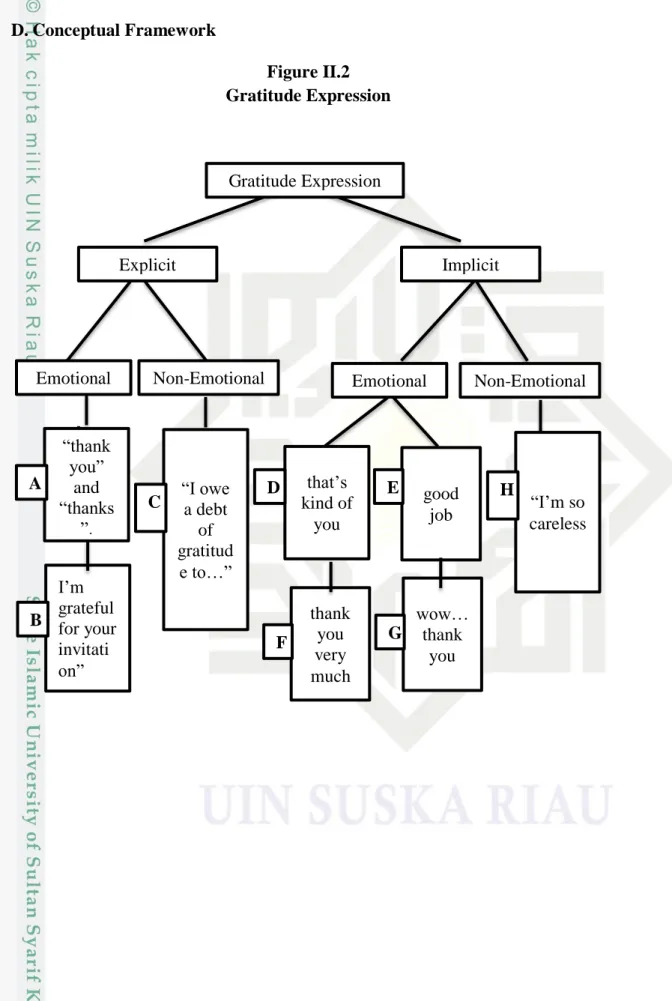
Figure II.2 Gratitude Expression
C D E
Explicit Implicit
Emotional Non-Emotional Emotional Non-Emotional
“thank you”
and
“thanks
”.
A
I‟m grateful for your invitati on”
B
“I owe a debt
of gratitud
e to…”
C “I‟m so
careless that‟s H
kind of you
D good
job E
thank you very much F
wow…
thank you G
Gratitude Expression
28 CHAPTER III
METHOD OF THE RESEARCH A. Research Design
The design of the research is descriptive qualitative research. According to Creswell, (2012) qualitative research is type of education research in which the research consists of collecting data using form with general, emerging question, gathering word or image data, and collecting data from small number of individual or sites.
The researcher used qualitative method since the method of structural analysis of this research was conducted by using a descriptive design.
According to Ary (2010) descriptive research studies are designed to obtain information concerning the current status of phenomena. Suryabrata (2010), also states that descriptive research is research which has objectives to describe method in certain situation systematically, accurately, and factually. So, this research determines the nature of a situation as it exists at the time of the research. In this case, the researcher described the situation as mention in statement of research.
Descriptive research was not only limited in collecting and explaining data but also analyzing the data. According to Gay (2006) a descriptive research determines and reports the way things are. One common type of descriptive research involves assessing attitudes or opinion toward individual, organizations, events, or procedures.
On the other hand, Bungin (2001) said that descriptive research purpose to describe some events, condition, or phenomena in society become the object of research”. Based on the variable of the research, it is classified as a descriptive research because it only deals with one variable. It is designed to be described and analysed, so the researcher described and analysed the expression of gratitude of the sixth semester students of English Education Department UIN SUSKA RIAU.
B. Time and Location of the Research
During the Covid 19 pandemic, teaching and learning activities on campus have not carried out face to face. This research were conducted from February to April 2022. Research activities was held at English Education Departmen of State Islamic University of Syarif Kasyim Riau, which is located on JL.
HR.Soebrantas No.155 Simpang Baru, Panam, Pekanbaru.
C. Subject and Object of the Research
1. The subject of this research was the sixth semester students English Education Department of UIN SUSKA RIAU.
2. The object of this research focused on the use of gratitude expression in teaching learning process.
D. Participants and Sample 1. Participants
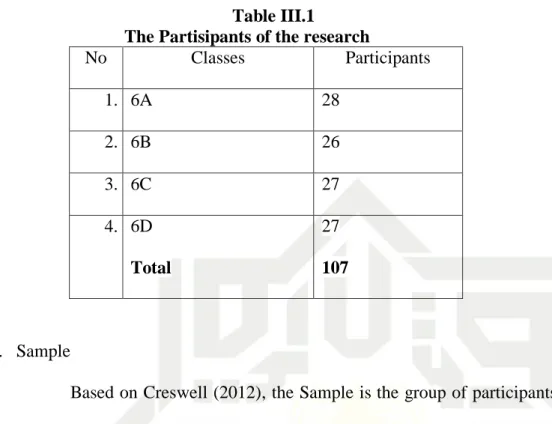
The Participants on this research was the students of sixth semester English Education Deparment State Islamic University of Syarif Kasyim Riau. The number of participants are 107 students in which:
Table III.1
The Partisipants of the research
No Classes Participants
1. 6A 28
2. 6B 26
3. 6C 27
4. 6D Total
27 107
2. Sample
Based on Creswell (2012), the Sample is the group of participants in a study selected from the target population from which the researcher generalizes to the target population. The researcher considered that in this research paper, the population was too large, The population was more than 100 persons. The researcher in determining sample used purposive sampling. According to Sugiono (2008), purposive sampling is a sampling technique by determining certain criteria. ( Mukhsin and Mappigau and Tenriawaru, 2017). Bernard (2002) in Erikan (2015) stated that the purposive sampling techniques also called judment sampling, is the deliberate choice of a pasticipant due to the qualities of the participant possesses. It is non random technique that does not need underlying theorist or a set number of participants. Simply put, the resaercher decides what needs to be known and sets out to find people who can and are willing to provide the information.
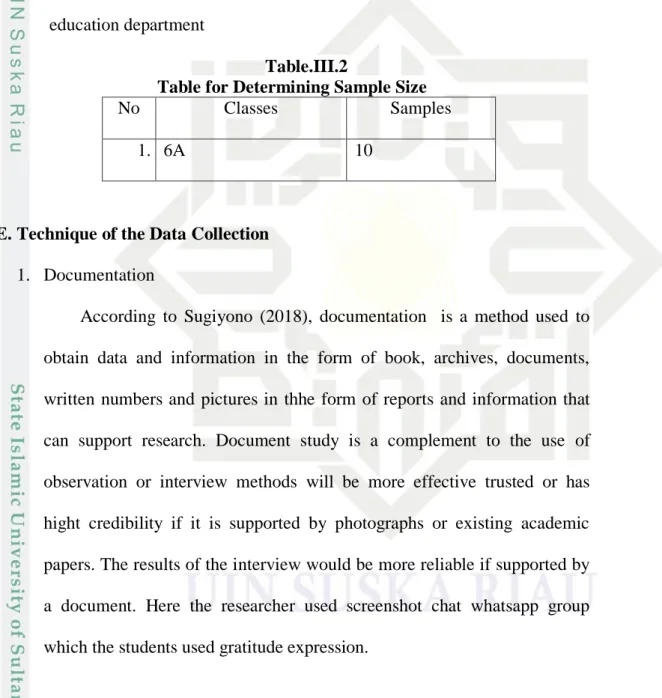
With purposive sampling, the researcher chose the sample those that representative and present of population. They are four classes of sixth semester. The reseracher chose 10 students purposively as the participants of the study were taken based on active in the class and in the group class from preliminary research in the sixth semester students of English education department
Table.III.2
Table for Determining Sample Size
No Classes Samples
1. 6A 10
E. Technique of the Data Collection 1. Documentation
According to Sugiyono (2018), documentation is a method used to obtain data and information in the form of book, archives, documents, written numbers and pictures in thhe form of reports and information that can support research. Document study is a complement to the use of observation or interview methods will be more effective trusted or has hight credibility if it is supported by photographs or existing academic papers. The results of the interview would be more reliable if supported by a document. Here the researcher used screenshot chat whatsapp group which the students used gratitude expression.
2. Interview
In this research, the researcher used interview of technique in collecting the data. The interview technique was asking the participant‟s about gratitude expression. The researcher asked open-ended questions and recird their answers (Creswell, 2012).
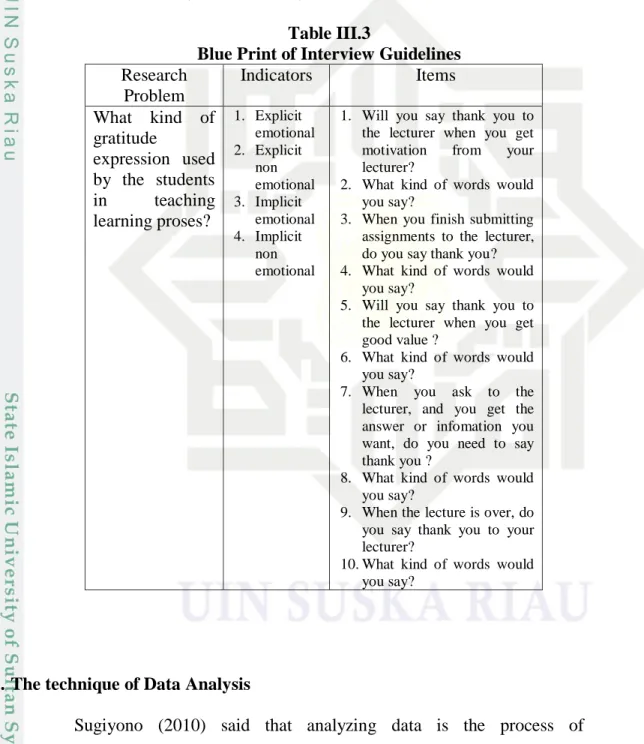
Table III.3
Blue Print of Interview Guidelines Research
Problem
Indicators Items
What kind of gratitude
expression used by the students in teaching learning proses?
1. Explicit emotional 2. Explicit
non emotional 3. Implicit
emotional 4. Implicit
non emotional
1. Will you say thank you to the lecturer when you get motivation from your lecturer?
2. What kind of words would you say?
3. When you finish submitting assignments to the lecturer, do you say thank you?
4. What kind of words would you say?
5. Will you say thank you to the lecturer when you get good value ?
6. What kind of words would you say?
7. When you ask to the lecturer, and you get the answer or infomation you want, do you need to say thank you ?
8. What kind of words would you say?
9. When the lecture is over, do you say thank you to your lecturer?
10. What kind of words would you say?
F. The technique of Data Analysis
Sugiyono (2010) said that analyzing data is the process of systematically searching and arranging the interview transcripts, field notes,
and other materials that you accumulate to increase your own understanding of them and to enable you to present you to present what you have discovered to others. In this research, to analyze the data, the researcher used descriptive qualitative analysis, the interview researcher was used 4 steps by Miles &
Huberman (1994):
1. Data Collection
The data from observations and interviews were colletion first. This recording consisted of description by see, hear and experiences by samples.
2. Data Reduction
Data reduction refers to process of selecting, focusing, simplifying, abstracting and transferring the data that appear in written-up field note or transciptions. The data reduction is analyzing that sharpens, sorts, focuses, discards and organization such a way conclusion could be drawn and verified. It means researcher made data more specific to easy in draw some of data based on the data collection.
3. Data Display
Data display are designed to assemble organized information into an immediately accessible, compact from so that the can see what is happen in and either draw justifield conclusion. It means, researcher was led of complex data into simple or selective form, so it will easy to understand.
4. Conclusion
The last stage is conclusion. After collecting the data and written the interview trascript the researcher was collected the gratitude expression the students used.
59 CHAPTER V
CONCLUSION AND SUGGESTION A. Conclusion
Based on the research finding, the researcher concludes that there are many gratitude expression used by the students to different situation:
1. From the situation of getting motivation from lecturer, submitting assignment, getting good value, getting information and feedback from lecturer and closing. 90% students gratitude expression used was “thank you” as the most common gratitude expression in all of the situation. The most gratitude expression used was “Thank you” as the common expression for gratitude situation.
2. The students also used formal gratitude expression and the students have the politeness gratitude expression to the lecturer.
B. Suggestion
Based on the conclusion of the research above, the researcher gave some suggestions. The first is lecturers, need to concern with the gratitude expresions or thanking strategy to teach the students to use various types of thanking strategy to express politeness and various gratitude expressions.
The second For English students, we need to grow our English as the foreign language by increasing our knowledge about the various gratitude expressions and thanking strategies to be used in different situations we faced in our environment.
The third is for further research, the researcher knows there are many problems come out relate to the gratitude expression. It is also expected to explore and investigate some other phenomenon of thanking strategies in any speech community in order to reveal some other types and reasons of gratitude expressions. To collect the data by using documentation, researcher have difficulty in retrieving documentation data, because the students did not always use gratitude expression in English but they prefered using to used gratitude in Indonesian language and also the researcher constrained in retrieving data by using documentation becouse the teching learning process was often done in the classroom and also used google meet.
REFERENCES
Aijmer, K. (1996). Convertation Routine in English: Convertation and Creativity.
New York: Addition Wesley Longman Limited.
Arikunto, S. (1990). Prosedur Penelitian Suatu Pendekatan Praktek. Jakarta:
Rineka Cipta.
Cresswell, J. W. (2012). Educational research : Palnning, conducting, and evaluating quantitative and qualitativeresearch. Nebrascha.
Cresswell, J. W. (2013). Qualitative Inquiry & Reseaerch Design: Choosing Among The Five Approaches. California : Sage Publications
Cheng. (2005). Changing Language Teaching Through Language Testing.
Cambridge, Cambridge university press
Dalilan. (2012). Strategies in Expressing Thanking in English Realized By Indonesian Learners. Indonesian Journal of English Language Teaching.
Fitzgerald, P. (1998). Gratitude and Justice. Ethics.
Hariyono, Rudy. 2006. Serious English for Serious Student. Surabaya: Gitamedia Press
Hornby. (2004). Oxford Dictionary for Advanced Learner. Oxford: Oxford University Press.
J. Bodman and M. Eisenstein. (1988). May God Increase Your Bounty: The Expression of Gratitude in English by Native and non-native Speakers.
cross current.
Kasper, G., & Dahl, M. (1991). “Research methods in interlanguage pragmatics.” Studies in Second Language Acquisition.
Leech, G. (1983). Principles of Pragmatics. London and New York: Longoman.
Meiramova, Assem K. 2015. The Peculiarities of Gratitude Expression Use in the Foreign Language (on theExample of English). Open Journal of Social Sciences.
M. Eisenstein and J. Bodmon. (1993). Expression Gratitude in American English . Oxford: Oxford University Press.
Miles, M. B., & Huberman, A. M. (1994). An Expanded Sourcebook Qualitative Data Analysis. California : Sage Publications.
Mittag, W. (2011). The rool of intrinsic motivation for teaching, theachers’ care and autonomy support in student’ self-determined motivation. Journal for Educational Research Online, Value 3 (2011), No. 1.
Moalla, Asma. (2013). “Who Is Responsible for Successful Communication?:
Investigating Compliment Responses in Cross-Cultural Communication”, SAGE Open.
Muhamad Sham Shahkat ali and Ammaarah Kootbodien. (2017). The effectiveness whatsapp as an interpersonalcommunication medium among abu dhabi university students. International Journal of Media, Journalism and Mass Communications (IJMJMC).
Nevalainen and Raumolin-Brunberg. (2003). Historical Sociolinguistics:
Language Change in Tudor and Stuart England. London: Person Education Ltd.
Nofsinger. (1999). Everyday Conversation. waveland press, Prospect Heights,.
Quirk, R. (1993). Language activator. London: Longman Group Ltd.
Interview with the students List of questions
1. When you get motivation from the lecturer, will you say thank you ? 2. What word of thing would you say ?
3. When you finish Submitting assignment, will you say thank you ? 4. What word of thing would you say ?
5. When you get good value from your lecturer, will you say thank you ? 6. What word of thing would you say ?
7. When you get information and feedback from your lecturer, will you say thank you ?
8. What word of thing would you say ?
9. When the class is closing, will you say thank you ? 10. What word of thing would you say ?
Interview dengan siswa Daftar pertanyan
1. Ketika kamu mendapatkan motivasi dari dosen, akankah kamu mengucapkan terimakasih ?
2. Kata terimakasih seperti apa yang akan kamu katakan ?
3. Ketika kamu selesai mengumpulkan tugas, apakah kamu mengucapkan terimakasih ?
4. Kata terimakasih seperti apa yang akan kamu katakan ?
5. Ketika kamu mendapatkan nilai yang bagus, apakah kamu akan mengucapkan terimakasih ?
6. Kata terimakasih seperti apa yang akan kamu katakan ?
7. Ketika kamu mendapatkan informasi dan jawaban dari dosen, apakah kamu akan mengucapkan terimakasih ?
8. Kata terimakasih seperti apa yang akan kamu katakan ?
9. Ketika kelas sudah selesai, apakah kamu akan mengucapkan terimakasih ? 10. Kata terimakasih seperti apa yang akan kamu katakan ?
Transcript interview with students 1 (march 23,2022 )
Researcher : assalamu‟alaikum wr wb, saya, saya rahayu nengsi saya mau interview adek, sebelumnya silahkan adek perkenalkan diri terlebih dahulu.
Student : perkenalkan kak nama saya laura diana, saya dari semester 6 mahasiswi pbi
Researcher : ok langsung saja disini pertanyaan pertama itu, apakah kamu akan mengucapkan terimakasih kepada dosen ketika kamu mendapat motivasi dari dosen ?
Student : iya
Researcher : kira- kira kata trimakasih seperti apa yang kamu akan ucapkan ? Student : thanks sir for your motivation
Researcher : owh ok, yang kedua hmm , ketika kamu sudah menyelesaikan ataupun mengumpulkan tugas ke dosen,ee apakah kamu mengucapkan trimakasih ?
Student : thank you sir
Researcher : terus ee kalau kamu itu mendapatkan nilai yang bagus dari dosen itu kira-kira kamu mengucapkan trimakasih atau gak ?
Student : oh itu pasti
Researcher : itu kata terimakasih seperti apa yang kamu katakan ? Student : thank you so much sir
Researcher : okk,, terus kalau kamu bertanya ke dosen, umpamanya ada pembelajaran yang tidak kamu mengerti dan dosen itu menjawab
sesuai dengan keinginan kamu itu tu kamu akan mengucapkan trimakasih atau kayak mana,
Student :pasti saya akan mengucapkan trimakasih Researcher : kata terimakasih apa yang kamu ucapkan ?
Student : thank you so much sir for your answer or maybe thank you
Researcher : the last is eee ketika kamu itu, ketika perkuliahan selesai apakah kalian mengucapkan trimakasih kedosen ?
Student : iya pasti
Researcher :kata trimakasih seperti apa yang kalian ucapkan ? Student : thank you sir
Researcher : ok mungkin itu aja laura, trimakasih atas waktunya pada hari ini, assalamu‟alaikum wr wb
Student : wa‟alaikumsalam wr wb
Transcript interview with students 2 (march 24,2022 ) Researcher : hallo assalamu‟alaikum
Student : hallo assalamu‟alaikum Researcher : wa‟alaikumsalm dek, Student : iya kak
Researcher : sebelumnya kakak perkenalkan diri dulu ya, Student : iya kak
Researcher : ee, ini kaka rahayu nengsi dari jurusan pbi ingin interview tentang penelitian kakak, sebelumnya apakah adek sibuk ?
Student : tidak kak