Mangulosi is chosen because for the Toba Batak people, the Mangulosi tradition is one of the many series of activities performed during the Batak Toba traditional wedding ceremony. This Mangulosi tradition is required in the life of Batak Toba people because in this tradition the meaning contained in it has an important influence on life. The marriage of the Batak Toba people cannot be separated from the gift of Ulo.
Based on the problem, the study aims to describe the types of politeness strategies used in Mangulosi as a traditional Bataknese wedding ceremony. Their foundational theory about the nature of politeness and how it works in interaction is presented in the first part. Manjalo Pasu-pasu The wedding blessing of the bride and groom is performed in the church by the pastor.
Speech Act
Classification of Speech Act
- Representatives
- Directives
- Commissives
- Expressives
- Declarative
This speech act involves saying something related to the truth of what the speaker is saying. This speech act is a speech act intended by the speaker to make other people perform the actions that the speaker has stated in the speech. The utterances in this speech act are praise, thank, complain, criticize, flatter, and congratulate.
The utterances in this act of speech are decide, cancel, forbid, allow, classify, and forgive.
Politeness
Politeness Strategy
- Bald on Record
- Positive Politeness
- Negative Politeness
- Off Record Strategy
It shows the listener that the speaker wants to know more about his opponent. By showing attentiveness, this tactic attempts to narrow the gap between the speaker and the listener. Overall, this output suggests that the speaker should pay attention to aspects of the listener's condition.
This includes obvious changes, obvious possessions, and anything the listener would like the speaker to notice and acknowledge. This strategy can be applied when the speaker shows interest, approval, or sympathy with the listener. In this case, the speaker can dramatize his good intentions, give the listener a good answer and make a good story in the conversation.
In addition, the use of jargon and slang indicates that the speaker and listener have the same knowledge of a specific object, such as a brand name. In this case, the speaker can use the listener's desire premise manipulation, the SH familiarity premise, and the listener's knowledge premise. This strategy compensates for the negative face of the listener by expressing express doubt that the prerequisites of the speaker's speech act have been met.
Next, the speaker must consider social factors such as distance and power in the conversation. Taking these factors into account, the speaker can adjust the weight of the weft so that the listener receives the weft better. By apologizing for the free trade agreement, the speaker can show reluctance to punch the listener's negativity in the face, correcting some of the attacks.
When the speaker says something that is not clearly related, he invites the listener to look for possible related interpretations.
Bataknese Traditional Wedding Ceremony
Or they can pretend to hand over the FTA to someone who isn't threatening them, hoping to see that the real target is the FTA that was aimed at them. By allowing the free trade zone to be partially lifted, the implications may "hang in the air," as rhetorical issues do.
Batak Toba Social Community System
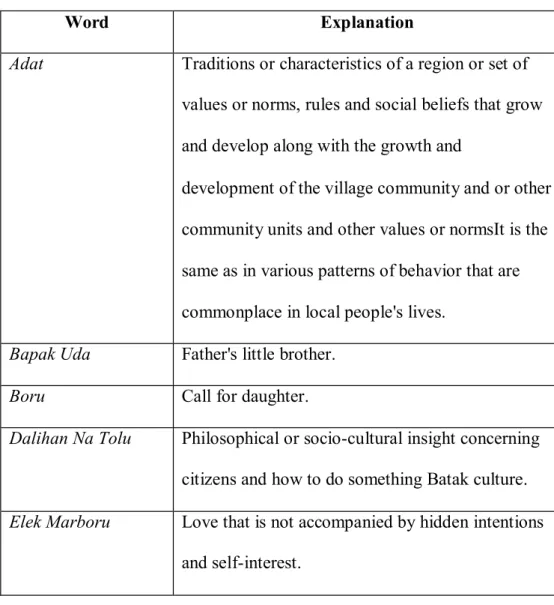
These hula-hula occupy the most respected position in Bataknese society and customs (all Bataknese sub-tribes), so all Batak people are ordered to respect the Hula-hula (Somba marhula-hula). Boru is the recipient or female buyer and dongan sabutunha is the clan or descendant.
Mangulosi
The relationship between the three parties can be seen in the Dalihan Na Tolu principle that says: Somba Marhula-hula, Elek Marboru, Manat Mardongan Tubu, which means respect for the hula-hula, love for the boru and courtesy for the dongan tubu. The meaning of this Mangulosi is that those who are given ulos feel the same happiness as the nuclear family. Accordingly, the clan family is related to the parboru as opung boru na (her sister's) clan, brother's or sister's husband, amang boru na (aunt's husband's clan) and the process continues. over and over in the same way.
It is different because in the Batak tradition, tulang is that they are the most respected and loved, so the amount of money given should be greater than the other amount as a form of the dignity of the woman's family. After the Mangulosi process, the bride and groom are led around the party venue three times. The ulos went around the bodies of the two and the ends of the ulos were pulled by the paranak's family and then in the last round the bride and groom were brought to the aisle seats.
Relevant Previous Study
From all studies on politeness, the researcher wants to see the difference on politeness, especially at Nganting Manuk's focus on Desa Suka. Where the object of the previous researcher is Nganting Manuk, while the object of this research is Mangulosi. The subject of the research was the Bataknese people of Sidamanik (a sub-district in North Sumatera, Indonesia).
The research was conducted using descriptive qualitative research to analyze and identify the politeness strategies used in giving ulos in a Toba Batak wedding ceremony. The information was taken from the Toba Batak wedding ceremony conversation of Omry Retno Simangunsong, S.Sos & Triana Puspita Sari Br. The findings of the study showed that the three politeness strategies found during the giving of ulos in a Toba Batak wedding ceremony, namely: bald on the record, positive politeness and negative politeness, specifically 15 (60%) for bald on the record, 9 (36%) . for positive politeness, 1 (4%) for negative politeness. The purpose of the study was to determine the differences in politeness strategies in the speech act of ordering male and female Toba Batak guests in the Toba Batak traditional ulaon performance in Tebing Tinggi.
The most dominant politeness strategy spoken by male guests are direct politeness strategies, indirect politeness strategies which are realized with metaphors, positive ones which are realized by making jokes and negative ones which are realized by reducing the force or threat on the interlocutor's face; while Toba Batak women guests are direct courtesy. The politeness strategy used by male Toba Batak guests is influenced by the attitude factor of male Toba Batak guest which is direct in expressing something, not literally, the experience factor is deeper in habits, so that can make jokes and metaphors and cultural factors. , that is, patrialism, power is in the hands of Toba Batak men, this is the background for Toba Batak men to use the four politeness strategies of Brown and Levinson (1987) while for Toba Batak guest women, situational factors are the background so that female guests are more dominant in telling direct politeness strategies and cultural factors, namely the attitudes and roles conveyed to Toba Batak women, the attitude of Toba Batak women is friendly, gentle, thorough and easy to accepted in society and the role as a woman who serves her husband, raises and teaches children and takes care of the house, which is the background for women guests in Toba Batak using four strategies Brown and politeness Levinson (1987). Where the object of the previous researcher is a reality show, while the object of this research is Mangulosi.
The title is "An Analysis of The Politeness Strategies Utilized by Pesbukers in their Variety Show". Most of the speakers and listeners on Pesbukers use positive politeness to create comfortable situations, create relationships and have good interactions between speakers and listeners so that the conversations go well.
Conceptual Framework
The previous study has a contribution as references to find the politeness strategies and how previous researcher analyzed the data in Bataknese Traditional Marriage Ceremony based on Brown and Levinson's theory.
RESEARCH METHOD
- Source of the Data
- Object of Research
- Subject of Research
- The Instrument of Collecting Data
- Technique of Collecting Data
- The Technique of Analyzing Data
- Triangulation
- The Data
2013:172), to the source of the data referred to in a study, is the subject from which the data was obtained by the researcher. The first phase in the analysis of qualitative data involves the identification and organization of where the data can be easily retrieved (Ary et al., 2010). To make the data well organized and familiar to the researcher, categorize and find the pattern of the data and then decide what is important regarding data analysis.
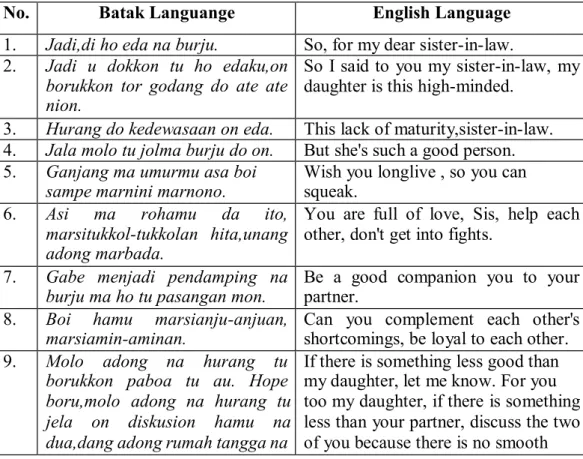
In this study, the data was collected from the words and sentences spoken during the Mangulosi event and analyzed politeness strategies, then the researcher categorized the data based on Brown & Levinson theory and finally summarized and concluded the data analysis based on of the research objectives. Here the researcher interprets the collected data to find the right meaning and category of the data based on the theories used. Researchers interpret the meaning of statements spoken during the Mangulosi event by describing the data and providing explanations and drawing data conclusions to answer politeness strategies that were mostly done. by speakers in the Mangulosi event.
In qualitative research, data can be categorized as good data if the data is valid. Source triangulation to test data credibility is done by checking data that has been obtained from multiple sources. In source triangulation, the researcher uses multiple sources of data to make the data valid. In researcher triangulation, researchers use more than one researcher to collect and analyze data because using multiple researchers can make the data valid.
In this research, the researcher will apply the triangulation of sources to validate the data because the researcher collects data from the conversations of different people in the Mangulosi event at the Batakese Toba wedding and will be analyzed based on Brown & Levinson (1978) theory. The data was collected from the utterances in the Mangulosi video captured by the researcher, as shown in the previous chapter.