Appendix 1
Matrix of Research
Title Variable Sub Variable Indicator Data
Collection
Research Method Research Problem The Influence Of
Action Learning Strategy to The Students Speaking Skill at the eight Grade of SMP Negeri 7 Jember in Academic Year 2019/2020
1. Action Learning
2. Speaking Skill
1. Team project Action Learning
2. Components
a. Teams b. Problems c. Competences d. Question/reflect
ion/feedback, e. Learning
coaches
a. Pronouncation b. Grammar c. Vocabulary d. Fluency
e. Comprehension
Primary : Students of SMP Negeri 7 Jember
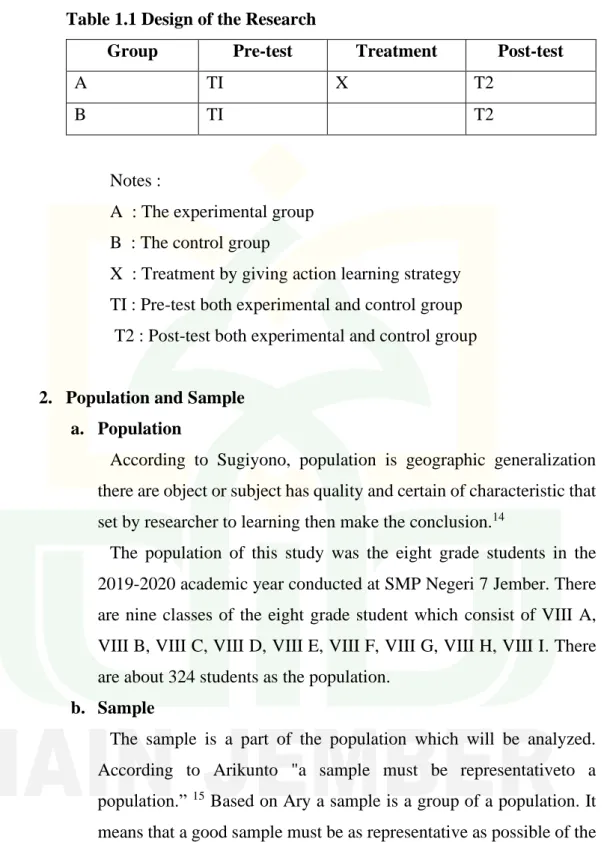
1. Research Design : Quasi
Experimental Quantitative 2. Technique of
Collecting Data:
Pre test,
Treatment, Post test
3. Instrument of Collecting Data:
- Research Instrument : speaking test - Content of
Validity - Reliability 4. Data Analysis :
T – test
Is there any Influence of action learning strategy to the students speaking skill at the eight grade of SMP Negeri 7 Jember in academic year 2019/2020
Appendix 2
The Schedule of The Research
No Activities Dates
1 Through lottery the sample from classes at eight grade
July 29th , 2019
2 Give try out August 1th. 2019
3 Teaching the Experimental and Control Group
August 5th , 2019 4 Give Pre-test to Control Group August 8th , 2019 5 Give Pre-test to Experimental Group August 10th , 2019 6 Teaching the Experimental and Control
Group
August 19th , 2019 7 Teaching the Control Group August 22th , 2019 8 Teaching the Experimental Group August 26th , 2019 9 Give Post-Test to Control Group August 29th , 2019 10 Teaching the Experimental Group August 31th , 2019 11 Give Post-Test to Experimental Group September 2nd , 2019
Appendix 3
Try Out
Students one by one explain about the pictures given by researchers using word (can). For examples:
➢ Balance : It is often found in the infirmary and pharmacy, you can use it to weigh yourself.
➢ Chalk : It is can be white or colored. you can write with it, but it’s not pen or pencil. It can only make temporary marks.
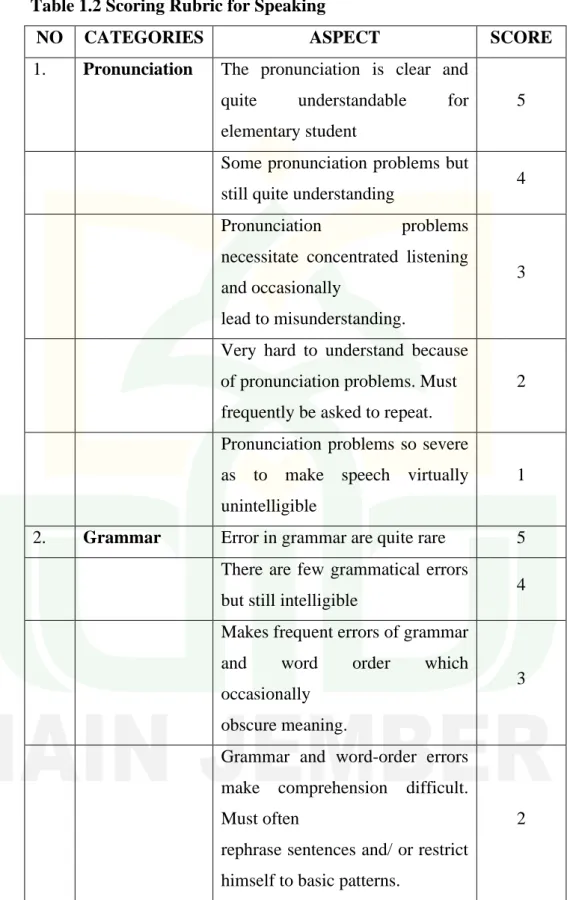
Scoring Rubric for Speaking
NO CATEGORIES ASPECT SCORE
1. Pronunciation Has few traces of foreign accent. 5 Always intelligible, though one is
conscious of a definite accent. 4 Pronunciation problems
necessitate concentrated listening and occasionally
lead to misunderstanding.
3 Very hard to understand because
of pronunciation problems. Must frequently be asked to repeat.
2 Pronunciation problems so severe
as to make speech virtually unintelligible
1 2. Grammar Makes few (if any) noticeable
errors of grammar or word order. 5 Occasionally makes grammatical
and word-order errors which do not,
however, obscure meaning.
4 Makes frequent errors of grammar
and word order which occasionally
obscure meaning.
3 Grammar and word-order errors
make comprehension difficult.
Must often
rephrase sentences and/ or restrict himself to basic patterns.
2
Errors in grammar and word order so severe as to make speech virtually
unintelligible.
1 3. Vocabulary Use of vocabulary and idioms is
virtually that of a native speaker. 5 Sometimes uses innapropriate
terms and/ or must rephrase ideas because of
lexical inadequacies.
4
Frequently uses the wrong words;
conversation somewhat limited because
of inadequate vocabulary.
3 Misuse of words and very limited
vocabulary make comprehension quite
difficult.
2 Vocabulary limitations so extreme
as to make conversation virtually impossible.
1 4. Fluency Speech as fluent and effortless as
that of a native speaker. 5 Speed of speech seems to be
slightly affected by language problems.
4 Speed and fluency are rather
strongly affected by language problems.
3 Usually hesitant often forced into
silence by language limitations. 2 Speech is so halting and
fragmentary as to make conversation virtually
impossible.
1 5. Comprehension Appears to understand everything
without difficulty. 5
Understands nearly everythig at normal speed, although occasional repetition may be necessary.
4 Understands most of what s said at
slower-than-normal speed with repetitions.
3 Has great difficulty following
what is said. Can comprehend only
“social
conversation” spoken slowly and frequent repetitions.
2
Cannot be said to understand even
simple conversational English. 1 Scoring: Score = Total score x 4
Appendix 4
RENCANA PELAKSANAAN PEMBELAJARAN (Pre Test)
Sekolah : SMPN 7 Jember Mata Pelajaran : Bahasa Inggris Kelas/ Semester : VIII/ 1
Materi Pokok : to state that we can do something Alokasi Waktu : 2x 40 menit
A. Kompetensi Inti
KI 1: Menghargai dan menghayati ajaran agama yang dianutnya
KI 2: Menghargai dan menghayati perilaku jujur, disiplin, tanggungjawab, peduli (toleransi, gotong royong), santun, percaya diri, dalam berinteraksi secara efektif dengan lingkungan sosial dan alam dalam jangkauan pergaulan dan keberadaannya.
KI 3: Memahami pengetahuan (faktual, konseptual, dan prosedural) berdasarkan rasa ingin tahunya tentang ilmu pengetahuan, teknologi, seni, budaya terkait fenomena dan kejadian tampak mata.
KI 4: Mencoba, mengolah, dan menyaji dalam ranah konkret (menggunakan, mengurai, merangkai, memodifikasi, dan membuat) dan ranah abstrak (menulis, membaca, menghitung, menggambar, dan mengarang) sesuai dengan yang dipelajari di sekolah dan sumber lain yang sama dalam sudut pandang/teori.
B. Kompetensi Dasar (KD) dan Indikator Pencapaian Kompetensi (IPK)
KD IPK
3.2 menerapkan fungsi sosial, struktur teks, dan unsur kebahasaan teks interaksi transaksional lisan dan tulis yang melibatkan tindakan
3.2.1 Mampu mengidentifikasi fungsi sosial daan unsur kebahasaan dari tindakan memberi dan meminta, serta menggapinya.
memberi dan meminta informasi terkait kemampuan dan kemauan melakukan suatu tindakan, sesuai dengan konteks penggunaannya.
(unsur kebahasaan can)
3.2.2 Mampu menyebutkan ungkapan memberi dan meminta, serta menanggapinya
4.2 menyusun teks interaksi transaksional lisan dan tulis sangat pendek dan sederhana yang melibatkan tindakanmemberi dan meminta informasi terkait kemampuan dan kemauan melakukan suatu tindakan, dengan memperhatikan fungsi social, struktur teks, dan unsur kebahasaan yang benar dan sesuai konteks.
4.2.1 menyusun teks percakapan yang menggunakan ungkapan memberi dan meminta, serta responnya.
4.2.2 mempraktekkan percakapan pendek yang menggunakan ungkapan memberi dan meminta, serta responnya.
C. Tujuan Pembelajaran
Setelah kegiatan pembelajaran, siswa diharapkan dapat:
1. Mengidentifikasi fungsi sosial dan unsur kebahasaan yang melibatkan tindakan memberi dan meminta, serta responnya.
2. Menyebutkan ungkapan memberi dan meminta, serta responnya.
3. Menyusun teks percakapan yang menggunakan ungkapan memberi dan meminta, serta responnya.
4. Mempraktekkan percakapan pendek yang menggukan ungkapan memberi dan meminta, serta responnya.
D. Fokus PKK - Nasionalis
E. Materi Pembelajaran
“to state that we can do something”
• The social function : to explain someone’s ability atau menyatakan dan menanyakan tentang kemampuan (can)
• (+) S + CAN + V1 + OBJECT
• (-) S + CAN + NOT + V1 + OBJECT
• (?) CAN + S + V1 + OBJECT Yes, I can
No, I can’t/ I can not
➢ Positive : I can play the guitar
➢ Negative : I can not play the guitar
➢ Interrogative : Can you play the guitar?
Yes, I can Sorry, I can’t
➢ Positive : I can do it now
➢ Negative : I can not do it now
➢ Interrogative : Can you do it now?
Yes, I can No, I can’t I’m not sure.
F. Media, Alat, dan Sumber Pembelajaran 1. Media/ Alat
- Buku rigs a bell, hangout, white broard, and board marker 2. Sumber Belajar
- Buku Guru dan Buku Siswa Kelas VIII Bahasa Inggris, When English Rings a Bell, Kementrian pendidikan dan Kebudayaan, Jakarta: 2014 G. Model Pembelajaran
1. Model :Scientific Approach 2. Metode: Diskusi, Role play H. Kegiatan Pembelajaran
Pertemuan III KEGIATAN
PEMBELAJARAN Deskripsi Alokasi
Waktu
Kegiatan Awal
• Guru menyapa siswa
• Guru mengajak siswa untuk berdoa bersama
• Guru memeriksa kehadiran siswa
10 Menit
• Guru menyampaikan garis besar materi dan juga penjelasan tentang kegiatan yang akan dilakukan siswa untuk menyelesaikan latihan dan tugas dalam
pembelajaran.
Kegiatan inti
1. Mengamati:
• Siswa mengamati contoh percakapan di buku rings bell hal.20
• Siswa mendengarkan guru membacakan percakapan
• salah satu siswa diminta untuk membacakan contoh percakapan dengan lantang dan jelas.
60 Menit
2. Menanya
Dari pengamatan tersebut, siswa mengajukan pertanyaan terkait proses pengamatan.
3. Mengumpulkan Informasi Siswa menjawab hangout yang di berikan oleh guru
4. Mengasosiasikan
• Siswa berkelompok, berdiskusi hasil pekerjaannya
• Siswa menyusun / membuat percakapan yang
berhubungan dengan menanyakan dan
menyatakan sesuai topik yang diberikan.
5. Mengkomunikasikan Dengan teman satu kelompok, siswa memainkan peran terkait percakapan yang telah dibuat dengan menggunakan
ungkapan menanyakan dan menyatakan dan responnya.
Kegiatan Akhir
• Guru bersama siswa menyimpulkan yang telah dipelajari
• Guru menyampaikan rencana pembelajaran pada pertemuan berikutnya
10 menit
• Guru mengajak berdo’a
• Guru memberi salam
I. Penilaian
1. Penilaian Sikap (Nasionalis) VIII G
No Nama Siswa Menjaga lingkungan Disiplin K C B SB K C B SB 1. Alfia Uswatun Hasanah
2. Andre Setiawan 3. Arjuna Aldillah 4. Arya Jaka Pradana
5. Daniar Mardhotillah Yoda 6. Dhieta Ayu Larasati 7. Dicky Abditya Firmansyah 8. Elisa
9. Fajrin Tri Septi Anggraini 10. Fatmawati
11. Giant Alief Fachrurrozy
12. Irvan
13. Krishna Ananda Ramadhani 14. Laila Sukmaning Nirwani 15. Lintang Azzahra
Wangeningrum 16. Lubna Annajud
17. Meldania Putri Hanum 18. Muhammad Syaiful Bahri 19. Nadia Nuril Qomariah 20. Naufal Irfan Faj'r Firdaus 21. Rahmat Dani Sultonudin 22. Reni Dwi Agustin 23. Ricky Septian Rosandi 24. Rizky Adhiyaksa Putra 25. Saskya Blezy Rahmadhani 26. Satrio Bagaskoro
27. Sebastian Isni Putra Holigvian Mahendra
28. Sefrans Randika Putra Hermanto
29. Shofiyatun Nisa' 30. Urliata Putri V.
31. Vela Oktavi Rimadani 32. Vita Agustin
33. Fauziah Annur Laily 34. Gaezka Ainun Asgil 35. Kafael Firdaus
VIII E
No Nama Siswa Menjaga lingkungan Disiplin K C B SB K C B SB 1. Adit Prayono
2. Alvimna Intan Anggraini Nur Firdausi Cholili
3. Ananda Tio Dwi Rizal 4. Angga Putra Ramadhani 5. Aurelia Carisa Putri 6. Dhea Anggi Widayanti 7. Dimas Ali Fadilah 8. Faissatul Munawaroh 9. Fery Kurniawan
10. Hilmia Riska Ainunnisa 11. Ica Puspita Pertiwi 12. Izam Riyanto
13. Jeffri Jayyid Ash Shiddiqi 14. M. Taufik Hidayat
15. Moch. Puguh Bustanul Maulana
16. Moch. Rahma Dani 17. Muhammad Alnazaky
Divananda Ikbar 18. Muhammad Faiz
19. Muhammad Yusuf Hidayat 20. Mustafa Wakil
21. Neysa Cipta Destalia 22. Pinki Adelia Prenata 23. Reza Kamelia Putri 24. Sabila Wildatus Afifah
25. Sakinah Salsabila 26. Salman Alfarizi 27. Vina Dwi Maulita 28. Wanda Purnama Sari 29. Windy Amelia Paramita 30. Yanuar Gilar Dhino
31. Aniela Enda Rima Nurjanah 32. Eko Saputra Kurniawan 33. Muhammad Davin Saputra 34. Nur Rachmawan Anas Vikri
Keterangan : K = Kurang C = Cukup B = Baik
SB = Sangat Baik
2. Penilaian Pengetahuan
Test : Jumbled words (10 soal)
Arrange the following words into good order
1. Night? – borrow – can – book – I – your – one - for 2. We – well – do – can – the job
3. They – not – eat – at all – can
4. Quickly? – the homework – all – can – do – we 5. Can – get – not – score – the – best - we
6. Bagas – can – bicycle – ride 7. You – can – the – take – book?
8. Is? – can – tell – where – me – it – you 9. To – do – can – I - help – you – it
10. Can – they – their – show – perrformance – tonight?
No Kunci Jawaban Skor 1 Night? – borrow – can – book – I – your – one – for
Can I borrow your book for one night? 1
2 We – well – do – can – the job
We can do the job well 1
3 They – not – eat – at all – can
They can not eat at all 1
4 Quickly? – the homework – all – can – do – we
Can we do all the homework quickly? 1
5 Can – get – not – score – the – best – we
We can not get the best score 1
6 Bagas – can – bicycle – ride
Bagas can ride bicycle 1
7 You – can – the – take – book?
Can you take the book? 1
8 Is? – can – tell – where – me – it – you
Can you tell me where is it? 1
9 To – do – can – I - help – you – it
I can help you to do it 1
10 Can – they – their – show – perrformance – tonight?
Can they show their performance tonight? 1 Rubrik Penilaian:
Nilai = Jumlah Skor yang Diperoleh X 100 Skor Maksimum
3. Penilaian Keterampilan Petunjuk kerja :
- Buat percakapan pendek tentang menanyakan dan menyatakan ( can ) responnya 2 baris
- Setelah selesai, siswa mempraktekan ke depan kelas hasil percakapan tersebut.
Contoh:
Dialog
Ayu : “Bagas, can you return the book to the library for me, please?”
Bagas : “certainly. I can”
Rubrik Keterampilan
NO CATEGORIES ASPECT SCORE
1. Pronunciation Has few traces of foreign accent. 5 Always intelligible, though one is
conscious of a definite accent. 4 Pronunciation problems
necessitate concentrated listening and occasionally
lead to misunderstanding.
3 Very hard to understand because
of pronunciation problems. Must frequently be asked to repeat.
2 Pronunciation problems so severe
as to make speech virtually unintelligible
1 2. Grammar Makes few (if any) noticeable
errors of grammar or word order. 5 Occasionally makes grammatical
and word-order errors which do not,
however, obscure meaning.
4 Makes frequent errors of grammar
and word order which occasionally
obscure meaning.
3 Grammar and word-order errors
make comprehension difficult.
Must often
rephrase sentences and/ or restrict himself to basic patterns.
2
Errors in grammar and word order so severe as to make speech virtually
unintelligible.
1
3. Vocabulary Use of vocabulary and idioms is
virtually that of a native speaker. 5 Sometimes uses innapropriate
terms and/ or must rephrase ideas because of
lexical inadequacies.
4 Frequently uses the wrong words;
conversation somewhat limited because
of inadequate vocabulary.
3 Misuse of words and very limited
vocabulary make comprehension quite
difficult.
2 Vocabulary limitations so extreme
as to make conversation virtually impossible.
1 4. Fluency Speech as fluent and effortless as
that of a native speaker. 5 Speed of speech seems to be
slightly affected by language problems.
4 Speed and fluency are rather
strongly affected by language problems.
3 Usually hesitant often forced into
silence by language limitations. 2 Speech is so halting and
fragmentary as to make conversation virtually
impossible.
1 5. Comprehension Appears to understand everything
without difficulty. 5
Understands nearly everythig at normal speed, although occasional repetition may be necessary.
4 Understands most of what s said at
slower-than-normal speed with repetitions.
3 Has great difficulty following
what is said. Can comprehend only
“social
2
conversation” spoken slowly and frequent repetitions.
Cannot be said to understand even
simple conversational English. 1
Kriteria Penilaian:
Nilai = Jumlah Skor yang Diperoleh pada tiap aspek x 4
Jember, 5 Agustus 2019
Peneliti Guru
Suciati Ningsih Sri Yuliati
NIM. T20156002 PTK. 3052750650200003
Appendix 5
Pre Test
➢ students make two-line conversations and demonstrate to the others.
Ayu : “Bagas, can you return the book to the library for me, please?”
Bagas : “certainly. I can”
Scoring Rubrik of Speaking Test
NO CATEGORIES ASPECT SCORE
1. Pronunciation Has few traces of foreign accent. 5 Always intelligible, though one is
conscious of a definite accent. 4 Pronunciation problems
necessitate concentrated listening and occasionally
lead to misunderstanding.
3
Very hard to understand because of pronunciation problems. Must frequently be asked to repeat.
2 Pronunciation problems so severe
as to make speech virtually unintelligible
1 2. Grammar Makes few (if any) noticeable
errors of grammar or word order. 5 Occasionally makes grammatical
and word-order errors which do not,
however, obscure meaning.
4
Makes frequent errors of grammar and word order which occasionally
obscure meaning.
3
Grammar and word-order errors make comprehension difficult.
Must often
rephrase sentences and/ or restrict himself to basic patterns.
2
Errors in grammar and word order so severe as to make speech virtually
unintelligible.
1
3. Vocabulary Use of vocabulary and idioms is
virtually that of a native speaker. 5 Sometimes uses innapropriate
terms and/ or must rephrase ideas because of
lexical inadequacies.
4
Frequently uses the wrong words;
conversation somewhat limited because
of inadequate vocabulary.
3
Misuse of words and very limited vocabulary make comprehension quite
difficult.
2
Vocabulary limitations so extreme as to make conversation virtually impossible.
1 4. Fluency Speech as fluent and effortless as
that of a native speaker. 5
Speed of speech seems to be slightly affected by language problems.
4 Speed and fluency are rather
strongly affected by language problems.
3 Usually hesitant often forced into
silence by language limitations. 2 Speech is so halting and
fragmentary as to make conversation virtually
impossible.
1
5. Comprehension Appears to understand everything
without difficulty. 5
Understands nearly everythig at normal speed, although occasional repetition may be necessary.
4 Understands most of what s said at
slower-than-normal speed with repetitions.
3 Has great difficulty following
what is said. Can comprehend only
“social
conversation” spoken slowly and frequent repetitions.
2
Cannot be said to understand even
simple conversational English. 1
Scoring :
Score = Total score x 4
Appendix 6
RENCANA PELAKSANAAN PEMBELAJARAN (Eksperimental Group)
Sekolah : SMPN 7 Jember Mata Pelajaran : Bahasa Inggris Kelas/ Semester : VIII/ 1
Materi Pokok : to state that we can do something Alokasi Waktu : 2x 40 menit
A. Kompetensi Inti
KI 1: Menghargai dan menghayati ajaran agama yang dianutnya
KI 2: Menghargai dan menghayati perilaku jujur, disiplin, tanggungjawab, peduli (toleransi, gotong royong), santun, percaya diri, dalam berinteraksi secara efektif dengan lingkungan sosial dan alam dalam jangkauan pergaulan dan keberadaannya.
KI 3: Memahami pengetahuan (faktual, konseptual, dan prosedural) berdasarkan rasa ingin tahunya tentang ilmu pengetahuan, teknologi, seni, budaya terkait fenomena dan kejadian tampak mata.
KI 4: Mencoba, mengolah, dan menyaji dalam ranah konkret (menggunakan, mengurai, merangkai, memodifikasi, dan membuat) dan ranah abstrak (menulis, membaca, menghitung, menggambar, dan mengarang) sesuai dengan yang dipelajari di sekolah dan sumber lain yang sama dalam sudut pandang/teori.
B. Kompetensi Dasar (KD) dan Indikator Pencapaian Kompetensi (IPK)
KD IPK
3.2 menerapkan fungsi sosial, struktur teks, dan unsur kebahasaan teks interaksi transaksional lisan dan tulis yang melibatkan tindakan
3.2.1 Mampu mengidentifikasi fungsi sosial daan unsur kebahasaan dari tindakan memberi dan meminta, serta menggapinya.
memberi dan meminta informasi terkait kemampuan dan kemauan melakukan suatu tindakan, sesuai dengan konteks penggunaannya.
(unsur kebahasaan can)
3.2.2 Mampu menyebutkan ungkapan memberi dan meminta, serta menanggapinya
4.2 menyusun teks interaksi transaksional lisan dan tulis sangat pendek dan sederhana yang melibatkan tindakanmemberi dan meminta informasi terkait kemampuan dan kemauan melakukan suatu tindakan, dengan memperhatikan fungsi social, struktur teks, dan unsur kebahasaan yang benar dan sesuai konteks.
4.2.1 menyusun teks percakapan yang menggunakan ungkapan memberi dan meminta, serta responnya.
4.2.2 mempraktekkan percakapan pendek yang menggunakan ungkapan memberi dan meminta, serta responnya.
C. Tujuan Pembelajaran
Setelah kegiatan pembelajaran, siswa diharapkan dapat:
1. Mengidentifikasi fungsi sosial dan unsur kebahasaan yang melibatkan tindakan memberi dan meminta, serta responnya.
2. Menyebutkan ungkapan memberi dan meminta, serta responnya.
3. Menyusun teks percakapan yang menggunakan ungkapan memberi dan meminta, serta responnya.
4. Mempraktekkan percakapan pendek yang menggukan ungkapan memberi dan meminta, serta responnya.
D. Fokus PKK
• Nasionalis
E. Materi Pembelajaran
“to state that we can do something”
• The social function : to explain someone’s ability atau menyatakan dan menanyakan tentang kemampuan (can)
• (+) S + CAN + V1 + OBJECT
• (-) S + CAN + NOT + V1 + OBJECT
• (?) CAN + S + V1 + OBJECT Yes, I can
No, I can’t/ I can not
➢ Positive : I can play the guitar
➢ Negative : I can not play the guitar
➢ Interrogative : Can you play the guitar?
Yes, I can Sorry, I can’t
➢ Positive : I can do it now
➢ Negative : I can not do it now
➢ Interrogative : Can you do it now?
Yes, I can No, I can’t F. Media, Alat, dan Sumber Pembelajaran
1. Media/ Alat
- Buku rigs a bell, hangout, white broard, and board marker 2. Sumber Belajar
- Buku Guru dan Buku Siswa Kelas VIII Bahasa Inggris, When English Rings a Bell, Kementrian pendidikan dan Kebudayaan, Jakarta: 2014 G. Model Pembelajaran
1. Model :Scientific Approach 2. Metode: Diskusi, Action learning.
H. Kegiatan Pembelajaran KEGIATAN
PEMBELAJARAN Deskripsi Alokasi
Waktu
Kegiatan Awal • Guru menyapa siswa 10 Menit
• Guru mengajak siswa untuk berdoa bersama
• Guru memeriksa kehadiran siswa
• Guru menyampaikan garis besar materi dan juga penjelasan tentang kegiatan yang akan dilakukan siswa untuk menyelesaikan latihan dan tugas dalam
pembelajaran.
• Siswa dibagi menjadi 6 kelompok belajar
Kegiatan inti
1. Mengamati:
• Siswa mendengarkan materi yang di sampaikan oleh guru
• Guru memberi contoh tentang materi
• Guru memberikan kesempatan bagi siswa untuk menuliskan contoh lain
• Siswa mengamati contoh percakapan di lks hal.19
• Siswa mendengarkan guru membacakan percakapan
60 Menit
• Setiap kelompok diminta untuk membacakan contoh percakapan dengan lantang dan jelas.
2. Menanya
Dari pengamatan tersebut, siswa mengajukan pertanyaan terkait proses pengamatan.
3. Mengumpulkan Informasi Siswa menjawab hangout yang di berikan oleh guru
4. Mengasosiasikan Siswa menyusun / membuat percakapan yang berhubungan dengan menanyakan dan menyatakan sesuai topik yang diberikan.
5. Mengkomunikasikan Dengan teman satu sebangku siswa memainkan peran terkait
percakapan yang telah dibuat dengan menggunakan ungkapan menanyakan dan menyatakan dan responnya.
Kegiatan Akhir
• Guru bersama siswa menyimpulkan yang telah dipelajari
• Guru menyampaikan rencana pembelajaran pada pertemuan berikutnya
10 menit
• Guru mengajak berdo’a
• Guru memberi salam
I. Penilaian
1. Checklist Penilaian Sikap Nasionalis
No Nama Siswa Menjaga lingkungan Disiplin K C B SB K C B SB 1. Alfia Uswatun Hasanah
2. Andre Setiawan 3. Arjuna Aldillah 4. Arya Jaka Pradana
5. Daniar Mardhotillah Yoda 6. Dhieta Ayu Larasati 7. Dicky Abditya Firmansyah 8. Elisa
9. Fajrin Tri Septi Anggraini 10. Fatmawati
11. Giant Alief Fachrurrozy 12. Irvan
13. Krishna Ananda Ramadhani
14. Laila Sukmaning Nirwani 15. Lintang Azzahra
Wangeningrum 16. Lubna Annajud
17. Meldania Putri Hanum 18. Muhammad Syaiful Bahri 19. Nadia Nuril Qomariah 20. Naufal Irfan Faj'r Firdaus 21. Rahmat Dani Sultonudin 22. Reni Dwi Agustin 23. Ricky Septian Rosandi 24. Rizky Adhiyaksa Putra 25. Saskya Blezy Rahmadhani 26. Satrio Bagaskoro
27. Sebastian Isni Putra Holigvian Mahendra 28. Sefrans Randika Putra
Hermanto 29. Shofiyatun Nisa' 30. Urliata Putri V.
31. Vela Oktavi Rimadani 32. Vita Agustin
33. Fauziah Annur Laily 34. Gaezka Ainun Asgil
35. Kafael Firdaus
Keterangan : K = Kurang C = Cukup B = Baik
SB = Sangat Baik
2. Penilaian Pengetahuan
Test : Jumbled words (10 soal)
Arrange the following words into good order 1. Night? – borrow – can – book – I – your – one – for 2. We – well – do – can – the job
3. They – not – eat – at all – can
4. Quickly? – the homework – all – can – do – we 5. Can – get – not – score – the – best - we
6. Bagas – can – bicycle – ride 7. You – can – the – take – book?
8. Is? – can – tell – where – me – it – you 9. To – do – can – I - help – you – it
10. Can – they – their – show – perrformance – tonight?
No Kunci Jawaban Skor
1 Night? – borrow – can – book – I – your – one – for
Can I borrow your book for one night? 1
2 We – well – do – can – the job
We can do the job well 1
3 They – not – eat – at all – can
They can not eat at all 1
4 Quickly? – the homework – all – can – do – we
Can we do all the homework quickly? 1
5 Can – get – not – score – the – best – we
We can not get the best score 1
6 Bagas – can – bicycle – ride
Bagas can ride bicycle 1
7 You – can – the – take – book?
Can you take the book? 1
8 Is? – can – tell – where – me – it – you
Can you tell me where is it? 1
9 To – do – can – I - help – you – it
I can help you to do it 1
10 Can – they – their – show – perrformance – tonight?
Can they show their performance tonight? 1 Rubrik Penilaian:
Nilai = Jumlah Skor yang Diperoleh X 100 Skor Maksimum
3. Penilaian Keterampilan Petunjuk kerja :
- Bentuk kelompok dengan teman sebangku
- Buat percakapan pendek tentang menanyakan dan menyatakan (can ) responnya sesuai tema masing-masing
- setelah selesai praktekan ke depan kelas hasil percakapan tersebut.
Contoh:
Dialog
a : Hi, How are you?
b : Hi, I'm fine, thanks. and you?
a : I'm alright, thanks.
b : what are you doing?
a : I'm cleaning this class b : Can I help you?
a : It's okay, I can do this alone b : No, you look very busy.
a : okay, now can you help me to clean that blackboard?
b : Sure, why not?
a : Thanks a lot.
b : You're welcome. anytime.
Rubrik Keterampilan
NO CATEGORIES ASPECT SCORE
1. Pronunciation Has few traces of foreign accent. 5 Always intelligible, though one is
conscious of a definite accent. 4 Pronunciation problems
necessitate concentrated listening and occasionally
lead to misunderstanding.
3 Very hard to understand because
of pronunciation problems. Must frequently be asked to repeat.
2 Pronunciation problems so severe
as to make speech virtually unintelligible
1 2. Grammar Makes few (if any) noticeable
errors of grammar or word order. 5 Occasionally makes grammatical
and word-order errors which do not,
however, obscure meaning.
4 Makes frequent errors of grammar
and word order which occasionally
obscure meaning.
3 Grammar and word-order errors
make comprehension difficult.
Must often
rephrase sentences and/ or restrict himself to basic patterns.
2
Errors in grammar and word order so severe as to make speech virtually
1
unintelligible.
3. Vocabulary Use of vocabulary and idioms is
virtually that of a native speaker. 5 Sometimes uses innapropriate
terms and/ or must rephrase ideas because of
lexical inadequacies.
4 Frequently uses the wrong words;
conversation somewhat limited because
of inadequate vocabulary.
3 Misuse of words and very limited
vocabulary make comprehension quite
difficult.
2 Vocabulary limitations so extreme
as to make conversation virtually impossible.
1 4. Fluency Speech as fluent and effortless as
that of a native speaker. 5 Speed of speech seems to be
slightly affected by language problems.
4 Speed and fluency are rather
strongly affected by language problems.
3 Usually hesitant often forced into
silence by language limitations. 2 Speech is so halting and
fragmentary as to make conversation virtually
impossible.
1 5. Comprehension Appears to understand everything
without difficulty. 5
Understands nearly everythig at normal speed, although occasional repetition may be necessary.
4 Understands most of what s said at
slower-than-normal speed with repetitions.
3 Has great difficulty following
what is said. Can comprehend only
“social
2
conversation” spoken slowly and frequent repetitions.
Cannot be said to understand even
simple conversational English. 1 Kriteria Penilaian:
Nilai = Jumlah Skor yang Diperoleh pada tiap aspek x 4
Jember, 19 Agustus 2019
Peneliti Guru
Suciati Ningsih Sri Yuliati
NIM. T20156002 PTK. 3052750650200003
Appendix 7
RENCANA PELAKSANAAN PEMBELAJARAN (Control Group)
Sekolah : SMPN 7 Jember Mata Pelajaran : Bahasa Inggris Kelas/ Semester : VIII/ 1
Materi Pokok : to state that we can do something Alokasi Waktu : 2x 40 menit
A. Kompetensi Inti
KI 1: Menghargai dan menghayati ajaran agama yang dianutnya
KI 2: Menghargai dan menghayati perilaku jujur, disiplin, tanggungjawab, peduli (toleransi, gotong royong), santun, percaya diri, dalam berinteraksi secara efektif dengan lingkungan sosial dan alam dalam jangkauan pergaulan dan keberadaannya.
KI 3: Memahami pengetahuan (faktual, konseptual, dan prosedural) berdasarkan rasa ingin tahunya tentang ilmu pengetahuan, teknologi, seni, budaya terkait fenomena dan kejadian tampak mata.
KI 4: Mencoba, mengolah, dan menyaji dalam ranah konkret (menggunakan, mengurai, merangkai, memodifikasi, dan membuat) dan ranah abstrak (menulis, membaca, menghitung, menggambar, dan mengarang) sesuai dengan yang dipelajari di sekolah dan sumber lain yang sama dalam sudut pandang/teori.
B. Kompetensi Dasar (KD) dan Indikator Pencapaian Kompetensi (IPK)
KD IPK
3.2 menerapkan fungsi sosial, struktur teks, dan unsur kebahasaan teks interaksi transaksional lisan dan tulis yang melibatkan tindakan
3.2.1 Mampu mengidentifikasi fungsi sosial daan unsur kebahasaan dari tindakan memberi dan meminta, serta menggapinya.
memberi dan meminta informasi terkait kemampuan dan kemauan melakukan suatu tindakan, sesuai dengan konteks penggunaannya.
(unsur kebahasaan can)
3.2.2 Mampu menyebutkan ungkapan memberi dan meminta, serta menanggapinya
4.2 menyusun teks interaksi transaksional lisan dan tulis sangat pendek dan sederhana yang melibatkan tindakanmemberi dan meminta informasi terkait kemampuan dan kemauan melakukan suatu tindakan, dengan memperhatikan fungsi social, struktur teks, dan unsur kebahasaan yang benar dan sesuai konteks.
4.2.1 menyusun teks percakapan yang menggunakan ungkapan memberi dan meminta, serta responnya.
4.2.2 mempraktekkan percakapan pendek yang menggunakan ungkapan memberi dan meminta, serta responnya.
C. Tujuan Pembelajaran
Setelah kegiatan pembelajaran, siswa diharapkan dapat:
1. Mengidentifikasi fungsi sosial dan unsur kebahasaan yang melibatkan tindakan memberi dan meminta, serta responnya.
2. Menyebutkan ungkapan memberi dan meminta, serta responnya.
3. Menyusun teks percakapan yang menggunakan ungkapan memberi dan meminta, serta responnya.
4. Mempraktekkan percakapan pendek yang menggukan ungkapan memberi dan meminta, serta responnya.
D. Fokus PKK
• Nasionalis
E. Materi Pembelajaran
“to state that we can do something”
• The social function : to explain someone’s ability atau menyatakan dan menanyakan tentang kemampuan (can)
• (+) S + CAN + V1 + OBJECT
• (-) S + CAN + NOT + V1 + OBJECT
• (?) CAN + S + V1 + OBJECT Yes, I can
No, I can’t/ I can not
➢ Positive : I can play the guitar
➢ Negative : I can not play the guitar
➢ Interrogative : Can you play the guitar?
Yes, I can Sorry, I can’t
➢ Positive : I can do it now
➢ Negative : I can not do it now
➢ Interrogative : Can you do it now?
Yes, I can No, I can’t F. Media, Alat, dan Sumber Pembelajaran
1. Media/ Alat
- Buku rigs a bell, hangout, white broard, and board marker 2. Sumber Belajar
- Buku Guru dan Buku Siswa Kelas VIII Bahasa Inggris, When English Rings a Bell, Kementrian pendidikan dan Kebudayaan, Jakarta: 2014 G. Model Pembelajaran
1. Model :Scientific Approach 2. Metode: Diskusi, Role play H. Kegiatan Pembelajaran
KEGIATAN
PEMBELAJARAN Deskripsi Alokasi
Waktu
Kegiatan Awal • Guru menyapa siswa 10 Menit
• Guru mengajak siswa untuk berdoa bersama
• Guru memeriksa kehadiran siswa
• Guru menyampaikan garis besar materi dan juga penjelasan tentang kegiatan yang akan dilakukan siswa untuk menyelesaikan latihan dan tugas dalam
pembelajaran.
Kegiatan inti
1. Mengamati:
• Siswa mengamati contoh percakapan di buku rings bell hal.20
• Siswa mendengarkan guru membacakan percakapan
• salah satu siswa diminta untuk membacakan contoh percakapan dengan lantang dan jelas.
60 Menit
2. Menanya
Dari pengamatan tersebut, siswa mengajukan pertanyaan terkait proses pengamatan.
3. Mengumpulkan Informasi
• Siswa menjawab hangout yang di berikan oleh guru 4. Mengasosiasikan
• Siswa menyusun / membuat percakapan yang
berhubungan dengan menanyakan dan
menyatakan sesuai topik yang diberikan.
5. Mengkomunikasikan
• Dengan teman satu kelompok, siswa
memainkan peran terkait percakapan yang telah dibuat dengan menggunakan ungkapan menanyakan dan menyatakan dan responnya.
Kegiatan Akhir
• Guru bersama siswa menyimpulkan yang telah dipelajari
• Guru menyampaikan rencana pembelajaran
10 menit
pada pertemuan berikutnya
• Guru mengajak berdo’a
• Guru memberi salam
I. Penilaian
1. Checklist Penilaian Sikap Nasionalis
No Nama Siswa Menjaga lingkungan Disiplin K C B SB K C B SB 1. Adit Prayono
2. Alvimna Intan Anggraini Nur Firdausi Cholili
3. Ananda Tio Dwi Rizal 4. Angga Putra Ramadhani 5. Aurelia Carisa Putri 6. Dhea Anggi Widayanti 7. Dimas Ali Fadilah 8. Faissatul Munawaroh 9. Fery Kurniawan
10. Hilmia Riska Ainunnisa 11. Ica Puspita Pertiwi 12. Izam Riyanto
13. Jeffri Jayyid Ash Shiddiqi 14. M. Taufik Hidayat
15. Moch. Puguh Bustanul Maulana
16. Moch. Rahma Dani 17. Muhammad Alnazaky
Divananda Ikbar 18. Muhammad Faiz
19. Muhammad Yusuf Hidayat 20. Mustafa Wakil
21. Neysa Cipta Destalia 22. Pinki Adelia Prenata 23. Reza Kamelia Putri 24. Sabila Wildatus Afifah 25. Sakinah Salsabila 26. Salman Alfarizi 27. Vina Dwi Maulita 28. Wanda Purnama Sari 29. Windy Amelia Paramita 30. Yanuar Gilar Dhino
31. Aniela Enda Rima Nurjanah 32. Eko Saputra Kurniawan 33. Muhammad Davin Saputra 34. Nur Rachmawan Anas Vikri
Keterangan : K = Kurang C = Cukup B = Baik
SB = Sangat Baik
2. Penilaian Pengetahuan
Test : Jumbled words (10 soal)
Arrange the following words into good order
1. Night? – borrow – can – book – I – your – one – for 2. We – well – do – can – the job
3. They – not – eat – at all – can
4. Quickly? – the homework – all – can – do – we 5. Can – get – not – score – the – best – we 6. Bagas – can – bicycle – ride
7. You – can – the – take – book?
8. Is? – can – tell – where – me – it – you 9. To – do – can – I - help – you – it
10. Can – they – their – show – perrformance – tonight?
No Kunci Jawaban Skor
1 Night? – borrow – can – book – I – your – one – for
Can I borrow your book for one night? 1
2 We – well – do – can – the job
We can do the job well 1
3 They – not – eat – at all – can
They can not eat at all 1
4 Quickly? – the homework – all – can – do – we
Can we do all the homework quickly? 1
5 Can – get – not – score – the – best – we
We can not get the best score 1
6 Bagas – can – bicycle – ride
Bagas can ride bicycle 1
7 You – can – the – take – book?
Can you take the book? 1
8 Is? – can – tell – where – me – it – you
Can you tell me where is it? 1
9 To – do – can – I - help – you – it
I can help you to do it 1
10 Can – they – their – show – perrformance – tonight?
Can they show their performance tonight? 1 Rubrik Penilaian:
Nilai = Jumlah Skor yang Diperoleh X 100 Skor Maksimum
3. Penilaian Keterampilan Petunjuk kerja :
- Bentuk kelompok dengan teman sebangku
- Buat percakapan pendek tentang menanyakan dan menyatakan ( can ) responnya sesuai tema masing-masing
- Setelah selesai praktekan ke depan kelas hasil percakapan tersebut.
Contoh:
Dialog
a : Hi, How are you?
b : Hi, I'm fine, thanks. and you?
a : I'm alright, thanks.
b : what are you doing?
a : I'm cleaning this class b : Can I help you?
a : It's okay, I can do this alone b : No, you look very busy.
a : okay, now can you help me to clean that blackboard?
b : Sure, why not?
a : Thanks a lot.
b : You're welcome. anytime.
Rubrik Keterampilan
NO CATEGORIES ASPECT SCORE 1. Pronunciation Has few traces of foreign accent. 5
Always intelligible, though one is
conscious of a definite accent. 4 Pronunciation problems
necessitate concentrated listening and occasionally
lead to misunderstanding.
3 Very hard to understand because
of pronunciation problems. Must frequently be asked to repeat.
2 Pronunciation problems so severe
as to make speech virtually unintelligible
1 2. Grammar Makes few (if any) noticeable
errors of grammar or word order. 5 Occasionally makes grammatical
and word-order errors which do not,
however, obscure meaning.
4 Makes frequent errors of grammar
and word order which occasionally
obscure meaning.
3 Grammar and word-order errors
make comprehension difficult.
Must often
rephrase sentences and/ or restrict himself to basic patterns.
2
Errors in grammar and word order so severe as to make speech virtually
unintelligible.
1 3. Vocabulary Use of vocabulary and idioms is
virtually that of a native speaker. 5 Sometimes uses innapropriate
terms and/ or must rephrase ideas because of
lexical inadequacies.
4 Frequently uses the wrong words;
conversation somewhat limited because
of inadequate vocabulary.
3
Misuse of words and very limited vocabulary make comprehension quite
difficult.
2 Vocabulary limitations so extreme
as to make conversation virtually impossible.
1 4. Fluency Speech as fluent and effortless as
that of a native speaker. 5 Speed of speech seems to be
slightly affected by language problems.
4 Speed and fluency are rather
strongly affected by language problems.
3 Usually hesitant often forced into
silence by language limitations. 2 Speech is so halting and
fragmentary as to make conversation virtually
impossible.
1 5. Comprehension Appears to understand everything
without difficulty. 5
Understands nearly everythig at normal speed, although occasional repetition may be necessary.
4 Understands most of what s said at
slower-than-normal speed with repetitions.
3 Has great difficulty following
what is said. Can comprehend only
“social
conversation” spoken slowly and frequent repetitions.
2
Cannot be said to understand even
simple conversational English. 1
Kriteria Penilaian:
Nilai = Jumlah Skor yang Diperoleh pada tiap aspek x 4
Jember, 19 Agustus 2019
Peneliti Guru
Suciati Ningsih Sri Yuliati
NIM. T20156002 PTK. 3052750650200003
Appendix 8
Post Test
➢ Students make conversations and demonstrate in front of the class
➢ Example of dialog conversation:
a : Hi, How are you?
b : Hi, I'm fine, thanks. and you?
a : I'm alright, thanks.
b : what are you doing?
a : I'm cleaning this class b : Can I help you?
a : It's okay, I can do this alone b : No, you look very busy.
a : okay, now can you help me to clean that blackboard?
b : Sure, why not?
a : Thanks a lot.
b : You're welcome. anytime.
Scoring Rubric for Speaking
NO CATEGORIES ASPECT SCORE
1. Pronunciation Has few traces of foreign accent. 5 Always intelligible, though one is
conscious of a definite accent. 4 Pronunciation problems
necessitate concentrated listening and occasionally
lead to misunderstanding.
3 Very hard to understand because
of pronunciation problems. Must frequently be asked to repeat.
2 Pronunciation problems so severe
as to make speech virtually unintelligible
1 2. Grammar Makes few (if any) noticeable
errors of grammar or word order. 5 Occasionally makes grammatical
and word-order errors which do not,
4
however, obscure meaning.
Makes frequent errors of grammar and word order which occasionally
obscure meaning.
3 Grammar and word-order errors
make comprehension difficult.
Must often
rephrase sentences and/ or restrict himself to basic patterns.
2
Errors in grammar and word order so severe as to make speech virtually
unintelligible.
1 3. Vocabulary Use of vocabulary and idioms is
virtually that of a native speaker. 5 Sometimes uses innapropriate
terms and/ or must rephrase ideas because of
lexical inadequacies.
4 Frequently uses the wrong words;
conversation somewhat limited because
of inadequate vocabulary.
3 Misuse of words and very limited
vocabulary make comprehension quite
difficult.
2 Vocabulary limitations so extreme
as to make conversation virtually impossible.
1 4. Fluency Speech as fluent and effortless as
that of a native speaker. 5 Speed of speech seems to be
slightly affected by language problems.
4 Speed and fluency are rather
strongly affected by language problems.
3 Usually hesitant often forced into
silence by language limitations. 2
Speech is so halting and fragmentary as to make conversation virtually
impossible.
1 5. Comprehension Appears to understand everything
without difficulty. 5
Understands nearly everythig at normal speed, although occasional repetition may be necessary.
4 Understands most of what s said at
slower-than-normal speed with repetitions.
3 Has great difficulty following
what is said. Can comprehend only
“social
conversation” spoken slowly and frequent repetitions.
2
Cannot be said to understand even
simple conversational English. 1 Scoring:
Score = Total score x 4
Appendix 9
Worksheet of Experimental Group’s Pre-Test and Post-Test - Pre-Test
- Post-Test
Appendix 10
Worksheet Control Group’s Pre-Test and Post-Test - Pre-Test
- Post-Test
Appendix 11
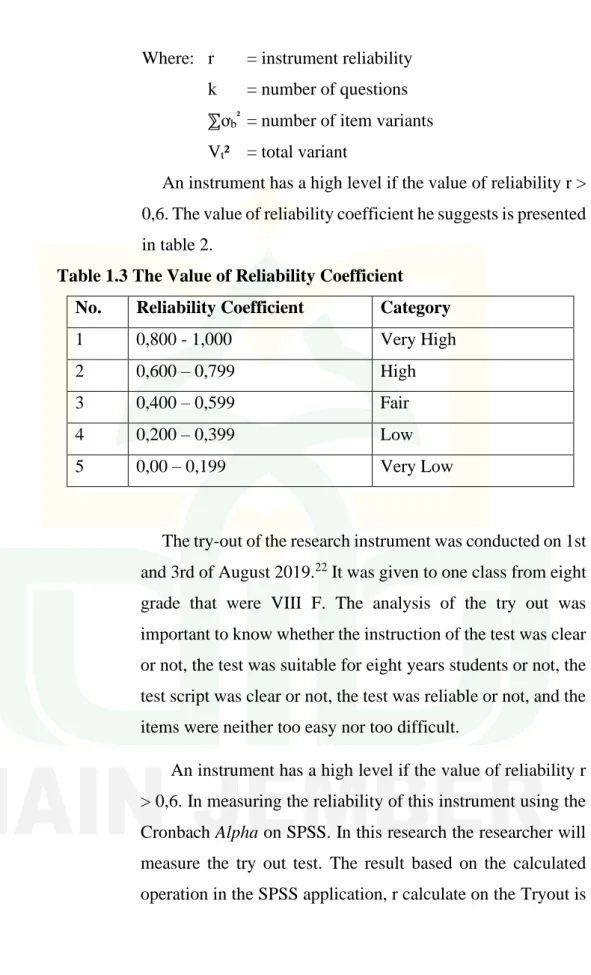
The Analysis Reliability of Tryout
Case Processing Summary
N %
Cases Valid 35 100.0
Excludeda 0 .0
Total 35 100.0
a. Listwise deletion based on all variables in the procedure.
Reliability Statistics Cronbach's
Alpha N of Items
.897 5
Appendix 12
Validity Testing of Tryout
Correlations
Pronunciation Grammar Vocabulary Fluency Comprehenton Totalscore
Pronunciation
Pearson Correlation 1 .663** .765** .587** .747** .903**
Sig. (2-tailed) .000 .000 .000 .000 .000
N 35 35 35 35 35 35
Grammar
Pearson Correlation .663** 1 .473** .440** .557** .747**
Sig. (2-tailed) .000 .004 .008 .001 .000
N 35 35 35 35 35 35
Vocabulary
Pearson Correlation .765** .473** 1 .616** .755** .857**
Sig. (2-tailed) .000 .004 .000 .000 .000
N 35 35 35 35 35 35
Fluency
Pearson Correlation .587** .440** .616** 1 .734** .796**
Sig. (2-tailed) .000 .008 .000 .000 .000
N 35 35 35 35 35 35
Comprehenton
Pearson Correlation .747** .557** .755** .734** 1 .902**
Sig. (2-tailed) .000 .001 .000 .000 .000
N 35 35 35 35 35 35
Totalscore
Pearson Correlation .903** .747** .857** .796** .902** 1
Sig. (2-tailed) .000 .000 .000 .000 .000
N 35 35 35 35 35 35
**. Correlation is significant at the 0.01 level (2-tailed).
Df of this study was 33 (N-2). with df 33 known R table of 0.3338.
Based on the data above, r calculate on Pronunciation is 0.903 > 0.3338. r calculate on Grammar is 0.747 > 0.3338. r calculate on Vocabulary is 0.857 > 0.3338. r calculate on Fluency is 0.796 > 0.3338. r calculate on Comprehension 0.902 > 0.3338.
r calculate from five aspect is higher. which is > 0.3338. So, the assessment on the tryout test is considered valid.
Appendix 13
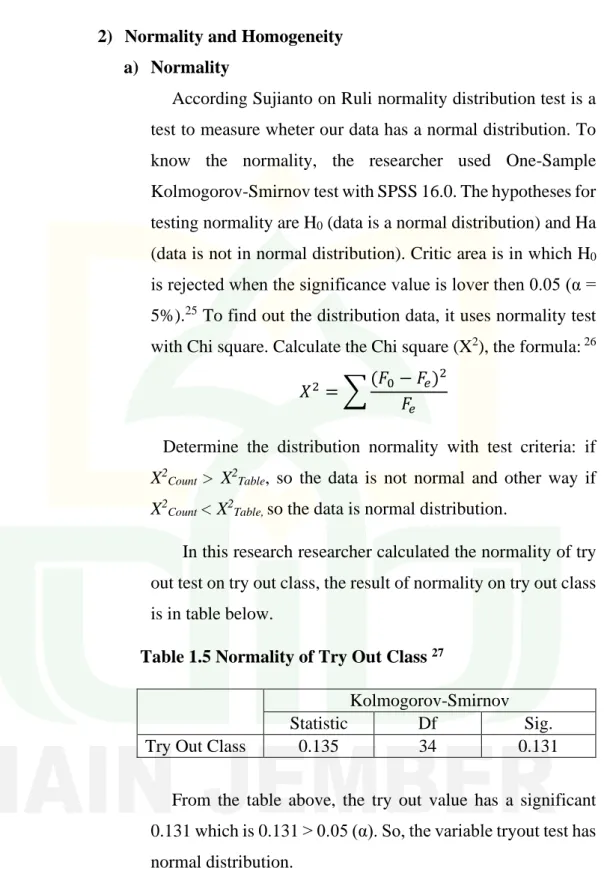
Normality Testing of Tryout
Tests of Normality
s
Kolmogorov-Smirnova Shapiro-Wilk
Statistic Df Sig. Statistic Df Sig.
FinalScore .132 35 .131 .939 35 .052
a. Lilliefors Significance Correction
Appendix 14
Homogeneity Testing of Tryout
Test of Homogeneity of Variances FinalScore
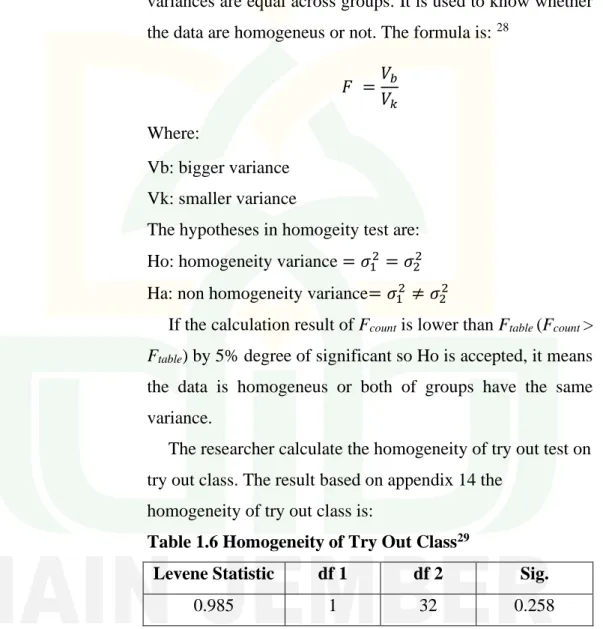
Levene Statistic df1 df2 Sig.
1.322 1 33 .258
ANOVA FinalScore
Sum of Squares Df Mean Square F Sig.
Between Groups 625.373 1 625.373 2.880 .099
Within Groups 7166.170 33 217.157
Total 7791.543 34
Appendix 15
Frequency Distribution of Experimental and Control Group’s Pre-Test and Post-Test
a. Frequency Distribution of Control group’s pre-test and post-test
N Mean Std. Deviation Std. Error
95% Confidence Interval for Mean
Minimum Maximum Lower
Bound
Upper Bound
PreTest 34 42.94 18.219 3.125 36.58 49.30 20 84
PostTest 34 50.94 15.392 2.640 45.57 56.31 28 88
Total 68 46.94 17.217 2.088 42.77 51.11 20 88
Mean to persen:
50.94 – 42.94 = 8
(8 : 42.94) x 100% = 18%
b. Frequency Distribution of Experimental group’s pre-test and post-test
N Mean Std. Deviation Std. Error
95% Confidence Interval for Mean
Minimum Maximum Lower
Bound
Upper Bound
PreTest 35 53.60 22.339 3.776 45.93 61.27 20 88
PostTest 35 66.51 17.943 3.033 60.35 72.68 32 92
Total 70 60.06 21.139 2.527 55.02 65.10 20 92
Mean to persen:
66.51-53.60 = 12.91
(12.91 : 53.60) x 100% = 24%
Appendix 16
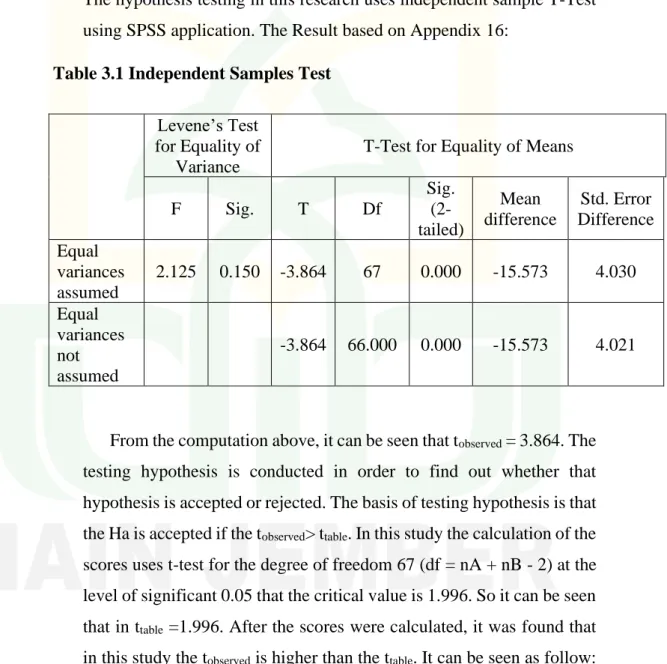
T-Test
Group Statistics
Kelas N Mean Std. Deviation Std. Error Mean
NilaiTest 8E 34 50.94 15.392 2.640
8G 35 66.51 17.943 3.033
Independent Samples Test Levene's Test
for Equality of
Variances t-test for Equality of Means
F Sig. T df
Sig. (2- tailed)
Mean Differen ce
Std.
Error Differen
ce
95% Confidence Interval of the
Difference Lower Upper Nilai
Test Equal variances assumed
2.125 .150 -3.864 67 .000 -15.573 4.030 -23.617 -7.530 Equal
variances not assumed
-3.873 66.000 .000 -15.573 4.021 -23.601 -7.545
Appendix 17
The Score of Try Out, Pre-Test and Post Test of Control and Experimental Group 1. The Score of Try Out Class
Number Name Pronoun Grammar Vocabulary Fluency Comprehension Total Score Nilai (Total Score x 4)
1 Aditia Ari Dwi Ifansyah 1 1 1 2 2 7 28
2 Ahmad Alfan Ramadani 2 1 2 2 2 9 36
3 Alifian Eka Wiyudha 2 1 2 2 2 9 36
4 Alini Zulfa Rahmania 1 1 1 1 1 5 20
5 Athallah Farril Prasetya 3 2 3 2 2 12 48
6 Bagas Erlangga 2 3 2 2 2 11 44
7 Deial Praba Indra 2 2 2 2 2 10 40
8 Dio Aguswan 3 3 3 2 2 13 52
9 Egis Febrilian Ageng Salwatania 1 2 1 1 2 7 28
10 Erika Maulida Ardiansyah 1 1 1 1 1 5 20
11 Eva Fahmadia Doat Arina 1 1 1 1 1 5 20
12 Faridatul Aliyah 4 3 3 3 3 16 64
13 Febri Eka Pratama 3 2 3 2 3 13 52
14 Ferdian Reza Putra P 1 1 1 2 1 6 24
15 Indi Damayanti 2 3 1 2 2 10 40
16 Jinggan Putri Permata Sari 1 1 2 1 1 6 24
17 Klarisa Maulidina Eka Aprisia 1 2 1 2 2 8 32
18 Lahoya Julio Saves 4 3 4 4 4 19 76
19 Meylisa Febiana Putri 1 1 2 1 1 6 24
20 Moch. Rafly Aprilianus 1 2 1 1 1 6 24
21 Mochammad Aldi 2 1 2 2 2 9 36
22 Muhammad Fandy Prasetyo 2 2 2 3 1 10 40
23 Muthia Denila Putri 2 2 1 2 2 9 36
24 Nabiel Humaidy Salam 2 2 2 2 2 10 40
25 Naufaldo Gustama 3 3 3 2 3 14 56
26 Novel Maulida Sari 2 2 1 2 1 8 32
27 Ramadani Indri Syah Putri 4 2 3 4 4 17 68
28 Rio Wahyurizqy Ramadhan 4 3 2 1 2 12 48
29 Rivaldi Ardiansyah 2 1 1 2 1 7 28
30 Salsabila Rahmadani Ahmad 2 2 1 2 1 8 32
31 Tiara Erma Yunika 3 3 2 2 2 12 48
32 Udyana Rosida Utami 2 1 2 1 1 7 28
33 Aurilia Nur Anggraini 4 3 3 3 4 17 68
34 Fawwaz Dhobith Kurniawan 3 4 2 2 2 13 52
35 Pungki Syah Putra 2 3 3 4 3 15 60
2. The Score of Pre-Test of Control Group
Number Name Pronoun Grammar Vocabulary Fluency Comprehension Total Score Nilai (Total Score x 4)
1 Adit Prayono 2 2 1 2 2 9 36
2 Alvimna Intan Anggraini Nur Firdausi Cholili 2 2 3 2 2 11 44
3 Ananda Tio Dwi Rizal 2 2 2 2 2 10 40
4 Angga Putra Ramadhani 1 1 1 1 1 5 20
5 Aurelia Carisa Putri 3 3 3 2 2 13 52
6 Dhea Anggi Widayanti 4 3 2 2 2 13 52
7 Dimas Ali Fadilah 2 3 2 2 2 11 44
8 Faissatul Munawaroh 4 3 3 2 2 14 56
9 Fery Kurniawan 1 2 1 2 2 8 32
10 Hilmia Riska Ainunnisa 1 1 1 1 1 5 20
11 Ica Puspita Pertiwi 1 1 1 1 1 5 20
12 Izam Riyanto 4 3 4 3 3 17 68
13 Jeffri Jayyid Ash Shiddiqi 3 3 3 3 3 15 60
14 M. Taufik Hidayat 1 1 1 1 1 5 20
15 Moch. Puguh Bustanul Maulana 3 2 2 2 2 11 44
16 Moch. Rahma Dani 1 1 1 1 1 5 20
17 Muhammad Alnazaky Divananda Ikbar 2 2 2 2 2 10 40
18 Muhammad Faiz 4 4 4 4 5 21 84
19 Muhammad Yusuf Hidayat 1 1 1 1 1 5 20
20 Mustafa Wakil 1 1 1 1 1 5 20
21 Neysa Cipta Destalia 2 2 2 2 2 10 40
22 Pinki Adelia Prenata 2 2 2 3 1 10 40
23 Reza Kamelia Putri 2 2 2 2 2 10 40
24 Sabila Wildatus Afifah 2 2 2 2 2 10 40
25 Sakinah Salsabila 4 3 3 3 3 16 64
26 Salman Alfarizi 3 2 1 2 1 9 36
27 Vina Dwi Maulita 4 4 4 4 4 20 80
28 Wanda Purnama Sari 4 4 2 2 2 14 56
29 Windy Amelia Paramita 2 1 1 1 1 6 24
30 Yanuar Gilar Dhino 3 2 2 2 1 10 40
31 Aniela Enda Rima Nurjanah 3 4 2 2 2 13 52
32 Eko Saputra Kurniawan 2 1 1 1 1 6 24
33 Muhammad Davin Saputra 4 4 3 4 4 19 76
34 Nur Rachmawan Anas Vikri 3 4 3 2 2 14 56
3. The Score of Post Test of Control Group
Number Name Pronoun Grammar Vocabulary Fluency Comprehension Total Score Nilai (Total Score x 4)
1 Adit Prayono 2 2 2 2 2 10 40
2 Alvimna Intan Anggraini Nur Firdausi Cholili 2 3 3 2 2 12 48
3 Ananda Tio Dwi Rizal 2 2 3 3 2 12 48
4 Angga Putra Ramadhani 1 2 2 2 1 8 32
5 Aurelia Carisa Putri 3 3 4 2 2 14 56
6 Dhea Anggi Widayanti 4 3 2 4 2 15 60
7 Dimas Ali Fadilah 2 3 3 3 2 13 52
8 Faissatul Munawaroh 4 3 4 4 2 17 68
9 Fery Kurniawan 2 2 3 2 2 11 44
10 Hilmia Riska Ainunnisa 1 2 3 2 1 9 36
11 Ica Puspita Pertiwi 1 2 2 1 1 7 28
12 Izam Riyanto 4 3 2 2 3 14 56
13 Jeffri Jayyid Ash Shiddiqi 3 4 3 4 3 17 68
14 M. Taufik Hidayat 1 2 2 3 1 9 36
15 Moch. Puguh Bustanul Maulana 3 2 2 3 2 12 48
16 Moch. Rahma Dani 1 2 3 3 1 10 40
17 Muhammad Alnazaky Divananda Ikbar 2 4 4 2 2 14 56
18 Muhammad Faiz 4 5 4 4 5 22 88
19 Muhammad Yusuf Hidayat 1 2 1 2 2 8 32
20 Mustafa Wakil 1 3 2 1 1 8 32
21 Neysa Cipta Destalia 2 4 3 2 2 13 52
22 Pinki Adelia Prenata 2 3 2 3 1 11 44
23 Reza Kamelia Putri 2 2 3 2 3 12 48
24 Sabila Wildatus Afifah 2 3 2 3 2 12 48
25 Sakinah Salsabila 4 3 4 3 3 17 68
26 Salman Alfarizi 3 2 2 3 2 12 48
27 Vina Dwi Maulita 4 4 5 4 5 22 88
28 Wanda Purnama Sari 4 4 3 3 2 16 64
29 Windy Amelia Paramita 2 2 2 1 3 10 40
30 Yanuar Gilar Dhino 3 2 3 2 1 11 44
31 Aniela Enda Rima Nurjanah 3 4 2 4 2 15 60
32 Eko Saputra Kurniawan 2 1 2 1 1 7 28
33 Muhammad Davin Saputra 4 4 3 4 4 19 76
34 Nur Rachmawan Anas Vikri 3 4 3 2 2 14 56