
His two empirical studies, of Volvo Car Corporation and AstraZeneca, offer affirmative views of bureaucracy, and a final chapter, drawing on the bio-philosophy of Henri Bergson, presents a vitalist model of bureaucracy capable of understanding its organization functional and continuous. and constant modifications and changes to adapt to external conditions. Jean-Jacques Rousseau, The Social Contract: 184 All we ask of men is to do the work set before them. To me, bureaucracy is not part of the problem, but part of the solution to a variety of social concerns and objectives.
Moreover, newspapers continuously report on the presence of corruption, bribery, nepotism and oligarchies in most parts of the world. This veritable mythology of the shortcomings of bureaucracy is shared among folk psychology, popular culture, and scholarly works. The aim of the book is thus to make bureaucracy a domain for empirical research anew, rather than serving as a "straw man" or a label denoting an outdated form of organization that is always already rejected as being out of step with the times.
Acknowledgements
1 The supplementarity of
This overtly negative view of bureaucracy is by no means a recent idea, but rather has been one of the consistent themes in both the organization theory literature and in other disciplines of the social sciences. The remainder of this chapter will discuss some of the book's main themes. This preference for certain images may be one of the decisive differences between the critics and the defenders of bureaucracy.
However, the locus classicus of the notion of innovation is Joseph Schumpeter's Theory of Economic Development (1934). Major organizational changes such as mergers and acquisitions have a decisive impact on the innovative capacities of the firm. Therefore, it is important to recognize the consequences of recent organizational changes in the two investigated firms, as well as established bureaucratic procedures and routines.

2 The concept of bureaucracy
The same can be said of the cotton plantations of the United States on the eve of the Civil War. This specialized group of engineers was the bearer of the credo of standardization and the driving force behind the "frenzy of efficiency" in the period after 1910. Weber speaks of the emergence of bureaucracy as an effect of the accumulation of wealth in modern society: .
He is subject to strict and systematic discipline and control while performing his duties. In the middle of the first decade of the new millennium, Weber's position remains debated. Von Mises also addresses one of the persistent themes in the literature on bureaucracy, that of the "bureaucratization of the mind" (von Mises 1944: 81ff).
On the other hand, conflicts between customers and colleagues are the most difficult parts of the job. This liberal view of the labor market does not reflect actual market conditions, says du Gay (1996).
3 Affirming the fluid
5 The state of the system is determined by the values of the input and output. For the passengers in each of the two trains, the other train is effectively stationary. Patriotta (2003) talks about the process of transforming "knowledge in progress" into widely shared and applicable knowledge in the form of "institutionalization" of knowledge.
Achieving epistemological closure" is therefore one of the most important achievements in a community of "knowledge workers". Here we move from "a static, commodified definition of knowledge" and emphasize instead the "becoming" of the organization. Handy (1997) discusses trust in virtual organization but does not provide a straightforward definition of the virtual organization.
Some writers speak of the design organization as being on the "front wave of post-bureaucracy". In this section, the notion of the market is mentioned as the embodiment par péférence of an epistemology of fluids. In the following, when we speak of a post-bureaucratic organizational ideology or even of the post-bureaucratic organizational landscape (see Ahrne, 1990), we use Louis Althusser's definition which states this.
However, the concept of market is problematic and is strongly influenced by various ideologically imbued assumptions and beliefs. Put differently, one could argue that the emphasis on the market as the primary arena for organizational activities and transactions, rather than on hierarchies, is at the heart of the image of the post-bureaucratic organizational form. This accountability rhetoric had material discursive effects on healthcare organizations in terms of the establishment of new roles, practices and institutions in the hospital.
The facticity of the post-bureaucratic organization is therefore disputed, but it still serves as an epistemic object that connects many different actors.
4 The innovative bureaucracy, Part I
Volvo Cars: the entrepreneurial bureaucracy
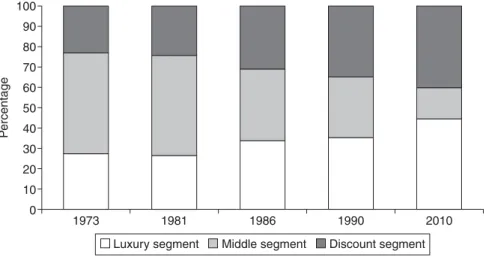
Volvo moved out of the middle segment and consolidated its position in the Premium Brand market segment of the automotive industry (Wickelgren, 2005). Volvo produces about 450,000 cars a year and sells about a quarter of its production in the United States. Being a skilled and successful project manager is one of the main criteria for building credibility in the industry.
Volvo executives believed that the car's image and design needed to change. Like quality, safety in the automotive industry is increasingly becoming part of the qualifying criterion, rather than an order-winning criterion (Beckman, 2004). When asked one of the technical project leaders whether it is important for the company to be creative, he replied:
There is less and less room to do anything outside the original specifications. Engineer) But innovation and creativity in the automotive industry are, she continued, not trivial matters due to the complexity of the product. A designer at Volvo gave an example of the cultural differences between Sweden and the US:.
Project manager) Another Volvo associate pointed to the need to follow the budget as one of the most important virtues in the American regime:. I don't think that we in the management team of the Powertrain division are really creative. A majority of those interviewed claimed that they thought the new Ford systems of driving control and reporting were complicated to use.
One of the designers post facto expressed a critical view of this change of decision:.
5 The innovative bureaucracy, Part II
One of the managers in the DMPK department pointed to the impact on motivation for the individual:. One of the integrative pharmacologists argued: “The number of meetings has accelerated and is obviously related to the size. One of the project leaders in the DMPK department testified to her own ambivalence towards formal meetings:.
One of the senior researchers in the DMPK department pointed to the downside of the massive production and storage of data:. A concern for some of the new arrivals in the organization thus took the form of nostalgia from the older employees. One of the managers in the DMPK department highlighted the differences between Swedish and British employees.
One of the managers in medicinal chemistry noted the effects of the process model being implemented in the company:. It is the company's ambition to be better than what the authorities require. A senior line manager reflected on the nature of the industry: “In this industry, you can.
One colleague, a chemist in the DMPK department, was critical of the whole idea of MITP. One of the molecular pharmacologists pointed out the need to establish priorities for collaborators: The head of the DMPK department said that the top management failed to foresee the consequences of the new regime:.
They are trying to remove some of the steps in the chain to make things easier for us.

6 Bureaucracy in an age of fluidity
Therefore, in the future, bureaucratic virtues may be re-evaluated in terms of resisting the "management craze of the month" culture. Mikhail Bakhtin A] lyrical theme runs through Bergson's work: a veritable hymn in praise of the new, the unpredictable, of invention, of freedom”. Metaphor is a trope that "transports"—the etymological meaning of the Greek word—from its original meaning to something else.
The metaphor of the machinery is most often used to capture the functioning of a bureaucracy. One of the most used metaphors to capture social formations and social organization is the organism. In the following, the understanding of the organism will be examined on the basis of Henri Bergson's writing on becoming and change in organisms.
In addition, Bergson is skeptical of the concept of individuality; for him, élan vital precedes all individuality. Life in 'I' does not answer to my name: 'I' is merely transitory." The essence of life is not to be found in individual particles, but in the totality of vital life. While rarely is Bergson's theory of the organism in itself emphasized outside what Ansell Pearson (1999) calls "biophilosophy," in this case this model of biological organisms captures the qualities we are interested in when advocating the bureaucratic form of organization.
Bergson's contemporary, Alfred North Whitehead, is the other great process philosopher of the 20th century besides Bergson. Judith Butler (1993) advocates another feminist material theory of the biological organism and, more specifically, the human body. What is of particular interest here is the notion of the bio-logical organism so central to Bergson's creative evolution.
Altogether, Bergson's model of the biological organism is dynamic because it points to the systematic organization without making such a system of mechanisms and processes deterministic.