
Further descriptions of the Kamchadal whaling are passing references^ or apparently traceable to Steller's original account. There are a few small indications that other Kurile Islands may have been occupied by Kamchadal, or Atanyrat, heavily culturally influenced from Kamchatka.
KORYAK
The difference between the whale nets of Olutores (Oliitorsky, Elutori) and those of the Japanese described by Kempfer and depicted by Fraser. The impetus for using nets to catch these largest marine mammals may come from Japan's knowledge that people in the north used them to catch whales.
CHUKCHEE
Meanwhile, the rest of the people, young and old, dance and jump on the shore with great joy (Frohlocken), as already mentioned above. With the Chukchee, we leave Asians whaling in such varied forms and turn to a review of American whaling techniques in the Bering Sea and North Pacific Ocean.
ALEUTIAN ISLANDS
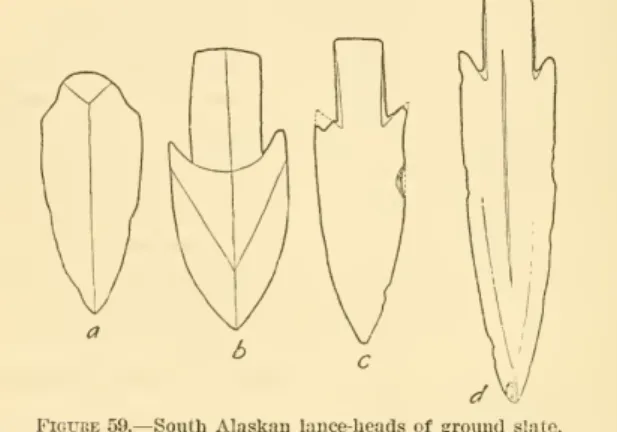
As a single Aleutian with his one oaredbaidar,^'and aiming only with a short spear, the point of which is composed of a sharp, ground slate, attacks this giant of the sea. The tip of the spear, usually found in the wound that caused the death of the animal, testifies to who the fish belongs to.
KODIAK ISLAND REGION
However, if he manages to get within 10 or 15 points of the sounding colossus, he shoots his arrow with his throwing stick, aiming for the region of the dorsal pits (Riickenflosse). When the gun is fired, the hunters seek by rowing the baidarkas back to get to a distance as quickly as possible, so as to avoid the twisting and beating of endless animals, which nevertheless occasionally occurs, especially when the distance is not it is so big that it exceeds the limit. through violent movements of the animal or by high waves or by the animal itself. Whales are in amazing numbers in the straits of the islands and in the vicinity of Kodiak; the natives pursue them in their small boats, and numbers killed with a poison-tipped spear.
The large whale that inhabits the waters of Cook Inlet is not killed, although it is much enjoyed by the Tanaina of the region. His control of whaling would include a knowledge of the preparation and use of aconite poison—the essential feature of whaling. Some reason had to be given to explain the extraordinary effectiveness of whaling arrowheads, and the common people (that is, the uninitiated) were probably led to believe that it was fattened from dead bodies.
Steensby (1917, p. 144) says of Koniag that they used a spear with a broad slate blade to hunt whales. As a final point regarding the weakening of the complex in its old form, we have direct historical statements as to when the change began.
ESKIMO
The resemblance to the Kodiak whaling lance with its removable slate head (or in Unalaska, flagged obsidian or trachyte) with characteristic marks inscribed upon it is immediately suggested by this statement. De Laguna (1934, p. 183), in a discussion of the distribution of barbed barbs, has claimed that the Norton Sound-Kuskokwim method of stinging marine mammals is similar to Kodiak whale launching, except that the latter site is only one penetration instead of a series of shocks, is made. The Kodiak-Aleutian procedure can be explained by recalling that: (1) Only one penetration is possible as the whale escapes after being launched; and (2) a single thrustis usually fatal, as the death of the animal is due to the action of the aconite poison."^ With repeated stings, death by it.
Boas (1899, p.GOl) says: "They [marks of ownership] occur almost exclusively on weapons used in hunting, which, after being sent, remain on the bodies of large game. These are, especially, balenharix[fig .16-19], whale spoons[fig. i], whaling heads and detachable arrowheads[flgs.24-25]. mainly from phanerogams, Papaveraceae, I.eguminosae and Ranunculac which are rich with these substances.
No.24] POISONING OF THE WHALE – HEIZER 441 animal is the result of blood loss or because a vital spot has been hit;
NORTHWEST COAST
The flesh and possibly the bacon around the wound is impregnated with aconite,*^*and proves to be of varying degrees toxic, some of the eaters being sick, others dying. This would be Tlinkit country, and we note that there are numerous statements that these people had nothing to do with drift whales."^ I suggest that the Tlinkit got their hands on a lot of poisoned whales over a long enough period of time to build up a fear of eating their fleshy blubber, which is reflected today. 44-48 (Quinault); Eeagan, 1925 (Quileute).) The Nootka is generally regarded as the local spring of whaling, and the practice spread southward across the Strait of Juan de Fucato Cape Flattery and as far south along the coast as the Quinault River.
If the functions just listed are compared with the Bering Sea whaling techniques in table 1, a great similarity can be seen. 34;The Kaniages, however, claim to be able to determine whether the flesh is still fit to eat by observing the gulls and other waterfowl that swarm about the carcass; and certain species of birds are absent, the Kaniagen will not touch the meat.” the flesh and blubber of the whale.
ACONITE POISON
In fact, at least the two northernmost islands of the Kurile chain (Paramushir and Sumshiri), and perhaps others, were not held by Ainu, but by Kamchadal. There seems to be no reason to suppose that the poison-point lance method was ever practiced north of the areas where it now occurs, that is, in Chukchee or Eskimoteritory. The cultural break at this point is a very deep one, and we noticed that a large number of cultural features of the Asian strip eastward across the Aleutians from Kamchatkar, rather than continuing north into Koryakor Chukcheet territory.
The entry into the Aleutian Islands and Kodiak could therefore hardly have been a gradual spread, otherwise poison knowledge would have been generally shared by all the people instead of the whalers alone. Thus, several possibilities are offered to explain the limited and unique presence of the Aleutian-Kodiak whaling method with reference to the other American method. However, this is suggested by the very specific similarities of the cultic or ceremonial oresoteric aspects of Aleut-Koniag whaling with that of the Nootka region in the far south, which uses the Eskimo-type whaling method.
We may never know the full details of whale culture, as native cultures were broken up before complete recording could be achieved, either by accident or by design. If we knew more about early Japanese whaling, we might expect to be able to reconstruct the history, or rather the prehistory, of whaling on the East Asian coast.
GENERAL IMPLICATIONS OF NORTH PACIFIC WHALING
It now seems much more probable that the Aleutians came from the southernmost parts of the eastern coast of Asia, beyond the Kuriles.**. 9 The Bering and Copper Islands are isolated, and people on their way from Kamchatka to the Aleutian Islands to the east can only stop temporarily, camping for a few days to replenish food supplies or rest. As for the Aleutians coming directly from the Kuriles to the Aleutians (eg Attn), I consider this highly unlikely on the grounds that the open water distance is too much.
In summary, Collins concludes that "The indications of cultural connections between the Aleutians and Kamchatka are so clear in advance of the expectation that evidence of aboriginal occupation will eventually be discovered in the Commander Islands." (Collins, 1937a, p. 377, Seealso Collins, 1937b, pp. 380-384.). The preceding evidence seems to point mainly to a spread of cultural traits from the Americas to Asia; ie from east to west. The use, as a weapon poison, of aconitine, extracted from the roots of Aconitum plants, I have previously indicated as apparently a transfer from the Kamchatka-Kurile region to the Aleutian Island-Kodiak region.
The conclusion is that "There can hardly be any doubt that the general direction of this circum-Pacific drift was from Asia, more particularly perhaps from the Lower Amur region, to North America."^*. I argue that with poison lance whaling we can add another item to the ever-increasing number of cultural elements and complexes that can be demonstrated to have entered the New World from Asia via the Aleutian island chain.
THE USE OF POISON HARPOONS AND NETS IN THE MODERN WHALE FISHERY
In the poison harpoons the ends of the barbs were connected as in figure 2 [see fig. It is clear that as soon as the animal jumped off the harpoon and was struck in the body, the ends of the barbs would be pulled open by the force acting on the harpoon was exerted, and that the inner point of the barbs would be pressed forcefully against the glass tubes and crush them. This fact, along with the observation that the ship's logbook made no mention of the use of poison, leads to the belief that the Youngs wanted to keep their experiment hidden. The news spread, probably through men who worked on the ship, and short notices appeared in newspapers and magazines.
Two problems emerged; first, how to obtain the greatest possible distribution of the poison, and, second, how to cause the greatest absorption of the poison in the shortest possible time. Two whales belonged to a species for which they were not regularly fished, and the other two were lost as a result of luck of the chase independent of the new method (poisoning). These marine mammals seem to be more sensitive to the action of the poison than all land mammals.
34;Because of this sensitivity," said Thiercelin, in the future it will be possible to practice reducing the dose of the poisonous agent to produce a less immediate death." The differences in the elapsed time between the wound and death can probably be attributed to the variable dispersion of the poison, depending on the more or less complete fragmentation of the bomb and the location of the wound. However, it was not possible to do so as the crew talked and other companies or people in other ports learned the technique and tried it.
THE MODERN USE OF HEAVY NETS IN WHALE CATCHING It is difficult to determine how early large nets were used in
Among the Koniag, each whaler found it expedient for his own purposes to remain silent – the whalers formed a closed group. There is no evidence that men were ever killed by handling whale blubber from animals killed by poison. The Japanese method of putting a net out into the open sea and entangling the whale by pulling the two ends together with boats (sepi.22) has no modern parallel.
In this respect, the Olutorski Koryak whaling net is similar to the modern whaling net described above, namely one end of the net is anchored on land. It is only necessary to add here that there appears to be no historical connection between the native poison spear whaling on the east coast of Asia and the Aleutian Islands and the modern European and American examples mentioned above. However, this can be doubted because the Japanese use nets to entangle wileys in the open sea, while everything is modern.
There is no recorded evidence that the Japanese have stimulated others in recent times to adopt their rather unusual whaling technique. This point is possible for further application in relation to the whole big question of the spread of whaling techniques, not only in modern hunting but also in aboriginal forms.
BIBLIOGRAPHY ACKEBMANN, M
GUNTHER, E
HOWAED, E. B
HULT^N, E
Description of the voyage of discovery of northeastern Siberia, the Frozen Ocean, and the Northeast Sea.
SCAMMON, C. M
BUREAU OF AMERICAN ETHNOLOG^ BULLETIN 133 PLATE
BUREAU OF AMERICAN ETHNOLOGY BULLETIN 133 PLATE 19
GREENLAND WHALES AND HARPOON WITH BLADDER
