CHANGING MEDIA, CHANGING MINDS: THE LESBIAN AND GAY MOVEMENT, TELEVISION, AND PUBLIC OPINION
By
Jeremiah J. Garretson
Dissertation
Submitted to the Faculty of the Graduate School of Vanderbilt University
in partial fulfillment of the requirements for the degree of
DOCTOR OF PHILOSOPHY in
Political Science December, 2009
Nashville, Tennessee
Approved:
Professor Marc J. Hetherington Professor John G. Geer Professor Bruce I. Oppenheimer
Professor Christian R. Grose
ii
© 2009 by Jeremiah Garretson All Rights Reserved
iii
ACKNOWLEDGEMENTS
This work would not be possible without a Vanderbilt University summer
research grant that provided needed resources for research which is now Chapter 4 of this dissertation.
It would impossible to understate the impact that the faculty and students in the Department on Political Science have had on this dissertation and particularly the Chair of the Dissertation Committee, Marc Hetherington.
iv
TABLE OF CONTENTS
Page
ACKNOWLEDGEMENTS ... iii
LIST OF TABLES………..vi
LIST OF FIGURES………...vii
Chapter I.INTRODUCTION: CHANGING MEDIA, CHANGING MINDS? ... 1
A Broad or Narrow Liberalization? ... 8
Additional Factors in the Liberalization of Attitudes toward Homosexuality ... 11
Outline of the Dissertation ... 14
II.THE THEORETICAL, HISTORICAL, AND PSYCHOLOGICAL ORIGINS OF THE LESBIAN AND GAY MOVEMENT ... 19
The Nature of Research on the Lesbian and Gay Movement ... 20
The Conception of Homosexual Identity ... 22
World War II, the Kinsey Report, and the Homophile Movement ... 23
The 1960s and the Creation of the Modern Lesbian and Gay Movement ... 28
Why Identity Politics?: Social Identity Theory and Movement Development ... 32
Conclusion ... 35
III.THE LESBIAN AND GAY MOVEMENT AND THEIR REPRESENTATIVES ... 37
Bill Clinton, Don’t-Ask-Don’t-Tell, and the Republican Revolution ... 48
Estimating Lesbian and Gay Rights Support in Congress ... 49
The Ideal Point Model ... 53
Conclusion ... 60
IV.THE CAUSE OF PUBLIC OPINION SHIFTS ON LESBIAN AND GAY ISSUES... 62
Research on Public Opinion involving Lesbians and Gays ... 68
Hypotheses Regarding Opinion Change towards Identity Groups ... 72
I. The Partisan Effect ... 72
II. The Media Effect ... 73
III. The Cohort Effect ... 75
v
IV. Religion and Demographic Effects ... 76
V. THE POLITICAL PROCESS, ENTERTAINMENT MEDIA, AND PUBLIC OPINION CHANGE ... 78
Data and Methods... 78
The Individual Level Analysis ... 82
Results and Discussion ... 87
Conclusion ... 103
VI. THE EFFECT OF MEDIA CONTACT WITH LESBIANS AND GAY: AN EXPERIMENTAL CONFIRMATION... 104
Observational vs. Experimental Studies... 105
Experimental Studies and Public Attitudes towards Lesbians and Gays ... 108
The Control and Treatment Conditions ... 109
The Subjects and Their Characteristics ... 113
Results and Discussion ... 120
Conclusion ... 125
VII. TAKING THE BAIT: BELIEFS ABOUT LESBIAN AND GAY FAMILIES AND THE 2004 PRESIDENTIAL ELECTION ... 127
Media-led Priming and Its Effect on Vote Choice ... 130
Ground Zero: Ohio in 2004 ... 137
An Individual Level Analysis of Ohio ... 141
Local vs. National Effects ... 143
Determining Causation: The 2000-2002-2004 ANES Panel ... 148
Discussion and Conclusion ... 156
VIII. CONCLUSION: BUSH, OBAMA, AND THE FUTURE OF LESBIAN AND GAY PUBLIC ATTITUDES ... 158
Obama: A Difficult Position ... 162
The Annihilation and Creation of Tolerance ... 165
I. APPENDIX I: QUESTION CODING FOR SECOND POOLED CROSS-SECTIONAL DATA SET ... 167
II. APPENDIX II: TREATMENT AND CONTROL CONDITIONS FOR EXPERIMENT... 172
III. APPENDIX III: QUESTION WORDING FOR EXPERIMENTAL LESBIAN AND GAY RIGHTS SCALE ... 178
BIBLIOGRAPHY ... 180
vi
LIST OF TABLES
Table Page
1-1. Summery of Questions Used to Construct Abstract Equality Measure ... 18
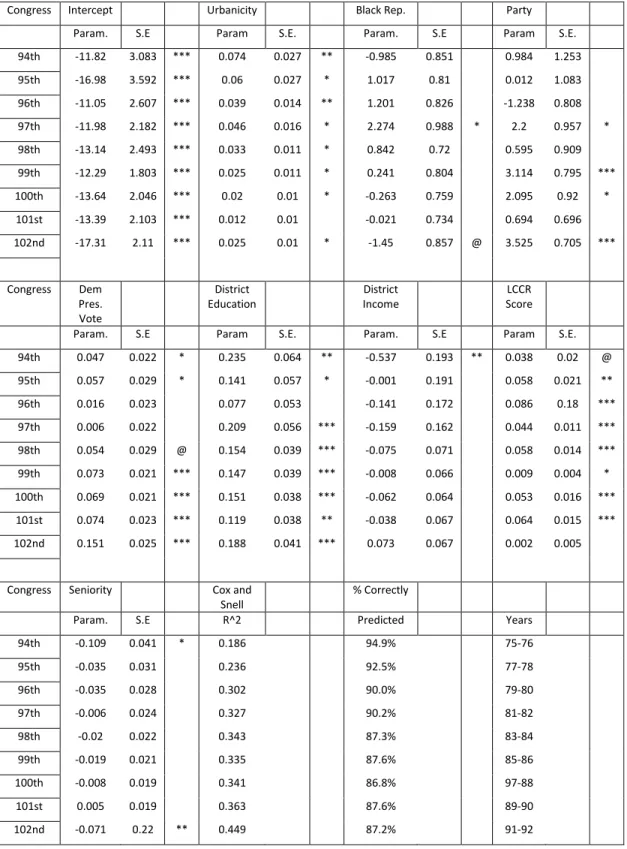
3-1. The Changing Basis of Support for the Gay Rights Bill in Congress ... 42
5-1. Multi-Level Logistic Regression for All Respondents and Democrats ... 88
5-2. Multi-Level Logistic Regression for Republicans and Independents ... 91
5-3. Multi-Level Logistic Regression for All Respondent and Democrats Only Controlling for Knowing Lesbians and Gay and Attribution of Homosexuality over Time ... 95
5-4. Multi-Level Logistic Regression for Republicans and Independents Only Controlling for Knowing Lesbians and Gay and Attribution of Homosexuality over Time ... 96
6-1. Regression Analysis of Experimental Data ... 124
7-1. Predicting Change in Bush Vote in Ohio (County-Level) ... 140
7-2. 2004 Ohio Exit Poll ... 144
7-3. 2004 National Exit Poll ... 145
7-4. Gay Adoption and the 2000-2002-2004 ANES Panel Study... 152
vii
LIST OF FIGURES
Figure Page
1-1. Stability and Political Issues ... 2
1-2. Social Issues and Public Opinion ... 3
1-3. Public Opinion Towards Same-Sex Relationships ... 4
1-4. The Number of Lesbian and Gay-Related Television News Stories and Major Fictional Characters on NBC, ABC, and CBS: 1968-2000... 7
1-5. Abstract Support for Lesbian and Gay Equality over Time ... 9
1-6. Interpersonal Contact with Lesbians and Gays and the Belief in a Origin of Homosexuality ... 13
3-1. Changing Effects of Race and District Urbanicity in Predicting Cosponsorship of the Gay Rights Bill: 1974-1992 ... 41
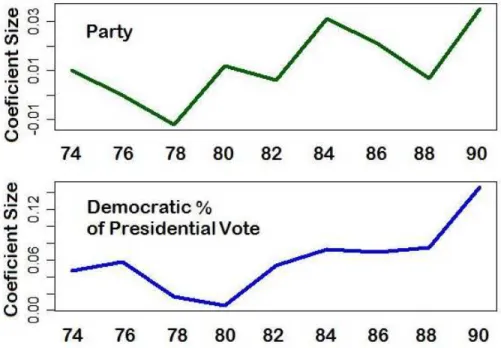
3-2. Changing Effects of Party and District Presidential Vote in Predicting Cosponsorship of the Gay Rights Bill: 1974-1992 ... 41
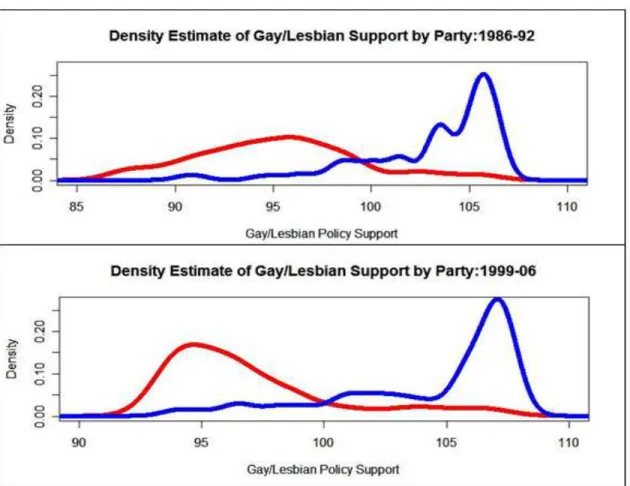
3-3. Density Estimates of Gay and Lesbian Policy Support for the Pre-Clinton House (1986-1992) and Contemporary House (1999-2000) ... 57
3-4. The Gay and Lesbian Policy Dimension in Congress Across Time ... 58
3-5. The Marginal Effect of Ideology (DW-NOMINATE) in Predicting Pro-Lesbian and Gay Policy Support in Congress by Party and Time Period ... 59
5-1. Public Opinion Towards Same-Sex Relationships ... 79
5-2. Partisan Change on Attitudes towards Same-Sex Relations ... 81
5-3. Cohort Effects on Attitudes Towards Same-Sex Relations ... 90
5-4. The Marginal Effect of an Additional Lesbian or Gay Television Character on Same-Sex Relation Attitudes Given TV Consumption ... 93
5-5. Estimated Probability of Support for Lesbian and Gay Job Protections by Period, Birthyear, and Party ... 98
viii
5-6. The Estimated Proportion of Public Opinion Change Due to Changes in Television, Demographics, Contact with Lesbians and Gays, and the
Biological Attribution of Homosexuality ... 99
5-7. Random Effects for Second Multilevel Model of Policy Attitudes towards Lesbians and Gay ... 100
6-1. Party Identification, Spring 2009 Study ... 114
6-2. Ideology, Spring 2009 Study ... 115
6-3. Lesbian and Gay Rights Support Scale Histogram, Spring 2009 Study ... 115
6-4. Histogram of Obama Feeling Thermometer, Fall 2008 Study ... 116
6-5. Histogram of Feeling Thermometer for John McCain, Fall 2008 Study ... 116
6-6. Histogram for George W. Bush Feeling Thermometer, Fall 2008 Study ... 117
6-7. Histogram of Feeling Thermometer for Sarah Palin, Fall 2008 Study ... 117
6-8. Mean Lesbian and Gay Rights Support Across by Experimental and Control Groups ... 121
7-1. Number of New Stories involving Gay Marriage by States with and without Ballot Measures on the Issue ... 134
7-2. The 2004 Presidential Vote and the Same-Sex Marriage Ban in Ohio (Counties) ... 137
7-3. Shift in Probability of Bush Vote Based on Gay Marriage Position ... 147
8-1. Timeline of Factors in Liberalization of Gay Rights Attitudes ... 160
8-2. Television, the 2004 Election, and Declining Acceptance towards Same-Sex Relations among Youth ... 161
AII-1. Image in “Obama” Condition ... 172
AII-2. Image in “McCain” Condition ... 174
AII-3. Image in “Ellen” Condition ... 175
AII-4. Image in Control Condition... 176
CHAPTER I
CHANGING MEDIA, CHANGING MINDS?
In the mid 1990s, a dramatic wave in the normally calm waters of public opinion began to form. The American public's attitudes towards lesbians and gays were changing and this change over the next fifteen years would be rapid. Immediately preceding this change, lesbians and gays began demanding the right to be portrayed in a positive
light in the news, on television, and on film. This wave of change happened most heavily among the nation's youth who normally inherit their parent's political positions and it mirrored prior changes in opinion that have occurred in thinking on racial equality and the role of women in society. Why, when most research shows that changes in what the public thinks are weak and ephemeral (Page and Shapiro 1992, Stimson 2004), did these issues change rapidly and in a single direction toward greater toleration? Why do we see differences between the young and old on these issues and not others (MacManus 1996)?
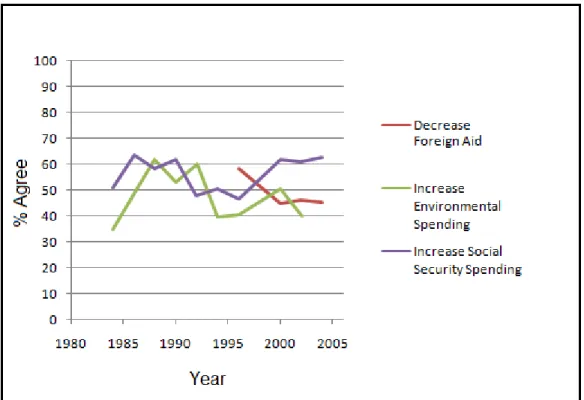
The key difference between trends on public opinion involving policy and governmental issues, or political issues, and trends in public opinion on social issues which involve attitudes on racial equality, gender roles, and minorities can be gleaned from examining Figures 1-1 and 1-2. Figures 1-1 and 1-2 contain examples of both of these two distinct types of public opinion issues. Figure 1-1 plots the change in attitudes on government spending levels for three different policy areas. Although these
preferences do change significantly over time, they do not appear to move towards a
2
point of broad consensus among the public. Contrast this with the issues displayed in Figure 1-2. Figure 1-2 shows attitudes on women working outside the home and attitudes on race-based integration of schools. Both issues show a sharp upward trajectory over time as a liberal public consensus slowly emerged. This trend toward liberal consensus is the key difference between political issues and social issues as discussed here.
Figure 1-1: Stability and Political Issues
These changes in public opinion that took place towards women and African- Americans in the 1960s and 1970s are similar to the shifts that took place towards lesbians and gays and their rights later in the 1990s. Figure 1-3 shows one of the earliest repeated survey questions on lesbian and gay rights over time asked by the General
3
Social Survey (GSS). The survey asked respondents if they thought sexual relations between members of the same-sex were wrong. From 1973 through 1990 the number of respondents who answered the most liberal category, “not wrong at all” was small and stayed small. Started in 1990s, however, a liberalizing trend emerged. More and more people started answering that there was nothing wrong with same-sex relations on the GSS during the 1990s and 2000s. In the most recent round of GSS interviews nearly 40% of the respondents stated that there was nothing wrong at all. In fact, among those under age 30, this has become the majority response.
Figure 1-2: Social Issues and Public Opinion
4
Figure 1-3: Public Opinion towards Same-Sex Relationship Source: the General Social Survey.
This presents a puzzle? Why do these social attitudes behave differently from other political attitudes? Why is it that social change has pervaded society since the 1960s and prior, heralding greater social liberalism with each generation, while political and economic issues have shifted back and forth between liberal and conservative eras and administrations with no consensus emerging (Stimson 1999, 2004)? Why has there been a marked liberalization in attitudes towards women, blacks, lesbians, gays and other minorities since the 1960s? The answer to this question has two parts. The first has to do with where the public receives some of their information on social identities and minority groups as opposed to their information on politics and political issues. Instead of relying merely on hard news---newspapers and television news programming---for information on most political issues, the public can extract social information on people in different
5
identity categories—minorities and women---from other media sources. Television portrayals, films, literature, or any other mass transmitted source, fictional or reality- based, can serve as information on the lives and beliefs of minorities. Positive portrayals can humanize individuals and erase the psychological barriers constructed between groups just as negative portrayals or silence can strengthen the misperceptions and misunderstandings that lead to animosities between minorities and majorities.
Most television and film relies on portraying the lives of individuals in novel situations in order to garner viewers. This presents a contrast to educating the public on government programs, policies, or political events and issues which is the purported goal of the news media. This gives opinion change on social issues a major advantage over opinion change on harder political and policy-related issues. Citizens can get information from pure entertainment, like a situation comedy, a drama or even a cartoon, rather than take time out of their busy lives to study an issue or watch a less entertaining and more difficult news program. Changes in public opinion can occur when there is a systematic and permanent change in the way the media, entertainment and news, presents the lives and issues of minorities. When women are shown working outside the home in films, the public ought to become more receptive to women working. When gays and lesbians appear on television in positive roles, the public ought to become less likely to view them as abominations. When African-Americans are shown as real people dealing the best they can with economic problems, thinking of them as inherently inferior becomes more difficult.
To describe permanent attitude change as if it where merely a construction of media and generational change, however, would result in missing a large piece of the
6
driving forces behind the social change process. Political parties and their leaders play a crucial role in advancing the interests of minorities. This role is as crucial as that of the media. The pronouncements and utterances of their leaders shape partisan identities in the mass public (Zaller 1992). When minorities gain some nontrivial amount of
resources through which to affect the political process, they can leverage it into coalitions with political leaders and particularly in places where they can affect electoral outcomes (McAdam 1999; Armstrong 2002; Clendinen and Nagourney 1999). Political elites can, in turn, move their adherents towards supporting the rights of the minority by openly embracing the minority though political communications. This effect of leaders on their followers’ attitudes about minorities has been a key finding of political science (Carmines and Stimson 1989). The approval of political elites signals to the television media that the mass public may be more receptive to a greater number of portrayals of that minority in fiction. For example, support for the rights of African-Americans and women at the political elite level were followed by a surge in liberal portrayals of African-Americans and women in the 1970s like George Jefferson on All in the Family or Mary Richards on The Mary Tyler Moore Show. While it is possible that the opposing party’s adherents may become less friendly towards the new group, eventually the intergenerational schism created by the media will force concessions in order for the more conservative party to appeal to young voters. This is the political process of social change. The interaction between political parties and the change in the media is crucial. Without each, change would not be possible.
Contrast Figure 1-3 with Figure 1-4. Figure 1-4 shows the number of television news stories on the big three network news channels, ABC, CBS, and NBC, which relate
7
to lesbian and gay issues for most of the later half of the 20th century. It also shows the rise in the number of lesbian and gay television characters on these same channels over the same time period. The number of television stories spikes in 1992 and 1993, with a sharp and sustained rise in television characters in 1995. These shifts take place at the
Figure 1-4: The Number of Lesbian and Gay-Related Television News Stories and Major Fictional Characters on NBC, ABC, and CBS: 1968-2000
start of the public’s wider attitude liberalization on lesbian and gay issues displayed GSS question in Figure 1-3. I will demonstrate that the more characters people watched and became comfortable with, the more tolerant their attitudes became. These shifts in television, along with the shifts in the Democratic Party’s support of lesbian and gay rights ultimately caused social change.
8
A Broad or a Narrow Liberalization?
Establishing that the GSS question above is representative of attitudes involving lesbian and gay rights in general and that all issues involving lesbian and gay equality are related would greatly aid this analysis. What do I mean when I say ‘public opinion towards lesbians and gays’? Public polling only sometimes asks questions over time on opinions as abstract as liking or disliking of a group and broad or narrow support for its rights. To create a more complete measure of support for lesbian and gay equality than any specific question, I would need to combine several different issues and questions that pertain to lesbian and gay rights as opposed to focusing a single specific issue that might go beyond lesbian and gay equality. For instance, a question involving employment protections for lesbians and gays might also reflect attitudes towards such laws for all groups, not just support for job protections for lesbians and gays. If a question, like the GSS above had a similar trend to a more abstract measure of support created from a broader range of issues, it specifically can used as a window to more complete understanding of public opinion towards lesbians and gays generally in an analysis.
In order to do this, I created a measure of public affect towards lesbians and gays similar to Stimson’s “public mood” (1999). The ‘public mood’ related to changes in the aggregate policy liberalism and conversativism of the public generally (1999, 2004).
Kellstedt (2003) has also found an underlying similarity in change on racial policy attitudes similar to the one demonstrated below on gay rights issues, although Kellstedt’s measure examines support for government intervention in erasing racial inequality rather than abstract support for that same equality.
9
Figure 1-5: Abstract Support for Lesbian and Gay Equality over Time
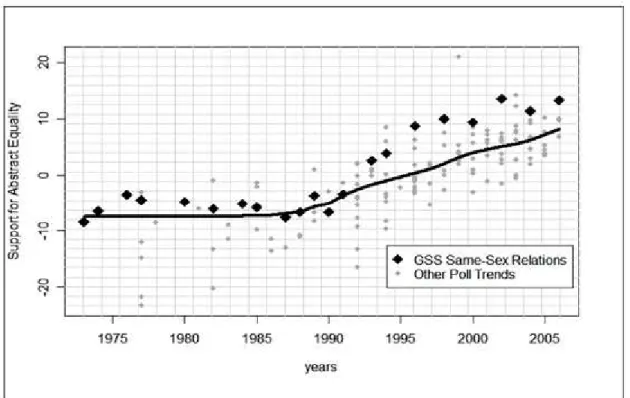
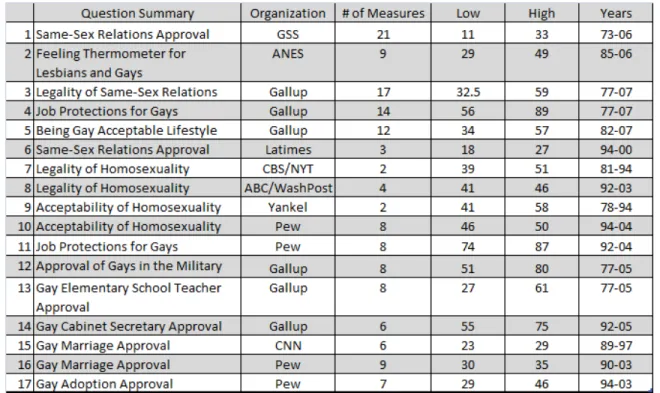
Figure 1-5 displays this abstract support for lesbian and gay equality in United States over time. This was derived by taking 17 questions concerning gay rights issues which were repeated over time and polled by the same organization. These polls are listed in Table 1-1 and involve attitudes towards job protections for lesbians and gays, support for same-sex marriage and adoption, support for gay teachers, support for a gay cabinet secretary, and many other issues involving some sort of equal social treatment for lesbians and gays. These questions represent a diverse source of issues and polling organizations. The mean of each specific question across time was subtracted from the percentage of respondents taking a pro-gay rights position. This mean-centered measure for each individual question is plotted on the graph using a gray circle for each year.
10
Although each of these issues has greater or lesser support among the public at any given time due to a variety of factors (Mucciaroni 2008), with the mean removed from each question we obtain a measure of the trend other time. The support for abstract equality obtained from these trends, and graphed using a black line in the figure, represents a LOWESS curve, or locally-weighted regression, fitted to the individual data points. The LOWESS curve fit shows the aggregate trend in the 17 repeated survey questions over time and adjusted for outliers. The trend on the General Social Survey’s question asking about public approval of same sex relations mentioned above is also overlaid in Figure 1- 5 and closely matches the overall trend in lesbian and gay equality support.
The public’s support for gay rights, as described by the abstract equality measure, remains static from the early 1970s to the mid 1980s. During the AIDS epidemic,
negative shifts in questions concerned with affect towards lesbians and gays offset positive shifts in questions regarding employment protections and broader civil rights.
However, in the early 1990s the public’s support for lesbian and gay rights increased rapidly and that support continues to grow into the present. Similarly, the aggregate mix of responses on the GSS question involving same-sex relations is static for over the first decade and a half of the survey’s run. Nearly 80 percent of the public choose the response that same sex relations were “always wrong” until 1991. After 1991, the number of people choosing the opposite response, “not wrong at all”, started to increase significantly and it mirrors the change in abstract equality. The GSS question is thus a representative question of the broader attitude change that occurred.
Except for some initial liberalization in the early 1990s, around the time of the election of Bill Clinton, the abstract equality measure closely matches that of the
11
television characters measure in Figure 1-4. The rise in television characters is a very much a plausible cause of the rise in abstract equality.
Other Factors in the Liberalization of Attitudes toward Homosexuality While media is key to my story of the public’s shift in public opinion towards lesbian and gays, several other alternative hypotheses have also been proposed, which I account for throughout the dissertation. However, each of these other factors likely also has changes in media and the behavior of political elites at their core.
The widely know delisting of homosexuality from the Diagnostic and Statistical Manual of the American Psychiatric Association (APA) has been created with causing attitude change towards lesbians and gays. These medical elites’ changing attitudes towards lesbians and gay are thought to have impacted the public (Zaller 1992).
However, the shift in the APA predated the larger shift in public opinion by twenty years, as illustrated by the shift in abstract equality. It is highly unlikely that it would take that long for the public to get the message. The shift in the APA’s attitudes is similar to the shift in medical thinking about intrinsic differences between the races that took place in the 1920s (Kinder and Sanders 1996; Gould 1996), but few would argue that a large scale liberalization on racial issues happened during that time period. Most would argue that events in the 1940s through the 1960s had more of a lasting impact on public opinion.
The changes of medical elites did have an impact, but the impact was likely the political cover they provided for the decisions of other elites in the political sphere.
Another potential factor has great normative appeal and has been embraced by the lesbian and gay movement. That factor involves lesbians and gays themselves being
12
responsible for change in public opinion through interpersonal contact and social networks. Lesbians and gays are more comfortable today revealing their sexual
orientation to family and friends and this increased contact may result in a liberalization of attitudes towards lesbians and gay. The number of people reportedly knowing gays and lesbians has increased. Also, research has shown that knowing someone gay has a positive effect on support for lesbian and gay rights (Altemeyer 2001; Lewis 2007).
The question that must be asked is why are gays and lesbians more likely to be out to more friends and family in the first place? It is likely that the increase in this phenomenon is also a function of media coverage. An increase in media portrayals likely increases the probability that gays and lesbians will feel comfortable ‘coming out’ and thus any interpersonal effect is an indirect effect of the media as well. Interpersonal contacts may also result from selection bias problems: gays and lesbians are more likely to come out to people whom they know are already supportive of lesbian and gay individuals and lesbian and gay rights (Lewis 2007). The number of ‘out’ gays and lesbians may also change over time, although it is equally difficult to assess whether this is due to an actual change in the number of people who think of themselves as gay and lesbian, or merely a change in the number who feel comfortable identifying on a survey (Villarroel et al. 2006). Fluctuations in the number of lesbian and gay (or homosexual) identified people in the U.S. are usually also within the margin of error of a standard survey (such as the GSS). This makes an assessment of the effect of a change in aggregate number of ‘out’ gays and lesbians on public opinion even more problematic.
However, the media climate does affect how lesbian and gay identities are constructed.
Historical evidence, which will be discussed in the next chapter, points to the late 1960s
13
and 1970s as the time when the lesbian and gay movement shifted their strategic focus to identity building activities including ‘coming out’, but public opinion change did not start shifting until the early 1990s. It seems unlikely that interpersonal contact alone would only start to be effective in the 1990s, since the gay and lesbian movement had
experienced more growth prior to those years. It took something else to make lesbians and gays more comfortable revealing their identity to others, and that was media representation.
Figure 1-6. Interpersonal Contact with Lesbian and Gays and the Belief in a Biological Origin of Homosexuality
Another alternative theory to explain attitude liberalization has been proposed by Haider-Markel and Joslyn (2008). They examine the relationship between those who believe in a biological or an ‘essential’ cause of homosexuality and find a strong
14
relationship between those holding this attitude and individual level support for lesbian and gay rights. They also find a strong aggregate level correlation.
Haider-Markel and Joslyn’s thesis has strong merit. A large number of medical articles and research on biological causations of homosexuality emerged in the early 1990s concurrent with the start of attitude liberalization, giving the thesis strong validity (Levay 1996). It is hard to imagine that this medical research is not exogenous to other forces, however. Figure 1-6 shows the rise in the percentage of people reporting contact with lesbians and gays and those believing in some sort of biological causation. Both of these hypotheses will be tested in the later chapters along with the hypothesis that social change was caused by the changing behavior of politicians and the rise of lesbians and gays in news and fictional media.
In sum, medical elites, contact with gays, and attitudes towards a biological cause of homosexuality all may contribute to the liberalization in attitudes towards lesbians and gays, but the primary factors are likely shifts in political elite and the media. Increases in
‘coming out’ are likely caused by media shifts. The timing of the APA decision doesn’t match the time that attitude liberalization became. The biological cause argument has the most merit, but the fact that only 40% of the public hold this attitude, as illustrated in Figure 1-6, means that even it is unlikely to be the cause of the bulk of the liberalization.
Outline of the Dissertation
Although I argue public opinion in partially elite led, attention needs to be paid to the factors that cause, and sometimes force, these elites to lead. The owners of television networks would not allow characters on the air that would offend public sensibility and
15
thus harm their ratings and profits. Politicians, likewise, are reluctant to change their public positions on issues. A politician’s shifting to support the civil rights of a very unpopular minority, especially one associated with immorality, would be anathema to winning reelection. A number of changes needed to take place in American politics before lesbian and gay rights could find support at elite levels. I demonstrate that for these changes to take place, a shift in the behavior of the lesbian and gay movement and the internal psychology of its members needed to take place. The change from a
mentality of advocating for lesbian and gay integration into American culture to a mentality of creating a separate subcultural social identity occurred in the 1960s. Once the gay and lesbian movement started developing a shared collective identity, liberal and Democratic politicians in cities that contained a sizable number of lesbians and gays could fashion appeals for votes based on advocacy for that identity. Chapter 2 explains some of the history of the lesbian and gay movement and its paradigmatic shift in the late 1960s and early 1970s. The defining moment of this shift was the 1969 Stonewall Riots in Manhattan.
The change in the behavior of politicians seeking elected office and reelection is the focus of Chapter 3. In order to gain votes, activists, and funds, Democratic politicians in the urban districts of San Francisco and Manhattan started supporting lesbian and gay rights. Later as the lesbian and gay movement institutionalized in the 1980s, interest groups developed which tried to provide the same resources not based on urban
geography, but based on party. In addition, Republicans, some of which had supported lesbian and gays partially in the 1980s, shifted rightward on gay rights in the 1990s to appeal to the social conservative activists emerging as one of their core constituencies.
16
The election of a pro-gay Democratic president in 1992 cemented the partisan cleavage thereafter.
Chapter 4 provides a background on previous research on public opinion change, and then draws on this previous research to form hypotheses regarding public opinion change on social issues. Partisanship and media exposure are major factors in
liberalization. In addition, young people are particularly susceptible to changes in media due to the lack of a reference frame about socially appropriate behavior that older
individuals have based on past media exposure. I test this theory in the later chapters.
Using a wide variety of survey data, Chapter 5 then determines why public opinion shifted. I find that the shift in elite attitudes triggered the start of public opinion change. Democrats in the public started liberalizing after Bill Clinton, who supported the lesbian and gay minority, was elected president. Furthermore, Clinton’s convincing win signaled to Hollywood that putting a substantially larger number of lesbian and gay characters on television would no longer deeply offend the public since Clinton’s support had not damaged his candidacy in 1992. This sustained and diversified the liberalization of attitudes beyond Democrats and also concentrated it in those whom had never
encountered any information on lesbians and gays before: the nation’s youth.
Of course, casual direction is a potential problem in Chapter 5. Did media cause or reflect public opinion change? In Chapter 6, I confirm using an experimental design that messages are causally prior to a change in attitudes. When individuals are exposed to a lesbian-identified individual via a mock interview, I find attitude change. This chapter demonstrates that more lesbian and gay television characters cause attitude liberalization.
17
Chapter 7 examines on potential consequence of opinion liberalization. As support for same-sex marriage increased, President George W. Bush used his position against same-sex marriage to appeal to voters. Although the media focused on states with ballot propositions banning same-sex marriage, I find evidence that same-sex marriage had a national effect on vote choice in the 2004 presidential election, which challenges previously published research (Donavan et al. 2005; Campbell and Monson 2005). Clinton’s election in 1992 helped liberalize lesbian and gay attitudes in the 1990s.
More liberal attitudes towards lesbians and gays may have helped reelect George W.
Bush by making lesbian and gay rights a partisan issue that Democrat can no directly oppose or anger their base.
Chapter 8 contains my conclusion and final thoughts on media and elite led social change in the wake of Barack Obama’s election as a purportedly pro-gay president and the nation’s first president with an African heritage. Barack Obama could lead on lesbian and gay issues as Clinton had attempted to do in 1993 and inspire greater liberalization, but risk his greater agenda if a backlash emerges. Else, he could attempt to bury his support for lesbian and gay rights under other pressing issues like the economic crisis and healthcare in order to avoid the backlash Clinton faced.
18
Table 1.1: Summary of Questions Used to Construct Abstract Equality Measure
19 CHAPTER II
THE THEORETICAL, HISTORICAL, AND PSYCHOLOGICAL ORIGINS OF THE LESBIAN AND GAY MOVEMENT
Political elites have an impact on the attitudes of their followers (Carmines and Stimson 1989; Zaller 1992). But they are also beholden to those followers for votes and reelection. They are thus averse to taking positions that would endanger their jobs as elected officials (Mayhew 1974). For instance lesbians and gays have traditionally been one of the least liked groups on the National Election Study’s battery of feeling
thermometers which ask individuals to rate groups and people on a scale from 0 to 100 with 100 being warm and 0 being cold. The mean rating of lesbians and gays was 28.5 even as late as 1988, which placed them well below Hispanics, Blacks, Christian fundamentalists, people on welfare, and even illegal aliens (Yang 1997). How is it possible that an unpopular minority, like lesbians and gays, could eventually gain the support of political elites whose electoral interests seem so opposed to being associated with a disliked social group?
The solution to this riddle is complicated, but crucial to understanding how an unpopular group can change the public’s attitudes about them. In this chapter I trace the history of the lesbian and gay movement to determine how it first gained the support of elected officials and eventually became a valued constituency of the Democratic Party.
The outcome required a shift in the ideology (or social movement frame) of the lesbian and gay movement from one of integration into the existing social order to one of
20
articulating a collective lesbian and gay identity. Except for a brief period in early 1950s Los Angeles, this did not happen until the late 1960s.
The Nature of Research in the Lesbian and Gay Movement
An old Indian legend can easily illustrate the ways in which academics from diverse disciplines have tried to establish the origins of the gay and lesbian movement. I shall now take great creative license in retelling it.
Three blind men walk into a room with an object they are trying to identify.
Without sight to see the object, they reach out their hands and feel the texture and shape of it. One man says, “It’s a wall”. He then describes a wide, rubbery surface a few feet off the ground. The second states, “No, No, It has to be a spear”. The second man then tells of a long cylindrical object he feels coming to a distinct and sharp point. The third man is dumbfounded at the first two. “It’s clearly a hose,” he replies. He relays to the other two that he has grasped a long flexible tube a few feet off the ground. The object, which none of the men could identify from their own limited perspectives, was an elephant. It announced its presence with a distinctive trumpeting sound emanating from its trunk. The three men had been focusing on the elephant’s side, tusk, and trunk, respectively, all parts of the same whole.
The same phenomenon of limited individual perspectives repeats itself over and over every time a problem as complex as social change or a social movement becomes an object of analysis for the social sciences and humanities. Psychologists focus on the cognitive changes taking place in individuals in a social movement at any given time.
The ways in which members of minorities and majorities think about their social status
21
and the attribution of that status is paramount. Rational choice theorists look at the complex costs and benefits that actors in a social movement deal with in determining their actions. Sociologists look at cultural changes spawned by movements and how or why formal organizations spin off from them. Historians chronicle events and the lives of individual leaders of movements. Political Scientists focus on the interaction between the various branches of government and social movements. Philosophers and political theorists read the documents produced by movements and study how they establish their legitimacy and the validity of arguments they make for their brand of social change.
Because the origin of the lesbian and gay movement has been told from so many different perspectives, this chapter will be necessarily incomplete. My goal here is to give an overview of the historical events that lead to the modern lesbian and gay
movement, the theoretical understandings of a legitimate society that motivated activists, and some of the psychological theories that might lead to better scientific understanding of those who participated and continue to participate and which led to movement success.
These aspects of the lesbian and gay movement are crucial to understanding why politicians would eventually court their votes actively despite public opinion. Several books and articles have already been written that go into these events and theories into greater detail (Armstrong 2002; D’Emilio 1998, 2000; Clendinen and Nagourney 1999;
Engel 2001; Jagose 1996; Mucciaroni 2008; Rimmerman 2000, 2002, 2008; Bull and Gallagher 1996; Duberman 1993). I will try to go into enough detail to illuminate the historical background of the following empirical chapters, but not to go into so much detail so as to delay the analysis of the effects that the lesbian and gay movement had on the party system, culture, and ultimately public opinion outlined in the coming chapters.
22
The Conception of Homosexual Identity
Germany in 1871 is an unlikely place to start a dissertation on American attitudes toward lesbians and gays. But it was in this year the German Empire adopted paragraph 175, a law criminalizing consensual sex between men (Jagose 1996). Laws had existed prior to this banning homosexuality, but the adoption and debate concerning
homosexuality shifted during this time period. The justification for such laws prior to this one had been religious in nature. What the debate concerning paragraph 175 emphasized, however, was not sin and the act of sodomy itself, but some sort of long- term characteristic of the individuals who engaged in sodomy.
The origins of this shift, its relation to the industrial revolution and urbanization, and its precise timing, have been much debated. The rise of the medical community and the enlightenment notions of sickness and treatment of disease are major causes of this shift (Foucault 1978). Over the centuries homosexual behavior had been considered at most a sinful act and probably something on par with an extramarital affair. Now with the rise of the medical community and concept of treatable disease, the justifications for laws against homosexuality had shifted to protecting the community from a sickness.
Homosexuality was no longer just considered an act engaged in by an individual. The emphasis was now on those who engaged in that act. They were now suspected of being different from other people and, by the medical community, of having a chronic
biological or mental defect. As the justification for laws shifted during the enlightenment from those justified by religious reasons or by the whims of a monarch, the public good became the paramount reason for legislation (Jagose 1996; Foucault 1978).
23
This marks the beginning of the notion of essentialism with regard to homosexuality. The essentialist theory states that homosexuality is not just acts of sodomy, but a long term characteristic of the individual who engages in those acts.
What was a short term moral lapse had now morphed conceptually into a homosexual identity for the polity. An important aspect of essentialism is that the identity has been decoupled from the act of sodomy. An individual could be completely celibate, but still be considered a homosexual. This disjunction marks the birth of the modern notion of homosexuality: homosexuality as identity.
World War II, the Kinsey Report, and the Homophile Movement
Enclaves of homosexuals developed as the population of the country relocated to urban areas and immigration swelled most large cities in the late 19th and early 20th centuries in the US. D’Emilio (1998) cites these changes as the cause of modern homosexuality. Interpersonal contact between homosexuals increased over this time period. As certain bohemian areas became known for having many lesbians and gays, more lesbians and gays moved in due to the reputation. According to D’Emilio, “a small but stable group life was forming (p. 22)”.
Somewhat counter-intuitively World War II effectively gave this process a shot in the arm. Traditional gender roles were ripped asunder as males left for overseas and women were mobilized into industry. The same-sex environment was freeing for many homosexuals both in the military and on the home front. Lasting friendships and relationships survived the hostilities (D’Emilio 1998). These were the social webs that
24
lead to the first rumblings of the lesbian and gay movement (Scagliotti, Schiller, and Rosenberg 1985).
Biological research would soon aid these social webs and deeply undermine the justification of laws criminalizing same-sex relations. In 1948, zoologist Alfred C.
Kinsey, with Wardell B. Pomeroy and Clyde E. Martin, published the widely read Sexual Behavior in the Human Male based on a set of 12,000 interviews performed by the authors. A volume on women followed soon after (Kinsey et al. 1953). The original study argued that the percentage of the public with a homosexual predisposition was close to 10%, a figure much greater than previously thought. Although the study had severe methodological flaws, and modern surveys have placed the percentage closer to 5% (Levay 1996), that number became greatly significant to the homosexual community in the United States. It signified to those who would form the movement that they had a potentially large group of compatriots similar in size to that of the Jewish community or the size of the Latino community in the United States during that time period.
The distinctive feature of the Kinsey study was the tone in which the article discussed same-sex behavior. Kinsey theorized sexual behavior as a continuum using a seven point scale between exclusively homosexual and exclusively heterosexual. This is different than the previously thought of as discrete identity categories of homosexual and heterosexual, although Freud (1995) had theorized that all individuals were bisexual by nature (Jagose 1996). But the larger issue in Kinsey’s work is the normative break he makes from the older medical literature.
The opinion that homosexual activity in itself provides evidence of a psychopathic personality is materially challenged by these incidence and frequency data. Of the 40 or 50 per cent of the male population which has homosexual experience, certainly a high proportion would not be considered
25
psychopathic personalities on the basis of anything else in their histories. … psychiatrists and clinicians in general might very well re-examine their justification for demanding that all persons conform to particular patterns of behavior. As a matter of fact, there is an increasing proportion of the most skilled psychiatrists who make no attempt to re-direct behavior, but who devote their attention to helping an individual accept himself, … (p.660)
He concludes the chapter entitled ‘Homosexual Outlet’ with the following paragraph:
If all persons with any trace of homosexual history, or those who were predominantly homosexual, were eliminated from the population today, there is no reason for believing that the incidence of the homosexual in the next
generation would be materially reduced. The homosexual has been a significant part of human activity ever since the dawn of history, primarily because it is an expression of capacities that are basic in the human animal (p.666).
Although Kinsey’s work was scientifically flawed, it affected both the medical establishment, where some individuals began to reevaluate the notion of homosexuals as holding psychopathic tendencies, and a large number of homosexuals going into 1950s.
Dr. Evelyn Hooker would later specifically study differences in the psychopathology between heterosexuals and homosexuals at the urging of a gay individual and confirm Kinsey’s hypothesis (Marcus 2002; Zaller 1992).
Not long after the Kinsey Report was released, the first formal lesbian and gay organizations began forming on the West Coast. This set of organized and mostly local lesbian and gay organizations became known as the homophile movement. They began when a former member of the Communist Party named Harry Hay met with a group of his gay friends specifically about creating a political organization for homosexuals (D’Emilio 1998). Although Hay was no longer active in the Communist Party, he drew loosely both on the theoretical arguments of Marxism and the organizational skills he had learned from the party. Hay and the early members of his organization developed a class- based analysis of a society divided by sexual orientation. ‘Liberation’ would come only
26
from concerted action by the oppressed, in this case homosexuals in place of the proletariat. The organization also believed in educating homosexuals to think of
themselves as an oppressed minority (D’Emilio 1998; Scaglioitti, Schiller, and Rosenberg 1985; Engel 2002). This conceptual innovation adopted from Marxist philosophy is similar to the consciousness raising that would later take place in the women’s movement in the 1960s and 1970s. It would prove later to be crucial in the broader lesbian and gay movement that developed in the late 1960s and early 1970s.
Their organization became known as the Mattachine Society. It developed as an underground, centralized society based around the Communist Party model. Members would join a cell, and when one cell got too large it would split (D’Emilio 1998). For an unpopular minority that could blend into society easily, this organizational model proved extremely effective. As it developed, it came to thrive throughout most of Southern California and branched into the Bay Area. As time went on, it eventually branched out to other major population centers like Chicago and New York City. Although the organization was predominantly male, women were included as well. Soon a separate organization formed in San Francisco for lesbians, the Daughters of Bilitis, and published a newsletter, The Ladder (Jagose 1996). The homophile movement largely became sex segregated at least at a local level due to problems incorporating gender differences as women left for other homophile organizations (D’Emilio 1998; Clendinen and
Nagourney 1999).
More important than the new members’ geographic locations were the different backgrounds and demographics of the new members. Although the early members had been leftists and hence outside the political mainstream, newer members were much more
27
diverse in their political views and professions (if not their race and gender). The new membership in Southern California created a schism in the organization. This was between the original members who favored more radical social change on one hand and those who believed more or less in the preexisting social order in the United States with the exception of the inferior place of homosexuals within that order. A series of changes started to take place within the organization. First it went above ground and radically changed its structure. Instead of separate cells, the organization now had a traditional president, executive committee, and meeting times like most traditional community organizations today (D’Emilio 1998).
The major divergence in outlook between the newcomers and older members revolved around what the preferred social identity that the organization should advocate for should be. Should the organization try to articulate the homosexual as a distinct social and political identity from mainstream society, one that believes in radical social change involving sexual liberalization, non-traditional gender-roles, a more equal society between all individuals, and a broad advocacy for social justice? Or should the
Mattachine Society try to advocate that homosexuals were no different from other members of society except for their choice of sexual partners? The older and more liberal members tended to take the former position, while the newcomers and more conservative members (not necessarily in a political sense) tended believe in the later (Rimmerman 2002; D’Emilio 2000). In the end, perhaps because of the conservative nature of the 1950s and the political need to distance itself from its communist origins, the latter members won out. Considering the McCarthy hearings would soon take place and that homosexuals in general were suspected of aiding communists (Johnson 2004), a
28
change that helped distance the organization from its former communist founders may have helped the organization survive (nominally) into the 1960s.
As an above ground, traditionally-minded advocacy organization, however, the Mattachine society proved to be less successful with membership retention and
recruitment than in the earlier below ground period. Without a clear message of liberation from gay oppression or an affirmative identity and life to advocate for, the Mattachine Society survived but stagnated throughout the 1950s and 1960s. It would take an interaction with a much broader network of social movements to rekindle the potential of a nationwide lesbian and gay rights movement.
The 1960s and the Creation of the Modern Lesbian and Gay Movement Lesbians and gays could not claim a single national elected official that was openly supportive of their rights during the 1950s and 1960s. Something needed to change for the movement to lobby elites effectively. The activity that changed the movement was the development of a collective identity. This grew its ranks and pushed sexuality into a more central psychological role for those involved in it.
While the 1950s was a conservative decade that inhibited the lesbian and gay rights movement, the 1960s would provide a number of factors conducive to a
widespread surge in its activity. Chief among these were the tactics developed by other identity-based movements like the Civil Rights Movement and the Women’s Movement (Scagliotti, Schiller, and Rosenberg 1985). These tactics would help the movement grow into a network of organizations capable of lobbying the leaders and elites that held influence over public opinion. The normalization of identity-based advocacy politics in
29
the 1960s made the ideas which proved successful for the radicals in the early Mattachine Society less controversial. In addition, the 1960s had led to a marked liberalization in the sexual attitudes of America’s youth. Although this did not always directly affect social mores toward homosexuality, it provided a crucial link between freedom, which all Americans support on an abstract level, and sexuality.
The Civil Rights Movement, the Women’s Movement, and later the Black Power movement that emerged all contributed to the lesbian and gay rights movement
specifically. A number of tactics that proved successful for these movements spread to the lesbian and gay rights movement as new and more radical local organizations formed.
Most notable, civil disobedience tactics would be used by the new Gay Activists Alliance (GAA) which formed in lower Manhattan (Clendinen and Nagourney 1999). In
Washington, DC members of one of the more liberal branches of Mattachine picketed the White House to lobby for an end to discrimination in the civil service against lesbians and gays (Engel 2002; Johnson 2004).
The key innovation that defined this newer wave of organizations was a devotion to articulating a collective identity different from the mainstream. Feminist, Black, Native-American, lesbian, gay, disabled, Latino, Baptist, Irish, or any other category that can have social or political meaning could form th basis of an identity movement.
‘Consciousness raising’ was a crucial part of the movement for gender-based equality and was an attempt to make women self-aware of the disadvantages they have in society solely due to their identity as woman. As the black power movement developed, ‘Black is Beautiful’ became a simple slogan of affirmation stating that being African-American was something of value and an identity that should be respected in society. Much of the
30
success of an identity-based lesbian and gay movement in the late 1960s can be attributed to these other new identity-based social movements. They rendered the identity-based politics that failed in the 1950s for Mattachine more intelligible and adoptable for would- be activists in the late 1960s.
Unlike the conservative message of no-difference between homosexuals and heterosexuals that the later Mattachine adopted, identity articulation involves embracing the differences and advocating that holding the specific identity is a good thing for individuals. This made it easier to create a subculture among activists that strengthened the interdependence of individuals with the activist group and raised its members’ self- esteem. For instance, those who claimed ‘Black is Beautiful’ were in most cases
asserting that being African-American and being proud of being African-American were good things for psychological health. They would also not advocate abandoning Black subculture for mainstream American culture in general. Gay activists even developed a similar slogan to ‘Black is Beautiful’ in the late 1960s, ‘Gay is Good’. The words lesbian and gay themselves became popularized in the lesbian and gay subculture as an act of identity articulation.
Examples of cultural symbols relating to the gay and lesbian movement also date to this period, including the intra-movement usage of the terms lesbian and gay and the rainbow symbol. However, the largest evidence of a surge in the lesbian and gay movement involves a sharp increase in the number of lesbian and gay organizations that developed in this time period and during the 1970s. These organizations marked the expansion of the movement and the growth of a potential for a larger impact on politics.
31
Elizabeth Armstrong, a sociologist, catalogued the ideological social movement frames of several lesbian and gay organizations operating in San Francisco during this time period (2002). Her classification scheme involves categories for the more
conservative homophile organizations, the more liberal gay liberation organizations that emphasized a shared struggle with other identity-based movements of the New Left (including the women’s and black power movements), and organizations that specialized in developing a shared identity among lesbian and gays without a broader political goal.
She found that nearly all lesbian and gay related organizations operating in the early and mid 1960s San Francisco were homophile organizations. However, in 1969 and 1970 organizations affiliated with gay liberation and identity-based politics emerged in San Francisco. By 1971 the numbers of these three different types of organizations were at parity. By 1973, the identity based organizations clearly outnumbered the other two types. As both the conservative homophile movement and the radical New Left declined in the late 1970s, the number of lesbian and gay organizations affiliated with these two movements evaporated, leaving only the identity-based organizations in their wake.
Meanwhile, the number of identity-based organizations not affiliated with the New Left in San Francisco exploded. Armstrong noted a few dozen organizations in the 1970s. By the 1980s, San Francisco had several hundred. Accounts of movement
activity in the urban centers of Manhattan and Los Angeles point to similar patterns, with radical gay liberation organizations associated with the New Left (including the GAA mentioned above) developing in the late 1960s alongside the remaining homophile organizations, and both giving way to less political organizations that emphasized a shared social and political identity (Clendinen and Nagourney 1999; Armstrong 2002;
32
D’Emilio 2000; Marcus 2002). The Stonewall Riots in Manhattan, which took place on June 28th, 1969, were both an outpouring of the new collective consciousness of lesbians and gays and also a symbol that strengthened that identity and solidified the idea of a shared struggle (Duberman 1993; Clendinen and Nagourney 1999). The rioters were identified as lesbians and gays and were demanding an end to police harassment of lesbians and gays. This would have not been possible without a collective identity shared by a massive number of individuals.
Why Identity Politics?: Social Identity Theory and Movement Development Something had truly changed in the urban centers. When the number of
individuals and organizations associated with a group explodes in a short period of time, entrepreneurial politicians and leaders take notice. These organizations and the collective identity they created and expanded make them successful and brought more individuals into that identity. Appeals for political support and promises of issue advocacy by elected officials become possible. Why would organizations that emphasized a shared identity be so successful in establishing a large social movement that endured, while other types of organizations such as the conservative homophile movement and the New Left gay liberation movement collapsed? Understanding the psychological gains versus the costs of participation would help us to understand how identity-based movements and the individuals involved within those movements are capable of producing lasting and dramatic shifts in public opinion, while advocacy organizations involving political issues like the redistribution of wealth or government services cannot. A viable explanation comes from social identity theory.
33
Social identity theory and its successor, self-categorization theory, were developed by Tajfel and Turner (1986) in an effort to describe human behavior concerning the relationship between collective (or group) identities and personal individual identities. They sought to understand when individuals sometimes act as interchangeable members of a group (soldiers in an army, rioters in a crowd, or members of a political party) and when they act as individuals divorced from the groups that they are members in. Turner and Tajfel originally proposed social identity theory as a solution to understand the collective behavior of groups.
The key aspect of social identity theory involves thinking of a specific collective identity and an individual’s personal identity as if they were at two ends of a continuum (Tajfel and Turner 1986). Depending on the salience of the social identity to the
individual in a specific context, they will think and behave as if they were a stereotypical member of a group, or, if their collective identities were not salient, as an individual.
Individuals also seek a positive social identity, one with prestige and esteem. A positive social identity is based on favorable comparisons between social groups. When an individual is a member of a group viewed as unfavorable by society, she or he will either seek to leave the group, compare their group with the other group on a different
dimension, or engage in a social conflict in order to change the social value of their group. To the extent that a society is marked by a belief system that incorporates mobility between groups based on effort, hard work, or luck, group membership and identities should be less central to the society. If individuals believe that there is little to no social mobility between groups then identity categories, and stereotypes based on them, will pervade and dominant social life.
34
Turner (Turner et al. 1987; Turner 1991) proposed self-categorization theory as a refinement on social identity theory. While social identity theory, as it was originally proposed, was an effort to describe intergroup relations, self-categorization theory is an attempt to describe the psychology of individuals and their relationship to shared collective identities. It maintains the idea of a continuum between social and personal identities for individuals. Collective identities are shared social categories that an individual can classify himself or herself as. To the extent that a self-classification as a member of a shared collective identity is made salient, an individual will behave as if a stereotypical member of that group. Which self-category is salient is related to its fit to the situation a person is in. There are two aspects to fit, comparative and normative.
Comparative fit is defined by the meta-contrast principle. When the differences between groups on a specific dimension are larger than the differences inside a group, there is a high meta-contrast, and group identity has a higher comparative fit. When the
differences within groups are larger than the differences between groups there is a low meta-contrast and group identity is less likely. Normative fit involves the
correspondence between the stereotypical aspects of the groups and the individuals’
expectations of those stereotypes from past experiences. When fit is high and the collective identity of a group is made salient, we should see the behavior of the group converge as compared to situations when personal identity is salient.
Social identity theory appears to explain the successful nature of an identity-based gay and lesbian politics in the following way. Recall that individuals seek a positive self- identity. By emphasizing that gays and lesbians have a significant shared social and political identity, and a positive shared identity, the lesbian and gay movement was able
35
to raise the self-esteem of its individual members (“Gay is Good”). Once the identity was established and reinforced in small social groups, it spread in a rapid fashion both during the early period of the Mattachine Society in Southern California and later in the major urban centers in San Francisco, Manhattan, and West Los Angeles in the late 1960s (the Stonewall Riots) and early 1970s. The New Left gay liberation organizations and the more insular gay-identity organizations that developed immediately after them both thrived on an identity-based politics. However, gay liberation organizations required a more active membership devoted to a wider range of social justice issues than just articulating a lesbian or gay identity. As the new left collapsed, only the more narrow organizations that focused solely on a gay identity survived and thrived. The New Left organizations required much more activity than the other identity-based organization but had a similar payoff in self-esteem.
The identity based organizations proved so successful that lesbian and gay subcultures developed almost overnight in the major urban centers. Homosexuals interacting and going to bars in these places were nothing new. However what had been an underground of informal social and sexual networks spread and transformed into something more.
Conclusion
The late 1960s and the rise of lesbian and gay-based organizations in that time period likely increased the salience of that identity for homosexuals. This was especially the case in the urban centers that housed the majority of these organizations. This
strengthened identity would led to more organizations which would strengthen the
36
identities of more individuals in a cycle that reinforced itself until nearly all homosexuals who were not completely predisposed against thinking of themselves as lesbian or gay for religious or moral reasons had adopted a lesbian or gay identity in San Francisco,
Manhattan, and west Los Angeles.
With a shared identity, an identity that could provide a basis for activism, politics, and political mobilization, politicians in these regions could now make appeals to those who held the new identity for money, support, volunteers, and, most important to
politicians, votes. The focus of the next chapter involves the changing behavior of elites in urban centers in response to this new identity.
37 CHAPTER III
THE LESBIAN AND GAY MOVEMENT AND THEIR REPRESENTATIVES
The shift in focus by lesbian and gay activists to an identity-based movement built on the examples of the Civil Rights movement, the women’s movement, and other
movements of the New Left has resulted in the creation of a lesbian and gay subculture now self-aware of its minority and subordinate status. This shared collective identity gave politicians in urban centers a new tool through which to appeal for votes in return for advocating for the group’s interests. This chapter analyzes support for lesbian and gay issues among members of Congress and, in particular, the House of Representatives.
It should be keep in mind that although a number of representatives became supportive of lesbian and gay issues in the 1970s, the broader public’s attitude towards lesbians and gays had not yet begun to liberalize. Politicians, even those in San
Francisco and Manhattan, would be taking a risk by coming out in favor of lesbian and gay rights. In the atmosphere of the 1970s, such support, even if it resulted in winning a local election, may come back to haunt a politician if they desired to run for statewide office even in New York and California. In fact the first two politicians to seek the lesbian and gay vote actively would both run for statewide office later in their careers.
Because of the group’s unpopularity, the lesbian and gay community itself was surprised when Diane Feinstein showed up at a candidate’s night for the Society for Individuals Rights (or SIR), a gay organization, and affirmed her support for the equal rights of lesbians and gays in 1969. Feinstein was running for the board of supervisors of
38
San Francisco (Armstrong 2002; Bailey 1999). Similarly, Bella Abzug, a women’s rights advocate in Manhattan, went as far as to campaign in gay bath houses during a run for New York’s 19th congressional district in 1970 (Clendinen and Nagourney 1999). Both were ultimately successful.
Something had changed in Manhattan and San Francisco A collective identity among gays and lesbians now allowed politicians to target appeals specifically towards this emerging identity group by promising support for lesbian and gay rights. Because of the shift to an identity-based politics in the lesbian and gay community, they would receive a sizable bloc of votes in return. This was simply not possible prior to the shifts that took place in the movement in the late 1960s. In this earlier era, seeking support of gays and lesbians would have been interpreted by the broader public (and even by some homosexuals) as akin to campaigning for the votes of felons or psychopaths. Although a scattered number of activists had adopted a lesbian or gay identity prior to the late 1960s, the number was likely small enough so as not to motivate a change in behavior by liberal activists running for political office.
The concentration of homosexuals in New York City and the Bay Area of California—in combination with the shift to an identity-based movement—drastically expanded the number of members of Congress susceptible to such appeals. Although western Los Angeles also had a large number of homosexuals and a spike in movement activity (Clendinen and Nagourney 1999), the geographical and demographic vastness of the city likely diluted the impact of potential lesbian and gay votes. This may explain the lack of a candidate like Feinstein or Abzug in Los Angeles, although a successful
political action committee had developed in L.A. to support lesbian and gay friendly