Copyright © 2018 Alexander Gabriel Sosler
All rights reserved. The Southern Baptist Theological Seminary has permission to reproduce and disseminate this document in any form by any means for purposes chosen by the Seminary, including, without limitation, preservation or instruction.
WHAT IS CHRISTIAN HIGHER EDUCATION FOR?
AN ASSESSMENT OF TELEOLOGICAL PRIORITIES AT SELECTED LIBERAL
ARTS INSTITUTIONS
__________________
A Thesis Presented to the Faculty of
The Southern Baptist Theological Seminary
__________________
In Partial Fulfillment
of the Requirements for the Degree Doctor of Education
__________________
by
Alexander Gabriel Sosler December 2018
APPROVAL SHEET
WHAT IS CHRISTIAN HIGHER EDUCATION FOR?
AN ASSESSMENT OF TELEOLOGICAL PRIORITIES AT SELECTED LIBERAL
ARTS INSTITUTIONS Alexander Gabriel Sosler
Read and Approved by:
__________________________________________
John David Trentham (Chair)
__________________________________________
Kevin M. Jones, Sr.
Date ______________________________
TABLE OF CONTENTS
Page
LIST OF TABLES . . . v
LIST OF FIGURES . . . vi
PREFACE . . . vii
Chapter 1. INTRODUCTION . . . 1
Introduction of the Research Problem . . . 2
Current Status of the Research Problem . . . 8
Philosophical-Educational Foundations . . . 10
Anthropological Foundations . . . 15
Research Purpose Statement . . . 24
Research Questions . . . 24
Definitions . . . 25
2. PRECEDENT LITERATURE . . . 27
Historical and Philosophical Development . . . 29
Conclusion . . . 89
3. METHODOLOGICAL DESIGN . . . 90
Research Question Synopsis . . . 90
Design Overview . . . 90
Population . . . 92
Sample . . . 92
Delimitations . . . 92
Ancient-Future Education . . . 76
Chapter Page
Limits of Generalizations . . . 93
Instrumentation . . . 93
Procedures . . . 93
4. ANALYSIS OF FINDINGS . . . 96
Compilation Protocol . . . 96
Participation Form Data . . . 96
Research Question 1 . . . 97
Research Question 2 . . . 101
Research Question 3 . . . 111
Conclusion . . . 119
5. CONCLUSIONS . . . 120
Research Purpose and Questions . . . 120
Research Implications . . . 121
Research Applications . . . 135
Research Limitations . . . 154
Further Research . . . 154
Conclusion . . . 155
Appendix 1. THESIS STUDY PARTICIPATION FORM . . . 158
2. SOSLER INTERVIEW PROTOCOL . . . 159
BIBLIOGRAPHY . . . 160
LIST OF TABLES
Table Page
1. Gender of representatives . . . 97
2. Position of representatives . . . 97
3. Mission statement assessment . . . 106
4. Alignment according to institutional documents . . . 107
5. Purpose of institution . . . 113
6. Purpose versus ideal graduates of institution . . . . . . 114
LIST OF FIGURES
Figure Page
1. Understanding the influences of the human heart . . . 17
2. The active heart . . . 18
3. Smith’s habitus of formation . . . 68
4. Sosler’s measurement of holistic formation . . . 101
5. Sosler’s formation paradigm . . . 142
PREFACE
My life, like all lives really, started and is sustained by grace. I have no merit that is worthy of love, but my life is filled with it. As I grow older, these moments of grace come more frequently—moments when time seems to slow and my soul feels overwhelmed to the point of tears for the goodness and steadfast love of God. I want to be worthy of the gifts I have been given. Unfortunately, there is no way I can do that. The gifts have been far too lovely. This life is a graced existence.
To Mom and Dad: You brought me forth in the gift of life. You raised me and supported me even while I rebelled and resented. You paid for much more than you ever should have. Your continuing love is a model of how I hope to love my own.
To my mentors: I am not worthy to be surrounded by such a great cloud of witnesses. Matt Koons, who first encouraged me toward doctoral studies, I stand on your shoulders. Jim Hibschman, whose ordinary, consistent, (grand)fatherly love is
unmatched. Coach, I am the man I am today (for better or worse!), because of your impact on my life. Pastor Drew, I would have quit ministry if it were not for you and First Baptist Church of Aurora. Thompsons, you modeled a faithful family in a time when I needed to see it. Guthries, when you love, you give. To my doctoral supervisor, Dr. John David Trentham, there were many times I felt like a complete idiot and out of my league when your encouragement helped me persevere. Thank you.
To the Hebbards: You taught me what it means to value my sense of place, to offer hospitality, to care for the poor wherever they are found, and to see Christ in the other. You also made this paper substantially better by your helpful critique and comments.
To my friends: You are too many to count or name, but your consistent love over my life has kept me sane and whole in numerous moments and in abundant ways.
You are a constant source of refreshment and joy.
To Milwood Baptist Church: There is no perfect church, but you are as close as I will see this side of the eschaton. I have taken much encouragement and nourishment from you; I hope to give to you a small taste of all you’ve given me. Nathan, your wise leadership, and more importantly your friendship, will stay with me for the rest of my life.
To Mariela and Auden, our children: You are living reminders of grace—
undeserved gifts. The joy of being your dad is unlike any earthly pleasure.
To Lauren, my wife: I am sure you often feel last, but in this case, I had to save the best for last. You likely did not know all the ways that I did not deserve your love when you first married me. You are likely much more aware now. Yet, despite knowing my deepest flaws, you still love. You are what my heart longs for. There is no one else I would rather spend my life with. You are a gift. “And excellent wife, who can find . . . ?”
All of you are gifts from God. I am thankful. This brings a happiness I do not deserve. It is grace.
Alex Sosler Austin, Texas
December 2018
CHAPTER 1 INTRODUCTION Some seek knowledge for
The sake of knowledge:
That is curiosity;
Others seek knowledge so that They themselves may be known:
That is vanity;
But there are still others Who seek knowledge in Order to serve and edifying others:
And that is charity.
—Bernard of Clarvaux, Selected Works
Like a pilgrim who sets out on a journey to find home, this research project set out on a quest to find the “home” of Christian education; that is, to uncover and discover the purpose(s) of educational pursuits. There is a destination for the pilgrim: he assumes an ultimate telos at which he will arrive. Along the way, he applies means to achieve his desired end. But without understanding the destination, the methods can disorientate and confuse. A wrong destination leads to a wrong application.
In the same way, every pedagogy aims at a certain destination and assumes a subsequent anthropology.1 As early as Aristotle, philosophers understood that an
understanding of purpose leads to subsequent understanding of nature.2 Aristotle defined the goal of human life as eudamonia. Popularly, this Greek word is translated as “human
1 Jerome Bruner writes, “Any choice of pedagogical practice implies a conception of the learner and may, in time, be adopted by him or her as the appropriate way of thinking about the learning process. For a choice of pedagogy inevitable communicates a conception of the learning process and the learner.” Jerome Bruner, The Culture of Education (Cambridge, MA: Harvard University Press, 1996), 63.
2 The whole task of Nicomachean Ethics was to answer the question, “What is the ultimate purpose of human existence?” Aristotle’s Nicomachean Ethics, trans. Robert C. Bartlett and Susan D.
Collins (Chicago: University of Chicago, 2011).
flourishing” or “happiness.” It captures the idea of a plant that bears fruit in the proper way at the proper time. So, how is it that a person “bears fruit” or fulfills his or her ultimate purpose? In essence, human flourishing searches for the life worth living. In light of this search, what is an education worth having? The task of education is the task of forming students for the purpose of their existence.3
Prerequisite to a study of purpose, one needs to understand the ontology of human beings. Thus, chapter 2 investigates the historical and philosophical goals of education. Chapter 3 narrows in and defines the methodology of the study. Chapter 4 begins the empirical section of the study. I report the data gathered from various institutions, and in the closing chapter (5) the findings are interpreted and applied.
Introduction of the Research Problem
T. S. Eliot frames the complicated task of researching purpose in education when he writes,
But the moment we ask about the purpose of anything, we may be involving ourselves in asking about the purpose of everything. If we define education, we are led to ask,
“What is man?”; and if we define the purpose of education, we are committed to the questions “What is Man for?” Every definition of the purpose of education, therefore, implies some concealed, or rather implicit, philosophy or theology. In choosing one definition rather than another, we are attracted to the one because it fits in better without answer to the question “What is man for?”4
Assessing the teleological ends of anything proves a formidable charge. One needs to consider nature, goodness, and purpose.
3 These are big, foundational questions. David Dockery writes on their value: “It goes beneath momentary methods, tools, and fads to keep an organization focused on its most basic identity and objective.”
David Dockery, Renewing Minds: Serving Church and Society through Christian Higher Education (Nashville: Broadman & Holman, 2007), 11. This is a less popular view of education, because it requires hard work and answering complex questions. It is what has created simplified measurements and simplified goals in the current educational system. Answering these complex, dynamic questions is hard to measure.
How does one measure capacity and growth in human flourishing? It is not impossible to measure, but performance on a test is much easier.
4 T. S. Eliot, To Criticize a Critic (New York: Farrar, Straus, and Giroux, 1965), 76.
The connection between all these concepts is rooted in early Greek philosophy.
Aristotle opens Nichomachean Ethics with the following words: “Every art and every inquiry, and similarly every action as well as choice, is held to aim at some good. Hence people have nobly declared that the good is that at which all things aim.”5 In education no less than personhood, the educator aims at something—whether that something is conscious or unconscious.6 Even the inanimate plant witnesses to this fact. In The New Atlantis Report, Stephen L. Talbott writes,
Even the “growth behaviors” of plants and the “chemical behaviors” of individual cells in our bodies are in some sense intelligent and purposive, wisely directed toward need-fulfilling ends. Purposive—or teleological (end-directed)—activity is no merely adventitious feature of living creatures. Being “endowed with a purpose of project,” wrote biochemist Jacques Monod, is ‘essential to the very definition of living beings.’ And according to Theodosius Dobzhansky, a geneticist and leading architect of the past century’s dominant evolutionary theory, “It would make no sense to talk of the purpose of adaptation of stars, mountains, or the laws of physics,”
but “adaptedness of living beings is too obvious to be overlooked. . . . Living beings have an internal, or natural, teleology.”
Every living thing has a purpose. It appears that even the natural world testifies to purposeful creation. The question then becomes how does one discover if he or she is aiming at a good goal? To find the answer of the “good,” one needs to investigate the purpose for which man is made.7
5 Aristotle’s Nicomachean Ethics, 1.
6 Stephen. L. Talbott, “Evolution and the Purposes of Life,” The New Atlantis 51 (Winter 2017): 63-91. If this is true of “non-cognitive” living creatures, then how much more for rational humanity.
7 In Greek, the translated words are arete for virtue, telos for end, teleios for wholeness, and eudaimonia for flourishing. Aristotle uses the example of a flower. One needs to understand the telos of a flower to understand the nature of a flower—particularly what makes a good (arete) flower. A flower is not a hammer (to be used to hammer nails) or food (to be enjoyed). The eudaimonia for the flower is one of bearing fruit and beauty. How one evaluates a flower is related to its flourishing. An arete flower is one that flourishes or blooms (eudaimonia). MacIntyre, developing on Aristotle’s Nichomachaen Ethics, comments,
“We define both ‘watch’ and ‘farmer’ in terms of the purpose of function which a watch or a farmer are characteristically expected to serve.” Alasdair MacIntyre, After Virtue: A Study in Moral Theory (Notre Dame, IN: University of Notre Dame, 1984), 58. Jonathan Pennington also includes helpful commentary on these words and biblical equivalents in The Sermon on the Mount and Human Flourishing: A Theological Commentary (Grand Rapids: Baker, 2017).
Regarding the university life, toward what is the university aiming? How would an institution define a “good” graduate? What is the “good life”8 for which they are educating? These foundational questions entail a myriad of educational, institutional, and curricular implications. The purpose guides the direction of a student’s formation. Without a sufficient end, it is impossible to form a coherent vision of the good life.
Educator Perry Glanzer writes,
Rules or definitions of virtue can only be effectively established when communities conceptualize a specific human and communal end derived from a particular identity and narrative. Based on this conception of human flourishing, communities then seek to establish certain rules and embody, prioritize, and exemplify particular virtues.9 The answer of telos provides coherent grounds for epistemology, ethics, and pedagogy.
How a person views the self and how a person views the world will have direct relation to how someone lives in that world. “To put it in somewhat different terms,” Parker Palmer writes, “our epistemology is quietly transformed into our ethic. The images of self and world that are found at the heart of our knowledge will also be found in the values by which we live our lives.”10 Palmer urges the reader to consider the ethical implications of philosophy and knowledge.
Furthermore, one’s pedagogy is formed by the answer to the foundational questions previously discussed. Psychologist Jerome Bruner affirms,
Any choice of pedagogical practice implies a conception of the learner and may, in time, be adopted by him or her as the appropriate way of thinking about the learning process. For a choice of pedagogy inevitably communicates a conception of the
8 In Aristotelian terms, the question becomes, “How does education form us for eudaimonia?”
Older English translations render this word as “happiness” but as studied by John Cooper, “flourishing” is likely a better translation as it refers to “the fulfillment of the natural capacities of the human species,”—
not a subjective mental state for a brief period. See John Cooper, Reason and Human Good in Artistotle (Cambridge, MA: Harvard University Press, 1975), 89n1.
9 Perry L. Glanzer, Todd Ream, and Nathan Alleman, Restoring the Soul of the University:
Unifying Christian Higher Education in a Fragmented Age (Downers Grove, IL: InterVarsity, 2017), 155.
10 Parker Palmer, To Know as We Are Known: A Spirituality of Education (San Francisco:
Harper & Row, 1983), 21.
learning process and learner. Pedagogy is never innocent. It is a medium that carries its own message.11
This fact is central to the argument that follows: pedagogy is never innocent. It is always loaded with meaning and answers to foundational questions of nature, purpose, and flourishing. My hope was to explicitly identify these issues in educational philosophy.
It is at this point where the modern college often fails students: it has lost its unifying answer to the foundational questions of meaning, purpose, goodness, and flourishing. Even in 1942, Mortimer Adler chastised the University of Chicago’s faculty at a conference in New York claiming “[they represented] perfectly the disunity and chaos of modern culture”12 as they rejected a unified curriculum proposed by then president Robert Maynard Hutchins. By doing so, they rejected the claim that “education and ethics more broadly must presume a rational and unchanging human nature and shared beliefs about the nature of reality.”13 In response, Sidney Hook, who was a staunch defender of John Dewey, wrote,
To speak of the nature of man is already a sign that a selective interest is present.
What is designated by the term “man” may have many natures depending upon the context and purpose of inquiry. Even if the nature of man is defined in terms of what differentiates him from other animals, we can choose any one of a number of diverse traits that will satisfy the formal conditions of the definition.14
Hook argues there is no unifying, coherent meaning to human personhood. Therefore, there is no clear comprehension of human development, much less grounds for curriculum.
By and large, the state of the university inherits this philosophy today.
However, for the Christian, there is a clear ground of human nature, and thus, clear grounds for pedagogy and curriculum. The modern college often confuses human
11 Bruner, The Culture of Education, 63.
12 Mortimer J. Adler, “God and the Professors,” in Science, Philosophy, and Religion: A Symposium (New York: Kraus Reprint, 1971), 138.
13 Chad Wellmon, “Whatever Happened to General Education?” The Hedgehog Review 19, no.
1 (Spring 2017), accessed September 20, 2016, http://www.iasc-culture.org/THR/THR_article_2017_
Spring_Wellmon.php.
14 Sidney Hook, Education for Modern Man (New York: Dial Press, 1946), 26.
nature and makes it an abstraction, and therefore unknowable. Like much of modern society, human nature is fragmented. It is no surprise that colleges and courses of study lack a unifying whole and remain confused. Without a clear understanding of human nature, and thus aim of human living, morality becomes vacuous. Alasdair MacIntyre points to the consequence of a fragmented worldview in After Virtue:
I have suggested so far that unless there is a telos which transcends the limited goods of practices by constituting the good of a whole human life, the good of a human life conceived as a unity, it will both be the case that a certain subversive arbitrariness will invade the moral life and that we shall be unable to specify the context of certain virtues adequately. These two considerations are reinforced by the tradition which cannot be specified at all except with reference to the wholeness of a human life—
the virtue of integrity or constancy. “Purity of heart,” said Kierkegaard, “is to will one thing.” This notion of singleness of purpose in a whole life can have no application unless that of a whole life does.15
In Christian and public college alike, the various academic disciplines, administrators, and student life officers have different answers to the foundational questions. There is no unity or singleness of purpose to the university, so there is no clear destination to which a student is directed. Or maybe more accurately, there are various competing visions of the good life, and the student never develops a coherent vision of life at all. Thus, there is a noticeable absence of teaching around virtue and flourishing.
John Inazu recognizes the lack of purpose in the university as a fundamental problem in modern institutions of higher learning:
The fundamental question of purpose—the point of an institutions existence—is one that plagues so much of higher education today. The absence of coherent institutional purpose is not always a bad thing, but it often reflects a deeper lack of commitment to something greater than the sum of the parts. That kind of ambiguity frequently elevates individual pursuits over any sense of a common good. Absent a shared purpose, the people with the loudest voices and the most money usually determine the shape of an institution.16
15 MacIntyre, After Virtue, 203.
16 John Inazu, “Princeton Seminary, Presbyterian Pastors, and Purpose,” The Hedgehog Review, March 2017, accessed April 4, 2017, http://iasc-culture.org/THR/channels/THR/2017/03/
princeton-seminary-presbyterian-pastors-and-purpose/.
Often, rather than a robust understanding of the good, true, and beautiful, the university is shaped by outrage (“loudest voice”) or financial benefits (“most money”). These
conclusions are also shared by Clark Kerr. He laments the loss of a common, singular soul of the university and elects to call it a “multiversity.” He laments the fragmentation and conflict inherent in most universities that are often “partially at war with itself.”17 He asserts,
A community, like the medieval communities of masters and students, should have common interests; in the multiversity, they are quite varied, even conflicting. A community should have a soul, a single animating principle; the multiversity has several—some of them quite good, although there is much debate on which souls really deserve salvation.18
Though there are no clear answers, it is worth noting a consistent theme:
education needs to wrestle with concepts like identity, human nature, meaning, and purpose, but the modern college does not have the resources for such conversation. The Christian conscience can fill the modern gap. Christianity presents meaningful answers to foundational questions and does have the resources to speak prophetically in today’s university culture. In an address to the Council for Christian Colleges and Universities, David Brooks affirms,
You [Christian colleges and universities] have what everyone else is desperate to have: a way of talking about and educating the human person in a way that integrates faith, emotion, and intellect. You have a recipe to nurture human beings who have a devoted heart, a courageous mind, and purposeful soul. Almost no other set of institutions in America society has that, and everyone wants it.19
In what follows, the research proposes how Christians can do what Brooks suggests Christian institutions ought to do. Without a clear and comprehensive understanding of personhood and a truly good life, educational attempts will remain fragmented and futile.
17 Clark Kerr, The Uses of the University, 5th ed. (Cambridge, MA: Harvard University Press, 2001), 7.
18 Ibid., 15.
19 David Brooks, “The Cultural Value of Christian Higher Education” CCCU Magazine 1, no.
1 (Spring 2016), accessed April 4, 2017, https://www.cccu.org/magazine/cultural-value-christian-higher- education/.
The Christian college has the resources to address a fragmented and disenfranchised culture. In a world divided, Christianity provides a needed remedy to appreciate diversity for the sake of unity.
Current Status of the Research Problem
If educational strategies depend upon the telos, then what does human
flourishing look like?20 Charles Taylor observes, “Every person, and every society, lives with or by some conceptions(s) of what human flourishing is: What constitutes a fulfilled life? What makes life really worth living? What would we most admire people for?”21 If that is true for societies, it is also true for colleges and universities. The question of telos is an important one for educators, for “the ends of education . . . can . . . be correctly developed only in reference to the final end of human beings and the ordering of the curriculum has to be an ordering to that final end.”22 These are not theoretical questions;
they have practical implications.
Different educators and philosophers provide a plethora of answers. Andrew Delbanco summaries the three most common goals of universities: (1) prepare students for a job;23 (2) develop leaders and good citizens to lead in the world, or (3) contribute to a student’s lifelong pursuit of happiness.24 Neil Postman argues that higher education should supply the resources and narratives to answer life’s fundamental questions: “A
20 Some (like Stanley Fish as previously mentioned) would reject this question altogether.
Along these lines, education is a transfer of information in which the teacher is trained—moral formation has no part in the classroom. As argued in chap. 1, this position is not compelling.
21 Charles Taylor, A Secular Age (Boston: Belknap Press of Harvard University Press, 2007), 16.
22 Alasdair MacIntyre, God, Philosophy, and Universities: A Selective History of the Catholic Philosophical Tradition (Lanham, MD: Rowman and Littlefield, 2009), 95.
23 Later, this goal is explained further under the homo economicus section of this thesis.
24 Andrew Delbanco, College: What It Was, Is and Should Be (Princeton, NJ: Princeton University Press, 2012).
story that constructs ideals, prescribes rules of conduct, provides a source of authority, and, above all, gives a sense of continuity and purpose.”25 Anthony Kronman laments that there often is not a clear answer to the question at all and seeks to restore the “spirit”
of mankind through secular humanism.26
John David Trentham is one researcher who looks at the student side of the equation following the protocol of William Perry.27 Universities can have various stated goals, but how is a student actually formed in the college years? Trentham’s study investigates the ways pre-ministry undergraduate students epistemically mature through the college career and proposes a multi-perspectival taxonomy of epistemological priorities and competencies as a paradigm for knowing and learning in Christian higher education.28 Following Trentham, several subsequent studies have examined the development from a student point of view in secular universities,29 Bible colleges,30 confessional liberal arts colleges,31 and non-confessional liberal arts colleges.32 Further
25 Neil Postman, The End of Education: Redefining the Value of School (New York: Knopf, 1995), 5-6.
26 See Anthony Kronman, Education’s End: Why Our Colleges and Universities Have Given Up on the Meaning of Life (New Haven, CT: Yale University Press, 2008).
27 William G. Perry, Forms of Intellectual and Ethical Development in the Colleges Years: A Scheme (New York: Holt, Rinehart and Winston, 1970).
28 John David Trentham, “Epistemological Development in Pre-Ministry Graduates: A Cross- Institutional Application of the Perry Scheme” (Ph.D. diss., The Southern Baptist Theological Seminary, 2012).
29 Christopher Lynn Sanchez, “Epistemological Development in Pre-Ministry Undergraduates Attending Secular Universities” (Ed.D. thesis, The Southern Baptist Theological Seminary, 2015).
30 Gregory Brock Long, “Evaluating the Epistemological Development of Pre-Ministry Undergraduates at Bible Colleges according to the Perry Scheme” (Ed.D. thesis, The Southern Baptist Theological Seminary, 2014).
31 Bruce Richard Cannon, “Epistemological Development in Pre-Ministry Undergraduates Attending Confessional Liberal Arts Colleges and Universities” (Ed.D. thesis,The Southern Baptist Theological Seminary, 2015).
32 Warren Dale Leatherman, “Comparing Epistemological Development among Pre-Ministry Undergraduates Attending Confessional versus Non-Confessional Liberal Arts Colleges” (Ed.D. thesis, The
studies have focused on pre-college contexts,33 seminarian men,34 and seminarian women.35
This current study investigates the perspective of the Christian university. In short, what are undergraduate institutions aiming at in the first place? What do they hope for their students to achieve or grow into by attending their university, and how do they plan to stimulate more intellectual and ethical development? The shift in study moves from a student emphasis to the administration and faculty focus. In this regard, Perry Glanzer and Todd Ream are a research team who have investigated institutional
commitments to identities and moral education.36 Their findings are significant, but this study sets out on a slightly different path. Where their study was oriented to discover ends in moral education, this study seeks to include both written documents and interviews to discover ends in education as a whole. In essence, this study seeks out to develop Glanzer’s and Ream’s document analysis and pair it with interviews at each institution like the research following Trentham.
Philosophical-Educational Foundations
A good foundation entails a correct understanding of truth, knowing, and education. It is necessary for the theological understandings of these concepts to be made explicit in order to evaluate the proper purpose of education.
Southern Baptist Theological Seminary, 2017).
33 Justin Robert Mullins, “Exploring the Impact of Secondary Educational Contexts on College Student Formation and Development” (Ed.D. thesis, The Southern Baptist Theological Seminary, 2018).
34 Jonathon Derek Stuckert, “Assessing Epistemological Development among Evangelical Seminarians” (Ed.D. thesis, The Southern Baptist Theological Seminary, 2016).
35 Jennifer Jeannean Kintner, “Assessing Epistemological Development among Evangelical Seminary Women” (Ed.D thesis, The Southern Baptist Theological Seminary, 2018).
36 See Perry Glanzer and Todd Ream, “Educating Different Types of Citizens: Identity, Tradition, and Moral Education,” Journal of College and Character 9, no. 4 (2008): 1-14.
Truth Is Personal Yet Objective
Growing in knowledge is experiential.37 To know is to act with skill. It is not something humans can master as if mankind could exhaustively attain objective truth.
Therefore, truth must be trusted, not mastered.38 What is true is trustworthy. Even science, the most “objective” of all studies, is based on trust. Michael Polanyi comments,
Science will appear then as a vast system of beliefs, deeply rooted in our history and cultivated today by a specially organized part of our society (i.e., scientists). We shall see that science is not established by the acceptance of a formula, but is part of our mental life, shared out for cultivation among many thousands of specialized scientists throughout the world, and shared receptively, at second hand, by many millions.39 It is not a matter of whether if trust exists, but of what is trustworthy and why.40
However, the presence of trust does not mean that truth is wholly subjective.
One of the disturbing developments on the modern university campus comes in the form of truth claims. With the prevailing relativism, there are as many truths as there are to one’s endlessly diverse selves. The individual is the arbitrator of truth. Therefore, as Molly Oshatz argues, every debate becomes personal.41 Disagreement turns into an attempt to dominate and submit to someone else’s reality. With the modern culture in
37 There is danger in truth’s being only personal or only objective. John Frame has a helpful critique of both rationalism and irrationalism: “Rationalism gives us a perfect knowledge—of nothing.
Irrationalism leaves us ignorant—of everything.” John Frame, The Doctrine of the Knowledge of God (Phillipsburg, NJ: Presbyterian and Reformed, 1987), 61. By saying “truth is personal,” I do not mean it is irrational and wholly subjective. At the same time, “truth is objective” is not to claim exhaustive
knowledge and the individual human mind is not the ultimate criterion of truth. Truth exists and it can be trusted, even without exhaustive comprehension.
38 Dru Johnson, Scripture’s Knowing: A Companion to Biblical Epistemology (Eugene, OR:
Cascade, 2015), 9.
39 Michael Polanyi, Personal Knowledge: Towards a Post-Critical Philosophy (Chicago:
University of Chicago Press, 1958), 163. It is worth noting that this is not a blind trust. Johnson includes six categories on which one bases his or her trust: community, authority, authentication, ritual, recognition, and discernment. Johnson, Scripture’s Knowing, 90-97.
40 For more on truth as personal, see Johnson, Scripture’s Knowing; Polanyi, Personal Knowledge; Esther Meek, Loving to Know: Covenant Epistemology (Eugene, OR: Cascade, 2011); and Palmer, To Know as We Are Known, chap. 4.
41 Molly Oshatz, “College without Truth,” First Things, May 2016, 16.
mind, it is important to reassert the objectivity of truth. Before truth is personal, it exists outside of the knower. Only then can one discuss and disagree about truth’s content without personal offense. Truth must be personal, but not right away. The danger, Oshatz continues, is that “if the only truth for me is my own personal truth arising from my identity and circumstances, then any and all disagreement about what is is by definition personal.”42 In conclusion, truth exists outside of oneself, but it also needs to be personally desired and claimed. Truth requires trustworthiness.
Knowing Is Transformational and Gradual
Since truth is personal, a personal encounter with the truth is transformational.43 Only in the existence of a relationship can knowing result. On this theme, Martin Buber contributes the “I-You” terminology. Personal interaction is necessary for knowledge to exist; truth can never be abstracted. Esther Meek summarizes,
In the I-You relation, I and You are present to one another in a way that puts all else in the background. Rather than “experiencing” the You, I behold it, encounter it, confront it, commune with it. In that encounter, I and You are present to one another in an enduring present.44
Knowing is an encounter. Truth, then, is found in multiple encounters that form trust.
These “I-You” encounters change the seeker, which means they are transformational.
Knowing and understanding function with more dynamism than digesting and regurgitating facts. David Dockery writes, “A focus on the mastery of content, though primary, is not enough. We believe that character and competency development are equally
42 Oshatz, “College without Truth,” 16.
43 In Jesus, truth is personified. It does not exist in some ethereal sense, but in a person. Jesus is referred to as the logos in John 1—the Word made flesh, reason incarnate. He refers to Himself as “the way, the truth, and the life” in John 14:6.
44 Meek, Loving to Know, 250.
important.”45 Character and competency involve more than knowing: it is a sort of know- how—which the Bible calls wisdom.46 Knowing results in a commitment to act in accordance with truth. Any knowing encounter transforms the knower, because knowing entails a commitment to act with accordance with truth. Applied knowledge is the essence of biblical wisdom. Therefore, wisdom is relational. It involves activity and not a passive transfer of information. Esther Meek writes that this dynamism shapes teacher practices:
“We must, in our teaching, not see ourselves as passing on information, but rather
intentionally, artfully, transformatively replicating ourselves to catalyze transformation in the student and their ongoing knowing for shalom.”47 The classroom, then, involves more than the master of the information at the front of the room disseminating his objective mastery of the teacher. Instead, with this relational and transformational view of truth, the classroom is a “community of mentors.”48 Each individual is shaping the experience and formation of the group and has a valuable contribution.49
45 Dockery, Renewing Minds, 75.
46 See Jas 3:13-17 as an example of this skill in godly living.
47 Meek, Loving to Know, 136.
48 This phrase is borrowed from David Dark. He writes,
But—I really wanted to get this right—I’m not one who presumes I’m bringing illumination, assistance, or even education to our classroom situation. Instead, I think of my evenings of reading and writing in prison as an opportunity to enter into a community of mentors, a group of people from whom I have much to learn, individuals who are each a library of wisdom, experience, and insight who, if I’m attentive, will transform me in my own desire to live toward God’s righteousness. I need them, though I hadn’t thought to put it this way, if I’m to have any hope of doing that. (David Dark, “The Context of Love Is the World: Liturgies of Incarceration,” Comment Magazine, March 3, 2014, accessed March 3, 2016, https://www.cardus.ca/comment/article/the-context-of-love-is-the-world- liturgies-of-incarceration/)
49 For more information on transformative knowing, see Meek, Loving to Know, chap. 5;
Martin Buber, I and Thou (New York: Scribner, 1958); James Loder, The Transforming Moment (Colorado Springs: Helmers & Howard, 1989).
Education Is Formative and Moral
If truth is personally transformative, then education is about forming the life, not just informing the mind. In the words of James K. A. Smith, “Christian education is Christian worship with the goal of the formation of radical disciples who desire the kingdom of God.”50 There is no non-formative education.51 Therefore, all education is moral. It is asking and answering, what is good, true, and beautiful? Both the ends and the means matter for such questions and answers. Mankind essentially exists as moral beings.52 N. T. Wright explains in After You Believe that a main outcome of salvation is Christian character.53 If Christianity is for moral formation, then education ought to assist in that task. It is a re-learning of how to be human and what matters.
Education is not a mere matter of understanding; it is an act of love. Love can never be neutral. Even the task of understanding is a performance of love. Education includes a self-giving, responsibility-taking, love.54 Far from being a transfer of information, education is about desiring the right things in the right ways. The task of education is not amoral as some may argue.55 Rather, morality infuses every educational effort. On this note, Stanley Hauerwas writes,
50 James K. A. Smith, Desiring the Kingdom: Worship, Worldview, and Cultural Formation (Grand Rapids: Baker, 2009), 19.
51 It is worth noting in the current cultural climate that secularity does not equal neutrality.
Rather, public, “secular” education is moral, pointing to a certain vision of the good life.
52 See Christian Smith, Moral, Believing Animals: Human Personhood and Culture (Oxford:
Oxford University Press, 2003).
53 N. T. Wright, After You Believe: Why Christian Character Matters (New York: HarperOne, 2010).
54 In the words of Abraham Joshua Heschel, “It is impossible to find Truth without being in love.” Abraham Joshua Heschel, A Passion for the Truth (New York: Farrar, Straus & Giroux, 1973), 45.
55 One such proponent is Stanley Fish, in Save the World on Your Own Time (Oxford: Oxford University Press, 2008). Gilbert Meilaender offers a friendly review in which he says that the educator can pass on information and skills to analyze with the hope that the student will love and desire to grow. In essence, he wants education to be moral, but disagrees that the educator should support any direction. See
Any knowledge worth having cannot help but shape who we are and accordingly our understanding of the world. Thus I use the description, “moral formation,”
rather than education, because I think all education, whether acknowledged or not, is moral formation.56
Education is a framing of the “good life”—what Aristotle would call eudaimonia. What does it look like for humanity to flourish? The task of education morally forms students according to the answer to that question.57
Anthropological Foundations
In the words of James K. A. Smith, “Behind every pedagogy is a philosophical anthropology, a model or picture of the human person.”58 The question which beckons, then, is, do educational philosophies have a correct anthropology? Unfortunately, many educational approaches are riddled with misconceptions of human nature and personhood.
The biblical picture of anthropology provides insights into how an educator can approach the means to eudaimonia. The question of nature can provide powerful correctives and establish healthy patterns in educational pursuits. Likewise, misguided anthropology can hinder and disorientate the path to flourishing.
The question of nature is fundamental to the task of education for, as the “old adage” goes, actio sequitur esse, “action follows essence.” Jonathan Pennington
acknowledges, “What we do is morally the fruit of who we are. This is the genius of the virtue-ethics understanding, or to put it in Greco-Roman terms, philosophy.”59 Next, this
Gilbert Meilaender, “Education & Soulcraft,” First Things, November 1, 2008, accessed April 4, 2017, https://www.firstthings.com/article/2008/11/004-education-soulcraft.
56 Stanley Hauerwas, The State of the University: Academic Knowledges and the Knowledge of God (Malden, MA: Blackwell, 2007), 46.
57 For more information on the inherent morality of education, see Palmer, To Know As We Are Known, chap. 2; Smith, Desiring the Kingdom; and Hauerwas, The State of the University.
58 Smith, Desiring the Kingdom, 40.
59 Pennington, The Sermon on the Mount and Human Flourishing, 32.
section turns to the biblical understanding of the nature of man, because Christian educators ought to care about seeing students flourish in action.
Embodied Soul
Wendell Berry cautions that the “dualism of body and soul is the most destructive disease that afflicts us.”60 Scripture testifies to both an “inner” and “outer”
aspect to human life. There is a plethora of formative influences on the heart, but only one determinative essence: what the Bible calls the heart or soul.61 This is the “inner person.” The “outer person” is often referred to as the “body” (2 Cor 4.16; Matt 10.28;
Gen 2.21-23; 1 Cor 6.16-20). However, there is an essential unity to the inner person and outer person.62 They are distinct, though they are not separate. Robert Gundry defends,
60 Wendell Berry, “Christianity and the Survival of Creation,” in Sex, Economy, Freedom and Community: Eight Essays (New York: Pantheon, 1993), 105.
61 Heart or soul can be used interchangeably in the Bible and historically by biblical thinkers, writers, and pastors. One such example is the Puritan classic by Thomas Brooks, Precious Remedies against Satan Devices (Carlisle, PA: Banner of Truth Trust, 2008). This thesis uses these terms interchangeably.
Walter Eichrodt provides statistics on how often the term heart (Gr. kardia) is used in the Bible. He observes that kardia occurs over 900 times in the Septuagint and is especially prominent in the Psalms (135x), Sirach (85x), Proverbs (75x), and most of the Prophets. In the New Testament, it occurs over 150 times, especially in Luke, Acts, Romans, and Matthew (16x). See Walter Eichrodt, New International Dictionary of New Testament Theology, ed. Colin Brown (Grand Rapids: Zondervan, 1975-1985), 2:623, 2:625. Kardia overlaps with reasoning and mental faculties and emotions. One could say that kardia is more expansive than reasoning and emotion, though often includes both. For how the heart relates to Christian psychology, see Robert C. Roberts, “Situationism and the New Testament Psychology of the Heart,” in The Bible and the University, ed. David Lyle Jeffrey and C. Stephen Evans (Grand Rapids: Zondervan, 2007), 139-59.
62 Merleau-Ponty is a thinker who is introduced later, but he accounts for the “hybridity” of humanity and suspension between “angelhood and animality”—as mind and body. James K. A. Smith summaries Merleau-Ponty’s anthropology:
He is trying to describe our comportment to the world as neither intellectualism nor merely a reflexive biological response to stimuli. Our being-in-the-world is between instinct and intellect. Such an account of embodied perception pushes back against Cartesian “thinking-thing”-ism that would reduce us to minds merely carried by vehicles of our bodies as well as a reductionistic animalism that would reduce all of our action and perception to mere biological response to stimuli. I don’t just abstractly think my way through the world, but neither am I a passive victim of impressions, bounced around by instinctual reflexes. . . . So what we need, Merleau-Ponty argues, is a model of the human person that does not fall prey to dichotomies of mind or body but rather does justice to our “betweenness”
and its peculiar preconscious knowledge. (James K. A. Smith, Imagining the Kingdom: How Worship Works [Grand Rapids: Brazos, 2013], 43-44)
“The soul has a body and the body has a soul and a man as a whole is both, a
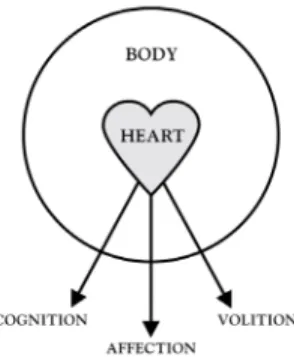
psychophysical unity—but a unity, not a monad . . . not atomic indivisibility.63 In other words, the body and soul can be separated conceptually to be discussed, but the person exists as one in reality or formation. Figure 1 provides a picture of this model. 64
Figure 1. Understanding the influences of the human heart
On the inner man, Tim Keller writes, “Our heart is the center of our personality, the seat of our fundamental commitments, the control center of the whole person. What is in the heart determines what we think, do, and feel—since mind, will, and emotions are all rooted there.”65 As illustrative in figure 1, from the heart flow all sorts of thoughts, affections, and choices.66 It is the moral center of a “human being as creature-before-
63 Robert Gundry, Soma in Biblical Theology (Cambridge: Cambridge University Press, 2005), 121-22. See figure 1.
64 Michael Emlet, “Understanding the Influences on the Human Heart,” Journal of Biblical Counseling 20, no. 2 (Winter 2002): 48.
65 Tim Keller, Center Church: Doing Balanced, Gospel-Centered Ministry in Your City (Grand Rapids: Zondervan, 2012), 58.
66 Hearts think and reason (Prov 23:7; Mark 2:8). Hearts feel and emote (Lev 19:7; Ps 4:7; Ps 13:2). Hearts act (Eccl 10:2).
Creator.”67 In its biblical usage, the heart refers to “human life in all its totality”68—not the American, western way of thinking it as the emotional center.
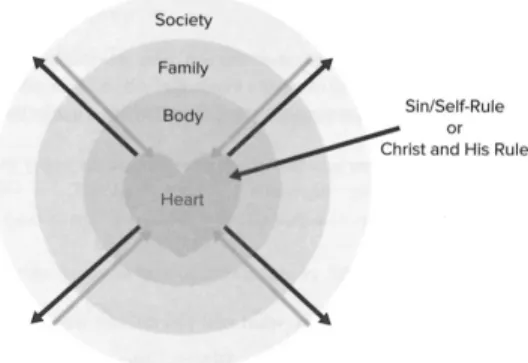
The centrality of the soul, or heart, does not mean there is no other formative influence. The heart is determinative. However, a body, family, and society influence what someone values, believes, and desires. In the words of Carl Henry, “No
evangelicalism which undermines man’s totality ignores the totality of man’s condition dares respond in the name of Christianity.”69 In the same vein, no education that ignores man’s totality dares call itself a Christian education. Figure 2 accounts for the centrality of the heart, while not neglecting other formative powers.70
Figure 2. The active heart
67 See Jeremy Pierre, The Dynamic Heart in Daily Life: Connecting Christ to Human Experience (Greensboro, NC: New Growth, 2016). Cf. Deut 6:5; Josh 22:5; 1 Sam 13:14; 1 Sam 16:7; 1 Chron 28:.9; Ps 14:1; Prov 4. :23; Prov 27:19; Jer 24:7; Matt 5:8; Matt 6:21.
68 Eichrodt, New International Dictionary of New Testament Theology, 2:624.
69 Carl Henry, The Uneasy Conscience of Modern Fundamentalism (Grand Rapids: W. B.
Eerdmans, 2003), 83.
70 John Henderson, Equipped to Counsel: A Training Program in Biblical Counseling, Leader Notebook (Mustang, OK: Association of Biblical Counselors, 2008).
Bodies. The first call of the “dominion” mandate of Genesis 1 is one’s own body.71 Things like diet, exercise, and sleep have formative influences on how someone thinks, responds, and chooses. Bill Smith writes, “The first plot of ground for which God has given us stewardship is his little garden that is our body. It is His body and caring or it properly is part of our dominion mandate.”72 The body God has given each person is not an evil container of a pure soul. Bodies matter. Humans do not exist as ethereal souls.
Hearts are primary though not self-existent. A person exists in a place that they can touch, feel, and experience in a body. Genetic makeup or skin pigment can alter how a person processes reality. This is one reason why diversity is important in education. By another’s embodied existence, they provide alternative perspectives, especially those of minority cultures and colors.
Embodiment emphasizes that people see from somewhere. In a nowhere culture like the present, it is important for Christian educators to draw out the embedded nature and “somewhere-ness” of a student—whether that be a small farming community or an elite prep school. These dynamics matter, because bodies matter, and a knower knows from a location and perspective. The location brings with it biases good and bad—
but nevertheless existing.73
71 Willie James Jennings argues that bodies should be more connected to one’s place than skin tone. He points to white imperialism as shifting identity from a sense of place and embodiment to scales of whiteness. In effect, the European world disconnected people from place where there was once an intimate connection. This divide continues today. See Willie James Jennings, The Christian Imagination: Theology and the Origins of Race (New Haven, CT: Yale University Press, 2010), 40.
72 Bill Smith, “Cultivating the Body,” Theopolis Institute, November 25, 2015, accessed December 26, 2017, https://theopolisinstitute.com/cultivating-the-body/.
73 Most writing by Wendell Berry elucidates the embodied nature of seeing from somewhere.
Jack Baker and Jeffrey Bilbro recently came out with a work that summarizes the thought of Wendell Berry and the implications for higher education in Wendell Berry and Higher Education: Cultivating Virtues of Place (Lexington: University of Kentucky Press, 2017).
Society. Family is the most basic institution in a society. A family’s influence on one’s identity, story, and purpose is self-evident in various ways. Everything as basic as how to spend money and on what to more complex issues like one’s religion are often identifiable through familial values.
If influential formation happens on the familial level, then it also happens on the societal level.74 Societies are more than linguistic systems. Craig Dykstra explains,
“They are patterned processes of social interaction. They act on individuals, and they call forth action from them. . . . They influence what persons pay attention to, what they notice when they do, and what they make of what they see.”75 Families guide in this direction, but families are formed within cultures. America was formed on the presupposition that the society will form citizens in a direction that leads to liberty. The republic aimed to form or reform the moral character of citizens and to strengthen their attachment to the
common good of the whole. The structure of American society and public life geared itself to form virtuous citizens.76 Furthermore, colleges and universities were founded to assist in this objective.
A society shapes how one imagines the metanarrative in which he or she finds themselves. This story helps a person make sense of life. Alasdair MacIntyre writes, “The story of my life is always embedded in the story of those communities from which I derive my identity. . . . What I am, therefore, is what I inherit, a specific past that is present to
74 Peter Berger and Thomas Luckman define society’s influence as the “primary socialization of the home world.” See Peter Berger and Thomas Luckmann, The Social Construction of Reality: A Treatise in the Sociology of Knowledge (New York: Anchor Books, 1966).
75 Craig Dykstra, Growing in the Life of Faith: Education and Christian Practices (Louisville:
Geneva, 1999), 133-34.
76 On this dynamic, see Michael Sandel, Democracy’s Discontent: America in Search of a Public Philosophy (Cambridge, MA: Belknap Press of Harvard University Press, 1998), especially the chapter entitled “Economics and Virtue in the Early Republic.”
some degree in my present.”77 The metanarrative grounds the “why” of moral living.
Culture provides the mechanisms of accountability for those who live within them.
David Brooks calls this societal dimension of formation a “moral ecology.” He defines it as
a set of norms, assumptions, beliefs, and habits of behavior and an institutionalized set of moral demands that emerge organically. Our moral ecology encourages us to be a certain sort of person. . . . The moral ecology of a given moment is never unanimous;
there are always rebels, critics, and outsiders. But each moral climate is a collective response to the problems of the moment and it shapers the people who live in it.78 A society has a strong pull on members of culture to influence what they find good, true, and beautiful. Colleges have sub-societies of their own. The student on campus is found within a certain moral ecology, so university teachers and staff need to consider what kind of moral ecology to which the student is invited.
Imagination and plausibility. The societal formation has a direct impact on how one imagines the world. Richard Sibbes was an early Puritan who defined
imagination.79 He wrote that imagination was “a power of the soul” that is “bordering between our senses and our understanding.” The office of imagination “is to minister matter to our understanding to work upon.”80 Imagination is the disposition with which one approaches the world.81 It provides an interpretive framework of reality. In many
77 MacIntyre, After Virtue, 221.
78 David Brooks, The Road to Character (New York: Random House, 2016), 261.
79 Tim Keller writes on imagination in “Puritan Resources for Biblical Counseling,” The Journal of Pastoral Practice 9, no. 3 (1988): 11-44. The Puritans offer a lot of resources on the impact of imagination. For the late Puritan Jonathan Edwards, what one knows depends on how one knows. This sense of imagination (the “how” of knowing) was central to his epistemology. For a discussion of this topic, see Harold Simonson, Jonathan Edwards: Theologian of the Heart (Grand Rapids: William B.
Eerdmans, 1974), 69-82.
80 Richard Sibbes, “The Soul’s Conflict with Itself, and Victory over Itself by Faith,” in Works of Richard Sibbes, ed. Alexander Balloch Grosart (Edinburgh: Banner of Truth Trust, 2001), 1:178-80.
81 For more on the social formation of imagination, see Charles Taylor, Modern Social Imaginaries (Durham, NC: Duke University Press, 2004), 23-30.
ways, imagination frames the metanarrative. Perception is not a passive process by which someone neutrally sees the world. Experience, family, and society train a person to see a certain way.
One’s imagination is affected by the cultural norms and habits of a place.82 A child growing up in poverty will function from a different set of assumptions about the world than someone born into wealth. Pierre explains, “These different assumptions are given, not voluntarily constructed.”83 In other words, assumptions are unconscious.
Imagination establishes what sociologists call “plausibility structures.” Peter Leithart defines plausibility structures as “social arrangements that provide support beliefs in a context of moral and epistemological relativity . . . ‘plausibility structure’ highlights the fact that our beliefs about the world take shape and are sustained within certain social and cultural contexts.”84 Society is a formative influence on how a person approaches and feels their way into the world. However, a biblical worldview includes an enchanted existence. At any moment, the descent of God redefines natural plausibility structures regardless of how habits may have formed the imagination. In the Christian worldview, grace is the descent of God to man, not the ascent of man to God. The gospel captures the imagination.85 It provides a picture of something better, a greater end, existence, and purpose, and then invites listeners into habits that lead to life and joy. Plausibility structures and societal or family influences can become naught in a moment.86
82 In commenting on the work of Wendell Berry, Baker and Bilbro write, “Well-stocked memories enables us to not merely access information but to embody wisdom and allow it to form our lives.” Baker and Bilbro, Wendell Berry and Higher Education, 100,
83 Pierre, The Dynamic Heart, 90.
84 Peter Leithart, “Hope Beyond Frustration,” Comment Magazine, March 13, 2014, accessed July 24, 2018 https://www.cardus.ca/comment/article/4169/hope-beyond-frustration/.
85 By imagination, I do not mean fictional. So much of Jesus’ presence resulted in amazement by the disciples and crowds.
86 For classroom settings and the language used about learning affecting imagination, see the masterful book edited by David Smith and Susan Felch, Christian Teaching and Imagination (Grand Rapids:
Conclusion
With all these formative influences recognized and affirmed, as Pierre writs,
“The dynamic heart is always a captive, response-able, and therefore responsible.”87 External issues hold powerful enticement but not dictatorship. Scripture constantly points to the heart as the morally responsible agent. One cannot place blame on the body, the family, or society which “made” them a certain way. These institutions can certainly hold sway over a person and guide their intuitions in a certain direction, but they do not bind someone to a definitive path. The heart has individual responsibility. David Brooks is most helpful on this point:
We can choose the narrative we tell about our lives. We’re born into cultures, nations, and languages that we didn’t choose. We’re born with certain brain chemicals and genetic predispositions that we can’t control. We’re sometimes thrust into social conditions that we detest. But among all the things we don’t control, we do have some control over our stories. We do have a conscious say in selecting the narrative we will use to organize perceptions.88
Reflection allows a person to re-embody the ordinary. It allows a pause, to recognize the story one finds himself in and to change. It can also increase passion for the habits in which one regularly participates.89
What does all this mean for the university? As previously stated, an educator cannot rightly discuss the purpose of education without a prior understanding of human personhood and identity. What influences student formation is just as important as the cognitive content presented in the classroom. Education is about the whole person—not
William B. Eerdmans, 2016). In it, a collection of writers reflect on classroom language and practices focused on pilgrimage, gardening, and building to reimagine the task of education.
87 Pierre, The Dynamic Heart, 90.
88 David Brooks, The Social Animal: The Hidden Sources of Love, Character, and Achievement (New York: Random House, 2011), 291.
89 One popular example of this reflection is Tish Harrison Warren, Liturgy of the Ordinary:
Sacred Practices in Everyday Life (Downers Grove, IL: Intervarsity, 2016). Warren causes the reader to reflect on the habits of a day to see how God forms and meets a person in the ordinary. One can go through the habits and can form without conscious reflection, but pausing to consciously reflect, one can re-embody what it means to be human, what the good life is, and how one’s habits affect life.
merely mental formation or heart influence. So often, Christianity, and perhaps especially Christian education, reduces itself to learning a different doctrine or better belief or changing mental assent. Rather, Christianity and Christian education is an invitation to an alternative way of life. Everything from the habits of student life activities to classroom practices powerfully influence students.
Research Purpose Statement
The purpose of this study was to identify and assess the teleological priorities articulated and practiced by Christian liberal arts colleges as represented in the Christian College Consortium with regard to student formation. A teleological priority can be defined based on a view of the human person and the goal of human flourishing—homo cogito (thinking) and the good life of examination, homo economicus (practical/material) and the good life of production, homo motus (feelings) and the good life of comfort, homo liturgicus (habits) and the good life of kingdom living, and homo amator (soul/heart) and the good life of loving God and neighbor. These categories are not mutually exclusive, but they represent various priorities of colleges and universities.
Research Questions
1. What categories emerge from the literature as defining a comprehensive spectrum of teleological aims in Christian liberal arts colleges?
2. How may current Christian liberal arts colleges be identified according to the emergent teleological typologies?
a. To what extent do the curriculum and publications at Christian liberal arts colleges reflect and/or emphasize one or more distinct teleological
priorities with respect to student development and formation?
b. How can these institutional alignments be allocated within the developed typology?
3. How do institutional representatives articulate various teleological priorities of student formation?