Abstract
Introduction
The extensive dimension of the different compositions makes it possible to put forward convincing arguments regarding the stability of the structure and the relationship between structure and properties. Crystal structures refined from neutron and applications would be realized.
Experimental Procedure
- Sample Synthesis
- TEM and Electron Diffraction Measurements
- X-ray Fluorescence Measurements
- Neutron and X-ray Diffraction Measurements
- Rietveld Refinements
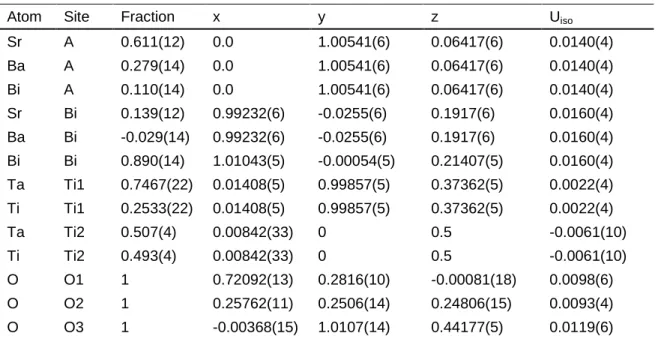
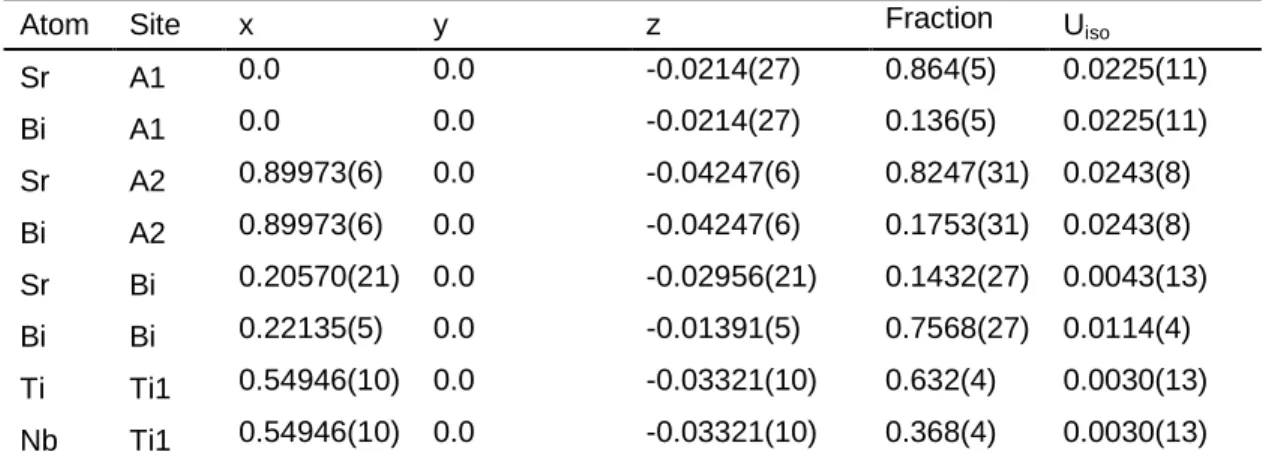
This present work aims to expand on our earlier work88 to quantify the structural distortions that lead to off-centering of the highly charged cations and static site mixing between Bi3+ and the perovskite-like A-site cations. In addition, the partial occupancies of A, B and Bi are constrained to allow refinement of the static mixing while maintaining the overall stoichiometry.
Results and Discussion
Crystal structure distortions of three layer Aurivillius oxide
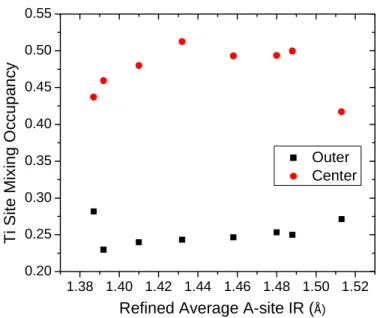
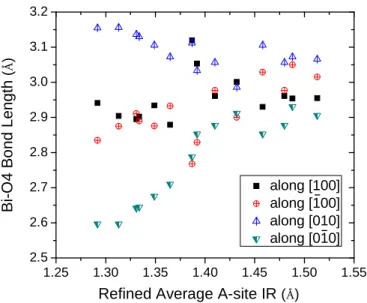
The details of the cation site mixing mechanism will be discussed again in the structure distortion section below. The bending angles of the outer octahedra are relatively small (<10o) and do not follow a specific trend due to the interaction with the [Bi2O2]2+ layers.
Crystal structure distortions of four layer Aurivillius oxide
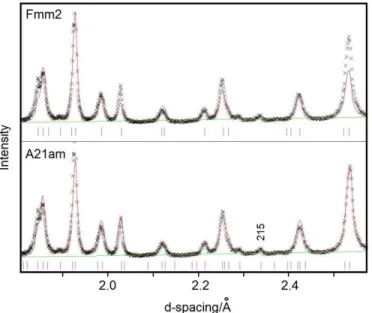
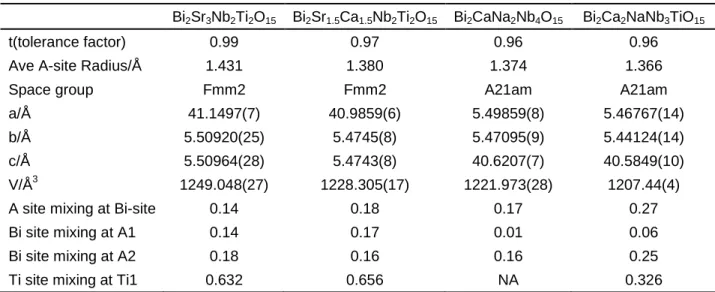
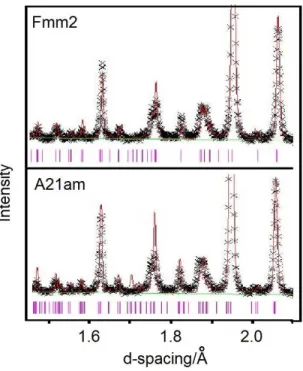
Numerous recalculated peaks and irregular peak intensities indicated a higher symmetry than space group A21am (as shown in Figure 0.12). Careful indexing of the powder XRD data using Topas110 yielded an Fmm2 space group of orthorhombic symmetry. A structural model was generated based on the reported structure of Bi4BaTi4O15111; space group Fmm2 allowed stable and accurate convergence of improvements for Bi2Sr3Nb2Ti2O15 and Bi2Sr1.5Ca1.5Nb2Ti2O15.
Considering the other two four-layer compounds (Bi2CaNa2Nb4O15 and Bi2Ca2NaNb3TiO15), we also find evidence for loss of reflections and conclude that these two oxides are orthorhombic in space group A21am (as shown in Figure 0.13). It can be concluded that most of the odd layered Aurivilius oxides crystallized in B2cb symmetry, while even layered oxides formed in the A21am space group.22,112 Since the adjacent perovskite octahedra tilt in opposite directions along the c-axis, it makes even number of zigzag lines, the entire structure will result in an unbalanced construction and therefore possibly a lower symmetry setting to reduce the energy. Similarly, another mixed B-site Aurivilius oxide Bi7Fe3Ti3O21 has been reported with Fm2m space group from neutron diffraction refinement.113 Single crystal refinement also confirmed the Fmm2 space group structure for Bi5Ti3FeO15.114.
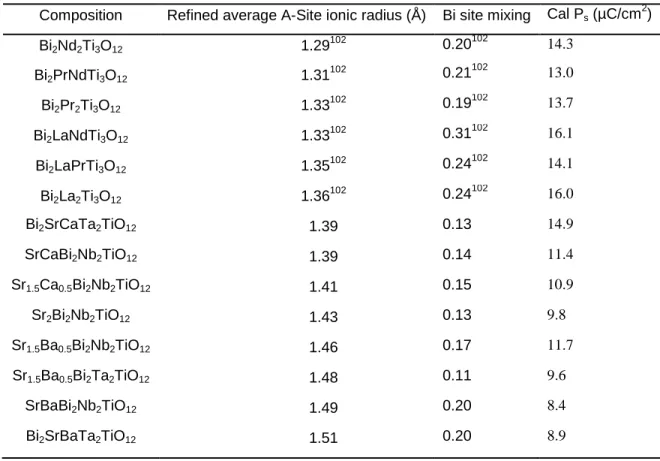
The tilt and buckling angles of Bi2Sr3Nb2Ti2O15 and Bi2Sr1.5Ca1.5Nb2Ti2O15 are much smaller than those of Bi2CaNa2Nb4O15 and Bi2Ca2NaNb3TiO15, consistent with their higher symmetry. The structure of Bi2.5Na2.5Nb4O15 refined from neutron diffraction patterns in the space group A21am with an A-site ionic radius of 1.39Å tilts 9.6o along the c-axis and kink angles average about 1.1o.116 The tilt angles still have a general decreasing trend as the A-site ionic radius increases, the value of the tilt angles and the slope of the trend of the slope versus the A-site ionic radius are both slightly higher than the three-layer tilt angles.
Conclusions
Acknowledgements
Hot Forge Sintering
The powders of samples were ground by hand and then ground using tungsten carbide grinding media. The green bodies of 15mm diameter and ~5mm thickness were prepared by uniaxial press (Carver Laboratory Press,Fred S. Carver Inc.) in a steel die at a pressure of about 5000lbs. The cylindrical pellets were then transferred to the hot forging furnace as the starting material.
The hot forging apparatus was assembled according to the schematic drawing of Takenaka et al.139 The pellets were wrapped with tape-cast ZrO2 thin films (about 0.5 mm thick) for easy separation from the alumina pressing bars after sintering. After a 1-hour conventional firing at 1100°C, uniaxial compression of 2000 psi was gradually applied along the thickness of the sample and continued weight sintering for another 2 hours at 1100°C. After 3 hours of holding at 1100 oC, the weight was slowly removed and held for another hour at 1100 oC to prevent cracks.
Characterization
Electrical Measurements
The morphology of the preferential growth in the b-c plane is related to the low surface energy of the (100) plane during sintering.128 Moreover, it is noted that there is a low percentage of grains stacked in the same direction. The behavior of increased conductivity with temperature confirms that all ceramic materials are typical dielectric materials with negative temperature resistance coefficients.142 The DC conductivity at high temperatures (>400oC) for all compositions is very low, on the order of 10-9 to 10 - 8 S/cm, which also qualifies them for piezoelectric applications at high temperatures.5 An abrupt change in the slope of the graphs can be recognized at about 400oC, which is considered to be related to the transition temperature for different predominant conduction mechanisms .143 Other ferroelectric mechanism materials also exhibit these types of transition temperatures that are close to the ferro-paraelectric transition range.143,144. As a result, the conductivity of the materials may be n-type, consistent with other Nb-containing Aurivilius oxides. More work needs to be done to define the dominant defect and conduction mechanism in this system.
However, the dielectric constant showed a broad shoulder and the shoulder temperatures increase with increasing frequency, which indicated the possible relaxation dielectric behavior.122 Further analysis of the data shows that the dielectric constants in the high temperature region (T>Tc) do not follow the Curie-Weiss law 1/εr-1/εm=(1/C)*(T- Tm), where εm is the maximum dielectric constant and C the Curie constant for a normal ferroelectric.149 The variation of the shoulder temperatures with frequencies is consistent with the Vogel-Fulcher relation, which again suggests the relaxor ferroelectric behavior.150 This is probably caused by the local structural disorder or the local space charge field formation. Temperature dependencies of the dielectric constant εr and loss factor tanδ in four Aurivillius oxides are shown in Figure 0.7 and Figure 0.8. The dielectric constants of the four compositions still follow the same pattern and differences up to 1MHz.
Apart from the spontaneous polarization, dominant defects in Aurivillius oxides such as oxygen vacancies have been reported to contribute to electrical polarization.143 XPS studies show that the oxygen ions in the Bi-O layer are less stable than in the perovskite layer, therefore Bi2O3- evaporation at high temperature would induce both bismuth and oxygen vacancies.154 The Ca/Sr2+ substitution at the Bi3+ site would also create oxygen vacancies.143 This may explain the apparent enhancement of the dielectric constant at low frequency and high temperature shown in Figure 0.5.143. four layer compositions have a weaker shoulder in the dielectric constant due to the structural disorder which can form local space charge area. Both are lossy capacitor forms, which may be due to the limitation of the equipment's applicable electric pole field (<100kV/cm) and low sample breakdown.
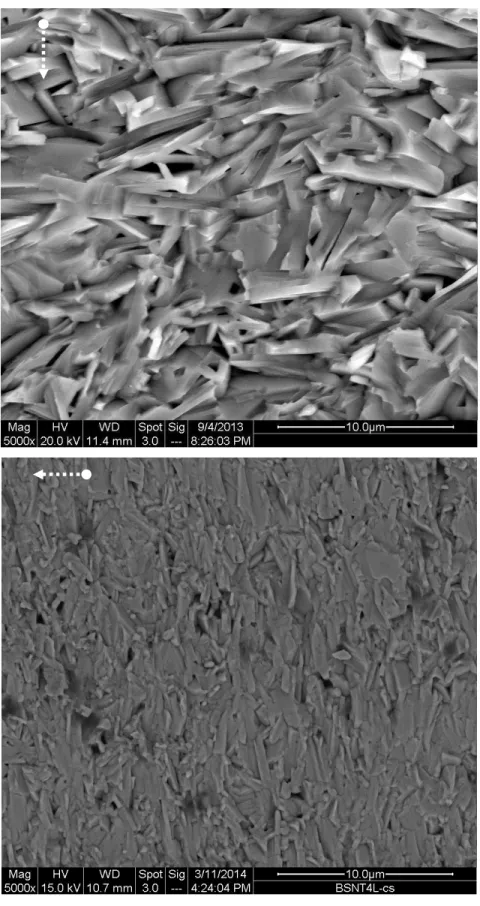
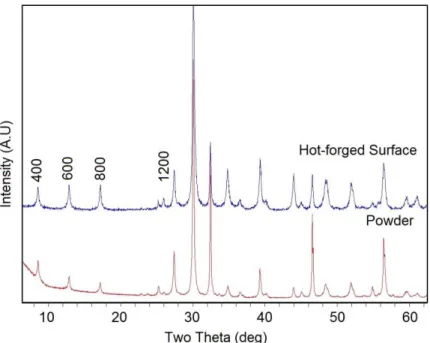
The significant anisotropic feature was confirmed by X-ray diffraction experiments performed along parallel plane and perpendicular direction as shown in Figure 0.12. The surface and cross-section SEM images of BCNN pellets were shown in Figure 0.13, the highly oriented thin plates stacked up along the forging direction. The temperature dependence of dielectric constant and dielectric loss along the c-axis at different frequencies is shown in Figure 0.15.
In addition, the concentration of the nanopolar region would also affect the normal ferroelectric or relaxor ferroelectric behavior for Aurivillius phases.151 This is probably the reason why many in situ mixing Aurivillius oxides are still conventional ferroelectrics.5,112,170 The peak temperature is consistent with the ferroelectric paraelectric phase transition temperature. , measured by HTXRD (Figure 0.16). In situ HTXRD patterns of Bi2CaNa3Nb5O18 powder from room temperature to 700oC. Figure 0.17: Temperature dependence of the direct conductivity of Bi2CaNa3Nb5O18 corresponding to the Arrhenius equation. Dielectric constants on the a-b plane are larger than along the c axis, as expected due to the high ionic polarizability (Figure 0.18).
Other Aurivillius oxides such as Bi4Ti3O12 showed the intermediate phase (Fmm2 or Cmca) between room temperature orthorhombic phase B2cb to high temperature tetragonal phase I4/mmm.153 Our HTXRD phase transformation study (Figure 0.22) on Bi2CaNa2Nb4O15 also shows the intermediate phase. The DC conductance along the a-b plane and c-axis of hot forged Bi2CaNa3Nb5O18 is shown in Figure 0.17.
The dielectric constants in the high temperature region (T>Tc) do not follow the Curie-Weiss law like normal ferroelectrics, in which 1/εr=(T-Tm)/C.170 All the compositions the frequency distribution of the dielectric constant, which the possible relaxor ferroelectric behavior may be. Up to this point, the quantitative and adequate understanding of the ferroelectricity and ferromagnetism origins for Aurivillius oxides remains elusive. This chapter thoroughly examines the crystal structures as well as electrical and magnetic properties of the Bi2Ln2Ti3-xMnxO12.
The temperature dependence of the dielectric constant and loss for Bi2LaNdTi3O12 and Bi2Nd2Ti2.4Mn0.6O12 at different frequencies is shown in Figure 0.5 and Figure 0.6. Continuing this work, rare earth metals containing Aurivilius oxides Bi2Ln2Ti3O12 can be considered one of the most promising ferroelectric materials. Gomes, “Effect of Nb doping on the microstructural and electrical properties of the Pzt ceramics,” J.
Beltran, "Experimental and theoretical study of the ferroelectric and piezoelectric behavior of strontium-doped Pzt", J. Mercurio, "The crystal chemistry and dielectric properties of the Aurivilius family of complex bismuth oxides with perovskite-like layered structures", J. Jiménez , "Influence of Bi-Site Substitution on the Ferroelectricity of the Aurivilius Connection Bi2srnb2o9", J.
Chu, "The Cr Substitution Concentration Dependence of the Structural, Electrical, and Magnetic Behavior for Aurivillius Bi5ti3feo15 Multiferroic Ceramics," J.