Author correspondence email: [email protected] Available online at: http://ejournal.iainmadura.ac.id/index.php/alihkam/
Copyright (c) 2023 by Al-Ihkam, Jurnal Hukum dan Pranata Sosial
Cultural-Based Deviance on Islamic Law; Zakat Tekke Wale’ Spending in Basala, Konawe, Southeast Sulawesi,
Indonesia
Kamaruddin
Institut Agama Islam Negeri Kendari, Indonesia email: [email protected]
Misbahuddin
Universitas Islam Negeri Alauddin Makassar, Indonesia email: [email protected]
Suprijati Sarib
Institut Agama Islam Negeri Manado, Indonesia email: [email protected]
Syamsul Darlis
Institut Agama Islam Negeri Kendari, Indonesia email: [email protected]
Article history: Received: August 05, 2023, Accepted: September 02, 2023, Published:
January 09, 2024
Abstract:
Owners of swallow's nest in Basala District, South Konawe Regency give zakat of tekke wale' (swallow's nest) using gold zakat rate. This implies deviation from Islamic law and striking difference from the provisions of zakat law formulated by most Muslim scholars. This research aims to reveal the business phenomenon and practice of tekke wale' zakat spending, the factors beyond preference to use zakat with gold rate as well as culture-based deviations on Islamic law regarding this specific practice of zakat. This research is qualitative with an empirical- normative approach which includes interviews with swallow nest owners, community leaders, and religious leaders. Besides,
al-Ihkam: Jurnal Hukum dan Pranata Sosial, 18 (2), 2023: 568-590 569 it involves literature review to gather the data. The research shows that swallow nest business is a relatively new livelihood for local people so they have no definite guidance on how to spend the zakat. Their preference using gold zakat rate are due to five factors, ranging from lack of knowledge, assumption that swallow's nest is not a part of agricultural business, easy calculation in giving zakat using gold rate, following the previous swallow's nest owners, to easiness to determine the zakat recipients and spending period. Meanwhile, three forms of deviation from Islamic law existing at the practice urges the specific legal product concerning this specific commodity.
Keywords:
Zakat; Tekke Wale’; Islamic Law
Introduction
The practice of zakat from tekke wale' (swallow's nest) business income in Basala District, South Konawe Regency is unique compared to other regions in Indonesia. Owners of swallow's nests pay zakat on their swallow's nest income based on 85 grams of gold zakat within one year. Meanwhile, zakat on swallow's nest income at other regions in Indonesia, such as Pasangkayu1, Luwu Utara2, and Wajo3 relies on minimum levels and limits assets (niṣāb) of agricultural zakat. The controversy in determining zakat amount and niṣāb then appears in this phenomenon. In common Islamic law, it is known that the amount of zakat from swallow's nests cannot be based on gold zakat.
This is because gold is categorized as hidden treasure ownership and it does not wait for any results to pay the zakat. Meanwhile, the swallow's nest business is waiting for results like agriculture to pay its
1 Ifal Arfandi, “Tinjauan Hukum Islam terhadap Zakat Sarang Burung Walet Bagi Peternak,” El-Iqtishadi 4, no. 1 (2022): 56–65, https://doi.org/https://doi.org/10.24252/el-iqthisady.vi.29687.
2 Hasdir Anwar, “Pertanian Sarang Burung Walet dalam Tinjauan Hukum
Zakat,” Maddika 03, no. 01 (2022): 21–34,
https://doi.org/10.24256/maddika.v3i1.2625.
3 Sulmayani, Achmad Ruslan, and Ruslan Hambali, “Pemungutan Pajak Sarang Burung Walet: Telaah Kontekstual,” Al-Azhar 2, no. 1 (January 2020): 36–46, https://doi.org/https://doi.org/10.37146/ajie.v2i1.37.
zakat.4 It should be equivalent to 653 kilograms of rice because the swallow's nest business has the same process as the agricultural business, namely waiting for the results of each harvest and is seasonal.5
On the other hand, swallow nest business also implies another specific problem. Theoretically, according to Syaikh Yūsuf al- Qarḍāwī, the conditions for assets which require the owners to pay zakat are full ownership, growing, fulfilling the minimum limit of zakat-able assets amount (niṣāb), exceeding basic needs, free from any debt, and completing a year period.6 Meanwhile, the majority of swallow nest owners use loans to construct the swallow nest building which means that actually, the assets they own are not fully owned due to the loan. Thus, this practice gives birth to culturally based deviation on Islamic law resulting from a lack of specific provision regarding the swallow's nest zakat.
Deviation from Islamic law is mentioned variably in academic discussion. Libesny, for instance, preferred to name it as a change, which he mentioned that daily life development and expanding culture requires adaptation of legal rules to new situation. He took an example of Ottoman qānūn which deviated from the Syarī’ah as it condified customary law instead of Islamic law. Another example of deviation that he named it as innovation is the Family Laws Ordinance Section 4 about inheritance per stirpes. 7 It is clear that any change or innovation of Islamic law does not always come in a negative tone. Instead, it is a part of adaptation to the new situation as will be clear later at the discussion about this specific case.
Scholars have studied a lot about zakat in general or swallow nest zakat in particular. These studies are classified into three discussion themes. The first theme concerns the provisions of zakat and tax on swallow nest profits, such as the work of Ifal,8 Anwar,9 and
4 Bahrul Ulum Rusydi et al., “Telaah Kesyariahan Zakat Burung Walet di Kecamatan Dua Boccoe Kabupaten Gowa,” Al Amwal 5, no. 1 (2020): 1–10, https://doi.org/10.24256/alw.v5i1.1821.
5 Anwar, “Pertanian Sarang Burung Walet dalam Tinjauan Hukum Zakat.”
6 Yūsuf al-Qarḍāwī, Fiqh Az-Zakāh (Al-Dirāsah al-Muqāranah li Ah-Kāmihā wa Falsafatihā fī Ḍau’i Al-Qur’ān wa as-Sunnah, Mu’assasah Ar-Risālah (Beirut, 1997).
7 Herbert J Liebensy, “Stability and Change in Islamic Law,” Middle East Journal 21, no. 1 (1967): 20.
8 Arfandi, “Tinjauan Hukum Islam terhadap Zakat Sarang Burung Walet Bagi Peternak.”
al-Ihkam: Jurnal Hukum dan Pranata Sosial, 18 (2), 2023: 568-590 571 Sulmayani et.al.10 The second theme concerns provisions and projections for zakat management, such as the work of Bastiar and Bahri,11 Mahdi et.al,12 Fuad,13 and Siectio.14 The third theme concerns with the modernization of zakat law, such as the work of Irfandi,15 Elimartati et.al,16 and Farah et.al.17
From these three themes, it was found that the study of zakat on swallow's nest income has not received maximum attention from scholars. In general, previous studies focused on the legal status and management of zakat from various perspectives. To complement existing research, this research is presented to reveal phenomenon of the practice of zakat swallow's nest spending, the factors that cause swallow nest owners to pay zakat on gold rate, and a review of Islamic law regarding the spending of swallow's nest zakat which slightly looks as deviation. The Basala District area of South Konawe Regency was used as a research location because the area has a distinctive swallow's nests zakat practice which is different from other areas in Indonesia. Thus, in the future, this research can be used as
9 Anwar, “Pertanian Sarang Burung Walet dalam Tinjauan Hukum Zakat.”
10 Sulmayani, Ruslan, and Hambali, “Pemungutan Pajak Sarang Burung Walet:
Telaah Kontekstual.”
11 Al-Qarḍāwī, Fiqh Az-Zakāh (Al-Dirāsah al-Muqāranah li Ah-Kāmihā wa Falsafatihā fī Ḍau’i Al-Qur’ān wa as-Sunnah.
12 Mahdi Syahbandir et al., “State Authority for Management of Zakat, Infaq, and Sadaqah as Locally-Generated Revenue: A Case Study at Baitul Mal in Aceh,” Al- Ihkam : Jurnal Hukum dan Pranata Sosial 17, no. 2 (2022): 554–77, https://doi.org/http://doi.org/10.19105/al-Ihkam.v17i2.7229.
13 Muhammad bin Mutahir Fuad, “Issues and Challenges of Zakāh al-Māl Collection in Brunei Darussalam,” International Journal of Zakat 8, no. 1 (2023): 64–76, https://doi.org/https://doi.org/10.37706/ijaz.v8i1.400.
14 Siectio Dicko Pratama, “The Role of Zakat in Alleviating Multidimensional Poverty,” IIJIEF : International Journal of Islamic Economics and Finance (IJIEF) 6, no. 1 (January 31, 2023): 125–42, https://doi.org/https://doi.org/10.18196/ijief.v6i1.17006.
15 Irfandi Irfandi, “Zakat Aset Produktif (Mustagallāt) dalam Tinjauan Fikih,”
Sibatik Journal 1, no. 6 (April 2022): 809–22,
https://doi.org/https://doi.org/10.54443/sibatik.v1i6.95.
16 Elimartati, Rizal Fahlefi, and Liza Erniyanti, “Strengthening Family Resilience through the Tradition of Agricultural Zakat Payment in Nagari Lima Kaum in Tanah Datar District of West Sumatera,” Samarah 5, no. 1 (June 2021): 496–
513, https://doi.org/10.22373/sjhk.v5i1.9147.
17 Farah Arum Firdaus, Irham Zaki, and Sri Herianingrum, “The Role of Generation Z Through Online Platform in Optimizing of Zakat Literacy and Fundraising,” AZKA: International Journal of Zakat & Social Finance 4, no. 1 (March 2023): 13–22, https://doi.org/10.51377/azjaf.vol4no1.118.
consideration in the formulation of legislative regulations regarding zakat law in Indonesia.
Method
This is a field research located in Basala District, South Konawe Regency. The primary data source for this research is based on the results of interviews and observation. The interview results were obtained by interviewing swallow nest owners, swallow nest developers, community leaders, and religious leaders. Table 1 shows the detail information about the subject in this research.
Table 1. The Informant Identity
No. Informant Position Gender Address
1 Latang Owner of Swallow’s
Nest Male Polo-Pololi
Village 2 H. Jamal Owner of Swallow’s
Nest Male Tombekuku
Village 3 Watinurung Owner of Swallow’s Nest Female Teporombua
Village 4 Lamma Owner of Swallow’s
Nest Male Lipu Masagena
Village 5 Sukardi Owner of Swallow’s
Nest
Male Iwoimendoro Village
6 Rizal Developer of
Swallow’s Nest Male Basala Village 7 Imam Boge Religious Leaders Male Basala Village
8 Anas Public figure Male Basala Village
Meanwhile, the secondary data is obtained from the literature review on zakat by Syaikh Yūsuf al-Qarḍāwī’s18 theory concerning the conditions for assets which require the owners to pay zakat.
Result and Discussion
Business Phenomenon and Practice of Zakat Tekke Wale'
Tekke wale' (swallow's nest) has a value or price that is quite expensive.19 The increase in its price from year to year is quite
18 Al-Qarḍāwī, Fiqh Az-Zakāh (Al-Dirāsah al-Muqāranah li Ah-Kāmihā wa Falsafatihā fī Ḍau’i Al-Qur’ān wa as-Sunnah.
al-Ihkam: Jurnal Hukum dan Pranata Sosial, 18 (2), 2023: 568-590 573 promising. In fact, sometimes, only certain groups can afford to buy it due to its quite expensive price. However, people believe that swallow nests have advantages that cause their purchasing power remain high. Swallow's nests are processed into various dishes20 but generally, they are cooked into something popular in Chinese restaurants. It is known as yen-ou and some people also cook it with a mixture of vegetables. It is said that in ancient times, in Chinese cuisine, it was a symbol of luxury that only nobles and palace residents could enjoy.
Swallows are cave-dwelling birds that are commonly found in Indonesia. They have small bodies with adult bird body sizes ranging from 10-16 cm. Male and female gender is difficult to distinguish, while the color of the swallow's feathers is blackish and less attractive.
With the habit of swallows inhabiting caves as a place to live, Indonesia has in fact a bright future in this regard due to the existence of natural caves spreading throughout the country. Unfortunately, nowadays, the sustainability of its natural habitat in caves is threatened. The continuous picking of swallow nests and the location of the caves which are deemed unsafe have resulted in the number of swallows living in the caves decreasing. As a result, the bird's nests are becoming less and less.
Moreover, there are even some caves that are previously famous for its high number of swallows yet it is now left without a single swallow. The rapid acceleration of the times has made many caves in Indonesia become tourism objects, so that swallows fly away from the caves.21 Therefore, people are starting to look for ways to breed swallows by constructing tall buildings as replacements for caves for them to nest in,22 as is currently being done by the people of Basala District, South Konawe Regency.
19 Muliati and Bulan Dawiya, “Studi Usaha Sarang Burung Walet dalam Meningkatkan Pendapatan Desa,” Jurnal Mirai Management 7, no. 1 (2022): 182–99, https://doi.org/https://doi.org/10.37531/mirai.v7i1.2358.
20 Mega Endiana Dewi, “Benefit of Edible Bird Nest Consumtion,” Jurnal
Kedokteran Ibnu Nafis 9, no. 1 (2020): 12–16,
https://doi.org/https://doi.org/10.30743/jkin.v9i1.43.
21 Ananda Ramadani, Suhartini, and Mawarda Indo Anja, “Jurnal Kesehatan Yamasi Makassar,” Jurnal Kesehatan Yamasi Makasar 7, no. 2 (2023): 91–101.
22 Bili Caesar and Bayu Nuswantara, “Kelayakan Finansial Budi Daya Sarang Burung Walet di Kecamatan Malinau Barat Kabupaten Malinau,” Jurnal Agristan 2, no. 2 (2020): 102–8, https://doi.org/10.37058/ja.v2i2.2354.
Swallow nests are made from the saliva of apodidae bird species. The main producing countries for swallow's nests are Indonesia, Thailand, Malaysia, China, and the Philippines. Indonesia is the largest country producing swallow's nests, contributing 85% of the world market.23 Swallow's nests are considered as a symbol of wealth, prestige, and power because the selling price per kilo is very expensive. The quality and price of swallow nests vary significantly depending on the geographic origin of the nest. In general, swallow nests produced by Indonesia have the highest prices compared to other countries.24
In terms of income, the swallow's nest business is very promising. Therefore, the owners of swallow's nest willingfully construct a tall building that resembled a multi-story shophouse without any glass with the windows left open to entice swallows to come. They typically use certain technological equipments to play audio that resemble the typical sound of swallows. Swallow nest cultivation buildings are represented in Figure 1 as follow.
23 Dede Sri Wahyuni et al., “Ulasan : Sarang Burung Walet Sebagai Pangan Fungsional,” Acta Veterinaria Indonesiana 9, no. 3 (2021): 201–14, https://doi.org/10.29244/avi.9.3.201-214.
24 Ting Hun Lee et al., “Edible Bird’s Nest: The Functional Values of the Prized Animal-Based Bioproduct from Southeast Asia–A Review,” Frontiers in Pharmacology 12, no. April (2021): 1–16, https://doi.org/10.3389/fphar.2021.626233.
al-Ihkam: Jurnal Hukum dan Pranata Sosial, 18 (2), 2023: 568-590 575 Figure 1. Swallow Bird Building
It can be seen that the building local citizens usually construct works well in inviting the swallow. Besides that building, during this cultivation activity, local people also use swallow attractor equipment to call or invite the swallows to come to the building. The equipment can be seen in Figure 2.
Figure 2. Swallow Caller Audio Placed in the Building
It can be seen in Figure 2 that swallow caller audio is really important to attract the swallow to come to the nest. The swallow nest business is different from keeping birds in cages that need to be cleaned and fed every day. Instead, the building is prepared for the swallows to fly in and out because they are free to come and go as they please. H. Jamal explains this unique process as follows;
“The owner of a swallow's nest does not have ownership over the swallows themselves as these birds are free to live and nest wherever they choose. As a result, entrepreneurs must invent strategies for designing swallow buildings that are attractive to nesting swallows.
Success in this effort often depends on luck”.25
In Basala District, owning a swallow's nest business isn't the only source of income for the owners. After constructing the swallow building, most owners lock it and resume their usual work. The progress of the swallow's nest business is checked after three to six months. Researchers found 51 swallow buildings in Basala Subdistrict spreading across 9 villages as can be seen in Table 2.
Table 2. List of Swallow Buildings in Basala District
No Village Number of Swallow Buildings
1 Basala 9 Building
2 Iwoimendoro 4 Building
3 Lere 4 Building
4 Lipu Masagena 10 Building
5 Polo-Pololi 17 Building
6 Tombekuku 3 Building
7 Teporombua 2 Building
8 Lambandi 1 Building
9 Epeesi 1 Building
Total 51 Building
It can be seen from Table 2 that Polo-Pololi Village is the area that has the most swallow buildings in Basala District. The reason is the tropical characteristic of the village. Swallows really like tropical areas that have lots of trees and adequate springs because they not only like to find food, but also like to play in the water in damp places. According to Rizal; "This is what makes Polo-poloi Village the largest contributor to the number of swallow buildings in Basala District".26
The construction of buildings and equipment for the swallow's nest business necessitates large sums of money. Therefore,
25 H. Jamal, Interview excerpt, 12 December 2022 - Translated
26 Rizal, Interview excerpt, 8 January 2023 - Translated
al-Ihkam: Jurnal Hukum dan Pranata Sosial, 18 (2), 2023: 568-590 577 the swallow nest business cannot be run by all levels of society “A decent swallow building has at least a 2-story building which requires construction costs of around Rp. 100,000,000,- up to Rp. 150,000,000,-, not to mention if the building has 3 to 4 floors which can cost Rp. 350,000,000,- up to Rp. 500,000,000,-“.27 This figure is certainly large for people with a lower-middle-class economy.
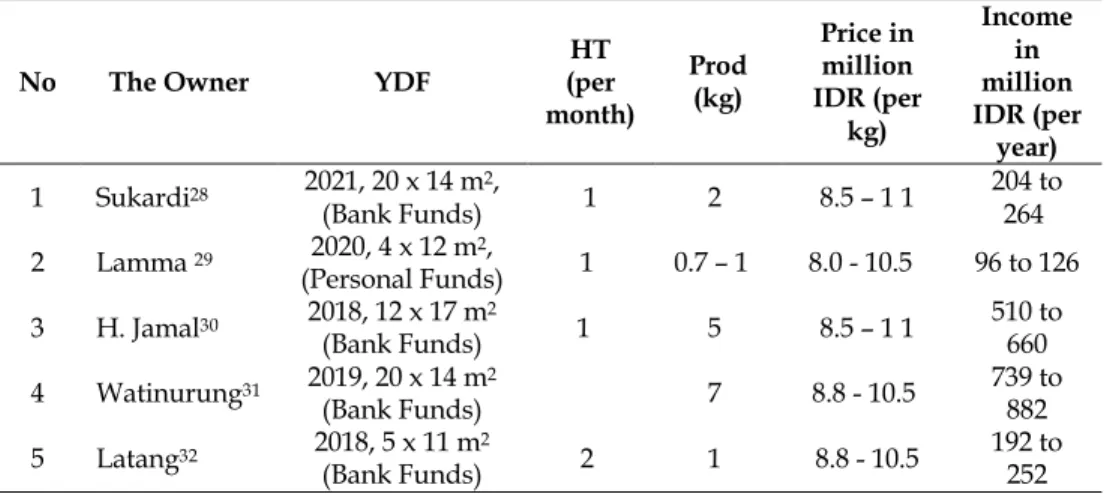
Following is the data from various swallow nest owners in the Basala District including the year they started their swallow nest business, the harvest time, the income earned from each harvest, the selling price per kilogram, and the total income from the business over one year.
Table 3. Swallow’s Nest Business Data
No The Owner YDF
HT (per month)
Prod (kg)
Price in million IDR (per
kg)
Income in million IDR (per
year) 1 Sukardi28 2021, 20 x 14 m2,
(Bank Funds) 1 2 8.5 – 1 1 204 to
264 2 Lamma 29 2020, 4 x 12 m2,
(Personal Funds) 1 0.7 – 1 8.0 - 10.5 96 to 126 3 H. Jamal30 2018, 12 x 17 m2
(Bank Funds) 1 5 8.5 – 1 1 510 to
660 4 Watinurung31 2019, 20 x 14 m2
(Bank Funds) 7 8.8 - 10.5 739 to
882 5 Latang32 2018, 5 x 11 m2
(Bank Funds) 2 1 8.8 - 10.5 192 to
252 Annotation:
YDF : year of the business started, dimension, and funding sources HT : harvest time
Prod : production
It can be seen from Table 3 that there are variations in the price of swallow's nests. These price variations are caused by three things, namely; (1) the quality of swallow's nest that has been harvested. The
27 Lamma, Interview excerpt, 2 Marc 2023 - Translated
28 Sukardi, Interview excerpt, 11 February 2023 - Translated
29 Lamma, Interview excerpt, 2 March 2023 - Translated
30 H. Jamal, Interview excerpt, 12 December 2022 - Translated
31 Watinurung, Interview excerpt, 9 March 2023 -Translated
32 Latang, Interview excerpt, 22 December 2022 - Translated
quality itself is divided into five types, namely; bowl-shaped and clear, bowl-shaped and brownish, small clear nest, small brownish nest, and broken nest, (2) different traders who buy the swallow’s nest, (3) time and season of sales.33 The quality of bird nests greatly determines the selling price. The best quality is bowl-shaped and clear in color which can reach a price of Rp. 9,000,000,- up to Rp.
11,000,000,- per kilo gram. A bowl shape and brownish color can be sold for IDR. 8,000,000,- up to Rp. 9,000,000,- while clear small swallow nests can be sold for Rp. 8,500,000,- up to Rp. 10,000,000,-.
The small brownish swift's nest ranges from Rp. 7,500,000 to Rp.
8,500,000,-. while cracked swiftlet nests can be sold for IDR. 7,000,000,- up to Rp. 8,000,000,-.34
Based on the provided information, it is clear that the difference in the selling price of swallow nests in the Basala District is primarily determined by the quality of harvested nests. The cleaner the nest, meaning there are fewer feathers and bird droppings, the higher the selling price will be and vice versa.
Owners of swallow's nests do not sell the swallow's nests immediately after they have harvested them. Instead, they collect them until they reach a certain target weight and price. After the owners sell the swallow's nest, they will calculate and record the number of purchase to know the zakāh rate for their income.
According to Latang,
"Zakat from swallow's nests is paid once every year following the gold zakat rate. The time for paying zakat is usually in the month of Żūlqa’dah in the Hijriyah calendar, and sometimes it is also paid one day after the Eid al-Fitr and Eid al-Adha holidays."35
The practice of zakat on swallow's nests using the gold zakat rate is based on an understanding among fellow swallow's nest owners that the zakat on swallow's nests has been based on the gold zakat rate from the old time, so they have just followed the habit. The
33 Rizal, Interview excerpt, 12 February 2023- Translated
34 H. Jamal, Interview excerpt, 5 January 2023 - Translated
35 Latang, Interview excerpt, 22 December 2022 - Translated
al-Ihkam: Jurnal Hukum dan Pranata Sosial, 18 (2), 2023: 568-590 579 form of payment for swallow zakat was explained by H. Jamal in the interview as follow:
"Swallow's nest zakat is paid by giving a certain amount of money or sugar, rice, and other household necessities to the needy in their area. It is also given to people who are affected/disturbed by the noise of the audio sound calling the swallow. Several swallow nest owners also pay zakat to nearby mosques in the form of money, cement, stone, red stone, or other building equipments which of course is intended for building mosques."36
In short, the practice of zakat on swallow's nests above is spent by each swallow's nest owner and paid individually once a year.
Preference for zakat recipients is due to each consideration.
Factors beyond Paying Zakat Using Gold Rate
There found five factors beyond belief and practice of swallow nest zakat spending using the gold rate.
First, there is a lack of knowledge regarding the law on zakat for the swallow's nest income. Owners of swallow's nest businesses and people of Basala District generally do not know for certain about legal provisions regarding zakat for swallow's nests. This is because the business of swallow's nests is relatively a new livelihood among the community. Moreover, there is no socialization or insight sharing regarding the issue. As a result of this, people practice zakat in a deviant way. Imam Boge, one of the informants, added so:
"Since the development of the swallow's nest business in Basala District until now, there has never been any socialization or assistance regarding the regulation and provision of the zakat spending from government institutions or from the zakat management institution. In this way, the owners of the swallow's nest only continue the habit of giving zakat as the old owners did."37
36 H. Jamal, Interview excerpt, 12 December 2022 - Translated
37 Imam Boge, Interview excerpt, 21 March 2023- Translated
Second, swallow nest owners consider the swallow nest business excluded from agricultural business category. This is proven in an interview with swallow nest owner who stated as follow;
"We use the gold zakat rate because the swallow's nest business is different from agricultural and livestock businesses. Swallows are not bred but only put up in a building. We simply let them fly into the building and nest in it. Thus, the most appropriate calculation of zakat is using gold rate."38
It is clear from the aforementioned interview that owners of swallow nests do not consider that their enterprise falls under the purview of agriculture or livestock categories. They deduced from this supposition that gold zakat rate was the right one to use in calculating the swallow business zakat.
Third, zakat with gold rate makes it easier to calculate. This agrees with Anas who mentioned so;
"Gold zakat is used as a basis for calculating swallow's nest business zakat because the amount of 85 grams is easier to calculate. It only needs to multiply 85 and the price of gold per gram then the result of this multiplication becomes a reference for the minimum amount of swallow nest income whose owners need to pay zakat for it."39
Therefore, when an owner of swallow's nests business gets annual sales equivalent to the price of 85 grams of gold, he/she must pay zakat numbering 2.5% of the price.
Fourth, the owners follow the habits of older swallow nest owners. Distribution of zakat using the calculation of gold rate as the minimum amount has been practiced by people of Basala District since 2000s when the swallow's nest business first started to become a livelihood. Anas explained that swallow nest business owners in Basala District have their way of giving zakat, namely;
38 Sukardi, Interview excerpt, 28 February 2023- Translated
39 Anas, Interview excerpt, 27 April 2023- Translated
al-Ihkam: Jurnal Hukum dan Pranata Sosial, 18 (2), 2023: 568-590 581
"The owners of swallow's nest business give zakat by distributing a part of their swallow's nest income to mosques and people living adjacent to the swallow's building. The former is for building and renovating mosques, while the later serves as a sort of compensation for any disturbance from the swallow building”.40
Fifth, it is deemed easy to determine the zakat recipents and period. Zakat reciepent of swallow nest, as mentioned above, is typically addressed to either mosques, the poors, or surrounding neighbors of the swallow building for specific consideration. This is as mentioned by Watinurung as follow:
"Zakat from swallow nests is also given to the owners of houses adjacent to the swallow building so that they do not feel disturbed by the audio sound of the swallow calling or what the Basala District community calls it pallawa dauccili (earplugs").41
Meanwhile, the period of zakat spending is once a year. This annual period is considered far simpler than that of agricultral one where the spending is after every harvest.
Zakat Tekke Wale' as Culturally Based Deviations on Islamic Law Islamic law is a set of regulations found in Islamic jurisprudence books derived from the Koran, Hadith, and the ijtihād of Islamic jurisprudence scholars. These regulations include those pertaining to zakat.42 Islamic law places a high value on the study of zakat law because, with its complexity, it can provide an alternative for societal welfare and increase governmental revenue streams.43
40 Anas, Interview excerpt, 27 April 2023- Translated
41 Watinurung, Interview excerpt, 9 March 2023 -Translated
42 Faisal Faisal et al., “Strengthening Zakat Rules in Indonesia: A Legal Study of the Law on Government of Aceh,” Samarah 7, no. 1 (2023): 126–45, https://doi.org/10.22373/sjhk.v7i1.13993.
43 U Sulia Sukmawati, Nurul Ariska, and Sri Wahyuni, “Analisis Literasi Zakat Perkebunan Jeruk di Desa Sebangun Kecamatan Sebawi,” Shar-E : Jurnal Kajian
Ekonomi Hukum Syariah 9, no. 1 (2023): 43–52,
https://doi.org/https://doi.org/10.37567/shar-e.v9i1.1761.
Thus, zakat is not only a religious ritual, but also an effort to strengthen the state's economy and prevalent werlface. The potential sources of zakat in Indonesia are obtained from three parts, namely;44 (1) Income of individuals, families, and community groups, (2), companies or industries, and (3) government agencies. In the context of swallow nests zakat in Basala District, it is only obtained from individual owners of swallow's nest businesses.
When considering the swallow's nests zakat practice in Basala District, one can view it as a culturally grounded deviation from the law. It also deviates significantly from the swallow's nest zakat provisions that Muslim scholars have determined in establishing the law of zakat. There are, furthermore, three types of deviations namely;
First, owners of swallow's nest business in Basala District give zakat for their business income even though the building for swallows to nest is not their full property and it is not free from debt because the majority of swallow's nest buildings are constructed using bank funds, such as the swallow's building owned by Sukardi, H. Jamal, Watinurung, and Latang in the previous discussion.
Apart of the provision, it is important to note that using bank loan is perhaps the only available choice they have when they want to construct a building as the very main part from swallow nest business. On the other hand, the income they get from the business is quite high so that they typically assume that they need to pay zakat from the swallow nest as a promising income source.
Second, according to most of Muslim scholars, zakat from swallow's nest business is supposed to be given based on agricultural rate. In contrast, owners of swallow's nest business in Basala District spend zakat based on the gold rate. The deviation from Islamic law in this section is regarding the niṣāb as well as period to spend the zakat.
Like what discussed earlier, the rate used in calculating and spending the zakat influence the nasab as well as zakat spending period. Using agricultural rate will require them to spend zakat every harvest which is considered impractical, while using gold zakat only requiers annual spending which is deemed far simpler and realistic.
44 Riduawan, Hamim Ilyas, and Mufti Alam Adha, “Corporate Zakat in the Perspective of Stakeholder Theory : A Case Study of Islamic Rural Banks,” Afkaruna
19, no. 1 (2023): 85–98,
https://doi.org/https://doi.org/10.18196/afkaruna.v19i1.16329.
al-Ihkam: Jurnal Hukum dan Pranata Sosial, 18 (2), 2023: 568-590 583 Third, owners of swallow's nest business pay zakat from the swallow's nest business income to mosques and the surrounding community as a form of apology. An apology is made because the audio sound of the swallow caller is loud enough to potentially disturb the activities of the people who live around the swallow building. In fact, this criteria is excude from people listed in QS. at- Taubah [9]: 60.45
ﺇِﻧﱠ ﻤَﺎ ﭐﻟ ﺼﱠ ﺪَﻗَٰ
ﺖ
ُ ﻟِﻞ ﻓُﻘَ ◌ۡ
ﺮَﺍ ءِ ◌ٓ
ﻭَﭐ ﻝ ﻣَ ◌ۡ
ﺴَٰ
ﻜِ
ﲔِ
ﻭَﭐ ﻝ ﻋَٰ ◌ۡ
ﻤِﻠِ
ﲔَ
ﻋَﻠَ
ﻲ ﻫَﺎ ◌ۡ
ﻭَﭐ ﻝ ﻣُﺆَ ◌ۡ
ﻟﱠﻔَ
ﺔِ
ﻗُﻠُ
ﻮﺑُ
ﻬُ
ﻢ ﻭَﻓِ ◌ۡ
ﻲ ﭐﻟﺮﱢ ﻗَﺎ ﺏِ
ﻭَﭐ ﻝ ﻏَٰﺮِ ◌ۡ
ﻣِ
ﲔَ
ﻭَﻓِ
ﻲ ﺳَﺒِ
ﻴﻞِ
ﭐﻟﻠﱠ ﻪِ
ﻭَﭐ ﺏ ﻥِ ◌ۡ
ﭐﻟ ﺴﱠ ﺒِﻴ ﻞِ
◌ۖ
ﻓَﺮِ
ﻳ ﻀَ
ﺔ ﻣﱢ ◌ٗ
ﻦَ
ﭐﻟﻠﱠ ﻪِ
ﻭَﭐ ◌ۗ
ﻟﻠﱠﻪُ
ﻋَﻠِ
ﻴﻢٌ
ﺣَ
ﻜِﻴ ﻢ ◌ٞ
..
Zakat expenditures are only for the poor and for the needy and for those employed to collect [zakāh] and for bringing hearts together [for Islam] and for freeing captives [or slaves] and for those in debt and the cause of Allah and the [stranded] traveler - an obligation [imposed] by Allah. And Allah is Knowing and Wise.
This verse mentions eight groups of peopleentitled to receive zakat; (1) the very poors, people who do not have assets, (2) the poors, people who have income but it is not sufficient to meet their basic needs, (3) ‘āmil zakāh, people or bodies46 that receive and distribute zakat to those who have the right to receive it as National Zakat Amil Agency (BAZNAS).47 Meanwhile, the purpose of zakat in the management of the National Zakat Amil Agency (BAZNAS), (4) slaves, people who are allowed to liberate themselves by their masters, (5) converts, people whose inclination towards Islam
45 Mazro’atus Sa’adah and Uswatun Hasanah, “The Common Goals of BAZNAS’ Zakat and Sustainable Development Goals (SDGs) According to Maqāṣid asy-Syarī'ah Perspective,” Al-Ihkam: Jurnal Hukum dan Pranata Sosial 16, no. 2 (2021):
302–26, https://doi.org/10.19105/AL-LHKAM.V16I2.4990.
46 Farkhah Farkhah, “Analysis of Strategies Zakat, Infaq, and Alms Collection at BAZNAS Semarang Regency,” IJIER ; Indonesian Journal of Islamic Economics Research 2, no. 1 (August 2020): 35–45, https://doi.org/10.18326/ijier.v2i1.4214.
47 H Hamzah, H Khaeriyah, and S Sudirman, “The Empowerment of Zakat as Social Financial,” Jurnal Iqtisaduna, 2019, 51–59, https://doi.org/https://doi.org/10.24252/iqtisaduna.v1i1.11809.
increases which will later be useful for defending and helping the Islamic religion from all bad things, ( 6) al-Gārimūn, people who are in debt and cannot pay their debts, (7) fī sabīlillāh, people who fight for the good of Islam and adhere to the Islamic religion, and (8) travelers, people who are traveling and do not have enough provisions to complete the journey.48
Thus, giving zakat to people who feel disturbed by the audio sound of swallows calling is not included in the group of people who are entitled to receive zakat. However, according to Anas
"The culture of giving zakat to the community around the swallow building has two functions, namely as an apology for the noise produced by the audio sound of the swallow caller and it functions as zakat to the nearby community”.
49
The interview excerpt implies that despite the exclusion from the eight categories, it is deemed necessary to give zakat for surrounding people, no matter in which economic levels each is in, as a sort of disturbance compensation. This also implies that likely, owners consider many things before constructing the buliding, including the location which is considered desirable for swallows to nest wxithin and people living around the building. If the neighbor can’t cope with the disturbance, it will also affect on the smooth running business of the swallow nest. This last form deviation, on the other hand, seems as typical negotiation of local people in running their business while building good social interaction with fellows.
The discussion above indicates that developments over time have given rise to several contemporary problems,50 such as zakat law which requires regulatory updates. Zakat on swallow's nest income has not been fully regulated so people have varying understandings of the applicable legal products. This phenomenon is evidence of relationship between sociology and law which pays attention to
48 Arfandi, “Tinjauan Hukum Islam terhadap Zakat Sarang Burung Walet Bagi Peternak.”
49 Anas, Interview excerpt, 27 April 2023- Translated
50 Ahmad Fikri Sabiq and Choirul Amirudin, “Pendayagunaan Zakat Sesuai Fatwa MUI Nomor 23 Tahun 2020 di LAZ Selama Pandemi Covid-19,” Jurnal Bimas Islam 14, no. 1 (2021): 161–84, https://doi.org/10.37302/jbi.v14i1.358.
al-Ihkam: Jurnal Hukum dan Pranata Sosial, 18 (2), 2023: 568-590 585 people's behavior. Therefore, the legal construction of swallow's nest zakat must be based on social phenomena.51
In line with it, the practice of swallow's nest zakat spending out of National Zakat Amil Agency (BAZNAS) scheme indicates a social reaction due to absence of specific law regarding the issue. Instead, they spend it individually targetting typical recipients as they prefer.
This strenghthens the notion that development of modern life requires society to have organic solidarity52 although in the other hand, this pratice shows failture to achieve one of the zakat goals, namely that it can be used for the welfare of society at large.53
Law of the Republic of Indonesia Number 23 of 2011 concerning Zakāh Management Article 2 letter e explains that the principle of zakat management must provide legal certainty to the public. Therefore, Indonesian legislation needs to pay attention to the needs of Indonesian Muslims by making regulations regarding property regulations and the amount of zakat so that people have legal certainty regarding zakat because there are several new livelihoods among the community, including the swallow's nest businesses which require legal certainty. Thus, the law does not only focus on managing zakāh as previously enacted focusing on old livelihoods, such as zakāh provisions for agriculture, trade, livestock, services, etc. Achieving effective rules for managing swallow's nest zakat will not only result in abundant legal productivity for the community but also legal certainty and guidance.54 This accords to Endra et.al., mentioning that the availability of a complete set of rules is the first step in creating security, order, prosperity, and justice in society.55
51 Sri Astuti A. Samad, “Kajian Hukum Keluarga Islam dalam Perspektif Sosiologis di Indonesia,” El-Usrah: Jurnal Hukum Keluarga 4, no. 1 (2021): 138–52, https://doi.org/DOI: http://dx.doi.org/10.22373/ujhk.v4i1.9899.
52 Rafik Patrajaya, “Tinjauan Sosiologi Hukum terhadap Zakat Sebagai Pengurang Penghasilan Pajak Undang-Undang Nomor 23 Tahun 2011,” El-Mashlahah 9, no. 1 (2019): 44–61, https://doi.org/10.23971/el-mas.v9i1.1342.
53 Indra Utama and Mugi Harsono, “Review of Zakat from The Perspective of
Philosophy of Science” 12, no. 1 (2023): 92–98,
https://doi.org/10.15294/JEEC.V12I1.72770.
54 Elma Fadilah, Saparuddin Siregar, and Rahmat Daim Harahap, “Analisis Praktik Pendistribusian Zakat Produktif Menurut Undang-Undang Nomor 23 Tahun 2011 oleh Badan Amil Zakat Nasional Delli Serdang,” Edunomika 7, no. 2 (2023): 1–10, https://doi.org/http://dx.doi.org/10.29040/jie.v7i2.9254.
55 Endra Wijaya et al., “Menjembatani Kesenjangan Antara Hukum dan Kebutuhan Masyarakat terhadap Hukum di Kelurahan Jatimulya, Depok, Jawa
Conclusion
Earning tekke wale' (swallow's nests) is relatively a new livelihood for the community, so the provisions regarding its zakat potentially leads to controversies. One of the triggers for this problem is the lack of specific regulation from both the state and the religion.
The diversity of understandings regarding the zakat spending gives rise to interpretations for each individuals, mainly among swallow's nest business owners. A real evidence of this diversity is found in the opinions on minimum limit of assets (niṣāb) which require owners to pay for zakat, the recipients of zakat, and the purpose of zakat turning out to deviate from Islamic law. This research is only limited to the analysis of Islamic law and does not provide any comprehensive results regarding the study of swallow nest zakat. Based on these limitations, it is recommended that further research be carried out as an effort to accommodate broad comparative aspects and the discovery of varied data so that a more comprehensive understanding can be obtained.
Barat,” E-Dimas 11, no. 4 (2020): 447–54, https://doi.org/10.26877/e- dimas.v11i4.3994.
al-Ihkam: Jurnal Hukum dan Pranata Sosial, 18 (2), 2023: 568-590 587 Acknowledgment
Researchers would like to express their gratitude to the swallow nest owners, community leaders, and religious leaders in the Basala District of South Konawe Regency. It is thanks to the valuable information provided by these individuals that this research was successfully completed. The author would also like to extend special thanks to their family for their unwavering support throughout the research process.
Bibliography
Al-Qarḍāwī, Yūsuf. Fiqh Az-Zakāh (Al-Dirāsah al-Muqāranah li Ah- Kāmihā wa Falsafatihā fī Ḍau’i Al-Qur’ān wa as-Sunnah, Mu’assasah Ar-Risālah. Beirut, 1997.
Anwar, Hasdir. “Pertanian Sarang Burung Walet dalam Tinjauan Hukum Zakat.” Maddika 03, no. 01 (2022): 21–34.
https://doi.org/10.24256/maddika.v3i1.2625.
Arfandi, Ifal. “Tinjauan Hukum Islam terhadap Zakat Sarang Burung Walet Bagi Peternak.” El-Iqtishadi 4, no. 1 (2022): 56–65.
https://doi.org/https://doi.org/10.24252/el- iqthisady.vi.29687.
Caesar, Bili, and Bayu Nuswantara. “Kelayakan Finansial Budi Daya Sarang Burung Walet di Kecamatan Malinau Barat Kabupaten Malinau.” Jurnal Agristan 2, no. 2 (2020): 102–8.
https://doi.org/10.37058/ja.v2i2.2354.
Dewi, Mega Endiana. “Benefit of Edible Bird Nest Consumtion.”
Jurnal Kedokteran Ibnu Nafis 9, no. 1 (2020): 12–16.
https://doi.org/https://doi.org/10.30743/jkin.v9i1.43.
Elimartati, Rizal Fahlefi, and Liza Erniyanti. “Strengthening Family Resilience through the Tradition of Agricultural Zakat Payment in Nagari Lima Kaum in Tanah Datar District of West Sumatera.” Samarah 5, no. 1 (June 2021): 496–513.
https://doi.org/10.22373/sjhk.v5i1.9147.
Fadilah, Elma, Saparuddin Siregar, and Rahmat Daim Harahap.
“Analisis Praktik Pendistribusian Zakat Produktif Menurut Undang-Undang Nomor 23 Tahun 2011 oleh Badan Amil Zakat Nasional Delli Serdang.” Edunomika 7, no. 2 (2023): 1–10.
https://doi.org/http://dx.doi.org/10.29040/jie.v7i2.9254.
Faisal, Faisal, Mukhlis Mukhlis, Jamaluddin Jamaluddin, Manfarisyah Manfarisyah, and Fitri Maghfirah. “Strengthening Zakat Rules
in Indonesia: A Legal Study of the Law on Government of Aceh.” Samarah 7, no. 1 (2023): 126–45.
https://doi.org/10.22373/sjhk.v7i1.13993.
Farkhah, Farkhah. “Analysis of Strategies Zakat, Infaq, and Alms Collection at BAZNAS Semarang Regency.” IJIER ; Indonesian Journal of Islamic Economics Research 2, no. 1 (August 2020): 35–
45. https://doi.org/10.18326/ijier.v2i1.4214.
Firdaus, Farah Arum, Irham Zaki, and Sri Herianingrum. “The Role of Generation Z Through Online Platform in Optimizing of Zakat Literacy and Fundraising.” AZKA International Journal of Zakāh &
Social Finance 4, no. 1 (March 2023): 13–22.
https://doi.org/10.51377/azjaf.vol4no1.118.
Fuad, Muhammad bin Mutahir. “Issues and Challenges of Zakāh al- Māl Collection in Brunei Darussalam.” International Journal of
Zakāh 8, no. 1 (2023): 64–76.
https://doi.org/https://doi.org/10.37706/ijaz.v8i1.400.
Hamzah, H, H Khaeriyah, and S Sudirman. “The Empowerment of Zakat As Social Financial.” Jurnal Iqtisaduna, 2019, 51–59.
https://doi.org/https://doi.org/10.24252/iqtisaduna.v1i1.1180 Irfandi, Irfandi. “Zakat Aset Produktif (Mustagallāt) dalam Tinjauan 9.
Fikih.” Sibatik Journal 1, no. 6 (April 2022): 809–22.
https://doi.org/https://doi.org/10.54443/sibatik.v1i6.95.
Lee, Ting Hun, Waseem A. Wani, Chia Hau Lee, Kian Kai Cheng, Sheikh Shreaz, Syieluing Wong, Norfadilah Hamdan, and Nurul Alia Azmi. “Edible Bird’s Nest: The Functional Values of the Prized Animal-Based Bioproduct From Southeast Asia–A Review.” Frontiers in Pharmacology 12, no. April (2021): 1–16.
https://doi.org/10.3389/fphar.2021.626233.
Liebensy, Herbert J. “Stability and Change in Islamic Law.” Middle East Journal 21, no. 1 (1967).
Muliati, and Bulan Dawiya. “Studi Usaha Sarang Burung Walet dalam Meningkatkan Pendapatan Desa.” Jurnal Mirai
Management 7, no. 1 (2022): 182–99.
https://doi.org/https://doi.org/10.37531/mirai.v7i1.2358.
Patrajaya, Rafik. “Tinjauan Sosiologi Hukum terhadap Zakat Sebagai Pengurang Penghasilan Pajak Undang-Undang Nomor 23 Tahun 2011.” El-Mashlahah 9, no. 1 (2019): 44–61.
https://doi.org/10.23971/el-mas.v9i1.1342.
al-Ihkam: Jurnal Hukum dan Pranata Sosial, 18 (2), 2023: 568-590 589 Pratama, Siectio Dicko. “The Role of Zakat in Alleviating
Multidimensional Poverty.” IIJIEF : Nternational Journal of Islamic Economics and Finance (IJIEF) 6, no. 1 (January 2023): 125–42.
https://doi.org/https://doi.org/10.18196/ijief.v6i1.17006.
Ramadani, Ananda, Suhartini, and Mawarda Indo Anja. “Jurnal Kesehatan Yamasi Makassar.” Jurnal Kesehatan Yamasi Makasar 7, no. 2 (2023): 91–101.
Riduawan, Hamim Ilyas, and Mufti Alam Adha. “Corporate Zakat in the Perspective of Stakeholder Theory : A Case Study of Islamic Rural Banks.” Afkaruna 19, no. 1 (2023): 85–98.
https://doi.org/https://doi.org/10.18196/afkaruna.v19i1.1632 9.
Rusydi, Bahrul Ulum, Rahmawati Muin, Abdul Wahab, and Nur Adriana. “Telaah Kesyariahan Zakat Burung Walet di Kecamatan Dua Boccoe Kabupaten Gowa.” Al Amwal 5, no. 1 (2020): 1–10. https://doi.org/10.24256/alw.v5i1.1821.
Sa’adah, Mazro’atus, and Uswatun Hasanah. “The Common Goals of BAZNAS’ Zakat and Sustainable Development Goals (SDGs) According to Maqāṣid Asy-Syarī'ah Perspective.” Al-Ihkam: Jurnal Hukum dan Pranata Sosial 16, no. 2 (2021): 302–26.
https://doi.org/10.19105/AL-LHKAM.V16I2.4990.
Sabiq, Ahmad Fikri, and Choirul Amirudin. “Pendayagunaan Zakat Sesuai Fatwa MUI Nomor 23 Tahun 2020 di LAZ Selama Pandemi Covid-19.” Jurnal Bimas Islam 14, no. 1 (2021): 161–84.
https://doi.org/10.37302/jbi.v14i1.358.
Samad, Sri Astuti A. “Kajian Hukum Keluarga Islam dalam Perspektif Sosiologis Di Indonesia.” El-Usrah: Jurnal Hukum Keluarga 4, no.
1 (2021): 138–52. https://doi.org/DOI:
http://dx.doi.org/10.22373/ujhk.v4i1.9899.
Sri Wahyuni, Dede, Hadri Latif, Sudarwanto Mirnawati B, and Chaerul Basri. “Ulasan : Sarang Burung Walet Sebagai Pangan Fungsional.” Acta VETERINARIA Indonesiana 9, no. 3 (2021):
201–14. https://doi.org/10.29244/avi.9.3.201-214.
Sukmawati, U Sulia, Nurul Ariska, and Sri Wahyuni. “Analisis Literasi Zakat Perkebunan Jeruk di Desa Sebangun Kecamatan Sebawi.” Shar-E : Jurnal Kajian Ekonomi Hukum Syariah 9, no. 1 (2023): 43–52. https://doi.org/https://doi.org/10.37567/shar- e.v9i1.1761.
Sulmayani, Achmad Ruslan, and Ruslan Hambali. “Pemungutan
Pajak Sarang Burung Walet: Telaah Kontekstual.” Al-Azhar 2,
no. 1 (January 2020): 36–46.
https://doi.org/https://doi.org/10.37146/ajie.v2i1.37.
Syahbandir, Mahdi, Wais Alqarni, Dahlawi Maz, Abdul Hakim, and Bunyamin Muhiddin. “State Authority for Management of Zakat, Infaq, and Sadaqah as Locally-Generated Revenue: A Case Study at Baitul Mal in Aceh.” Al-Ihkam : Jurnal Hukum dan Pranata Sosial 17, no. 2 (2022): 554–77.
https://doi.org/http://doi.org/10.19105/al-Ihkam.v17i2.7229.
Utama, Indra, and Mugi Harsono. “Review of Zakat from the Perspective of Philosophy of Science” 12, no. 1 (2023): 92–98.
https://doi.org/10.15294/JEEC.V12I1.72770.
Wijaya, Endra, Rifkiyati Bachri, Aprilia Wardani, and Kris Padayanti.
“Menjembatani Kesenjangan Antara Hukum dan Kebutuhan Masyarakat terhadap Hukum di Kelurahan Jatimulya, Depok, Jawa Barat.” E-Dimas 11, no. 4 (2020): 447–54.
https://doi.org/10.26877/e-dimas.v11i4.3994.