
Introduction
Motivation and Objectives
Freeze casting uses the phase separation between a solvent and solid or solute dispersed during solidification to model the pore structure. Versatility and adaptability make freeze casting an attractive technique for tuning the pore structure to meet the requirements of any application.
Thesis Organization
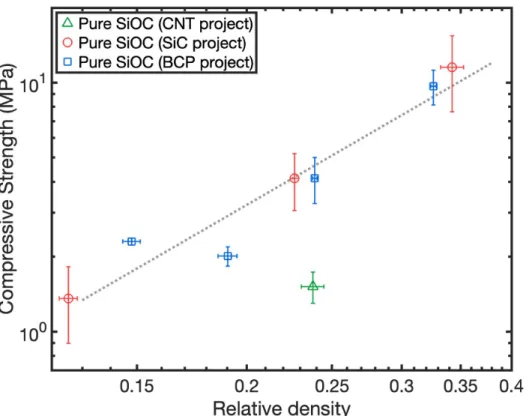
The thermally reversible nature of thermoreversible gel casting allows for a longer processing window—the system can remain in the liquid state as long as needed above CMT—and for recyclability of failed castings. The compressive strength versus relative density of freeze-cast pure SiOC from all three projects - the SiC-reinforced, the CNT-reinforced and the BCP hierarchical porous solid - is shown in Fig.
Background
Freeze Casting
- Solid Contents
- Solvents and Additives
- Solidification and Post-freezing Treatments
- Particle Engulfment
- Sintering/pyrolysis and Post-freeze Casting Treatments
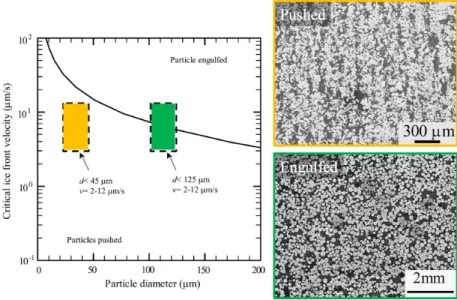
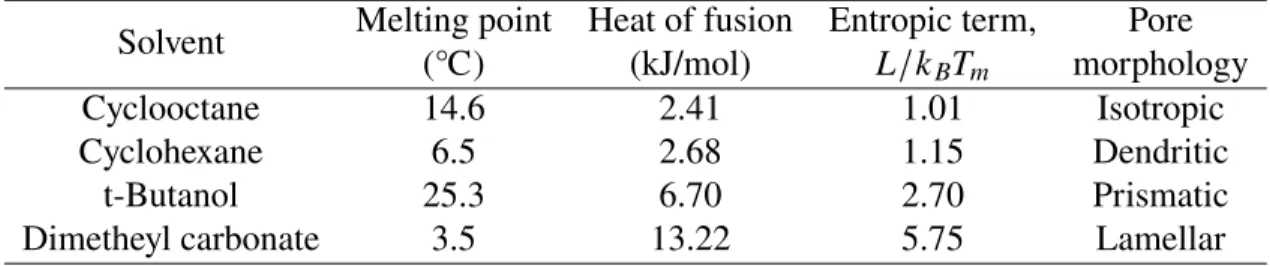
Since the pore structure is negative of the solvent crystals, the pore morphology is controlled by the solvent crystal structure. The shape of the freezing front can cause order-of-magnitude variations in the drag force.
![Figure 2.1: Schematic of the freeze casting process showing solution/suspension preparation, solidification, sublimation, and sintering/pyrolysis steps [125].](https://thumb-ap.123doks.com/thumbv2/123dok/10412697.0/20.918.239.683.117.535/schematic-solution-suspension-preparation-solidification-sublimation-sintering-pyrolysis.webp)
Self-assembled Block Copolymers
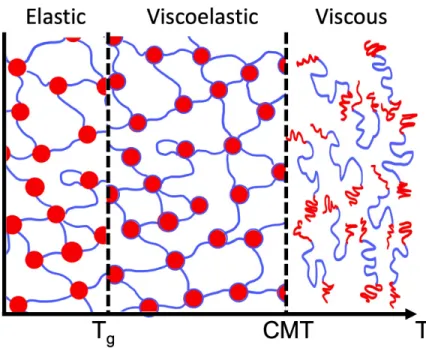
It is difficult to obtain well-dispersed suspensions with nanoparticles small enough to mimic the characteristics of a self-assembled block copolymer where the size. Preceramic polymers have a radius of gyration of less than 10 nm, which is small enough to mimic the characteristics of a self-assembled block copolymer.
Preceramic Polymers
- Overview of Polymer-derived Ceramics (PDCs)
- Polysilsesquioxane
- Polycarbosilane
4.2(d) is an SEM image of the freeze-dried structure made from the suspension containing the dispersant. The ratio of the excluded volume to the actual volume (𝑉) of the filler determines the percolation threshold, Φ𝑐, and is approximately equal to the reciprocal of twice the aspect ratio, D/2L [12].
![Figure 2.12: Typical classes of silicon-based preceramic polymers as precursors of polymer derived-ceramics [36] © 2010 The American Ceramic Society.](https://thumb-ap.123doks.com/thumbv2/123dok/10412697.0/36.918.263.659.100.426/typical-preceramic-polymers-precursors-ceramics-american-ceramic-society.webp)
SiC Whisker-reinforced Composites
Introduction
Microstructure selection maps show the morphology of the freeze front (planar, cellular and dendritic freeze front) as a function of freeze front speed and temperature gradient [77, 99]. Therefore, we propose a new model, specifically designed to accurately describe solidification conditions with high aspect ratio particles and a lamellar freezing front in freeze casting.
Experimental Procedures
- Freeze Casting
- Materials and Synthesis
- Characterization
- Two-dimensional Solidification Experiments and Simulations 29
- Viscosity
- Surface Energy
- Freezing Simulations
Pyrolyzed samples were cut 3 mm from the bottom of the sample, perpendicular to the freezing direction. Two sets of self-aligning discs were used to ensure that the force was applied along the freezing axis of the samples.

Results and Discussion
- Freeze-cast Samples
- Pore Structures
- Mechanical Properties and Permeability
- Two-dimensional in-situ Solidification Experiments
- Theory
- Freezing Simulations and Bridge density
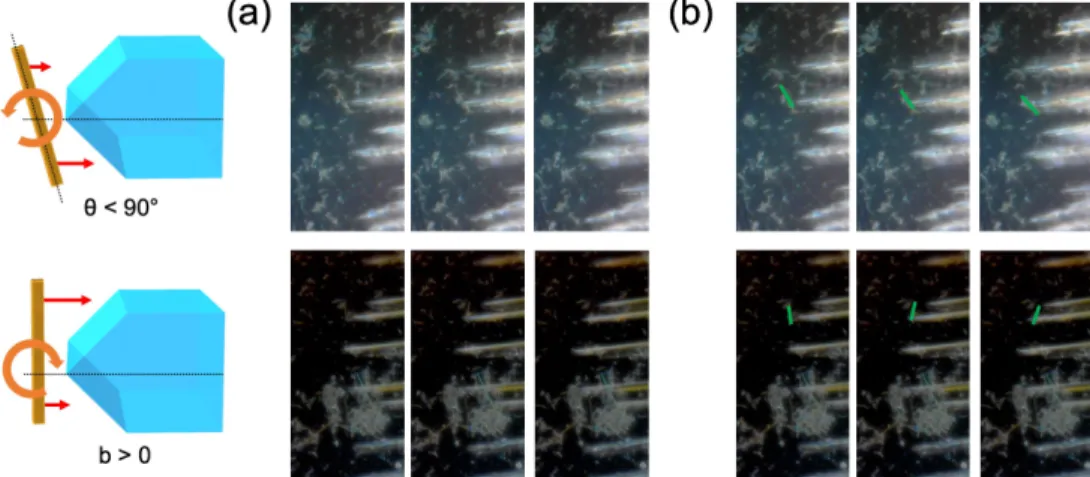
The theoretical determination of the freezing front (the shape, size and spacing of the freezing dendrites) is not the focus of this study. Therefore, as the freezing front advances, rejected solutes can accumulate, creating a concentration gradient ahead of the freezing front. The cutting angle 𝜃, and offset distance 𝑏, determine the orientation and the magnitude of the torque.
3.10(b) shows that whiskers that are not perpendicular to the freezing front (𝜃 ≠ 𝜋/2) experience torque and rotate out of the way of the freezing dendrites, leaving whiskers that are mostly parallel or perpendicular to the freezing front and the lamellar walls . For example, the high aspect ratio particles can rotate out of the way even if the freezing velocity is above the critical freezing front velocity.

Conclusions
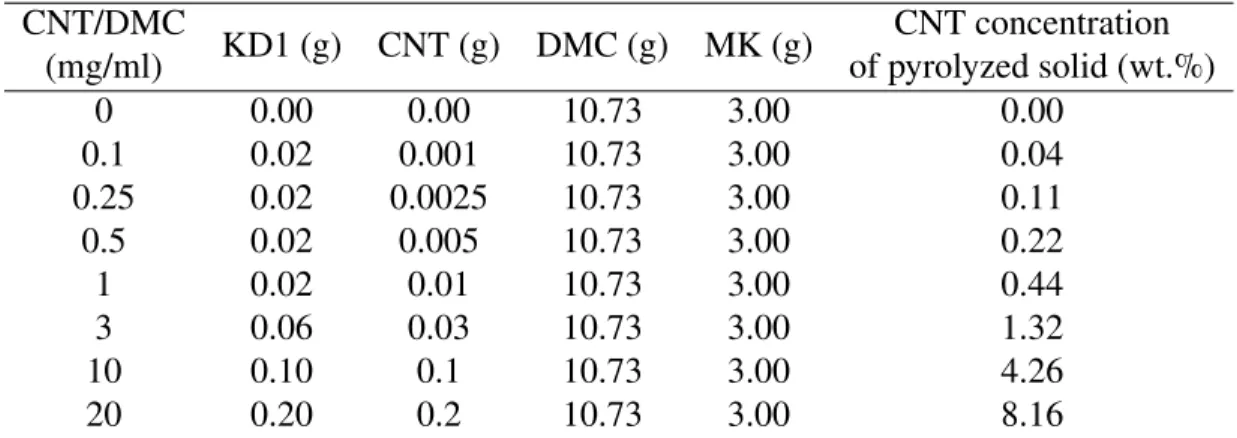
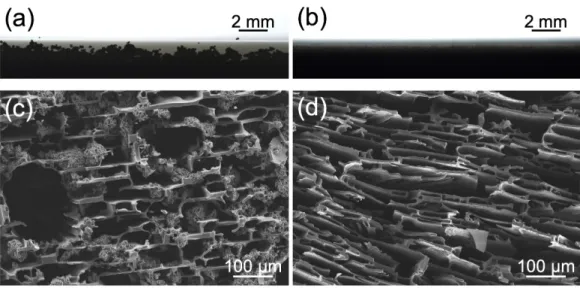
Representative SEM micrographs of the resulting freeze-cast structures with 1.3 wt% CNTs (c) without and, (d) with KD1. The efficiency of the dispersion in suspension has a direct correlation with the uniformity of CNT distribution in freeze-cast structures. The ratio of the height of the two peaks (ratio-3) indicates that carbon is in the form of MWCNT (ratio-5) rather than graphite (ratio 20) [148].
Hardening of the bulk disc samples, analogous to the walls, increases the maximum stress in the stress-strain curve of the frozen structure. 5.1(f) reveals the mesoporous coating on the surface of the freeze-cast pore walls, resulting from the infiltration of the BCP/PCP gel.
Carbon Nanotube-reinforced Composites
Introduction
The second requirement is that the reinforcements are small enough and of sufficiently low density relative to the solution so that they can be pushed through the freezing front and embedded in the walls without protrusions. Finally, the reinforcements must be dispersible in the solution/suspension to achieve uniform distribution in the final freeze-cast structures. In light of these limitations, we chose multi-walled carbon nanotubes (MWCNTs) as reinforcing fillers.
It has previously been shown that the mechanical properties (e.g. Young's modulus, compressive strength and toughness) are very sensitive to the quality of dispersion of CNTs in the matrix; the better the distribution, the stiffer, stronger and tougher the composition [9]. In the latter, however, the high pressure and temperatures required to densify ceramic powders by hot pressing can degrade CNTs, limiting their reinforcing effect [197].
Experimental Methods
- Materials and Processing
- X-ray Diffraction
- Electrical Conductivity
- Permeability
- Mechanical Properties
- Compressive Strength
- Fracture Toughness
The permeability of the porous solids was assessed from the flow rate of water over a range of pressure drops. Discs were placed between compression plates with an aligner before the start of the compression test to ensure that the load was applied along the long axis of the pre-crack. Cylindrical pyrolyzed samples were core drilled to be 13 mm in diameter and the perimeter of the samples was enclosed by a low shrinkage mineral-filled acrylic system (VariDur 3003, Buehler, IL, USA) to prevent leakage from the circular side of the samples.
Therefore, VariDur 3003 was used to cover both ends of the specimen and a pair of spherical washers were placed between the specimen and the compression plates to ensure that the compression load was applied along the axis of the specimen (A schematic of the setup can be found in [125]). Two pieces of Teflon-coated Mylar 0.07 mm thick and 10 mm long were glued together and embedded in the powder mixture to create the pre-crack in the center of the disk after pyrolysis.
Results and Discussion
- Carbon Nanotube Dispersion in Solution and Freeze-cast
- Electrical Conductivity
- Permeability
- Mechanical Properties
Even the freeze-cast structure with the highest CNT concentration (8.2 wt%) has few small (<20𝜇m) agglomerates, a sharp contrast to the one prepared without dispersants in Fig. Interestingly, the CNT agglomerates in the Brazilian disc are larger both in size and number than those in freeze-cast CNT composites with the same CNT concentration. while the porous coating was formed on the freeze-cast walls through removal of the volatile BCP phase and conversion of polycarbosilane to.
In addition, CNTs were able to change the conductivity by 10 orders of magnitude with the addition of 8.2 wt% of the reinforcement. Pure SiOC from two of the projects, the SiC reinforced and the BCP hierarchical project, are very similar.
Conclusions and Implications
Hierarchical Composites via Self-assembly of Block Copolymer . 73
Experimental Methods
- Materials and Processing
- Pore Structure
- Permeability
- Mechanical Properties
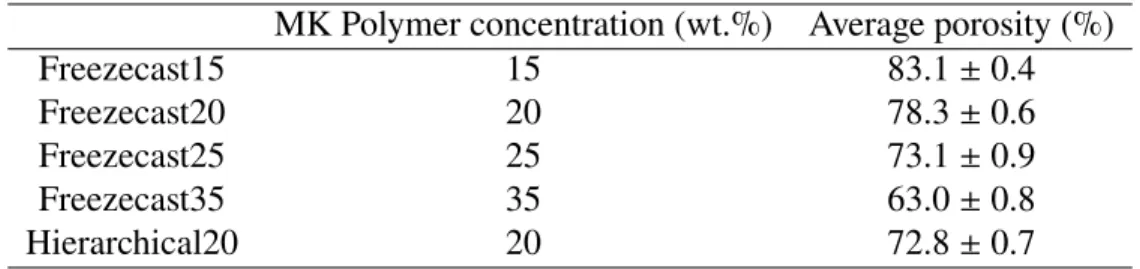
The bottom one millimeter of the sample was sanded with sandpaper to improve infiltration before curing at 200℃ prior to infiltration with BCP/PCP gel. The mesoporous coating was prepared by self-assembly of BCP (KurarityTM LA4285, PMMA-PnBA-PMMA, Kuraray America, Inc., Houston, TX, USA). In comparison, the sample labeled Freezecast20 had the same polymer concentration as Hierarchical20 in the freeze-drying phase.
The samples were ground into powders and degassed at 300℃ under vacuum for 3 hours before measurements. The top and bottom of the samples were covered with a low-shrink acrylic system (VariDur 3003, Buehler, IL, USA) to minimize contact stresses.
Results and Discussion
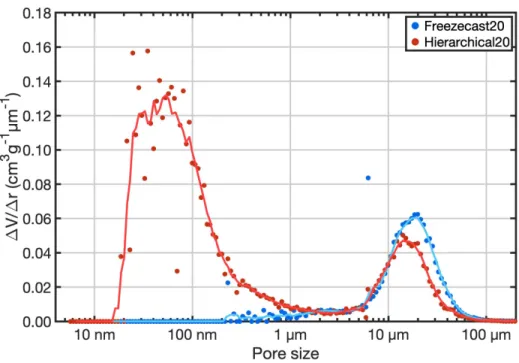
This bimodal pore size distribution of the hierarchical pore structure was confirmed by MIP in Figs. Enlarged spaces are possible as a result of infiltration and subsequent drying of the BCP/PCP gel. The hierarchical sample has a specific surface area of 5.23 m2/g, which implies that the surface area of the conformal mesoporous coating is m2/g, calculated from the weight and surface area difference between the Hierarchical20 and Freezecast20 samples.
Similarly, the strain at maximum stress for the Hierarchical20 (Fig. 5.5) is also consistent with that of the Freezecast samples, taking density into account. The peak is followed by a low stress plateau during crack propagation, and finally a gradual stress increase due to the compaction of the fractured pore structure [65].
Conclusions and Implications
The stress–strain curves, SEM images of the fracture surfaces and macro images of fractured samples of CNT-reinforced, SiC whisker-reinforced and hierarchical. As discussed in 5.3, the compressive strength of the hierarchical structure is comparable to that of pure SiOC with the same relative density. The engulfment probability of the whiskers in turn influences the mechanical and transport properties of the PDC derived from the said PCP.
On the experimental side, the in-situ 2D setup can be adapted to include thermal gradient control. E.1(a) shows high freezing front initiation velocities which rapidly decrease to a steady-state value from the bottom to the top of the sample.
Summary, Conclusions, and Future Work
Summary and Conclusions
The permeability decreased slightly but remained in the range of 10−12 m2 as the porosity of the composites decreased. In contrast, Chapter 5 outlined the method to increase the surface area of the pore structure by depositing a high surface area conformal layer via BCP self-assembly. The introduction of the pore hierarchy also resulted in an increase in mechanical properties, maintaining the permeability of the macroporous structure.
In summary, it is useful to study how different composite strategies affect the fracture behavior and mechanical and transport properties of different porous solids. These observations indicate that the fracture behavior is strongly influenced by the density of the interlamellar connections rather than the density of the porous ceramic and that the fracture behavior is independent of the relative density or strength.
Suggestions for Future Work
However, many are left for the future studies in this burgeoning field of composites via freeze molding. Effect of the length and overall size of MWNTs on the improvement efficiency of the mechanical and electrical properties of nanocomposites - experimental study. An analytical solution of the critical interfacial velocity for trapping insoluble particles by a moving solid/liquid interface.
The quantitative characterization of the concentration and dispersion of multiwalled carbon nanotubes in suspension by spectrophotometry. Nucleation-Controlled Freeze Casting of Preceramic Polymers for Uniaxial Pores in Si-Based Ceramics.

Torque from Fluid Motion
Torque from Frictional Force
The freezing front velocities at 3 mm were used in the simulation to calculate the engulfed whisker fraction. To measure the lamellar spacing, the pyrolyzed samples were cut through the radial center parallel to the freezing direction for longitudinal views of the pore structures. The lamellar distances increased with sample height, as expected from a lower freezing front velocity (Fig.
The relationships between lamella spacings and freezing front velocities were established through the sample height of vol.% SiC whiskers in Fig. The measured lamella spacing and freezing front velocity from the 2D solidification setup agree well with those from the freeze-cast samples, indicating that the 2D solidification setup is capable of producing similar freezing conditions (freezing front velocity and dendritic/lamellar spacing) to those of the freeze-cast samples.
![Figure 2.6: Microstructure selection map of crystal morphology and size depending on temperature gradient and growth rate [93] © 2003 John Wiley & Sons, Inc..](https://thumb-ap.123doks.com/thumbv2/123dok/10412697.0/27.918.223.696.107.534/figure-microstructure-selection-crystal-morphology-depending-temperature-gradient.webp)
![Figure 2.8: Solvent nucleation control via a wettability gradient enables a long-range pore alignment from [201]](https://thumb-ap.123doks.com/thumbv2/123dok/10412697.0/29.918.160.756.100.571/figure-solvent-nucleation-control-wettability-gradient-enables-alignment.webp)
![Figure 2.9: SEM images showing (a) the effects on alignment of a magnetic field on TiO 2 scaffolds containing 3 wt% Fe 3 O 4 (reprinted from [137] with permission from Elsevier) (b) the effects on alignment of an electric field on aqueous slurries (reprint](https://thumb-ap.123doks.com/thumbv2/123dok/10412697.0/30.918.175.752.101.437/alignment-magnetic-scaffolds-containing-reprinted-permission-elsevier-alignment.webp)
![Figure 2.13: Schematic of the processing and chemical structures of preceramic polymers to polymer-derived ceramics [68, 125].](https://thumb-ap.123doks.com/thumbv2/123dok/10412697.0/37.918.255.664.107.399/figure-schematic-processing-chemical-structures-preceramic-polymers-ceramics.webp)
![Figure 2.14: Two proposed models of the microstructure of polysiloxane-derived SiOC. Reprinted from [183] with permission from Elsevier.](https://thumb-ap.123doks.com/thumbv2/123dok/10412697.0/38.918.316.602.102.558/figure-proposed-microstructure-polysiloxane-derived-reprinted-permission-elsevier.webp)
