AN ANALYSIS OF TEACHER COMPETENCE ON TEACHING LEARNING PROCESS OF ENGLISH AT SMAIT IQRA’ KOTA
BENGKULU
THESIS
Submitted as A Partial Requirements for the Degree of Sarjana (S. Pd) in Study Program of English Education
By
ANNISA NADIA SRN. 1516230058
STUDY PROGRAM OF ENGLISH EDUCATION DEPARTMENT OF TADRIS
TARBIYAH AND TADRIS FACULTY
STATE INSTITUTE OF ISLAMIC STUDIES (IAIN) BENGKULU 2020
DEDICATION Bismillahirrahmaanirrahim.
In the name of Allah, the most gracious and merciful. All praise and gratitude to him who has given strength and patience to finish this thesis.
Shalawat and Salam to our prophet Muhammad SAW, his family and friends.
This thesis is dedicated to :
My beloved parents, my father (Herman) and my mother (Yuri Sedilensi) who always pray me and could reach the succesful. I do love you so much
My lovely sister (Eka Marti Anita) for giving me good direction and examples to the end
My beloved friends in KKN 102 and PPL which is part of my struggle
Thanks for my classmates in TBI B Class and generation TBI 2015 for friendship and togetherness during this time and always provide support and encouragement. Deeply my closed friend (Yulita, Sonya, Dina, Vebbriza, Helvi, Erwin, Aji, Gading, Reto, etc that can not mention one by one)
Thanks for my family R4P Comunity especially for my senior pandawa 5 and eighth generation who become part of the struggle, always support me and had created unforgetable moment in my life. Depply my great friend (Laras, Rikha, Putri, Adetia and my beloved Haris Suwandi who have helped a lot and always provide support)
Thanksfull for Shidiq Kos (Mr. Heri and Mrs. Rinti) as second home and great friends (Helma and Refi)
All people that helped support and motivated me
MOTTO
“ Allah does not burden someone but according to his ability
”
) Q.S Al-Baqarah: 286 (
“ Nothing is easy from a struggle, but nothing is impossible if god wants, and there
is no succes without struggle
”
(Annisa Nadia)
ACKNOWLEDGEMENT
Alhamdulillah, All praise to Allah, the singer power, the Lord of universe, master of the day of judgment, God all mighty, for all blessing and mercesies so the researcher was able to finish this thesis entiled An Analysis of Teacher Competence on Teaching Learnng Process of English at SMAIT Iqra’ Kota Bengkulu Peace be upon Prophet Muhammad SAW, the great and good inspiration of world revolution. The researcher is sure that this thesis would not be completed without the helps, supports, and suggestions from several sides. Thus, the researcher would like to express her deepest thanks to all of those who had helped, supported, and suggested her during the process of writting this thesis. This goes to : 1. Prof. Dr. H. Sirajuddin. M., M.Ag., M.H. as the Rector of the State
Institute of Islamic Studies (IAIN) Bengkulu
2. Dr. Zubaedi, M.Ag., M.Pd. as the Dean of Faculty of Tarbiyah and Tadris IAIN Bengkulu
3. Dr. Kasmantoni, M.Si. as the Head of Language Education Department 4. Feny Martina, M.Pd. as the Head of English Study Program IAIN
Bengkulu
5. Dr. Syamsul Rizal, M.Pd. as the first Advisor for his guidance and direction during thesis writing
6. Fera Zasrianita, M.Pd. as the second Advisor for her precious advices, corretions and helps to revise and her kindness
7. Deeply thanks for Mr. Widyono, S.Pd. as the headmaster of SMAN 3 Kota Bengkulu, Mrs. Salamah, S.Pd. as pamong and all the teacher there
8. Deeply thanks for Mr. Sutrisno, M.TPd. as the headmaster of SMAIT Iqra’ Kota Bengkulu, Ustadzah Rusti and all the teacher there
9. All of lecturers who teach the researcher from first semester to eight semester and all of staffs in Tarbiyah and Tadris Faculty
10. My Almamater State Institut for Islamic Studies (IAIN) Bengkulu
The researcher realizes that thesis is still far from being perfect.
The researcher hopes that this thesis is useful for the researcher in particular and the readers in general.
Bengkulu, January 2020 The Researcher
Annisa Nadia NIM. 1516230058
ABSTRACT Annisa Nadia, (1516230058), 2020.
An Analysis of Teacher Competence on Teaching Learning Process of English at SMAIT Iqra’ Kota Bengkulu. Thesis, English Study Program, Tarbiyah and Tadris Faculty, State Institute for Islamic Studies (IAIN) Bengkulu.
Advisor I: Dr. Syamsul Rizal,M.Pd. Advisor II: Fera Zasrianita, M.Pd.
Key Words: Teacher Competence, Teaching Learning Process
Teacher competence has been identified as mastery of a task teaching and educating skills, attitudes, and appreciation needed to support the success of the learning process. The objective of this research was to to investigate the extent to which teachers are in SMAIT Iqra’ Kota Bengkulu competent in terms of pedagogical competence, personality competence, social competence, and proffesional competence. This research was qualitative study using case study method. The observation of teacher competence (Pedagogic, personality, social, and professional competence) based on Minister of National Education Decree 16/2007 concerning standars of academic qualifications and teacher competence was consists of 4 competencies 14 sub-competencies and 78 indicators. The main findings indicate that personality competence and social competence are relatively higher than pedagogic and professional competence. Those competencies very needed to increase student potential and achievement.Furthermore, for some relevant and useful learning implication, it is recomended to increase teacher competence. As a whole it had been claimed as a professional teacher because it significantly concerned with things such as the mastery of material, the use of technology, and the professional of competence.
ABSTRAK Annisa Nadia, (1516230058), 2019.
An Analysis of Teacher Competence on Teaching Learning Process of English at SMAIT Iqra’ Kota Bengkulu. Thesis, English Study Program, Tarbiyah and Tadris Faculty, State Institute for Islamic Studies (IAIN) Bengkulu. Academic Year 2018/2019.
Advisor I: Dr. Syamsul Rizal, Advisor II: Fera Zasrianita, M. Pd.
Kata Kunci: Kompetensi Guru, Proses Belajar Mengajar
Kompetensi guru telah diidentifikasi sebagai penguasaan tugas mengajar dan mendidik keterampilan, sikap, dan penghargaan yang diperlukan untuk mendukung keberhasilan proses pembelajaran. Tujuan dari penelitian ini adalah untuk mengetahui sejauh mana guru di SMAIT Iqra 'Kota Bengkulu kompeten dalam hal kompetensi pedagogik, kompetensi kepribadian, kompetensi sosial, dan kompetensi proffesional. Penelitian ini merupakan penelitian kualitatif yang menggunakan metode studi kasus. Pengamatan kompetensi guru (Pedagogik, kepribadian, sosial, dan kompetensi profesional) berdasarkan Keputusan Menteri Pendidikan Nasional 16/2007 tentang standar kualifikasi akademik dan kompetensi guru terdiri dari 4 kompetensi, 14 sub-kompetensi dan 78 indikator.
Temuan utama menunjukkan bahwa kompetensi kepribadian dan kompetensi sosial relatif lebih tinggi daripada kompetensi pedagogik dan profesional.
Kompetensi tersebut sangat dibutuhkan untuk meningkatkan potensi dan prestasi siswa. Selanjutnya, untuk beberapa implikasi pembelajaran yang relevan dan bermanfaat, direkomendasikan untuk meningkatkan kompetensi guru. Secara keseluruhan telah diklaim sebagai guru profesional karena secara signifikan berkaitan dengan hal-hal seperti penguasaan materi, penggunaan teknologi, dan profesional kompetensi.
TABLE OF CONTENT
COVER...i
ADVISOR SHEET...ii
RATIFICATION...iii
DEDICATION...iv
MOTTO...v
PRONOUNCEMENT...vi
ACKNOWLEDGEMENT...vii
ABSTRAC...ix
ABSTRAK...x
TABLE OF CONTENT...xi
LIST OF TABLE...xiii
LIST OF APPENDICES...xiv
CHAPTER I : INTRODUCTION A. Background of Study...1
B. Identification of The Problems...5
C. Limitation of the Problem...6
D. Formulation of the Problem...6
E. Objective of Problem...6
F. Significance of Research...6
G. Definition of the Variabel of Research...8
CHAPTER II : LITERATURE REVIEW A. Concept of Learning and Teaching...9
1. Definition of Learning and Teaching...9
B. Teaching Learning Process...10
1. Teaching...10
2. Learning...12
3. The Roles of Teacher...14
4. The Roles of Students...16
5. Components Involves in Teaching Learning Process...17
C. Process Assessment in Learning...26
1. Understanding Process Assessment in Learning...26
2. Criteria in Assessing the Teaching and Learning Process...29
3. Process Assessment Techniques in Learning...31
D. Teacher Competence...32
1. Definition of Teacher Competence...32
2. Competences of Teacher...34
E. Some Related Previous Studies...38
CHAPTER III : RESEARCH METHODOLOGY A. Research Design...40
B. Subject of the Research...40
C. Technique for Collecting the Data...41
D. Research Instrument...43
E. Research Procedures...44
F. Technique for Analyzing the data...44
G. Trustworthiness of the Data...45
CHAPTER IV: FINDINGS AND DISCUSSIONS A. A Brief Review...47
B. Findings...49
C. Discussion...67
CHAPTER V: CONCLUSION AND SUGGESTION A. Conclusion...71
B. Suggestion...71 REFERENCES
LIST OF TABLE
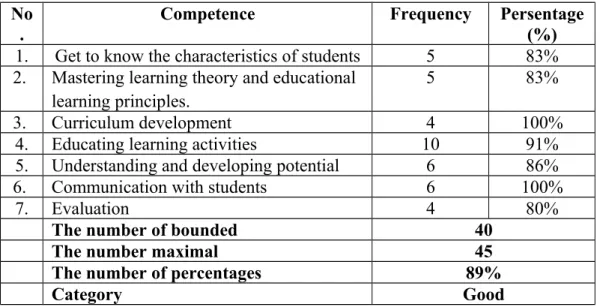
Table 1: Pedagogic Competence...50
Table 2: Personality Competence...60
Table 3: Social Competence...63
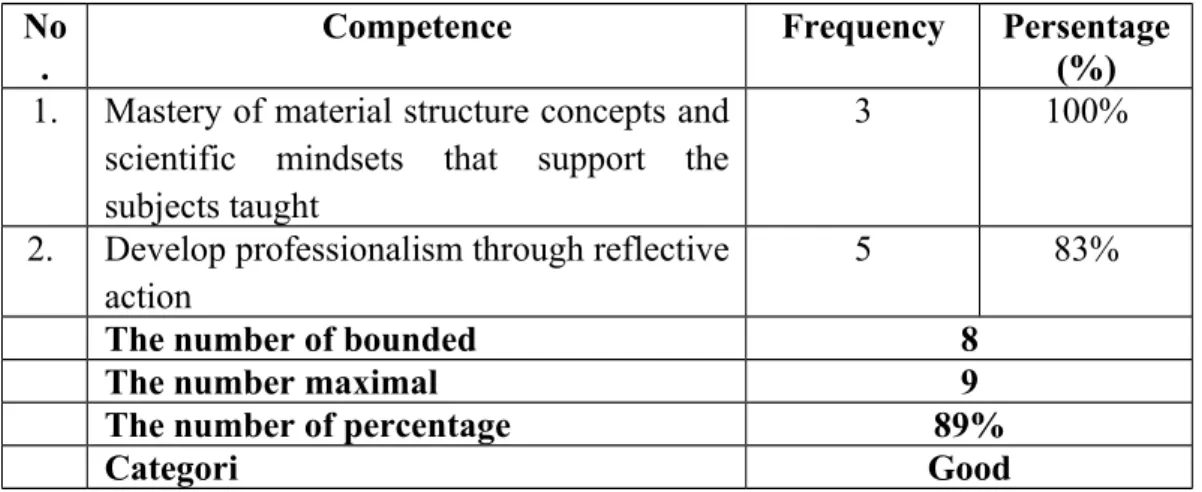
Table 4: Professional Competence...65
LIST OF APPENDICES Appendix I: Pre-observation
Appendix II: English Achievement Details Appendix III: Observation Checklist
Appendix IV: Transcrip Interview with Teacher Appendix V: Lesson Plan (RPP)
Appendix VI: Sylabus
Appendix VII: Teacher Biograpy Appendix VIII: Documentation Appendix IX: Kartu Bimbingan Appendix X: Surat Penelitian
Appendix XI: Surat izin penelitian dari yayasan Appendix: XII: Surat Selesai Penelitian
Appendix XIII: Surat Pembaharuan Judul
CHAPTER I INTRODUCTION A. Background of the Problem
English is one of the international languages which is widely used by people in many types of communication. This language is commonly used in human activities, such as tourism, technology, business, education, and other fields in the international scope. It is the language that people should master when they intend to communicate with others from different countries in the world. It is why, English is better started from young age because it can help them to get easier in mastering the language.
In Indonesia, English is taught as a foreign language in a formal school. It is implemented as a compulsory subject in junior and senior high schools. In those schools, English is taught in the teaching-learning which process covers the four English skills, there are listening, speaking, reading and writing. Those skills are integrated in English teaching-learning process, and it will develop students’ skill.
So far, many students face some difficulties in learning this subject.
Consequently, some improvement in the English teaching learning process is needed.
In teaching learning process, the teacher should determine teaching method that is suitable with the material. The teacher should also use suitable media to teach the material. A good class management will help the teacher control class situation. Those three elements will help students understand the material easily.
As one component in the learning process, the teacher has a position that determines the success of learning, because the teacher's main function is to design, manage, and evaluate learning. The teacher is in charge of transferring a set of organized knowledge so that knowledge becomes part of the student's knowledge system. In line with that, the 2013 Curriculum emphasizes that the position of the teacher in the learning process is very strategic and decisive.
Strategic because the teacher will determine the depth and breadth of the subject matter. Determine because the teacher sorts and selects the learning material that will be presented to students. One of the factors that influence the teacher in an effort to expand and deepen the material is the design of learning that is effective, efficient, interesting, and the results of high-quality learning can be done and achieved by each teacher1.
Therefore, the teacher plays an important role in the teaching and learning process to create effective and innovative learning and to arrange the class so that students are active, creative and pay attention to the class when learning.
In addition, a teacher needs to have the personality to master the subject matter and master the methods of teaching as his competence. Without this the teacher will fail in carrying out his duties. So teaching competence must be owned by a teacher who is a skill in managing educational activities. So that teachers who have teaching competence are able to create an effective and enjoyable learning environment and are better able to manage their classes so that student learning outcomes are at optimal levels. In addition to the foregoing,
1 Prof. Dr. H. Muhammad Siri Dangnga, M. S and Andi Abd. Muis, M. Pd. I. . TEORI BELAJAR DAN PEMBELAJARAN INOVATIF. (Makasar: SIBUKU Makassar, 2015), p. 115-116
competencies in the process of interaction learning and teaching can also be a tool for extrinsic motivation, in order to provide encouragement from outside students2.
As a profession, all teachers should have pedagogical competence, personality competence, professional competence and social competence.
Pedagogical competence is the ability in the management of students that includes an understanding of the student, designing and conducting learning, evaluation of learning outcomes, and the development of student to actualize various potentials.
Personal competence is personal abilities that reflect the personality steady, stable, mature, wise and dignified, become role models for students, and noble.
Professional competence is the mastery of learning materials that include a broad and deep mastery of curriculum materials, school subjects and substance of knowledge that overshadow his material, as well as mastery of the structure and science’s methodology. While the social competence is teacher's ability to communicate and interact effectively with students, other teachers, staff, parents/guardians of students and the surrounding community3. The four of the competences above should be owned by all teachers who wanted to teach.
Because, the competence is the capital, and precondition to become a real teacher.
2 Syarif Bahri Djamarah, Prestasi Belajar dan Kompetensi Mengajar (Surabaya: Usaha Nasional, 1991), p.17.
3 Kunandar, Guru Profesional Implementasi Kurikulum Tingkat Satuan Pendidikan (KTSP) dan Sukses Dalam Sertifikasi Guru, (Jakarta: Raja Grafindo Persada, 2009), p. 75-77.
In previous observations and interview with student on 22th December at SMAIT Iqra’ Kota Bengkulu, researchers looked at the pedagogic competencies possessed by the teachers in the school namely; the teacher facilitates the development of the potential of students by holding extracurricular activities every saturday, the teacher controls the characteristics of students, and organizes educational learning, and evaluates at the end of learning. Then the teacher’s personal competencies in the school are: the teacher shows an attitude that reflects a polite and polite personality, authoritative, mature, wise so that students can imitate what is in a teacher.
In professional competence, things that can be seen from the teachers in the school such as teachers master the material and concepts that are appropriate for teaching materials and use various methods. As well as on social competence researchers see teachers teaching good ways of communicating and providing inspirational stories that are able to build students’ social lives.
Through professional treatment, it is hoped that a learning process will occur in students. Thus, teacher teaching outcomes are determined by the level of student learning outcomes. The higher the student learning outcomes, the better the results of teaching the teacher4. As a result the teaching and learning process between teachers and students can run well and cause learning goals to be achieved.
4 Drs. Ahmad Jazuli, M. Pd, dkk. Kurikulum dan Pembelajaran, Teori dan Praktik.
(Bengkulu: Perpustakaan IAIN Bengkulu, 2007). p. 12
Additionally, a good teacher is the most determinant of the students’
achievement in the classroom5. So, the achievement of the students is seen from how the teachers master all the abilities of teaching.
Departing from the discription of the successful implementation of teaching learning process above, the researcer chose High School Integrated Islamic (SMAIT) Iqra’ Bengkulu city as the background of the study for a reasons that this school had have many achievement not only in city level, but also provincial, regional, national until international. But in here the researcher only reported the achievements in the field of English studies. The contests won by SMAIT IQRA’ Bengkulu from the first year until now can be seen in the apendix.
Based on the description above, the author chose to raise the title "An Analysis Teacher Competence on Teaching Learning Process of English at SMAIT Iqra’ Kota Bengkulu" as research material.
B. Identification of the Problems
Base on the background above, the researcher finds some problems in teaching learning process of English in classroom that is successfull. It can be seen that the student have concentrating the teaching-learning process. It is also supported by facilities and classroom comfortable. Beside that, they do pay attention to the lesson, some of them can answer the teacher’s question in classroom activities of teaching learning process, while the others are active. It is way, the mark of the students assessment score was high. It gotten from the score when they try to practice english in front of class.
5 Hayes, C. (2003). Teacher Professional Development: A Primer for Parents and Community Members. P. 54
C. Limitation of Problem
Based on th identification above, the researcher limits the research area only in English teacher competence in teaching learning process at SMAIT Iqra’
Kota Bengkulu.
D. Formulation of the Problem
The researcher formulates the research in two questions, namely: to what extend are teacher in SMAIT Iqra’ Kota Bengkulu competent in terms of pedagogical competence, personality competence, social competence, and proffesional competence?
E. Objective of the Problem
The research aims to analyze the teacher pedagogic competencec in teaching English with the following research objectives to investigate the extent to which teachers are in SMAIT Iqra’ Kota Bengkulu competent in terms of pedagogical competence, personality competence, social competence, and proffesional competence?
F. Significance of the Study
This study is expected to bring out some significant results, both theory and practice:
1. Theoretical Significance
a. The researcher expects that the teacher can get a new idea to teach English in teaching leaning process.
2. Practical Significance a. Students
The researcher hopes that this research will be helpful for the students to more understanding in teaching learning process. So that learners were able to achieve mastery learn optimally so as to achieve a proud achievement.
b. Teacher
This study will be beneficial for teachers of English to be more creative in finding the variety of materials for teaching english to students.
c. For schools
This research is expected to contribute positively in order to improve the quality of education.
d. Other researcher
The research is used as the references for those who want to conduct a research of English.
e. The reader
The result will be given the information to the readers in the way in carrying out the information about teaching learning process of English.
G. Definition the Variables of Research
There are some terms used in this research are defined to make them clear and in order to avoid misunderstanding. They are clarified as follows:
1. Teaching Learning Process
According to Richard and Roger, teaching learning process is defined as instructional process through organization and direct instruction of teacher, learner, and material in the classroom6.
In here, teaching learning process is a process that is focused on the way teachers deliver material in the teaching and learning process.
2. Teacher Competence
According Kiymet Selvi, teacher competencies have been broadening with respect to reform studies in education, development of teacher education, scientific results of educational science and other fields7.
In here, teacher competence is the teacher's ability to educate students in the teaching and learning process in order to create outstanding students based on the four competencies they have, namely pedagogical, personal, professional, and social competence.
6C. Richards, and Theodore S Rodgers. Approach and Methods in Language Teaching.
(London:Cambridge University Press, 1998). P. 22
7 Kiymet Selvi. Teachers’ Competencies. Cultura. International Journal of Philosophy of Culture and Axiology, vol. VII, no. 1/2010, p.. 167
CHAPTER II LITERATURE REVIEW A. Concept of Learning and Teaching
1. Definition of Learning and Teaching
Learning is an act of getting experience, knowledge, skills, and values by understanding what to do and how to do any taks by synteshizing the different types of information perceived by us. Learning brings about changes in the existing behaviour of an individual8. According to behavioristic theory, learning is a change in behavior as a result of the interaction between stimulus and response. in other words, learning is a form of change experienced by students in terms of their ability to behave in new ways as a result of interactions between stimulus and response9.
From the opinion of the expert above, it can be conclude that learning is a process of interaction and understanding between a person and environment with a conscious condition that cause changes in behaviour.
Teaching is outside the learner. Learning is internal to learners. You can not motivate others if you are not self-motivated. Motives are not seen, but, Behaviors are seen. Is learning a motive or behavior? Learning is both a motive and behavior but only behavior is seen, learning is internal, performance is external10.
8William Dharmaraj. Learning And Teaching. Bharathidasan University Tiruchirapplli- 620 024, 2015, p. 4
9 Abu Ahmadi dan Widodo Supriyono. Psikologi Belajar. (Jakarta: Rineka Cipta, 2013), p. 20 10A. H. Sequeira. “Introduction To Concepts Of Teaching And Learning”. Article In Ssrn Electronic Journal · September 2012, p. 31&32
Teaching which is implied in the first definition of learning, may be defined as showing or helping someone to learn how to do something, giving instruction, guiding in the study of something, providing with knowledge, causing to know or understand11.
B. Teaching Learning Process
1. Teaching
Teaching has important rules to help learners in order to understand materials. Teaching is a process of arranging condition under which the learner changes his way consciously in the direction of his goal.
Based on those statements, the main task of a teacher is arranging and giving the knowledge for the students consciously and pointed to the goal, that is making the learner understand more about the science or knowledge. It can be watched and identified by observing what teachers do.
Therefore, teaching consists of activities, tasks, and learning experiences selected to bring help about learning and how to use it in the classroom. It is an activity that tries to help someone to acquire (change or develop skill, attitudes, appreciations and knowledge). It means that teaching activity is an activity which helps the learners learns how to do something by giving instruction and some guidance to learners until the learners understand.
11H Douglas Brown. Principles of Language Learning And Teaching. Fourth Edition.
(San Fransisco State University: Longman, 2000), p. 7
From the idea above, it can be concluded that the process of teaching is a process of helping, facilitating and guiding the learners with the main goal that is making them understand more about the knowledge or science.
In relation to the teaching curriculum in Indonesia today, the curriculum in the process dimension is the realization of ideas and curriculum design into a learning process. Teachers are the main education staff who develop ideas and designs into learning processes.
The function of the teacher is to bring both parties (the teacher and students) into a contact, a relationship, and help put that contact in harmony.
The most important activity is not the adjustment of students to the teacher, but the adjustment of students to the world. Teaching is the right art and procedure in certain environments and environments. The most important part of the art of teaching is making children feel they need learning. The method that can be done by the teacher is by learning with interesting practical activities, giving them a problem to solve, choosing subject matter that attracts students' natural interest. Teachers must learn a lot to be able to do this, not only academic knowledge, but also students' psychological knowledge.
Thus, based on the curriculum in Indonesia today that teaching focuses more on student participation in the teaching and learning process, so that students are active and creative by encouraging students to solve problems themselves related to subject matter and encourage students to use their own ideas in making solutions to these problems. The problem solving activity must
be supported by a pleasant learning atmosphere so students are interested in participating in the learning process. Learning must provide broad opportunities for students to develop themselves into learning outcomes that are the same or higher than those stated in the Graduate Competency Standards.
2. Learning
According to Kimber and Garmezy, “Learning is a relatively permanent change in behavioral tendency and is the result of reinforced practice”12. Teaching learning process is defined as instructional process through the organized and direct instruction of teacher, learner, and material in the classroom13. Teaching and learning process has very close relationship and one into another cannot be defined apart.
Brown identifies the components of definition of learning as follow:
a. Learning is acquisition or getting.
b. Learning is retention of information or skill.
c. Retention implies storage systems, memory, cognitive organization.
12 H Douglas Brown. Principles of Language Learning And Teaching. Fourth Edition., p.7
13 C. Richards, And Theodore S Rodgers. Approach And Methods In Language Teaching. London: Cambridge University Press, 1986. P. 22
d. Learning involves active, conscious focus on and acting upon even outside or inside the organism.
e. Learning is relatively permanent, but subject to forgetting.
f. Learning involves some forms of practice, perhaps reinforced practice.
g. Learning is changes in behavior.
Furthermore, teaching cannot be defined apart of learning. Teaching is guiding and facilitating learning, enabling learner to learn, and setting the condition for learning14. It can be concluded that learning is a process to get something like information or skill in cognitive organization that can be change the human’s behavior. By the learning it is hoped that students can understand the process of learning. They will be able to take the responsibilities for their own getting or learning and have good competence.
According to Gultom, "... the learning process of the 2013 Curriculum was developed based on the principles of active student learning through observing (seeing, reading, listening, listening), asking questions (oral, written), analyzing (connecting, determining relevance, building stories / concept), communicating (oral, written, pictures, graphics, tables, charts, etc.)”
In accordance with the above opinion, the learning process in the 2013 curriculum begins with observing activities by students by looking at, reading,
14 H Douglas Brown. Principles of Language Learning And Teaching. Fourth Edition., p.8
listening and listening to problems related to the subject matter. After students observe, students can ask questions about what is seen, read, heard and listened to both verbally and in writing. The next step is analyzing activities by collecting information, connecting information obtained by students, and determining the relationship between information with one another (processing information). The final activity carried out by students is communicating the results of observations made by students.
3. The Roles of Teacher
The quality of the teacher’s teaching is directly related to the quality and value of the learning that is taking place in his student. It means that the teacher plays an important role in teaching learning process. Meanwhile, some teacher’s roles in teaching learning process are follow:
a. Teachers as facilitators, they provide everything that student’s need in the classroom, such as the material and teaching media.
b. Teachers as classroom managers, they must be able to manage the classroom activity during teaching learning process.
c. Teachers as instructors, they are people who give instruction or direction to students.
d. Teachers as consultant, they give good advice to the students although students need or not, or students have any problem.
e. Teachers as evaluator, they have to know how far the students’ progress in learning English.
Besides all those roles above, that there are three functions of teacher as follow:
1. Teachers as instruction designers which enables the teacher to design the teaching learning activity in order to reach goal.
2. Teachers as instruction managers, it means that the teacher has to be able to manage each step of teaching learning process.
3. Teacher as evaluators of students learning, concerning the function that the teacher giving attention to the students’ development.
It can be concluded that every teacher is expected to direct, facilitate and encourage the students to participate in teaching learning activity to create interactive language learning in order to achieve the goal in the teaching learning process.
According to the Indonesian curriculum, in essence the 2013 curriculum is an improvement of the previous curriculum. The target of curriculum change is none other than the teacher as the direct implementer
in the classroom. Therefore, the discussion is more directed at how the role of teachers in the 2013 curriculum.
The scientific approach actually focuses on several roles of the teacher in learning. How do teachers streamline learning through methods and scientific thinking (science).
There are several roles of teachers in the application of the 2013 curriculum in learning:
a. The teacher as a learning designer
b. Teachers as Learning Artists
c. Learning motivator
d. Learning mediator
e. Learning instructors
4. The Roles of Students
Learner’s roles cannot be ignored, because students’ participation is an important involvement in the classroom interaction and the language learning.
In the latter type of interaction in classroom interactions, the roles of student as an active participant in social learning began to be emphasized”. In other words, that student also has an important role to realize the goal of teaching learning process15.
Therefore, a good classroom interaction will encourage students to participate actively in the process of teaching and learning, because when students respond to the teacher’s question and gives comments, it will help them explore their ideas and knowledge that is good for the development of their language acquisition.
Johnson and Paulson states that learner‟s roles are as follows:
a. Learners plan their own learning program and these ultimately assume responsibility for what they do in the classroom.
b. Learners monitor and evaluate their own progress.
c. Learners are members of group and by interacting with the others.
d. Learners tutor other learners.
e. Learners learn from teacher, from the other students and other teaching source.
5. Components Involves in Teaching Learning Process
There are some components to support teaching learning process running well and effectively. Those components are relating each other and the
15 Richard, C. Jack. Approaches And Method In Language Teaching. (Cambridge:
Cambridge University Press, 2002). P. 10
teaching process will be interrupted if there is missing a component. Teaching learning process can be divided into seven components16, they are:
a. Students
The student is the seeker, the receiver and the saver of the subject materials needed to achieve the goal. In the teaching learning process, the students are the one who seek the knowledge which is delivered by the teacher.
b. Teacher
Teacher is the manager of teaching learning activities and the teaching arranger. Teacher also has big contribution to make the teaching learning run effectively.
c. Goal
Goal is an effort about the intended changes which could be achieved after following certain teaching and learning process. These changes involve affective, cognitive and psychomotoric areas. The goal of teaching and learning process should be realistic and suitable with the needs of the students.
d. Material
Materials have an important role in the teaching learning process Materials should teach students to learn, that they should be the resource
16 Giono, H. J. Belajar Dan Pembelajaran. (Surakarta: Sebelas Maret University Press., 1997). P. 20
books for ideas and activities for instruction/learning, and they should give teachers rationale for what students do.
A subject material is something presented by teacher to be developed then understood by students, to reach the determined instructional goals. In other words, the subject material is one of important components to reach the teaching goals. The subject material consists of facts, generalization, concept, regulation etc. content in the subject.
Material is one of curriculum component or can be called curriculum content. And usually, it includes textbooks or books that were appropriated to their curriculum. In the selection the material teachers must be responsible because it makes them overwhelmed. Before the selection of the right material, they are supposed to consider different factors especially for the suitability of their class. Many kinds of materials can be used by teachers. Beside handbooks for material, teachers can use cassettes, posters, pictures and dictionaries to support the teaching learning process. Some principles in selecting material are as follows:
1. The material should be appropriate to reach the instructional goals.
2. The material should be suitable with the education level/the student’s maturity.
3. The material should be organized systematically and be continuous.
4. The material should have content both factual and conceptual things.
To give some materials to the students’ needs good preparation such as syllabus. Syllabus is the preparation to do the teaching activity by
applications the teaching principles and through teaching steps to gain the goals of teaching learning.
A good syllabus should be flexible, it means it can be changed according to the teaching situation and condition which need changes, also give chance for unpredicted things as long as the changes is not basically and totally. So, made a good teacher should have a good syllabus too.
e. Method
Method is an overall plan for orderly presentation of language material, no part of which contradicts and all of which is based upon the selected approach. An approach is axiomatic whereas method is procedural. It means that method is treated at the level of design in which the roles of teacher, learners and instructional material are specified17.
The method of teaching is necessary and it plays a significant role in achieving the desire of learning. Thus, method is theoretically related to all approach and is organizationally determined by design.
The methods treat at the level of design. Without method a teacher will not able to teach optimally. According to Freeman and Larsen, there are some English teaching methods namely: Grammar Translation Method (GTM), Direct Methods (DM), The Audio Lingual Method (ALM), The Silent Way, Suggestopedia, Community Language Learning (CLL), The Total Physical Response Method (TPR), and The Community Language Teaching (CLT). In addition there are model of Learning such as Content-
17 Endang, Fauziati. Teaching Of English as Foreign Language (TEFL). (Surakarta:
Muhammadiyah University Press, 2002).P.5
Based Instruction, Task-Based Instruction, Cooperative Learning and Collaborative Learning18.
f. Media
The word “media” comes from the Latin and it is the plural form of
“medium” which means mediator or agent. Media are devices used for conveying the information to the students so that they can achieve the goal easily. The media is able to perform the message and also stimulate the students in learning activity. Media are things that characterize delivering message and able to stimuli the thoughts, feels and audiences (students) desire so they can support them in the process of studying.
So, media are things to transfer messages which are able to stimulate ideas, feelings and student‟s desire to support the learning process on themselves. The media creatively stimulate the learners to learn better and are able to develop their performance according to the instructional goals. The advantages of teaching media are:
1. Teacher can deliver the material appropriately.
2. The process of the teaching and learning becomes more interesting.
3. The process of teaching and learning can more interactive.
4. The time of teaching and learning is deductible.
5. Student learning quality increased.
6. The process of teaching and learning can apply wherever and whenever.
18 Freeman, Larsen, Diane. Techniques And Principles In Language Teaching.
(Hongkong: Oxford University Press, 2000).
7. Positive attitude of students in learning process increased.
8. The teacher‟s role becomes more positive and productive.
As the explanation about some advantages of the using teaching media above it can be concluded that media can make the process of teaching learning more achievable for teacher and students. Teaching media have an important role in the teaching learning process that is intended to make teaching learning process more effective and efficient, that the quality of education can be improved. Media are divided to be some parts as follows19:
a. human media, in this case the media are teachers themselves.
b. printed media, for example: books, textbooks and script texts.
c. audio media, for example: tape recorders.
d. visual media, for example: graphics, maps, blackboard, pictures and photos
e. audio-visual media, for example: videos, films and televisions.
f. computer media, for example: computers and laptops.
There are many kinds of media used in teaching, so each of the media has a different characteristic. Something has to be considered in choosing the media as follow:
1. The media should be suitable to the instructional goal.
2. The media should be suitable to the instructional goal.
3. The media should be appropriate with the student‟s condition.
4. The media should be easy to prepare.
19 Azhar, Arsyad. Media Pembelajaran. (Jakarta: Pt. Raja Gravindo Persada, 2009).P. 81
5. The media should be able to explain something will thet be explained by teacher to the students.
6. The balancing between the coast of media and the result will be reached.
In teaching learning, media have certain functions to contribute the process of teaching learning. Levie & Lents (1982) explain the functions of teaching media, as follows20:
a. Attention
Media are able to interest the attention of the students in teaching learning in the class or out of class. Generally, students are more interested to learn something by a real object than theory.
b. Affection
Affection is related to students‟ feeling. Using media can come up the emotions of students. For example, students are more diligent and discipline.
c. Cognitive
Cognitive is related to the achievement in catching, memorizing, showing and sharing everything to the other. Media can help the students easily catch the target of learning process.
d. Compensatory
20 Azhar, Arsyad. Media Pembelajaran., p.16
In compensatory, media are used to accommodate the students who have less achievement in understanding the lesson verbally or orally.
Based on the explanation above, it can be concluded that media are very useful to contribute the process of teaching learning, especially to memorizes, appearing emotions of students, easily catch the target, and to accommodate the students achievement.
g. Evaluation
Gronlund in state that evaluation may be defined as a systematic process of determining the extent to which instructional objectives are achieved by students21. There are two important aspects of this definition.
First, note that evaluation implies a systematic process, which omits casual, uncontrolled observation of students. Second, evaluation assumes that instructional objectives have been previously identified. Without previously determined objectives, it is difficult to judge clearly the nature and extent of student learning22.
Evaluation is an assessment activity to achieve student‟s competence. Hamalik argues that, “Evaluation is a continuity process regarding collecting and interpreting information to assess the decisions made to plan a teaching system”. That idea has three implications, they are:
21 Purwanto, Ngalim. Prinsip-Prinsip Dan Teknik Evaluasi Pengajaran. (Bandung:
Remaja Rosdakarya, 2012).P. 3
22 Nunan, David. Second Language Teaching And Learning. (Boston: Heinle And Heinle Publiser, 1992).P. 184
1. Evaluation is a continuously process, not only in the end of teaching, but it started before the teaching conducts until end of teaching.
2. The process of evaluation is always aimed to a certain purpose that is to get the answers about how to improve the teaching is.
3. Evaluation demands using the accurate instruments of assessment to get information needed in making a decision. Thus, evaluation constitutes a process dealing with collecting information enables to determine the progress of teaching and to do better in the future time.
According to statement above, in this case evaluation is an effort to control how far the students‟ progress is in learning. Besides that, evaluation has some functions. The functions of evaluation are not only to determine the students‟ progress in learning, but so-far-ranging. According to Cronbach, the functions of evaluation are:
a. Evaluation helps the students realize themselves to change or develop their behavior.
b. Evaluation helps the students getting satisfied to what had been done.
c. Evaluation helps the teacher determine whether the method used proper or not.
d. Evaluation helps the teacher make consideration of administration.
e. Evaluation helps to determine number of students‟ achievement progress.
f. Evaluation helps to place the students into appropriate and harmonious teaching learning situatio.
g. Evaluation helps to know students‟ background (psychological, physic, and environment).
h. Evaluation gives feedback to teachers and used to improve teaching learning process and remedial program.
From the statements above it is clear that the functions of evaluation are useful for both the students and the teacher.
According Arikunto to the usage to measure the students, there are three kinds of tests23:
1. Diagnostic test
It is a test used to know the students weakness, so from this weakness it is able to do the right action. It is to help the students to solve their problems. Diagnostic test is done from input and during the students study.
2. Formative test
It purposes is to know how far the students been after passing a certain programs. It is done in the end of the program. Sometimes it is called posttest. It is to improve the teaching learning.
3. Summative test
Summative evaluation occurs at the end of a program or course and is used to determine its overall effectiveness. The term summative means the summing up of all available information regarding a program at its “terminal point,” defined by a point in time (for
23 Arikunto, Suharsimi. Prosedure Penelitian. (Jakarta. Pt. Rineka Cipta, 1999). P. 33
example, the end of a school year) or by some stated level of competence or mastery.
C. Process Assessment in Learning
1. Understanding Process Assessment in Learning
Before explaining the assessment of the process in learning which is a combination of several words, first it will explain some of the meanings about assessment and learning. Assessment in English is known as assessment, which means evaluating something. Assessing means making a decision about something by referring to a certain measure, such as judging good or bad, healthy or sick, clever or stupid, high or low, etc24.
According to Endang Purwanti, Assessment can be interpreted as a process to get information in any form that can be used as a basis for making decisions about students, both concerning the curriculum, learning programs, school climate and school policies. A similar opinion was also conveyed by Akhmad Sudrajad, assessment or assessment is the application of various ways and the use of various assessment tools to obtain information on student learning outcomes or the achievement of competencies (abilities) of students.
According to Ign. Masidjo, valuation is an activity comparing the results of measuring the nature of an object with a relevant reference so that the quantity of an object is obtained qualitatively. Assessment is a general term that includes all the methods used to assess performance of individuals or
24 Supardi, Penilaian Autentik Pembelajaran Afektif, Kognitif, Dan Psikomotor Konsep Dan Aplikasi, Pt Rajagrafindo Persada, Jakarta, 2015, Hlm. 11
groups of students25. Whereas according to the Ministry of Education and Culture quoted by Fadlillah assessment is the process of gathering information or evidence through measuring, interpreting, describing, and interpreting evidence of measurement results26.
The term learning is a translation of the instruction word. learning is all efforts made by educators so that the learning process occurs in the learners themselves. Implicitly in learning, there are activities to choose, set, and develop methods or models to achieve the desired learning outcomes.
Learning emphasizes more on ways to achieve goals and relates to how to organize the content of learning, convey the contents of learning, and manage learning.
Learning does not merely convey material in accordance with the curriculum target, without regard to the condition of the students, but also related to the human, material, facilities, equipment, and procedures that influence each other in order to achieve the learning objectives. so, learning is the interaction between teacher and student, as well as theory and practice Learning activities are a goal conscious business, which systematically aims at behavior change.
The change referred to refers to a process that must be passed, without a process of change that is not possible and goals cannot be achieved. And the
25 Elis Ratnawulan Dan Rusdiana, Evaluasi Pembelajaran, Cv Pustaka Setia, Bandung, 2015, P. 24
26Fadlillah, Implementasi Kurikulum 2013 Dalam Pembelajaran Sd/Mi, Smp/Mts, Dan Sma/Ma, Ar-Ruzz Media, Yogyakarta, 2014,. P. 202
process referred to here is learning activities as an interactive educational process.
Based on some understanding according to experts, it can be concluded that the assessment in the process of learning is the activity of comparing or applying measurement results to give value to objects in the context of learning.
Process assessment is carried out when the learning process takes place.
Process assessment is an assessment that focuses on the assessment objectives on the level of effectiveness of teaching and learning activities in the context of achieving teaching goals. Assessment of the teaching and learning process concerns the assessment of the teacher, student activities, teacher-student interaction patterns and the implementation of the teaching and learning process.
Assessment of the learning process is related to the paradigm that in learning activities the main activity lies in students, students who predominantly engage in independent learning activities and teachers only do guidance. In this context the teacher must monitor the difficulties of students in the process every meeting.
2. Criteria in Assessing the Teaching and Learning Process
Some criteria that can be used in assessing the teaching and learning process include the following27:
27 Nana Sudjana, Teaching And Learning Process Results Evaluation, Pt Remaja Rosdakarya, Bandung, 2012, P. 60-62
a. The consistency of teaching and learning with the curriculum
The success of the teaching and learning process is seen to what extent the reference is carried out in real form and aspect:
1. Teaching goals.
2. Teaching materials provided 3. Types of activities carried out.
4. How to carry out each type of activity.
5. Equipment used for each activity.
b. Implementation by the teacher
This implementation can be seen in terms of:
1. Conditioning student learning activities
2. Prepare learning tools, resources, and equipment 3. Time provided for teaching and learning activities.
4. Provide assistance and study guidance to students.
5. Carry out assessment of the process and student learning outcomes.
6. Generalize the results of teaching and learning at that time and follow- up for subsequent teaching and learning activities.
c. Implementation by students
Implementation by students can be seen in terms of:
1. Understand and follow the instructions given by the teacher.
2. All students participate in learning activities.
3. Learning tasks can be completed properly.
4. Utilizing all learning resources provided by the teacher.
5. Mastering the teaching goals set by the teacher.
d. Teacher-student interaction
Student teacher interactions can be seen in:
1. Question and answer or dialogue between teacher and students or between students and students.
2. Teacher assistance to students who experience learning difficulties, both individually and in groups.
3. The availability of certain teachers and students is used as a learning resource.
4. Always have teachers in teaching and learning situations as learning facilitators.
5. The appearance of the teacher as a way out when students face a dead end in their learning assignments.
6. There is an opportunity to get continuous feedback from the learning outcomes obtained by students.
3. Process Assessment Techniques in Learning
Assessment of the process of learning activities can be carried out in the following ways, namely28:
28 Abdul Majid, Penilaian Autentik Proses Dan Hasil Belajar (Pt Remaja Rosdakarya, Bandung, 201), P. 156
a. Use the observation sheet both to assess students, teachers, and to assess both.
b. Assessing interactions that occur in the classroom during learning.
Techniques for obtaining data and information about the teaching-learning process, namely, among others29:
1. Questionnaires and interviews, namely submitting written questions (questionnaires) or verbally (interviewing) to data sources regarding the information needed. For example, students or teachers are asked for their views on curriculum, assessment, learning tools and equipment.
2. Observation or observation, namely seeing first hand the events, events, behavior of the teacher or student when the teaching and learning activities take place.
3. Scale, both the rating scale and the attitude scale, which is aimed at the teacher or student with regard to the teaching-learning process.
4. Case studies, namely in-depth study of the behavior and development of certain students who experience learning difficulties, difficulty adjusting, learning failure and others.
D. Teacher Competence
1. Definition of Teacher Competence
The word competency is rooted in other languages "competere" which means "suitable" (according). Adelsberger stated that the concept of competency was developed in the field of psychology which refers to the
29 Nana Sudjana, Op. Cit., P. 64
ability of someone to respond to certain demands given by their environment.
While according to Mullins who stated that “Competences are what people need to be able to perform a job and competencies are aspects of behaviour that influence a person’s competent performance”30.
The definition of this definition illustrates that competence is a set of skills, knowledge, attitudes and abilities that are needed by a person, team, or organization to be able to complete their work properly.
While teacher competence is defined as mastery of a task (teaching and educating), skills, attitudes, and appreciation needed to support the success of the learning process that it does. Thus, the competencies possessed by each teacher will show the true quality of the teacher. These competencies will be realized in the form of mastering skills, knowledge and professional attitudes in carrying out their duties and functions as teachers31.
According to gordon as saying by Mulyasa, that there are six aspect or the contained in the concept of competence, that is as follows32:
a. Knowledge is conscientiousness in the field of cognitive, for example a teacher know how to undertook the identification of learning needs, and learning how to do with students suit its needs.
30Euis Rusmini. “Pedagogical Competence Of Teachers Of Social Science Education At Smpn 2 Sidomulyo”, Jurnal Studi Sosial Vol 6, No 1 (2018), P. 4
31Cut Fitriani, Murniati Ar, Nasir Usman. “Kompetensi Profesional Guru Dalam Pengelolaan Pembelajaran Di Mts Muhammadiyah Banda Aceh”, Jurnal Magister Administrasi Pendidikan Pascasarjana Universitas Syiah Kuala Volume 5, Issn 2302-0156 ,No. 2, Mei 2017, P.
89-90
32Haniatin Nabila. “The Influence Of Pedagogic Competence And Professional Competence To Performance Of Teachers Social Studies In Trowulan District”, International Conference On Ethics Of Business, Economics, And Social Science, Issn: 2528-617x, Icebess 2016 Proceeding, P. 560-561
b. Understanding is the depth of cognitive and and affective owned by individuals, for example a teacher who will implement learning must have good understanding concerning characteristics and conditions students.
c. Skill is something owned by individuals to perform the or work is charged with, for example the capability of teachers in choosing and make props simple to made it easier to learn to students.
d. Value is a standards of behavior is believed and psychologically have fused within one person, for example standards of behavior teachers in weighting (honesty, openness, democratic, and other).
e. Attitude is feelings (happy or not happy and like or dislike) or a reaction to a stimulation coming from outside, reaction to economic crisis, feelings for a raise, and others.
f. Interest is a tendency someone to perform an action , for example interest to do something or to study something.
2. Competence of Teachers
According to article 28 paragraph 3 government regulation number 19 year 2005 on national education standards and article 10 (1 act no 14 years 2005) on teachers and lecturers, competence of teachers consist of competence pedagogical, competence personality, competence professional, and social competence33.
33 Haniatin Nabila. “The Influence Of Pedagogic Competence And Professional Competence To Performance Of Teachers Social Studies In Trowulan District” P. 560
a. Pedagogical Competence
According to A. Fatah Yasin, pedagogic competence is the ability of an educator in managing the learning of students include the ability to understand the learners, the ability to create learning design, the ability to implement the learning, the bility to evaluate learning outcomes, the ability to develop learners to actualize its potential34.
Meanwhile, The Ministry of National Education through the Directorate General of Quality Improvement of Educators and Education Personnel divides the teacher's pedagogical competencies into 7 (seven) sub-competencies and 45 (forty-five) indicators. Indicators of teacher pedagogic competence indicators include: mastering the characteristics of students, mastering learning theory and the principles of educational learning, curriculum development, activities educating learning, develop potential students, communication with students, and assessment and evaluation35.
b. Personality Competence
According to Bhargava & Pathy concerning the competence of personality in his article Morallo entitled Personal and Professional Competencies of Senior Teacher Education Students stated that the
"Teacher's personal competencies include knowledge of the subject matter,
34 Julkifli Hidayat Ada And St. Azisah. The Contribution Of Teachers’ Pedagogical Competence Toward The Effectiveness Of Teaching Of English At Mtsn Balang-Balang. Volume 02, Number 02, December 2016. Uiniversitas Islam Negeri Alauddin, Makassar . P. 242-243
35Euis Rusmini. Pedagogical Competence Of Teachers Of Social Science Education At Smpn 2 Sidomulyo, Jurnal Studi Sosial Vol 6, No 1 (2018). P. 4
effective communication skills, punctuality, being a disciplinarian and understanding the nature of child psychology”.
The conclusion of this statement is the personal competence of teachers include knowledge of the subject matter, effective communication skills, punctual, disciplined and understand the character of psychology children.
Mulyasa states that there are some personal competence that must be possessed by a teacher namely: personality steady, stable and adults;
discipline, wise, and charismatic; being a role model for students, and noble.
Indicators of personal competence in this study based on the opinion of Mulyasa and the development of questionnaires by researchers from higher education, which shows a mature person and by example, work ethic, high responsibility and pride a teacher, discipline, wise and authoritative, a role model for students and noble36.
c. Professional Competence
Professional competence is the ability in mastering the materials to fulfill the standard base competency which has been set by the Minister of Education. The teachers must have a number of standard competencies to be professional teacher either based on the Regulation of the
36 Pahrudin, Et Al. The Effect Of Pedagogic Competency, Personality, Professional And Social Competency Teacher To Study Achievement Of Economic Lesson In State Senior High School Of East Lombok District Academic Year 2015/2016. Proceeding The 2nd International Conference On Teacher Training And Education Sebelas Maret University Volume 2 Number 1 2016 Issn : 25002 – 4124, P. 336
Minister of National Education of the Republic of Indonesia No. 16/2007, Slavík (2008) or Bantang (2008).
The following is the sub-competences of professional competence based on The Regulation of National Education Minister of the Republic of Indonesia:
1) Mastering the materials, the structure and the concept of the subject taught
2) Mastering standard competency and basic competencies of the subject taught
3) Developing the learning materials creatively 4) Developing their own professionalism 5) Using the information technology
Slavík categorized the teacher's professional competence into five items, they are as follows;
1) Mastery a systematic body of knowledge.
2) Ability to apply practical experience in the specialization according to the subject of the study.
3) Ability to transform the knowledge based on the subject of study.
4) Ability to integrate the inter-disciplinary knowledge and create subject- links.
5) Ability to use the information and communication technology effectively.
The other opinion came from Bantang who stated that there are some abilities that have to be owned by the teachers related to the professional competence. The abilities are:
1) Mastering the subject taught 2) Planning the lesson
3) Managing the class
4) Being able to use instructional media 5) Understanding the students' characteristics 6) Being able to select the appropriate materials 7) Being able to conduct an action research37.
Therefore, three sources about professional competencies are related one another. But the researchers used The Regulation of the National Education Minister of the Republic of Indonesia No. 16/2007 as the main indicator.
d. Social Competence
According to Surya, social competence is required by a person's ability to succeed in dealing with others, including skills in social interaction and social responsibilities. In that Regulation no 19 of 2005 stated that, social competence includes the ability to communicate, get along in school and society.
Mulyasa states that social competency is the ability of teachers as part of the public to communicate and interact effectively with others 37 Syamsinar, Baso Jabu: The Problems In Professional Competence Of Teachers In Teaching English Subject At Vocational High Schools. Elt Worldwide Vol. 2 No. 2 October 2015, P. 97-98