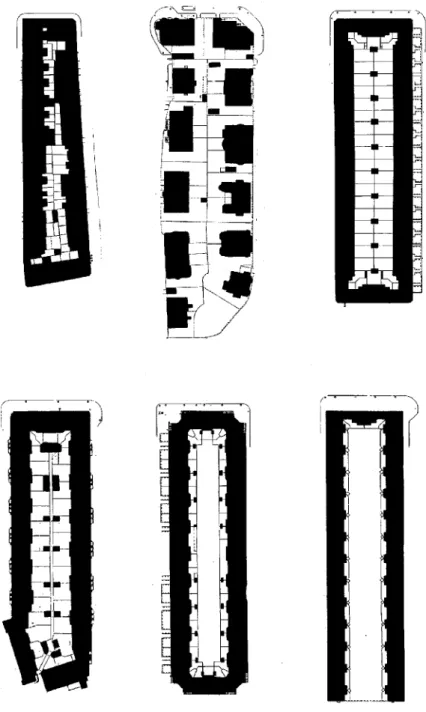
U R B A N F O R M S THE DEATH AND LIFE OF THE URBAN BLOCK
P H I L I P P E P A N E R A I
JEAN CASTEX & JEAN-CHARLES DEPAULE
ENGLISH EDITION AND ADDITIONAL MATERIAL BY IVOR SAMUELS
U R B A N F O R M S
THE DEATH AND LIFE OF THE URBAN BLOCK
Translated by Olga Vitale Samuels
Translation#Elsevier Ltd 2004
Translated from the original French by Olga Vitale Samuels Original Title:Formes urbaines, de l’Iˆlot a` la barre
ISBN 2-86364-6028#editions Parenthe`ses, Marseilles 1997, 2001
All rights reserved. No part of this publication may be reproduced in any material form (including photocopying or storing in any medium by electronic means and whether or not transiently or incidentally to some other use of this publication) without the written permission of the copyright holder except in accordance with the provisions of the Copyright, Designs and Patents Act 1988 or under the terms of a licence issued by the Copyright Licensing Agency Ltd, 90 Tottenham Court Road, London, England W1P 9HE. Applications for the copyright holder’s written permission to reproduce any part of this publication should be addressed to the publishers
British Library Cataloguing in Publication Data
A catalogue record for this book is available from the British Library Library of Congress Cataloging-in-Publication Data
Panerai, Philippe,
[Formes urbaines. English]
Urban forms : the death and life of the urban block / Philippe Panerai, Jean Castex, and Jean-Charles Depaule ; English edition and additional material by Ivor Samuels.
p. cm.
Includes bibliographical references and index.
ISBN 0-7506-5607-7 (alk. paper)
1. City planning–Europe–History–19th century. 2. City planning–Europe–History–20th century. I. Castex, Jean. II. Depaule, Jean-Charles. III. Samuels, Ivor. IV. Title.
NA9183.P35 2004
7110.4009409034–dc22 2003063574
ISBN 0 7506 5607 7
For information about all Architectural Press publications visit our website at http://books.elsevier.com
Printed and bound in Great Britain
CONTENTS
Introduction to the first English-language edition vi
Introduction to the second French edition ix
CHAPTER 1
HAUSSMANNIEN PARIS: 1853–82 1
CHAPTER 2
LONDON: THE GARDEN CITIES, 1905–25 30
CHAPTER 3
THE EXTENSION OF AMSTERDAM: 1913–34 56
CHAPTER 4
THE NEW FRANKFURT AND ERNST MAY: 1925–30 90
CHAPTER 5
LE CORBUSIER AND THE CITE´ RADIEUSE 114
CHAPTER 6
THE METAMORPHOSIS OF THE BLOCK AND THE PRACTICE OF
SPACE 124
CHAPTER 7
THE DEVELOPMENT AND DIFFUSION OF ARCHITECTURAL
MODELS 134
CHAPTER 8
BUILDING THE CITY: 1975–95 158
CHAPTER 9
AN ANGLO-AMERICAN POSTSCRIPT 168
References 200
Biographical Notes and Bibliography – Chapters One–Eight 203
Index 217
It has taken more than 25 years to publish an English version ofFormes urbaines: de l’ıˆlot a la barre, yet the story it tells – of the erosion and disappearance of the urban block – is as relevant today as ever. The book has been translated into Italian, Spanish, Dutch, German and Serbo-Croat and the tardiness of this present transla- tion is a rebuke to our Anglo-Saxon culture. We seem willing to venture abroad in search of the latest fashions in dress or design but are reluctant to make available to an English-speaking audience works of a more enduring relevance. This is surprising when we consider that the potential audience is much larger than only those countries where English is the mother tongue.
The first French edition was published in 1977 by a team from the School of Architecture at Versailles, which was supported by a grant from the Direction d’Architecture of the Ministe`re d’ E´quipments. Versailles was one of the newly cre- ated schools of architecture that were established after 1968 and this research group had close links with the Italian Typomorphological School of urban analysis. (Darin, 1998).
I bought a copy in 1978 and very much regretted not having this work available in English, because this was just the time when urban design was emerging as a separate activity among the environmental professions in the Anglo-Saxon countries. It should be noted that, in these countries, unlike much of Continental Europe, where town planners are still struggling for a separate professional identity, there have been two professions responsible for the built environment ever since the early years of the last century. By the late 1960s, the reaction against modernism had led to the claim that the poor quality of the public realm, which was one of the main targets of this critique, was largely due to this division of responsibility between the two professions.
That this was a simplification is borne out by the equally poor quality of the public realm in those parts of the world where there was no such schism.
Hence it was in the 1970s in the UK that the notion of urban design began to emerge as a discipline to fill the gap between the two professions of architecture and planning.
It was suggested that architecture was too concerned with individual special build- ings, while planning at that time, particularly in academic circles, had become pre- occupied with process and management, economics and social welfare, and any concern with physical form was perceived as being academically frivolous. The public realm was a sort of no-man’s-land between the two – and it was the public realm of
postwar development that was the target of so much popular discontent. Urban design as a separate activity with its own pressure groups and (later) journals was invented to fill the gap. The first postgraduate training courses were also being set up at this time and this book would have made an ideal basic text for these courses for a number of reasons, which are still relevant today.
First,Formes urbainesacknowledged the importance of the detailed physical design of our environment in the enabling of populations. This was at a time when the social- science preoccupations of planning implied that, if we got the economic and social policies right, it did not matter about the design of physical form. It used scaled plans and sections of urban tissues, not diagrams. It is important in elevating the detailed discussion of urban form beyond the functional level of Neufert or The Architect’s Handbook, but it also points out the importance of economic processes and social and cultural determinants to the use of space in different contexts.
Secondly, it is truly a work of urban design in the way that it focuses on the connec- tion between the form of cities and their architecture – especially with respect to ordinary buildings. Our towns and cities are made from these ordinary buildings and most of them are houses in some form or other – ‘thematic buildings’. The urban tissue is only infrequently punctuated by special buildings – art galleries, churches, even schools. This is self-evident, yet a quick look through architectural journals and, even more, the curricula of our architecture schools will indicate how little importance is given to these ordinary buildings by the profession or those that train them. Dunham Jones has pointed out that in the US – where, unlike in many European countries, there is no need for architects to ‘sign’ every project – 75 per cent of all new construction occurs in the suburbs and ‘is shunned by most architectural designers’ (2000, p. 5). It is this book’s great virtue that it is exclusively concerned with these ordinary buildings and their designers.
Thirdly, it is important because it brings a genuinely Europe-wide vision to the topic.
We all know how much the Hausmannien urban surgery, theperce´e(a new route cut through the existing urban fabric) was emulated in other countries. But it also tracks the remarkable interchange between Berlage, Unwin and May and how they were all linked by a common experience, which included working in one another’s office. It also acknowledges and discusses the importance of the transmission of ideas through meet- ings, conferences and publications. The chapter added to this English-language edition extends these interchanges across the Atlantic: from Clarence Stein – who knew and was influenced by both Howard and Unwin and visited Hampstead Garden Suburb, Letchworth and Welwyn and later worked as a consultant to Stevenage, the first of the post-World War Two British New Towns programme – through Jacobs and Lynch to Krier’s influence on the Congress for the New Urbanism.
As a study whose methods are based on the techniques of urban morphology, it also links to a wider cultural basis, which crosses both countries and disciplines. The authors connect to Italian and German traditions of morphological study, which
I N T R O D U C T I O N T O T H E F I R S T E N G L I S H - L A N G U A G E E D I T I O N O FU R B A N F O R M S
owe as much to historians and geographers as to architects and town planners. Again, at the time of publication of this book, the study of urban morphology was little known in Britain outside a limited circle of geographers, and even less known in the United States.
With respect to the position of the book in its French context, Manuel de Sola´- Morales has summed this up in his Foreword to the Spanish edition of 1986 (reprinted in the latest French edition) and we can do no better than quote him:
Until then [the publication ofFormes urbaines] modern French town planning was seen by any external observer as associated to the crude sketches of master plans, general lay-outs and growth corridors, always succeeding in deviating the treatment of all spatial projects towards an abstract and imprecise dimension, where the claim of being synthetic was often translated in a simplistic way with felt tips and great gestures, rendered more with the arm than with the hand, carried out more on the boards of municipal meetings than on the drawing tables of professional designers.
[M. Sola´-Morales in Panerai, Castex and Depaule, 1998.]
The final reason for translating this work so long after it was first published is that the last decade has seen a revived use of the street and block by designers in the Anglo- Saxon countries (the French lump Britain and the US together under this term, so we think it is particularly appropriate for us to do so in this work). In the United States the work of the New Urbanists and the Charter for the New Urbanism has returned to the street and block as basic elements of the urban tissue, whether in urban renewal projects or urban extensions. In the UK the Urban Villages Movement, the building of Poundbury and the renewal projects at Hulme, Manchester, and Crown Street, Glasgow, demonstrate a similar return to traditional forms.
These facts on the ground are the justification for a new chapter ‘An Anglo-Saxon postscript’. The story, so passionately told by the three original authors, has thus come full circle, which is closed or, better, continued by this chapter. This edition, then, becomes a celebration of the urban qualities set out in the earlier parts of this book and a salute to the prescience of those who first wrote it.
Ivor Samuels Oxford 2003
INTRODUCTION TO THE SECOND FRENCH EDITION
INTENTION
If one were to define this book in one word, that word would be ‘agony’. The agony of a well-defined spatial organization: the urban block, typical of the classical European city that the nineteenth century transforms and the twentieth does away with alto- gether. Behind the block there is thus a notion of the city whose evolution we are trying to outline.
In 1975 we started the introduction to this study in this way. At the time the issue seemed original, indeed ludicrous. Interest in the form of the city had not yet become a common concern. In France, architects as a whole had taken to methodological-struc- turalist games (we did that, too), and the town planners still believed in the magic power of planning on a grand scale. Some politically involved groups, infiltrated by the sociologists, were addressing the city inhabitants and rightly denounced the bulldozer- type renovations and the consequences they brought. Renovation¼deportation.
The large housing schemes had already been discredited, but one believed that
‘bending’ the blocks or introducing some facilities on the ground floor could correct their excessive harshness. The examples of Toulouse Le Mirail or the Arlequin of Grenoble carried everyone’s hopes for the future. Criticism of recent urbanization did not yet dare to attack the dogmas of modern town planning or, if it did at all, only from a political point of view, for analysing the form of the built reality was still something unusual.
The issue, though, of ‘capturing the formal qualities of space’ had already been vigorously raised by Henri Lefebvre, even though not everyone agreed on what he meant to say. Our study, in any case, drew on his proposals for its legitimacy: space and formal qualities were here taken literally, while borrowing, without too many ideological precautions, some of his tools from the Italians.
The interest in ‘the physical dimension of the city’ and the attempt to penetrate the mysteries of the ‘urban tissue’ seem to us, looking back, a relevant pursuit, and in attempting to understand how buildings had, little by little, distanced themselves from the city, and exploring, through some revealing examples, the painful history that we have inherited, can be called, after the elegant formula of Fre´de´ric Edelman,
‘a discreet and useful indicator of the disconcerting ways of architecture’.*It is still necessary in presenting this new edition, to remove some misunderstandings.
*Le Monde, 1977.
The relative autonomy of urban form, which we have tried here to highlight, is not an absolute autonomy. It does not exclude either the economic or cultural determinants, which have their significance in the production of the city and of architecture, nor the pressure of social conditions on the life of the city’s inhabitants. In stating this notion, we wanted to confirm the legitimacy of a reasoned approach to the models or refer- ences on which depend the work of the thinkers (the idea of developing and transmit- ting architectural models).
We are tempted today to go even further, following Henri Raymonde in the reversal of the point of view that he suggests,*i.e. to state that the understanding of archi- tectural and urban forms is as legitimate and effective a means of understanding a society as any other. The reality of the built environment sometimes brutally informs us of the operating ideologies, the economic conditions and the social relations. This is not the case in the discourse. The reality of the built environment also allows us to capture the discrepancy between talking about and acting on the reality. Which architect’s, planner’s or politician’s text does not declare its extreme sensitivity to the wellbeing of the city’s inhabitants, but in practice. . .?
The issue of the block has also been a source of confusion. In raising it we were initially indicating a scale – the scale of the local organization of urban tissues. We were not thinking of the city of grand layouts or great monuments, nor of domestic details, but of a long-ignored, in-between realm.
And, at the same time, how could one not be affected by the emblematic character of the block and of its slow disintegration so expressively shown in Ernst May’s scheme?
Nevertheless the fact of having brought the block to the foreground has had some perverse effects. It has brought the careless reader or the hurried designer to trans- form the issue into a caricature: city¼block or modernity¼single building. The new neighbourhoods of the new towns or modest urban renovations were thus filled with pseudo-blocks, which are but the urbanistic rendering of a valueless postmodern formalism. This has brought us to develop the initial conclusion insisting on the importance of the subdivision of plots and of the status of spaces and of developing a reflective attitude towards the projects.
The choice of examples (the definition of the corpus) finally requires some commen- tary. The chosen period – from Haussmann to Le Corbusier – strongly indicates a succession of changes without precedent in urban history. In order to capture these changes, the proposed itinerary implies a degree of arbitrary choice, due to our interests and to the material we had at our disposal at that time. Other itineraries could possibly have said the same things – the breaking up of the urban tissue – but we insisted on choosing some realized examples, in order to be able to reflect not only
*Homage to Friedman.
on projects or intentions, but to confront the projects, to see the theories that sup- ported the built and inhabited reality.
Even if this study deals with historical facts – how could one have an interest in the city and not play about a little with history? – this piece of work is not the product of a historian. It does not have either the pretences or the methods. It mixes architectural knowledge, awareness of context and direct observation in order to bring about some reflection (which, then, of course, takes you back to history) while raising questions over our capacity today to design the city. Questions, that, even if the context has changed in twenty years, are still current today.
I N T R O D U C T I O N T O T H E S E C O N D F R E N C H E D I T I O N
CHAPTER 1
HAUSSMANNIEN PARIS: 1853–82
The transformation of Paris under Haussmann is of interest not only due to the fact that it gave the city the aspect that it still has today. Paris became a haussmannien city (with the help of the Third Republic), but it also became the ‘bourgeois city’ par excellence. With Haussmann, ‘the city becomes the institutional place of the modern bourgeois society’1 and, evidently, it is here where the essential interest of the Haussmannien interventions reside. They created a certain type of city, a space devised from the logic of the bourgeoisie, now the predominant class; they imposed a specific spatial model, which remains after Haussmann and the fall of the Empire and conditioned town planning at the beginning of the Third Republic.
THE BOURGEOIS CITY: THE GRAND PROJECTS OF PARIS
Haussmann took the oath as prefect of the Seine on 29 June 1853. His nomination to Paris2 had as its explicit aim the implementation of the large plans required by Napole´on III; the discussions following the oath taking dealt with this topic and on the means needed to achieve it. He immediately had to change the attitude of the Municipal Council, which was considered to be recalcitrant, even though it had been nominated by the government, and created an unofficial committee, which would have control of the large state plans and would function as a sort of private municipal council.3This committee, which Haussmann considered unnecessary, did not meet more than once. Nevertheless, it is important, because it shows the type of relationship between the various authorities, government, municipality and administrations and it
1 M. Tafuri, ‘Lo spazio e le cose’, inLo Spazio visivo della citta´(Capelli), 1969.
2 George Eugene Haussmann was born on 27 March 1809 into a Lutheran family stemming from the Electorate of Cologne, which, from 1703, first settled in Alsace, then in Versailles and then in Paris. He attended the Lyce´e Henry IV, where he had as a fellow student the Duke of Chartres, eldest son of the future Louis-Philippe. In spring 1831 he obtained his doctorate in law and on 22 May of the same year he became general secretary of the Pre´fecture of the departement of the Vienne. He then becamesous-pre´fetof Yssingeaux (on 15 June 1832);sous-prefe´tof Ne´rac (October 1832), where he obtained the collaboration of the bridge engineer Alphand and established the road system of the canton; thensous-prefe´tof Saint-Girons (1 March 1840) and took an interest in the lunatic asylum of Saint-Lizier; thensous-prefe´tof Blaye (23 November 1840), where he took charge of roads and schools and where he entertained steady relationships with the bourgeoisie of Bordeaux. In 1848 he became adviser to the prefecture of Bordeaux and in the autumn of 1848 Haussmann supported Bonaparte in his candidature for the presidency of the Republic. In January 1849 he was nominatedprefe´tof the Var, where he took on a political role: to redo the elections; he organized the plot subdivision of Cannes. From May 1850 he was prefe´t of the Yonne; he ‘reorganized’ the Municipal Councils; he supported the countryside in favour of the re- establishment of the Empire; and he obtained the collaboration of the Bridge engineer Belgrand in the water distribution works of Auxerre. Asprefe´tof the Gironde (26 November 1851) he took on the mission to engage the ‘support of Bordeaux’ in thecoup d’e´tatof 2 December 1851; he collaborated with Alphand in the organization of official receptions, like the one of 7 October 1852, in which Louis Napole´on proclaimed the keynote speech of the Empire. On 21 June 1853 he eventually became theprefe´tof the Seine.
3 We owe many clarifications to H. Malet,Le Baron Haussmann et la renovation de Paris, (Paris: Editions municipales), 1973.
Haussmann even proposed himself later as ‘minister for Paris’ and wrote a letter to Napole´on III, which even included the text of the decree of nomination (December 1860). Napole´on III only gave him the right to be present at the council of ministers and then gave the name of Haussmann (by the decree of 2 March 1864) to one of the principal axes of the new Paris, which was round the corner from the house of his birth in the Roule quarter).
clearly defines the Bonapartiste political regime. The prefect had a privileged status and was classified as being in the private domain. It was executed with the minimum of publicity and through special channels in order to allow maximum efficiency.
From the time of his taking on this role, Haussmann took the opposite view to the administration of the previous prefect, Berger – whose hesitation with regard to action plans resembled those of Rambuteau, the prefect of Louis-Philippe. It was no more the case of administering the city ‘as a good father’, respecting the rules of prudence and with due care shown to private interventions. Haussmann’s methods, like those of his predecessors, had the same relationship as the one between the new and aggressive capitalism of the merchant bank and the consummate capitalism of the first half of the century, the capitalism of the grand Parisian bank. They no more corresponded to ‘a period of moderate, but constant growth in production and income, 1815–1852’, a growth that still rested on an archaic structure, where wealth was built on agriculture and commerce, but not yet industry. On the contrary, at the heart of the ‘prosperity regime’ of the Empire, Haussmann’s methods were there to stimulate growth. They were part of the new enterprising fervour, which promised ‘a perspective of rapid profits and an unlimited future for the banks’.4This coincided with an unprecedented accumulation of capital (especially between 1852 and 1857 with some still good periods until 1866).
Haussmann developed, as a management method, the theory of productive expendi- ture. The point of departure was the traditional Parisian budget surplus, which is difficult to assess, but which, on 55 million francs in receipts, fell to 10 million, once the debts are deducted, if one can believe in Haussmann’s analysis presented to a badly disposed, if not hostile, council. This was pushed up to 18 million francs in the budgetary projections for 1853 and which he found to be near to 24 million at the end of the exercise.5 The theory of productive expenditure recommends the use of the surplus, all or in parts, not for some direct short-term interventions, but to finance the interest on a considerable and long-term loan.6But the municipal finances can face this discounting of a rapid and constant growth of resources only if it is based on a growth in economic activity, business and population.
The wealth of the taxpayers was the city’s wealth. The best way to increase the budget was to make the taxpayers richer, and the very large projects were at the same time the instrument and the product of this strategy. The city was managed like a capitalist business. In fifteen years, the surplus borrowed against the ‘productive expenditure’ increased from 20 million to 200 million francs.7
4 R. Cameron,La France et le de´veloppement e´conomique de l’Europe 1800–1914(Paris: Le Seuil), 1971.
5 H. Malet, op. cit.
6 In 1867 the city had issued savings certificates (which are in fact a disguised way of borrowing money), almost 400 million francs in the Land Credit, refundable in ten years; and the project of debt liquidation envisaged a loan for sixty years at an interest of 5.4 per cent (H. Malet, op. cit.).
7 H. Malet, op. cit.
But one cannot stress too highly the stimulative function of Paris’s great projects vis-a`- vis the development and improvement of the capitalist system after 1852. We know that the projects of the first network (1854–8) were carried out partly under public control by the city, which was its own developer, even though it had not yet sufficient technical and controlling expertise and was risking longer delays in their execution. This hap- pened because the developers were not able to cope with the organization of very large building sites, being short of capital and without sufficient financial means. It was, in fact, necessary to deliver to the city some entirely completed and paved large arteries with laid-out and planted pavements. Haussmann’s programme was, thus, a call for the intervention of large financial firms, which, following the Saint-Simonian principle of marrying banks with industries, gave rise to large projects and undertakings.
The Cre´dit foncier of the Pe´reire Brothers (founded in 1852), four-fifths of whose lending went to the property market, was Haussmann’s chosen tool for financing the planning of Paris. The Cre´dit mobilier (Pereire, Morny and Fould, 1852), while being the bank of the industry, also financed some large estate companies such as: the Socie´te´ de l’Hotel et des Immeubles de la rue de Rivoli (1854), which became the Compagnie Immobilie`re de Paris in 1858. Shortly after 1863, it failed as the Socie´te´ Immobilie`re de France, in a Marseille speculation, which expected too much from the opening of the Suez Canal (this did not happen until 1869).
The similarity of methods and aims between those large banking firms and Haussmann’s productive spending was striking: he wanted to activate credit and drain vast markets by using large organizations capable of lending for the long term (this was a new technique in 1852). It was intended to direct the economy by founding large enterprises (this is again the Saint-Simonian idea). Haussmann could adopt these objectives as his own, since he had perfectly understood the methods and possibilities of investment banks and these were the methods that he applied in the management of Paris.
Obviously it was not presented in this way. Rather, Haussmann promoted a ‘cult of the Beautiful and the Good, with the beauty of nature as inspiration for great art’.8 The economic mechanism was concealed under the technical arguments, which in turn were hidden under aesthetic pretexts. Classical culture was used as reference, at least on the surface, and without being embarrassed by eclectic contaminations. In the city a rhetoric of axes, of squares marked by monuments, a network of monu- ments, whose returns were from now on visible, claimed to reproduce the forms codified in the classical system. We can observe that, whatever our judgements on aesthetic matters, the image of the capital city that Haussmann gave Paris entirely pleased the new bourgeoisie. The infatuation was complete. Zola says of the key characters ofThe Quarrythat ‘the lovers felt the love of the new Paris’. Foreign tourists
H A U S S M A N N I E N P A R I S : 1 8 5 3 – 8 2
8 Baron Haussmann, ‘Confession d’un lion devenu vieux’, quoted by W. Benjamin, ‘Paris, capitale du XIXe sie`cle’, inL’Homme, le langage et la culture(Paris: Denoe¨l), 1971.
If there was any criticism of the work of Haussmann, it was mainly political: it recognized in Haussmann ‘the typical Bonapartist civil servant’;9it attacked, directly
9 A. Dansette,Du 2 de´cembre au 4 de´cembre(Paris: Hachette), 1972.
or indirectly, the unconditional bond that tied him to Napole´on III and to the political/financial system of the Empire. The ‘bourgeois’ republicans would only need the change of government in 1870 to turn over their criticism and leave to the Third Republic the task of completing what had been started. The criticism of the Orleanistes coincided with that of the old banking system, which was annoyed by b. The avenue de l’Ope´ra today.
By making the administrative circumscription coincide with the defensive walls built in 1843, Haussmann defined the framework into which the evolution of Paris would take place up to today. Simultaneously, the interventions that took place in the historical centre led to the disappearance of popular areas, with the intention of giving a ‘modern’ image, appropriate to a commercial and cosmopolitan city.
the unorthodox audacity of the new commercial banks. Their spokesman, Thiers, came to pour out his criticism from his home in the place Saint-Georges, in the centre of the Dosne housing development of 1824 (Thiers was Dosne’s son-in-law) – that is to say in the centre of one of those speculative operations of the Restoration, whose methods had been overtaken by Haussmann. With regard to the criticism of the Radicals, it was the Commune that managed the project and it was no more men- tioned than it was implemented.
The technical challenge was that of modernization and sanitation and, more impor- tantly, the improvement of living conditions, transport and infrastructure.
Haussmann’s city experienced the most profound structural change to become a planned city. The notion of route was transformed, thus allowing the diversification and multiplication of distributive functions in a complex context with an efficient distribution of people, food, water and gas, and the removal of waste. Facilities, in the contemporary meaning, suddenly appeared everywhere: town halls, offices, minis- tries, schools, post offices, markets, abattoirs, hospitals, prisons, barracks, chambers of commerce, stations and so forth. The challenge was to distribute these facilities in the urban structure and to allow them to develop and expand.10To the functional specialization, which in itself implied the notion of facility, was related a goal of systematization and control, of which they became a tool in their relationship to the urban structure. The identification of a hierarchy was established by the road network and by the facilities that it distributed. The setting up of these complex mechanisms emphasized the differences that were supported an ideology of separa- tion, the practice of zoning.
This strategy of control and separation, which is the ultimate result of Haussmannization, becomes clearer when one discovers that, between 1835 and 1848, ‘Paris had become the biggest industrial city in the world’11 with more than 400,000 workers employed in industry out of a total population of 1 million inhabi- tants in 1846. The embellishments of the Paris of Napole´on III are, first, a result of a problem of quantity: in absolute terms, since the city had already more than a million inhabitants in 1846; then in terms of growth, because, with the same boundaries, those of the Thiers enclosure, the population practically doubled, going from 1,200,000 inhabitants in 1846 to 1,970,000 in 1870, according to the last estimate of Haussmann.12But, beyond quantity – from then onwards, Paris must be treated as a very big city – there was the problem of the relationship of the social actors who made up these numbers. In the light of such a large number of workers and after the many ups and downs of the Second Republic, complacently exaggerated as ‘great fears’ by the bourgeoisie, the relationship between the domineering and the domi- nated classes was sharply defined. And the bourgeoisie, which took the initiative and
10 One can see that the problem concerning facilities was widely solved after the Revolution and during the Empire, by expropriating properties belonging to the nobility and to the Church. In any case, Paris in 1848 was a city with a small infrastructure and was very congested. Facilities andperce´eswent hand in hand in Haussmann’s vision for Paris.
11 R. Cameron, op. cit.
12 D. H. Pinkney,Napole´on the Third and the Rebuilding of Paris(Princeton: Princeton University Press), 1958.
was at the zenith of its power, set out all its tools of control. A new type of space took shape, not totally dissociated from the old space, but capable of reinterpreting it, to reproduce or to deviate its forming mechanisms, to develop them into a more and more ample and coherent project. The aim of our study is, first, to describe Haussmann’s spatial models, not from an exhaustive analysis of the urban whole, but starting from one urban element that is at the same time characteristic and essential: the block. The block dominates our perspective; but it is necessary to ask how it was produced and how it was organized in the structure of the haussmannien city.
MODES OF INTERVENTION IN THE CITY
THE NETWORK OFPERCE´ES
The existence of a plan, drawn by the very hand of Napole´on III, as many witnesses attest,13 would lead us to expect a global and coherent scheme for Paris. Several critics14have insisted on Haussmann’s ability to control the whole city, something that is quite in contrast with previous practice, which fell short of wide-ranging actions and was quite incapable of conceiving a plan at the level of the urban whole.15 The setting up of a developed administrative and technical tool, the Direction des Travaux de la Seine, could be interpreted as the clearest proof of the global dimension of Haussmann’s concerns.
However, one must not think that the control over the city by Haussmann happened everywhere, nor that it was felt at all levels and affected all authorities. Haussmann was far from having to create a city with all its components: he worked in an already largely structured environment. He did not deal with the whole city but, using a limited range of modes of intervention, was concerned only with certain selected elements. In this way, as can be seen even in the plan designed by Napole´on III, his intervention happened at first at a level he favoured to the point of becoming some- times exclusive: the global level. At this level is the network ofperce´es, which both pierce the city and connect the large monumental establishments such as squares, stations and important public buildings. For example, the boulevards of Strasbourg and Sebastopol, which were created in sections from 1852 to 1858, established a perspective
H A U S S M A N N I E N P A R I S : 1 8 5 3 – 8 2
13 D. H. Pinkney, op. cit. tells us of the adventures of this famous plan ‘in colour’, of which one copy was given to William of Prussia and where the original drawings were lost in the fire of the Tuileries. Napole´on III is said to have redrawn by memory one copy after the fall of the Empire, to be of help to the memoirs of Merruau, the former secretary of the Prefecture. The content of this plan remains very hypothetical, with Haussmann’s consummate shrewdness having always conjured to put into it afterwards all sorts of innovations and transformations.
14 Notably P. Lavedan,L’oeuvre du Baron Haussmann(Paris: PUF), 1954, and L. Hautecoeur,Histoire de l’architecture classique en France(Paris: Picard), 1957.
15 The dissociation of Paris and Versailles explains in the greater part the unsuitability of the urban structure of Paris. The new plans addressed the territorial dimension, especially in the west, reusing the parks and gardens of the seventeenth century. The plan of the artists, laid out by the Convention, beside the idea of an east–west axis, which would be taken up by all later regimes, was still a catalogue of fragmentary interventions, standing curiously between late baroque and the Enlightenment.
The First Empire did not have the means or the understanding of a global intervention: it only showed, by a complex contradictory architectural way of thinking, a semantic value alien to the structure of the old city, which was therefore globally condemned. The palace of the king of Rome by Percier and Fontaine, in its anti-urban isolation on the slope of Chaillot, plays this role, a little like, in Milan, the more consistent project of the Forum of Antolini of 1807 (M. Tafuri, op. cit.). The ‘urban fragment’ was favoured, and this preference continued all through the Restoration and the July Monarchy.
of 2.3 km between the Gare de l’Est and the dome of the Chamber of Commerce and distributed this complex of open spaces, created in crossing Paris by the square Saint- Jacques and the place du Chaˆtelet, with its two theatres symmetrically aligned.
This double network of perce´es and monumental buildings had a triple aim:16 to enhance the monuments by isolating them and making visual connections between them, and to do away with unhealthy and degrading living conditions and establish modernity everywhere: space and light and easy connections between stations and districts.
He carried out, in fact, a correction at the global level of the urban structure. This level represents the new totality (the very large city, the capital), that ensures con- nections at the scale of the ensemble, the level that understands the characteristic institutions of this global order. By the forms used and the way they were implemen- ted, the creation in Paris of an overall order places these projects firmly within the tradition of the classical city. In fact, the manifestation of a global level in the city was characteristic of the baroque city:17it coincided with a stage in the urban growth that made a structural readjustment necessary and called for new structuring elements:
boulevards and avenues. These were devised from a culture that was anchored in the visual and was largely dependent on representational issues in a delicate moment of history, where there was a coming and going between the city and the regional territory (from the city to the villa, from the villa to the park and the region). The above-mentioned elements express themselves in the visual, which can be read best in spread-out areas, i.e. in contrast with the concentrated city with its closeness and overlapping.18 These avenues, planted with trees, were the basis of Haussmann’s formal vocabulary. With Haussmann, only certain agreed values were made read- able. They functioned like masks, hiding differences in social status, in districts, in activities. The haussmannien perce´es are of a rigorous, almost monotonous, formal conformity: they overshadow the identity of the districts (the centre, the working- class east, the residential west) to the benefit of the global signifier of Paris, the capital city. We can observe here the social implications of a mechanism that cannot be understood in terms of formal structure: we will call this uniform mask, projected onto the city and its history, the space of the nineteenth century bourgeoisie.
In practice, the haussmannienperce´eswere divided into three networks, not hierarch- ical, but based on financial considerations. The first network (1854–8) comprises some essential work, financed by the state, that paid half or two-thirds of the costs (for the clearing of the Louvre, for example). The crossing of Paris was an important compo-
16 Morini,Atlante storico dell’urbanistica(Milan: Hoepli), 1963. The drawing up of the plan by Haussmann added a fourth aim, that of safety (military), in which we did not want to get involved.
17 The term of classical culture sends us back, even beyond the French classicism of the seventeenth and eighteenth centuries, to the formal language and the operating methods in architecture and in the city that was set up at the time of the Renaissance.
The Baroque is a critical readjustment to this culture after the crisis of the sixteenth century. M. Tafuri,Architecture et Humanisme(1969) (Paris: Dunod), 1980. G. C. Argan,L’Europe des Capitales, Paris, Skira, 1964.
18 M. Tafuri, ‘Lo spazio e le cose’, op. cit.
nent of this network. The rue de Rivoli was extended from west to east, while the north–south axis was formed by the boulevards de Sebastopol and Saint-Michel, the sequence of the central spaces was greatly energized from Chaˆtelet to the Hotel de Ville, with extension to the future Halles and towards the Cite´. The avenue de l’Impe´ratrice became an access route for parades, 140 metres wide in the replanned bois de Boulogne.
The second network (1858–68 and beyond) was defined by a convention between the city and the state, decided, not without problems, by the Legislative Body in April 1858 and known as the ‘treaty of the 180 million’. The state and the city shared the expenses roughly one-third to two-thirds – 50 million francs to 130 million. This network established theperce´esof Paris, formed by routes radiating from important nodes such as the place du Chaˆteau d’Eau (de la Re´publique), the Etoile of the Arc de Triomphe and the place du Trocade´ro. Some rectilinear connections were also created, which catalysed the remodelling of several districts: the boulevard Malesherbes between the districts of the gare de l’Ouest (gare Saint-Lazare) and Monceau; the boulevards Saint-Marcel and des Gobelins, which gave access to the rear of the hill of Sainte-Genevie`ve; the avenue Daumesnil in the direction of the bois de Vincennes. The clearing of the Cite´ was also part of this programme.
The third network, the decision for which was rushed through because of the annexa- tion on 1 January 1860 of the peripheral communes, was in reality the remainder of the operations that had been left out of the second network. But these operations were taken on board by the city alone, whose revenue office received some credit facilities, such as the right to create the Office of Public Works in 1858 (in this way 100 million francs in short-loan credit was given to developers), or the authorization to borrow 270 million francs in 1860. However, this form of financing would be insufficient and Haussmann resorted to more or less orthodox expedients, such as paying firms with delegation-of-debt vouchers, a private form of legal tender. The third network achieved the completion of the star-shaped squares of the place du Chaˆteau d’Eau and of the place du Troˆne. It made proposals for the Halles and the Ope´ra with its connections with the stations through the rue Lafayette, on the left bank with the boulevard Saint-Germain and the rue de Rennes and with the relatively isolated parks of Montsouri and Buttes Chaumont.
THE UNITY OF THE INTERVENTIONS
This network of axes made its mark on urban growth. The Haussmann intervention presupposed a particular form of growth and we will try to find the consequences at the level of urban tissues, in the organization of districts and blocks. On the plan of Paris it is easy to identify, besides the perce´esor rectified arteries, some districts that bear the hallmark of Haussmann: the Plaine Monceau, Chaillot, the back of the Mont Sainte-Genevie`ve, the Buttes Chaumont, even if they are only sketched out and like Clignancourt, still very incomplete. We have to ask ourselves to which growth process
H A U S S M A N N I E N P A R I S : 1 8 5 3 – 8 2
these districts owe their appearance and, for this, we are going to proceed by compar- ing other modes of growth, whether earlier or foreign.
The Paris of the Restoration – in fact, in the absence of global networks other than the incomplete boulevards and the barrier of the Fermiers Ge´ne´raux, which by substitu- tion would itself become a boulevard – shows a fragmentary growth. Each period tends to leave discrete and finite elements within that growth, which can be extended only by adding other elements. The connection of the fragments was a simple juxta- position. The city was a collage of dispersed or adjoining fragments. This was an eighteenth-century idea, represented by Laugier’s theories of the city or by Piranesi’s settings, which reduced urban space to a collection of pieces of architecture in a game of different forms devoid of connecting logic. Georgian Bath, Edinburgh and London are cities of fragments par excellence.
In Paris, the fragments became entangled among the spontaneous growth that fol- lowed the axes. But they are recognisable as developments often of rationalized forms.
The kingdom of Charles X had a real wealth of speculative enterprises:
In 1824, the development of the village of Beaugrenelle, a chequerboard with squares; the subdivisions behind the Madeleine, of the old Beaujon folly and the Saint-Georges district above Notre-Dame de Lorette;
In 1825, the subdivisions of the Plaine of Passy through the creation of wide radiating routes converging on existing (Etoile, Maillot) or on new rond- points; the development in a rectangular grid of Batignolles, which, later, in 1845, would extend over the Cardinet estates;
In 1826, the development of the Europe district, a very ambitious project with 26 streets, many of which were in a star layout;
In 1827, the development of the Saint-Lazare property, which comprised thirteen streets in a rather closed plan, which extended around the church of Saint-Vincent-de-Paul.
If each of these developments thus constituted a perceivable unitary ‘fragment’ within the plan, in general construction continued to take place through autonomous and dispersed elements, without any more control over the building envelope than the current spontaneous developments, i.e. without more regularity than the one that, at a given time, generally defined a type of building. In the pre-established layout of plots a certain relationship can be observed between the form of the buildings and the whole form of the development. But this relationship remains implicit; there is no intermediate unit of intervention like the block or a grouping of the buildings. On the contrary, the situation was completely different in Georgian England. First, a range of types existed that were completely standardized by means of codes of construction which regulated, in great detail, dimensions and the quality of the material of each portion of the building. Secondly, they had ‘units of intervention’ connected with each other, which were entities capable of dealing with issues of project planning,
financing or site supervision: the house (by class), the row, the group of rows, the estate.19
The method employed by Haussmann was very different and did not attempt in any case to form autonomous fragments as in previous periods or in the English city. The objective of the structural adjustment imposed by the global network went precisely against the city conceived by fragments; and, even in the free zones, where a con- tinuous and logical planning was still possible, one did not see the setting up of a rational and coordinatedperce´e, but rather a division carried out in successive waves.
The district of Wagram, for example, was constructed in fragments, in 1858, in 1862, in 1866 and into 1884–99, and it is but the result of a succession of plans conceived at the global level, which cut through the area. The haussmannien city did not intend to add fragments, like London, but it superimposed hierarchical grids, of which each element belonged to a star-shaped network; it hierarchically redivided areas. This practice did not leave us a sample of intervention units as in England. At one end there was a central authority, which called on large financial groups, which would deliver some completed large arteries. But this process does not set any unit of inter- vention with the exception of the road works. At the other end of the spectrum, the plot continued to be recognized as the unit of intervention suitable for the erection of blocks of flats. The same owner could have a certain number of flats, but scattered around and not part of a whole or a physical unity of intervention. In La cure´e, Saccard ‘had six houses on the boulevards. He had four completely finished, two on the rue de Marignan and on the boulevard Haussmann; the remaining four, on the boulevard Malesherbes were still being built.’
The relationship between these two levels of intervention, spaced out at each end of the hierarchy, is not clarified – far from it – by an implementation process, which would link the project, site and financing.
The perce´es, in the more general cases and excluding the more modest connecting blocks, produce edges. The expropriation law, modified by the Second Republic, authorized the acquisition of all plots left by the line of theperce´eonce the route was set up, and there remained here and there a fringe to be divided up following a new
H A U S S M A N N I E N P A R I S : 1 8 5 3 – 8 2
19 Summerson, ‘Georgian London’, London 1945 and 1962. There were four types of taxation that dealt with the extent of the area and the price of construction. Within these limits, a small number of solutions were possible and it was easy for them to be established in the form of models by some architects, such as George Dance, who established, with Robert Taylor, those of the Building Act of 1774. Each building, identified in relation to its type, was defined by its associative properties to form therange´e (row or terrace). The grouping of the building in the row had its own rules, which were a little freer. The operations of punctuation, of blocking (at the end) of the row were commonly understood, including the subtle modifications of the public–
private axis at the ends of the block, when the private space stopped being totally hidden. The row was a finite and regular fragment of an inferior level and one could go from the row to the fragment of a superior level, the plot subdivision, the estate, through a certain number of forms, themselves also codified: the crescent, the square, the association, back to back or at a corner of two or more rows, formed a more or less open block. This method was strictly additive from end to end. Those who took part in this operation went from ‘the modest mason or carpenter who, holding their peaked hat in their hands, apply for some plots at the price of five shillings per foot in a back street to the rich gentlemen, who are quite ready to deal with one side or more of a square paying around 15 shillings or one pound’. And, in spite of the efforts of the controlling public authority to prevent ‘each speculator [from taking] on more than a moderate portion of the land’, vast monopolies were formed, which gathered in one global unity all these hierarchical units of intervention.
Figure 2
Paris’s transformations.
a. Plan showing the new roads cut into Paris between 1850 and 1870.
b. Haussmann’s Paris, by Alphand.
b
plot subdivision. The relationship here was direct between the intervention at the global level, the perce´eand the interventions on the plots. The block was not taken into account in defining an intermediary unit of implementation. If the relationship was mediated by the type of building, we would find ourselves faced with a sub- ordinate type, which was often adapted in a rather improvised manner. The orga- nization of the perce´e dominated the plan; each building fac¸ade was nothing more than the results of this cut, a small separate unit, and was incapable of being separated from the global organization, with its specific rules. What we might
H A U S S M A N N I E N P A R I S : 1 8 5 3 – 8 2
Figure 3
Perce´esin the Wagram district.
call the punctuation, such as corners and rotundas, related to the monumental axes and only contributed in a minor way to the definition of the fac¸ades of the indi- vidual blocks.
The more extensive developments produced both edges and blocks. The process of construction of these blocks was often laborious and it was not uncommon for them to be subdivided later. This was what happened in the Wagram district in 1882 and again in 1899. Certainly, in a very classical manner, the corners and the more valuable edges had been built first, leaving free the heart of the block and some backs, which then lent themselves to future subdivision. The block did function as the traditional structure but it was an implicit unit. This did not stop it from suffering the indirect consequence of the perce´es at the global level, followed by the capitalist requirements of densification, apparent both in the type of building and in the plot subdivision. But this type of block was not an unchanging unit of intervention.
Finally, there were some concentrated operations that directly produced a small number of blocks in a more rigorous form. Some of these are in the form of St Andrew’s crosses while others are rectangles cut on the diagonal, like the crossing of the rue Perdonnet, the rue Louis-Blanc and rue Cail (1866), between the rue du Faubourg Saint-Denis, the boulevard de la Chapelle and the rue Philippe-de-Girard;
or, later, the junction of the rue Euge`ne-Sue and the rue Simart, between the rue Orderer and the rue Mercadet (1882–5). Rarer are the forms derived from the monumental vocabulary, such as the trident that is situated in the Sainte-Pe´rrine de Chaillot convent, developed in 1865 (rue Bassans, rue Euler, rue Magellan). Here in a relatively modest way, which was out of the influence of the large networks, the intervention unit is explicitly the block. A precise method of coordination was set up, in which we can recognize a model to which the less organized and more complex interventions can be linked. It is, thus, as a model that we clearly see the new appearance of a haussmannien block.
If Paris, unlike London a century earlier, did not succeed in regularising the units of intervention in an organized sequence – i.e. the clarification of a precise relationship between the property, the financial organization and the working of the perce´es within the urban structure – this can be ascribed to two causes. The first is related to the degree of development of the banks and enterprises, to the status of property and to the role of the bourgeoisie, in spite of the parallels that one would wish to establish between the two periods of construction of industrial capitalism. There was not yet a lasting organization or a stable concentration of finance in France. The second cause derives from the city itself or, rather, from the relationship between the new interventions and the existing city. On the one hand there is a free association of fragments and, on the other hand, a project of global reinterpretation which attempts a degree of overall control.
H A U S S M A N N I E N P A R I S : 1 8 5 3 – 8 2
Figure 4
The haussmannien tissue.
a. The intersection of Saint-Andre´ between the rue Perdonnet and the rue Louis-Blanc in the 10th arrondisse- ment. In 1866 four homogeneous blocks resulted from the cutting on the diagonal of an older quadrangular grid between the rue du Faubourg Saint-Denis, the rue Phlippe de Girard and the boulevard de la Chapelle.
b.Perce´eof the boulevard Voltaire starting from the place de la Re´publique. The diagonal of the boulevard disturbs the tissue of the plot subdivision. From both sides of the cut arbitrary shaped left over plots appear, which, when compared with the old subdivisions, look even more irrational. But the junction between old and new is perfectly accomplished: the continuity of the built-up area is scrupulously observed.
a
b
THE RELATIONSHIP WITH THE EXISTING CITY: INSERTION AND EXCLUSION
The block is an implicit given which was inherited from the traditional city, but the network of the greatperce´eshad as its objective to correct the structure of an imperfect whole by supplying it with a new type of space. As mentioned earlier, behind these interventions was the bourgeois strategy. This, the relationship of Haussmann’s inter- ventions in the old city is at the same time one of conformity and correction, con- tinuation and destruction, acceptance and violence.
We have shown already how the project of providing Paris with a global network could be read through reference to classical culture. It is this reference that we would like to identify and enlarge upon, because for us the relationship with the existing city is completely mediated by the relationship with the classical culture. It is easy to identify in Haussmann’s plan some elements or some forms from the classical lan- guage. For example, from the plan of Rome of Sixtus V, the haussmannien networks take on a functional role of connecting some distant poles of the urban space. In one the Roman basilicas, in the other the stations and some important strategic nodes.
The extension of routes is the same, and each of these is focussed on a building or monumental site which are seen as landmarks at one end, with no relationship between architecture and the intervening space. The vocabulary of tridents and stars derives its origins again from Rome and Versailles and from the plans of Le Noˆtre. One can even recognize a relationship between St Augustine, embraced by two boulevards (of which one has remained on paper) and the way in which Christopher Wren had thought of placing St Paul’s in his plan for the complete reconstruction of London.
It seems to us, however, that we have to go beyond those instrumental references. In fact, most plans available for comparison are those created on a tabula rasaor are extensions, while Haussmann worked within an existing structured space, making perce´esthrough it, which produced a very different result. His intervention, in fact, recalls the ways of working in cities in the early Renaissance and, more precisely, those ways whose objective was ‘the revision of the plan of the old city, by opening new streets and spacious and regular squares’.20This revision did not use the existing growth structures, nor did it develop existing elements, but, as if history had been interrupted, it was intended to install inside the city and regardless of the existing tissues an entirely new system, ‘to transmit a new code of behaviour, a new ration- ality, complex and, at the same time, dialectic, in the laying out of the space of human activities’.21This revision, thus, was underlined by a principle of exclusion – exclusion of history, of social issues, of spatial elements – and, at least at the beginning, it was ‘in substance unacceptable by contemporary critics’.22
20 G. C. Argan,The Renaissance City(New York: Braziller), 1969.
21 M. Tafuri, op. cit.
22 M. Tafuri, ibid., applies this judgement to the first manifestations of the new urban order devised by Brunelleschi. The idea of an inorganic space, isomorphic, established outside any possibility of growth, where buildings did not have any more associative properties and were purposely isolated in squares was, at first, unacceptable. The Renaissance shows a wealth of examples of ‘resistance’ of the old tissues to this new morphology.
The process aimed at confiscating a certain number of sites in the city to the advantage of the new aristocracy in power, to set up there its residence and to show the ideology on which rested its power. To confiscate these sites (generally in the centre) meant confronting the space of the authority which conceived the plan with the space of the acting classes (the periphery). Later on, this cutting of the city by exclusion would find bigger applications as the modes of intervention were improved into a better-organized classical culture. Some districts in the periphery – where everything was new, the orientation, the pronounced opening up of the city towards a man made landscape, in which it was establishing itself, the structure of property ownership and the built types – had become in the seventeenth and eight- eenth centuries the exclusive sites of the ruling classes. In Rome, these were the hills of the Quirinale and of the Trinita´ dei Monti, in Amsterdam the three canals, and in Paris the faubourg Saint-Germain, which faced the Tuileries and the large land- scaped areas opening up towards the west, along the Seine (Cours la Reine, Champs Elyse´es, etc.).
Haussmann understood this process of exclusion very well when he took from the classical culture these types of intervention and especially so in developing into a system of effective control. Not only did he confiscate the centre (the Cite´, the sequence Chaˆtelet-Hoˆtel de Ville), and open up some bourgeois peripheries (the Plaine Monceau, Chaillot, even the Buttes-Chaumont), but he also inserted in the old tissue a continuous network whose grid provided a context for future dev- elopment. The exclusion relationship, instead of being confined to the centre and some other areas, was finally dispersed wherever the new bourgeois space contrasted with the interior of the districts it tried to hide. As a result, there was a disconcerting visual clash between the two types of space, because this exclusion, carried out in a violent way by demolition23 moving people about, does not always supress the old tissue, which it tends to conserve in a relationship of domination.
In concrete terms this confrontation happened by a layering process. The Haussmannien edges were fused to the existing tissue, so that nothing could be seen and there was the possibility of misunderstanding the plot subdivisions and their relationships. The plot subdivision demonstrates the compatibility between the new edges and the old blocks, through some skillful sutures. Haussmann was tolerant of the archaic elements and he left, on the contrary, the new to insinuate itself further into the old. One only needs to follow the boulevard Haussmann from end to end to recognize this ability, which the smallest observation of this Grand Boulevard in its old part (from the rue de Richelieu to the Porte de Saint-Denis) does not demon- strate. He did not have to solve the problem of inclusion: the tissue all around was perfectly homogeneous and the rules of the subdivisions of the plots were the same everywhere, in the boulevard and in the neighbouring blocks. Along the hauss-
H A U S S M A N N I E N P A R I S : 1 8 5 3 – 8 2
23 L. Hautecoeur, op. cit., tells us that 27,488 houses were demolished from 1852 and 1870 in order to build 102,487.
mannienperce´e, the easily followed rules of inclusion have a meaning: it was the other face of the exclusion–conservation relationship that we describe. It is also the mark of an act of violence.
It is within this exclusion–insertion relationship that the structuring role of the haussmannien block must be understood. A large majority of blocks were modified by Haussmann; these were cut in half and belonged to an ensemble that the under- lying strategy of the division of space threatened its functional, structural and, in the long run, physical unity. Essentially it is a reductive reinterpretation of the block, which started in this way, but which we find completed in the typically haussmannien blocks, which we have already noted as models for a whole series of operations. The haussmannien block totally conforms to the urban composition, but it went through a series of modifications, which ended up by altering and deforming the nature of this conformity. It is the idea of the city, which, in the end, was changed.
THE HAUSSMANNIEN BLOCK
THE MORPHOLOGY
The block produced by the cutting of the star plan grids of the haussmannien net- works was almost inevitably a triangular slice across the traditional Paris block, which usually was rectangular. But there were also some rectangular haussmannien blocks and we will make reference to some of them.
The dimensions of the triangular block, which is the most common, vary a great deal and seem to exclude the definition of an optimal building envelope, which could have been more or less valid everywhere. Nevertheless, it seems that either the very large blocks were excluded, like those which the previous periods favoured (the convent of the Filles-Dieu, between the faubourg Saint-Denis and the faubourg Poissonie`re had been divided between 1772 and 1792 into blocks of between 30,000 and 50,000 square metres), or the block was now compact and tended, because of its triangular shape, to a reduced depth. This is the case around the college Chaptal and in the northern portion of the Europe district, which had been restructured by Haussmann (between 1867 and 1881), where the greatest depths of the block is about 60 or 65 metres, rarely reaching 90 metres, for a total area of 3,400, 6,300 and up to 20,000 square metres.
The rectangular block was often a residual block linked to aperce´ethat did not touch the original grid of arteries. It had the possibility of being very long for its width: in a relationship of 1 to 7 along the boulevard Se´bastopol and of 1 to 4 along the boule- vard Pe´reire, with widths of 16 metres in one case and 36 metres in the other. These very compact rectangular blocks are not far from becoming single building blocks surrounded by the streets.
THE SUBDIVISION OF THE BLOCKS INTO PLOTS
The subdivision of the blocks into plots followed rules dictated by the form of the triangular blocks.
Each plot is carefully laid out so that it is perpendicular to the street.
The central dividing line in the interior of the block is the bisector of the acute angle formed by the streets (in the case of corners of the triangular blocks), a median line that accommodates the geometrical irregularities.
If we exclude the deep plots such as those aligned along the street, each plot is of around the same proportion.
It seems, thus, that the haussmannien block derived from an overall organization, a clear rationalization and a certain regularity. But these first conclusions must, after all, be seen as largely relative. If the management of the whole was carried out by a developer, then its realization, which depended on private owners and on small com- panies, hardly ever happened all at once. The block was built in plots, one by one, although these were sometimes grouped so as to form fewer units. A single intervention is rare only for the small operations we have already mentioned and in those cases there is a clear regularity of the block. The block between the rue de Moscou and the rue de Berne is symmetrical in two halves about the bisecting line and, on the rue de Berne, it faces nineteen double buildings, perfectly identical over the length of 250 metres, in one single row, backing onto the chemin de fer de l’Ouest.24 But, in general, the progressive development of the buildings followed a set of rules, although in some cases the division of plots did not happen on the bisecting line and there were some arrangements where the form of some plots was anormal.25
Rationalization and its corollary, regularity, have to be correctly interpreted. The triangular outline obviously produced inequalities. There were undoubtedly some acute angles that were difficult to deal with, especially for the layouts of flats.
Thus, whatever one tried to do, the plots were all different. The aim was thus not to achieve a beautiful uniformity in the English manner. In many cases (but it is not absolutely so) one can find some large plots in the corners and in the centre of the block. One can find some traverse plots in the best portion, then, when they approach a depth of perhaps 30 metres, some single-orientation plots were inserted. These plots have varied, even unusual, shapes, which range from triangles, which are sometimes very acute, to a V and trapezoidal forms and, through combinations of these, some- times resulting in complicated polygons.
More than their form, it is the plot area that varies so as to offer a range of sizes. In the Moscou-Clapeyron block of the Europe district. they range from 200 to 1,100
H A U S S M A N N I E N P A R I S : 1 8 5 3 – 8 2
24 The rue de Berne, which was listed in 1881, was opened by a landowner, Monsieur Monnier, in a part of the Europe district, which had been disturbed by the cutting of the chemin de fer de l’Ouest in 1837. The block, situated between the rue de Berne and the rue de Moscou, was not entirely dealt with in one operation after all, because its fac¸ade on the rue de Le´ningrad existed already.
25 The conserved remains in the ground were sometimes taken into consideration, but these cases remain exceptional in the small homogeneous blocks we are dealing with.
Figure 5
Haussmannien blocks,perce´es.
H A U S S M A N N I E N P A R I S : 1 8 5 3 – 8 2
Figure 6
Haussmannien blocks, dimensions.