
For Fukuyama, in The Great Disruption: Human Nature and the Reconstitution of Social Order, sets out to identify recent patterns in social order and disorder, offer new explanations for their origins, and predict what will happen next. For concise reviews of the renewed interest in the influence of biology on human morality, see Jane Maienschein &. According to Fukuyama, maintaining social order despite technological and economic change is one of the greatest challenges facing information age democracies today (p. 10).
State authority in the form of formal law will always be a necessary supplement and corrective.
LESSONS AND CHALLENGES
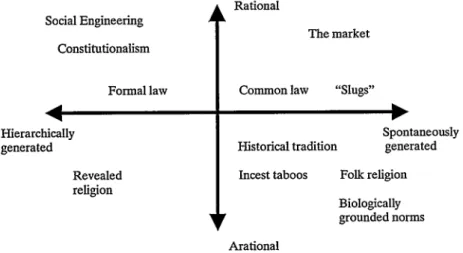
For discussion of the Moralistic Fallacy, see Charles Crawford, The Theory of Evolution in the Study of Human Behaviour. A second challenge for future discussions of the biology of human psychological predisposition concerns the nature of adaptation. One of the disadvantages is that it sometimes obscures very important relationships between different quadrants.
The existence and content of the norm in the hierarchical/rational quadrant can therefore come from sources of social order in the spontaneous/rational quadrant, via the spontaneous/rational quadrant. May 2000] On the Nature of Norms 2103 brain somehow developed beyond the reach of the evolutionary processes that built it. It is therefore wrong and misleading, perhaps more so, to defend any theory of human norm or morality formation independent of the effects of evolution on the human brain.
THE UNIVERSAL GRAMMAR OF CRIMINAL LAW
TESTING FLETCHER'S CLAIM OF UNIVERSALITY
Due to the nature of Ifugao social organization, there can be no crime. Unfortunately, as noted in note 11 above and the accompanying text, one of the important questions that Fletcher does not have much to say about in Basic Concepts is the extent to which the system of public prosecution as opposed to private prosecution is central to the idea of crime. right. Looking at Fletcher's theory through the lens of the six case studies presented here should prove useful in several ways.
126 ("Oswald suddenly turned on the KGB agent and grabbed his gun, shooting it [sic] toward the crowd below.") First, it should be noted that most, but not all, of the examples are historical. The most appropriate response to violation was revenge, which is permitted anywhere, at any time, and against any member of the enemy family.”46.
First, who would think that such prosecutions simply reflect the extreme end of the subject/object spectrum. In other words, does it make sense to talk about the perpetrator's family members as "accomplices". In this case, the suicide occurred "in the presence of a distinct criminal act: the violation of the exogamy of the totemic clan..., one of the foundations of totemism, maternal rights and the classification system of kinship."61.
On the one hand, the Japanese ideal seems far removed from the civil engagement, deportation, dissolution, and blame model of "treatment." The purpose of punishing offenders, he says, is “rarely seen as an attempt to restore the moral order of the universe.
THE TYRANNY OF MONEY
SICKNESS
Perhaps the ability to spend lavishly is an important incentive for greater productive activity in the first place. Much of Luxury Fever reads as an amplification of various potential market failures: primarily externalities and public goods, but also signaling in the presence of asymmetric information, etc. To illustrate, Frank somewhat curiously calls the specific idea that individuals will respond to incentives in the form of high tax rates on consumption by working less "flow economics" (p. 226, passim).
However, no such model seems to lie too close to the surface in the text. Frank doesn't close the loop by explaining how, if we all respond to a "steeply progressive" consumption tax by spending more time with our families, we'll still get the "trillions of dollars" in benefits from more savings (p. 250, passim), except perhaps to say in passing that we should count the value of leisure in the national income accounts (p. 242), as if that alone would help to buy bricks and mortar for public goods. If only we could shift from the rat-race treadmill of "conspicuous consumption" to more important "inconspicuous" consumption (pp. 90-92, passim) - more leisure, more savings, more spending on public goods - we would all be better off likely to be in the increasingly familiar range of "trillions of dollars."
34;In the current environment, Bill Gates needs a $100 million estate to indicate that he is the captain among captains of industry." This provides an argument for consumption taxes that is not widely emphasized in the primarily economic literature not, which argues for such a It also resonates with the social contractarian thinking of Rawls, which resonates in the interconnectedness of individuals in a well-ordered society and, importantly, with the primary benefit of the "social bases of self-respect., 17 It is not, however, Frank's lingua franca, as we shall see.
BOADWAY & NEIL BRUCE, WELFARE ECONOMICS The first theorem of welfare economics will generally fail in the presence of aggregate consumption"); Martin Shubik, Monetary Externalities: A Game Theory Analysis, 61 AM. Combined with the fact that we need no preferential rates for capital gains in under a consistent cash flow consumption tax, it is far from clear that a "revenue neutral" conversion to a consumption tax will mean any increase in the rate structure at all.I will return to this idea later.
DIAGNOSIS
This is a matter of fundamental social justice and fairness, in the spirit of Kant or Rawls. Ironically, though, there is something to be said for this first point, even in the non-consequentialist terms I want to emphasize. He cannot live happily in the domain of this first argument, which holds that at least some people behave foolishly in their own light.
Early in the book, Frank provides evidence that money, at least above a certain level, does not buy happiness (Chapter Five). This is not a "painless and simple win-win" kind of deal, and I feel that Frank has done a disservice to his generally noble public service by overselling this point. As used in the speech of everyday life, the word carries an undertone of disapproval.
However, Frank must defend his rich ideas in the often impoverished language of subjective well-being. That we must prove that the gains for the poor somehow outweigh the "losses" for the rich - that the "net balance of social welfare" has increased - in the spirit of the third argument above, in order to defend basic decency. Or, worse, in the spirit of the second argument, we must show that there is actually no loss for the rich at all.
Social norms are simply, in the standard view - though more often than not, the project of "social norms". 34; better angels of our nature"' in law, we cannot do better than become happy peacocks.
A CHALLENGE FOR POLITICAL LIBERALISM
Frank even acknowledges—in passing—that we may be free: “I do not mean to suggest that we are not creatures of free will on any meaningful interpretation of the term” (p. 176). Let us hope that we can aim higher, and in this effort to make ourselves the best we can be, moral theory – of the old-fashioned Kantian variety – deserves a place at the table. After all, philosophy is credited with killing God, embracing pluralism, and letting the pragmatic genie out of the bottle.
A related dimension of the same problem—the apparent inhospitality of moral theory toward normative social scientists like Frank—relates to the role of religion. In this admittedly scandalously quick summary I think of the diverse works of Nietzsche (on the death of god), Richard Rorty (on pragmatism), Bernard Williams (on skepticism and the limits of philosophy), Allan Gibbard (on the use of evolutionary biology ), David Gauthier, Brian Skyrms, Greg Kavka and others (on rational choice social theory). A THEORY OF NORMATIVE JUDGMENT (1990); DAVID GAUTHIER, MORAL AGREEMENT (reprint ed. 1987); BRIAN SKYRMS, EVOLUTION OF THE SOCIAL CONTRACT (1996); RATIONAL COMMITMENT AND SOCIAL JUSTICE: ESSAYS FOR GREGORY KAVKA (Jules Coleman et al. eds., 1998).
One of the important insights to be gained from Luxury Fever is the way in which the tax system affects issues of justice, as I have argued throughout my work – tax can be both the cause and the cure for social justice problems. Thus, social contract theory—social justice in general—cannot ignore the broad contours of the tax system because of its effects on the basic structure of society and on the rational aspirations of its citizens. A critical mistake—in my opinion, the worst mistake one can make when reading Rawls's Political Liberalism—is to think that the moral virtues have fallen out of the social contract project.
While remaining agnostic regarding the internal content of any reasonably comprehensive religious or moral doctrine, Rawls repeatedly emphasizes the importance of the political virtues, especially the ability to act from a sense of justice.' A basic moral psychology and moral sense have always been central to Rawls's work. The extravagant spending of the rich affects the allocation of resources, making non-luxury goods more "dear" in Luther's epigraph; represents a failure to save the capitalist classes that are best able to do so;.
