i
Analysis the Implementation of English for Specific Purposes (ESP) Class in Islamic Banking Study Program of IAIN Bengkulu
(A Descriptive Qualitative Analysis)
THESIS
Submitted as A Partial Requirements for Sarjana Degree in English Education Program
Arranged By :
SELLA FRANSISKA 1516230123
ENGLISH EDUCATION STUDY PROGRAM TARBIYAH AND TADRIS FACULTY
STATE INSTITUTE OF ISLAMIC STUDIES (IAIN) BENGKULU
2020
ii
iii
iv
v
ACKNOWLEDGMENT
In the name of Allah the beneficent, the Merficul in the name of Allah the most Gracious and Merficul. Alhamdulilah, all praise be to allah the most graceful and the Merficul, after such a hard work , finally the writer could finish research and finish the report in the form of the minor thesis (skripsi), entitled “Analysis the Implementation of English for Specific Purposes (ESP) in Islamic Bangking Study Program of IAIN Bengkulu” (A Descriptive Qualitative Analysis)
1. Prof. Dr.H. Siradjudin M., M.Ag, M.H as Rector of the IAIN Bengkulu.
2. Dr. Zubaedi, M.Ag M.Pd As The Dean of Tarbiyah and Tadris faculty of IAIN Bengkulu.
3. Feny Martina, M.Pd as the chief of English Study Program IAIN Bengkulu.
4. Dr.Syamsul Rizal, M.Pd as fisrt supervisor.
5. Feny Martina, M.Pd as second supervisor.
Finally the words are not enough to be expressed, except praise is to Allah the worlds for blessing and guidence, May their good deeds be accepted by Allah subhanahuWata‟ala Amin.
Bengkulu, Januari 2020
SELLA FRANSISKA SRN.1516230123
vi ABSTRACT
Sella Fransiska. (2020). Analysis the Implementation of English for Specific Purpose (ESP) Class in Islamic Bankking Study Program of IAIN Bengkulu.
Supervisor 1: Dr. Syamsul Rizal, M.Pd; and Supervisor 2: Feny Martina, M.Pd.
Key Words: ESP, Islamic Banking.
The aims of this study were to analyze: (1) teacher’s roles in English for Specific Purpose (ESP) class in Islamic Banking Program of IAIN Bengkulu academic year 2018/2019; (2) the teacher’s materials implementation of ESP class for Islamic banking in Islamic Banking Program of IAIN Bengkulu academic year 2018/2019; (3) the course design implementation of ESP class for Islamic banking in Islamic Banking Program of IAIN Bengkulu academic year 2018/2019. This study used descriptive qualitative method. The research was conducted at the sixth semester of Islamic Banking program of FEBI IAIN Bengkulu in academic year 2018/2019. The researcher explored the implementation of ESP for Islamic Banking Program that covers: teaching materials, learning activities, and teacher’s roles in the classroom. The result showed that: (1) the lecturer’s roles at the sixth grade of Islamic Banking IAIN Bengkulu IAIN Bengkulu in academic year 2018/2019 were: explaining lesson related to Islamic Banking topics; guiding students to do oral activities in the classroom; supporting or encouraging students to be active in the classroom; and giving corrective feedback to the students’ oral production in the classroom; (2) the English lecturer used some printed learning materials in conducting the lesson with the subject matters related topics to Islamic Banking activities. In addition, the teacher could integrate the textbook content and other supporting learning materials as well as appropriate learning activities. As the result, the teacher’s learning materials can be implemented innovatively in the classroom; (3) the lecturer design systematic lesson plan before conducting teaching in the classroom by using CLT approach and gave project in form of oral production activities in form of role play of various situations in bank activities; and the evaluation also conducted orally in order to improve students’ speaking skill which is the main goal of the lesson.
vii ABSTRAK
Sella Fransiska. (2020). Analisis Implementasi BAhasa Inggris untuk Tujuan Khusus pada Program Studi PErbankan Syariah IAIN Bengkulu. Pembimbing 1:
Dr. Syamsul Rizal, M.Pd; dan PEmbimbing 2: Feny Martina, M.Pd.
Kata Kunci: ESP, PErbankan Syariah.
Tujuan PEnelitian ini adalah untuk menganalisis: (1) peran guru dalam mengajarkan ESP pada program studi Perbankan Syariah IAIN Bengkulu tahun ajaran 2018/2019; (2) penerapan materi ESP bagi siswa perbankan syariah tahun ajaran 2018/2019; (3) rancangan pembelajaran ESP bagi siswa perbankan syariah tahun ajaran 2018/2019. Penelitian ini menggunakan metode deskriptif kualitatif.
Penelitian ini dilaksanakan di program studi perbankan syariah semester VI A IAIN Bengkulu. Peneliti mengeksplorasi penerapan ESP pada program studi PErbankan Syariah yang meliputi: materi pembelajaran, aktivitas belajar, dan peran guru di dalam kelas. Hasil penelitian menunjukkan bahwa: (1) peran guru ESP pada semester VI program studi perbankan syariah IAIN Bengkulu tahun ajaran 2018/2019 adalah: (1) dosen ESP pada semester VI program studi perbankan syariah IAIN Bengkulu tahun ajaran 2018/2019 adalah: menjelaskan pelajaran Bahasa Inggris yang berkaitan topic-topik perbankan syariah; menunyun mahasiswa melakukan aktivitas bahasa lisan di kelas; mendukung dan memotivasi siswa menjadi lebih aktif di kelas; (2) Doesn ESP menggunakan beberap materi cetak dalam melaksanakan pembelajaran denganmateri yang berkenaan dengan aktivitas perbankan Islam. Kemudian, pengajar ESP dapat mengintegrasikan buku bahan ajar dan materi pembelajaran pendukung lainnya dengan aktivitas pembelajaran yang tepat. Hasilnya, materi pembelajaran dapat terimplementasi secara inovatif di kelas; (3) dosen ESP merancang pembelajaran secara sistematis sebelum melakukan pembelajaran di kelas dengan menggunakan pendekatan CLT dan memberi tugas pada siswa dalam bentuk aktivitas produksi bahasa lisan dengan cara bermain peran atas bermacam-macam situasi; dan evaluasi belajar juga dilakukan dengan evaluasi lisan agar siswa dapat meningkatkan kemampuan berbicara yang menjadi tujuan utama pembelajaran ini.
1 CHAPTER I INTRODUCTION
A. Background of the Study
English for specific purposes (ESP) is teaching English that is relevant with the students’ area.1 The word ―specific‖ shows special linguistic needs in learning English and special area as aim why the students learning English. Therefore ESP course tries to facilitate the students in learning English to support them in all activities in special area.
Helen Basturkmen stated that ESP is understood as preparing the learners to use English in their academic, professional, or workplace environment.2 ESP concern on narrower topic to guide the students establish needed ability to communicate effectively in target area. The teacher obligates to understand the specific purpose of the students. Specific purpose in English here designate for certain purpose which must be reached by the students in learning English. For example, the students learn English because they purpose to master English communication in Banking area. If the specific purpose of the students is learning English for Bangking activities, the teacher requires to providing English material related to Bangking activities in English teaching and learning process.
1Tom Hutchinson and Alan Waters, English for Specific Purposes: A learning CentredApproach, (New York: Cambrige University Press, 1987), p.8
2Helen Basturkmen, Ideas and Options in English for Specific Purposes, (London:
Lawrence Erlbaum Associates, 2006), p. 133.
2
According to Basturkmen (2010) as quoted by R.Syamsul3 , needs analysis is the identification of language and skills used in determining and selecting material in ESP-based learning. This analysis can also be used to assess the learner and the learning process at the end of the learning period. The results of the needs analysis are further used as the basis for syllabus design, selection and preparation of materials, teaching and learning process, and evaluation.
From explanation above, it can be concluded that target need and learning are the components that must be existed in the instrument that is used to analyze the students’ need. Although the students need analysis is the first stage before arranging a course design, it cannot be conducted if course designer does not consider target need and learning need of the students.
The synergy between educators, students, curriculum, processes, and evaluations must certainly be a concern at class. Therefore, it is necessary systematic and continuous studies are carried out in the process ESP learning. Stufflebeam and Shinkfield (1985) stated4 ―Evaluation is the process of delineating, obtaining, and providing descriptive and jugmental information about the worth and merit of some object’s goals,design,implementation, and impact in order to guide decision making, serve needs for accuntability, and promote understanding of the
3Syamsul Rizal, Devloping ESP Reading Comprehension Instructionals Materials Through Scheme Theory Approach at PAI Study Program of Tarbiyah Faculty of IAIN Bengkulu, The 4th UAD TEFL International Confrence, 2017, P.495.
4Anid. Evaluasi Program Pembelajaran, Yogyakarta, Parama Publisging, 2017, P. 105.
3
involved phenomena‖. Certainly one of the strategies that needs to be done to determine the extent to which the learning process taking place in the school has achieved the expected results. As for things what needs to be evaluated on ESP learning, evaluation of the process, evaluation the teacher and evaluation of results learning, but in this research just focus evaluation the teacher.
There are many problems happened in ESP implementation. The first problem is concerned with teachers. It is in relation to identity crisis of the teachers. There is an argument about who should teach ESP, whether it is language teachers or subject teachers. Language teachers sometimes do not understand the material fully, so they will get difficulty in explaining the content of for example reading text. Meanwhile, the subject teachers sometimes have language problem which will block them in teaching English for Specific Purpose.5
The issues on ESP teachers in Indonesia no specific institution or universities which are officially responsible to produces ESP teachers.6 Even ESP has been introduced at any vocational schools and universities, for decades there is no even one universities which is responsible for preparing ESP teachers. As the results, there are none of existing ESP teachers who are graduated from undergraduate or graduate programs at universities which specially and formally prepare ESP teacher. It is a
5Gita Andriani, Problems In Teaching English For Specific Purposes (ESP) In Higher Education, Sriwijaya University, April 23 2014, p.36-37.
6 Kusni, Reformulating English For Specific Purposes (ESP) In Indonesia: Current Issues And Future Prospects, Faculty of Languages and Arts State University of Padang, 2013, p.41.
4
universal problem at most institutions in Asia that university graduates become ESP teachers overnight without adequate preparation in ESP teaching methodology.
Many young and unqualified teachers are given demanding teaching schedules and do not have much opportunity to get involved in any activity for professional development. the ESP teachers are mostly S1 or even S2 graduates from English Department with a very limited knowledge of their students‟ majors and less experience in ESP teaching for they are newly appointed English lecturers., some ESP teachers at universities are content teachers (mostly Masters and Ph.D) who know English (proficient enough in English) and mostly graduated from abroad with no knowledge of how to teach ESP. Most of them have never been trained how to be ESP teachers.
Lastly, it is more frustrated that they have rarely developed their knowledge on ESP by attending seminars, workshops, accessing or reading any reference materials on ESP practices, and accessing sites related to theories and practices of ESP. How can they be professional ESP teachers? Even the numbers of ESP teachers in Indonesia nowadays are bigger, but they are not specially prepared to be ESP teachers. Also, they tended to be relatively junior in terms of their years of experience and standing in ESP, and who have lack of significant level of ESP training. As less experienced and not well-qualified ESP teachers, it is
5
harder for them since they have to teach in relatively big classes. And they are not supported by areas.
The second problem is Indonesia ESP Course designs7, both at vocational schools and universities, are problematic issues. Theoretically, the subject should be an ESP subject, however, in reality it is an English for general purposes. At universities, ESP course design is made individually by the lecturers who do not fully understand ESP. It has never been in touch of ESP specialists or stakeholders‟ evaluation. the most basic problem in term of the design of the ESP course is the absence of needs analysis as the basis for developing the ESP courses . Needs analysis as theoretically the most important characteristics of ESP have never been done systematically to determine what specific English skill the students need to develop. ESP national curriculum designers for English at vocational schools and ESP lecturers at universities for many study programs as well do not have serious intention to begin their tasks by conducting needs analysis. this situation happens since they do not deeply understand their tasks. So, it is rather logic if the absence of needs analysis will lead to the purposes of many ESP courses in Indonesia do not show that the courses are ESP.
The last Issues of ESP Objectives and Course Materials In terms of ESP course objectives8, it was plausible to find out that the goals and
7 A Falaus. The current challenges of teaching ESP, IOP Publishing,Technical University of Cluj-Napoc,2017,P.1.
8 Kusni, Reformulating English For Specific Purposes (ESP) In Indonesia: Current Issues And Future Prospects, p.42.
6
objectives of ESP courses at Indonesian universities were not really sound ESP courses . English for Economics in a well known university, for example, aims at developing students‟ mastery of English grammar.
English for Chemistry, in other side, aims at preparing students to take TOEFL. English for Biology aims at developing the four English skills (speaking, listening, reading, and writing) in which the ESP course is only one semester (2 credit-hours) along the four-year study time for the students. Those are some examples of deviations from the nature of ESP course objectives happening in Indonesian universities. In the side of ESP course materials, since the early age of ESP, there have been some ESP teaching materials published and widely used. In Indonesia, some of those materials are also available. Currently, ESP materials are also available online. Each of these materials has a major influence on re-shaping the art of the possibility in ESP materials. The problems, however, are related to the lack of findings of needs analysis which capture the materials.
Deviations from ESP theoretical domain characterize ESP materials in Indonesia at vocational schools and at universities.
From the explanation above, it can be concluded that the most problems happen to the teacher implementation in ESP are teacher identity, design of the course, and syllabus designer. Problems above are related one to each other. They effect one each other. In the fact have some problems in the implementation.
7
In IAIN Bengkulu, especially at Islamic Banking sixth semester in academic year 2019, the researcher conducted small observation by visiting the class and interviewing English teacher during English lessons.
In a real practice of English For Spesific Purpose (ESP) ,the teachers do not yet have adequate teaching materials and ESP learning syllabus that fits the needs of students in the workforce. Even some teachers teach without regard to basic competencies and student competency standards.
New lecturers have difficulty teaching because of teaching, at college, may be a new thing for them. The researcher also interview the lecturer, the researcher asked: ―where did you graduated from?‖. However the lecturer answered, ― i have graduated in English Literature. This is a problem in implementation ESP.
From the background and problem above, it is important to the researcher to do research in ESP implementation. That’s why the researcher is very interested in doing a research entitled ―Analysis the Implementation of English for Specific Purpose (ESP) Class in Islamic Bangking Study Program of IAIN Bengkulu”
B. Identification of the Problem
Based on the background of the study, The Researcher identifies the problems in implementation of ESP, they are :
1. ESP material is made individually by lecturers who do not fully understand ESP.
8
2. ESP teacher not graduated from ESP or graduate programs Banking and formally prepare ESP teacher.
C. Limitation of the Problem
Based on the problems above, the researcher only focuses on teacher’s implementation in teaching ESP, Actually, careful examination of the expectations and perceptions of the ESP learners and instructors is seen to be important in determining the success of ESP courses. There can be a variety of solutions, with the ones suggested in this research among the most frequently implemented by ESP practice in the world.
D. Research Questions
Based on the background above, the problems in this research can be formulated as the following questions:
1. How are the teacher roles of ESP class for Islamic banking in Islamic Banking Program of IAIN Bengkulu academic year 2018/2019?
2. How are the teacher materials implemented in ESP class for Islamic banking in Islamic Banking Program of IAIN Bengkulu academic year 2018/2019?
3. How is the course design implemented of ESP class for Islamic banking in Islamic Banking Program of IAIN Bengkulu academic year 2018/2019?
9 E. Research Objectives
The objectives of this research are:
1. To anlyze teacher competence in English for Specific Purpose (ESP) class in Islamic Bangking Program of IAIN Bengkulu academic year 2018/2019 .
2. To analyze the teacher materials implementation of ESP class for Islamic banking in Islamic Banking Program of IAIN Bengkulu academic year 2018/2019?
3. To analyze the course design implementation of ESP class for Islamic banking in Islamic Banking Program of IAIN Bengkulu academic year 2018/2019?
F. Significance of the Study 1. Theoritical of Significance
The study may give a deeper explantion of ESP the demand of the target situation in Islamic Banking Department. The result of this research is also expected to be one of the references for the following analysis of the implementation of English in Islamic Banking fields.
2. Practical Significance
This study shows the implementation of ESP for Islamic Banking Department in terms of learning English and the learners themselves. The findings are also expected to help ESP teachers to develop the material and practical activities.
10 G. Definitions of Key Terms
By knowing the key terms, it makes this research is easier to be understood by other researcher and readers. There are many key terms that are related to this research such as: teaching, vocabulary and young learners
1. English for Specific Purposes (ESP) is a learner-centered approach to teaching English as an additional language, which focuses on developing communicative competence in a specific discipline such as academics, accounting, agrology, business, IT, teaching, and engineering.
2. Analysis is the process of considering something carefully or using statistical methods in order to understand it or explain it.
3. Islamic Banking or Islamic finance or sharia-compliant finance is banking or financing activity that complies with sharia and its practical application through the development of Islamic economics. Some of the modes of Islamic banking/finance include Mudarabah, Wadiah, Musharaka, Murabahah, and Ijara
11 CHAPTER II LITERATURE REVIEW
A. Brief Insight of ESP and EGP 1. ESP Versus EGP
Widdowson and Wright estabilish the following distinctive features of EGP and ESP9:The most important EGP features are that it focus is often on education. As the learners’ future needs are impossible to predict, the course contentis more difficult to select and due to this point, it is important for the content in the syllabus to have higher surrender value.The most elevant ESP features are that focus is on traing. As English is intended to be used in specific vocational context, the selection of the appropriate content is casier. Morevre, it is important for the content in the syllabus to have a high surrender value, most relevant to the vocational context. The aim may create a restricted English competence
Surrender value stands for the overall utility (value) of the English taught by specific course, the higher the surrender value, the greater utility of the English. These distinctive features reveal the true nature of EGP and ESP.The learners and the purposes for learning English constitute the major difference between ESP and EFP. ESP learners are usually adults, who are familiar with English language.ESP
9 Alexandra-Valeria. A General View On The Relationship Between Esp And Egp.
Professional Communication And Translation Studies, Volume3, 2010.P50.
12
learners are highly motivated because their needs are catered to. They are learning the language in order to communicate profesional information and to perfom some particular, joib-related functions.
In ESP course, it is need analysis that determines which language skills are useful for the learners to be able to acomplish certain profesional tasks (e.g for a banking, a touris guide should be focused on the speaking skill). ESP course are centered on the context. The English language is taught as subject related to the learners real needs and wishes ina particular field of human activity. The English language is usable immediately in the employment context. The learners are highly motivated as they are awere of their specific purposes for learning English
The age of EGP learners varies from children to adults and Leraning the English Lnguage is the subject of the courses. EGP courses are mostly focused on grammar, language structure and general vocabulary. EGP courses are responsible to the beneral languae acquistion and, for the vast majority of learners, they are extremely useful. EGP helps students to cope with any subject-matter course. It gives them the ability to generate more language. EGP learners, it well-taught, can use English to cope with the language in any undefined tasks. EGP courses deal with many different topics and each of the four skills is equally treated. Due to the general nature of these courses no needs analysis is conducted.
13 2. Characteristics of ESP
Strevens (1988) defined ESP by identifying its absolute and variable characteristics. His definition makes a distinction between absolute and variable characteristics10 :
Absolute Characteristics
a. ESP is defined to meet specific needs of the learner. ESP is designed based on the students’ need in their future work field. In this research, ESP is intended to give English training for specific context of Islamic Banking. It means that the English teacher should design the ESP learning related to the students’ activities in Islamic Bank in real.
b. ESP makes use of the underlying methodology and activities of the discipline it serves. The teacher designed and apply a certain learning and teaching method in order to reach the learning objectives based on the context, in this case English for Islamic Bank context. In teaching and learning materials should cover activities that related to Islamic Bank activities.
c. ESP is centred on the language (grammar, lexis, register), skills, discourse and genres appropriate to these activities.
There are some focus on the use of lexis and register of language. There various kinds of vocabularies that related to Islamic Bank activities. In learning ESP is focused on the
10Mohammad Kaosar Ahmed. Issues in ESP (English for Specific Purposes), International Journal for Teachers of English, Vol. 4, 2014, P.41
14
students’ need. Teacher can teach student a specific language skill, for example, in Islamic Banking, students need speaking skill rather than othe skills. Therefore, most of learning activities are speaking skill. Then, the English teacher should also consider specific topics related to the Islamic Banking to discuss, for example: transaction in Islamic Banking, Islamic Banking Product, etc.
Variable Characteristics
a. ESP may be related to or designed for specific disciplines. It means that ESP only focuses on one field of education or profession in order to focus on giving specific English materials based on the students’ profesionalism.
b. ESP may use, in specific teaching situations, a different methodology from that of general English. Teacher designed a specific teaching method in order that students become familiar in English activities in their major.
c. ESP is likely to be designed for adult learners, either at a tertiary level institution or in a professional work situation. It could, however, be for learners at secondary school level.
ESP is English for adult where the students have had basic English. Therefore, in this stage, the do not get general English anymore. Instead getting specific learning materials of ESP.
15
d. ESP is generally designed for intermediate or advanced students. ESP is an intermediate level where the students join the class for develop their English in specific context based on their field of study or work field. Therefore, the students who join in ESP should have learn general English.
e. Most ESP courses assume some basic knowledge of the language system, but it can be used with beginners. ESP can also be taught to beginner as long as the teaching method and learning materials are appropriate.
3. Need Analysis of ESP
Needs Analysis in ESP ESP is a course that aims to prepare students in using English in specific area, it can be academic, professional, or workplace environments. Thus, to provide proper English material, a teacher requires to analyze the students' needs in ESP. The term ―need‖ it self indicates the existence of certain problem that call for intervention and resolving.11Needs of the students mean there are things that must be known, understood, and found solution to create effective ESP course. Hutchinson and Waters also argued that the term ―need‖ is reasonable reason why there is important thing to conduct.12 In short, the students’ needs analysis tries to find the
11Chams Eddine Lamri, An Introduction to English for Specific Purposes http://.faclettre.univ-tlemcen.dz, accessed on 24th April 2017.
12 om Hutchinson and Alan Waters, English for Specific Purposes. Loc Cit. p. 53
16
problems, nature, and cause; and decides what prime concern must be created.
In analyzing the learners’ needs, a teacher requires considering types of needs divided into two types, they are:13
a. Target needs, this type analyzes what the learners must conduct with English in target situation. In other word, what are English linguistic elements that must be learn to communicate in target area. It can be more understood by looks some components in target situation that are necessities, lacks, and wants. Necessities are what the learners have to know in order to function English effectively in target situation. While the lacks are what are the difficulties faced by students in learning English and the wants are the students’ opinion and the students’ hope personally in learning English.
b. Learning needs. Hutchinson and Waters defined learning as the way to think about what route can be taken to learn English for their specific purpose.
From explanation above, it can be concluded that target need and learning are the components that must be existed in the instrument that is used to analyze the students’ need. Although the students need analysis is the first stage before arranging a course
13 Tom Hutchinson and Alan Waters, English for Specific Purposes. Loc Cit. p. 55-
17
design, it cannot be conducted if course designer does not consider target need and learning need of the students.
4. Materials in ESP
All materials used in class were provided by the group of instructors, who prepared them in such a way that students would be able to work on each step using their target language. In most of the cases, they adapted those used for courses of general English to suit the needs of this specifc instance. Dudley-Evans and St John said that14 ESP practitioners often have to plan the course they teach and provide the materials for it. It is rarely possible to use a particular textbook without the need for supplementary material, and sometimes not really suitable published material exists for certain of the identifed needs. It means that the ESP teacher can use a particular textbook or unpublished book as teaching materials in teaching ESP as long as it is reliable for the learning context.
Related to ESP materials, there are some main issues must be emphasised before proceeding any further15:
a. There are major and minor ESP areas/courses, and published materials are sensible to this reality. Business English and Maritime English are examples of these. Some courses that are
14Revista Pensamianto.Desigining and Implementing an ESP Course Revisting an Experince, Sede de Occidente , Vol.17(28) , Universidad de Costa Rica, 2017, P.204.
15Ana Bocanegara-Valle. Evaluating and Desigining materials for the ESP classroom, Universidad de Cadiz, 2010. P.142.
18
tailor-made to suit a particular group of students would also fall within the minor category (for instance, English for tourism to a group of taxi drivers and policemen in a popular town for British tourists).
b. Subject-matter content is fundamental to ESP materials. Also known as carrier content, informative content, discipline-based knowledge, specific content, specialist knowledge or expert knowledge, this refers to the information which is specific to a particular discipline and which people, like students and future experts, possess in their mother tongue. ESP teachers will need a reasonable understanding of the specific discipline as well as ―an interest in the disciplines or professional activities the students are involved in.
c. ESP teachers become evaluators, designers and developers of materials, simply because publishers are naturally reluctant to produce materials for very limited markets; and most ESP areas conform to this reality. These roles are not exclusive to ESP teachers but, if compared with EFL/ESL teachers, they are more often engaged in the task of evaluating, designing and developing materials for their classroom use. It is precisely this additional role of materials providers/developers that has endowed ESP teachers with the denomination of practitioners.
19
d. Unlike EFL/ESL teaching, there exists a mismatch between pedagogy and research; that is, there is a gap between coursebooks and pedagogical practice, on the one hand, and research findings, on the other. For instance, there is a lack of fit between how academic writers write and what the textbooks teach about writing.
Its means that materials specifically generated for teachers that teach ESP Matching carrier content to real content, Aspects that is used to assist the real content Example: English for Banking. And than The core materials are usually paper-based, however; teachers use videos related to learning goals and learners’ needs, projectors, smart board, computer/internet and real objects.
Carver (1983) states that there are three characteristics common to ESP courses:16
a. authentic materials – the use of authentic learning materials is possible if we accept the claim that ESP courses should be offered at an intermediate or advanced level. The use of such materials, modified by teachers or unmodified, is common in ESP, especially in self-directed studies or research tasks. The students are usually encouraged to conduct research using a variety of different resources including the Internet; (Milevica)
16Mohammad Kaosar Ahmed. Issues in ESP (English for Specific Purposes), International Journal for Teacher of English, Vol. 4, 2014,P.52
20
b. purpose-related orientation – refers to the simulation of communicative tasks required by the target situation. The teacher can give students different tasks - to simulate the conference preparation, involving the preparation of papers, reading, note-taking and writing.
c. self-direction – means that ESP is concerned with turning learners into users. For self –direction, it is necessary that teacher encourage students to have a certain degree of autonomy – freedom to decide when, what, and how they will study. For high-ability learners it is essential to learn how to access information in a new culture. Since ESP courses are of various types, depending on specific scientific field or profession, and have specific features, teachers teaching such courses need to play different roles and acquire certain knowledge (Milevica).
In conclusion, in determining teaching materials, teachers can rely on some important considerations, namely: the target audience of the course and the appropriate structural grading - students should be taught what they need to know in the right order with the right opportunities.
5. Evaluating Published Materials
21
It is important to evaluate published materials used in ESP class. The group of instructors used several instruments and strategies to evaluate the students’ progress along the course; they can be17: a. Language – Learning Log
Every week, students had to all out a form with phrases and expressions they learned during that specific week. they also had to mention those aspects that presented some problems for them as well as to include some phrases and expressions they would like to learn in the course. Through this instrument, the teaching team could assess if the use of vocabulary and structures studied was correct or not. During the subsequent planning sessions, the team analyzed the logs and designed several activities to provide feedback accordingly.
b. Role Plays
The development of the speaking and listening skills was the main focus of the course; learners were continuously asked to make up and present conversations. The instructors provided feedback to students regarding the strategies used to convey meaning as well as language use.
c. Techno- Homework
17Revista Pensamianto.Desigining and Implementing an ESP Course Revisting an Experince, Sede de Occidente , Vol.17(28) , Universidad de Costa Rica, 2017, P.205.
22
Students were asked to keep an electronic reflection journal about their learning process. they also received electronic messages from their instructors and they had to answer back to them. the electronic reflection was reviewed on a weekly basis. Since students’ language profeciency was very low, they could write their reflections in Spanish. the main objective of this activity was to give the opportunity to express feelings regarding the learning process.
d. Audio and Video Recordings
The midterm evaluation was based on analyzing the students’
oral performance while helping international students at the window. Students were taken to their job area and were asked to help international students who would approach the window asking for specifc information. The international students were the two members of the teaching team and a guest. The activity was taped.
The information provided by the recording helped the instructors to design several activities to work on such areas as communication strategies used during the conversations, content, language use, and pronunciation. these activities were incorporated in the subsequent lesson plans.
e. Portfolio
Students kept a portfolio with all the material used in class, their refections on their learning process and their vocabulary lists.
23 f. Final Oral Project
At the end of the course, as a requirement of the Practicum course, learners had to present an oral activity that would show how much they had learned along the course. This activity would be attended by the Practicum professors and the students enrolled in the Practicum. To lower their anxiety, learners rehearsed a conversation that would take place between an international student and an employee from the UCR Registrar’s Office. This conversation was recorded by the instructors and was used to provide feedback. the Practicum professors considered the presentation a success. the result was due to hard work and continuous practice.
It means ESP teachers need to use several instruments and strategies to evaluate the students’ progress along the course.
Measuring the potential teaching/learning value of authentic texts, coursebooks and other types of materials is one of the ESP practitioner’s duties. Unlike language teaching at primary or secondary school levels, where administrations, departments or staff choose particular coursebooks for a whole institution, materials evaluation is particularly frequent in ESP at tertiary level. This is simply due to the fact that, as a general rule, no single coursebook is followed from beginning to end but, rather, extracts (units, exercises
24
or tasks) from a number of published materials are brought together and, if necessary, supplemented with in-house activities.
6. The Teachers Roles in ESP Classroom
Administrations and other stakeholders (including learners) take for granted that a good ESP teacher is also a good materials writer or a good developer of course materials. Dudley-Evans and St John stated that only a small proportion of good teachers are also good designers of course materials18. This statement was also supported by Bernard and Zemach that what all ESP practitioners have to be is good providers of materials‖. Indeed, even though materials writers were good teachers, ―not all good teachers [would] make good materials writers.
This is particularly evident if ESP practitioners lack the necessary grounding in materials evaluation, design and development, which in most cases makes them act as materials developers driven by personal intuition, beliefs and experience, if they have any. In any case, materials writing may also be understood as a need to reduce dependency on publisher materials and, more importantly, as a means of professional development.
18 Ana Bocanegara-Valle. Evaluating and Desigining materials for the ESP classroom, Universidad de Cadiz, 2010. P.157.
25
Barnard and Zemach claim that ESP practitioners,19 as prospective materials writers, should have ―teaching experience in the relevant specialism‖, ―some degree of knowledge of the relevant specialism‖, ―an interest in the relevant specialism‖, and ―familiarity with learning materials available for the specialism‖, among others. To my understanding, this heavy reliance on ―specialism‖ is the key feature that emphasises the difference between EFL/ESL teachers and ESP practitioners as materials providers, at the same time as it challenges the latter to: (1) become familiar with the specialist subject (carrier content); Ana Bocanegra-Valle 158; (2) become familiar with the language of the subject (real content); - become familiar with the teaching of adult learners, and large/heterogeneous groups; (3) become familiar with materials evaluation, design and development; (4) be ready to spend time on evaluating, designing and developing materials;
(5) be ready to review, pilot test and update materials; (6) be creative, imaginative and flexible; (7) be ready to accept new challenges and overcome anti-scientific attitudes; (8) be ready to rely on expert colleagues’ knowledge and professional experience; and (9) be ready to take into account students’ specialist knowledge.
It means that role of ESP teachers are: as a teacher, course designer and materials provider, researcher, collaborator, and an evaluator it means 'providers of material' thus involves choosing
19 Ana Bocanegara-Valle. Evaluating and Desigining materials for the ESP classroom, Universidad de Cadiz, 2010. P.157.
26
suitable published material, adapting material when published material is not suitable, or even writing material where nothing suitable exists.
Three techniques can be recommended to the ESP teacher: 20 a. Become familiar with the ESP course materials Of course every
teacher should always be familiar with the materials to be used in class. But in this instance the familiarity must extend also to understanding exactly the ESP intention of each text and exercise.
The course-books will have been written, almost certainly, in a collaboration between a teacher of English and a subject specialist.
The course writer will thus have been aware of the main difficulties and unfamiliarities facing the teacher, and will have dealt with most of them in the accompanying teacher's notes.
b. Become familiar with the language of the subject Remember the experience of the professor's secretary, the hospital almoner, the reader of Scientific American or of the New Scientist — in short, the educated layman who from interest or necessity accepts and becomes familiar with the language of a subject, though without pretending or seeking to become a specialist in the subject itself.
c. Allow students to put you right! Do not be above letting the students correct your solecisms in the subject (not errors in English; the teacher will not normally commit errors of grammar, for example).
Then you will be in a stronger position to help the students with
20 Mohammad Kaosar Ahmed. Issues in ESP (English for Specific Purposes), International Journal for Teacher of English, Vol. 4, 2014,P.52
27
their mistakes in the language. The most important requirement is that the teacher should regard success with teaching an ESP course as a professional challenge.
7. Course Design in ESP
Course design is a series activity to design course or learning activities. Hutchinson and Water21 define Course design is the process of interpreting the raw needs analysis data to produce "an integrated series of learning experiences to lead learners to a particular state of knowledge. While According to Munby22 ―ESP courses are determined in all essentials by the prior analysis of the communication needs of the learners‖. Course design is a series process—need analysis, interpreting need analysis data, creating syllabus, material writing, classroom teaching, and evaluation.
While According Widdowson23 ESP course design must be process oriented. A process oriented approach in designing ESP course based on the principle to satisfy the cognitive need of the learners, guarantee the eventual attainment of desired terminal behavior. A process oriented approach based on subject methodologies contains because these needs converge in learning process itself.
21T. Hutchinson, and A. Waters, English for Specific Purposes: A learning-centred Approach. Cambridge: Cambridge University Press, 1987, p. 65.
22J. Munby, Communicative Syllabus Design, Cambridge: Cambridge University Press, 1987, p. 2
23H. G. Widdowsen, English for Specific Purposes: Criteria for course design for English for academic and technical purposes, Newbury House, 1981, p. 102.
28
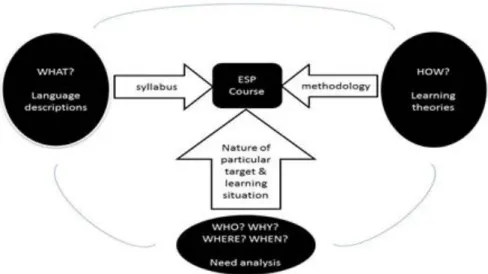
Factors Affecting ESP Course Design, in relation to the factors affecting course design Hutchinson and Water24 used Kipling’s honest serving men to outline the basic questions that we need to know before designing course, as follows:
1. Why does the students need to learn?
2. Who is going to be involved in the process? This will need to cover not just the students, but all the people who may affect on the process: teachers, sponsors, inspectors, etc.
3. Where is the learning to take place? What potential does the place provide? What limitation does it impose?
4. When does the learning take place? How much time is available?
How will it distributed?
5. What does the student need to learn? What aspect of language will be needed and how will they be described? What level of proficiency must be achieved? What topic areas will need to be covered?
6. How will the learning be achieved? What learning theory will underlie the course? What kind of methodology will be employed?
Based on the question, Hutchinson and Water25 identified factors affecting to ESP course design namely language description, theories of learning and need analysis, as can be seen in the following figure
24 Huncthinson and Waters, loc.cit., p. 21-22
25 Ibid., p. 24.
29
Figure 1 Factors affecting ESP Course Design
The above figure shows that there are three main points affecting ESP course design. The first is language descriptions, the answer of question of what. Language description shows the language knowledge needed by the learners that put at the syllabus. The second factor is how the learner learn a language, and the third factor is the nature of particular target and learning situation. Phillips (as citied in Wello and Dollah)26 considers factors contributing to the success and failure of ESP course as follows:
1. The subject content embodied in the learners’ purposes;
2. The duration for ESP course 3. The weekly intensity of the course
26 Well and Syarifuddin, An Introduction to English for Specific Purposes, UNM University Press, 2008, p. 34.
30
4. The composition of the students group according to their mother tongues
5. Age, academic background, degree of competence in second language (if any)
6. The staff- students ratio 7. The staff teaching load
8. The organizational structure of educational institution 9. The budgetary provision for the course and
10. He availability of educational technology.
Furthermore, Wello and Dollah27 classified factors affecting the ESP course into institutional – time allotted for learning English, classroom and learning condition, and attitude of the head institution and staff--, the teachers factor—the competence of the teacher, the confidence of the teachers in using English, teaching strategies, the attitude of the teacher--, and the learner factor—internal and external factors.
B. Some Related Previous Studies
In ESP research, there have been a lot of researchers who conducted their research focused on ESP, especially Islamic economic context. The first Heni Fitriawati (2019) conducted her research entitled need analysis in english for specific purposes at vocational school (a descriptive Research at the Eleventh Grade Students of Marketing Major
27 Well and Syarifuddin, An Introduction to English for Specific Purposes, UNM University Press, 2008, p. 97.
31
of SMK Negeri 1 Demak in the Academic Year of 2016/2017). This research analyzes the marketing students’ need in learning English at SMK Negeri 1 Demak due to the marketing students learn English using English textbook which has same content with other majors. In fact, the school has five distinctive majors. The subject of this research is the eleventh grade of marketing students in XI PM 1. This research used descriptive qualitative research with observation checklist and questionnaire as the tools in collecting data. To analyze the data, the writer involved four activities;
observing English teaching and learning process, giving questionnaire to the marketing students, analyzing and describing the obtained data, and calculating percentage of students’ answer in questionnaire. The result of this research shows that the eleventh grade of marketing students in XI PM 1 needs more specific English material and English skill in marketing field. In addition, based on classroom observation, in teaching process the teacher requires to find appropriate way that can make the students more interesting and active. Therefore, to maximize their competence in marketing activities, the marketing students hope that the school can design ESP program.
The second, Nunun Indrasari (2016) conducted her research entitled A Need Analysis at The Second Semester of Physics Education Students of IAIN Raden Intan Lampung in The Academic Year of 2015/2016 . The data were in the form of qualitative data which are taken from the interview and the questionnaire. The data were about the
32
problems which are usually faced by physics students during learning English and the students’ needs and wants towards the ESP course in IAIN Raden Intan Lampung. The findings describe the students’ need of ESP for physics students, the lecturers’ view points on the practice of ESP instructions, and descriptions of problems commonly faced by ESP students in Physics Education of IAIN Raden Intan Lampung.
The third, Yulianti Kartika (2016) conducted her research entitled Teaching English for Specific Purposes of Secretary Department at SMK Nasional Pati in the Academic Year 2015/2016. This research is to know the difficulties faced by the teacher and the strategies used by the teacher in teaching English for Specific Purposes of Secretary Department at SMK Nasional Pati. This research is qualitative research with a descriptive method. The result of this research shows that the teacher’s difficulties are (a) difficulty in arranging ESP syllabus, (b) Difficulty of the availability of ESP textbook, (c) Difficulty to find book activity for the students, (d) Difficulty of the availability of supporting tools, and (e) Difficulty to arrange classroom activity.
The three studies above had similarity and differences. The similarity lied on the core of the research that focused on ESP. However, this research would be different in some aspects: first, this research focused on the implementation of ESP in Islamic Banking program. On the other hand, Heni Fitriawati (2019) focused her research on marketing area; Nunun Indrasari (2016) focused on physical educational program;
33
and Yulianti Kartika (2016) focused on secretary program. In other words, although the research focused on ESP analysis, but they different in aspects; second, this research applied different research methods which cover: different research design, data collecting, and data analysis. Third, different in population and sample would also cause differences in the research findings.
34 CHAPTER III RESEARCH METHOD A. Rescarch Design
This research conducted a qualitative method. Creswell stated that qualitative research as an approach for exploring and understanding the meaning individuals or groups ascribe to a social or human problem where the process of research involves emerging questions and procedures, data typically collected in the participant’s setting, data analysis inductively building from particulars to general themes, and the researcher making interpretations of the meaning of data28. It indicates that qualitative research is a method to explore and understand information about a group of people of their problem through scientific interpretation in order to get meaning.
According to Sukmadinata , Qualitative research opposite from the philosophy of constructivism which assumes that reality is plural dimensional, interactive and social experience an exchange interpreted by individuals.29 Depend on the Sukmadinata‟s methods of qualitative research, this research is often conducted in the field, allowing direct interaction with the people being studied in their context. Researcher collects the data themselves by examining documents, observing behavior and interviewing participants. According to Moleong state that descriptive qualitative research is a type of research which does not include any calculation or
28John W. Creswell. Research Design : Qualitative, Quantitative, and Mix Methods Approaches, (London, Sage, 2014),p.32.
29 Sukmadinata, Nana Syaodih. Metode Penelitian Pendidikan: PT. Remaja Rosdakarya.(Bandung,2013)p.94
35
enumerating.30 This was a descriptive research because it described the data.
The method that used was qualitative description, the researcher as an observer while the teaching process was going on. The information was collected without changing the environment or real condition.
B. Sources of Data
This research was conducted at the sixth semeter of Islamic Banking program of FEBI IAIN Bengkulu in academic year 2018/2019. The researcher explored the implementation of ESP for Islamic Banking Program that covers: teaching materials, learning activities, and teacher’s roles in the classroom. Those aspects was the data in this research and did analized and evaluated.
C. Data Collecting Technique
The researcher used some research instruments in collected data in this research. The instruments are: observation checklist, interview, field note, and documentation. In collecting the data, the procedures of using instrument can be seen as follows:
1. Observation Checklist
Observation is a basic method for obtaining data in qualitative research. The researchersused this instrument to monitor and describe on teaching and learning activities in the classroom. It is the list of some point that the researchers want to observe when observation taking place in the
30Sugiyono. Metode Penelitian Kuantitatif, Kualitatif, dan R&D.( Bandung: Penerbit Alfabeta.2012)
36
classroom. The aspects that were not covered in this instrument would be written in form of field notes to complete the data in this research.
2. Interview
Interview is an activity that involves interviewer and interviewee where the interviewer will give some questions to be answered by interviewee. In an interview, data are collected through face-to-face or telephone interaction between the interviewer and the respondent‖. Thus, in this case, the interviewer has to conduct collecting data with doing interaction or communication directly. But, it can be conducted face to face or through via electronic.
3. Documentation
Documentation can be written and picture by someone that can be used to obtain information. In conducting documentation method, the researcher can provide magazines, books, and documents used by students and teacher during the lesson. The functions of documentation method is to make credible and authentic the result of observation or interview during the research. The procedure is the researcher came to the drama class and follow the lessson. Then the researcher recorded the students’
activities in form of video or recording.
D. Instrument of the Research
37
A tool to collect the data is called research instrument. Instrument must be suitable, valid, and, trustworthy.31 In this research, the researcher used the following research instruments to collect the data:
1. Observation Checklist
In this research, the researcher designed observation checklist to collect the data. It halps the researcher to collect the data systematically in the classroom and interpret the actions that related to the implementation of ESP for Islamic Banking Program that covers: the need, teaching materials, learning activities, and teacher’s roles in the classroom.
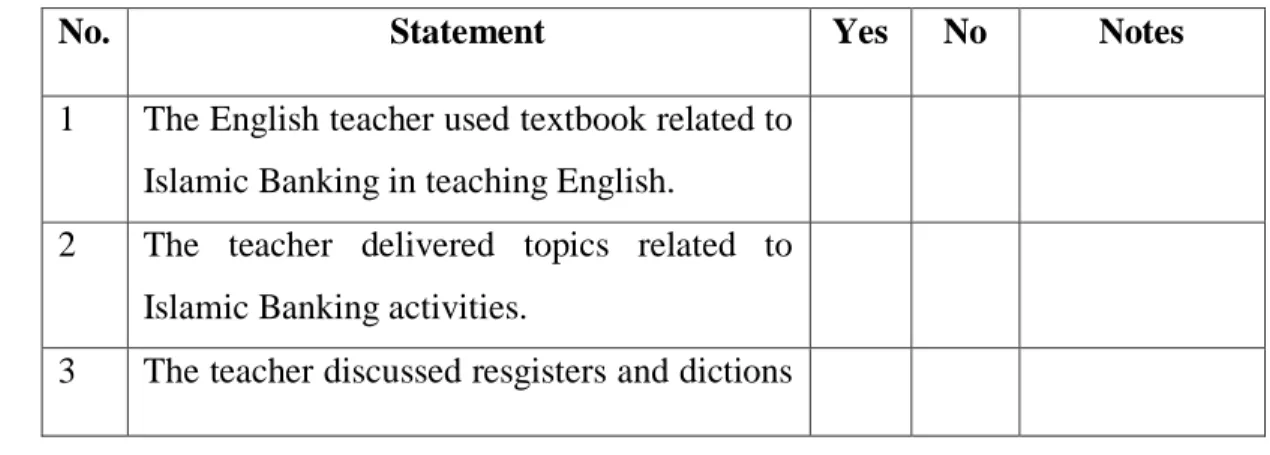
The process of collecting the data through observation checklist, the researcher: (1) came to classroom to join the class and followed whole process happened in the classroom; and (2) prepared the observation checklist to observe the students’ need, teaching materials, learning activities, and teacher’s roles in the classroom. For the observation checklist, it can be seen as follows:
Table 3.1 Observation Cheklist
31 Mariano M. Ariola, Principles and Method of Research. (Phillipine: Rex Book Store, Inc.), 2006,p. 140.
No. Statement Yes No Notes
1 The English teacher used textbook related to Islamic Banking in teaching English.
2 The teacher delivered topics related to Islamic Banking activities.
3 The teacher discussed resgisters and dictions
38 related to Islamic Banking
4 The discourse discussed in the classroom is related to Islamic Banking.
5 The teacher gave performance activities like in real Islamic Bank office.
6 The teacher asked students to perform dialogues with the topics related to Islamic banking daily activities.
7 The teacher introduced some kinds of Islamic Bank documents in English.
8 The teacher focused on only a certain English skill in teaching Islamic Banking (Only Speaking)
9 The students were active in following the lesson about English Islamic Banking Activities in the classroom.
10 The Students were involved actively in doing English activities of Islamic Bank in the classroom.
11 The students enjoyed the class because they were familiar with the topic of Islamic Banking in English
12 The English teacher made simulation of Islamic Bank activities in English class.
13 Learning activities were dominated by practice or perfomance about Islamic Banking stuation rtaher than theory.
14 The teacher brought some learning medias related to Islamic Bank.
15 Teacher’s teaching method was appropriate
39
2. Field Note
The researcher wrote the things related to the students’ need, teaching materials, learning activities, and teacher’s roles in the classroom in form of field note in order to complete the data in the research. Field note was written during the classroom and completed after the lesson. In the field notes, the researcher wrote all things that were not included into the other instruments. The function of the field note was as complementary data in this research.
3. Interview
To get deeper information or data in this research, the researcher did interview. The researcher interviewed the teacher in order to explore the information related to the need, teaching materials, learning activities, and teacher’s roles in the classroom. Interview was conducted after the classroom. The researcher prepared a list of questions to guide her in interview.
The process of collecting the data through observation checklist, the researcher: (1) prepared questions that the researcher would like to ask to the teacher; (2) asked one by one prepared questions; and (3) recorded the
for Islamic students’ activities in the future work field.
40
teacher’s answers. Interview was conducted in several times in order to obtain complete data.
Table 3.2 Interview Sheet
Documentation
The researcher was made documentation all activities during the research. The aim of documentation is to support the authenticity of the data in the research. To completed the documentation, the researcher did: (1) collected all documents, such as: the result of observation checklist, filed notes, interview recorder and interview script, and phorograph during the research; (2) attach them in form of research appendices.
1. What are then purposes of learning English for Islamic Banking students?
2. What English skills do the Islamic Banking students want to improve?
3. What difficulties do the students find during the process of teaching and learning English in Islamic banking context?
4. What is the main source of teaching and learning English in Islamic Banking Classroom?
5. What is the relationship between the teaching source used and the target area?
6. Do you use a specific technique in teaching English for Islamic Banking class? What technique?
41 E. Data Analysis
The researcher was applied interactive model of data analysis proposed by Miles and Huberman that consists of three main components:
data reduction, data display, and drawing and verifying conclusion32:
Figure 2:
Interactive Model of Data Analysis
Data Reduction is started by explaining, selecting the basic
things, focusing on something important to the content of data which derives from the field. It describes deeply to the observation result.
Data reduction was done by making summary contact, developing category coding, making reflection note and data selection. The data are reduced because they are not related to the title of the research and the formulation of the research problem.
Data Display is the process showing data in form of words,
sentence, narrative, table, and graphic in order that the data collected are mastered by the researcher as the basic to take
32Matthew B. Miles and A. Michael Huberman. Qualitative Data Analysis: A Sourcebook Third Edition. (USA, Sage Publishing, 1994) P. 174.
42
appropriate conclusion. A display is an organized, compressed assembly of information that permits conclusion drawing and action.
In this research, the researcher used narrative essay in displaying the data because it is the most common data display used in qualitative research.
Verification and Conclusion is making conclusion is the
process of drawing the content of data collected and the form of a good statement and having clear data. The conclusion drawing can be started from tentative conclusion which still needs to be completed. After getting the data, it is analyzed continuously and verified about the validity to get more significant and clear result.