Thank you for your motivation, help and encouragement during my education and supporting me even when I was down. Thank you so much for your support, prayer and patience to make my education a success.
INTRODUCTION INTRODUCTION
Identifications of the Research
Limitation of the Research
Research Questions
Objectives the Research
To describe the teaching strategies used by the English teachers at MI Plus Ja-alHaq Bengkulu. To describe how teachers use these strategies in teaching English to promote the participation of young learners at MI Ja-alHaq Bengkulu.
Significances of the Study
- For Students
- For Teachers
Definition of Key Terms
- English Teachers
- Young Learners
- Teachers’ Strategies
- Teaching
- Definition of Young Learner
- The Characteristics of Young Learner
Young learners are students studying in primary or secondary school aged 7-15 and they learn English as a second language. According to Harmer, the characteristics of young students have eleven characteristics:15 1) Young students answer even though they do not understand;. In addition, Brumfit has a list of characteristics that new students share: New students have just started their education.
The teacher must know the characteristics of babies, or the characteristics of young learners you have taught, if you are a teacher. In addition, teaching English as a foreign language to young learners requires teachers to have a thorough understanding of the development, needs and characteristics of young learners.
Teaching Strategy
- Definition of Teaching Strategy
The teacher must know and be aware of some characteristics so that he can choose the best technique and method to help the children learn. Teaching strategy is a teaching activity that should be carried out by the teacher and the student so that the purpose of teaching is achieved effectively and efficiently. Based on the above definition, it can be concluded that teaching strategies are a plan prepared by the teacher to achieve certain educational goals.
From a certain understanding of learning strategies, it was concluded that the learning strategy is an approach to managing activities, by integrating the sequence of activities, equipment and materials, as well as the time spent in the learning process, in order to achieve the learning goals that are been determined actively and effectively.
English Teachers’ Strategies for Young Learners
It is not as simple as what the scientist imagined; the teacher should have a sense of patience, imagination, humor and cheerful spirit and become the mother of the young students. The teaching strategy involves the teacher doing the demonstration and the students practicing with feedback from the teacher. Look and Say is the technique where students listen to the teacher and look at the object or print, then repeat a word or phrase after the teacher.
Children either watch the teacher point to the words on the board or point to the print on the page or in the textbook themselves. Thus, the reader's (teacher's) repetition of the story is necessary to create an understanding of the plot of the story.
Young Learners Participation
For this reason, well-designed lessons can be effective in solving problems related to the learning process. successful if students actively carry out the exercises directly and are related to the stated learning goals. There are several important things related to student participation, as follows. a) Exercises and practices should be done after students are given information about a certain knowledge, attitude or skill. In order for the material to be truly internalized, the next activity is to give students the opportunity to practice or practice the knowledge, attitudes, or skills.
Through positive reinforcement (good, right) it is hoped that the behavior will be maintained or demonstrated by the students. Conversely, negative reinforcement (incorrect, wrong, needs refinement, etc.) is hoped that the behavior will be eliminated or that students will not repeat similar mistakes.
Previous Relevant Studies
The results showed that there were three specific lesson plans and teacher-constructed lesson plans. The purpose of this study is to describe teacher-implemented vocabulary learning for the third grade students of MI Kedungharjo in the academic year 2015/2016. The research was conducted to find out how the teacher used to learn vocabulary, for example, the material used by the teacher, the media used by the teacher, the techniques used by the teacher, the problem and solutions faced in the implementation of the learning process.
Based on the data collected, the researcher concluded that the materials used by the English teacher were (1) Hospital, (2) Food and drink, (3) Time, (4) Clothes and colors, and (5) Bedroom objects. The media used by the English teacher are real objects, pictures, videos and the students' English books.
Theoretical Framework
According to Creswell, descriptive research is research that is a detailed depiction of people, places, or events in a qualitative research setting.57 Descriptive research is conducted because data analysis is presented descriptively. This research is a descriptive qualitative research that focuses on the strategies of English teachers for young learners. According to McMillan & Scumacher, qualitative research explores the richness, depth and complexity of phenomena.58 The purpose of qualitative research is to provide descriptions of social phenomena that occur naturally.
Library research is getting secondary data and field research is getting primary data directly from participants. The strength of qualitative research is its ability to provide descriptions of how people experience a particular research problem.
Subject of the Research
Data and Data Source
Data in this study were obtained by conducting participant interviews on teacher competencies, supported by an observation checklist for detailed observation of results and documentation to describe the data. A data source is the center of analysis from which we collect data. The data source is therefore the material where the researcher can obtain the required information.
Data Collecting Technique and Instrument
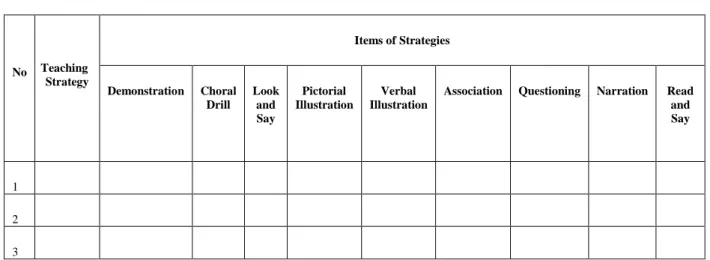
Therefore, the source of the data is the material from where the researcher can obtain the required information. A). To collect data, the researcher used observation sheets administered during the teaching and learning process. The researcher collected the data on teachers' strategies in teaching English by using notes and reports.
In this case, the researcher collected data on English teachers using an instrument that was a document that could be seen in the teachers' curriculum and the teacher's vocabulary teaching materials. The researcher used interviews to find out how the teacher uses their strategy in teaching English at MI Ja-Alhaq Bengkulu.
Research Procedure
To describe the implementation strategies of English teachers that encourage the participation of young learners.
Technique of Data Analysis
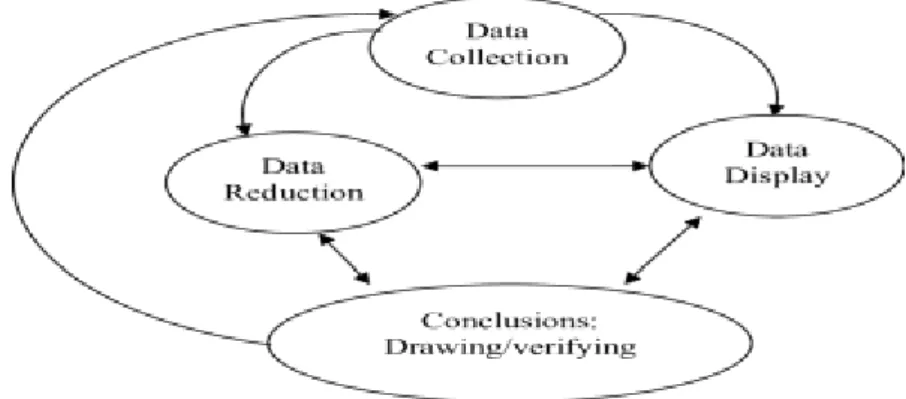
Researcher had analyzed the data in three parts based on expert opinion: data reduction, data presentation and conclusion. It involves the interpretation of data collected using analytical and logical reasoning to determine patterns, relationships or trends in data analysis and some of the procedures the researcher performs. In this study, the data collection used by the researcher was documentary observation, documentation and interviews.
The next step in analyzing data is to display the data after the reduction. The researcher analyzes all sections with the same code and then merges these categories and finds a link between the categories.
Conclusion Drawing/verification
Trustworthiness
In source triangulation, the researcher uses multiple sources or participants to obtain data accuracy. Theoretical triangulation means that the researcher compares the data finding with the perspective theory that is relevant. From these types of triangulation, the researcher used methodological triangulation to obtain data validity.
The researcher used triangulation of data sources to compare and double check the validity of the information. To begin the analysis, the researcher paid attention to the English teacher during classroom instruction, to see if the strategies used were consistent with the theory formulated by the researcher.
Results
- Teachers’ Strategies in Teaching English at MI Plus Ja-alHaq Bengkulu
- Teachers’ Apply Those Strategies in Teaching English to Encourage Young Learners Participation at MI Plus Ja-alHaq Bengkulu
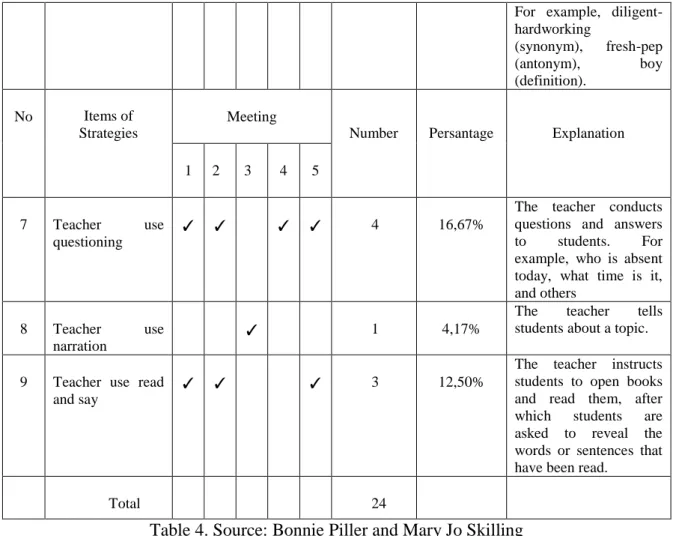
The research question is: what is the teacher's strategy in teaching English and how do the teachers apply these strategies in teaching English to encourage young students' participation in MI Plus Ja-alHaq Bengkulu. The teacher instructs students to open books and read, then asks students to reveal the words or sentences read. The teacher demonstrates to clarify a concept or to show students how to do something.
3 14.28% The teacher instructs the students to open books and read them, after which the students are asked to reveal the words or sentences that have been read. Based on the chart above, that the teacher more often uses verbal illustration strategies, namely 20.83%, then demonstration and question, which is 16.67%, look and say, read and say, namely 12.50%, picture illustration 8, 33%.
Discussion
The interview result shows that teacher 1 stated that the strategy is to make it easier for the teacher to set learning goals. There are different types of strategies used by Teacher 1, and the strategies commonly used in learning English are the use of English and Indonesian, providing translations. exercises, choir training, showing students how to express what is going to be said, showing the meaning verbally through pictures and the like. Based on the above description, it can be concluded that teacher 1 of the 9 strategy items uses all these strategies. Meanwhile, Teacher 2 stated that strategy is a method or goal to make it easier for teachers to convey material/practice during learning.
So the English teaching strategy is very satisfactory if the teaching strategy is equipped with media or facilities and unlimited class hours so that students are more motivated to learn English. So this study is different from previous studies because this study focuses on English teacher strategies for young learners and the strategy is on Bonnie Piller and Mary Jo's theory, while previous research focuses on teacher strategies with different media and theories.
Conclusion
While Teacher 2 the most used strategies are the verbal illustration strategy 23.80% and the question strategy 19.04%, the demonstration strategy, look and say, and read and say 14.28%. However, the main strategies that teachers often use to encourage young student participation are: verbal illustration, demonstration, look and say, and questioning.
Suggestion
The interaction between the nine teaching strategies occurred between student-content, student-to-student and student-teacher. Teacher education, development and decision-making: A model of teaching and related strategies for language teacher education. Retrieved from: http://www.rds-yh.nihr.ac.uk/wp- content/uploads/2013/05/5_Introduction-to-qualitative-research-2009.pdf.
English language teaching and learning for young students at SD Islam Al-Azhar 29 Semarang (A descriptive study in the fifth grade of SD Islam Al-Azhar 29 Semarang in the academic year 2015/2016).