ESSAYS IN MULTIDIMENSIONAL MEASUREMENT: WELFARE, POVERTY, AND ROBUSTNESS
By Suman Seth
Dissertation
Submitted to the Faculty of the Graduate School of Vanderbilt University
in partial ful…llment of the requirements for the degree of
DOCTOR OF PHILOSOPHY in
Economics August, 2010 Nashville, Tennessee
Approved:
Professor John A. Weymark Professor Yanqin Fan Professor Mark A. Cohen Professor James E. Foster
To my parents, whose persistent inspiritation and honest support convinced me to successfully complete this once seemingly impossible journey.
Acknowledgements
This is a great opportunity for me to express my sincere gratitude to those without whose assistance this dissertation would have been di¢ cult to …nish. At the very beginning, I would like to convey my deepest appreciation to my advisor Professor James Foster for his competent guidance, thoughtful advice, and gracious support. He has always encouraged me to work independently, but has been available with his valuable suggestions whenever essential.
I now take the opportunity to thank my co-advisor Professor John Weymark and my dissertation committee members Professor Mark Cohen and Professor Yanqin Fan for their help, advice, and support. I thank to Professor Weymark for being exceedingly generous in spending his valuable time mentoring me to improve the quality of the …rst chapter of my dissertation. I am grateful to Professor Cohen for his precious support during the second and third years of my doctoral program. I am thankful to Professor Fan for her valuable advice on the part of the dissertation where I have used econometric techniques.
Sabina Alkire, the director of the Oxford Poverty and Human Development Initiative (OPHI), has played a crucial role in determining the composition of my dissertation. Mo- tivated by OPHI’s interest in policy analysis, two chapters of my dissertation apply multi- dimensional techniques to the Indian context. I thank Sabina for her support and amicable advice. I appreciate the …nancial support from Professor Jennifer Reinganum and the Re- gional Bureau for Latin America and the Caribbean UNDP that partly funded my research in this dissertation.
I am grateful to Professor Gregory Hu¤man, Professor Jeremy Atack, and Professor William Collins, who have been the Director of Graduate Studies at di¤erent points of
time during my stay at Vanderbilt University, for their valuable advice. I am indebted to the faculty members of the economics department who have taught me various tools of economics. I thank Kathleen Finn, Cathy Zebron, and all others administrative sta¤s who have always been happy to assist me.
On the course of the past six years of my doctoral program, I have been fortunate to have some wonderful friends such as Tamara, Bingyu, Yuling, Valeska, Rosa, Scott, Sujan, Shabana, Alper, Caleb, Sang Soo, Bob, Tommaso, Ali Sina, Suchismita, Indranil, Soumita, Gaston, and Maria Emma, and I am thankful for their generous help and support. I thank David Frisvold, Aniruddha Bagchi, and Rajdeep Sengupta for their advice at di¤erent stages of this program. I appreciate the valuable comments that have come from Koen Decancq on the …rst chapter of my dissertation.
Finally, I express my gratitude to those who did not directly assist me on my disserta- tion writing, but have been a continual source of inspiration. As always, there has never been a lack of inspiration from my parents and my younger brother, who have continuously motivated me from thousands of miles away. I am also grateful to my aunt Rama Pal and my uncle Sankar Prasad Pal for their help and encouragement. During the last three years of dissertation writing, I have been through several pleasing and cheerful moments and also through a number of moments when I was upset and discontent. The person whom I have always found beside me through all these moments is my wife Barnali. I am grateful to her not only for being such a wonderful partner, but also for being an excellent friend.
Table of Contents
Page
Dedication . . . ii
Acknowledgement . . . iii
List of Tables . . . viii
List of Figures . . . ix
Chapter I. Introduction . . . 1
II. A Class of Distribution and Association Sensitive Multidimensional Wel- fare Indices . . . 8
Introduction . . . 8
Preliminaries . . . 10
A Class of Indices . . . 12
Non-Distributional Axioms . . . 14
Inequality Sensitivity Axioms. . . 18
Distribution Sensitive Inequality . . . 19
Association Sensitive Inequality . . . 20
Sensitivity to Both Forms of Inequality . . . 23
Related Social Welfare Indices . . . 25
Conclusion . . . 27
Appendix . . . 29
A. Proof of Theorem 1 . . . 29
B. Proof of Theorem 2 . . . 31
C. Proof of Theorem 3 . . . 37
III. Rank Robustness of Composite Indices: Dominance and Ambiguity . . . . 41
Introduction . . . 41
Notation and De…nitions . . . 45
Robust Comparisons . . . 46
Full Robustness . . . 48
Epsilon Robustness . . . 50
Measuring Robustness . . . 53
Illustrative Example . . . 56
The Prevalence of Robust Comparisons . . . 61
Illustrative Example . . . 62
Conclusion . . . 63
D. Proof of Theorem 6 . . . 66
IV. Composite Indices: Rank Robustness, Statistical Association, and Redun- dancy . . . 68
Introduction . . . 68
Robustness . . . 69
Prevalence of Robustness: Empirical Applications . . . 72
Prevalence, Transformation, and Positive Association . . . 75
Fixed Robustness and Transformations . . . 75
Increased Robustness and Positive Association . . . 79
Robustness and Redundancy . . . 84
Conclusion . . . 86
Appendix . . . 88
E. Proof of Theorem 11 . . . 88
F. Proof of Theorem 14 . . . 88
V. Multidimensional Welfare: An Indian Experience . . . 91
Introduction . . . 91
The Welfare Index and the Data . . . 93
The Class of Welfare Indices . . . 93
The Data and the Unit of Analysis . . . 95
Dimensions and Indicators . . . 96
Material Well-Being . . . 96
Educational Well-Being . . . 100
Quality of Health . . . 101
Statistical Properties of the Attributes . . . 103
Stastistical Tests . . . 104
Results . . . 108
Conclusion . . . 113
VI. Measuring Multidimensional Poverty in India: A New Proposal . . . 115
Introduction . . . 115
Poverty Measurement Methodologies: Brief Review . . . 117
Below The Poverty Line (BPL) 2002: Methodology and Critiques . . . 119
2002 BPL Methodology . . . 120
Critiques of the BPL Process . . . 122
Multidimensional Poverty: A New Methodology . . . 131
The Alkire and Foster Methodology . . . 134
Weighting . . . 139
Data . . . 140
The 2002 BPL Method versus the AF Method . . . 141
Matching Dimensions, Indicators, and their Poverty Cut-o¤s. . . 142
Under-coverage Rate and Over-coverage Rate . . . 145
Coverage Rates for the Alternative Methodology . . . 147
Towards an Improved Measure: Re‡ecting Multiple Deprivations . . . 150
Dimensions, Indicators, and Cut-o¤s . . . 151
Weighting . . . 151
Results . . . 153
Conclusion . . . 158
Appendix . . . 160
G. Below Poverty Line Survey Questions (2002) . . . 160
H. Dimensions, Indicators, and Poverty Cut-O¤s Analogous to Year 2002 BPL Questions . . . 161
I. Score Structure of the Ten Matched NFHS-3 Questions . . . 166
J. Dimensions, Indicators, and Cut-O¤s for the Deprivation Measure . . . . 167
K. Weighted and Unweighted Population . . . 172
L. Contribution of Each Dimension by State: M0 for Multiple Deprivations, k = 4, Nested Weights . . . 173
VII. Conclusion . . . 175
Bibliography . . . 181
List of Tables
Table Page
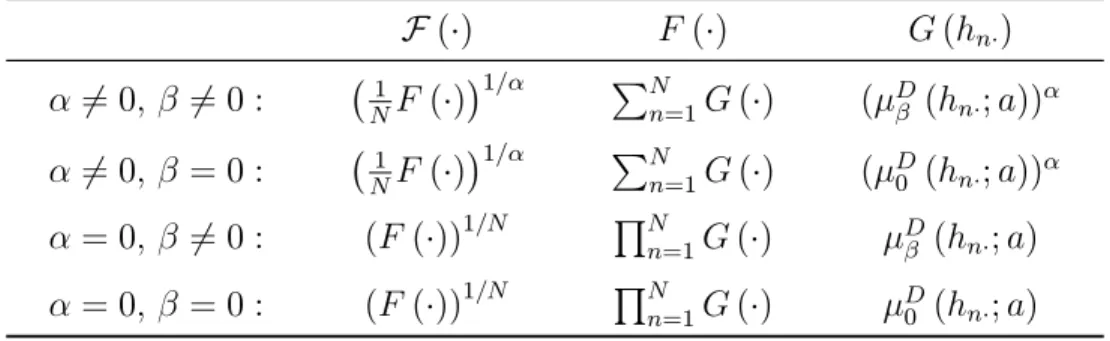
1 Functional Forms ofG,F, andF . . . 37
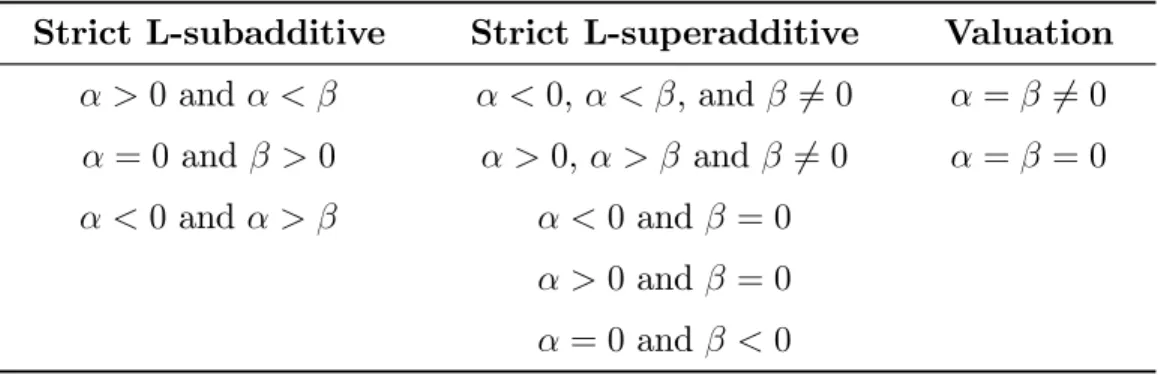
2 Modularity Properties ofG. . . 38
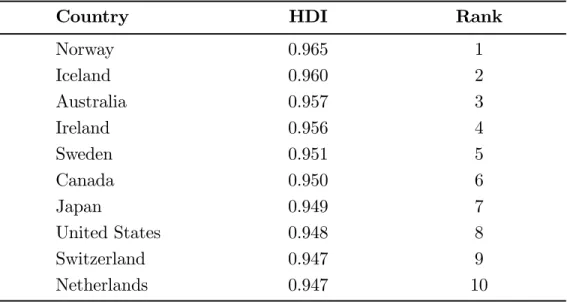
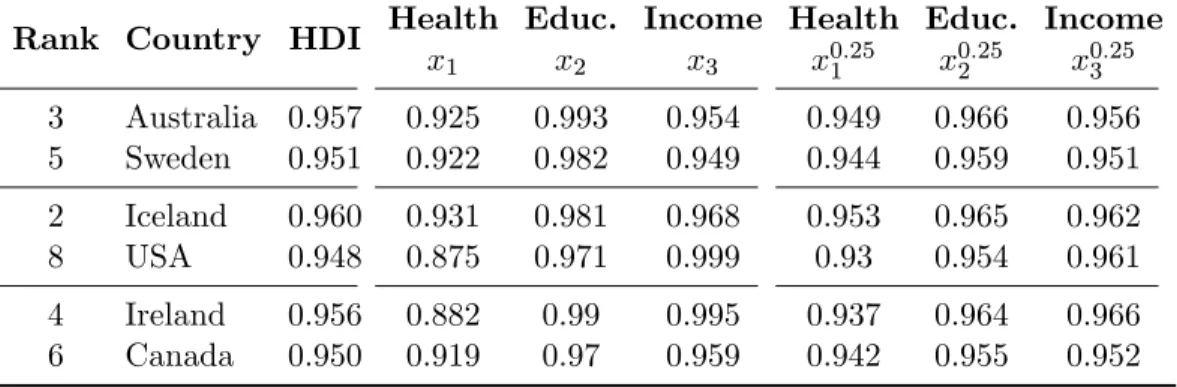
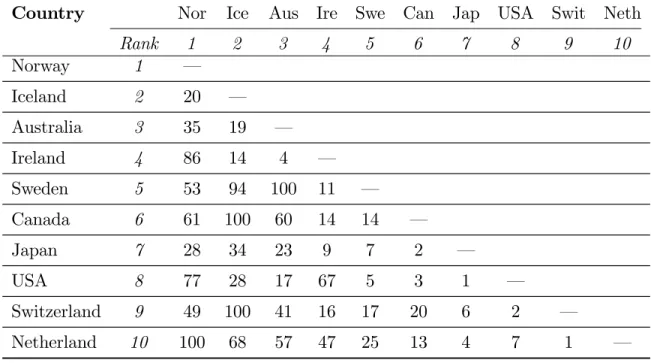
3 Human Development Index: The Top 10 Countries in 2004 . . . 56
4 Robustness of Three HDI Comparisons . . . 57
5 Measure of Robustness . . . 60
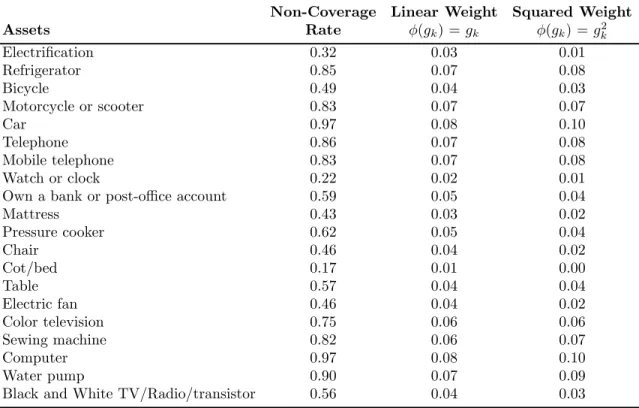
6 Weights Attached to the Selected Assets . . . 99
7 Achievements across Various Population Subgroups . . . 110
8 Association Sensitive Welfare Indices witha= (1=3;1=3;1=3) . . . 111
9 NFHS Questions Analogous to BPL Questions and Dimensional Headcount Ratios 143 10 Indicators and Cut-o¤s of the Chosen Dimensions . . . 144
11 De…nition of Over-coverage and Under-coverage . . . 145
12 BPL Poverty Rates Calculated from the NFHS-3 Dataset . . . 147
13 India: Multidimensional Poverty Measures . . . 148
14 Dimensions, Indicators, and the Headcount Ratios . . . 152
15 Multidimensional Poverty Measures . . . 152
16 State-wise Decomposition of Poverty for 4/11 Cut-o¤ . . . 154
17 Poverty Decomposition by Dimensions . . . 155
18 Spearman’s Rank Correlation Matrix for Di¤erentM0 Rankings . . . 157
List of Figures
Figure Page
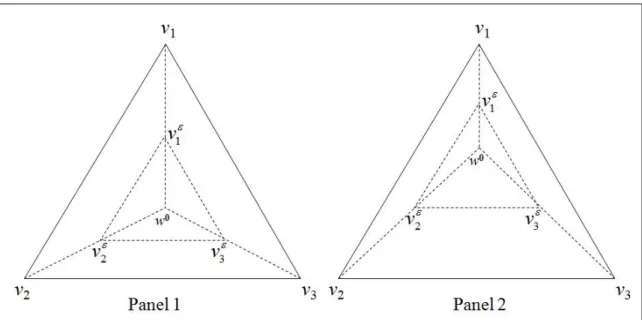
1 Multiple Weighting Vectors: The epsilon-Robustness Set . . . 51
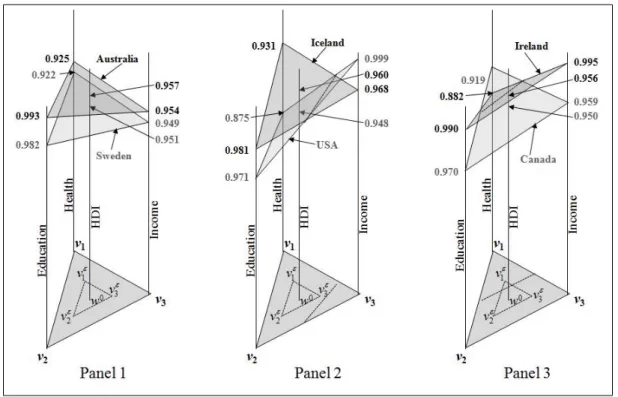
2 Graphical Analysis of Three HDI Comparisons . . . 58
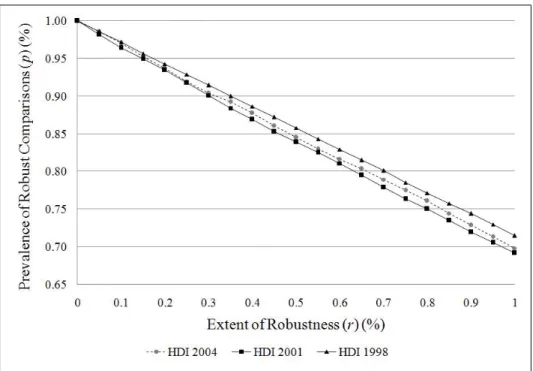
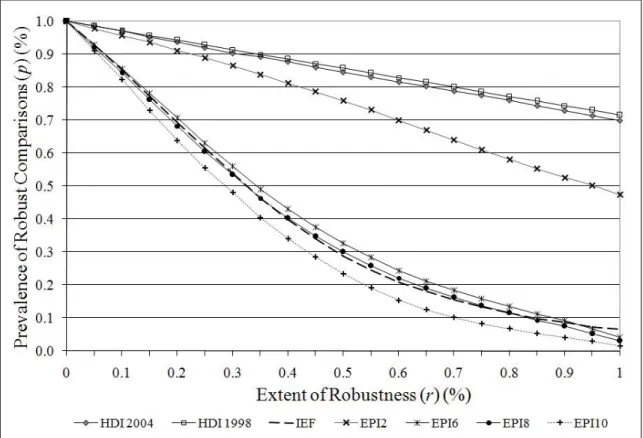
3 Prevalence Functions of HDI for Various Years. . . 62
4 Prevalence Functionsp(r) . . . 74
5 Kernel Density Estimate of the Three Attributes . . . 104
6 Adjusted Headcount Poverty Ranking Vs. NSS Income Poverty Ranking . . . 156
CHAPTER I
INTRODUCTION
Measuring social welfare and deprivation has always been a challenging task for both economic theorists and policy makers. The standard norm has been to use of income for these purposes. Even in the second half of the twentieth century, the welfare or human development or well-being as it is variously known, of a society was predominantly gauged in terms of average income or wealth. Similarly, individuals or households in many countries are still identi…ed as destitute if they fail to acquire incomes above a subsistence threshold.
This led to the measurement and analysis of both welfare and poverty being based only on a single component or attribute (also known as ‘dimension’) of well-being.
However, the proponents of the basic needs approach (Streeten et al., 1981) and later the capability approach (Sen, 1985) have shown that the perception of human welfare and deprivation go beyond income or wealth. The basic needs approach identi…es an individual or a household as destitute if they fail to achieve the resources — such as food, shelter, health care, and education — needed to sustain long term physical well-being. The capability approach developed primarily by Amartya Sen, on the other hand, argues that well-being should be based on what individuals are capable of doing and being, and not merely on the commodity bundle that they own. These two approaches have their di¤erences (Anand and Ravallion, 1993), but they are common in at least one aspect: both encourage the measurement of social welfare and poverty to be based on multiple components or attributes of well-being, such as education and health, instead of income alone.
These approaches have inspired several indices of welfare or poverty over the last few decades and motivated many international orgnizations and policy makers to embrace a multidimensional framework for assessing the level of both well-being and deprivation. Ex- amples include, but are not limited to, the well known Human Development Index (HDI) and the Human Poverty Index (HPI) published annually by the United Nations Develop- ment Programme (UNDP), various physical quality of life indices, e.g. Morris (1979), and the Human Opportunity Index (de Barros et al., 2009) developed recently by the World Bank researchers. In 2002, the government of India has proposed identifying families below the poverty line using a multidimensional survey (Government of India, 2002). A recent commission appointed by French President Nicolas Sarkozy also recommends using a multi- dimensional de…nition of well-being (Stiglitz, Sen, and Fitoussi, 2009). For further instances where the governments of di¤erent countries have moved towards proposing a multidimen- sional de…nition, see Alkire and Sarwar (2009).
In this dissertation, the indices are classi…ed into the following two categories, when the measurement is based on more than one attribute of well-being: multidimensional index and composite index. An index that summarizes the state of a society by aggregating achieve- ments of individuals or households based on multiple attributes is called amultidimensional index, where anachievement refers to the quantity of an attribute obtained by an individual.
For a multidimensional index, it is mandatory that the information on all attributes for each individual or household is available from the same data set.
However, it often happens that either (i) the information is collected from di¤erent sources or (ii) the achievements in di¤erent attributes belong to di¤erent sets of individuals within a society or (iii) the information is available only in aggregated form. The …rst situation
occurs when one uses di¤erent sample surveys to collect information on di¤erent attributes;
for example, information on income or consumption expenditure may be collected from an expenditure survey, but information on health may be available from a health survey.
Clearly, the same set of individuals is not interviewed in both surveys. The second situation arises when the information on selected attributes is based on di¤erent sets of individuals.
For example, the life expectancy rate is based on the individuals who passed away, the mortality rate is based on the children under …ve years of age, the literacy rate is based on the individuals older than fourteen years, the school enrolment rate is based on the individuals who are in the age group of …ve to fourteen years, etc. Under these circumstances, the achievements across individuals are aggregated to construct anindicator for each attribute, and then all these indicators are combined by taking a weighted average to obtain a composite index. Thus, an index that summarizes the state of a society by aggregating the indicators of multiple attributes is called acomposite index. The composite indices are not only restricted to welfare economics, but are also widely applied to other branches of social science. The well-known examples include, but are not limited to, the Human Development Index, the Human Poverty Index, the Environmental Performance Index, the Global Peace Index, the Index of Economic Freedom, the Child Well-Being Index, and the index for colleges in the U.S. News college rankings.
Note that the de…nitions of a multidimensional index and a composite index are di¤erent, but it may sometime be hard to draw a concrete line of distinction between them. For instance, information on individual achievements may be collected using the same survey and also may be available for the same set of individuals in a society. If the achievements are …rst aggregated across individuals to obtain an indicator for each attribute, and these indicators
are then aggregated to obtain an index, then clearly, this is a multidimensional index by de…nition. However, if one assumes that the indicators in the …rst stage are given and aggregates these indicators to obtain an index, then based on the second stage aggregation only, the same index can be interpreted as being a composite index.
One may confront several challenges while constructing an index based on multiple at- tributes. The major challenges are: to choose an appropriate set of attributes, to collect reasonable data, to determine a suitable set of weights re‡ecting the importance of each attribute, to select an appropriate aggregation method so that the data can be meaning- fully summarized, and to verify the statistical signi…cance of the evaluation generated by the index. This dissertation primarily focuses on various issues related to the method of ag- gregation so that the interpretation of the indices and the comparisons based on them have meaningful policy implication. In particular, it focuses on three di¤erent aspects concerning the aggregation methods of three di¤erent sets of indices: multidimensional welfare indices, composite indices, and multidimensional poverty indices. Furthermore, the tools developed in this dissertation are applied to real world data showing how they may in‡uence existing policy decisions.
Chapter II is devoted to developing a class of multidimensional social welfare indices that is sensitive to inequality across individuals because a satisfactory index of social welfare or poverty should be sensitive to theinequality in the distributions of the attributes (Atkinson, 1970; Foster and Sen, 1997). Aside from its direct concern, inequality may well have neg- ative indirect e¤ects on social welfare. For example, a high level of inequality may lead to political instability (Alesina and Perotti, 1996; Justino, 2004), tensions among di¤erent eth- nic groups (Stewart, 2008), an increase in crime rates (Fajnzylber et al., 2002), and feelings
of deprivation among the members of society. These consequences, in turn, have adverse e¤ects on the level of social welfare. Thus, the …rst aspect of aggregation is concerned with developing a class of social welfare indices that is sensitive to inequality across individuals.
If two societies have the same level of average achievement in each attribute, then the one with less inequality across individuals should re‡ect a higher level of social welfare.
The second aspect of aggregation is associated with the composite indices that are ob- tained by taking a weighted average of various indicators of attributes. These indices are frequently used to rank societies or countries. These rankings are often of high national priority. It is a matter of pride for countries to be on the top of the lists. Moreover, various donor countries judge the performance of the debt seeking developing countries based on these composite indices. However, the choice of weights when constructing these indices is crucial because a choice of di¤erent weights, other than the one used, may alter the existing rankings and thus leading to ambiguous comparisons. A comparison is ambiguous or not robust if it is reversed when di¤erent weights are chosen. On the other hand, a compari- son between a pair of countries or societies is completely robust if the comparison is never reversed when weights are changed. Therefore, in addition to making comparison across regions, it is important that one verify how robust these comparisons are. The next two chapters of the dissertation deal with this second aspect of aggregation. In Chapter III, a natural measure for evaluating the level of robustness is proposed and characterized. In Chapter IV, this new measure of robustness is applied to certain real world data sets to examine how the prevalence of robust comparisons varies when the targeted level of robust- ness is altered. It is shown that this relationship is in‡uenced by the association among the indicators across societies. The research in the Chapter III and IV is jointly conducted with
my advisor James Foster and Mark McGillivray.
The Chapters V and VI are devoted to the application of the class of multidimensional welfare indices developed in the …rst chapter and an application of a class of multidimensional poverty indices developed by Alkire and Foster (2008), respectively, to the Indian context. I
…nd the applications to the Indian context interesting for the following reasons. There has been almost a three-fold increase in the national per-capita gross domestic product of India between 1990-91 and 2007-08. Furthermore, analyses using various poverty measures have suggested a signi…cant fall in poverty when it is de…ned purely in terms of income. At the same time, the national family health survey and the human development report reveal that more than …fty percent of the rural women are illiterate, …fty seven infants do not survive out of every thousand newborns, nearly ninety percent of the rural households use solid biomass fuel for cooking purposes, and sixty seven percent of the population live without improved sanitation facilities as mandated in the millennium development goals (MDG) by the UNDP. Clearly, an improved performance in terms of income alone fails to re‡ect improved performance in other attributes of well-being. Moreover, inequality in achievements also remains high across the population and also across di¤erent population subgroups, such as across various geographical regions, across religions, and across castes/tribes. Although the dimension-speci…c averages partly explain these observations, they ignore the existing inter-person inequality. Thus, India happens to be an appropriate context for the application of a multidimensional social welfare index that is also sensitive to inter-personal inequality and the Chapter V is devoted to this objective.
The third aspect of aggregation concerns multidimensional poverty indices. In 2002, the Government of India has proposed identifying families below the poverty line using a
multidimensional survey. The survey consists of thirteen questions with …ve responses each.
A household is identi…ed as poor if the household fails to secure a certain score out of these thirteen questions. A poverty index is constructed by just counting the number of poor persons. Consequently, the poverty index is neither sensitive to the depth, nor the breadth of poverty. By saying that the index is not sensitive to the depth of poverty, it is meant that the index does not change if a deprived person becomes more deprived in one attribute.
Similarly, by saying that the index is not sensitive to thebreadth of poverty, it is meant that the index does not change if a poor individual becomes deprived in an additional attribute in which (s)he was not deprived before. Moreover, the poverty index does not allow for poverty decomposition across attributes. In other words, it is not possible to calculate the contribution of each attribute to total poverty. A recently proposed class of multidimensional poverty indices by Alkire and Foster (2008) is sensitive to both the depth and the breadth of poverty, and allows for the decomposition of poverty across attributes. In Chapter VI, this new poverty index is applied to the Indian context to analyse the state of multidimensional poverty. The research in this chapter is conducted jointly with Sabina Alkire.
Finally, in Chapter VII, possible extensions are discussed and concluding remarks are provided. Since the research in some of the chapters has been conducted jointly, for the sake of uniformity, third person pronouns are used instead of …rst person pronouns throughout the rest of this dissertation.
CHAPTER II
A CLASS OF DISTRIBUTION AND ASSOCIATION SENSITIVE MULTIDIMENSIONAL
WELFARE INDICES
Introduction
In this chapter, we are concerned with the evaluation of social welfare when there are two or more attributes of well-being. To have a common basis for comparison across di¤erent societies, we suppose that the set of attributes is …xed. However, to allow for comparisons across societies with di¤erent set of individuals, we de…ne our indices for all population sizes.
For a society, we summarize the achievement of every individual in every attribute by an achievement matrix. A social welfare index is de…ned as a real-valued function on the set of possible achievement matrices. We propose a new class of multidimensional social welfare indices and characterize them axiomatically. Indices in this class are constructed in two stages. First, an overall achievement score is obtained for each individual by aggregating over the di¤erent attributes of well-being and then these scores are aggregated across indi- viduals. In each stage of this aggregation, we use a generalized mean, which is characterized by a single parameter. Therefore, we refer to our new two-stage welfare indices as the class of two-parameter generalized mean social welfare indices.1 The class includes several indices proposed in the literature, such as those of Foster et al. (2005) and Decancq and Ooghe (2009), as special cases. Indices in our class are particularly amenable for empirical applica- tions because of their simple functional form. Seth (2009) has used this new class of indices to critically evaluate the Human Development Index.
1Since writing this dissertation, we have learned that Kockläuner (2006) has proposed a similar class of indices for measuring poverty and has discussed some of its properties. See also Kockläuner (2008).
A satisfactory index of social welfare should be sensitive to the inequality in the distri- butions of the attributes of well-being (Atkinson, 1970; Foster and Sen, 1997). Aside from its direct concern, inequality may well have negative indirect e¤ects on social welfare. For example, high levels of inequality can lead to political instability, tensions among ethnic groups, increase in crime rates, and feelings of deprivation among the members of society.
When there are multiple attributes of well-being, there are two distinct forms of inequal- ity. The …rst is concerned with the dispersion across the individual achievements of each attribute (Kolm, 1977) and the second is concerned with the correlation — or more pre- cisely, association — across attributes (Atkinson and Bourguignon, 1982). The …rst form of inequality is distribution sensitive inequality and the second is association sensitive in- equality. Many multidimensional indices of social welfare, inequality, or poverty, such as the Human Development Index, Human Poverty Index, and various physical quality of life indices, are insensitive to either of these forms of inequality, whereas others, such as those proposed by Hicks (1997), Foster et al. (2005), Gajdos and Weymark (2005), and Alkire and Foster (2008) only take account of distribution sensitive inequality. There have also been a small number of multidimensional indices proposed that take account of both kinds of inequality. See, for example, Tsui (1995, 1999, 2002), Bourguignon (1999), Bourguignon and Chakravarty (2003), Decancq and Lugo (2009), and Decancq and Ooghe (2009).
This class of indices developed in this chapter is most closely related to that of Foster et al.
(2005). They also constructed a class of welfare indices by applying a two-stage aggregation procedure in which a generalized mean is used in each stage. However, they used the same generalized mean parameter in both stages. Using a single parameter is quite restrictive because it is then not possible for their indices to be association sensitive. By using two
parameters, our indices can be both distribution and association sensitive.
Bourguignon (1999) has also proposed a two-parameter class of indices, albeit in the context of measuring inequality. Each of Bourguignon’s indices is a monotonic transform of one of our indices. However, Bourguignon does not provide an axiomatic characterization of his class. Furthermore, as discussed later, the value of his welfare indices can respond to a change in the inequality aversion parameter in a way that is counter intuitive.
The rest of this chapter is organized as follows. In the second section, we introduce our basic de…nitions and notation. In the third section, we de…ne and discuss the class of two- parameter generalized mean social welfare indices. In the fourth section, we introduce the non-distributional axioms and use them to characterize our class de…ned in the third section.
We then, in the …fth section, introduce our inequality aversion axioms and characterize the subclasses of our class of indices that satisfy them. We consider other subclasses of our indices in the sixth section. In the …nal section, we discuss possible extensions of our analysis and provide some concluding remarks.
Preliminaries
The set of attributes of well-being is D = f1; : : : ; Dg, where D N is the number of attributes.2 Throughout the analysis D is …xed with D 2. For example, the attributes could be income, years of education, and an index of health status. Alternatively, the attributes of well-being could be incomes in di¤erent time periods or states of nature. The former would be appropriate for studying income inequality over time, whereas the latter
2We use the following standard notation. The setNis the set of positive integers. The Euclideank-space is Rk and it’s non-negative and positive orthants areRk+ and Rk++, respectively. It is sometime convenient to think of aj kreal-valued matrix as being a vector inRjk. TheD-dimensional simplex isSD=fx2RD+1+
jPD+1
i=1 xi= 1g. The interior ofSD is denoted byInt(SD).
would be appropriate for studying income inequality under uncertainty (Ben Porath et al., 1997). The set of individuals is N= f1; : : : ; Ng. We let the population size vary, so N can be any integer in N.
The quantity of an attribute obtained by an individual is referred to as anachievement.
An achievement matrix for a population of size N is a matrix H 2RN D++, whose ndth entry is the achievement hnd of attribute dby personn. Thenth rowhn of H is the vector listing the achievements of all D attributes by person n. The dth column hd of H is the vector listing the achievements of all N individuals for attribute d. Let HN denote the set of all possible achievement matrices of population size N and let H = [N NHN be the set of all possible achievement matrices.
A social welfare index is a function W : H ! R. The social welfare associated with the achievement matrix H 2 HN is at least as large as the social welfare associated with the achievement matrixH0 2 HN0 if and only ifW(H) W(H0). The matrices H and H0 could be for societies with di¤erent sets of individuals, as would be the case when making comparison between di¤erent countries or regions. Of course, if they are the achievement matrices for a single society, thenN must equal N0.
We employ the following operations on vectors and matrices. For all M 2 N and all x; y 2 RM, the join of x and y is (x_y) = (max (x1; y1); : : : ;max (xM; yM)) and the meet of x and y is (x^y) = (min (x1; y1); : : : ;min (xM; yM)). For all r; M 2 N and all z 2 RM, ther-replication of z is the vector [z]r = (z; : : : ; z) 2 RrM in which z has been replicated r times. Similarly, for all r; L; M 2 N and all Y 2 RLM, the r-replication of Y is the matrix [Y]r 2RL0M in which the rows of Y has been replicatedr times, whereL0 =r L.
The following special vectors and matrices are used in the subsequent discussion. The
M vector whose components are all equal to 1 is 1M. Similarly, the L M matrix 1LM is the matrix with a 1 in every entry. The M vector whose components are all equal to 1=M is M.
A Class of Indices
The class of social welfare indices that is introduced here is de…ned using generalized means. For vectors in RM++, for all 2R, and all a 2RM+, the generalized mean of order for the weight vector a 2 SM 1 is the function M( ;a) on RM++ de…ned by setting, for all x2RM++,
M(x;a) = 8>
><
>>
: hPM
m=1amxmi1=
if 6= 0 QM
m=1xamm if = 0
. (1)
The parameter determines the curvature of the level surfaces of M. For = 1, a gen- eralized mean is simply a weighted arithmetic mean. It is a weighted geometric mean and a weighted harmonic mean for = 0 and = 1, respectively. As ! 1, M(x;a) ! maxm2M fxmg, and as ! 1, M(x;a) ! minm2Mfxmg.3 Of particular interest are generalized means in which all attributes receive the same weight. That is, in (1), the weight vector a is equal to M. Note that a generalized mean is twice di¤erentiable.
It is common in the literature on multidimensional social welfare and inequality to con- struct an overall index in two stages. This can be done by either (i) …rst aggregating across individuals for each attribute and then aggregating across attributes or (ii) …rst aggregat- ing across attributes for each individual and then aggregating across individuals. Following Pattanaik et al. (2007), the former method is called column-…rst two-stage aggregation and the latter is called row-…rst two-stage aggregation. Pattanaik et al. (2007, Propositions 1
3We require that be inRand thereby exclude the limiting cases of =1and = 1.
and 2) have shown that the column-…rst procedure completely ignores interactions across dimensions, which is important if the index is to be association sensitive. Thus, here, we only consider the row-…rst procedure. In the …rst stage, achievements are aggregated to obtain an individual’soverall achievement score. For a population size ofN 2N, the overall achievement score for individual n is obtained by applying an aggregation function QNn : RD++ ! R for all n in N. Then, in the second stage, these scores are aggregated using a function N :RN !R. Formally, therow-…rst two-stage aggregation method can be de…ned as follows.
Row-First Two-Stage Aggregation For every N N and every n in N, there exist functions N : RN ! R and QNn : RD++ ! R such that for all H 2 HN, the social welfare indexW can be written as
W(H) = N(QN1 (h1); : : : ; QNN(hN )). (2)
The indices we propose use generalized means for each stage of the aggregation. For every choice of the parameters and in R and every weight vector a in Int SD 1 , the two-parameter generalized mean social welfare index W( ; ; ; a) is de…ned by setting
W(H; ; ; a) = N( D(h1;a); : : : ; D(hN ;a); N). (3)
for every N N and every H 2 HN. Note that (3) is obtained from (2) by setting N( )
= N( ; N)andQNn( ) = D( ;a)for allN N and for allninN. Intuitively, the index is a generalized mean of generalized means. LetGdenote the set of all two-parameter generalized mean social welfare indices.
Following Atkinson (1970), N(x)is referred to as theequally distributed equivalent over- all achievement, where x is the vector of overall achievements. The parameter measures society’s aversion towards inter-personal inequality in these achievements. That is, mea- sures the degree to which one individual’s overall achievement is substitutable for a second individual’s overall achievement in the social welfare index W. Similarly, the parameter measures the degree of substitutability across the dimensions of well-being of any individual.
In de…ning the class of indices G, we have not required that they be either distribution or association sensitive. As we shall show, such sensitivity can be achieved by placing restrictions on the parameters that de…ne these indices. In the subsequent sections, under the maintained assumption that we use row-…rst aggregation, we shall provide an axiomatic characterization of the class of all two-parameter generalized mean social welfare indices, as well as characterizations of the sub-classes that satisfy distribution sensitivity, association sensitivity, or both of these properties together.
Non-Distributional Axioms
In this section, we axiomatically characterize the two-parameter class of generalized mean social welfare indices G given our assumption that the index is constructed using row-…rst aggregation, that is, assuming that the social welfare index W has the form in (2). The axioms that we employ are standard in the literature. Furthermore, none of the axioms considered in this section take into account distributional or associational concerns.
The …rst axiom requires the value of social welfare index to change continuously with a change in the achievement of any person in any dimension.
Continuity (CONT) For every N N,W is continuous on RN D++.
The next axiom imposes convenient normalizations on the aggregation function Q and the social welfare indexW. If an individual has the same achievement in all dimensions, then the overall achievement is equal to this value. Moreover, if everybody has the same overall achievements, then the value of the social welfare index is equal to this common value.
Normalization (NORM) For every N N, every > 0, and every H 2 HN such that H = 1N D,
QNn(hn) = 8n2N and W(H) = .
The social welfare index can be thought of as being a representation of a social preference on the set of achievement matrices. We assume that this preference is homothetic. A preference is homothetic if whenever two achievement matrices for the same population are socially indi¤erent, then so are the achievement matrices obtained by proportionally scaling both of them. By assuming that this preference is homothetic, we are implicitly assuming that we are concerned with relative inequality; that is, there is no change in inequality if an achievement matrix is proportionally scaled.4
Homotheticity (HOM) For every N N, every >0, and everyH; H0 2 HN,
W(H0) = W(H),W( H0) = W( H).
We assume that the identities of individuals are not ethically signi…cant. This is accom- plished by requiring the social welfare index to be symmetric in the sense that the index is
4Tsui (1995) introduced a stronger version of homotheticity axiom called ratio scale invariance, which has also been used by Decancq and Ooghe (2009). However, this axiom has been questioned by Bourguignon (1999, p. 479). For a related discussion, see Weymark (2006, p. 311).
invariant with respect to permutations of the individual achievement vectors.
Anonymity (ANON) For every N N, every H; H0 2 HN, and for every permutation matrix P 2RN N+ such that H0 =P H,
W(H0) = W(H).5
The preceding axioms do not place any restrictions on the value of the index for achieve- ment matrices for societies with di¤erent population sizes. We assume that if an achievement matrix is replicated an arbitrary number of times, then the value of the social welfare index is unchanged. Thus, social welfare is being measured in per capita terms.
Population Replication Invariance (POPRI) For every r 2 N and every H; H0 2 H such that H0 = [H]r,
W(H0) =W(H).
We assume that each attribute of well-being contributes positively to social welfare. It is, therefore, natural to assume that the value of the social welfare function increases if the value of some attribute for some individual increases with no decrease in the value of any attribute for any individual.
Monotonicity (MON) For every N N and every H; H0 2 HN such that H0 H and H0 6=H,
W(H0)> W(H).
5A permutation matrix is a square matrix with each row and column having exactly one element equal to one and the rest equal to zero.
The restriction of the social welfare index to achievement matrices in HN provides an index of social welfare for any group of sizeN. We assume that social welfare increases if the social welfare of a subgroup of the society increases, while that of the rest of the population is unchanged. This increase in subgroup social welfare may be accompanied by both increases and decreases in achievements of individuals in the subgroup. Our monotonicity axiom does not apply to such comparisons.
Subgroup Consistency (SUBCON) For every N1; N2; N 2 N such thatN1+N2 = N, every H1; H10 2 HN1, and every H2; H20 2 HN2, if W(H10) > W(H1) and W(H20) = W(H2), then W(H10; H20)> W(H1; H2).
It is common in empirical analysis for an individual’s overall achievement score to be obtained by taking a weighted sum of his achievements in each dimension. These weights could measure the relative importance of the di¤erent achievements. See, for example, Decancq and Lugo (2008). Alternatively, they can be used to convert the units for each dimension into a common scale. Suppose that the set of achievements D is partitioned into two disjoint subsetsD1 andD2. For given values of the achievements inD2, the aggregation functionQNn for personn in a row-…rst two-stage aggregation procedure de…nes a conditional ordering of achievement vectors for the attributes in D1. When …xed weights are used to aggregate the attributes in D, this conditional ordering is independent of the values in D2. We do not assume a prori that …xed weights are used in this aggregation. However, we do assume that for every partition of D into disjoint subsets D1 and D2, the aggregation function QNn de…nes a conditional ordering of achievement vectors for the attributes in D1
that is independent of the values of the attributes in D2. That is, QNn is assumed to be
completely strictly separable. More precisely, we assume that QNn is additively separable for alln inN.6
Additive Separability (ADDSEP) For every N N and every n 2N, the aggregation function QNn can be written as
QNn(hn) =Un(V1n(hn1) + +VDn(hnD)) (4)
for all hn 2 RD++, where Un : R ! R is a continuous and increasing function, and Vdn : R++!R is a continuous function for all d in D.
For row-…rst two-stage aggregation, Theorem 1 shows that the non-distributional axioms introduced in this section characterize the set of two-parameter generalized mean social welfare indices G.
Theorem 1 An index W : H ! R is a two-parameter generalized mean social welfare index if and only ifW is obtained using row-…rst two-stage aggregation and satis…es CONT, NORM, HOM, ANON, POPRI, MON, SUBCON, and ADDSEP.
Proof. See Appendix A.
Inequality Sensitivity Axioms
In this section, we introduce axioms that are concerned with the sensitivity of the social welfare indices to the two forms of inequality described above. First, we introduce a distrib- ution sensitivity axiom that ensures that the social welfare index takes account of the spread
6Additive separability of QNn is equivalent to complete strict separability if D 3. However, for D = 2, additive separability is a somewhat stronger assumption than complete strict separability. See Blackorby et al. (1978, Section 4.4).
of the multidimensional distribution and we then characterize the subclass of the class of two-parameter generalized mean social welfare indicesG that satis…es this axiom. Next, we introduce two alternative association sensitivity axioms and we characterize the subclasses of G that satisfy each of these axioms. Finally, we characterize the subclasses of G that satisfy both our distribution sensitivity axiom and one of our association sensitive axioms.
Distribution Sensitive Inequality
Distributional sensitivity of the social welfare index W is obtained by requiring that the value of the index increases if an achievement matrix is subjected to a common smoothing.
For everyN Nnf1gand everyH0; H 2 HN,H0 is obtained fromHby acommon smoothing if there exists a bistochastic matrix B such that H0 =BH and H0 is not a permutation of H.7 Note that the same bistochastic matrix is being applied to each attribute. Formally, we require our social welfare index to satisfy the following axiom due to Kolm (1977).
Increasing under Common Smoothing (ICS) For everyN Nnf1gand everyH0; H 2 HN such that H0 is obtained fromH by a common smoothing,
W(H0)> W(H).8
When there is only one dimension of well-being, H0 and H are distributions of a single attribute, and the requirement that H0 be obtained from H by a common smoothing is equivalent to saying thatH0 can be obtained fromH by a sequence of Pigou-Dalton transfers, possibly supplemented by permutations of some of the distributions in this sequence.
7A bistochastic matrix is a non-negative square matrix whose row and column sums are both equal to one.
8This axiom is also known as the Uniform Majorization Principle. See Kolm (1977) and Weymark (2006) for further discussion of this and related distribution sensitivity axioms.
Theorem 2 characterizes the subclass of G that satis…es ICS.
Theorem 2 A two-parameter generalized mean social welfare indexW(H; ; ; a) satis…es ICS if and only if <1 and <1.
Proof. See Appendix B.
In the de…nition of a generalized mean M, the parameter determines the curvature of the level surfaces (iso-achievement curves) of M. The restriction < 1 implies that the aggregation function Q is strictly quasi-concave and thus has a strictly convex upper contour set. Consequently, the overall achievement score increases when one achievement vector is obtained from the second by a strictly convex combination of the achievements of the latter. Note that the …rst stage aggregation function is analogous to the constant elasticity of substitution (CES) function in the utility analysis. Similarly, if <1, then the aggregation function is also strictly quasi-concave in its arguments which are the overall achievements of the individuals.
Association Sensitive Inequality
We now consider the sensitivity of the social welfare index W to a change in the associa- tion between dimensions while leaving the marginal distributions unaltered.9 Association sensitivity was introduced into the literature on multidimensional social welfare by Atkinson and Bourguignon (1982) and has subsequently been considered by Tsui (1995, 1999, 2002), Bourguignon (1999), Bourguignon and Chakravarty (2003), and Decancq and Lugo (2009),
9What we refer to association between dimensions is often called dependence in the statistics literature and correlation in the literature on economic inequality. We do not employ the term ‘correlation’here so as to emphasize that we are not restricting our attention to the correlation coe¢ cient used in statistics.
among others. There are various ways in which the di¤erent dimensions of well-being may be interdependent, with the consequence that there are a number of di¤erent concepts of association sensitivity. See Joe (1997, Chapter 2) for a discussion.
Here, association sensitivity of W is obtained by requiring that the value of the index increases if an achievement matrix is subjected to an association increasing transfer. For everyN Nnf1gand everyH; H0 2 HN,H0 is obtained fromHby anassociation increasing transfer if H0 6= H, H0 is not a permutation of H, and there exist two individuals n1 and n2 such thath0n1 = (hn1 _hn2 ),h0n2 = (hn1 ^hn2 ), andh0n =hn for all n2 Nnfn1; n2g.10 To interpret this de…nition, consider two individuals and an achievement matrix such that neither individual has at least as much of every attribute than the other. If for each attribute, we reallocate their achievements between these two individuals so that one of them has at least as much of every achievement as the other, then the resulting achievement matrix has been obtained from the former by an association increasing transfer. As emphasized by Bourguignon and Chakravarty (2003), whether an association increasing transfer is socially bene…cial depends on whether the attributes are substitutes or complements in W. As a consequence, we have the following two di¤erent association sensitivity axioms, the choice of which depends on which of these two cases apply.
Decreasing under Increasing Association (DIA) For everyN Nnf1gand everyH0; H 2 HN such thatH0 is obtained fromH by a …nite sequence of association increasing transfers,
W(H0)< W(H).
10The concept of an association increasing transfer was introduced by Tsui (1999) under the name of a cor- relation increasing transfer. Tsui’s concept was in turn was based on the idea of a basic rearrangement due to Boland and Proschan (1988). These concepts are closely related to the correlation increasing switches considered by Bourguignon and Chakravarty (2003). For formal de…nitions of these concepts, see the articles cited above and for a discussion of the relationship between them, see Chakravarty (2009) and Seth (2009).
Increasing under Increasing Association (IIA) For everyN2Nnf1gand everyH0; H 2 HN such thatH0 is obtained fromH by a …nite sequence of association increasing transfers,
W(H0)> W(H).
Theorem 3 characterizes the subclasses of G that satisfy these axioms.
Theorem 3 (i) A two-parameter generalized mean social welfare index W(H; ; ; a) sat- is…es DIA if and only if < . (ii) A two-parameter generalized mean social welfare index W(H; ; ; a) satis…es IIA if and only if > .
Proof. See Appendix C.
After an association increasing transfer takes place, one of the two individuals a¤ected by the transfer has at least as much of every attribute as the other a¤ected individual. If the attributes are substitutes (resp. complements) from the perspective of social welfare, then such a transfer should decrease (resp. increase) the value of the social welfare index, which requires that is less than (resp. larger than) . For example, if two of the attributes are income and some indicator of health status, then it is natural to regard them as being substitutes because an individual with poor health can better deal with his condition if he has su¢ cient funds to help ameliorate this situation. On the other hand, if quality of health and housing infrastructure are two attributes of well-being, then good health is better enjoyed by an individual whose housing infrastructure is improved as well. In this situation, these two attributes are complements to each other.
Sensitivity to Both Forms of Inequality
By combining Theorems 2 and 3, we obtain the subclasses of G that are both distribution and association sensitive.
Theorem 4 (i) A two-parameter generalized mean social welfare index W(H; ; ; a) sat- is…es ICS and DIA if and only if < < 1. (ii) A two-parameter generalized mean social welfare index W(H; ; ; a) satis…es ICS and IIA if and only if < <1.
To illustrate the signi…cance of the parameter restrictions in Theorem 4, we consider the problem of a policy maker who needs to decide which person to allocate a marginal transferT in his budget so as to maximize the increase in social welfare. For simplicity, in the following discussion we suppose that both and are non-zero. For anyN N and anyH 2 HN, if the transfer T is provided to personn to improve her achievement in dimension d, then the increment in social welfare is:
@W(H; ; ; a)
@T = adhnd1Cn C cnd,
where ad is the weight of dimension d in the calculation of the overall achievement scores, cnd = @hnd=@T is the increase in achievement hnd due to the transfer, Cn = (hn;a) is the overall achievement score of person n, and C = N1W(H; ; ; a)1 . Note that C is identical across all individuals. Let!nd=adhnd1Cn cndfor allnand alld. To maximize the increase in social welfare, the policy maker should assist personnto increase her achievement in dimensiond if
!nd > !n0d0 8n0 2N=fng and 8d0 2D=fdg. (5)
First, to illustrate the role that the restriction <1 plays, we consider the situation in whichhnd=hnfor alldandcnd=cfor alldand alln. In this case,!nd=hn 1c. Consider the problem of determining which individual the budget increase should be spent on. Because
<1, the policy maker should provide the transfer to the individual or individuals for which hn is minimal.
Second, we consider the role that the restriction < 1 plays. This role is most clearly seen whenad=afor alldandcnd =cfor alldand alln. Consider the problem of determining which attribute the budget increase should be spent on conditional on individual n being the person receiving the transfer. Because Cn does not depend of d and because < 1, it follows from (5) that the transfer should be spent on the attribute or attributes for which hnd is minimal.
Third, to illustrate how the substitutability and complementarity between attributes a¤ects the allocation of the transfer, we again consider the situation in which ad = a for all d and cnd = c for all d and all n. We already know that if individual n receives a transfer, the transfer should be spent on the attribute or attributes for which hnd is minimal. If the social welfare index is not association sensitive, then = and thus !nd =achnd1. Hence, the transfer should be allocated to the individuals and attributes for which hnd is minimal regardless of what anybody’s overall achievement score is. If, however, the social welfare index is association sensitive, then 6= and thus !nd = achnd1Cn and the transfer should be allocated to those individuals and attributes for which hnd1Cn are maximal.
Suppose that hnd =hn0d0, where d (resp. d0) is the attribute with minimal achievement for individualn(resp. n0). Then, the transfer should not go to individualn0 if the attributes are substitutes ( < ) and Cn0 > Cn. Similarly, the transfer should not go to individual n0 if
the attributes are complements ( > ) and Cn0 < Cn. When the attributes are substitutes (resp. complements), then higher (resp. lower) association is detrimental to social welfare and, thus, the individual with the lower (resp. higher) overall achievement score should be favored whenever they have the same minimal achievements.
Related Social Welfare Indices
Foster et al. (2005) have proposed a one-parameter class of generalized mean social wel- fare indices, which we refer to as the FLS class. The FLS class is the subclass of our two-parameter generalized means G obtained by setting = 1. The FLS indices ex- ibit distribution sensitivity, but as can be seen from Theorem 4, they are not association sensitive. When = = 1, the social welfare index is simply the arithmatic mean across individuals of weighted arithmatic means across attributes. This index is neither association nor distribution sensitive. Several well-known indices are simple means of weighted arith- metic means. For example, the Human Development Index (United Nations Development Programme, 2006) and the Morris (1979) physical quality of life index have this functional form.
For the FLS class, both column-…rst two-stage aggregation and row-…rst two-stage ag- gregation yield an identical evaluation. This invariance property is calledpath independence.
Path Independence (PATHIN) For everyN N, there exist functions :RN++ !R++
and Q : RD++ ! R++ such that for all H 2 HN,
(Q(h1); : : : ; Q(hN )) =Q( (h1); : : : ; (hD)).
Note that the class of two-parameter generalized mean social welfare indices cannot be simultaneously association sensitive and path independent. If the data for di¤erent attributes are available at di¤erent levels of aggregation, we do not have enough information to consider association among attributes. For example, education data may be available at the individual level, income data may be available at the household level, and health data may be available at the municipality level. In such circumstances, it may be appropriate to require the social welfare index to be path independent. Subclasses ofGthat satisfy PATHIN are characterized in Theorem 5.11
Theorem 5 (i) A two-parameter generalized mean social welfare index W(H; ; ; a) sat- is…es PATHIN if and only if = . (ii) A two-parameter generalized mean social welfare index W(H; ; ; a) satis…es PATHIN and ICS if and only if = <1.
Proof. For any N 2 N and any H 2 HN, letW1 = N( D(h1;a); : : : ; D(hN;a); N) and W2 = D( N(h1; N); : : : ; N(hD; N); a). It is straightforward to show that if = , then W1 =W2. By Hardy et al. (1934, Theorem 26),W1 > W2 if < andW1 < W2 if > .12 Hence, W1 6= W2 if 6= . Part (ii) of the theorem follows directly by combining part (i) with Theorem 2.
The subclass of G for which 2 (0;1) and < 1 shares the same ordinal properties as the class of welfare indices proposed by Bourguignon (1999). For a2Int(SD 1), 2(0;1), and <1, the Bourguignon social welfare index is de…ned as
WB(H; ; ; a) = 1 N
XN
n=1( D(hn;a)) = (W(H; ; ; a)) , (6)
11For a class of path independent standard of living indices, see Dutta et al. (2003).
12Although Hardy et al. (1934) assume that both and are positive, their proof can be easily extended for all and inR.
for allN Nand allH2 HN. Thus, our indexW(H; ; ; a)is a monotonic transformation of the corresponding Bourguignon index.
By using the inequality aversion parameter to transform W(H; ; ; a) as in (6), it is unclear how to interpret a comparison of welfare levels for di¤erent values of . To see why, consider anyN 2Nand suppose that there are two societies with achievement vectorsH; H0 2 HN such that hn = h0n =h for all n. In this situation, WB(H; ; ; a)6= WB(H0; 0; ; a) for any 6= 0. However, it is not clear why di¤erences in inequality aversion should result in di¤erent levels of social welfare when everybody has the same achievement vector.
Bourguignon has used his welfare index to construct an inequality index by setting IB(H; ; ; a) = 1 WB(H; ; ; a)=WB(H; ; ; a), where H = BH and B = 1N N=N. It is shown in Seth (2009) that for some > 0 > 00, IB(H; ; ; a) < IB(H; 0; ; a) >
IB(H; 00; ; a). Thus, with this index, inequality is not monotonically increasing in the inequality aversion parameter for a given achievement matrix.
Recently, Decancq and Ooghe (2009) have proposed a class welfare indices that are also constructed using a row-…rst two-stage aggregation procedure. In the …rst stage, they use the geometric mean D0 to aggregate across attributes and in the second stage, they use a generalized mean N with <0to aggregate across individuals. This procedure implicitly assumes that attributes are substitutes and thus their indices can only satisfy IDA but not IIA. Note that the Decancq-Ooghe class is a subclass ofG.
Conclusion
In this chapter, we have proposed a class of two-parameter generalized mean social welfare indices and characterized it axiomatically. Under appropriate parametric restrictions, we
have shown that these indices are both distribution and association sensitive. Because of their simple functional structure, our indices are easy to implement empirically. We have also shown that the indices proposed by Foster et al. (2005) and Decancq and Ooghe (2009), as well as the Human Development Index, are subclasses of our indices. We have also discussed how indices are related to the Bourguignon class of indices.
Our indices proposed here assume that the degree of substitution between each pair of attributes is the same. As a consequence, all attributes are either substitutes or complements to each other. A natural extension of our analysis would be to construct a more general class of indices that would treat some attributes as substitutes, while simultaneously treating other attributes as complements.
Following Tsui (1995), we have only considered association increasing transfers of the kind introduced by Boland and Proschan (1988). Alternative concepts of dependence among attributes could be used to construct indices based on them. Decancq (2009) has done this for positive orthant dependence.
Seth (2009) has used the indices proposed in this chapter to measure social welfare in Mexico using 2000 census data and has found that the ranking of Mexican states di¤ers when association sensitivity is taken into account than when it is not. In Chapter four, I apply the index to the Indian context showing how the consideration for inequality may alter the state level rankings.
Appendix
A. Proof of Theorem 1
Proof. The su¢ ciency part of the proof is straightforward. To prove necessity, suppose that W is obtained using row-…rst two-stage aggregation, i.e., W takes the form (2), and that it satis…es CONT, NORM, HOM, ANON, POPRI, MON, SUBCON, and ADDSEP.
Consider any N and any H^ 2 HN such that ^hnd = ^xn for every d 2 D. By NORM, QNn(^hn) = ^xn for every n 2 N and, hence, W( ^H) = N(^x), where x^ = (^x1; : : : ;x^N). Let H = PH^ for some permutation matrix P. Reasoning as above, W(H) = N(x), where xT =Px^T andx^T is the transpose ofx. ANON implies^ W( ^H) =W(H)and therefore N(^x)
= N(x). Thus, N is symmetric in its arguments. It follows from NORM that N is a re‡exive function, i.e., N( ; : : : ; ) = for all 2 R++. Consider any H 2 HN and let = W(H). De…neH0 2 HN by settingh0nd = for alln inNand dinD. By NORM, it follows thatW(H0) =W(H). Now consider any >0. Then by HOM we haveW( H0) =W( H), and by NORM it follows that =W( H0). We conclude that W(H) =W( H)for any
>0 and anyH inHN, and so W is homogeneous of degree one. Using the vector x^de…ned above, it further follows that N( ^x) = N(^x) and therefore N is also homogeneous of degree one.
Let XN 2 RN++ denote the set of all vectors of overall achievement scores with the …xed population size N and let X = [N NXN. De…ne : X ! R so that N(x) = (x) for all N and all x2XN. The function inherits continuity from W. Furthermore, inherits the analogue of subgroup consistency from W. For any r 2 N, let H~ = [ ^H]r, with the same H^ de…ned earlier. By POPRI, W( ~H) = W( ^H) and therefore satis…es replication invariance