For permission to use material from this text or product, submit all requests online at www.cengage.com/permissions. S C I E N C E F O C U S We have developed two ways to change the genetic traits of populations 88 4-5 What is species diversity and why is it.
SUSTAINING BIODIVERSITY
Public Parks 234 S C I E N C E F O C U S Effects of Gray Wolf Reintroduction in Yellowstone National Park 235 C A S E T U D Y Costa Rica—A Global Conservation 237 Leader.
SUPPLEMENTS
What’s New
New Concept-Centered Approach
New Design
Sustainability Remains as the Integrating Theme of This Book
Core Case Studies and the Sustainability Theme
Five Subthemes Guide the Way toward Sustainability
Next comes the search for solutions to natural capital degradation and other environmental problems. The search for solutions involves trade-offs, because every solution requires weighing advantages against disadvantages.
Case Studies
Critical Thinking
Visual Learning
Major Changes in This Edition
A Closer Look
Boundary research boxes list key areas of recent research, with links to this research provided on the website for this book (see pp. 71, 96 and 172). The Green Careers articles in the text list various green careers with further information available on this book's website (see pp. 72, 73 and 244).
In-Text Study Aids
Active graphing exercises in CengageNOW for many chapters that engage students in graphing and evaluating data. Improved flow and content based on input from 47 new reviewers (identified by an asterisk in the list of reviewers on pp. xx–xxii).
Supplements for Students
This book includes chapters on developing good study habits, sharpening your memory, getting the most out of lectures, exercises, and reading assignments, improving your test-taking skills, and becoming a critical thinker. New to this edition is this lab manual, which includes hands-on exercises and data analysis labs to help your students develop a range of skills.
Supplements for Instructors
Create a customized version of this lab manual by adding lab exercises you've written or those from our collection with Cengage Custom Publishing.
Other Textbook Options
Help Us Improve This Book
Acknowledgments
We also greatly appreciate having had the opportunity to work with Jack Carey, former biology publisher at Brooks/Cole, for 40 years before his recent retirement. We are now happy and excited to be working with Yolanda Cossio, the biology publisher at Brooks/Cole.
Guest Essayists
We also thank Ed Wells and the dedicated team who developed the accompanying lab manual.
Quantitative Exercise Contributors
Tyler Miller, Jr
Since 1975, Miller's books have been the most widely used textbooks on environmental science in the United States and around the world. He has worked with Tyler Miller since 2003 as a contributing editor on previous editions of Essentials of Ecology, Living in the Environment, Environmental Science, and Sustaining the Earth.
Scott E. Spoolman
He has written numerous articles in the fields of science, environmental engineering, politics and business. He has also worked as a consulting editor in the development of over 70 college and high school textbooks in the natural and social sciences.
Why Is It Important to Study Environmental Science?
Get an overview of an assigned reading in this book by looking at the Key Questions and Concepts box at the beginning of each chapter. This way you can outline a chapter to help you understand the chapter material.
You Can Improve Your Study and Learning Skills
This way, you can skim through a chapter or book and quickly review the main ideas. Answer the critical thinking questions found in the Thinking About boxes across chapters, in many figure headings, and at the end of each chapter.
You Can Improve Your Critical Thinking Skills: Becoming
Seek to identify and assess any motives of those presenting evidence and drawing conclusions. As a result, evaluating information on the Internet is one of the best ways to put the principles of critical thinking discussed here into practice.
Know Your Own Learning Style
A good way to improve your critical thinking skills is to compare your answers with those of your classmates and discuss how you arrived at your answers.
This Book Presents a Positive and Realistic Environmental Vision
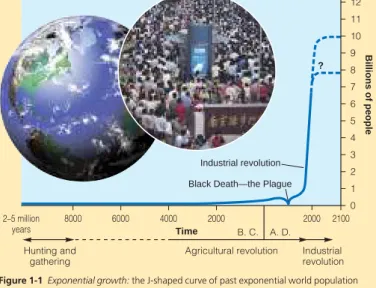
If you could continue to double the thickness of the paper 42 times, the stack would reach from the earth to the moon - 386,400 kilometers (240,000 miles) away. This can destroy some areas for agriculture, shift water supplies, eliminate many of Earth's unique forms of life, and disrupt economies in various parts of the world.
Environmental Science Is a Study of Connections in Nature
AND 1-1B 7things. It integrates information and ideas from the
The goals of environmental science are to learn how nature works, how the environment affects us, how we affect the environment, and how we can deal with environmental problems and live more sustainably. An important subfield of environmental science is ecology, the biological science that studies how organisms, or living things, interact with their environment and with each other.
Major Fields of Study Related to Environmental Science
8 CHAPTER 1 Environmental Problems, Their Causes and Sustainability organisms that interact with each other and with their. We should not confuse environmental science and ecology with environmentalism, a social movement dedicated to protecting the earth's life-support systems for us and all other forms of life.
Sustainability Is the Central Theme of This Book
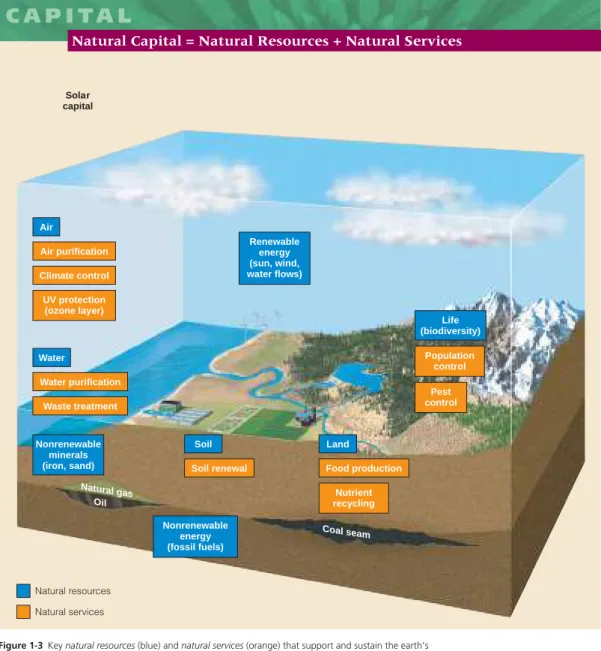
AND 1-1B 9A critical component of sustainability is natural
Another component of sustainability – and another sub-theme of this text – is the recognition that many human activities can degrade natural capital by using normally renewable resources faster than nature can replenish them. For example, in some parts of the world we are cutting down mature forests much faster than nature can regenerate them.
Environmentally Sustainable Societies Protect Natural Capital
In its summary statement, the report warned that "human activity is putting such pressure on the Earth's natural functions that the ability of the planet's ecosystems to sustain future generations can no longer be taken for granted." The good news is that the report suggests we have the knowledge and tools to conserve the planet's natural capital, and it describes common sense strategies for doing so. The same lesson applies to our use of the earth's natural capital—the global trust fund that nature provides for us.
There Is a Wide Economic Gap between Rich and Poor Countries
11Europe. Most are highly industrialized and have a high
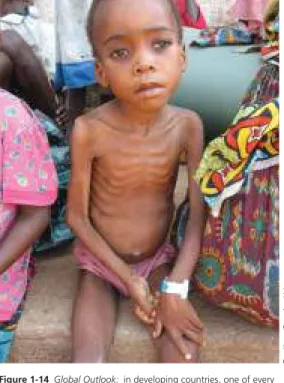
About 97% of the projected growth in the world's population between 2008 and 2050 is expected to occur in developing countries, which are least equipped to cope with such large population growth. Despite a 40-fold increase in economic growth since 1900, more than half of the world's people live in extreme poverty and struggle to survive on less than $2 a day.
Some Resources Are Renewable
We Can Overexploit Commonly Shared Renewable Resources
The Tragedy of the Commons
Degradation of Normally Renewable Natural Resources
Some Resources Are Not Renewable
Recycling non-renewable metal resources requires much less energy, water and other resources and causes much less pollution and environmental degradation than exploiting pristine metal resources. Reusing such resources uses even less energy and other resources and causes less pollution and environmental degradation than recycling.
Our Ecological Footprints Are Growing
15living in today’s developing nations will reach 1.2 bil-
In 2003, humanity's total or global ecological footprint was about 25% higher than Earth's ecological capacity (below) and is predicted to double the planet's ecological capacity by 2050. 16 CHAPTER 1 Environmental Problems, Their Causes and Sustainability For more details on the growing ecological footprint.
Cultural Changes Have Increased Our Ecological Footprints
Pollution Comes from a Number of Sources
AND 1-5B 17create nuisances such as noise and unpleasant smells,
We Can Clean Up Pollution or Prevent It
Experts Have Identified Five Basic Causes of Environmental Problems
Poverty Has Harmful
Environmental and Health Effects
Causes of Environmental Problems
AND 1-5B 19Thegreat news is that we have the means to solve the
Affluence Has Harmful and Beneficial Environmental Effects
Prices Do Not Include the Value of Natural Capital
20 CHAPTER 1 Environmental problems, their causes and sustainability Consequently, the prices of goods and services do not. This helps create jobs and stimulate the economy, but it can also lead to the degradation of natural capital, again because the value of natural capital is not included in the market prices of goods and services.
People Have Different Views about Environmental Problems
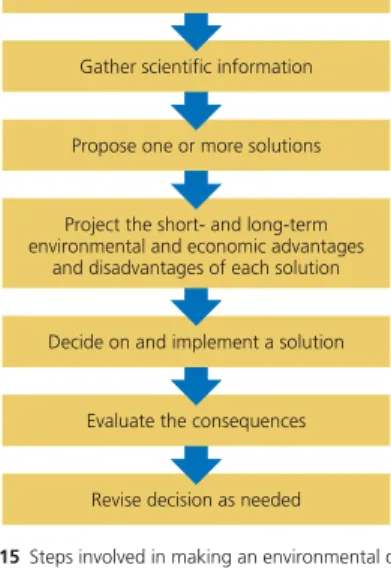
We Can Learn to Make Informed Environmental Decisions
We Can Work Together to Solve Environmental Problems
Another project involves renovating much of the city's low-income housing and building new low-income rental units. The city developed a riverfront park along both banks of the Tennessee River that runs through downtown.
Individuals Matter
The city encouraged zero-emission industries to set up there and replaced its diesel buses with a fleet of quiet, zero-emission electric buses, made by a new local firm. Since 1989, levels of the seven major air pollutants in Chattanooga have been below those required by federal standards.
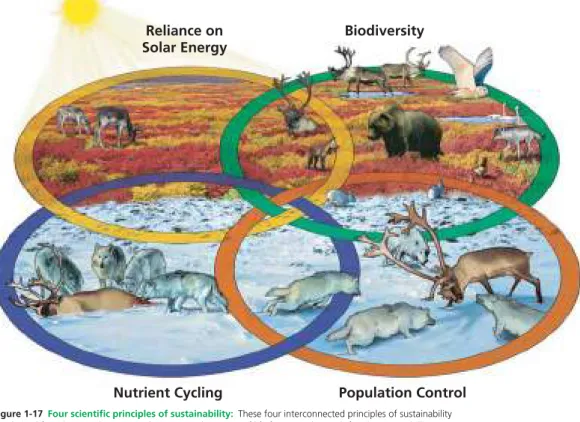
Studying Nature Reveals Four Scientific Principles
Reliance on Solar Energy
Biodiversity
Nutrient Cycling Population Control
- What is the difference between economic growth and economic development? Distinguish among gross
- What is a resource? What is conservation? Distinguish among a renewable resource, nonrenewable re-
- What is culture? Describe three major cultural changes that have occurred since humans arrived on the earth
- Identify five basic causes of the environmental problems that we face today. What is poverty? In what ways do
- What is an environmental worldview? What is envi- ronmental ethics? Distinguish among the planetary
- Discuss the lessons we can learn from the environmental transformation of Chattanooga, Tennessee (USA). Explain
- What are four scientific principles of sustainability ? Explain how exponential growth ( Core
- List three ways in which you could apply Concepts 1-5A and 1-6 to making your lifestyle more environmentally
- Describe two environmentally beneficial forms of expo- nential growth ( Core Case Study )
- Explain why you agree or disagree with the fol- lowing propositions
- Suppose the world’s population stopped growing today
- When you read that at least 19,200 people die prema- turely each day (13 per minute) from preventable mal-
- What do you think when you read that (a) the aver- age American consumes 30 times more resources than
- For each of the following actions, state one or more of the four scientific principles of sustaina-
- Explain why you agree or disagree with each of the fol- lowing statements: (a) humans are superior to other
- List two questions that you would like to have answered as a result of reading this chapter
- Which two countries have the largest ecological deficits?
- Which two countries have an ecological credit?
- Rank the countries in order from the largest to the small- est per capita footprint
Explain why you agree or disagree with each of the following statements: (a) humans are superior to other statements: (a) humans are superior to other life forms, (b) humans are in charge of the earth, (c) all economic growth is good, (d) the value of other life forms depends only on whether they are useful to us, (e) because all life forms eventually become extinct, we should not worry about whether our activities are cause premature growth. extinction, (f) all life forms have a. With no plants to help absorb and retain water, the amount of water flowing from the deforested valley increased by 30-40%.

Science Is a Search for Order in Nature
To test their prediction, Bormann and Likens repeated their controlled experiment and measured the phosphorus content of the soil. These predictions can be compared to the actual measured losses to test the validity of the models.
Scientific Theories and Laws Are the Most Important Results
Scientists Use Reasoning, Imagination, and Creativity
Each of the 13 videos describes how scientists working on two different problems related to a specific topic learn about how nature works. Also watch video 2, Thinking Like Scientists, in another Annenberg series, Teaching High School Science (see the website at www.learner.org/resources/series126.html).
The Results of Science Can Be Tentative, Reliable, or Unreliable
But unless that happens, those views are considered the results of reliable science. Otherwise, the results may represent preliminary science that needs further testing and evaluation, or they may be classified as unreliable science.
Environmental Science Has Some Limitations
34 CHAPTER 2 Science, Matter, Energy and Systems self-corrective testing process, open peer review, reproducibility and debate. Scientific hypotheses and results that are presented as reliable without being subjected to the rigors of peer review, or that have been disproved as a result of peer review, are considered unreliable science.
Matter Consists of Elements and Compounds
C O N C E P T 2 - 2 Matter consists of elements and compounds, which in turn are made up of atoms, ions or molecules.
Atoms, Ions, and Molecules Are the Building Blocks
An atom that loses one or more of its electrons becomes an ion with one or more positive electrical charges because the number of positively charged protons in its nucleus is now greater than the number of negatively charged electrons outside the nucleus. his. Similarly, when an atom gains one or more electrons, it becomes an ion with one or more negative electrical charges because the number of negatively charged electrons is greater than the number of positively charged protons in its nucleus .
Elements Important to the Study of Environmental Science
37One example of the importance of ions in our study
Ions Important to the Study of Environmental Science
Compounds Important to the Study of Environmental Science
Organic Compounds Are the Chemicals of Life
Matter Comes to Life through Genes, Chromosomes, and Cells
Matter Occurs in Various Physical Forms
Some Forms of Matter Are More Useful than Others
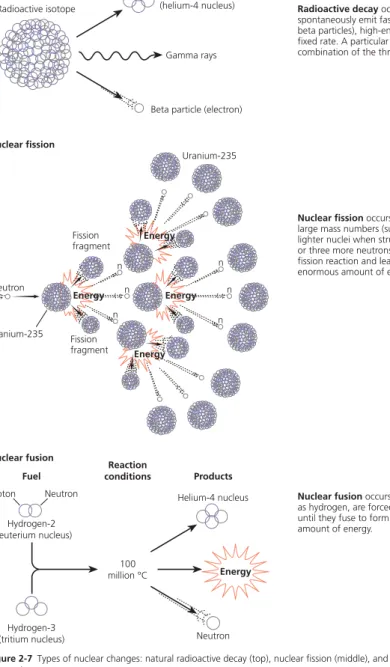
Matter Undergoes Physical, Chemical, and Nuclear Changes
In addition to physical and chemical changes, matter can undergo three types of nuclear changes, or changes in the nuclei of its atoms (Figure 2-7). Fusion of hydrogen nuclei to form helium nuclei is the source of energy in the sun and other stars.
We Cannot Create or Destroy Matter
40 CHAPTER 2 Science, matter, energy and systems In a chemical change or chemical reaction, there is a change in the arrangement of atoms or ions within the molecules of the substances involved.
Energy Comes in Many Forms
AND 2-4B 41ing mass of air), flowing water, and electricity (flowing
Examples of potential energy include a rock you hold in your hand, an unlit match, the chemical energy stored in gasoline molecules, and the nuclear energy stored in the nuclei of atoms. When a car engine burns gasoline, the potential energy stored in the chemical bonds of gasoline molecules turns into mechanical (kinetic) energy, which powers the car, and heat.
Some Types of Energy Are More Useful Than Others
In electromagnetic radiation, another form of kinetic energy, energy travels in wave form as a result of changes in electric and magnetic fields. Hold this book and it has potential energy; he lands on his foot and his potential energy is converted to kinetic energy.
Energy Changes Are Governed by Two Scientific Laws
AND 2-4B 43there will always be enough energy. Yet if you fill a
During each conversion, high-quality energy is degraded and released into the environment as low-quality heat. Whenever energy is changed from one form to another, some of the initial high-quality energy input is degraded, usually into low-quality heat that is dissipated into the environment.
Systems Have Inputs, Flows, and Outputs
Systems Respond to Change through Feedback Loops
AND 2-5B 45or information is fed back into the system as an input
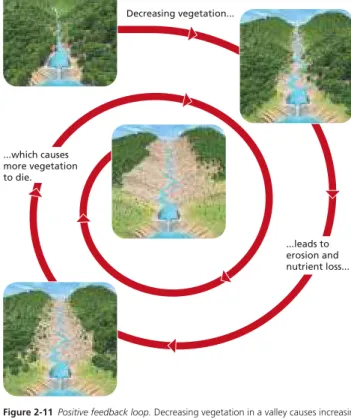
In the Hubbard Brook experiments, for example (Core Case Study), researchers found that when vegetation was removed from a stream valley, runoff water caused erosion and nutrient loss, which caused more vegetation to die. A negative or corrective feedback loop causes a system to change in the opposite direction from which it is moving.
Time Delays Can Allow a System to Reach a Tipping Point
An important case of a negative feedback loop is the reuse and recycling of some resources such as aluminum, copper and glass. Such a negative feedback loop can therefore promote sustainability and reduce the environmental impact of human activities by reducing the use of matter and energy resources and the amount of pollution and solid waste produced by the use of such material.
System Effects Can Be Amplified through Synergy
Hubbard Brook and Feedback Loops How could researchers have used a negative feedback loop to stop or correct the positive feedback loop that resulted in increasing erosion and nutrient losses in the Hubbard Brook experimental forest? When that output becomes an input, because the can is recycled and used in place of raw aluminum to make a new product, much less aluminum is extracted and the environmental impact of the mining production system is reduced.
Human Activities Can Have Unintended Harmful Results
Without these laws, economic growth based on the use of matter and energy resources to produce goods and services (Figure 2.10) could be permanently expanded and cause even more serious environmental problems. But these scientific laws place limits on what we can do with matter and energy sources.
A Look Ahead
- Distinguish between inductive reasoning and deduc- tive reasoning and give an example of each. Explain
- What is a paradigm shift? Distinguish among tenta- tive science (frontier science), reliable science, and
- What is a chemical formula? Distinguish between organic compounds and inorganic compounds and
- Distinguish between a physical change and a chemi- cal change (chemical reaction) and give an example
- What is energy? Distinguish between kinetic energy and potential energy and give an example of each
- What is the law of conservation of energy (first law of thermodynamics) and why is it important? What
- Define and give an example of a system? Distinguish among the input, flow (throughput), and output of a
- Explain how human activities can have unintended harmful environmental results. Relate the four
- What ecological lesson can we learn from the controlled experiment on the clearing of forests described in the
- Think of an area you have seen where some sig- nificant change has occurred to a natural system. What is
- Describe a way in which you have applied the
- Respond to the following statements
- A tree grows and increases its mass. Explain why this phe- nomenon is not a violation of the law of conservation of
- If there is no “away” where organisms can get rid of their wastes, why is the world not filled with waste matter?
- Someone wants you to invest money in an automobile engine, claiming that it will produce more energy than
- Use the second law of thermodynamics to explain why a barrel of oil can be used only once as a fuel, or in other
- Which years confirm their hypothesis?
- Which years do not support their hypothesis?
- If the crab population reaches 100% of the goal figure, what would you predict the striped bass goal figure
What is the law of conservation of energy (first law of thermodynamics) and why is it important? What about thermodynamics) and why it is important. Explain why this phenomenon is not a violation of the law of conservation of nomen is not a violation of the law of conservation of matter.

Cells Are the Basic Units of Life
Species Make Up the Encyclopedia of Life
These and millions of species yet to be classified are the entries in the encyclopedia of life on Earth. Up to half of the world's plant and animal species live in tropical rainforests that are rapidly being cleared (core case study).
Ecologists Study Connections in Nature
53In most natural populations, individuals vary slightly
Many of the organisms in a community interact with each other in feeding and other relationships. In fact, it is the global ecosystem in which all organisms exist and can interact with each other.
The Earth’s Life-Support System Has Four Major Components
55Atmosphere
The geosphere consists of the earth's very hot core, a thick mantle composed mostly of rock, and a thin outer crust. The biosphere comprises those parts of the atmosphere, hydrosphere and geosphere where life exists.
Life Exists on Land and in Water
This thin layer of land extends from about 9 kilometers (6 miles) above the Earth's surface to the bottom of the ocean and includes the lower atmosphere, most of the hydrosphere, and the uppermost part of the geosphere. Scientists divide the aquatic parts of the biosphere into zones of aquatic life, each of which contains numerous ecosystems.
Three Factors Sustain Life on Earth
What Happens to Solar Energy Reaching the Earth?
AND 3-3B 57would be too cold to support the forms of life we find
This, in turn, is changing Earth's climate as we discuss in detail in Chapter 19. Learn more about the flow of energy—from sun to Earth and within Earth's systems—at CengageNOW.
Ecosystems Have Living and Nonliving Components
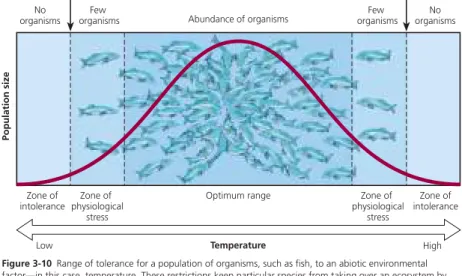
There is substantial and growing evidence that these activities increase the natural greenhouse effect and heat the Earth's atmosphere (Science Focus, p. 33). Question: Which scientific principle of sustainability (see back cover) relates to the concept of tolerance.
Several Abiotic Factors Can Limit Population Growth
Of course, if the water gets too hot or too cold, none of the trout can survive.
Producers and Consumers Are the Living Components of Ecosystems
AND 3-3B 59take place during photosynthesis, the overall reaction
Omnivorous animals such as pigs, foxes, cockroaches and humans play dual roles by feeding on both plants and animals. Instead of carbon dioxide and water, the end products of this process are compounds such as methane gas (CH4, the main component of natural gas), ethyl alcohol (C2H6O), acetic acid (C2H4O2, the key component of vinegar), and hydrogen sulfide (H2S, when sulfur compounds break down).
Energy Flow and Nutrient Cycling Sustain Ecosystems and
AND 3-4B 61
Energy Flows through Ecosystems in Food Chains and Food Webs
Every use and transfer of energy by organisms entails a loss of some of the usable energy in the form of heat to the environment. Food chains and networks show how producers, consumers, and decomposers are connected as energy flows through trophic levels in an ecosystem.
Usable Energy Decreases
So, eventually an ecosystem and the biosphere would run out of energy if they were not powered by a constant influx of energy from an outside source, ultimately the sun. Energy flow and tropical rainforests What happens to the flow of energy through tropical rainforest ecosystems when such forests are degraded (Key case study).
AND 3-4B 63Figure 3-14 Greatly simplified food web
The large loss of chemical energy between successive trophic levels also explains why food chains and webs rarely have more than four or five trophic levels. In most cases, too little chemical energy remains after four or five transfers to support organisms feeding at these high trophic levels.
Some Ecosystems Produce Plant Matter Faster Than Others Do
Use Figure 3-15 to explain (a) why there are not many tigers in the world and why they are at risk of premature extinction due to human activities, and (b) why there are so many insects (Science Focus, p. 54). ) in the world. Study how energy flows between organisms at different trophic levels and through food webs in tropical rainforests, prairies, and other ecosystems on CengageNOW.
Nutrients Cycle in the Biosphere
Water Cycles through the Biosphere
Second, we clear vegetation from land for agriculture, mining, road construction and other activities and cover much of the land with buildings, concrete and asphalt. Active Figure 3-17 Natural capital: simplified model of the hydrological cycle with major adverse impacts of human activities shown in red.
Carbon Cycles through the Biosphere and Depends
Since 1800, and especially since 1950, we have interfered with the earth's carbon cycle by adding carbon dioxide to the atmosphere in two ways (shown by red arrows in Figure 3-18). Computer models of Earth's climate systems show that increased concentrations of atmospheric CO2.
Nitrogen Cycles through the Biosphere: Bacteria in Action
69combine gaseous N2 with hydrogen to make ammo-
We interfere with the nitrogen cycle in several ways (as shown by the red arrows in Figure 3-19). Question: What are three ways you directly or indirectly affect the nitrogen cycle?
Phosphorus Cycles through the Biosphere
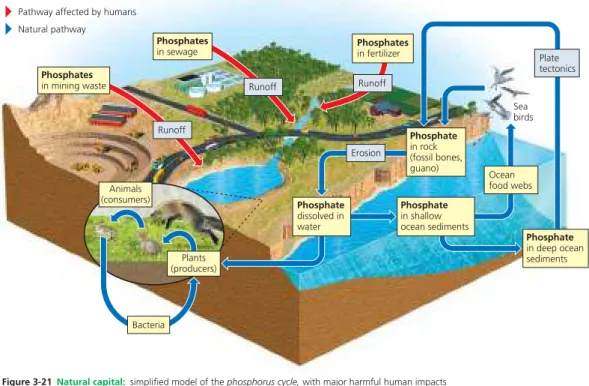
According to the 2005 Millennium Ecosystem Assessment, human activities since 1950 have more than doubled the annual release of nitrogen from the land into the rest of the environment. This excessive input of nitrogen into the air and water contributes to pollution, acid deposition and other problems that will be discussed in later chapters.
Sulfur Cycles through the Biosphere
71by anaerobic decomposers in flooded swamps, bogs,
Human activities have affected the sulfur cycle primarily by releasing large amounts of sulfur dioxide (SO2) into the atmosphere (as shown by red arrows in Figure 3-22). Question: What are three ways your lifestyle directly or indirectly affects the sulfur cycle.
Some Scientists Study Nature Directly
73In a GIS, geographic and ecological data can be stored
Such compilations of information can lead to a better understanding of environmental problems and to better decision-making about how to deal with such problems.
Some Scientists Study Ecosystems in the Laboratory
Some Scientists Use Models to Simulate Ecosystems
In 2005, scientists launched the Global Earth Observation System of Systems (GEOSS) - a 10-year program to integrate data from sensors, gauges, buoys and satellites that monitor the Earth's surface, atmosphere and oceans.
We Need to Learn More about the Health of the World’s Ecosystems
- Review the Key Questions and Concepts for this chapter on p. 5 What are three harmful effects resulting from
- What is a cell? What is the cell theory? Distinguish between a eukaryotic cell and a prokaryotic cell
- Distinguish among the atmosphere, troposphere, stratosphere, greenhouse gases, hydrosphere, and
- List three ways in which you could apply Concept 3-4B and Concept 3-5 to making your lifestyle more environ-
- How would you explain the importance of tropical rain forests ( Core Case Study ) to people who think that
- Explain why (a) the flow of energy through the bio- sphere ( Concept 3-2 ) depends on the cycling of nutri-
- Explain why microbes are so important. List two benefi- cial and two harmful effects of microbes on your health
- Make a list of the food you ate for lunch or dinner today
- Why do farmers not need to apply carbon to grow their crops but often need to add fertilizer containing nitrogen
- What changes might take place in the hydrologic cycle if the earth’s climate becomes (a) hotter or (b) cooler?
- What would happen to an ecosystem if (a) all its decom- posers and detritus feeders were eliminated, (b) all its
- Describe what happens to solar energy as it flows to and from the earth. What is the natural greenhouse effect
- Distinguish between the abiotic and biotic components in ecosystems and give two examples of each. What is the
- What is a trophic level? Distinguish among producers (autotrophs), consumers (heterotrophs), and de-
- Distinguish among photosynthesis, chemosynthesis, aerobic respiration, and anaerobic respiration (fer-
- Explain what happens to energy as it flows through the food chains and food webs of an ecosystem. Distinguish
- What happens to matter in an ecosystem? What is a biogeochemical cycle (nutrient cycle)? Describe the
- Describe three ways in which scientists study ecosys- tems. Explain why we need much more basic data
- Calculate the per capita carbon footprint for each country and the world and complete the table
- It has been suggested that a sustainable average world- wide carbon footprint per person should be no more than
- By what percentage will China, Japan, Russia, the United States, and the world each have to reduce their carbon
Explain why we need much more basic data on the structure and condition of the world's ecosystems. For biologists, the comeback of the American alligator is an important wildlife conservation success story.

Biodiversity Is a Crucial Part of the Earth’s Natural Capital
Key Questions and Concepts
79Species diversity is the most obvious, but not the only,
Ecosystem Diversity - The diversity of the Earth's deserts, grasslands, forests, mountains, oceans, lakes, rivers, and wetlands is another important component of biodiversity. Earth's biodiversity is an important part of the natural capital that keeps us alive.
Biological Evolution by Natural Selection Explains How Life
AND 4-2B 81
The Fossil Record Tells Much of the Story of Evolution
The Genetic Makeup of a Population Can Change
This genetic diversity occurs through mutations: random changes in the structure or number of DNA molecules in a cell that can be inherited by offspring (Figure 11, p. S43, in Appendix 6). Most mutations are the result of random changes that occur in the encoded genetic instructions when DNA molecules are copied each time a cell divides and whenever an organism reproduces.
Individuals in Populations with Beneficial Genetic Traits
AND 4-2B 83Note that natural selection acts on individuals, but
We have developed certain traits that have allowed us to take over much of the world (see Case Study below). Like many other species, humans have survived and thrive because we have certain traits that allow us to adapt to and modify parts of the environment to increase our chances of survival.
Adaptation through Natural Selection Has Limits
Evolutionary biologists attribute our success to three adaptations: strong opposable thumbs that allow us to grasp and use tools better than some other animals that have thumbs, the ability to walk upright, and a complex brain. An important adaptation of humans is the strong opposable fingers, which allow us to grasp and manipulate things with our hands.
Three Common Myths about
Populations of genetically diverse species that reproduce quickly—such as weeds, mosquitoes, rats, bacteria, or cockroaches—. In contrast, species that cannot rapidly produce large numbers of offspring—such as elephants, tigers, sharks, and humans—take a long time (typically thousands or even millions of years) to adapt through natural selection.
Evolution through Natural Selection
Second, even if a beneficial heritable trait is present in a population, the population's ability to adapt may be limited by its ability to reproduce. In contrast, species that cannot produce large numbers of offspring quickly—such as elephants, tigers, sharks, and humans—take a long time (usually thousands or even millions of years) to adapt.
Geological Processes Affect Natural Selection
Climate Change and Catastrophes Affect Natural Selection
85These long-term climate changes have a major ef-
Rocks and fossil evidence show that 200-250 million years ago, all of today's Earth's continents were locked together in a supercontinent called Pangea (top left). About 180 million years ago, Pangea began to break apart as the Earth's tectonic plates separated, eventually resulting in the present-day locations of the continents (below right).
How Do New Species Evolve?
AND 4-4B 87of years—making it difficult to observe and document
Learn about different types of speciation and ways they occur at CengageNOW. Species and American alligators Imagine how a population of American alligators (core case study) could have evolved in two.
Extinction Is Forever
Extinction Can Affect One Species or Many Species at a Time
89Some biologists argue that a mass extinction should
However, there is considerable evidence that a large number of species have gone extinct several times in the past. The existence of millions of species today means that speciation is, on average, before extinction.
Species Diversity Includes the Variety and Abundance of Species
C O N K E P T 4 - 5 Species diversity is a major component of biodiversity and tends to increase the sustainability of ecosystems. For most terrestrial plants and animals, species diversity (mainly species richness) is highest in the tropics and declines as we move from the equator to the poles (see Figure 2, pp. S22-S23, in Appendix 4).
Species-Rich Ecosystems Tend to Be Productive
AND 4-6B 91
Each Species Plays a Unique Role in Its Ecosystem
They may live in only one type of habitat, use one or a few types of food, or tolerate a narrow range of climatic and other environmental conditions. When environmental conditions are fairly constant, such as in a tropical rainforest, specialists have an advantage because they have fewer competitors.
Niches Can Be Occupied by Native and Nonnative Species
AND 4-6B 93Some people tend to think of nonnative species
However, some non-native species can threaten a community's native species and cause unintended and unexpected consequences. The wild African bees are not the fearsome killers depicted in some horror movies, but they are aggressive and unpredictable.
Indicator Species Serve as Biological Smoke Alarms
AND 4-6B 95
Climate change due to global warming has also been identified as the main cause of extinction of the golden toad in Costa Rica (Figure 4-9). The rapidly increasing global extinction of various amphibian species is a warning of harm.
Keystone and Foundation Species Help Determine the
- What are the four major components of biodiversity (biological diversity)? What is the importance of
- What is biological evolution? What is natural selec- tion? What is a fossil and why are fossils important in
- What are two limits to evolution by natural selection?
- Describe how geologic processes and climate change can affect natural selection. Describe conditions on
- What is speciation? Distinguish between geographic isolation and reproductive isolation and explain
Their possible disappearance suggests that environmental health is deteriorating in some parts of the world. Maintaining this part of the earth's biodiversity starts with the knowledge that sharks may not need us, but that we and other species do.
REVISITING
- List three ways in which you could apply Concept 4-4B in order to live a more environmentally sustainable
- Explain what could happen to the ecosystem where American alligators ( Core Case Study ) live
- What role does each of the following processes play in helping implement the four scientific prin-
- Describe the major differences between the ecological niches of humans and cockroaches. Are these two spe-
- How would you experimentally determine whether an organism is a keystone species?
- How would you respond to someone who tells you
- How would you respond to someone who says that be- cause extinction is a natural process, we should not worry
- Congratulations! You are in charge of the future evolution of life on the earth. What are the three most important
- What is species diversity? Distinguish between species richness and species evenness and give an
- What is an ecological niche? Distinguish between spe- cialist species and generalist species and give an ex-
- Distinguish among native, nonnative, indicator, keystone, and foundation species and give an example
- Explain how the role of the American alligator in its ecosystem ( Core Case Study ) illustrates
- What is the average number for each of the nine columns of data—unprovoked shark attacks, deaths, and non-fatal
- What percentage of the world’s average annual unpro- voked shark attacks between 1998 and 2007 occurred in
- What percentage of the average annual unprovoked shark attacks in the United States between 1998 and 2007 oc-
What percentage of the average annual unprovoked shark attacks in the united states between 1998 and 2007 oc- attacks in the united states between 1998 and 2007 occurred in florida. Biodiversity, an important part of the earth's natural capital, is the focus of one of the four scientific principles.

Species Interact in Five Major Ways
Most Species Compete with One Another for Certain Resources
When there is intense competition between two species for the same resources, both species suffer harm due to reduced access to important resources. As our ecological footprint grows and spreads (Figure 1-10, p. 15) and we take over more of the Earth's land, aquatic resources and net primary productivity (Figure 3-16, p. 64) uses are taking over the habitats of many other species and robbing them of the resources they need to survive.
Most Consumer Species Feed on Live Organisms of Other Species
Other prey species achieve some protection by living in large groups, such as e.g. schools of fish and herds of antelope. At the individual level, members of predator species benefit and members of prey species are harmed.
Predator and Prey Species Can Drive Each Other’s Evolution
105race, each step in this process takes hundreds to thou-
Some Species Feed off Other Species by Living on or in Them
In Some Interactions, Both Species Benefit
In Some Interactions, One Species Benefits and the Other Is Not
P O S M E T 5 - 2 Some species develop adaptations that allow them to reduce or avoid competition with other species for resources.
Some Species Evolve Ways to Share Resources
Populations Have Certain Characteristics
Most Populations Live Together in Clumps or Patches
109Clumped (elephants)
Question: Why do you think the creosote bushes are uniformly spaced while the dandelions are not. Why do you think living in packs would help some predators find and kill their prey.
Populations Can Grow, Shrink, or Remain Stable
The most common pattern is clusters of population members scattered throughout their habitat, mostly because resources tend to be found in patches. Because of their sparse distribution, desert creosote bushes (Figure 5-10b) have better access to scarce water resources.
No Population Can Grow
Indefinitely: J-Curves and S-Curves
The population size of southern sea otters has fluctuated in response to changes in environmental conditions. Name two species whose populations are likely to decline if the population of southern sea otters in kelp beds declines significantly.

When a Population Exceeds Its Habitat’s Carrying Capacity,
Over time, the population size stabilizes at or near the carrying capacity (K) of its environment, resulting in a sigmoidal (S-shaped) population growth curve. For example, the decline in southern sea otter populations has led to declines in the populations of species that depend on them, including giant kelp.
Species Have Different Reproductive Patterns
Humanity's ecological footprint is approximately 25% larger than the Earth's ecological capacity (Figure 1-10, bottom, p. 15) and is growing rapidly.
Genetic Diversity Can Affect the Size of Small Populations
Under Some Circumstances Population Density Affects
Several Different Types of Population Change Occur
Humans Are Not Exempt from Nature’s Population Controls
115States than do any other wild animals. Each year, these
Such deterrents may protect one area, but cause the deer to forage in someone else's yard or garden. Suburban dwellers may consider not planting their yards with plants that deer like to eat.
Communities and Ecosystems Change over Time: Ecological
Some blame white-tailed deer for invading suburban farms and yards to eat food that humans have made readily available to them. Others say humans are most to blame, because they have invaded the deer's territory, eliminated most of the predators that kept their populations in check, and provided the deer with plenty of food in their lawns and gardens.
Some Ecosystems Start from Scratch: Primary Succession
117burned or cut forests, heavily polluted streams, and
In the soil left behind on disturbed land systems, new vegetation can germinate, usually within a few weeks, from seeds already in the soil and from those introduced by wind, birds and other animals. In the absence of new disturbances, secondary succession will repeat over time, but not necessarily in the same order shown here.
Some Ecosystems Do Not Have to Start from Scratch: Secondary
It took 150–200 years after the farmland was abandoned for the area to become covered with a mature oak and hickory forest. A new disturbance, such as deforestation or fire, would create conditions that favored pioneer species such as annual weeds.
Succession Doesn’t Follow a Predictable Path
Such interactions, in turn, increase sustainability by promoting population control and increasing the complexity of the food web for the energy flow and nutrient cycling that constitute the functional component of biodiversity (Figure 4-2, p. 79).
Living Systems Are Sustained through Constant Change
- Review the Key Questions and Concepts for this chapter on p. 10 Explain how southern sea otters act as a key-
- Define interspecific competition, predation, parasit- ism, mutalism, and commensalism and give an exam-
- Define and give an example of coevolution
- Describe and give an example of resource partitioning and explain how it can increase species diversity
- What is population dynamics? Why do most popula- tions live in clumps?
- Describe four variables that govern changes in popula- tion size and write an equation showing how they in-
- Describe the exploding white-tailed deer population prob- lem in the United States and discuss options for dealing
- What is ecological succession? Distinguish between primary ecological succession and secondary eco-
- Explain how the role of the southern sea otter in its ecosystem ( Core Case Study )
- What difference would it make if the southern sea otter ( Core Case Study ) became prematurely extinct be-
- Use the second law of thermodynamics (p. 43) to explain why predators are generally less abundant than their
- Explain why most species with a high capacity for population growth (high biotic potential) tend to have
- List three factors that have limited human population growth in the past that we have overcome. Describe how
- Why are pest species likely to be extreme examples of r-selected species? Why are many endangered species
- Given current environmental conditions, if you had a choice, would you rather be an r-strategist or a
- How would you reply to someone who argues that we should not worry about our effects on natural systems be-
- What was the approximate carrying capacity of the penguin population on the island from 1960 to 1975?
- What is the percentage decline in the penguin population from 1975 to 1999?
Explain how the role of the southern sea otter in its ecosystem (Core Case Study) and the role of the southern sea otter in its ecosystem (Core Case Study) illustrates the principle of sustainability of population control. Name three factors that have limited human population growth in the past that we have overcome.
Human Population Growth Continues but It Is Unevenly
How Long Can the Human Population Keep Growing?
Altering Nature to Meet Our Needs
AND 6-2B 125
The prospects for stabilizing the human population in the near future are zero. Instead, they say, we should ask what the optimal sustainable population of the earth might be, based on the cultural carrying capacity of the planet.
The Human Population Can Grow, Decline, or Remain Fairly Stable
The population of the country where you live must be stabilized as quickly as possible. The United States had the third largest population in the world with 304 million inhabitants in 2008, but only 4.5% of the world's population.
Women Are Having Fewer Babies but Not Few Enough to Stabilize
AND 6-2B 127first 100 million people, 52 years to add another 100
The decline in TFR has slowed population growth in the United States. In 1907, the three leading causes of death in the United States were pneumonia, tuberculosis, and diarrhea; 90% of the US
Several Factors Affect Birth Rates and Fertility Rates
Several Factors Affect Death Rates
AND 6-2B 129tion, better nutrition, medical advances such as immu-
Even though more is spent on health care per person in the United States than in any other country, people in 41 other countries, including Canada, Japan, Singapore and a number of European countries, have longer life expectancies than Americans. Child mortality is considered one of the best measures of a society's quality of life because it reflects a country's general level of nutrition and health care.
Migration Affects an Area’s Population Size
Still, about 40 countries, including Taiwan, Cuba and most of Europe, had lower infant mortality rates than the United States in 2008. Some analysts would accept new entrants only if they can support themselves, arguing that they give legal immigrants public access. services make the US a magnet for the world's poor.
Populations Made Up Mostly of Young People Can Grow Rapidly
131years. In developing countries, the percentage is even
These differences in population age structure between developed and developing countries are dramatic, as Figure 6-9 shows. This figure also shows why almost all the future growth of the human population will be in developing countries.
We Can Use Age-Structure Information to Make Population
Retired baby boomers can use their political influence to get the smaller number of people in the baby-bust generation who followed them to pay higher income, health and Social Security taxes. However, the rapidly increasing number of immigrants and their descendants may dilute their political power.
Populations Made Up Mostly of Older People Can Decline Rapidly
According to some analysts, the retirement of baby boomers is likely to create a shortage of workers in the United States, unless immigrant workers or various forms of automation replace some of them. Their power may also be weakened by the growth of members of the echo baby boom generation (Figure 6-5).
Populations Can Decline from a Rising Death Rate
The AIDS Tragedy
133structure. According to the World Health Organiza-
As Countries Develop, Their Populations Tend to Grow
Some Problems with Rapid Population Decline
Planning for Babies Works
135One of the conference’s goals was to encourage action
Empowering Women Can Slow Population Growth
- What is the cultural carrying capacity of a population?
- List four variables that affect the population change of an area and write an equation showing how they are re-
- Describe population growth in the United States and explain why it is high compared to those of most other
- List ten factors that can affect the birth rate and fertility rate of a country. Distinguish between life expectancy
- What is the demographic transition and what are its four stages? What factors could hinder some developing
- How has human population growth ( Core Case Study ) interfered with natural processes related
- List three ways in which you could apply some of what you learned in this chapter to making your lifestyle more
- Which of the three major environmental worldviews summarized on p. 20 do you believe underlie the two
- Identify a major local, national, or global envi- ronmental problem, and describe the role of population
- Is it rational for a poor couple in a developing country such as India to have four or five children? Explain
- Do you believe that the population is too high in (a) the world ( Core Case Study ), (b) your own
- Some people have proposed that the earth could solve its population problem by shipping people off to space
- Some people believe our most important goal should be to sharply reduce the rate of population growth in de-
- Congratulations! You are in charge of the world. List the three most important features of your population policy
- Calculate the rates of natural increase for the populations of Country A and Country B. From the rates of natural
- Describe where each of the two countries may be in terms of their stage in the demographic transition (Figure 6-12,
- Explain how the percentage of people under 15 years of age in Country A and in Country B could affect the per
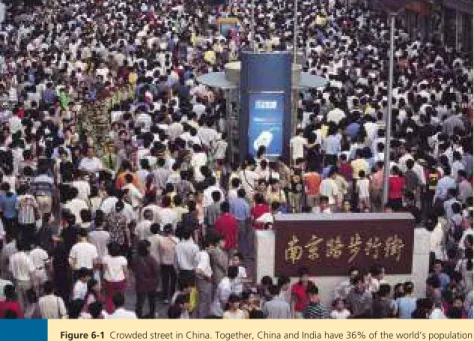
China's economy is growing at one of the world's fastest rates as the country undergoes rapid industrialization. Name three factors that account for the rapid growth of the world's human population over the past 200 years.
The Earth Has Many Different Climates
143and help distribute air, heat, moisture, and
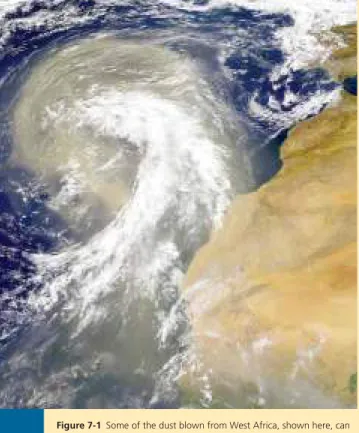
Heat is also distributed to the different parts of the ocean and the world when seawater mixes vertically in shallow and deep ocean currents, mostly due to differences in the density of seawater. The ocean and the atmosphere are strongly linked in two ways: ocean currents are affected by winds in the atmosphere (core case study), and heat from the ocean affects atmospheric circulation (Figure 7-4).
Greenhouse Gases Warm the Lower Atmosphere
These cells lead to an irregular distribution of climates and deserts, grasslands, and forests, as shown in Figure 7-6 (Concept 7-1). How might the distribution of the world's forests, grasslands, and deserts shown in Figure 7-6 differ if the prevailing winds shown in Figure 7-3 did not exist?
The Earth’s Surface Features Affect Local Climates
145As the drier air mass passes over the mountaintops
On the steep side of the range, the air descends, warms and releases some moisture. This leads to semi-arid and arid conditions on the steep side of the mountain range and the land beyond.
Climate Affects Where Organisms Can Live
147Figure 7-9 Generalized effects of elevation (left) and latitude (right) on climate and biomes. Parallel changes
There Are Three Major Types of Deserts
149Figure 7-11 Climate graphs showing typical variations in annual temperature (red) and precipitation (blue) in tropi-
Question: Which month of the year has the highest temperature and lowest rainfall for each of the three types of deserts.
There Are Three Major Types of Grasslands
151Figure 7-12 Climate graphs showing typical variations in annual temperature (red) and precipitation (blue) in tropi-
Question: Which month of the year has the highest temperature and least precipitation for each of the three types of grassland. Due to the short growing season, the tundra's soil and vegetation recover very slowly from damage or disturbance.
Temperate Shrubland: Nice Climate, Risky Place to Live
During the short summer, alpine tundra can be covered with a variety of beautiful wildflowers. The downside of its favorable climate is that people living in chaparral are at high risk of losing their homes and possibly their lives due to frequent fires during the dry season followed by mudslides during rainy seasons.
There Are Three Major Types of Forests
155and abundant precipitation, often spread fairly evenly
They survive cold winters by shedding their leaves in the fall and becoming dormant through the winter (see photo 4 in the detailed content). 156 CHAPTER 7 Climate and Terrestrial Biodiversity arctic tundra in northern regions of North America, Asia, and Europe (Figure 7-8) and above certain elevations in the High Sierra and Rocky Mountains of the United States.

157nowhere else on earth. They also serve as sanctuaries
Mountains Play Important Ecological Roles
C O N C E P T 7 - 3 In many areas, human activities hinder the ecological and economic services provided by the Earth's deserts, grasslands, forests, and mountains.
Humans Have Disturbed Most of the Earth’s Land
Major Human Impacts on Terrestrial Ecosystems
- Review the Key Questions and Concepts for this chapter on p. 14 Describe the environmentally beneficial and
- Distinguish between weather and climate. Describe three major factors that determine how air circulates in
- Define and give four examples of a greenhouse gas
- What is a biome? Explain why there are three major types of each of the major biomes (deserts, grasslands, and
- Describe how the three major types of deserts differ in their climate and vegetation. How do desert plants and
- Describe how the three major types of grasslands differ in their climate and vegetation. What is a savanna? Why
- What is temperate shrubland or chaparral? Why is this bi- ome a desirable place to live? Why is it a risky place to live?
- Describe how human activities have affected the world’s deserts, grasslands, forests, and mountains
- Describe the connections between the earth’s winds, climates, and biomes ( Core Case
- What would happen to (a) the earth’s species and (b) your lifestyle if the winds stopped blowing
- List a limiting factor for each of the following
- Why do deserts and arctic tundra support a much smaller biomass of animals than do tropical forests?
- Why do most animals in a tropical rain forest live in its trees?
- Why do most species living at high latitudes or high al- titudes tend to have generalist ecological niches while
- Which biomes are best suited for (a) raising crops and (b) grazing livestock? Use the four scientific
- What type of biome do you live in? List three ways in which your lifestyle is harming this biome?
- You are a defense attorney arguing in court for sparing a tropical rain forest. Give your three most important argu-
- Congratulations! You are in charge of the world. What are the three most important features of your plan to help
- In what month (or months) does the most precipitation fall in each of these areas?
- What are the driest months in each of these areas?
- What is the coldest month in the tropical grassland?
- What is the warmest month in the temperate grassland?
Scientists have made a good start in understanding the ecology of the world's terrestrial biomes. Explain why there are three main types of each of the main biomes (deserts, grasslands and types of each of the main biomes (deserts, grasslands and forests).
Most of the Earth Is Covered with Water
C O N C E P T 8 - 3 Human activities threaten aquatic biodiversity and disrupt the ecological and economic services provided by saltwater systems. C O N C E P T 8 - 5 Human activities threaten biodiversity and disrupt the ecological and economic services provided by freshwater lakes, rivers and wetlands.
Most Aquatic Species Live in Top, Middle, or Bottom Layers of Water
Oceans Provide Important
Ecological and Economic Resources
Marine Ecosystems
It makes up less than 10% of the world's ocean surface, but contains 90% of all marine species and is the site of most commercial marine fisheries. This is the result of the area's abundant supplies of sunlight and plant nutrients flowing from the land and distributed by wind and ocean currents.
Estuaries and Coastal Wetlands Are Highly Productive
167Figure 8-6 View of an estuary from space. The
The dominant organisms in these nutrient-rich coastal forests are mangroves – 69 different tree species that can grow in salt water. The Food and Agriculture Organization has estimated that between 1980 and 2005, at least one-fifth of the world's mangrove forests were lost, mainly due to human coastal development.
Rocky and Sandy Shores Host Different Types of Organisms
169Undisturbed barrier beaches generally have one or
Large storms can then flood and even wash away seaside buildings and severely erode sandy beaches.
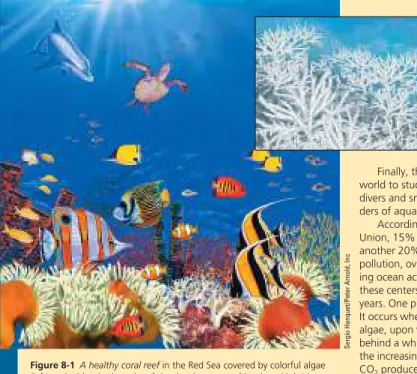
Coral Reefs Are Amazing Centers of Biodiversity
The Open Sea and Ocean Floor Host a Variety of Species
171Figure 8-11 Natural capital
Human Activities Are Disrupting and Degrading Marine Systems
In 2006, about 45% of the world's population (including more than half of the US population) lived along or near coasts. By 2040, up to 80% of the world's people are predicted to live in or near coastal areas.
Major Human Impacts on
In this four-year study, the international team of scientists found that human activity has severely affected 41% of the world's ocean surface, with no area left completely untouched. Hoegh-Guldberg and 16 other scientists, unless we take action soon to significantly reduce carbon dioxide emissions, the oceans could become too acidic and too warm for most of the world's coral reefs to survive this century, and important the ecological and economic services they provide will be lost.
Marine Ecosystems and Coral Reefs
173in the Chesapeake Bay area grew from 3.7 million to
The bay has become a huge pollution sink because only 1% of the waste entering the bay is washed into the Atlantic Ocean. The hard work to improve the water quality of the Chesapeake Bay has paid off.
Water Stands in Some Freshwater Systems and Flows in Others
Some Lakes Have More Nutrients Than Others
Freshwater Systems
175Over time, sediment, organic material, and inor-