6-30-2022
EVALUATING THE EFFECTIVENESS OF TAX OBJECTION REVIEW EVALUATING THE EFFECTIVENESS OF TAX OBJECTION REVIEW IN INDONESIA’S TAX AUTHORITY
IN INDONESIA’S TAX AUTHORITY
Yuli Trisnawati
Universitas Indonesia, [email protected] Siti Nuryanah
Universitas Indonesia, [email protected]
Follow this and additional works at: https://scholarhub.ui.ac.id/jaki
Part of the Accounting Commons, Corporate Finance Commons, Finance and Financial Management Commons, and the Taxation Commons
Recommended Citation Recommended Citation
Trisnawati, Yuli and Nuryanah, Siti (2022) "EVALUATING THE EFFECTIVENESS OF TAX OBJECTION REVIEW IN INDONESIA’S TAX AUTHORITY," Jurnal Akuntansi dan Keuangan Indonesia: Vol. 19: Iss. 1, Article 4.
DOI: 10.21002/jaki.2022.04
Available at: https://scholarhub.ui.ac.id/jaki/vol19/iss1/4
This Article is brought to you for free and open access by the Faculty of Economics & Business at UI Scholars Hub.
It has been accepted for inclusion in Jurnal Akuntansi dan Keuangan Indonesia by an authorized editor of UI Scholars Hub.
Cover Page Footnote Cover Page Footnote
Acknowledgment & Disclosure The authors would like to thank Lembaga Pengelola Dana Pendidikan (LPDP) as the funder of education and research. We also thank all informants involved in the research, both from the DGT, Taxpayers, Tax Consultants, Tax Lecturers, and Setkomwasjak. In this research, we do not have any conflict of interest with the object of research. Last but not least, the author would thank Doddy Kristianto, for the free proofreading.
This article is available in Jurnal Akuntansi dan Keuangan Indonesia: https://scholarhub.ui.ac.id/jaki/vol19/iss1/4
Jurnal Akuntansi dan Keuangan Indonesia Volume 19 Issue 1 June 2022
EVALUATING THE EFFECTIVENESS OF TAX OBJECTION REVIEW IN INDONESIA’S TAX AUTHORITY
Yuli Trisnawati
Department of Accounting, University of Indonesia [email protected]
Siti Nuryanah
Department of Accounting, University of Indonesia [email protected]
Abstract
An evaluation of the effectiveness of tax objection review by the Directorate General of Taxes (DGT) is required due to the increasing number of tax disputes that continue to litigation and a low winning rate for DGT in tax court (approximately 40%). This study aims to analyze the effectiveness of reviewing tax objections at DGT using Campbell's Effectiveness Theory (1989) with criteria of programs and goals success, program satisfaction, inputs and outputs conformity, and overall goal achievement. This is case study research with a qualitative method presented in a descriptive analysis. Data was collected through documentation, interviews, and satisfaction surveys. Informants are from the DGT, Taxpayers, Tax Consultants, Tax Lecturers and the Secretariat of the Tax Supervisory Committee (Setkomwasjak). The results indicate that the tax objection review at the DGT has been moderately effective, as evidenced by the achievement of the predetermined targets. However, several criteria should be improved, such as input and output quality, workload and independence. The separation of the objection review unit from the Regional Office (Kanwil) of the DGT is one of the recommendations proposed to increase the independence of tax objection review.
Keywords: tax objection, tax dispute, taxpayer satisfaction, effectiveness Abstrak
Semakin banyak jumlah sengketa yang berlanjut ke ranah litigasi dan tingkat kemenangan Direktorat Jenderal Pajak (DJP) yang masih rendah (sekitar 40%) membutuhkan evaluasi efektifitas pada proses penelaahan keberatan pajak. Penelitian ini bertujuan untuk menganalisis efektivitas penelaahan keberatan pajak di DJP. Pengukuran efektivitas menggunakan Teori Efektivitas Campbell (1989) dengan kriteria keberhasilan program, keberhasilan sasaran, kepuasan terhadap program, kesesuaian input dan output serta tujuan secara keseluruhan. Penelitian ini merupakan studi kasus dengan metode kualitatif dan disajikan dalam analisis deskriptif.
Pengumpulan data dilakukan melalui dokumentasi, wawancara dan survei kepuasan. Informan penelitian berasal dari DJP, Wajib Pajak, Konsultan Pajak, Dosen Pajak dan Sekretariat Komite Pengawas Perpajakan (Setkomwasjak). Hasil penelitian menunjukkan bahwa penelaahan keberatan pajak di DJP sudah cukup efektif dibuktikan dengan tercapainya target yang ditentukan sebelumnya. Terdapat beberapa kriteria yang harus diperbaiki terkait kualitas input dan output keberatan, beban kerja dan independensi. Pemisahan unit penelitian keberatan dari Kantor Wilayah (Kanwil) DJP menjadi salah satu rekomendasi yang diusulkan untuk meningkatkan independensi penelaahan keberatan pajak.
Kata kunci: keberatan pajak, sengketa pajak, kepuasan Wajib Pajak, efektivitas
INTRODUCTION
In September 2021, the Directorate General of Taxes (DGT) was defeated by PT. Perusahaan Gas Negara Tbk (a state- owned enterprise) during the judicial review process for tax disputes in the Supreme Court with a total loss worth 926 billion Rupiah (Age 2021). This case is one of many recent tax dispute cases won by taxpayers, and the loss worth is quite large for tax revenue.
According to the Tax Court, the number of appeals filed increases each year and adds to the Tax Court’s workload.
Thus, it took longer for the Tax Court to decide decisions for every case. Lubis (2021) states that the average tax dispute duration from the issuance of a Tax Assessment Letter (Surat Ketetapan Pajak- SKP) to the Tax Court decision is 28,4 months, and the Supreme Court Decision is 53,6 months. Both taxpayers and the DGT spend a lot of resources to obtain legal certainty in a tax dispute. If tax disputes are not immediately resolved, it could decrease foreign investment because tax is a notable consideration for foreign investors (Hidayah 2018).
Setiawan (2021) said that around 5%
of taxpayers submit objections to the DGT every year, and 40% of them escalate to legal proceedings to the Tax Court.
Undeniably, improvements in the tax dispute process, especially in internal DGT, are needed to make the process more effective and efficient. Effective resolution of tax disputes in DGT can prevent tax disputes from continuing into the litigation, which is time-consuming and costly for both taxpayers and DGT. It is important to evaluate the effectiveness of objections given the increasing number of appeals submitted to the tax courts and the low DGT win rate. Indications of ineffectiveness in the objection process make this research important to do by comparing the reality that occurred with the criteria of effectiveness theory.
Several researchers have conducted previous research on the evaluation of
objections, but most of them only researched in one operational unit. One of the previous studies in Indonesia on the effectiveness of tax objections was carried out at Tax Office (KPP) Pratama Palembang Ilir Barat from 2012 to 2014.
Ferina et al. (2015) stated that the settlement of tax disputes at KPP Pratama Palembang Ilir had been effectively proven by Objection Decision Letter (Surat Keputusan-SK) issuances that do not exceed 12 months or the deadline for resolving objections. Putra and Mispiyanti (2021) have also researched the Standard Operating Procedure (SOP) implementation for the Settlement of Objections at the Regional Office DGT in the Special Region of Yogyakarta. As a result, the implement- tation of Settlement of Objections is appropriate with SE-122/PJ/2010 and PMK-9/PMK.03/2013. Since most prior studies in Indonesia (such as Ferina et al.
(2015); Putra and Mispiyanti (2021)) examined tax objection processes in one operational unit of the DGT, the present study attempts to fill the gap by using national-level data.
In Romania, Moldovan (2019) evaluated the effectiveness and efficiency of the Romanian tax complaint agency from 2013 to 2017 using secondary data released by the Romanian Tax Authorities.
The effectiveness index is measured by the level of tax dispute resolution at the internal level, whereas efficiency is measured by the settlement period. The study concludes that tax dispute cases at the internal level are ineffective and inefficient.
Further, most prior studies examining tax objection review processes only took into account perspectives of tax authority without considering the perspectives of taxpayers as stakeholders in settlement of objections. Taxpayer satisfaction in all types of services, including in settlement of tax disputes, is important because taxpayers are the main stakeholders for DGT.
This study analyzes the effectiveness of the tax objection review at the DGT using secondary data and primary data from many perspectives, such as taxpayers,
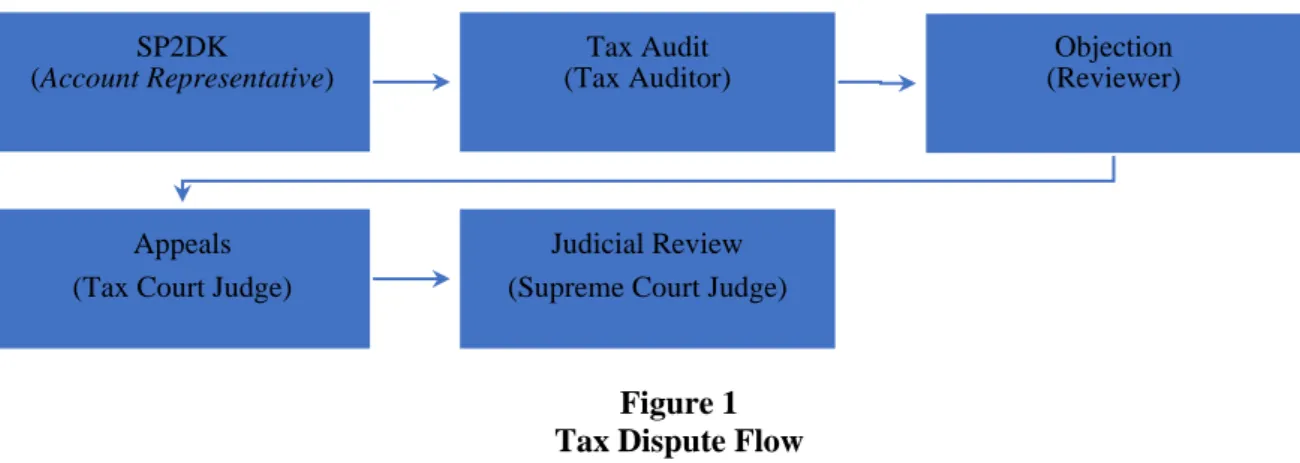
Figure 1 Tax Dispute Flow
Source: UU KUP, has been reprocessed
tax officials, practitioners, and professional academics. This study presents a more comprehensive measurement of the effectiveness of the settlement process at DGT compared to previous studies. The indicators used to measure effectiveness refer to Campbell’s effectiveness theory (1989) with criteria of programs and goals successfulness, program satisfaction, inputs and outputs conformity, as well as overall goal achievement. Campbell's theory of effectiveness is used because it is more comprehensive and suitable for evaluating effectiveness in the public sector.
This paper consists of four parts:
introduction, literature study, result and conclusion. First, an introduction includes background, research problem, and the importance of the research conducted.
Second, literature review contains the underlying literature and a summary of previous research. Third, the results and discussion of the research findings. Finally, the conclusion section summarises the research results, implications, and suggestions for further research on the same issue.
LITERATURE REVIEW
Tax Disputes and Resolution
According to Zuraida (2021), a tax dispute is a dispute between the taxpayer or the insurer and the tax officer as a result of the emergence of a tax determination by the tax office that can be appealed to legal action under the jurisdiction of the tax
court. Hadi et al. (2017) stated that there are three types of tax disputes, namely regulatory disputes, tax assessment disputes, tax collection disputes and other decisions from the tax autho- rities. According to Siahaan (2012), there are several ways to resolve tax disputes, such as with compromises (tax officials are authorized to resolve disputes that occur with taxpayers, such as reducing or eliminating administrative sanctions);
disputes within the taxation authority (settlement of disputes on tax determination by filing an objection to a different division supervisory agency or regional tax office of the decision maker but still under the same tax authority); and tax adjudications (settlement of disputes that carried out by jurisdiction court, for example, appeals at the Tax Court and judicial review at the Supreme Court).
Tax Objection Processes in Indonesia's DGT
Figure 1 illustrates the flow of tax dispute resolution in Indonesia, starting from the internal DGT until the litigation process in Tax Court and Supreme Court.
Tax dispute arises if taxpayers and the Tax Officers have a different interpretation of the regulation. First, Account Representative (AR) send a request for an explanation to taxpayers (Surat Permintaan Penjelasan atas Data dan/atau Keterangan - SP2DK) if the data submitted by taxpayer is not in accordance with the Tax Return (Surat Pemberitahuan
SP2DK
(Account Representative)
Tax Audit (Tax Auditor)
Objection (Reviewer)
Appeals (Tax Court Judge)
Judicial Review (Supreme Court Judge)
Pajak - SPT) report. If the explanation given by taxpayer to AR is adequate and taxpayers correct the SPT, tax dispute endsat this stage. Next, if taxpayer neither provides explanation or corrects the SPT, the stage will be leveled up to tax audit to test taxpayer's compliances both formally and materially for a period of 12 months.
In the second stage, if taxpayer able to show evidence and a reasonable convincing calculation, the audit findings can be eliminated. On the other hand, if there is insufficient evidence from taxpayer, the Tax Auditor will determine the tax assessment letter (SKP). If taxpayer agrees with SKP determined by Tax Auditor, tax dispute ends at the audit stage. However, if taxpayer is not sasatisfiedith SKP, taxpayer has the right to file an objection within no more than 3 months from the date of SKP.
The last objection stage managed by DGT is examination by the Objection Reviewer team. In this process, taxpayer is invited to discuss the corrections that are objected to. This stage is just a review of the previous process. Then, the DGT have to decide whether to accept or reject the taxpayer’s objection within 12 months. If DGT did not issue a decree within 12 months, then taxpayer objection is deemed to be granted. If taxpayer agrees with the objection decree, then tax dispute ends.
The following sequences are the court jurisdiction stage. If taxpayer does not agree with objection decree, taxpayer can file an appeal to the Tax Court within no more than 3 months. The Panel of Judges of the Tax Court resolves the tax dispute filed by the Appeal within 12 months and can be extended for 3 months for certain reasons. If the taxpayer agrees with the Appeal Decision from the Panel of Judges, as well as the DGT, the dispute is resolved at the Appeal stage. However, suppose one of the parties, both the taxpayer and the DGT, is not satisfied with the Appeal Decision. In that case, they can file a judicial review to The Supreme Court within 3 months from discovering new written evidence that determines and/or lies
or deception from the opposing party. The Supreme Court's decision is the final decision in tax disputes.
Effectiveness Theory
Ramdhani and Ramdhani (2017) define effectiveness as a result that can be measured from the achievement of pre- determined goals or targets while efficiency is defined as the relationship between usage of resources with results achieved, resources can be human resources, time, costs, etc. Campbell et al. (1989) measure organizational effectiveness based on practices that occur in various business fields and summarize them into five effectiveness measures, namely programs and goals success, program satisfaction, inputs and outputs conformity, as well as overall goal achievement, each of which has a definition of success. Campbell's theory can be used to measure effectiveness in the private and public sectors because this theory is general, so it is suitable for various types of organizations.
In evaluating the tax objection process in tax authority, to the best of authors’ knowledge, no prior studies has yet measured the effectiveness of the tax objection process as a whole as in Campbell's Effectiveness Theory. Yolanita and Yuniningsih (2020) use the effectiveness theory proposed by Campbell (1989) to study local government programs in Central Java. Although it has never been used to measure the effectiveness of business processes in a tax authority, including the Indonesia’s DGT, Campbell's theory is considered suitable to measure the effectiveness of the objection process by adjusting the criteria in this theory with the objections business process carried out.
Program Successfulness
Successfulness of the program is related to the operational achievement compared to the operational targets. Lihardi and Preffy (2021) define program success as the organization's ability to carry out tasks to achieve goals. In the tax objection process, the success of the program is seen in the punctuality in resolving objections.
Goal Successfulness
Goal success is related to the achievement of certain goals that an organization wants to achieve. These goals can be outputs that are predetermined for a certain period. Lihardi and Preffy (2021) define effectiveness as a measure of how far goals are achieved in realizing organi- zational objectives. DGT's winning rate in the tax court is the goal successfulness in the objection process at the DGT which is presented in the annual perfor-mance report (Laporan Kinerja - LAKIN). LAKIN is a form of accountability for the implement- tation of tasks and functions entrusted to the DGT to use the budget.
Program Satisfaction
Effectiveness is measured by the satisfaction of parties who receive benefits from the program. Lihardi and Preffy (2021) define effectiveness as a satisfaction with the quality of a program organized by the organization. Satisfaction with the program in the objection process means that taxpayers and tax officers are satisfied with carrying out the objection process. In measuring the level of taxpayer satis- faction, the Four Maxims theory is used, and the objection reviewer's perception is measured through the PDCA theory.
Adam Smith's Four Maxims Theory
According to Wealth of Nations, Smith (2011) argues that the principles of tax collection are still relevant today. It is known as Adam Smith's four maxims theory which consists of four principles.
First, the principle of justice and equality (equality), tax levied in proportion to the taxpayer ability to pay and equal to the benefits received from the state. Second, the principle of certainty and not determined arbitrarily (certainty), tax collection from taxpayers must be certain regarding time of payment, method of payment, and amount to be paid. Third, the principle of convenience (convenience of payment), tax should be collected at a time and in a way that is not troublesome for taxpayers. Fourth, the principle of efficiency (economic of collection), tax
collection cost, and tax obligation cost should be as low as possible and not prevent taxpayers from carrying out their economic activities.
PDCA Theory
The PDCA theory was put forward by W. Edwards Deming in 1950. Putra and Mispiyanti (2021) wrote that the main purpose of PDCA is to achieve customer satisfaction with the process that has been carried out by management. The variables measured in this theory include four variables Plan, Do, Check, and Act, which defined as follows. Plan Activity has a meaning as an understanding of goals, business processes and how to solve problems. Do Activity is defined as training and activities carried out. Check Activity means monitoring the ongoing activities compared to the plan that has been prepared previously to find recommend- dations for improvement for the next process. Act Activity means the follow-up action taken to respond to findings from Check Activity so that effectiveness and efficiency can be increased in the future.
Input and Output Conformity
Effectiveness is measured by the quality of inputs included in a process and then adjusted to the quality of outputs produced. The input of the objection process is the SKP resulting from the tax audit by the tax auditor. The number and quality of tax audits determine the quality of inputs in the objection process. Mean- while, the output of the objection process is the objection decision letter produced by the objection reviewer. The smaller the appeal, the more satisfied the taxpayer will be with the result of the objection.
Overall Goal Achievement
Febria et al. (2018) define the achievement of overall goals as when an organization has succeeded in achieving its goals in quantity and quality. In the objection process, the overall objective is defined as the level of efficiency, reliable human resource management, integrated system and internal control to produce a
Figure 2
Research Conceptual Framework Source: Campbell et al. (1989), with modification
quality objection decision to support the purpose of DGT as a collector of state revenues.
Conceptual Framework
Authors apply this theory to measure effectiveness, which consists of five criteria adjusted to the objection process contained in the DGT strategic plan to produce the framework in Figure 2 to obtain a more comprehensive evaluation result. The results of the comparison between reality and the criteria in Campbell's theory of effectiveness can be very effective, effect- tive, moderately effective, less effecttive, or ineffective.
RESEARCH METHODS Research Object and Design
This study is using qualitative methods and presented in descriptive analysis. To ensure the data's validity and
reliability, data is triangulated from three sources: taxpayers, DGT (i.e., objection reviewers and an official representing DGT's head office), and external parties comprised of practitioners (tax consul- tants), academics, and the Tax Supervisory Committee.
Data Collection Technique
Data were collected by three methods, namely documentation, survey and interview. Primary data was collected in the form of perceptions obtained through interviews and surveys. Secondary data was accrued from the DGT Performance Report (LAKIN) from 2016 to 2020, including the number and nominal of objections, time duration for resolving objections and the number of appeals from taxpayers.
The perception surveys are aimed at taxpayers and tax officers who handle objections. Perception from taxpayers is
Table 1 Survey Respondents
No. Respondent Target Number of
Answers
Number of Answers processed
Response Rate
1. Taxpayer 102 32 31 31,3%
2. Objection
Reviewer 102 36 36 35,3%
Table 2
Profile of Taxpayer Respondents
Taxpayers Respondents’ Data Number Percentage
Gender Male 20 64,52%
Female 11 35,48%
Age Less than 20 years 1 3,22%
21 – 30 years 11 35,48%
31 – 40 years 12 38,71%
41 - 50 years 6 19,35%
More than 50 years 1 3,22%
Education Senior High School 2 6,45%
The diploma I/II/III 4 12,90%
Bachelor Degree 17 54,84%
Master and Doctoral Degree
8 25,81%
Business Type Industry 8 25,81%
Service 9 29,03%
Construction 1 3,22%
Government Agencies 1 3,22%
Trading 12 38,71%
Average Turnover <Rp 4,8 billion 5 16,13%
Rp 4,8 – 50 billion 3 9,68%
Rp 50 – 100 billion 9 29,03%
Rp 100 – 200 billion 1 3,22%
>Rp 200 billion 13 41,93%
Role Consultant 4 12,90%
Employee 23 74,19%
Owner 4 12,90%
Working Period < 1 year 4 12,90%
1-3 years 5 16,13%
3 – 6 years 10 32,26%
>6 years 12 38,71%
aimed to determine the implementation of Four Maxims principles (equality, certainty, convenience, and economic of collection) while perception from tax officers is intended to gather information about the performance of Objection Reviewer. The survey uses a Likert scale of 1 to 6 (strongly disagree, disagree, slightly disagree, slightly agree, agree, strongly agree).
The selection of survey respondents in this study uses purposive sampling.
Target respondent intended is the Objection Reviewer whose author has access to be contacted and the taxpayer who is the respondent is the taxpayer recommended by the Objection Reviewer. The survey was conducted digitally through Google Form by providing a survey link to the target respondents. The questionnaire is sent to the Objection Reviewer and the taxpayer at the same time in one message. The Objection Reviewer, who is the respondent's target, is asked to fill out the
Table 3
Profile of Reviewer Respondents
Objection Reviewers Respondents’ Data Number Percentage
Gender Male 20 55,56%
Female 16 44,44%
Age 31 – 40 years 26 72,22%
41 - 50 years 9 25,00%
More than 50 years 1 2,77%
Education Diploma I/II/III 1 2,77%
Bachelor Degree 26 72,22%
Master and Doctoral Degree
9 25,00%
Position Level Reviewer Level I 19 52,77%
Reviewer Level II 13 36,11%
Reviewer Level III 3 8,33%
Reviewer Level IV 1 2,77%
Working Period < 1 year 3 8,33%
1-3 years 19 52,77%
3 - 6 years 10 27,77%
6 - 9 years 2 5,55%
>9 years 2 5,55%
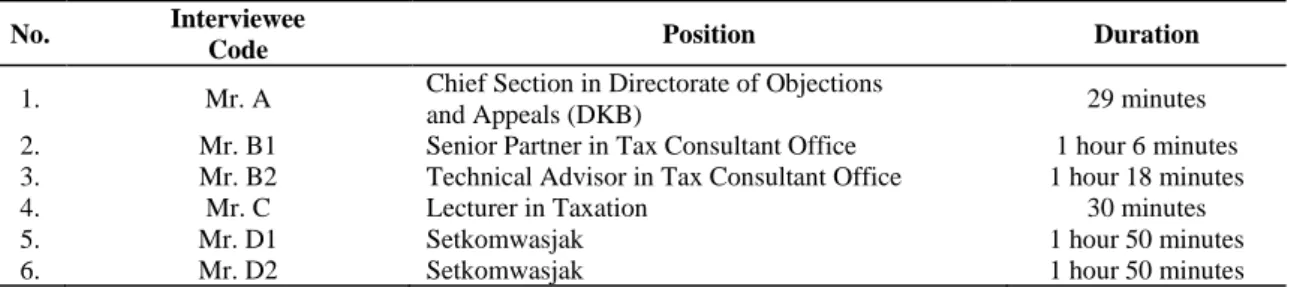
Table 4 List of Interviewees
No. Interviewee
Code Position Duration
1. Mr. A Chief Section in Directorate of Objections
and Appeals (DKB) 29 minutes
2. Mr. B1 Senior Partner in Tax Consultant Office 1 hour 6 minutes
3. Mr. B2 Technical Advisor in Tax Consultant Office 1 hour 18 minutes
4. Mr. C Lecturer in Taxation 30 minutes
5. Mr. D1 Setkomwasjak 1 hour 50 minutes
6. Mr. D2 Setkomwasjak 1 hour 50 minutes
Objection Reviewer questionnaire link and give another link to taxpayers who have or are submitting an objection request. Before being distributed to the target respondents, a pilot study of the survey questions was conducted first. The pilot study was conducted on several target respondents, consisting of 3 taxpayers who had filed objections and 3 reviewers of objections.
The survey questions were revised based on feedback from the sample respondents.
The survey questions are derived from previous research from Sianigan (2006) with modifications adapted to current regulations. The survey questions for taxpayers and objection reviewers are available in the Appendix of this paper.
Table 1 presents the number of survey respondents, which consists of 31
taxpayers and 36 objection reviewers. In Table 1, it can be seen that one respondent's answer was not included because it did not meet the requirement of having filed a tax objection. The summaries of respondents' profiles are presented in Table 2 (taxpayers) and Table 3 (objection reviewers).
In addition to surveys, this study also uses in-depth interviews with semi- structured questions. The interview is to verify information gathered from LAKIN as well as the survey results. The list of interviewees can be seen in Table 4. Due to the current pandemic conditions, interviews were conducted using a combination of two methods, face-to-face and online meetings with Zoom, Google Meet, or Whatsapp calls, depending on the respondent's
Table 5
Data on Completion of Objection Files in 2020
Completion Time 2020 Entry Files Percentage
1 month 46 0.28%
2 months 50 0.31%
3 months 53 0.33%
4 months 40 0.25%
5 months 45 0.28%
6 months 72 0.45%
7 months 148 0.92%
8 months 218 1.35%
9 months 527 3.26%
10 months 3.926 24.27%
11 months 8,291 51.26%
12 months 2,758 17.05%
TOTAL 16,174 100%
Source: DIP (2021), has been reprocessed
willingness. The interview duration differs between each interviewee because of the different interview questions and the answers that can be developed for each interviewee.
The selection of interview participants in this study uses purposive sampling. The informants were chosen because they have the information needed to answer the research questions described in the five criteria in Campbell's theory of effectiveness. Moleong (2011) revealed that in qualitative research, sampling is carried out to obtain as much information as possible from various sources to detail the information and does not aim to generalize as in quantitative research.
Sampling will end if there is repetition of information from different sources. The number of respondents in this study was deemed sufficient because there had been repetition of answers so that the authors could answer the research questions.
The data analysis technique refers to Miles and Huberman (1992) namely data simplification, data presentation, and conclusion drawing. In the simplification process, the results of interviews, surveys and documentation were codified based on previously defined keywords. The codification results are presented to answer research questions about the effectiveness of reviewing objections based on criteria in Campbell's Theory. Data reduction was carried out on data that did not answer the
research question. After the data is presented, conclusions are drawn.
RESULTS AND ANALYSIS The effectiveness of the review of objections in this study is measured based on the five criteria of Campbel’s Effectiveness Theory (1989): programs success, goals successfulness, program satisfaction, inputs and outputs conformity and overall goal achievement. Each criterion could be categorized into five ranks, very effective, effective, moderately effective, less effective and ineffective.
Program Successfulness
The Succesfulness of the program is measured by the Key Performance Indicator (Indikator Kinerja Utama - IKU) of Objection Reviewer within the DGT Regional Office. Article 26 of the general provisions and tax procedures (KUP Law) states that the DGT must issue an Objection Letter within 12 months. Otherwise, the submission of the Taxpayer's objection is granted. Ferina et al. (2015), Putra and Mispiyanti (2021), and Moldovan (2019) also measure the effectiveness of objections based on the duration of the complaint resolution. The objection process is said to be effective if it is completed within a period according to the applicable provisions. Based on data from the DGT, in 2020, the period for resolving objections is summarized in Table 5.
Table 6
Tax Court Decision Win Rate Year DGT Winning
Target
DGT's Winning Realization
Performance (max.120%)
2016 35% 44.87% 120%
2017 38% 50.98% 120%
2018 40% 43.54% 108.85%
2019 41% 40.54% 98.88%
2020 43% 43.10% 100.23%
Source: LAKIN DGT
Objection letters are issued mostly between 10 to 11 months, which contribute more than 75%. This figure corresponds to the survey results from Objection Reviewer that 80.6% of respondents resolved object- tions within 10-12 months. Thus, it can be concluded that DGT has succeeded in the objection program because none of tax objections were settled for more than 12 months. From the data on the objection letter issued in 2020 (files entered 2019 to 2020), no decree was granted automatically because the completion time was more than 12 months. This finding supports the results of Ferina et al. (2015) which state that the settlement of tax disputes at KPP Pratama Palembang Ilir has been effective. Like- wise, Putra and Mispiyanti (2021) stated that the objection process at the Regional Tax Office of the Special Region of Yogyakarta was in accordance with the applicable SOP.
However, Mr. B2 as a tax advisor stated that ideally tax objections are resolved within 6 months so that taxpayers can get legal certainty quicker. His state- ment is in line with results from taxpayers’
survey which 96.7% of respondents want the objection process to be completed in less than 6 months. The current condition is that the DGT cannot fulfill the wishes of the taxpayer to settle objections within 6 months due to the limited number of reviewers of objections, 80% workload for Article 36 (application for reduction or elimination of administrative sanctions in the form of interest, fines, and increases) and the provisions of the law which stipulates the settlement period of 12 months. From the side of DGT, Mr. A stated:
"The settlement of objections, if carried out simultaneously, can be completed in 3 months, but with a note that the ratio of files to the Objection Reviewer is reduced by 2x and does not work on the application for Article 36."
On the other hand, Mr. D1 said that the DGT has implemented positive laws so that output produced is said to be effective if it was carried out in accordance with regulations. Identical opinion said by Mr.
B1 that taxes are about administration, policy, and law so everything must be conducted under current provisions. A conclusion that can be drawn from program success is that DGT has achieved the program's success based on the applicable provisions. In the other word, it can be said that tax objection process is already effective.
Goal Successfulness
One of DGT's strategic goals mentioned in LAKIN 2020 is Synergy of Effective Supervision and Law Enfor- cement. This strategic goal is manifested in the KPIs as a percentage of the number of appeals / lawsuits in the Tax Court that retain by DGT. Directorate of Objections and Appeals at the DGT is responsible for formulating and implementing policies and technical standardization regarding object- tions and appeals. Also, it represents DGT during the appeals and lawsuits process in the Tax Court.
The definition of the KPI is to retain DGT decisions during appeal disputes and lawsuits in the Tax Court. Thus, the more decisions that can be retained by DGT in Tax Court will secure tax revenue target.
Table 6 shows the percentage of KPI
Table 7
Taxpayer's Perception of Objections from the Four Maxims Theory
Number Variable Approval Rate
1. Equality 69.00%
2. Certainty 60.22%
3. Convenience 71.51%
4. Economics of collection 53.33%
achievements in the number of decisions that retained in the Tax Court from 2016 to 2020. The ruling that won the DGT in a dispute with the taxpayer in the Tax Court, namely “reject” (score 1), “unacceptable”
(score 1), “increase the tax to be paid”
(score 1), “removed from the list of disputes "(score 1) and "partly granted"
(score 0.5). So, a partial approval is considered to win the DGT and the taxpayer at the same time.
Table 6 shows the realization of the DGT's winning rate in the Tax Court in last five years. Compared to the target in the KPI, the achievement is always above 100%, except in 2019, only 98.88%. So, it can be said that the implementation of the objection at DGT has achieved goal success because, on average, it always fulfills the target. There are many factors in determining targets, especially in the public sector because they will be related to achieving targets that affect employee performance and takehome pay. In addition, the decision of the tax court on tax disputes is not easy to predict, for example in the case of the same dispute with the same panel but with different taxpayers, the decision may be different.
Therefore, DGT does not want to set a target that is too high (above 50%). Mr. A explained that:
“The current year target is set based on the previous year's target win rate plus 2%. Ideally, the DGT win rate is above 50%.”
Moldovan (2018) also uses the same measure when determining the win rate of the Appeal in Romania that the performance of the objection is said to be effective if the winning ratio in the Tax Court is more than 50%. Mr. D1 stated that the DGT's winning rate was not optimal
because there were still more losses in the Tax Court, which was around 60%. Even though the DGT has succeeded in fulfilling the KPI target, the DGT's winning rate in the Tax Court has not exceeded 50% which should ideally be achieved by the DGT. From these findings it can be concluded that goal successfulness of the program is moderately effective.
Satisfaction with Program
Satisfaction with the objection program is seen from the perception of stakeholders as parties who directly feel the impact of the objection process. This study measures satisfaction based on the perceptions of taxpayers and employees who are directly related to the objection process, Objection Reviewer. Approval level of surveys more than 50% in each respondent category. Thus, respondents are satisfied with variables given in the survey question.
Taxpayers Perception
Mr. C said that the perception of taxpayers is important because any strategy carried out by the DGT will have an impact on the satisfaction of Taxpayers who are the main stakeholders. Perceptions of taxpayers satisfaction were measured using Four Maxims Theory divided into four criterias, equality, certainty, conve- nience and economic of collection. This theory was chosen because taxpayers are considered satisfied with tax services if they are in accordance with tax collection principles. The results of the measurement of the respondents' level of agreement can be seen in Table 7. The details of the approval level for each survey question are available in the Appendix of this paper.
Table 8
Opinion Reviewers Perception of Objections from PDCA Theory
Number Variable Approval Rate
1. Plan 72.50%
2. Do 72.87%
3. Check 72.78%
4. Act 54.91%
All four variables in the Four Maxims Theory get approval level above 50%, meaning that taxpayers have a positive perception of all variables. The highest approval score was obtained by the convenience variable, in line with Mr.
D1's statement that:
"Overall, the DGT administration is getting better, the service is good, the officers are more friendly than before",
Mr. D2 also said the same thing, that taxpayers are no longer afraid to come to the tax office. Both statements imply that the objection process has made things easier and more convenient for you.
Moreover, the submission of objections can now can be done electronically via djponline. On the other hand, the economic of collection variable gets the lowest agreement, which is 53.33%. The two sources from tax practitioners, Mr. D1 and Mr. D2 stated that the objection process took too long and thus created uncertainty for taxpayers, especially if the taxpayer continued his legal efforts into litigation, the level of uncertainty would be even higher. In this case, the process would be time-consuming and costly for taxpayers.
Mr D1 says:
“Taxpayers want to finish the dispute in objection, they don’t like to continue to The Court because the higher the level, the more uncertainty. The decision will be based on the judge's opinion."
Mr D2 added:
"In Court, the decisions can be different.
The same case, different taxpayers, different judges will be different decisions. The same case, the same taxpayer, different judges will be different decisions. The same case, the same judge, different taxpayers will be different decisions, and so on".
Based on survey results and and interviews, it can be concluded that satisfaction with the program from the taxpayer's perception is already effective.
Objection Reviewers Perception
Objection Reviewer's perception is measured based on the PDCA Theory indicators with criterias: Plan, Do, Check and Act. Putra and Mispiyanti (2021) used this theory to evaluate the objection SOP implementation at the Regional Office of the DGT of the Special Region of Yogyakarta. The results of the Objection Reviewer's perception measure- ment are shown in Table 8. The details of the approval level for each survey question are available at the Appendix of this paper.
The data show that in all variables, the Reviewer’s perceptions are above 50%, meaning that, in general, it can be said to have been effective. In the Plan-Do- Check the approval value is above 70%, meaning that the implementation of the objection at the DGT has implemented the SOP as it should. This confirms previous research that the implementation of the objection was in accordance with the applicable SOP (Putra and Mispiyanti 2021). The lowest level of approval is on the Act variable relating to the objection decision issued by the Objection Reviewer. There is a concern for the Reviewer that the resulting objection decision does not meet the principles of fairness for the taxpayer. Mr. D2 said that since the Gayus case 1 in 2008, the Reviewer has tended to be more careful in granting taxpayer objections because of the fear of state losses if interest payments
1 Gayus case is the tax mafia case in 2010 involving a former DGT employee named Gayus Tambunan.
Table 9
KPI Examination Effectiveness of Number of SKPs Not Filed Objections Year Number of
SKP
Amount of SKP No Objection
Target Realization Achievements
2016 255,718 246,148 88% 96.26% 109.39%
2017 204.584 193.384 88% 94.53% 107.42%
Source: LAKIN DGT, has been reprocessed Table 10
KPI Examination Effectiveness from ACR Achievements
Year Target Realization Achievements
2018 100% 147.44% 120%
2019 100% 115.96% 115.96%
Source: LAKIN DGT, has been reprocessed
arise. This fear should no longer occur, given the increasingly adequate internal control of the DGT. The Act stages, however, should be improved because the results of the objection decisions mostly reject the objections of the taxpayers, which lead to the submission of higher legal remedies which is costly for both the taxpayer and the DGT.
Input and Output Level Input Quality
KPI Effectiveness of Tax Audit
Mr. C stated that the effectiveness of the objection can be seen from upstream or downstream. From upstream, this is a compliance process called active compli- ance from the taxpayer before the Letter of Request for Explanation of Data and/or Information (SP2DK) process and ends with an internal objection process by the DGT. In the objection process, the input comes from the SKP resulting from the tax audit by the tax auditors. Setiawan (2021) stated that the average objection was about 5% per year of all SKPs issued by the DGT in that year. Mr. D1 stated the number of objections compared to the issued SKPs is very small, but that does not mean that the taxpayers who do not file objections agree because some of them may not know if there are legal remedies that can be taken.
The average of 5% objections looks small, but when compared to developed countries, for example, Australia, where the percentage of objections is only about 2%
of the legal products issued annually, it still needs improvement. In the audit process,
from 2016 to 2017 KPI audit effectiveness was measured by the number of SKPs that were not objected to by the taxpayer, with the following data in Table 9.
From Table 9, it can be confirmed that tax objections are around 5% of the number of SKPs issued annually. The Audit Effectiveness Indicator of the Number of SKPs that is Not Filed Objections is no longer used in 2018, replaced with the achievement of the Audit Coverage Ratio (ACR), which is the level of taxpayer audit based on the distribution of the taxpayers being audited with the number of taxpayers who are required to submit SPT. Table 10 shows ACR's achievements in 2018 and 2019.
From Table 10 it is known that the realization always exceeds the target with the provision that the maximum achievement is 120%. In 2020, the ACR indicator was no longer used to measure audit effectiveness. The indicators used are the completion of the examination and acceptance of the results of the examination.
In the last five years, audit effectiveness indicators have changed twice. However, the DGT's reasons for making such changes remain unknown.
The DGT might want to find a more suit- able indicator to measure the effectiveness of tax audit. Further, even though the DGT could achieve its targets as presented in Table 9 and Table 10, interview partici- pants argued that audit process as input for objections has not been running effectively.
It can be concluded as less effective. The
Table 11
Data for Filing Objections 2016 to 2020
Year Number of Objections
Nominal of Objection (Rupiah)
2016 8,485 19,683,546,654,798
2017 11.303 20,854,565,273,752
2018 22,258 44,329,414,012,077
2019 23,463 40,136,905,936,777
2020 20,955 21,796,730,109,468
Source: DIP (2021), has been reprocessed Table 12
Type of Objection Decision 2016 to 2020
Year Accept Receive Partially Reject Add Total
Amount % Amount % Amount % Quantity % SK
2016 716 7.86% 1.321 14.51% 7.065 77.59% 3 0.03% 9.105
2017 684 9.59% 1.327 18.61% 5.118 71.79% - - 7.129
2018 1.446 13.71% 2,219 21.03% 6.885 65.26% - - 10.550
2019 2,512 12.78% 3,865 19.67% 13,276 67.55% - - 19,653
2020 3.014 15.76% 3.351 17.52% 12.759 66.72% - - 19,124
Average 11.94% 18.27% 69.78% 0.01%
Source: DIP (2021), has been reprocessed
same perception was conveyed by Mr. D1 that the problems that occurred in the audit, ultimately forced the taxpayer to continue the dispute to the court, because of the distrust that arose in the DGT's internal process. Mr. B1 stated that the tax audit process does not always follow the established procedures, for example the time period in the verification dispute is not utilized optimally because the audit is carried out in a very short period of time and is almost due. Mr. B2 added that the audit plan that should have been made before the audit process was made during or after the audit process, only to fulfill the formal requirements of the tax audit.
Amount Submission of Tax Objection In the objection process, the input for the objection is the SKP of the result of the examination that is submitted for the objection. The following is the data on the number and nominal of objections filed in the last five years. Table 11 shows that the number of objections submissions tends to increase yearly. However, based on interviews with Setkomwasjak officials, the percentage of objection applications remains relatively constant each year, which is in the range of 5% of the total
issued SKPs. Therefore, the increase in the number of submissions may be due to the increase in the number of taxpayers, which may subsequently increase the number of tax returns submitted, increase the number of SKP issued, and may eventually increase the number of objection applications. In 2020, due to the Covid-19 pandemic, the number of objections decreased because there is an extension of the deadline for submitting an objection from 3 months to 6 months.
In addition to the number of SKPs, another thing that is more important in the input of objections is the quality of the SKPs resulting from the examination itself. According to Mr. B1:
"The time frame in the examination process, the 2 months for the taxpayer to provide evidence, please use it as much as possible, often now it's tight, sometimes asking for Quality Assurance is not given because it's about to be due".
Mr. B2 responding to the examination process added:
"The program audit should have been prepared at the beginning, in fact there were auditors who checked first, program audits were made later, that was also because they were afraid of being examined by the Inspector General."
Table 13
Filing of Appeals 2016 to 2020 Year Number of Objection
Decrees Issued
Number of Appeals Percentage
2016 9.105 10,874 119.43%
2017 7.129 5,982 83.91%
2018 10.550 8.846 83.85%
2019 19,653 11.028 56.11%
2020 19,124 12,216 63.88%
Source: DIP (2021), has been reprocessed
From the informants' perception, it can be concluded that the quality of the objection input is not optimal. It can be said less effective.
Output Quality
Decision Letter of Tax Objection
From the output side, the objection process produces an Objection Decree with the results of the objection decision in the form of granting, partially granting, refusing, or increasing the amount of tax payable. One of the performance measure- ments of the objection reviewer is the level of approval of the taxpayer on the results of the objection decision. The results of the SK Objection in the last five years can be seen in Table 12.
From Table 12, in the last five years, most objection decrees issued by the DGT have rejected taxpayers' objections with an average of 69.78%. The trend from 2016 to 2020, the percentage of issuance of SK Objections that reject taxpayer objections has decreased. The decrease in the percentage of objection rejection decrees is one of the indicators of the DGT's progress in tax dispute settlement. This is in line with the opinion of Mr. B1, who stated that currently, the objection process at the DGT is better than five to ten years ago. However, Mr. B2 stated that the taxpayer still considers this objection a formality to go to the Appeal. it can be concluded that the issuance of the SK due to the objection is less effective.
Amount of Submission Appeal
The trend of filing appeals to the Tax Court in the last five years can be seen in Table 13. The number of objection decisions is issued in the current year while
the number of appeals submitted in the current year can come from decisions issued in the previous year considering that the deadline for filing appeals is three months from the issuance of the objection decision letter. If we look at the trend of filing appeals from 2016 to 2020, the percentage of filings for appeals has decreased significantly, where in 2016 almost all objection decrees issued by the DGT were filed for appeal to the Tax Court by taxpayers. In 2017 and 2018 the submissions were still around 80% and decreased again in 2019 and 2020 which was around 60%.
The decrease in the percentage of appeal submissions is also an indication of the improvement in the management of objections at the DGT in line with the decrease in SK rejection of objections from 2016 to 2020. The decrease in the percentage of appeal submissions means that taxpayers are starting to be satisfied with the objection decree issued by the DGT. However, the number of appeal files submitted to the Tax Court has increased from year to year, although the percentage has decreased. The increase in the number of appeal files at the Tax Court is not accompanied by an increase in the number of Judges at the Tax Court, Hidayah (2018) presents data from the Secretariat of the Tax Court that the number of judges in the Tax Court is only 55 people so that one judge has an average of 291 cases that must be resolved each year.
Mr. D1 also states:
"At the Tax Court there are more than 14,000 disputes handled, the workload of Tax Court judges can reach 20 times the workload of judges in the District Court".
Table 14
Tax Objection Collection Fee for 2016 to 2020 Year Nominal of
Objection (Rupiah)
Cost of Tax Collection Objection
(Rupiah)
Percentage of Cost of Tax Collection Objections
2016 19,683,546,654,798 9,500,149,008 0.0483%
2017 20,854,565,273,752 11,134,407,932 0.0534%
2018 44,329,414,012,077 12.007.121.929 0.0271%
2019 40,136,905,936,777 12,884,984,016 0.0321%
2020 21,796,730,109,468 6,680,137,969 0.0306%
Average 0,0383%
Source: LAKIN DGT, has been reprocessed
The high percentage of appeal submissions which causes the accumulation of appeal files in the Tax Court is the output of less effective objection process.
Overall Goal Achievement
Efficiency (Cost of Tax Collection)
One of the main objectives of the DGT is optimal state revenue. In achieving its goal, which is a revenue target of 1300 Trillion Rupiah, the cost of collecting taxes issued from the APBN is around 6.5 trillion Rupiah or about 0.05% of the total tax revenue. At the completion of the Objec- tions and Appeals, the collection fees in the last five years are presented in Table 14.
From Table 14, the collection fee in the field of Objections and Appeals, the average percentage is 0.0383%, while the total tax collection fee is around 0.05%.
Mr. A said the cost of collecting Objections and Appeals was efficient when compared to the disputed rupiah value. In addition to optimal state revenue, another objective of DGT is to provide agile, effective, and efficient public services. This goal is described in three targets, namely reliable Human Resources (HR), an integrated system and adequate internal control.
Reliable Human Resources
In the survey to the Objection Reviewer, respondents were asked to write down the problems encountered in resolving the objections. The survey was conducted with open-ended questions where respondents were asked to write down one problem that best reflected their condition. From the 36 respondents, the
problems that were written down included:
13 respondents wrote problems related to workload, 6 respondents wrote problems related to independence, 4 respondents wrote problems related to competence, 10 respondents wrote problems related to organization support and the rest wrote other problems such as SOP implement- tation problems and manual work that still needs to be done.
Workload
Regarding workload problems, Mr. A said:
“The number of objection files tends to increase from year to year. The Head Office has taken this into account in compiling the formation of the need for an objection reviewer every year, with reference to the average completion time of 14 hours per 1 objection file. Settlement of objections will be 4x faster if the ratio of the file to the Objection Reviewer is reduced by 2x and does not carry out the application for Article 36 UU KUP.”
From existing data, it was found that the portion of the work of the Objection Reviewer at the Regional Office of the DGT about 80% was the completion of the application for Article 36 of the KUP Law, namely the Reduction or Elimination of Tax Administration Sanctions as well as the Cancellation or Reduction of SKP or Tax Collection Letters (Surat Tagihan Pajak - STP). This information indicates an ineffectiveness in the objection process due to the workload of the Objection Reviewer. To overcome this workload problem, the DGT needs to increase the number of objection reviewers and
specialize in the work of objection reviewers.
Independence
Regarding psychological problems, Mr. B2 stated that the demand for revenue targets from the Regional Office of the DGT created an inner conflict in granting taxpayer objections, on the one hand objection reviewers wanted to uphold justice but on the other hand wanted to secure state revenues through the rejection of taxpayer objections. Uphold justice here means giving the fairest decision in accordance with the evidence submitted by the taxpayer. In the current condition, the Objection Reviewer is still under the Regional Office of the DGT, meaning that it is still under the same roof as the KPP and is still burdened with revenue targets.
One way that can be done to overcome this problem is to separate the objection review unit from the DGT’s Regional Office so that there is no conflict of interest considering that the DGT Regional Office is still assigned with revenue targets and has the authority to manage Tax Audit strategy in KPP.
Competence
In addition, the problem of self- competence is also an obstacle for reviewers of objections in deciding objection cases due to lack of education and training on tax disputes. To improve the competence of complaint reviewers, education and training are needed. In addition, increased motivation is needed to increase objection reviewers' confidence in deciding tax dispute cases. However, with the existing competencies, in general, the reviewers of objections at the DGT are able to fulfill the specified KPI. This shows that the competence is moderately effective.
Organization Support
Regarding the organization support, Mr. D2 stated that there are many cases of repeated tax disputes, and the final decision has been issued by the Supreme Court. For DGT, the same case should serve as
jurisprudence so that the objection process will produce a higher quality decision. In the Tax Court, the percentage is 74 vs. 26, meaning that 74% of tax dispute cases are evidentiary cases, while the remaining 26%
are juridical disputes or disputes over the interpretation of tax rules. Mr. D1 said that ideally, evidence disputes do not need to be brought to litigation but should be resolved internally by the DGT. The same thing was conveyed by Mr. B1 who stated that the type of verification dispute should be able to be completed in the examination, if the taxpayer is given the opportunity within 2 months to properly prove the subject of the dispute. In addition, the existence of sanctions of 50% on defeat of objections and 100% on defeat of appeals (changed to 30% and 60% in the HPP Law), makes taxpayers will continue to fight even until the Supreme Court wins tax disputes.
Integrated System
Mr. D1 said that in determining the effectiveness of objections, it is necessary to look at the business processes that occur, starting from SP2DK, examinations, objections to appeals in the Tax Court so as not to judge the problem only comes from a certain point. Input and output are very influential and supported by the surrounding environment. For this reason, an integrated system is needed from the input of tax disputes in the SP2DK process to the internal output of the DGT, namely the SK Objection. Currently, each process has its own information system that is not integrated to the others. DGT is preparing an integrated information system called the Tax Administration Core System Update (PSIAP), which is a tax administration business process redesign project through an integrated information system and taxation database improvement (Farman 2021). PSIAP is expected to be implemented in 2024. In terms of tax regulations, this year two laws that are conducive to the investment climate in Indonesia have been promulgated, namely the Job Creation Law (UU Cipta Kerja) and the Harmonization of Tax Regulations Law