FINANCIAL ACCOUNTABILITY OF DAYAH IN ACEH PROVINCE: ITS MEANING AND PRACTICE
Uun Dwi Al Muddatstsir1*
Asmuni2 Marliyah3
1,2,3Universitas Islam Negeri Sumatera Utara, Medan, Indonesia
*Corresponding Author: [email protected]
ABSTRACT - This study aims to examine the accountability perspectives and practices of financial reporting within dayah institutions in Aceh. The object of this study is dayah institutions located in Langsa City, East Aceh, and Aceh Tamiang. Data were gathered using in-depth interviews with the informants that were selected using purposive sampling with criteria: being a middle-upper management in one of these institutions and have involved in the production of accounting reports. In analyzing the data, the study employs the Miles and Huberman model along with Nvivo Software. The findings reveal that dayah's perspective on financial responsibility is a moral concept that upholds the values of integrity, communicativeness, and concern for meeting organizational duties regarding the use of public funds. In terms of accountability practice, it has not fully complied with the financial accounting standards outlined in PSAK 45 by the Institute of Indonesia Chartered Accountants (IAI), particularly with regard to the financial statements of non-profit entities, which include the disclosure of financial statements, activity reports, cash flow statements, and notes to financial statements. Consequently, it is imperative to expedite the improvement of financial reporting in dayah institutions.
Keywords: Accountability, Dayah, Finance.
ABSTRAK - Akuntabilitas Keuangan Dayah di Aceh: Pemahaman dan Praktiknya. Penelitian ini bertujuan untuk memberikan gambaran dan pemahaman tentang perspektif akuntabilitas keuangan pada lembaga dayah di provinsi Aceh serta praktik akuntabilitas keuangan yang dilakukannya. Pendekatan penelitian yang dilakukan adalah kualitatif dengan teknik analisis data yang dikembangkan oleh Miles dan Huberman serta di kombinasikan dengan alat analisis Software Nvivo. Objek penelitian adalah lembaga dayah yang ada di Kota Langsa, Aceh Timur dan Aceh Tamiang. Informan penelitian ini adalah para pimpinan dayah dan pihak yang terlibat dalam pembuatan laporan keuangan dayah. Hasil penelitian memberikan gambaran bahwa perspektif dayah tentang akuntabilitas keuangan adalah suatu konsep akhlak yang menjunjung tinggi nilai integritas, komunikatif, dan kepedulian untuk memenuhi pertanggungjawaban organisasi dalam menggunakan dana publik. Praktik akuntabilitas belum memenuhi standar akuntansi keuangan yang digariskan dalam PSAK 45, khususnya dalam hal pengungkapan laporan keuangan, laporan aktivitas, laporan arus kas, dan catatan atas laporan keuangan. Oleh karena itu, diperlukan upaya-upaya yang dapat mempercepat perbaikan laporan keuangan pada lembaga dayah di Aceh.
Kata Kunci: Akuntabilitas, Keuangan, Dayah.
© SHARE Jurnal Ekonomi dan Keuangan Islam Vol. 11, No. 2, 2022; pp. 502-525
INTRODUCTION
The formation of dayah institutions is the driving force behind the development of human resources in Aceh province. Dayah is the Acehnese word for pesantren, which is a distinct Islamic educational institution within the Muslim community (Syarifuddin, 2021). The dayah Education Office (DEO) was established by the government of Aceh to promote dayah institutions throughout the province. Aceh is the only province in Indonesia with government representatives for dayah service. The office was created specifically to serve dayah affairs in order to improve the educational quality of dayahs (Chowdhury, 2019), both in terms of educational quality and administrative good management efficiency, including the DEO's program.
The government is required by provincial regulation (Qanun) No. 9/2018 to allocate a specific budget for the development of dayah institutions. This Qanun stipulates that the dayah education budget must be managed in an equitable, efficient, transparent, accountable, and inclusive manner (Hadi, 2018). In addition to the government budget, dayah institutions also generate revenue from internal businesses, endowment funds, and other sources. These funds should ideally be managed responsibly and transparently.
However, dayah faces a variety of operational challenges, ranging from dayah leadership to students, instructors, curriculum, funding, buildings, and infrastructure, to student graduation. Financial management and reporting in particular do not appear to be highly valued by these organizations, as evidenced by the fact that only basic financial statements are prepared, despite the fact that some businesses outsource their financial management to professionals (Muddatstsir, 2018b). As a result, it is worthwhile to investigate the accounting practices in this specific organization.
Accounting practice is assumed to be as natural as performance evidence.
However, some contend that the concept of accounting is still difficult to understand, making it challenging for non-profit organizations to function (Kuruppu & Lodhia, 2019). The findings of many research conducted thus far using simple methods without the use of analytical tools have revealed that there are still many flaws in accounting practices within organizations (Maraye, 2022; Mzenzi, 2022; Chu, 2022).
Over the years, research on accounting practices have focused on profit organizations, as evidenced by its progress (Girei, 2022; Cordery et al., 2021).
Until recently, researchers have focused primarily on pure accounting (Witono, 2021; Klenk, 2019; Muddatstsir, 2018a; Saad, 2018). Financial Reporting for non-profit organizations in Indonesia is governed by Financial Accounting Standards No. 45, also known as PSAK 45. Non-profit entities or non-profit organizations are organizations whose primary objective is to support an issue or matter in order to increase public awareness for a non-commercial (non- monetary) purpose (Sharif, 2018).
Religion plays a significant role in shaping and enforcing ethical conduct in accounting and other fields. Even though religious organizations need accounting's role in financial management in order to develop organizations with a high level of integrity in society, the accounting function in religious organizations remains unattractive (Gibassier, 2018). Accounting and accountability requirements are viewed as a form of public trust in management institutions. According to Klenk (2019), Talib (2020), and Gafur (2021), the accounting procedures of one religious organization were transparent and in accordance with mandated standards. Goddard (2006) investigation, on the other hand, uncovered numerous flaws in the accounting function, specifically that the generated reports did not accurately reflect the organization's actions and were not utilized as a decision-making tool. This is supported by the findings of Talib (2020), who researched NGOs and found that reporting was not transparent and that not all NGOs produce annual reports (Silvia, 2017;
Maraye, 2022). In order to fill these gaps, it is necessary to conduct research on non-profit organizations.
This research will contribute to better results by utilizing modern analytical tools to investigate accounting practices and forms of accountability utilized by Islamic organizations. This study utilizes the agency theory, developed by Michael Johnson (Chen, 2020; Frank, 2010), as the foundation for developing the assumption. The theory essentially describes the dynamic relationship that exists between management and fund owners (Chen, 2020; Schäuble, 2019). In light of this research, the theory will explain the interaction between dayah managers as agents and the larger community as principals who empower agents to manage finances and provide quality services to all stakeholders.
The remainder of the paper is organized as follows: after a brief introduction, the literature review is presented, followed by the research methodology, the results, and finally a discussion of the results. The limitations of the study are discussed in the conclusion, as well as some suggestions for future research.
LITERATURE REVIEW Dayah
Dayah is an Acehnese term for an Islamic boarding school that consists of "a dormitory where students live and study." In Indonesia, it is referred to as pesantren. However, in Acehnese society, the term pesantren refers to a modern Islamic boarding school that combines general science with religious teachings.
While dayah is a purely Islamic boarding school that is managed traditionally and has a public figure (Nur, 2019).
It has been known since the time of the Islamic Kingdom of Samudera Pasai, through the time of the Islamic Kingdom of Aceh Darussalam, and all the way up to the present day. Dayah is thought to have existed in Indonesia since the early days of Islam. It was introduced around the year 800 A.D. by Arab traders who anchored off the coast of the island of Sumatra and were also involved in the spread of Islam. It was founded to hasten the spread of Islam and served as a source of information about Islam at the time.
Visitors come to dayah in Aceh every day for a variety of reasons, including reciting the turats or kitab kuning (in Indonesian Islamic education, it refers to the traditional set of Islamic texts used by the educational curriculum of the pesantrens), making donations, requesting prayers, or seeking advice or opinions from the respected religious experts who resided in dayah. They believe that dayah scholars (ulama) have stronger prayer power than common people since the level of worship conducted by dayah scholars is likewise higher than that of common people. Thus, dayah has a high level of integration with its surroundings, functioning as a point of reference for religious activities and societal norms (Marhamah, 2020).
The top authority figure in most dayah is an Abu or Kyai (in Java), and his successors come in second, while senior students function as supervisors of day-to-day operations. Dayah is regarded as a distinct and morally upright community by the general public. Dayah is a culturally significant concept that all Muslims understand.
Dayah embodies simplicity, just as Pesantren has always been indicentric with it. In recent years, dayah has begun to evolve into modern institutions by incorporating various technologies into their education, including the
construction of luxurious buildings. However, the simplicity can still be seen in the daily lives of the kyai and students within society.
Agency Theory
According to this theory, corporate executives should be viewed as "agents" for shareholders, acting solely in their best interests, rather than as the shareholders' prudent and circumspect representative (Yolles, 2021; Sharon, 2020). Thus, there is a tug of war between the business owner and the management, with the management free to pursue personal interests. Consequently, it is assumed that management may engage in deception or manipulation in order to advance personal interests at the expense of the organization (Martinez, 2017;
Donaldson & Davis, 1991).
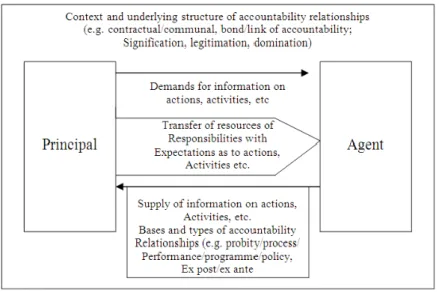
Figure 1. Relation Between Principal and Agent
This agency theory can be applied to current and future issues. In addition, the agency connection will incur a fee known as agency cost. Michael and Meckling define agency costs as expenses incurred by agents to ensure that actions are taken in response to management's needs, that managers refrain from taking specific actions that could jeopardize management, or that management is compensated if such actions are taken (Yolles, 2021).
Sitorus argued further that managers with zero agent costs would be incapable of making optimal decisions. Therefore, the managers should be adequately compensated for their efforts (Sitorus, 2019). Additionally, agency theory can assist in resolving two issues between the agent and principal: 1) There is a
disagreement, and the principal finds it difficult or expensive to monitor and determine the agent's management activities, 2) The second issue is risk- sharing, which arises when the principal and agent display divergent risk management behaviors.
Financial Accountability
Financial responsibility is one of the most delicate aspects of managing a non- profit organization like dayah. This dimension demonstrates how the organization manages its funds, which are derived from contributions from the congregation, the government, and other sources and entrusted to the dayah manager for the common good of dayah, which has historically been one of the ummah's sources of benefit (Fauré, 2019).
The operations of dayah heavily rely on conformity, and those operations are regarded as arbitrary when exact conformity with the organization is lacking.
The Qanun states that dayah must adhere to legal requirements and conditions in order to maintain its legal status as a result of public donations to its operations. Allah stated,
"O you who believe, obey Allah and obey His Messenger, and the ulil amri among you. Then if you disagree about something, then return it to Allah (the Qur'an) and the Messenger (his Sunnah), if you truly believe in Allah and the Last Day. That is more important (for you) and better as a result" (Surah An-Nisa: 59).
This responsibility extends to financial management, which refers to the principles that govern the administration of organizational resources in an efficient, effective, accountable, and transparent manner while adhering to Islamic sharia (Ibrahim, 2010). The management stages include planning, implementation, accountability, supervision, data generation, fundraising, and financial sustainability (Smith, 2019).
According to PSAK No. 45 (updated version), the primary goal of financial statements for non-profit organizations is to provide stakeholders with relevant and trustworthy information (Akanga, 2017). The stakeholders include donors, organizational members, creditors, the government, student parents, and administrators. The financial statements required by PSAK 45 must include a statement of financial position, activity reports, cash flow statements, and notes to financial statements.
Financial accounting standards for dayah organizations are presented in accordance with PSAK No. 45, which is used in conformity with the DEO, and thus with standard concepts and methods in organizational accounting practice in a specific environment. Financial accounting standards exist to provide a framework for the preparation of financial statements for a variety of purposes based on the needs of each organization, with the ultimate goal of producing a report that can be used to demonstrate that the organization's funds have been used appropriately. In Indonesia, the Financial Accounting Standards Board, known as IAI, is responsible for regulating financial reporting.
Accounting in Islam
Accounting in a broad sense is central to the Islamic faith, as Muslims believe they are accountable to God and society for all of their actions. Accounting originates from the Arabic term hesab, which means "account." The term 'account' is used in the Qur'an in its broadest sense, referring to the obligation of every Muslim to 'account' to Allah for all human endeavors (Muddatstsir, 2018b; Yasmin, 2018).
In this sense, each Muslim has an "account" with Allah, who keeps track of both good and evil deeds. Each individual's "account" will be revealed by Allah on the day of judgment. This adds a degree of judgment to things and actions that is absent from conventional financial statements. Thus, the fundamental similarity between hesab in Islam and 'accounting' resides in the Quranic obligations that each Muslim must fulfill.
Similarly, management and capital suppliers must be held accountable for their business activities both within and outside of their organization. Accountability in this context refers to accountability to one's community (ummah) or the larger community (Saad, 2018; Ibrahim, 2018). In good faith, Muslims cannot separate their behavior into religious and secular aspects, and their actions must always be constrained by Sharia. As a result, Islamic law imposes a slew of obligations and behaviors, such as worship, prayer, behavior, and morality, as well as economic transactions and business practices.
Thus, in Islam, responsibility requires each Muslim to ensure that their actions in the world are consistent with Islamic principles, "Man is accountable to God, and his success in the afterlife is dependent on his conduct on earth." This idea is central to Islam's message in the political, social, and personal spheres. Islam regards responsibility as a universal standard that applies to all situations.
Good Corporate Governance
Good Corporate Governance (GCG), according to Chouaibi (2022), aims to provide a mechanism for orienting economic agents, the legal system, and corporate governance to moral and social goals based on norms. The purpose of all economic activity conducted by businesses is to improve the well-being of individuals and communities (Ibrahim et al., 2019). The first of the GCG's five implementation requirements is transparency, which includes information disclosure to stakeholders. This is essential for building public confidence in management or organizational managers' decision-making, so that all stakeholders are aware of what is occurring and what will occur in the future.
In this situation, accountability is the clarity of who is responsible for what.
Participation is the third factor, and it is essential that all parties involved in the decision-making process participate. This study focuses on the public's demand for dayah financial management in Aceh. The interview findings are supported by documentation of the legitimacy of dayah's establishment, dayah's organizational structure, Standard Operating Procedures (SOP) pertaining to the roles and authorities of each field, previously prepared financial statements by each dayah, and guidelines for preparing financial statements.
METHODOLOGY
This study employs a qualitative methodology and a case study approach. The data analysis utilizes Milles and Huberman's qualitative stages (Huberman, 2005). This investigation is focused on dayah type A, which can be found in the following municipalities/districts in Aceh Province: East Aceh District, Langsa City, and Aceh Tamiang District. Meanwhile, the informants in this study were Aceh Province administrators and all dayah stakeholders.
The main and supplementary components in determining the type of Pesantren are determined by Minister of Religious Affairs Regulation No. 13/2014. The informants for this are chosen using the purposive sampling technique, with the following requirements in mind: 1) be a dayah leader; 2) actively involved in financial/administrative reporting; and 3) willing to participate. In addition, documentation techniques are used to support the interview findings. The types of documents include the dayah's founding legislation, its organizational chart, its Standard Operating Procedures (SOP) outlining the roles and authority of each field, financial reports, and instructions for preparing financial reports.
The qualitative data analysis activities are carried out interactively and
continuously until the data is saturated. The second stage consists of analyzing with Nvivo 12 software as well as reading Txt and content that is similar to other data, locating items that are related to one another, and searching for meanings, words, and knocks that are related to interviews and articles. The third step is to analyze and compare the phenomenon to existing concepts and theories.
RESULT AND DISCUSSION Results
The results indicate that the three dayah institutions have not actively submitted accounting reports as a form of accountability for the use of public funds.
Financial record keeping, which is still very simple and poorly documented, makes it difficult for organizations to report, resulting in donors not receiving accurate information about organizational accountability. Theoretically, accounting is important as a form of accountability for an organization that accepts public donations. For similar reasons, the government has shown little enthusiasm for educating and evaluating institutions to ensure proper financial reporting documentation, so the organization has grown accustomed to simple reporting that is not necessarily accountable.
From this perspective, the dayah organization's financial reporting and accountability requirements have not been fulfilled such that donors are informed of how and where their donations are used. Currently, digitalization is required for a variety of tasks, including the processing of dayah financial reporting, which is regarded as quite effective and efficient in comparison to manual reporting. Dayah organization as an entity with Islamic values is essential to the implementation of accounting and accountability in accordance with Islamic teachings, specifically having proof as a form of financial reporting accountability.
Discussions
Development of Dayah in Aceh
In order to efficiently run the organization and achieve its desired goals and objectives, management must fulfill its obligations. If this accountability system is implemented, managers will take a more proactive role in managing their company because they will be held accountable for monthly reporting
(Martinez, 2017). Islam also requires accountability, as explained in Surah Al Baqarah verse 282 of the Quran:
"O you who believe, if you do not do mu'amalah in cash for a specified time, then you should write it down. And let a writer among you write it correctly. And the writer should not be reluctant to write it down as Allah has taught him" (Surah Al-Baqarah: 282).
From this verse, we can deduce that all parties involved have an obligation to ensure that all relevant transactions are recorded and that all parties involved have access to accurate information about the current state of affairs. This is performed in anticipation of unpleasant situations, such as those involving external organizations, and as evidence that managers fulfilled their responsibilities in accordance with the vision and mission of the organization (Cheuk, 2021).
In the execution of community development, dayah functions not only as an educational and religious institution, but also as an institution for the empowerment of people. It is reasonable to include dayah as a deciding element in the formation of the Indonesian social pyramid. The importance of Dayah's role necessitates that it contributes significantly to all aspects of social development, both educationally and through community development. Dayah has long been recognized as an educational institution which its mission it is to liberate its students from the shackles of ignorance, which are the adversaries of education in general. The next level of education will equip students with the knowledge of science and religion as a tool for influencing the development process, which is fundamentally a social transformation toward an ideal social order.
The potential of dayah as a community-based, democratic school run by and for the people is essential to the ethical development of the nation. The presence of a highly regarded scholar or charismatic figure in dayah who serves as a role model for the community, the availability of adequate Human Resources in dayah, the spirit of independence, elegance, and simplicity that grows among students and dayah's extended family, and the substantial public interest and attention to dayah all contribute to the development of the Indonesian nation.
The significant amount of religious instruction in dayah, along with general education, skill acquisition, and more in-depth moral counseling, are extremely potent pillars for the growth of this great country.
It is regrettable that, in this age of technological acceleration, very few dayah graduates are absorbed at the next level of education and in employment that requires a depth of general knowledge, particularly in the field of technology, so that people prefer general education for their children's education over dayah, whose influence is becoming increasingly minimal, particularly dayah salafiah (the Traditional Boarding School).
Moreover, Islamic boarding schools receive unmatched levels of support from the government in terms of infrastructure investment, financial resources, and the qualities of their teaching staff. Dayah salafiah (Tradisional Boarding School) believes that dayah's image should be numbered, particularly for the business community and above.
The community is the entity that directly benefits from dayah's educational outcomes. Dayah graduates who are religiously competent are valuable members of society. Religious rituals such as prophet birthday celebrations, inheritance distribution, and sacrificial animal slaughter all necessitate specialized knowledge that is only available through dayah education.
Dayah recognizes the community's need for qualified religious sciences personnel. Dayah thus provides the community's younger generation with a broad religious understanding. Abu and Tengku, as the dayah Leader is commonly known, demonstrate how students are prepared for real-world experiences.
The community makes use of students' religious life for communal recitation, religious lectures in sites of celebration, aqiqahan, corpse management, tahlilan, and other rites. According to the study's findings, Abu and the Tengku were frequently invited to engage in specific activities by the local community and the government, with dayah typically arranging the participation of the children. The students are used as performers in the community, such as hostesses, Quran readers, and prayer leaders.
Abu is routinely invited to events hosted by government entities such as the Office of Religious Affairs, the Village Office, the Sub District Office, and even the Police Station. As a result, Abu gained knowledge and followed the social progress of society for the development of the nation and state. Abu instilled in the students a social life marked by the synergistic connection of dayah, society, and government. Abu's contribution to society, nation, and state
as a progressive agent, particularly spiritual and mental development, was considerable.
Dayah Financial Management
Additionally, dayah is very open to any party that wants to learn about the state of dayah and join in on spreading information about how to manage dayah professionally. However, the demands of it all for pilgrims and guardians of students are not overly onerous, which has a significant impact. Dayah really understands many shortcomings that are had regarding administration matters, where the administration in dayah is still very traditional and minimal in reporting.
Essentially, management is a functional area inside a business or educational institution that examines the use of finances, acquiring funds, and disseminating the outcomes of the company's activities (Triyuwono, 2016).
Financial management has developed from management that focuses primarily on fundraising operations to management that prioritizes funds and asset management.
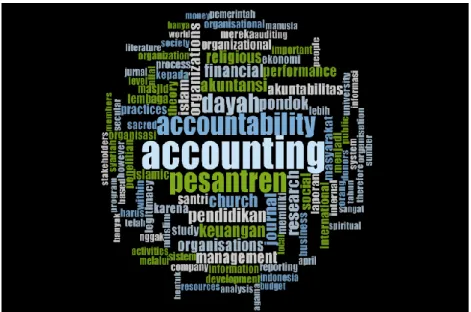
Figure 2. Word Cloud from Nvivo 12 Plus Analysis Results
The results of the data analysis show that the terms accounting, accountability, finance, reporting, dayah, system, stakeholder, and government commonly appear when utilizing the Nvivo 12 Plus software on Word Cloud. This implies
that the phrases that frequently surface have something to do with dayah's accountability.
Dayah's financial management can be regarded narrowly as bookkeeping.
Meanwhile, in a broader sense, it refers to an institution's administration and accountability to its patrons, both individual and institutional. According to the definition, Islamic boarding school finance and corporate finance both cover bookkeeping and financial management (Hadi, 2018).
Dayah implements finance in a manner that is remarkably similar to how financial management is conducted in other financial organizations. This includes financial planning, implementation, evaluation, and accountability.
Financial management tasks provide for the successful and efficient planning, funding, public disclosure, and utilization of funding needed for dayah program implementation. In order to achieve this, dayah's financial management goals include improving the efficacy and efficiency of how its funds are spent, raising financial accountability and transparency, and decreasing budget abuse.
Internal control and supervision are two activities that are essential to dayah financial management. It is possible to carry out supervision in line with the necessary conditions and legal restrictions. Dayah's leaders must manage expenses in accordance with the established budget.
Internal control has evolved into a variety of sectors over the years. It is involved not only in many different sorts of organizations, such as enterprises, but also in all activities at every level of its organization. As a result, current internal control outperforms past internal control and accounting control.
Internal control was formed originally to meet the needs of enterprise management, and was followed by external audit and macro control. Internal control has gone through five stages: internal inspection, internal control system, internal control structure, integrated framework of internal control, and enterprise risk management-integrated frame, which correspond to the simple- to-complex, dispersed-to-systematic development norms. Internal control is a set of policies and processes designed to safeguard an organization's assets, assure accurate financial reporting, promote compliance with laws and regulations, and ensure effective and efficient operation.
The system not only relates to accounting and reporting, but also to the organization of communication processes, both internally and externally, and to the organization's handling of funds received and issued, in which case the
organization must first implement procedures for handling funds received and issued. Prepare accurate and timely financial reports for board members and officials, and conduct an annual audit of the financial accounts of the second organization. Third, evaluate staff and programs. Maintains inventory and existence of real and personal property records, and the fourth Personnel in charge of enforcing policies and settling conflicts. Implementing and effectively monitoring internal control systems can guarantee that these organizations meet their goals, such as providing professional community services while maximizing resource utilization and limiting the risk of fraud, mismanagement, or errors.
The Aceh Government Regulation, also known as Qanun Number 9/2018, states that the Internal Control System is an integral process in actions and activities carried out continuously by the leadership and all employees to provide adequate confidence in the achievement of organizational goals through effective and efficient activities, reliable financial reporting, security of state assets, and compliance with laws. That dayah's organizational administration is an integral component gives reasonable assurance that the following objectives are met. The effectiveness and efficiency of Dayah's operations, the dependability of dayah's financial reporting, and compliance with applicable rules and regulations.
To secure dayah's assets, ensure the accuracy and dependability of dayah's financial records and information, and so on, immediate control within the dayah organization is essential. Encourage dayah's operations to be more efficient. Examine compliance with dayah management-mandated policies and procedures. The dayah Leadership is being handled as part of the dayah financial review implementation. Its personnel are only in charge of coordinating dayah activities, while the dayah Leadership and participating parties directly manage finances. When there is a dayah transaction including expenditure and receipt, as indicated by the receipt of minutes under the sight of multiple dayah parties, this evaluation is recognized. Dayah can execute financial monitoring on all incoming and exiting funds in the application of financial supervision. signed and recorded in the minutes by the treasurer.
To achieve this goal, pesantren leaders and financial staff must be creative in identifying financing sources, choosing accountants who are experts in bookkeeping and financial accountability, and properly employing funds in accordance with existing laws and regulations (Muddatstsir, 2018b). In order
to run its organization, dayah requires the public's trust as a donor in the management of its funds; therefore, the legality of the institution serves as the primary legal responsibility for dayah's establishment.
In this study, it was determined that dayah had complied with the legal requirements of his organization, thereby fulfilling his obligations as an official organization. In reality, however, the community does not view legality as a significant aspect of dayah; rather, the ash/leader of dayah is the most influential in deciding whether or not to believe any problem.
Contrary to agency theory, which states that agency relations organizations arise when one or more people hire other people (agents) to provide the necessary services and delegate the authority to delegate the agent's decisions, this is not the case. In fact, research explains that there is a very close relationship between the organization's managers and its employees and other participants (Schäuble, 2019).
Within the context of financial administration Contrary to the Agency Theory, where there is a relationship between dayah managers and the community, the community does not care about dayah financial reporting at this time. The community has a great deal of faith in dayah management because dayah is managed by individuals who have a deep understanding of Islam, and they believe that it is impossible for managers to take actions that violate Islamic law.
In the context of government, agency theory explains that agency relationships arise when one or more people (principals) hire another person (agent) to provide a service and then delegate decision-making authority to the agent.
However, in this study, Agency Theory is not apparent, as the dayah manager is not employed by the government, preventing the government from intervening easily in the organization of dayah. In this study, it was also discovered that, according to the Dayah Education Office (DEO), it is difficult for the government to intervene in dayah, not only because dayah does not belong to the government, but also because the government lacks the budget to distribute or distribute aid to dayah.
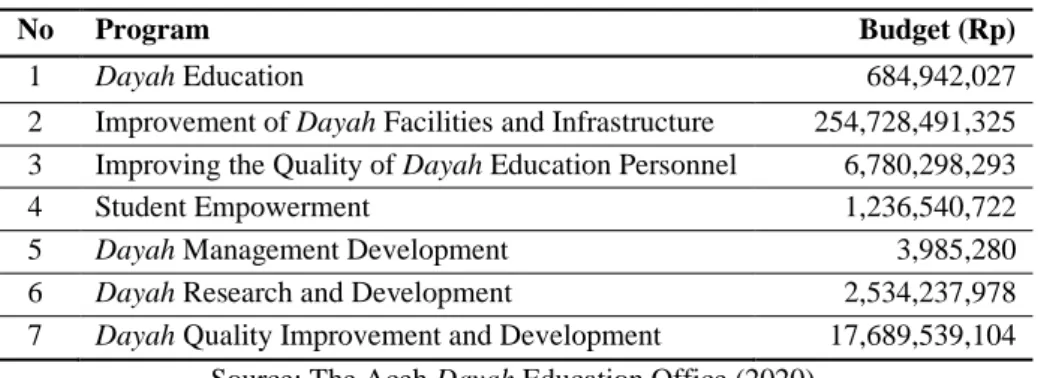
The Aceh government is focused on the fact that the Aceh government, through the DEO, has committed funding in 2020 to expand dayah's potential and advancement through several projects, including the following:
Table 1. Dayah Education Office Program Budget
No Program Budget (Rp)
1 Dayah Education 684,942,027
2 Improvement of Dayah Facilities and Infrastructure 254,728,491,325 3 Improving the Quality of Dayah Education Personnel 6,780,298,293
4 Student Empowerment 1,236,540,722
5 Dayah Management Development 3,985,280
6 Dayah Research and Development 2,534,237,978 7 Dayah Quality Improvement and Development 17,689,539,104
Source: The Aceh Dayah Education Office (2020)
As seen in the table above, the Aceh government has worked to increase the capacity of the dayah in a variety of methods. However, due to the large number of dayahs in Aceh, these initiatives cannot be enjoyed equally by all dayahs, and hence the government's dayah Management Development cannot be deemed to have helped all dayahs in Aceh.
Silvia (2017) noticed in his research that religious groups are currently under fire for a lack of accountability for accounting system management, notably erroneous documentation and financial reporting to ascertain the primary source of income for mosque religious organizations. Yasmin (2018) found that religious organizations' internal control systems are still ineffective, which increases risks associated with managing organizational performance and can affect financial management practices.
Dayah's financial administration in Aceh is centralized (Chowdhury, 2019).
Dayah and finance personnel are in charge of the Islamic boarding school's financial administration (centralized). Dayah must focus on numerous financial planning variables by gathering and evaluating data and compiling it as evaluation material at the end of the year.
The financial planning process in Dayah is carried out by the appropriate head of staff, but it is supervised, overseen, and authorized by the dayah Leader. In dayah, all activities, such as learning, are intrinsically interwoven.
Furthermore, various other dayah activities are linked, such as activities in the dormitory, at the mosque, in the field, and needs in public kitchens, among others, thus this situation has a big impact on dayah's financial planning process.
Financial planning occurs once a year, near the end of the school year, following the receiving and discussion of all reports at the year-end meeting.
However, planning takes place on a monthly basis and at the end of each semester. Dayah's funds aren't always stable, but they get the job done; yet, they lack a constant donor. While dayah has not yet agreed to publish their financial reports, the study's findings indicate that they do not oppose to revealing their financial reports to anyone who wants them, indicating that dayah has began to open up to their financial reporting.
Dayah religious non-profit organizations play such an important and diverse role in modern society that their success is dependent on public confidence and faith in their actions. Paul (2011) discovered a complete absence of trust in the charitable sector. This is confirmed by their research, which found that 74% of the general public believes that tighter control of the rules governing charitable organizations is required. The majority of them believe the money will be donated to charity. However, not all of the funds will go to the beneficiaries of the dayah religious non-profit organization.
This study shows that accountability is widespread and essential in dayah religious non-profit organizations. This rationale supports the view that the greater responsibilities of dayah's religious non-profit organizations should be viewed as an opportunity rather than a threat (Gautama, 2022). Thus, increasing the accountability systems of dayah's religious non-profit organizations can assist limit the danger of social harm and certain enterprises' hostility to improving their social performance. As a result, maintaining public trust and financial support for charitable operations is vital, as is establishing accountability for philanthropic activities. One of the challenges with accountability in faith-based organizations is that much of their work deals with mental issues that are difficult to quantify.
Responsibility in Islam demands each Muslim to ensure that their actions in the world conform to Islamic principles (Sharif, 2018; Kamri et al., 2014), "Man is accountable to God, and his eternal prosperity is contingent upon his behavior on earth." Indeed, this notion is central to Islam's message regarding the political, social, and individual spheres. Islam considers responsibility as a universal norm that applies to all.
The financial accountability of dayah is presented to leadership through monthly and annual reports. The accountant submits a technical report to the
leadership of the pesantren. Financial reports are submitted by the accountant or treasurer for each activity and section. They documented the evidence of receipt, storage, and payment to the persons concerned, which the treasurer subsequently reported to the dayah leadership. Meanwhile, for government- funded operations, dayah's leadership and treasurer always create, evaluate, and correct an LPJ (Responsibility report), which is then immediately forwarded to the government (Cheuk, 2021).
However, the dayah that is the subject of this study is still unable of producing financial statements in compliance with PSAK 45 (Klenk, 2019). Dayah has only produced cash flow statements so far, despite the fact that PSAK mandates that all religious organizations have a balance sheet, activity and cash flow reports, and comments to financial statements. The primary factor is that dayah's human resources are still relatively limited; thus far, dayah's managers are his own students who lack a formal degree. The role of the government in offering training on dayah financial management in Aceh is not yet optimal.
Islamic corporate governance is a derivative of the concept of good corporate governance (GCG) and has the same goal as conventional GCG. But what makes the difference is that Islamic corporate governance is based on Islamic laws. Globally, ICG is included in the GCG category. Good Corporate Governance is a system that regulates and controls companies in running their business in order to increase success and accountability based on laws and ethical values. In practice, the dayah has carried out the values of Islamic corporate governance, namely by complying with all regulations required by the government to have organizational legality, making financial reporting even though it is still simple, all of this is done in order to create public trust in the dayah. This is in accordance with his research by Asutay (2019) which states that NGO managers have carried out their duties well even though they are still very simple, as a result of the manager's ability to be minimal in depth and without payment or voluntarily.
The Aceh Government Regulation, or more commonly referred to as Qanun No. 9 of 2018, concerning the implementation of dayah education, states that the Internal Control System is a continuous process of actions and activities carried out by leaders and all employees in order to instill sufficient confidence in the achievement of organizational goals through effective and efficient operations, the validity of financial reporting, the safeguarding of state assets, and compliance with laws and regulations.
Action and Offers
This study is a variation of action research that seeks to address research and societal issues. This study shows how the dayah institutions in Aceh Province should make the most of their human resources in order to report their financial flow as a means of accountability in order to address the issues found in this study. This study also suggests that the government should play a role in allowing dayah institutions to take an active part and interact with institutions recognized as capable of bolstering human resources in dayah institutions.
Additionally, the dayah institutions must publish the results of financial statements whose funding comes from the general public, so that the community believes in dayah's good management, thereby increasing public trust and encouraging the public to donate more to the dayah organization.
Concerning actions, these results were presented to the organization's leadership, which then forwarded to the DEO which responsible for dayah development. To gather aspirations from different stakeholders and identify the challenges faced, follow-ups can be conducted, such as Focus Group Discussions (FGD). Furthermore, higher education institutions, that have human resources capable of resolving dayah financial reporting issues, can provide direct and ongoing assistance, allowing problems to be appropriately resolved and implemented across all dayahs in Aceh.
CONCLUSION
This study reveals that the dayah institutions in Aceh have not fully complied with the financial accounting standards outlined in PSAK 45 by the Indonesian Institute of Accountants (IAI), particularly with regard to the financial statements of non-profit entities, which include statements of financial position (balance sheet) at the end of the period, activity reports, cash flow statements, and notes to financial statements.
In addition, the report concludes that dayah institutions have not optimized their human resources through integration with regulatory bodies. Therefore, it is essential to expedite the enhancement of financial reporting in dayah institutions. These findings have implications for the improvement of dayah institutions' financial reporting in Aceh Province and throughout Indonesia. It has particular implications for the development of financial reporting policies for dayah institutions.
This study has limitations in terms of research scope, as it is limited to Aceh Province. It is suggested that future studies broaden their scope to include all provinces in order to compare practices across provinces, and that they also include some international non-profit organizations as a pattern. Furthermore, researchers should be able to observe the impact of effective financial management and accountability on non-profit organizations, as well as the effect on the number of donations received.
REFERENCES
Ahrens. (2015). Newcastle City Council and the Grassroots: Accountability and Budgeting under Austerity. Accounting, Auditing & Accountability Journal, 28(6), 909-933. https://doi.org/https://doi.
org/10.1108/AAAJ-03-2014-1658
Akanga. (2017). Microfinance Accountability in Cameroon: A Cure or a Curse for Poverty Alleviation? Journal of Accounting and Organizational
Change, 13(1), 112--130.
https://doi.org/https://doi.org/10.1108/JAOC-11-2015-0087
Asutay, M. (2019). The State of Islamic Governance in Islamic Financial Institutions: Islamic Governance Index. Research in Corporate and Shari’ah Governance in the Muslim World: Theory and Practice, Emerald Publishing Limited. https://doi.org/https://doi.org/10.1108/978-1-78973- 007-420191037
Chen, C. (2020). Interface between context and theory: the application and development of Agency Theory in the Chinese context. International
Journal of Emerging Markets, 18(1).
https://doi.org/https://doi.org/10.1108/IJOEM-06-2019-0433
Cheuk, S. (2021). Financial Management Capacity, Accountability, Own Income Generation, Revenue Diversification and Financial Sustainability in Charities Of Malaysia. Studies on Applied Economics, 39(1).
https://doi.org/https://doi.org/10.25115/eea.v39i1.4279
Chouaibi, J. (2022). Do board directors and good corporate governance improve integrated reporting quality? The moderating effect of CSR: an empirical analysis. EuroMed Journal of Business, 17(4).
Chowdhury. (2019). Financial Reporting Practices of Local NGO’s Operating in Bangladesh. Journal of Economics, Business and Management, 7(1), 24. https://doi.org/doi: 10.18178/joebm.2019.7.1.575
Chu, V. (2022). “Felt responsibility”: a mediator for balancing NGOs’ upward and downward accountability. Journal of Accounting & Organizational Change, 18(2). https://doi.org/https://doi.org/10.1108/JAOC-05-2020- 0057
Cordery, C., Belal, A. R., & Thomson, I. (2021). NGO accounting and accountability: past, present and future. Accounting Forum 45:2, pages 142-170. https://doi.org/https://doi.org/10.1080/01559982.2019.1593577 Donaldson, L., & Davis, james h. (1991). Stewerdship Theory Or Agency
Theory: CEO Governance And Shareholders Returns. Australian Journal Of Management, Volume 16, 49–56.
Fauré. (2019). To Speak or Not to Speak the Language of Numbers: Accounting as Ventriloquism. Accounting, Auditing and Accountability Journal,
21(3), 337–361.
https://doi.org/https://doi.org/10.1108/AAAJ-07-2017-3013
Frank, D. (2010). The Misapplication Of Mr. Michael Theory Brought Down The Economy And Why Might Again. Markets On Trial: The Economic Sociology Of The U.S. Financial Crisis Part B, 30(2), 29–64.
Gafur, A. (2021). Akuntabilitas Berbasis Amanah Pada Pondok Pesantren.
Jurnal Akuntansi Multiparadigma, 12(1), 95–112.
https://doi.org/https://doi.org/10.21776/ub.jamal.2021.12.1.06
Gautama, V. (2022). Accountability and legitimacy dynamics in an Islamic boarding school. Journal of Accounting & Organizational Change, 18(4).
https://doi.org/https://doi.org/10.1108/JAOC-02-2021-0016
Gibassier. (2018). Integrated Reporting is likeGod: No One has Met Him, but Everybody Talks about Him”: The Power of Myths in the Adoption of Management innovations. Accounting, Auditing and Accountability
Journal, 31(5), 1349-1380.
https://doi.org/https://doi.org/10.1108/AAAJ-07-2016-2631
Girei. (2022). Managerialisation, accountability and everyday resistance in the NGO sector: Whose interests matter? Critical Perspectives on Accounting.
https://doi.org/https://doi.org/10.1016/j.cpa.2022.102418
Goddard, A. (2006). Accounting and navigating legitimacy in Tanzanian NGOs. (In special issue: NGO accountability). Accounting Auditing &
Accountability Journal, 19(3).
Hadi, A. (2018). The Existence of Dayah Educational Institutions in the
National Political Escalation. AL-IJTIMA`I-International Journal of Government and Social Science, 2(2), 145–160.
Huberman, M. (2005). Qualitative Data Analysis. Universitas Indonesia Press.
https://doi.org/979-456-103-7.
Ibrahim, A. (2010). Konsep akuntansi konvensional dalam pandangan syariah:
Telaah kritis terhadap komponen pembentuk akuntansi konvensional.
Jurnal Media Syariah, 12(23).
Ibrahim, A. (2018). Islamic Work Ethics and Economic Development in Islamic Countries: Bridging Between Theory and Reality. Paper presented at the International Conference of Moslem Society, Kuala Lumpur, Malaysia.
Ibrahim, A., Fitria, A., & Dianah, A. (2019). Internal Control System of the State Islamic Universities in Indonesia: Studying the Effectiveness and Risk Management. Share: Jurnal Ekonomi dan Keuangan Islam, 8(1), 68- 89.
Kamri, N. A., Ramlan, S. F., & Ibrahim, A. (2014). Qur’anic Work Ethics.
Journal of Usuluddin, 40(-), 135-172.
Klenk. (2019). Accountability in Practice Organizational Responses to Public Accountability Claims. International Journal of Public Administration, 38, 13. https://doi.org/https://doi.org/10.1080/019 00692.2015.1069841 Kuruppu, S., & Lodhia, S. (2019). Shaping accountability at an NGO: a
Bourdieusian perspective. Accounting, Auditing & Accountability Journal, 3(1), 178–203. https://doi.org/https://doi.org/10.1108/AAAJ-09- 2016-2696
Maraye, P. (2022). Evaluating NGO accounting and reporting practices in a developing economy: the case for reforms. Journal of Public Budgeting, Accounting & Financial Management, 12(3).
https://doi.org/https://doi.org/10.1108/JPBAFM-01-2022-0021
Marhamah. (2020). Pendidikan Dayah dan Perkembangannya di Aceh. At- Ta’dib: Jurnal Ilmiah Pendidikan Agama Islam, 10(1).
Martinez. (2017). As sembling International Development: Accountability and the Disarticulation of a Social Movement. Accounting, Organizations and
Society, 63, 6–10.
https://doi.org/https://doi.org/10.1016/j.aos.2017.02.002
Muddatstsir, U. D. Al. (2018a). Praktik Akuntabilitas Masjid: Studi Kasus Pada
Masjid Al Akbar Surabaya. Economica, 9(2), 96. https://doi.org/DOI : 10.21580/economica.2018.9.2.2350
Muddatstsir, U. D. Al. (2018b). The Way to Build a Mosque Accountability. In Proceedings of the Journal of Contemporary Accounting and Economics Symposium on Special Session for Indonesian Study, 793–801.
https://doi.org/10.5220/0007021407930801
Mzenzi, S. I. (2022). Accounting and accountability in Muslim secondary schools in Tanzania: a Bourdieusian perspective. International Journal of
Public Sector Management, 8(1).
https://doi.org/https://doi.org/10.1108/IJPSM-01-2022-0012
Nur, I. (2019). Mudernising The Dayah. Epistemé: Jurnal Pengembangan Ilmu
Keislaman, 12(2).
https://doi.org/https://doi.org/10.21274/epis.2019.14.2.253-267 Office, T. A. D. E. (2020). The Aceh Dayah Education Office Work Plan.
Paul, P. (2011). Financial Management in the Voluntary Sector. Taylor and &
Francis Group.
Saad. (2018). Islamic Accountability Framework in the Zakat Funds Management. Social and Behavioral Sciences, 5(2), 508–515.
https://doi.org/https://doi.org/10.1016/j.sbspro.2014.11.139
Schäuble, J. (2019). The impact of external and internal corporate governance mechanisms on agency costs. Corporate Governance, 19(1).
https://doi.org/https://doi.org/10.1108/CG-02-2018-0053
Sharif. (2018). A robust zakah system : Towards a progressive socio-economic development in Malaysia. MIddle-East Journal of Scientific Reseaerch,
7(4), 550–554.
https://doi.org/https://doi.org/10.1016/j.ausmj.2018.08.001
Sharon, S. S. (2020). Refleksi Rumah Adat Ammatoa Dalam Akuntabilitas Organisasi. Jurnal Akuntansi Multiparadigma, 11(1), 59–76.
https://doi.org/https://doi.org/10.21776/ ub.jamal.2020.11.1.04
Silvia. (2017). Oral -Aural Accounting and the Management of the Jesu it Corpus. Accounting, Organizations and Society, 59, 44–57.
https://doi.org/https://doi.org/10.1016/j.aos.2017.04.003
Sitorus. (2019). The Romance of Modern Accounting Education: An Impact from Positivism and Materialism. Global Business and Economics
Review, 21(1), 78–95.
https://doi.org/https://doi.org/10.1504/GBER.2019.096858
Smith. (2019). An Ethnographic Study of Culture and Performance in the UK Lingerie Industry. The British Accounting Review, 51(3), 241.
https://doi.org/https://doi.org/10.1016/j.bar.2019.02.002
Syarifuddin, S. (2021). Islamic Plurality in the Perspectives of Ulama Dayah in Aceh. The International Journal of Social Sciences, 2(3).
https://doi.org/https://doi.org/10.26811/peuradeun.v9i3.583
Talib, A. (2020). An institutional perspective for research in waqf accounting and reporting: A case study of Terengganu state Islamic Religious Council in Malaysia. Journal of Islamic Accounting and Business Research, 11(2).
Triyuwono, I. (2016). Contemporary Issues in Management & Social Sciences.
Pertanika Journal of Social Science and Humanities, 24(May), 89–104.
Witono, B. (2021). Regulation Hegemony And Accountability Of Thelocal Government: A Study On Regional Financial Management In Indonesia.
The International Journal of Accounting and Business Society, 29(1), 57.
Yasmin. (2018). Exploring De-Facto Accountability Regimes in Muslim
NGOs. Accounting Forum, 42(3), 235–247.
https://doi.org/https://doi.org/10.1016/j.accfor.2018.07.002
Yolles, M. (2021). Towards a general hybrid theory in wicked problem structuring part 2: the relational agency paradigm. Kybernetes, 50(2).
https://doi.org/https://doi.org/10.1108/K-10-2019-0691