Please respect intellectual property rights
This material is copyright and its use is restricted by our standard site license terms and conditions (see palgraveconnect.com/pc/info/terms_conditions.html).
If you plan to copy, distribute or share in any format, including, for the avoidance of doubt, posting on websites, you need the express prior permission of Palgrave Macmillan. To request permission please contact [email protected].
Finance
Ioannis Akkizidis and Sunil Kumar
Khandelwal
FINANCIAL RISK MANAGEMENT FOR ISLAMIC BANKING AND FINANCE
Palgrave Macmillan Finance and Capital Markets Series
For information about other titles in this series please visit the website:
http://www.palgrave.com/business/financeandcapitalmarkets.asp
Financial Risk Management for Islamic Banking and
Finance
IOANNIS AKKIZIDIS AND
SUNIL KUMAR KHANDELWAL
© Dr. Ioannis Akkizidis and Dr. Sunil Kumar Khandelwal 2008 First Foreword © Agil Natt 2008
Second Foreword © Amgad S. Younes 2008
All rights reserved. No reproduction, copy or transmission of this publication may be made without written permission.
No paragraph of this publication may be reproduced, copied or transmitted save with written permission or in accordance with the provisions of the Copyright, Designs and Patents Act 1988, or under the terms of any licence permitting limited copying issued by the Copyright Licensing Agency, 90 Tottenham Court Road, London W1T 4LP.
Any person who does any unauthorised act in relation to this publication may be liable to criminal prosecution and civil claims for damages.
The authors have asserted their rights to be identified as the authors of this work in accordance with the Copyright, Designs and Patents Act 1988.
First published in 2008 by PALGRAVE MACMILLAN
Houndmills, Basingstoke, Hampshire RG21 6XS and 175 Fifth Avenue, New York, N.Y. 10010
Companies and representatives throughout the world.
PALGRAVE MACMILLAN is the global academic imprint of the Palgrave Macmillan division of St. Martin’s Press, LLC and of Palgrave Macmillan Ltd.
Macmillan® is a registered trademark in the United States, United Kingdom and other countries. Palgrave is a registered trademark in the European Union and other countries.
ISBN-13: 978–0–230–55381–1 hardback ISBN-10: 0–230–55381–8 hardback
This book is printed on paper suitable for recycling and made from fully managed and sustained forest sources. Logging, pulping and manufacturing processes are expected to conform to the environmental regulations of the country of origin.
A catalogue record for this book is available from the British Library.
A catalog record for this book is available from the Library of Congress.
10 9 8 7 6 5 4 3 2 1
17 16 15 14 13 12 11 10 09 08 Printed and bound in Great Britain by CPI Antony Rowe, Chippenham and Eastbourne
Other books by Ioannis Akkizidis
1. Guide to Optimal Operational Risk & Basel-II, 2006, Auerbach Publications / Taylor &
Francis, Boca Raton / New York, ISBN: 0849338131.
2. Integrating Market, Credit and Operational Risk: A Complete Guide for Bankers & Risk Professionals, 2006, Risk Books, London, ISBN: 1904339964.
Apart from its manuscript, the first book also includes a practical operational risk software tool for designing and evaluating an operational risk management framework based on advanced measurement approaches.
The second book is a best seller. Its Chapter 3 ‘Operational Risk’ and Chapter 4 ‘Extreme Value Theory in Risk Management’ are listed from the GARP Association as recommended material for 2007 FRM Study Guide Readings. For more information please visit:
https://www.garpdigitallibrary.org/display/booktitle.asp?btid=161
This book is dedicated to:
‘My Father’
(Dr. Ioannis Akkizidis)
‘My Larger Family’
(Dr. Sunil Kumar)
vii
Contents
CHAPTER
List of Tables x
List of Figures xii
Foreword by Agil Natt xiv
Foreword by Amgad S. Younes xvi
Preface xviii
About the Authors xxiv
Acknowledgements xxvi
Abbreviations xxviii
1 Principles of Islamic Finance 1
Introduction 1 2 Risk Management Issues in Islamic Financial Contracts 28 Introduction 28
An overview of financial risks 30
Identifying risks in Islamic finance 36
Risk of non-compliance with Shariahrules 41
Main elements used in financial risk analysis 41 Mushãrakahcontracts of partnership and financial risks 42
Mudãrabahcontracts of partnership 49
Murãbahacontract agreements and financial risk 54 Salamcontract agreements and financial risk 58 Istisnãcontracts and financial risks 63 Ijãrahcontract agreement and financial risk 68
3 Basel II and IFSB for Islamic Financial Risk 80 Introduction 80
The Basel accord 82
Risk management according to Basel II and the Islamic
financial industry 83
The three pillars of Basel II 84
Pillar 2: Supervisory review 96
Pillar 3: Market discipline 98
IFSB principles of risk management 99
4 Credit Risks in Islamic Finance 109
Introduction 109
Credit risk exposure identification 110
Credit risk assessment models 113
Credit risk valuation 118
Credit risk mitigation 133
Credit rating systems 134
Validating the credit rating systems 139
5 Market Risks in Islamic Finance 148
Introduction 148
Identification of market risk factors 149
Rate of return risk 149
Commodity risk in Islamic finance 154
FX rate risks 159
Equity price risks 160
Valuation issues on equity prices and FX rates 160 Quantification of foreign
exchange risk, equity risk, and commodity risk 161
Data referring to market risk factors 161
Sensitivity in market risk 163
Market risk valuation models 164
VaR models for Islamic financial contracts 164
Position and market data 166
Position risk and exposure risk 168
Evaluation methods of market risk 168
Variance–co-variance method 169
Monte Carlo simulation method 173
Historical simulation 174
Back-testing and stress-testing for market risk exposures 176
6 Operational Risk in Islamic Finance 182 Introduction 182 Main elements in operational risk analysis 183
Identification of operational risk 185
Measuring operational risks 197
Loss events 199
Evaluating operational risk based on VaR analysis 203 Elements in the framework of the operational
risk management 206
7 Concluding Remarks 211
Index 217
x
List of Tables
1.1 Differences between conventional financing and
Islamic financing 3
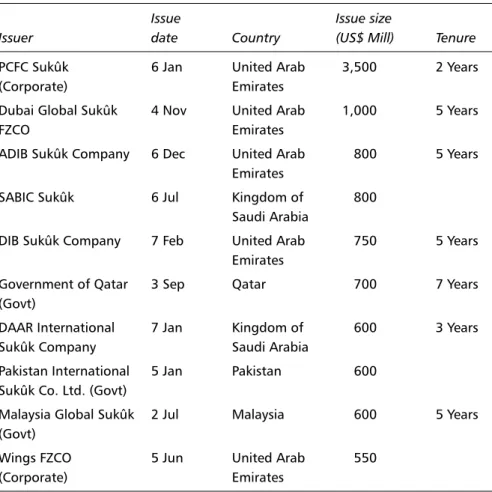
1.2 Typical balance sheet of an Islamic bank 10 1.3 Differences between Mushãrakahand Mudãrabah 17 1.4 Top 10 Sukûkuntil February 2007 based on size 25
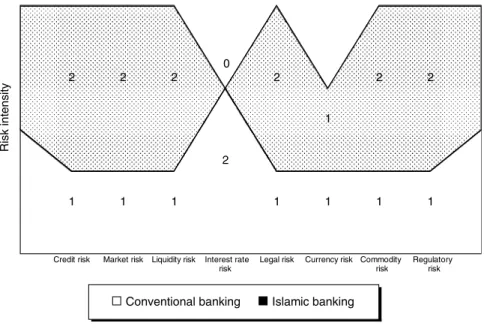
2.1 Risks in Islamic financial services 39
2.2 Comparative information requirements –
conventional vs Islamic banks 40
2.3 Pattern of risks where financial institutions are
exposed by applying Islamic financial contracts 73 3.1 Alternative approaches to credit, market, and
operational risk 87
3.2 Template for the calculation of the credit risk
exposures as per Pillar 1 under Basel II 91 3.3 Detailed loss event type classification 93 3.4 Beta factors for the different business lines 94 3.5 The IFSB guidelines on risk management 100 4.1 Different cases for estimating the probability of
default based on quantitative criteria 123
4.2 Classification of the levels of credit ratings with the indication of the creditability and the reliability
as well as the meaning in terms of exposure 137 5.1 Factors that initiate commodity risk in Islamic
financial contracts 158
5.2 Advantages and drawbacks by applying Historic,
Monte Carlo, and Variance–Co-variance Methods 175
5.3 The three zone ‘traffic light’ for the overshooting
and the multiplier factor 177
6.1 Examples of types of operational causes, events and,
consequences 188
6.2 Sources of operational risks 190
1.1 Structure of Islamic financial service industry 4 2.1 Major types of risks in the financial industry 32
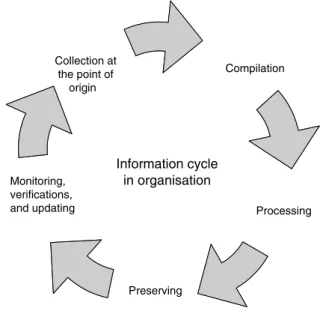
2.2 Information management in organisations 35
2.3 Risk profiling – conventional vs Islamic banks 38 2.4 Main elements considered in financial risk analysis 42 2.5 Structure of Mushãrakahpartnership joint venture
contract agreements 43
2.6 Credit, operational, market, and liquidity risks during
the lifetime of Permanent Mushãrakahcontracts 45 2.7 Credit, operational, market, and liquidity risks
during the lifetime of Diminishing Mushãrakahcontracts 46 2.8 Ownership pattern and risk in Mushãrakahcontracts 48 2.9 Structure of Mudãrabahcontract agreements 49 2.10 Risks in Mudãrabahcontract agreements during
the investment period 51
2.11 Risks in Mudãrabahcontract agreements during
the business profitability and loss period 52 2.12 Murãbahastructure and its main interrelations 55 2.13 Credit, operational, and market risks during the
lifetime of a Murãbahacontract 56
2.14 Relation structure in Salamcontract agreements 59 2.15 Operational, credit, market, and liquidity risks during
the lifetime of Salamcontracts 61
2.16 Relation structure in Istisnãcontract agreements 63 2.17 Operational, credit, market, and liquidity risks during
the lifetime of Istisnãcontracts 66
2.18 Ijãrahcontract agreements 69
2.19 Credit, operational, and market risks during the
lifetime of Ijãrahcontracts 71
xii
List of Figures
3.1 The three pillars of Basel II accord 85 4.1 Relations between the Islamic financial counterparties
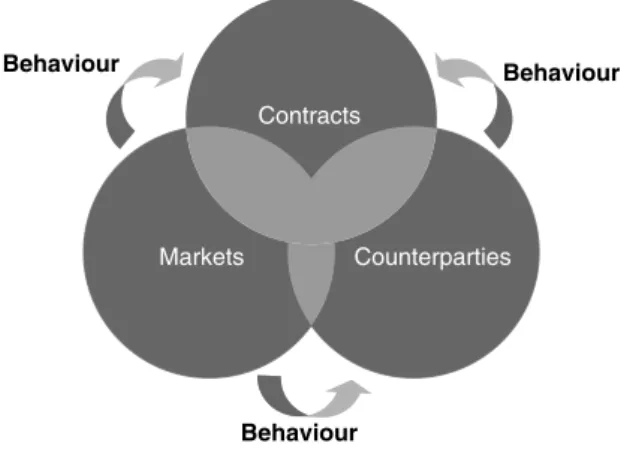
and contracts and the guaranties and collaterals 110 4.2 Representation of the links between a counterparty
with several contracts and risk coverage by
several guaranties and collaterals 112
4.3 Model layout of the expert system for credit
risk assessment 115
4.4 Distribution of expected and unexpected losses
in credit risk 128
4.5 Periods and samples used for the rating valuation 143 5.1 The four types of market risks that exist in the
different Islamic financial products 150
5.2 Interaction and relation between commodity
risk in Islamic finance with other commodity risk factors 155 5.3 Flow chart referring to the Value-at-Risk approach 165 5.4 Main components considered in VaR models 166 5.5 Normal distribution of the changes caused by the
value of a market analysis portfolio 169
6.1 Operational risk analysis based on operational risks
and losses 183
6.2 Main approaches in operational risk
identification analysis 184
6.3 Sources of operational risks and where they
affect Islamic financial contracts 194
6.4 Interactions among the different causes of
operational risks 197
6.5 The three approaches used to cultivate and
populate the loss event databases 202
6.6 Loss distribution for operational risk 203
I congratulate the authors Messrs Akkizidis and Khandelwal for writing this book,Financial Risk Management for Islamic Banking and Finance. There have been many books written on Islamic banking and finance, but few have been written on risk management aspects, especially within the context of financial products which are Shariah-compliant. I find the book compre- hensive in its approach and detailed in information which will render it as a valuable reference material for practitioners and students alike. The book starts with an introduction of various products and services that are currently being marketed and then discusses the various risk management issues in Islamic financial contracts. It also discusses on the IFSB principles of risk management and Basel II. The authors have also provided various methodologies and logical steps involving mathematical models to identify and measure risks in Islamic finance.
The publication of this book will be greatly welcomed by industry players and students. Both authors are well versed in this subject and have done extensive research to write this book, which covers all practical and theoretical concepts of financial risk management pertinent to the Islamic financial services industry. The growth in the Islamic financial services industry has been phenomenal in the last two decades and has formed the basis of a viable alternative system which in some aspects has rivalled its conventional counterpart. Today, we see traditional financial capitals of the West joining the race with the new entrants of the East in laying and expanding the infrastructure for a robust Islamic financial system. Yet, the number of knowledgeable Shariah financial practitioners is still trailing behind. Against this background, institutions like INCEIF have mapped out their global agenda of developing competent financial practitioners to serve the global market. The challenge for the future will be to bridge the gap between the theories propounded by academia and the practical
xiv
Foreword by Agil Natt
activities of the industry and ultimately, to further enhance Islamic banking and finance into a prime mobiliser of resources for the betterment of mankind.
I believe this book will be able to spur further thoughts and research with the objective of adding to this new and exciting body of knowledge.
Agil Natt President and Chief Executive INCEIF – The Global University in Islamic Finance Kuala Lumpur
The financial industry today has evolved itself to be one of the most competitive, stringent, diverse, and aggressive environments to operate in.
Successful financial institutions are acquiring, consolidating, and increas- ing market share, expanding product offerings and offering innovative structures and services across multi-diverse portfolios. However, the complexities of risk management threaten to limit growth. The Basel II accord aggravates the challenges by mandating that all risk-related deci- sions and processes be fully tracked and analysed to support enterprise risk management requirements.
Traditionally, risk management was based on risks to financial assets and people as a function, but risk management has evolved and become less about managing the present and more about being proactive in tackling scenarios and achieving business excellence.
With the Basel II accord, being transparent to all conventional financial institutions, Islamic banks thrive for compliancy in the era of modern and diversified financial management. With the majority of risks remaining the same (Credit Risk, Market Risk, Liquidity Risk, Rate of Return Risk, Operational Risk, etc.), it is crucial for Islamic banks to recognise and evaluate the overlapping nature and transformation of risks that exist between and amongst the categories of risks. Adverse changes in the Islamic banking market, counterparties, or products, as well as changes in the economic and political environments in which they operate and the effects of different Shariahrulings, are examples of Business Risks; in this regard, Islamic banks are expected to view the management of these risks from a holistic perspective.
This book is a welcome attempt to help Islamic banking and finance readers to broaden their horizons and enlighten their understanding towards Risk Management with a new perspective. The objective remains simple:
xvi
Foreword
by Amgad S. Younes
‘Risk Management remains to be of crucial importance in today’s modern conglomerates.’ I do believe that this book will become an invaluable reference point to all those senior executives, risk managers and practition- ers, researchers and students.
AMGADS. YOUNES
Senior Vice-President Head of Financial Control, St. Planning and Total Risk Management Abu Dhabi Islamic Bank Abu Dhabi, United Arab Emirates
Nowadays, in European, American and most Westernised markets, financial institutions such as Credit Swiss, Deutsche Bank, HSBC, the Islamic Bank of Britain, etc., are offering more products and services for Islamic finance (it is estimated that only Arab investors have more than US$800 billion on deposit in overseas banks, much of which is secured in Swiss and European banks). Moreover, a great number of financial institutions in GCC (Gulf Co-operation Council) countries and Asia are managing funds of over US$300 billion and are encouraged from their markets to provide Islamic financial products. The Asia-Pacific region houses the most populous Islamic nation on earth, approximately 800 million. As a result of the growth market of Islamic finance, the demand for risk management for Islamic financial products and services is becoming a very critical issue for both Westernised and Islamic financial markets.
In addition to what Westernised (non-Islamic) finance is providing, Islamic banks are providing specific financial products (contracts) which make them perform as investors, instead of only as creditors. These products are based on principles that are driven by Profit and Loss (P&L) sharing policies. Both the structure of all Islamic financial contracts and the P&L policies need to fully comply with Shariah (Islamic) laws.
Additionally, Islamic financial institutions and also Westernised institu- tions that provide Islamic products (via Islamic windows) are on the road to complying with the Basel II accord. Thus, they are facing the challenge of developing internal models in order to quantify, supervise, and manage all three major types of their financial risks; that is, credit, market, and operational risks. Moreover, they need to provide adequate solutions and define the associated minimum requirements for the super- visory regime.
This book covers all risk management issues for all Islamic financial products and services, including Mushãrakah, Mudãrabah, Murãbaha,
xviii
Preface
Salam, Ijãrah, and Istisnã, considering all of their unique characteristics that are underlined by the Shariahprinciples and law.
Therefore, the book provides an overview of the systematic methodolog- ical steps for evaluating and managing all types of financial risks for the Islamic financial products. It describes all types of risks and addresses the issue of how to identify both qualitatively and quantitatively their signifi- cance levels. Moreover, the book shows how to define when the risks appear within the lifetime of the different types of contracts. Measurement techniques for quantitatively assessing all types of risks are also described in this book.
Additionally, the book demonstrates the methodologies to model and evaluate financially, using mathematical approaches, the risks in the con- tracts referring to Islamic finance. The overall effects of risks including their impact on the bank’s profit-and-loss and asset and liability on the bal- ance sheets are also discussed. Hence, all risks that are initiated from the fluctuations of the balance sheet and the sharing (PLS) and non-sharing (P&L) profit-and-loss financial products is fully explained in this book.
Risk management for Islamic banking financial products and services is one of the greatest challenges that many Westernised as well as Islamic banks are facing and probably will continue to face in the future. Therefore, this book is a valuable guide for those that are working on both conventional (non-Islamic) and Islamic finance.
ORGANISATION OF THE BOOK
The book is divided into 7 chapters, consisting of different sections:
Chapter 1: Principles of Islamic Finance
Chapter 1 begins with an overview of Islamic financial principles. The reasons for the advent of Islamic finance can be traced to social and ethical dimensions of the financing. The role of Shariahand other classical Islamic schools of thought in Islamic finance is discussed in this chapter.
Prohibition of Riba, avoidance of Gharar and Haram activities, and payment of Zakat are important cornerstones of Islamic finance and are introduced in chapter 1. Additionally, major differences between conven- tional and Islamic finance are also presented. The chapter further covers sig- nificant areas of Islamic finance, such as accounting standards, international risk management framework, and the growth of the industry. Accounting in Islamic finance is not the same as conventional finance and a glimpse at a typical Balance Sheet of an Islamic bank reveals some of the differences.
Moreover, the chapter explains the treatment of assets and liabilities as
needed in Islamic accounting. One of the fundamental tenets of Islamic finance is the participation in the business activity and avoidance of a pure financial debt. Profit and Loss Sharing (PLS) contracts are a result of this.
The relevance of PLS contracts in Islamic finance is explained in this chap- ter, along with the reasons for their limited use. Six most common types of Islamic financial contracts are identified as relevant in the current state of the progress of Islamic finance. Mushãrakah, Mudãrabah, Murãbaha, Salam, Istisnã, and Ijãrah are the most commonly used Islamic financial contracts and have been selected for further analysis in this chapter. The chapter deals with Mushãrakahand Mudãrabahas investment contracts and explains them in detail with the help of examples drawn from real-life activ- ities of Islamic banks. Permanentand Diminishing Mushãrakah, along with differences between Mushãrakah and Mudãrabah, are analysed in this chapter. Furthermore, the chapter, with the help of supportive examples, deals with the most popular Islamic contract form, Murãbaha. Further, Salamand Istisnãas vehicles for forward sale are discussed and examples are presented to demonstrate their applicability. Being very similar but not the same, the two are differentiated on the basis of fundamental points.
Ijãrah, the Islamic leasing, is also dealt with in this chapter. Bonds in Islamic finance, known as Sukûk, are a recent phenomenon. The market for Sukûk has been growing rapidly, with several large Sukûk being issued recently. This chapter also presents an analysis of Sukûk.
Chapter 2: Risk Management Issues in Islamic Financial Contracts
In chapter 2, a brief overview of financial risks is presented, along with a detailed risk profiling of Islamic financial contracts (Mushãrakah, Mudãrabah,Murãbaha,Salam,Ijãrah,and Istisnã), for the existence of the different types of financial risks; that is, credit, market, operational, liquid- ity. Examples, with detailed graphical timeline analyses of the contract life, are provided to support the reader’s understanding of the risks inherent within the different financial contracts. An overview of risks in Islamic finance is explained, along with a comparison with conventional finance. It shows that all discussed Islamic financial contracts are exposed to opera- tional risks. Likewise, credit risks appear in all contracts except in the Salam and Istisnã contracts. Moreover, it demonstrates that all contracts that are dealing with commodities that is,Murãbaha,Ijãrah,Salam, and Istisnã are exposing the financial institutions to commodity price risk; on the other hand, the Mushãrakah,Mudãrabahcontracts, which are partner- ship agreements, are initiating equity risks. Some of the Islamic financial contracts are typical due to the changing relationship between the contract- ing parties over the time period of the contract. Chapter 2 further discusses
in detail, with the help of graphs, the several overlapping risks which can arise out of single events; for example, in the case of Diminishing Mushãrakah, an interruption of regular cash flows to the institution can cause credit and liquidity risks. Furthermore, the chapter also presents risk management strategies for the Mushãrakah, Mudãrabah, Murãbaha, Salam,Istisnã, and Ijãrahin relation to credit risk, market risk, operational risk, and the resulted liquidity risk. This chapter is a useful guide to identi- fying for all the existing as well as future types of Islamic financial contracts the different types of risks that may arise within their lifetime. This is mainly based on the evaluation of the associated financial events linked to the expected inflow-cashand outflow-cashflows.
Chapter 3: Basel II and IFSB for Islamic Financial Risk
Chapter 3 provides all necessary information needed for banks that provide Islamic financial products, to comply with the Basel II accord. Islamic financial contracts are typified by the changing relationship between the contracting parties during the lifetime of the contracts. This has a direct bearing on the risk exposures. This chapter highlights the detailed analysis of credit, market, and operational risks that has been given by the Basel II accord. The three mutually-enforcing Pillars are the foundation of Basel II and this chapter discusses the applicability of these pillars in Islamic finan- cial industry. It highlights that Basel II is primarily for conventional banks and thus is not fully relevant to Islamic financial institutions. However, in line with any other industry guidelines, some of the principles of risk man- agement as proposed in Basel II are applicable to Islamic financial industry as well. The basic role of capital cannot be changed and thus the role of risk management in any institution. Further, the chapter analyses the various approaches presented under Pillar 1 along with their relevance to the Islamic financial industry. Pillar 2 and Pillar 3 are supportive in nature and hence their role in risk management is more at a supervisory level, which has been presented in this chapter. The chapter also signifies the link between the role of social responsibility of Islamic finance and market dis- closure. The chapter further identifies that the IFSB is playing a key role in the development of standards for risk management in the Islamic financial industry. The recent release of standards for risk management is the first systematic attempt at consolidating the efforts for bringing Islamic financial risk management under one umbrella, and this is discussed. The six major risks as identified by the IFSB for the Islamic financial industry credit, market, operational, equity investment, liquidity, and rate of return are explained in this chapter. Furthermore, the suggested treatment for these according to the IFSB is also analysed.
Chapter 4: Credit Risks in Islamic Finance
In chapter 4, the risks of credit defaults referring to counterparties, collaterals, and guarantees are fully covered for all Islamic types of finan- cial contracts. As discussed in this chapter, financial institutions are exposed to credit risks that correspond to lending in the Murãbaha, leasing in the Ijãrah, promises to deliver or to buy in Istisnãand Salam, and investments failure in the Mushãrakah and Mudãrabah contracts. Furthermore, the chapter identifies different methods and techniques for developing models for credit risk that results from Islamic products. The chapter also highlights credit value-at-risk (VaR) based on expected and unexpected losses. The Credit VaR estimation is viewed as the economic capital to be held as a buffer against unexpected losses. The chapter also discusses how financial institutions are mitigating credit risks by employing collaterals or guarantees granted by tier counterparties.
Chapter 5: Market Risks in Islamic Finance
Chapter 5 discusses how Islamic financial institutions are exposed to market risk primarily through four types of risks, which are: rate of return (mark- up) or benchmark rate risks related to market inflations and ‘interest rates’, commodity price risks as they typically carry inventory items (predefined prices), FX rate risks in the same way as conventional banks and equity price risks mainly in regards to the equity financing through the profit and loss sharing contract modes. Islamic financial products carry more than one market risk factor; moreover, even a simple portfolio usually contains dif- ferent types of contracts. This combination of risk factors and contracts increases the complexity of collecting and combining the information needed for market risk analysis. As discussed in this chapter, the sensitivity to market risk in Islamic contracts reflects the relationship between the cause from a financial risk factor and its adverse impact to the financial institution’s earnings from these contracts. In financial analysis, the most prominent techniques to valuate market risks are the value-at-risk (VaR), and this analysis is outlined in this chapter.
Chapter 6: Operational Risks in Islamic Finance
In chapter 6, operational risk, one of the major topics in today’s financial risk management, is discussed. The chapter presents all the key aspects of operational risk management by giving guidelines on how to identify and qualitatively map risks in operations within all the business lines as well as how to transfer their qualitative attributes to quantitative measurement indicators. It outlines some of the initial main elements of operational risk
analysis, which includes the identification, mapping, assessment, and measurement and evaluation. It particularly makes reference to Islamic financial products and especially the compliance with the Shariah principles and laws. Three different approaches for operational risk identi- fication analysis are presented: the self-assessment analysis, the quantitative operational risk indicator approach, and the operational risk loss approach.
The chapter further discusses the identification factors and operational risk mapping. It particularly goes deeper into the identification of operational risk causes, events, and consequences. It graphically illustrates the different sources of operational risks with regard to the different Islamic financial contracts. It talks about how the loss data collection is a primary approach for the assessment of operational risks. The issue of IT security is particu- larly highlighted. It also underlines that in some cases the operational risks related to IT systems/technologies have a significant impact and can even lead to credit and market risk.
Chapter 7: Concluding Remarks
Concluding remarks are provided in chapter 7. This chapter brings together all the issues and ideas discussed throughout the book. A brief summary of the important conclusions is also presented in this chapter. It discusses future directions of financial risk management in Islamic Banking and Finance.
References are given at the end of every chapter for those interested in strengthening their knowledge beyond the material and scope of this book.
All referenced documents written by the Basel Committee on Banking Supervision are available free of charge from their website www.bis.org/bcbs/publ.htm and documents from the IFSB can be found on http://www.ifsb.org
A list of acronyms is finally given to ease understanding of the terms used throughout the book.
Dr Ioannis Akkizidisis a Risk Management Consultant & Analyst at IRIS Integrated Risk Management AG, Zürich, Switzerland. Ioannis is a main author of the bestselling book entitled Integrating Market, Credit and Operational Risk: A Complete Guide for Bankers & Risk Professionals (2006), where two of its chapters are part of the recommended material for the GARP’s 2007 FRM Study Guide. He is also the main author of the book entitled Guide to Optimal Operational Risk & Basel II (2006). His first degree is in engineering (in Athens, Greece), whereas his postgraduate masters degree is in applied mathematical analysis and control systems from the University of Portsmouth, England, UK. He holds a PhD in applied mathematics and artificial intelligence obtained from the University of Wales, UK. He has published several scientific papers in international journals and presented at international conferences and events, giving talks on the subject of Financial Risk Management including Islamic Finance. He has work experience worldwide over many years in risk management and his main interests lie in designing and implementing models as well as bringing new ideas in the risk and financial management field for financial institutions and large corporations.
Dr Sunil Kumar Khandelwalis Head of Risk Management – Middle East – at IRIS integrated risk management ag, Dubai, United Arab Emirates. He is mainly responsible for providing strategic direction to organisational activities.
He specialises in Basel II, Operational Risk and Islamic Finance. His interests are also in e-banking, and e-commerce. He holds an MBA in Finance from The University of Southern Queensland, Australia. He has a PhD in applied IT (Banking & Finance) from The Indian Institute of Technology, Bombay.
He is providing research support to banks for risk management and Basel II.
He was the Chief Strategist and Architect of the e-services for the Ministry of Health, UAE. He has delivered several talks, discussions, and speeches
xxiv
About the Authors
CHAPTER
on banking and finance. He has also chaired numerous sessions in round tables and meetings on finance. He has several articles to his credit in journals, newspapers, and magazines. He is an active member of GARP and ISACA in UAE. He has been actively involved in several co-operative activities of the financial industry in UAE.
Contacts
The authors will be pleased to have feedback and are open to any discussion referring to the subject and material presented in this book. Please contact them via e-mail and/or postal address on:
Dr Ioannis Akkizidis [email protected]
[email protected] IRIS integrated risk management ag
Bederstrasse 1, CH-8027 Zürich, Switzerland Dr Sunil Kumar
[email protected] IRIS integrated risk management ag Dubai, United Arab Emirates.
The authors would like to specially thank all those who gave them support in different ways for the completion of this book. Ioannis Akkizidis would like to thank the members of IRIS Integrated Risk Management AG for the valuable participation in discussions, feedback, and bringing ideas for improving the quality of this book; special thanks to Mr Jäk Andreas for encouraging him to write this book and for his valuable comments on its text. Thanks also to Ms Kathy Cleemput for her useful feedback on the text of the book and Mr Nikolaj Tsenov for putting the idea in my mind for writ- ing a book on this topic. Many and special thanks go to Dr Vivianne Bouchereau for the proof-reading of the manuscript and also for her small contributions in the material of this book. Her work and contribution played a key role in the quality of this book. Also, many thanks go to Mr Nikos Akkizidis for his helpful ideas and discussions in many financial and risk management aspects; his knowledge and ideas are always more than valuable.
Sunil Kumar is thankful to Ioannis Akkizidis for taking up and leading the tasks of this wonderful book. He is thankful to Prof. L. M. Bhole, Professor Emeritus at The Indian Institute of Technology for going through the chapters carefully and suggesting improvements. Special thanks to Ms Sujata for maintaining the time schedule and ascertaining the scheduled delivery of the contents of the book. Special thanks to Dr. Mohamed Salah Eldin Mudawi for providing the much-needed library support. Sunil Kumar is thankful to the large section of bankers in UAE who have regularly pro- vided inputs needed to strengthen the contents of the book. Finally, thanks for all those who have supported directly and indirectly in this quest for knowledge.
The authors would like also to thank Palgrave Macmillan Publications for giving them the opportunity to publish their work. And last, but not least,
xxvi
Acknowledgements
a great ‘thank you’ goes to all their individual families and friends for their constant support, encouragement, and patience; special thanks from Ioannis goes to his mother Ms Kyriaki Akkizidou, his sister Dr. Athena Akkizidou, as well as to Mr. Vasilios Masmanidis and Mr. Christos Ventiadis for their initial and endless support. Sunil is thankful to his family for patiently wait- ing for their share of time.
Abbreviation Explanation
AAOIFI Accounting and Auditing Organisation for Islamic Financial Institutions
ADB Asian Development Bank
AMA Advanced Measurement Approach
BIA Basic Indicator Approach BOT Build Operate Transfer CAH Current Account Holders CCR Counterparty Credit Risk
DIB Dubai Islamic Bank
EAD Exposure at Default
IDB Islamic Development Bank IFSB Islamic Financial Services Board IIFS Islamic Financial Services
IMA Internal Model Approach
IRB Internal Rating Base
IRR Interest Rate Return
KSA Kingdom of Saudi Arabia
LGD Loss Given Default
LIBOR London Interbank Offered Rate
OIC Organisation of the Islamic Conference P&L Profit and Loss
PD Probability of Default PER Profit Equalisation Reserve PLS Profit and Loss Sharing
RRR Rate or Return Risk
xxviii
Abbreviations
SA Standardised Approach Shariah Body of Islamic law SPV Special Purpose Vehicle
UAE United Arab Emirates
UIAH Unrestricted Investment Account Holder
VaR Value at Risk
I N T R O D U C T I O N
Efficient financial systems are one of the pre-requisites for a developing and growing economy. Resilient and responsive financial systems enable the government to implement monetary policies effectively, which is used to control and manage several macro-economic parameters. Banking is a major component of the financial system and hence has far-reaching impact on the overall financial health and stability of an economy. Any disruption in the banking system has serious implications for the economic conditions of a country. Banking and financial system in a country connects individual economic units, thereby creating a national network of financial claims, and helps in the creation of national financial market. Essentially, banking sys- tem routes the financial transactions, plays the role of financial intermedi- ation and helps in the creation of wealth. The intermediation process in financial market creates a series of interconnected contractual obligations and relations which alters the values of the variables in the risk equation.
Intermediation helps in rationalising the decision to save and invest by sur- plus units and to borrow and invest by deficit units. The intermediation is generally a very long chain involving several financial entities and processes, each of which is aimed at reducing cost, improving the match between the needs and availability of funds, creation of tailor-made finan- cial products based on the market needs, and provision of timely funds.
The last two decades have seen integration of financial markets across the globe. Due to globalisation and the rapidly growing international trade, most of the financial entities and markets are connected to each other through telecommunication network, forming a complex web of global financial network. These linkages of participants on the global financial system create a network of interdependencies in terms of financial claims and settlements. Any disturbance in the settlement of financial claim at any
1
CHAPTER 1
Principles of Islamic
Finance
of the nodes of this web is capable of generating a ripple effect which can turn a local financial crisis into a global financial catastrophe. The risk of settlement, also sometimes referred to as Herstatt risk,1 is just one of the possible damages which these interdependencies can cause. Other than these, due to the heavy reliance on interest rates, the financial markets are highly prone to changes in them. Any alteration in the interest rate, either state governed or market forced, causes impact on several dimensions of banking and financial sectors. Borrowing and lending, the prime function of financial intermediaries, is directly related to interest rates.
Conventional banks have been playing the role of financial intermediation for several decades. Interest differential was the original source of revenue in primitive models of banking which have been supported by charges, com- missions and fees as new methods of income generation in modern banking system. Other than the role of intermediation, banks have been providing temporary cushions for short-term money requirements in the market as well as assisting in performing the function of price discovery in the money mar- ket. Conventional banking is largely based on interest rates, accounting, vari- ous products and services, risk management activities, as well as long-term strategies, which are based on interest rates. Islamic scholars have raised questions about the necessity and validity of the interest in the process of financial intermediation. In the desire to provide sustainable and justified distribution of wealth and income, Islamic finance has attempted to find alternates to the conventional form of financing. Interest has been considered as a form of exploitation since it is merely a charge on money. Hence, the prohibition of giving and taking interest among the Muslim population can be considered as a prime reason for the origin of Islamic banking.2Interest, as called Riba(literally meaning ‘extra’), is considered to be Haram(liter- ally meaning ‘forbidden’) and hence is prohibited. Added to this was the dis- enchantment of Muslims for investing in economic activities involving Gharar (literally meaning ‘risk’, ‘uncertainty’, and ‘hazard’). Due to the strong emphasis in Islamic economics on equitable distribution of wealth in the society, there has been insistence on sharing the revenue with the less for- tunate in the form of Zakat3 (literally meaning ‘purification’). Hence, the Islamic banking is mainly based on the absence of Ribain the transactions, avoidance of Ghararin contractual terms, payment of Zakatfor the needy and poor, and avoidance of Haram activities. A common thread running across all these tenets is protection of the poor and weak from exploitation by the rich and powerful. Islamic finance has a strong root in sustainable soci- ety with focus on welfare, equality, and justice. Social implications of com- mercial activities cannot be neglected in Islamic finance since it has a strong emphasis on a socially responsible form of financing. The activities of Islamic finance are not purely materialist, although profit is a motive, but it is supported by strong social responsibilities and accountabilities. The social
objectives cannot be separated from commercial objectives in Islamic finance. Some of these differences between conventional financing and Islamic financing are summarised in Table 1.1.
The formal and structured Islamic banking is of recent origin, although it was present in unorganised and privately-held activities, the systematic efforts begun in the mid-seventies. With the opening of the Islamic Development Bank (IDB) in Saudi Arabia and Dubai Islamic Bank (DIB) in United Arab Emirates, the formalisation of Islamic financial services began.
IDB is now an international financial institution consisting of members from 56 countries and DIB is one of the largest Islamic Banks in the world.
This phase of development of Islamic financial sector was marked by set- ting up of Islamic banks which can offer Riba-free banking. During the late seventies and early eighties, Islamic banking spread to Egypt, Malaysia,
Table 1.1 Differences between conventional financing and Islamic financing Conventional finance Islamic finance
Primarily based on Interest rate Interest is prohibited
Facilitate financial activities Facilitate social, economic and financial activities
Structured and formalised Unstructured and still informal in many ways
Stress on financial efficiency Stress on social, ethical and financial efficiency
Restricted moral dimension Strong moral dimension Highly systematised in terms of risk Standards for risk management, management, accounting and other accounting and other activities are still
standards developing
Existing set of legislations to deal Legal support still in development with legal issues with several legal areas under doubt Highly developed banking and Developing banking and financial financial product market product market
Existence of conventional Non-existence of significant Islamic
money market money market
Availability of inter-bank funds Non-availability of inter-bank funds Strong and developed Non-existing secondary market for secondary market for securities securities
Existence of short-term Non-existence of short-term money
money market market
Jordan, Sudan, Pakistan, and Iran. Faisal Islamic Bank in Egypt, Jordan Islamic Bank for Finance and Investment in Jordan, Sudanese Islamic Bank in Sudan and several others in Middle East countries started their oper- ations. Malaysia systematically adopted Islamic banking with the setting-up of the Bank Islam Malaysia Berhad. During this phase rapid expansion was seen, with some of the countries adopting completely Islamic models of banking, including Sudan and Iran. After the late eighties, the shift was on developing marketable, consumer-friendly, Shariah-compliant Islamic financial products. Several innovative products were introduced, with more and more banks coming up with unique solutions for Islamic financing. At the same time, the need was felt for standardisation and good governance.
Efforts to develop International Accounting Standards for Islamic financial services gathered momentum. Organisations such as Islamic Financial Services Board (IFSB) and Accounting and Auditing Organisation for Islamic Financial Institutions (AAOIFI) had been working in the direction of providing standards for the Islamic financial industry. Central Banks in countries offering Islamic financial services started developing standards for the supervision of Islamic financial institutions. Islamic insurance (Takaful) developed as a separate branch of Islamic financial services.
Hence, the framework of Islamic financial services include, among other things, Islamic banks, other Islamic financial institutions, AAOIFI, IFSB, Central Banks, and other interest groups (Figure 1.1). During 2007, more than 250 Islamic banking institutions were providing a wide range of finan- cial products all over the world. The number is growing rapidly due to the entry of new institutions and conventional banks into Islamic banking by opening an Islamic window. The growth is one of the indicators of the success
Figure 1.1 Structure of Islamic financial service industry
Banks
Accounting standards
Shariah board
Governance standards
Other interest groups
Standards Risk management Central bank
supervision Other
financial
Institutions
of the Islamic form of banking. Muslims all over the world have been keen on accepting the Islamic form of financing, largely due to religious reasons.
Equal interest has been shown in Islamic banking by non-Muslims due to financial reasons.
The growth of sustainable development and the raising concern over wasteful consumption and exploitative production has also helped in the development of Islamic banking, which accepts an ethical approach to financing rather than a pure profit-based financial approach. Money should not be used to exploit the plight of others is the fundamental rule. Coupled with this, the other tenets of Islamic banking include avoiding Gharar, insistence on clear terms in contract, prevention of transactions for specula- tive activities and linking financing to productivity. Banks do not remain mute spectators in Islamic financing, but become an active partner and attempt to participate fully in the sharing of profit and losses with customers and thus Islamic banking is also known as Profit and Loss Sharing Banking.
In true essence, Islamic banking cannot be conducted without a participa- tion in profit and loss. The foundation of Islamic banking lies in the partici- pation and not in simple financial intermediation. While conventional banks perform the function of transfer of funds from the surplus to the deficit units by using interest on the funds intermediated as the source of revenue, Islamic banks perform the same function by way of active participation between the two units, linking the risks and return in a more formal way.
Thus, we can summarise that Islamic banking and finance wishes to achieve the objectives of a more equitable society with better distribution of wealth and income, promote ethical business activities, create a just and fair financial system where the rich do not benefit at the cost of the poor, and remove uncer- tainty in business dealings. Due to the emphasis on equity-based financing over debt-based financing, the risks in Islamic banking differ from conven- tional banking. The credit risk, market risk and operational risk, albeit present in Islamic banking, differ in their origin, impact and implications. These will be explored in detail in the next few chapters of the book.
Although theoretically Islamic banking seems to use the same tenets for financing as used by conventional banking, they differ greatly in terms of their application. The method of conducting Islamic banking differs from bank to bank, from country to country, and sometimes from product to prod- uct. These differences can be partly attributed to the presence of the Shariah board, which governs and guides the banks regarding the conduct of Islamic banking. The Shariah board interprets various products, services and situ- ations based on Holy Quran and fiqh(Islamic jurisprudence). There are four classical schools of Islamic thoughts; namely,Hanafi,Maliki,Shafi’i, and Hanbali. These schools have specific presence in different parts of the world and hence the Shariahruling differs which can also be found based on them. China and Turkey are more influenced by the Hanafi; in a large
part of Africa Maliki is followed; Indonesia and Malaysia have large fol- lowers of the Shafi’ischool; and Hanbaliappears to be followed in Arabia.
These four schools represent most commonly accepted rulings of Islamic jurisprudence. The interpretation of Shariahscholars can be based on one or more schools of thought and hence can have impact on the conduct of the Islamic banking.4Multiple factors are considered before Shariahprovides a ruling on a particular case. This multiplicity of methods of financing has been a prime reason for the lack of standardisation of products, processes, and policies. This did not hamper the growth and development of Islamic banking, but has resulted in some confusion among the followers of Islamic banking. Due to the multiplicity of interpretations of situations, the progress on the front of developing specific legislation for Islamic banking has been slow. Malaysia, Pakistan and Bahrain have developed specific legislations dealing with Islamic banking, whereas most of the other countries offering Islamic banking are using conventional banking legislations with some modifications for Islamic banking along with Shariahrulings.
The existing literature deals with Islamic banking in isolation and thus restricts the comprehensive view where Islamic banking is seen as an inte- gral part of the global financial system. Risk management has been exten- sively dealt with, but with the focus on conventional banks. There is only a handful of literature on risk management in Islamic banking and finance.
This chapter begins the systematic attempt to bridge this gap and under- stand risk management in Islamic banking and finance holistically. The Balance Sheet of an Islamic Bank is presented as a starting point for under- standing the grouping of assets and liabilities which are different from the conventional banks. A typical Balance Sheet of an Islamic Bank is also pre- sented in order to offer an overview of how reporting is managed in Islamic financial institutions. Zakatas an obligation has a bearing on the financial statements and thus is also shown in the Balance Sheets. The role of AAOIFI has also been highlighted.
The nature of Islamic financial activities cannot be understood without clear understanding of Profit and Loss Sharing (PLS) principles. This chap- ter presents an overview of the PLS contracts and their role in Islamic finan- cial activities. Various rules related to PLS contracts are explained and the present concerns are also analysed. The reasons for the limited popularity of the PLS contract are further explored in this chapter.
The chapter presents an analysis of some of the more common Islamic financial products, including Mushãrakah, Mudãrabah, Murãbaha, Salam, Istisnã, and Ijãrah. A brief overview of Sukukis also presented. PLS contracts are the foundation of Islamic finance and Mushãrakahand Mudãrabah are the two common forms of contract using PLS in Islamic finance. The bank and customer join as partners and undertake business activities. Where the bank contributes only the capital, it is called a Mudãrabahcontract. Under
a Mushãrakahcontract, the bank can take part in the management of the joint business. Several Islamic scholars claim that these two forms of Islamic finance should preferably be used as compared to Murãbaha. Several rules related to Mushãrakahand Mudãrabahare enumerated in this chapter. The analysis is supported with examples from real life.
Murãbaha is the most popular type of Islamic financing contract.
Popularly known as ‘cost-plus’ financing, it has been the instrument of choice for Islamic banks. Due to limited risk exposures, as compared to other contract types,Murãbahahas been in use for a long time and has con- tributed maximally to the total Islamic business (for a detailed analysis of risks related to Murãbaha, please refer to chapter 2). Murãbaha is most commonly used for financing consumer goods, real estate, machinery, and equipment. As per most common Shariah opinions,Murãbahashould not be used on a long-term basis and should be treated as a ‘stop-gap’ arrange- ment until other Islamic financial instruments are fully developed.
Islamic finance does not permit forward sale, with the two exceptions of Salam and Istisnã. These are discussed in detail in the present chapter.
Salam can be used for agricultural commodities, whereas Istisnã can be used for manufactured (or constructed) goods. Different requirements for Salamand Istisnãare explained in this chapter. Parallel Salam, where two simultaneous agreements are used by the banks, is also explained with the help of examples. A quick comparison that brings out the main differences between these two types of contract is also presented in this chapter.
Leasing in Islamic finance is managed through Ijãrah, which is dealt with in this chapter. Ijãrah is subjected to certain rules as provided by Islamic fiqh, which are explained. Several dimensions of Ijãrahcontracts relating to alternative methodologies for creating a contract are explained in detail in this chapter. The two main types of Ijãrahcontracts – that is,Ijãrah thumma al bai, and Ijãrah wa Iqtina– are also presented. A risk analysis of these two is presented in subsequent chapters.
Sukûkis most commonly known as Islamic Bonds. A detailed analysis of highly dynamic Sukûk is presented in this chapter. Since the market for Sukûkis going through a rapid transformation, some of the information may be required to be updated from other sources while using it. There are large varieties of Sukûk, depending on the type of underlying contracts; but, based on essential qualifications, Sukûk can be debt-based or equity-based.
Differences between conventional bonds and Sukûk are also presented in this chapter.
The Islamic banking balance sheet
The extent of liability of the owner provides two alternative models of the organisations. One can be based on the concept of unlimited liability,
which is popularly known as ownership form of business, and the other can be with owners having limited liability. Joint stock companies, which are based on the concept of limited liability, are a result of rapid industri- alisation during the early twentieth century. Heavy investments and involvement of large-scale funds made it necessary to have organisation with pooled capital. There was also a need for specialised management which is separate. Joint stock companies with the distinctive features of limited liability, separation of ownership from management, and legal entity were a result of industrial revolution. Due to their typical nature and complicated financial structures, companies need special methods and standards for maintaining their accounts. Asset valuation and accurate measurement of income and liabilities is one of the difficulties faced by the accounting. Availability of alternative methods for doing this, along with choices of concepts and conventions, has added confusion to the existing chaotic situation. In the last few decades this problem has been solved to a large extent by adopting universal concepts, conventions, and principles. All throughout, the effort has been to monetarise everything.
Focus has been on determining income and valuation. The concept has been further extended to growth and finally to the wealth maximisation.
Islam has reservations over these issues and offers an alternative view which includes social, moral, and ethical dimensions to the valuation and measurement of assets. However, it should not be misunderstood that Islamic finance is against income and profit. Zakat (obligatory alms) is calculated on income and profit and thus both are relevant and not Haram (prohibited). Income in accounting is ex-post calculation and is a historical concept. The valuation of assets using discounted cash flows is generally not acceptable in Islamic finance, since, according to Islamic finance, there is no debt-related time value of money. The concept that ‘a dollar today is worth more then a dollar tomorrow’ does not find much support in Islamic finance. This is in line with the prohibition of Riba, as it mainly represents the time value of money. Islamic finance can use the method popularly known as ‘current cash equivalent method’. Along with other reports, due to the calculation of the Zakat, the Income and Expenditure Account as well as Balance Sheet are also emphasised. Due to the close integration of all the beneficiaries of a business venture, reporting of true profits is essential in order to provide justice to them at the time of distri- bution of profits. Reporting in conventional accounting is limited to finan- cial information, whereas in Islamic finance there is an emphasis on reporting non-financial facts, whilst keeping co-operative aspects of eco- nomic activity in mind rather than competitive aspect. Due to the social responsibility attached to the economic activity, it is expected that the reporting should be more elaborate and extensive, also keeping the non- financial aspects in it. The sustainability of Islamic banking depends on
the public trust, which is directly related to candid, sufficient, timely and true and fair information disclosure. Hence, sufficient reporting is of the utmost importance in Islamic banking.
Accounting aims at presenting the ‘true and fair’ financial view of the organisation. There has been a series of developments related to account- ing standards. International standards have evolved and have helped in standardising the accounting practices in conventional banking. Islamic banking attempted to align with the success of International Accounting Standards by creating the AAOIFI standards for Islamic accounting.
Before the introduction of AAOIFI standards, each Islamic bank had its own accounting standards, practices, and regulations. Differences in these standards, practices, and regulations have led to inconsistencies, rendered financial results non-comparable, and created confusion. This was added to the growing resentment among Islamic institutions towards a blind adoption of the Western accounting model, which was presumed to be materialistic and based on consumerism. There has also been concerns regarding the belief by Islamic and some Western scholars that conven- tional accounting models do not take into account the ‘other costs’, such as environment degradations, inequality of income distribution, social implications, and the degeneration of resources. Islamic accounting ide- ally wanted to move away from simple monetary measurements, various conventional accounting concepts and conventions and include non- pecuniary information so as to provide a better view of the use of resources as per Islamic jurisprudence. Islamic institutions wanted their own accounting standards, which are Shariahcompliant, leading to the devel- opment of AAOIFI. The aim of any accounting standard is to record and present true and fair economic facts. The Islamic accounting differs from the conventional accounting standard in this respect as the former concen- trates only on the pecuniary impact of the transactions, where the Islamic accounting attempts to focus on the pecuniary as well as the ethical and social impact of the transactions. Out of several controversies related to Islamic accounting, the most prominent is the treatment of Zakat. Some scholars believe that Zakatis a cost and hence should be included in the expenses; whereas some others feel that it is a part of profit distribution and hence should be treated as appropriation.
Islamic financial institutions will have to prepare similar sets of finan- cial statements as prepared by conventional banks; statement of income, statement of cash flows, and a balance sheet. Other than these, they also have to prepare a statement consisting of transactions related to Zakat funds. Islamic economists ideally want to have only investment deposits on the liability side and on the asset side only profit-sharing contracts. But this is practically not possible due to the many complexities involved. For all practical purposes, Islamic banks have current account and investment
deposits on the liabilities side and on the asset side they have several profit-sharing variants of products such as Mushãrakah, Mudãrabah, Murãbaha,Istisnã,Salam, and Ijãrah, which are discussed further in this chapter. The fundamental difference between Islamic banking and conven- tional banking arises due to the prohibition of Riba. The non-interest- bearing current accounts are distinguished from the investment deposits.
The asset side of the Islamic bank comprises of funds which are held with the Central Bank and other financial institutions, property and other assets, along with Murãbaha, Mudãrabah, Ijãrah, and other financing.
The liability side largely consists of depositor funds. Islamic banks have to follow certain rules regarding the maintenance of the accounts. First, each project should be financed and recorded through a special project account which can specifically record and report the transactions related to the project. Hence, it is more transaction-based accounting. Second, the Mudãrabah account should be maintained separately and the settlement should be on the basis of realised cash and not recorded cash. Similarly, third, in the case of diminishing Mushãrakah, the net accrued profits should be considered at the end of the year. Fourth, the profits should be distributed each year and should not be accumulated. Finally, for Murãbahacontracts, the profits should be calculated after the termination of the contract. They generally cannot divide liabilities into different cat- egories based on liquidity.
At the time of writing this book, not many banks followed the AAOIFI standards and hence the financial statements of Islamic banks are non- comparable and are not standardised, although most of them use a similar format for reporting. A typical balance sheet for an Islamic bank is pre- sented in Table 1.2.
Table 1.2 Typical balance sheet of an Islamic bank ASSETS
Cash and cash equivalent Financing and receivables
– Murãbaha – Salam – Istisnã
Investments securities Mudãrabahinvestments Mushãrakahinvestments
Continued
Table 1.2 Continued Investment in other entities Inventories
Investment in real estate Assets acquired for leasing Other investments
Fixed assets Other assets
Balances with and due from financial institutions Diminishing Mushãrakah
LIABILITIES
Deposits and other accounts – Current accounts – Savings accounts – Term deposits – Others
Deposits of other banks Salampayable
Istisnãpayable
Declared but undistributed profits Zakatand taxes payable
Other accounts payable NET ASSETS
REPRESENTED BY Islamic Banking Fund Reserves
Inappropriate / Un-remitted profit Surplus / (Deficit) on revaluation of assets Remuneration to ShariahAdvisor / Board CHARITABLE FUND
Opening Balance
Add: Additional provisions Less: Utilisation of funds Closing Balance
Understanding profit and loss contracts
Conventional banking, largely based on interest, is characterised by non- participation of contracting parties in the profits and losses resulting out of the fulfilment of contracts. The contracts consist of pure lending with the onus of making profits solely lying on the borrower and the lender clearly demarking his liabilities. Further, in the case of profits, the borrower does not pay anything to the lender which is in proportion to his share and, in the case of bankruptcy, the shareholders have to suffer, according to which Islamic finance was the unjust distribution, leading to inequality. Islamic banking is dominated by Profit and Loss Sharing (PLS). It primarily pro- motes PLS between the lender and borrower by converting their relation- ship from borrower and lender to partners. Islamic financial institutions are facing credit, operational, market, and liquidity risks of a higher degree, mainly due to PLS.5 It needs transparent contracts as a foundation to the transaction. The Shariahrequires that the contract should be drawn in clear terms and nothing should be hidden or left unclear. Any uncertainty is not permitted and is treated as Gharar. Moreover, the contracts should be as per the Shariahrules and principles. Absence of a universally acceptable legal framework for Islamic contract has led to several problems. The progress on designing, developing, and propagating the legal structure has been unsatis- factory. In countries such as Sudan and Iran that completely follow an Islamic financing system, there has been a frugal legal system to support, and in several other countries which are following Islamic banking as a par- allel system, there is a lack of prudent Islamic legal system in place. There have also been inconsistencies between the conventional and Islamic legal interpretations relating to financial transactions.
PLS is one of the fundamental principles of Islamic financing and can acquire several forms, depending upon the type of contract. The most com- mon form of it is where a bank provides funds and an entrepreneur provides time and effort. At the end of a stipulated period, if there are profits, they are shared in the agreed proportion. If there are losses it is generally the bank that takes the entire responsibility, unless there is a mismanagement and negligence on the part of the entrepreneur. Hence, apparently there appears to be greater risks in profit and loss sharing contracts. Primarily, the rate of return on any investment is calculated ex-post and thus any pre-determined fixed rate of return is not permitted. The profit and loss sharing con