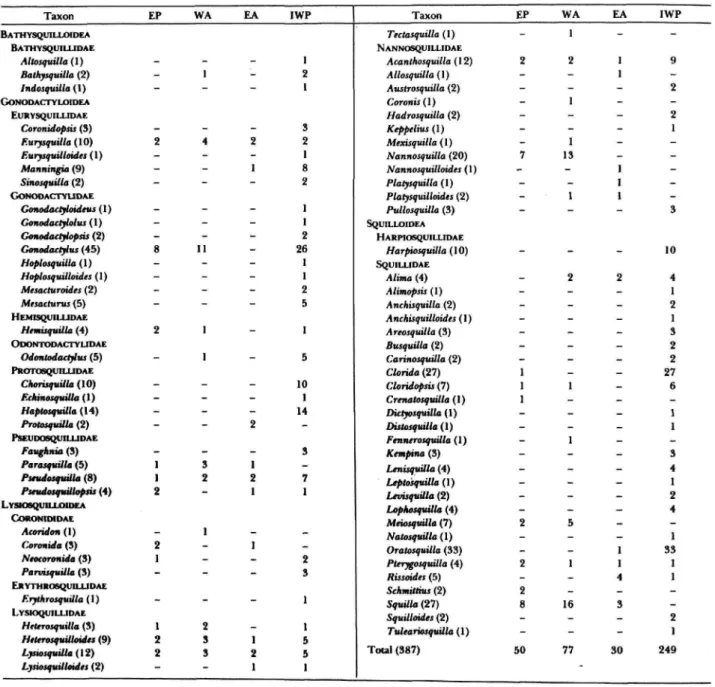
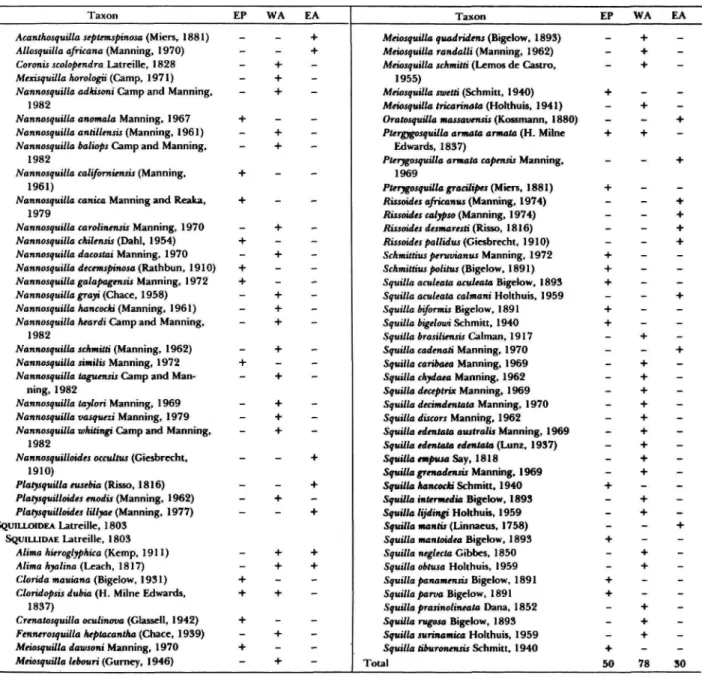
Here, we investigate how biotic and environmental traits influence rates of evolutionary divergence and apparent extinctions in the Atlantic-East Pacific Stomatopoda. The squilloid Squilla aculeata is represented by separate subspecies in the Eastern Atlantic and Eastern Pacific subregions, but it does not occur in the Western Atlantic. Thirty-seven genera are known in the Atlantic-Eastern Pacific region, and 17 or 22% of all genera are endemic there.
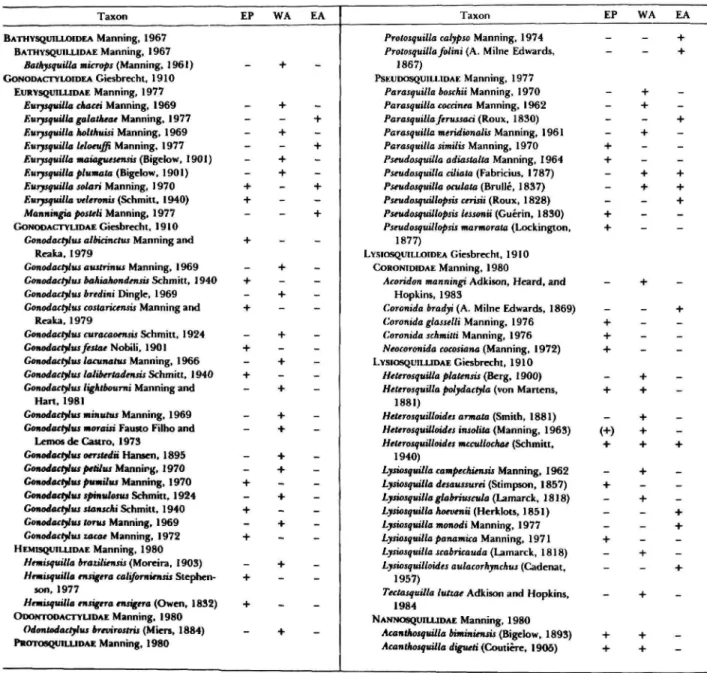
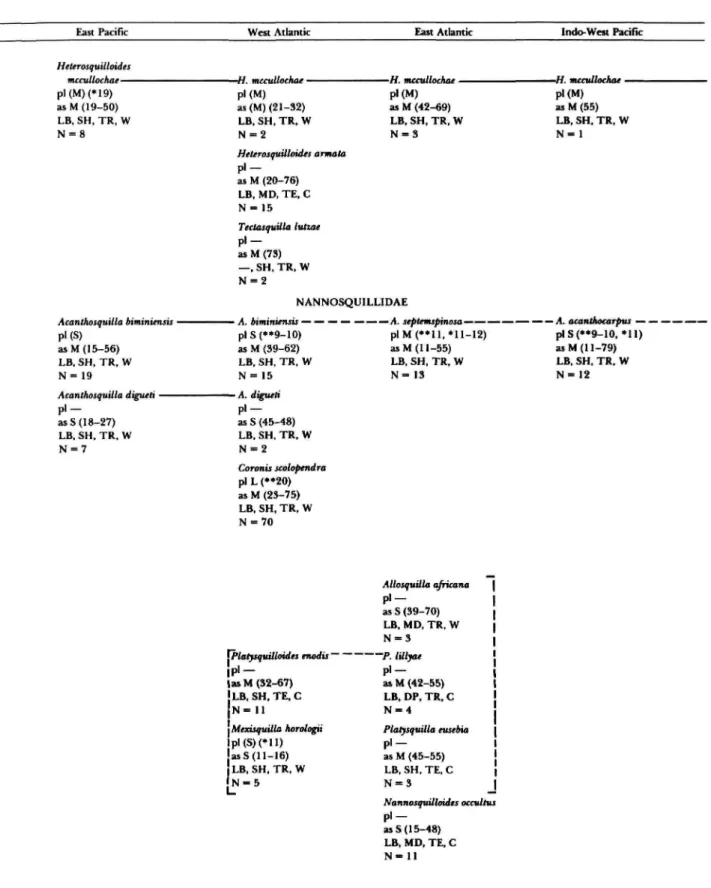
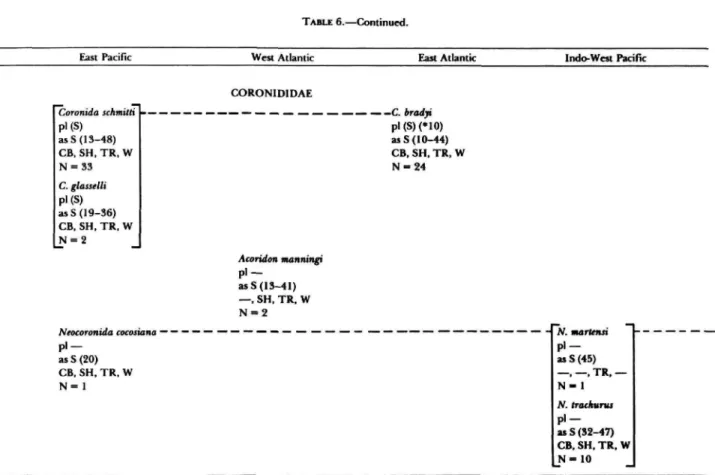
No members of the genera Gonodactylus and Nannosquilla, each represented by numerous species in the western Atlantic and eastern Pacific, are known from the eastern Atlantic. Of the 30 species and subspecies found in the eastern Atlantic Ocean and the 78 species and subspecies known from the western Atlantic Ocean, only 5 are (Pseudosquilla ciliata, P. oculata). The body sizes, postlarval sizes, habitat connections, and phyletic affinities of stomatopods occurring in the Atlantic-East Pacific region are shown in Tables 4 to 7.

Four other species of Odontodactylus (maximum length from 102-171 mm) are known from the Indo-West Pacific. All species of Gonodactylus in the Western Atlantic have diverged at the species level from sibling lineages in the Eastern Pacific (Table 4). In the Eastern Atlantic, the endemic protosquillid genus Protosquilla (Table 4) is closely related to a small Indo-West Pacific relative, Chorisquilla (maximum lengths usually less than 50 mm).
The East Atlantic genus Protosquilla, on the other hand, has Indo-West Pacific affinities but is absent from the Americas.
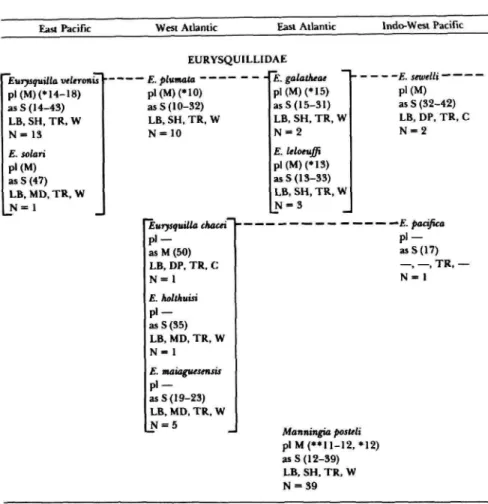
One lineage of Eurysquilla (E. maiaguesensis-E. pacified) is present in the western Atlantic and Indo-western Pacific, but is conspicuously absent from both the eastern Pacific and eastern Atlantic. The genus Manningia, represented by one species in the eastern Atlantic and several in the Indo-western Pacific, is absent from America. A related genus of large body size (lengths to 266 mm), Lysiosquilbides, is known from both the eastern Atlantic and from Thailand in the Indo-West Pacific.
However, Coronis also reaches moderate sizes (up to 75 mm), but is only found in the western Atlantic. Eastern Pacific species of Coronida and Neocoronida are similar to their eastern Atlantic and Indo-West Pacific relatives, respectively (Table 6). Neocoronida, known from the Indo-West Pacific and Cocos Island in the eastern Pacific, never reached the Atlantic or became extinct in the Atlantic.
The East Atlantic endemic genera Platysquilla and Allosquilla are absent from the West Atlantic, but are closely related to the West Atlantic Platysquilloides and Mexisquilla; The related species Platysquilloides are found in the western and eastern Atlantic Oceans, but not in the eastern Pacific Ocean. Similar populations of Cloridopsis dubia reach relatively large body sizes (up to 156 mm), and are known from both sides of the Americas; this genus is further represented by six species (lengths up to at least 93 mm) in the Indo-West Pacific region.
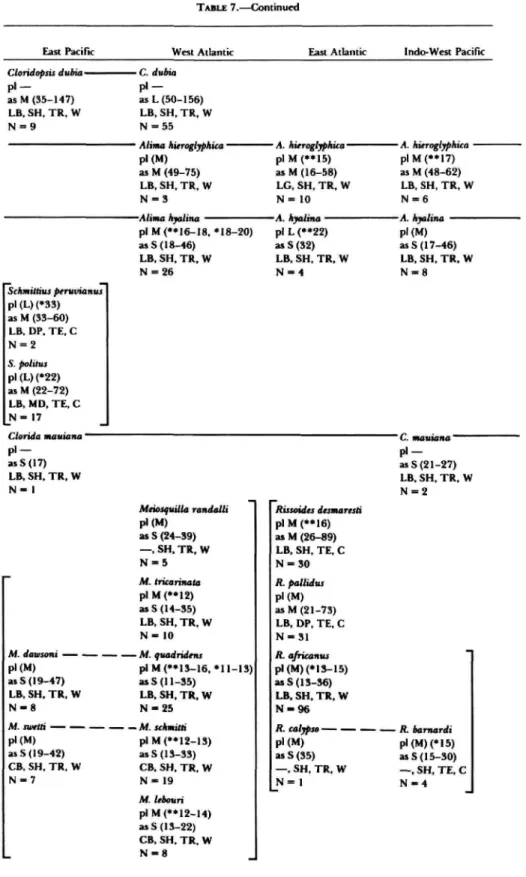
Two species of Alima are pantropical, except the eastern Pacific, and two additional species occur in the Indo-Western Pacific. Species of Schmittius, known only from the eastern Pacific, appear to be closely related to Squilloides in the Indo-Western Pacific.
Although this genus is endemic to the Eastern Pacific, it is related to a similar lineage (Squilloides) in the Indo-Western Pacific. Known only in the eastern Pacific, the related genus Crenatosquilla possesses even smaller postlarvae (<9 mm; Reaka and Manning, 1980), perhaps comparable in size to those of Gonodactylus and Nannosquilla. Pterygosquilla armata occurs in cold, deep water (up to 380 m), and subspecies are known from all geographic subregions in the southern hemisphere.
These distribution patterns suggest that these species are specialized for colonization, making it likely that these species reached the eastern Pacific Ocean but did not survive. Squilla aculeata is represented in the eastern Atlantic and eastern Pacific Oceans by several subspecies, but is absent from the western Atlantic Ocean, where it is replaced by a related species, S. Although absent from the eastern Atlantic Ocean, Cloridopsis includes both the American and Indo-Western Pacific. representatives.
There is no evidence to determine whether it became extinct in or never reached the eastern Atlantic, but the occurrence of several species of this genus in the Indo-West Pacific suggests that it may be an old lineage with an extinct Tethyan distribution in parts of its original range. Both Schmittius and Clorida live in the Eastern Pacific and show Indo-West Pacific affinities. DISTRIBUTION COMMUNITIES.—Bathysquilla microbes occur in both the western Atlantic and the Indo-West Pacific, but not in the eastern Atlantic or eastern Pacific.
Summarizing information for all families of stomatopods, we first discuss general relationships between body size, postlarval size and habitat to the degree of morphological change and speciation that has occurred since different genera were isolated in the East Atlantic, West Atlantic and East Atlantic subregions. . For example, the American species of Gonodactylus differ from Indo-West Pacific genera of this genus, and all 19 American species are endemic to either the eastern Pacific or the western Atlantic.
Three species lineages are present in the East Pacific and East Atlantic, but not the West Atlantic (Pseudosquillopsis cerisii-P. Eight species lineages occur in the West Atlantic and Indo-West Pacific before, but not the East Pacific (the Indo-West Pacific affinities) of a ninth species, Heterosquilloides armata, is not known.) Apparent extinctions are therefore more in the East Pacific than in the West Atlantic Ocean.
We do not know whether Heterosquilloides armata arose in the Western Atlantic or became extinct in the Eastern Atlantic and Eastern Pacific. Of the seven species lineages and two generic lineages where we judge extinction likely in the East Atlantic (Table 9), six are characterized by medium to large body size; however, the three remaining small or medium-sized lineages ( Gonodactylus , Eurysquilla maiaguesensis , and relatives, Acanthosquilla digueti ) include 23 American species. Relatively few taxa are found in the Indo-West Pacific and East Pacific, but not in the Atlantic (Table 9).
In addition to one species in the eastern Atlantic, several species of Manningia are known in the Indo-West Pacific. Two additional generic lineages (Protosquilla, Nannosquilloides) are present in the eastern Atlantic but absent in the New World. In the eastern Atlantic, an endemic representative of one family (Protosquillidae) and 5 endemic genera with 9 species (Protosquilla, Platysquilla, Allosquilla, Nannosquilloides and Rissoides) apparently diverged.
Seven species lineages are missing and most likely extinct in the eastern Pacific, as opposed to only one in the western Atlantic. Apparent extinctions are most prominent in the Eastern Atlantic Ocean, followed by the Eastern Pacific Ocean and then the Western Atlantic Ocean.
![TABLE 9.—Instances of possible and very likely (*) extinctions of stomatopod Crusucea (cases of gaps in distribution but where extinction was not judged probable are omitted from this list; [ ] - lineage replaced by a relative, probably due to endemic dive](https://thumb-ap.123doks.com/thumbv2/123dok/11155002.0/38.874.133.729.194.1051/instances-possible-extinctions-stomatopod-crusucea-distribution-extinction-probable.webp)
Literature Cited
Rediscovery and Range Expansion of Heterosquilla armata (Smith, 1881): Studies on Stomatopod Crustacea of the Indian River Region of Florida, I. An Annotated Checklist of Mantis Shrimps of the Central Eastern Florida Coast: Studies on Stomatopod Crustacea from the Indian River River Region of Florida, II. An account of the Crustacea Stomatopoda of the Indo-Pacific region, based on the collection in the Indian Museum.
Bulletin of the Central Research Institute, University of Travancore (Trivandrum), series C (Natural Sciences I, 3 figures. Notes on Some Australian and New Zealand Stomatopod Crustacea, with an account of the species collected by the Fisheries Research Ship Endeavour. A review of the Platysquilla complex (Crustacea, Stomatopoda, Nannosquillidae), with the designation of two new genera.
In an account of the zoological collections made during the survey of H.M.S. "Alert" in the Strait of Magellan. Stomatopods of the West Coast of America, based on collections made by Allan Hancock's expeditions, 1933-38. Some shrimps of the Madera Formation (Pennsylvanian) Manzanita Mountains, New Mexico. Crustacea: Malacostraca) from the Mississippian Heath Shale of Central Montana.
Australian Stomatopoda (Crustacea) in the collections of the Australian Museum, with a checklist and key to known Australian species. Seasonality and duration of developmental stages of Heterosquilla tricarinata (Claus, 1871) (crustaceans: stomatopods) and larval eye replacement at metamorphosis.

Index
Requests for special treatment—use of color, folds, box-bound covers, etc.—require, on the same form, the added approval of the sponsoring authority. Press review of manuscripts and art for requirements of serial format and style, completeness and clarity of copy, and arrangement of all material, as outlined below, will, within the judgment of the Press, govern acceptance or rejection of manuscripts and art. The first page of text should bear the title and author at the top of the page; the second page should have only the author's name and professional mailing address, to be used as an unnumbered footnote on the first page of printed text.
Formal tables (numbered, with captions, box headers, stubs, rules) should be submitted as carefully typed copy, double-spaced separated from the text; they will be typed unless otherwise requested. Synonymy in zoology should use the short form (taxon, author, year:page), with the full reference at the end of the paper below. Extensive notes should be collected and placed at the end of the text in a notes section.
For titles of books and articles, use capital letters in sentence form, according to the rules of the language used (exception: capitalize all important words in English). Legends for illustrations should be submitted at the end of the manuscript, with as many legends typed, double-spaced, on a page as is convenient. They should be called figures and numbered consecutively as they will appear in the monograph.
The use of the metric system of measurement is preferred; where use of the English system is unavoidable, give metric equivalents in brackets. Copy of the index may be submitted at the site proof stage, but plans for an index should be indicated when the manuscript is submitted.