20 CHAPTER 4 DATA ANALYSIS
In this chapter 4, the researcher discussed the representation of the nineteenth century Javanese women in the Kartini film by Hanung Bramantyo. It introduces representations of women's lives in the nineteenth century, such as education, marriage, and traditions carried out in the Kabupaten. The researcher provides an answer to the question through journals, books, theses, and field observations. Researchers obtained results from the study of the film. The characters in the Kartini film have distinct personalities. Five Javanese female characters in this film are named Kartini, Kardinah, Roekmini, Ngasirah, Moerjam, and Sulastri. These five characters possess the following personalities:
Kartini is portrayed in the film as a progressive, brave, mentally strong, firm, rebellious, and obedient figure. Then there's Kardinah, who is supportive, creative, and obedient. Roekmini is an optimistic and obedient person, but she is also a rebel.
Moerjam, who is strict, firm, and old-fashioned, comes after Ngasirah, who is caring and obedient. Sulastri is the final one. She is depicted as a submissive and frail figure.
In the following sub-chapter, the above information is supported by in-depth research using screen shots of scene film, dialogue, and each character's body language.
21 4.1 Kartini/Raden Ajeng Kartini
Kartini is one of the Indonesian female heroes who is very famous among other female figures because of her book, habis gelap terbitlah terang. According to Citra Mustikawati(2015), because the contents of the letter contain many of Kartini's thoughts for the sake of women, she is known as a fighter for women's emancipation.
Raden Ajeng Kartini was designated a "National Hero" by the government (Mustikawati Citra, 2015). She was a noblewoman in Jepara; born on April 21, 1879.
When she lived, she and her two younger sisters wanted to get equal rights in many aspects of life including access to education. Although she was privileged to get an education because she came from a noble family, she dreamed of establishing a native girls' school with her sisters (Kartini & Symmers, 1921, p. XV). In the film, Kartini experiences many obstacles in realizing the wishes she has planned. In the film, Kartini is shown as having many characteristics: progressive, brave, mentally strong, firm, rebellious, and obedient.
Kartini, in the film, is represented as a progressive woman. For example, there is a scene where Kartini does things she should not be doing. In the Dutch colonial era, the journal articles circulated were usually written by men coming from noble family, educated family, or Dutch. Javanese noblewomen never wrote journal articles. In those days, only a few women could write, so that they could not express their thoughts and views. However, the film shows that Kartini dares to produce many articles and news
22
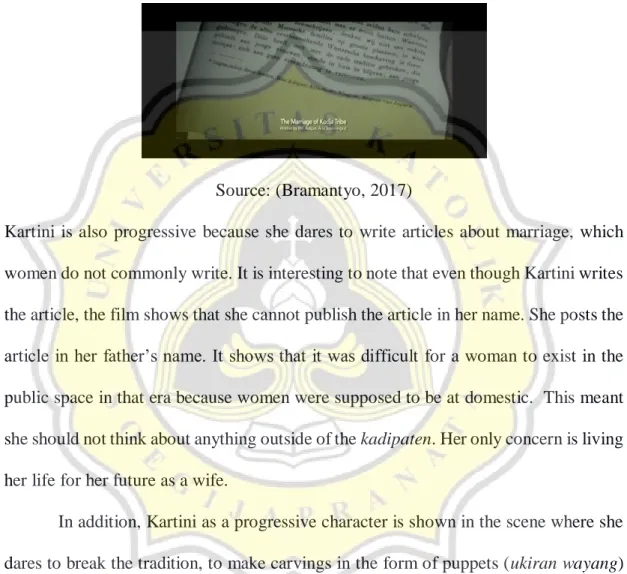
published in the newspapers using her father’s name as the writer. Kartini writes an article about Arab/Kodja marriage.
Figure 4.1 Kartini article with her father’s name as writer
Source: (Bramantyo, 2017)
Kartini is also progressive because she dares to write articles about marriage, which women do not commonly write. It is interesting to note that even though Kartini writes the article, the film shows that she cannot publish the article in her name. She posts the article in her father’s name. It shows that it was difficult for a woman to exist in the public space in that era because women were supposed to be at domestic. This meant she should not think about anything outside of the kadipaten. Her only concern is living her life for her future as a wife.
In addition, Kartini as a progressive character is shown in the scene where she dares to break the tradition, to make carvings in the form of puppets (ukiran wayang) demonstrates how brave Kartini is. Although other people believe that a person who makes a carving in the form of a wayang will be cursed by God, Kartini boldly dares
23
to tell people that crafting a wayang will not make them cursed. She believes that producing the craft can change the economy in Jepara.
Kartini is also referred to as a brave and mentally strong character in this film.
The scene in which Kartini, accompanied by her father and her father, her two brothers, and her two sisters, accepts Pak Sijthoff's invitation to visit Semarang for his birthday party. In the film, when they arrive at the dinner banquet, the two Javanese guests mock Kartini and her sisters because they think that Javanese women should not go far from home. Her sisters look worried. However, Kartini keeps walking regardless of others’
stares and ridicule.
Figure 4.2 Javanese guest judging Kartini and sister in an event
Source: (Bramantyo, 2017)
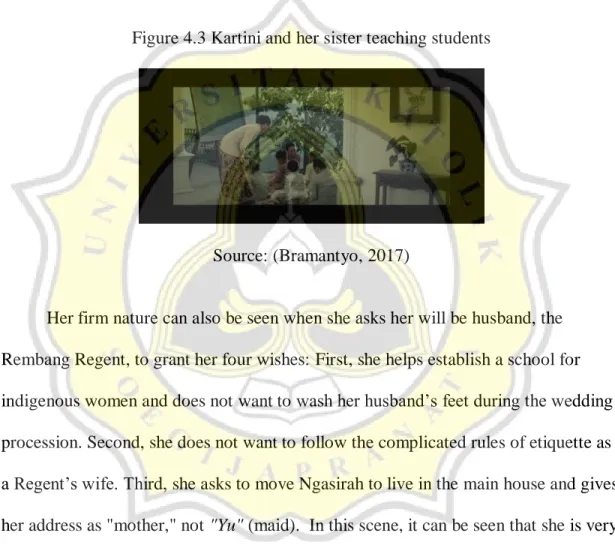
Kartini's character is not only those, but she is also firm in making decisions. The firmness in Kartini's life is shown in the film when she and her sister build a school for women and children. They establish schools to help women get an education. She is firm in her decision to establish a school for them, even though making such a decision for something as big as establishing a school is unusual for women at that
24
time. According to Kartini & Symmers (1921), Kartini said the reason is the subject closest to her heart was a girls' school, but she also requested that it be a vocational school, preparing the native girl for self-sufficiency (Kartini & Symmers, 1921, p.
19).
Figure 4.3 Kartini and her sister teaching students
Source: (Bramantyo, 2017)
Her firm nature can also be seen when she asks her will be husband, the Rembang Regent, to grant her four wishes: First, she helps establish a school for indigenous women and does not want to wash her husband’s feet during the wedding procession. Second, she does not want to follow the complicated rules of etiquette as a Regent’s wife. Third, she asks to move Ngasirah to live in the main house and gives her address as "mother," not "Yu" (maid). In this scene, it can be seen that she is very firm in her stance.
25
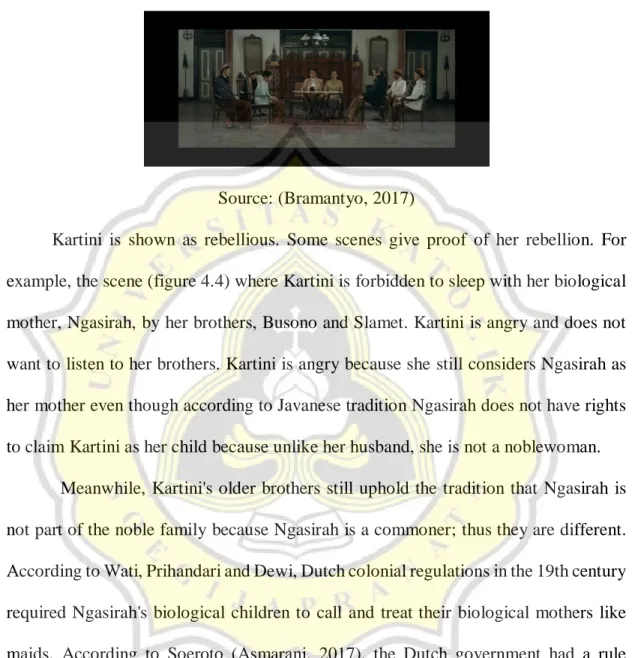
Figure 4.4 Kartini’s gesture when gives three requirements to R.M Djoyodiningrat
Source: (Bramantyo, 2017)
Kartini is shown as rebellious. Some scenes give proof of her rebellion. For example, the scene (figure 4.4) where Kartini is forbidden to sleep with her biological mother, Ngasirah, by her brothers, Busono and Slamet. Kartini is angry and does not want to listen to her brothers. Kartini is angry because she still considers Ngasirah as her mother even though according to Javanese tradition Ngasirah does not have rights to claim Kartini as her child because unlike her husband, she is not a noblewoman.
Meanwhile, Kartini's older brothers still uphold the tradition that Ngasirah is not part of the noble family because Ngasirah is a commoner; thus they are different.
According to Wati, Prihandari and Dewi, Dutch colonial regulations in the 19th century required Ngasirah's biological children to call and treat their biological mothers like maids. According to Soeroto (Asmarani, 2017), the Dutch government had a rule requiring a nobleman to marry a noblewoman in order to be appointed regent. It is also linked to erfopvolging (succession) in order to determine whether a noble (male) is born from a noble woman. According to Imron (Rosyadi, 2017, p. 11), in that time,
26
feudalism system is strict and powerful. Because the Regent Adipati had to marry Moerjam, who was a noblewoman, Ngasirah's position as the main wife had to be replaced. As a result, Moerjam became as garwa padmi (first wife), and Ngasirah became garwa ampil. As a consequence, Kartini and other Ngasirah biological children had to refer to their mother as "Yu," a female maid's nickname. In terms of Javanese tradition, it must also be done. If a child does not follow the rule, they are considered disobedient to their parents (Wati et al., 2018).
Two other examples of Kartini’s rebellion are on the way she walks and sits. A rigid etiquette is widely applied in noble families.
Figure 4.5 Kartini, Kardinah and Roekmini sitting on the wall
Source: (Bramantyo, 2017)
In the film, Kartini and her sisters violate many ettiquites. As in the picture figure, Kartini sits on the wall with one leg raised. As a noblewoman, it is strictly forbidden.
Women should sit gracefully. Javanese women are known for their grace. They do not allow to lift or spread their legs wide when sitting cross-legged. It is not graceful and polite for a noblewoman to act ethically, as they do.
27
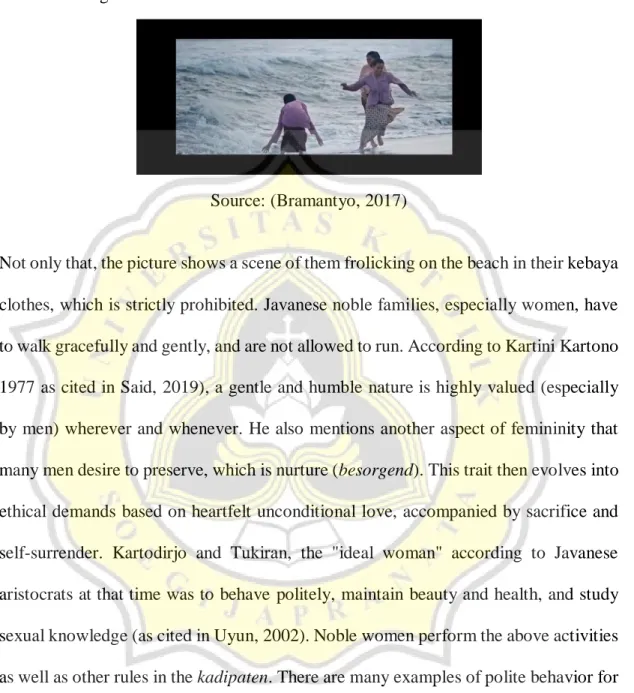
Figure 4.6 A scene when Kartini and her sisters run in a beach
Source: (Bramantyo, 2017)
Not only that, the picture shows a scene of them frolicking on the beach in their kebaya clothes, which is strictly prohibited. Javanese noble families, especially women, have to walk gracefully and gently, and are not allowed to run. According to Kartini Kartono 1977 as cited in Said, 2019), a gentle and humble nature is highly valued (especially by men) wherever and whenever. He also mentions another aspect of femininity that many men desire to preserve, which is nurture (besorgend). This trait then evolves into ethical demands based on heartfelt unconditional love, accompanied by sacrifice and self-surrender. Kartodirjo and Tukiran, the "ideal woman" according to Javanese aristocrats at that time was to behave politely, maintain beauty and health, and study sexual knowledge (as cited in Uyun, 2002). Noble women perform the above activities as well as other rules in the kadipaten. There are many examples of polite behavior for Javanese women, such as not laughing loudly, calling someone older than us mas/mbak, not speaking loudly, and so on. The film also includes one of the activities described by Kartodirjo and Tukiran. For example, in the scene where Kartini portrays
28
caring for the body as one of the activities that a noble woman in seclusion might do.
However, the film does not depict Kartini's activities to maintain her health and learn about sex.
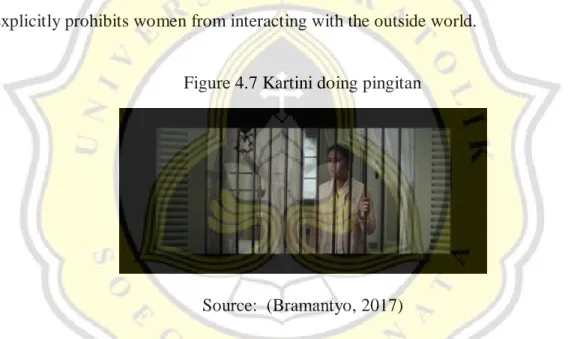
In Hanung Bramantyo's film, Kartini is a woman who is progressive, brave, firm, mentally strong, and rebellious. Interestingly, Kartini is also shown as a person who is still bound to the traditions. Kartini agrees to do pingitan, a tradition which explicitly prohibits women from interacting with the outside world.
Figure 4.7 Kartini doing pingitan
Source: (Bramantyo, 2017)
Kartini must learn to be a good wife while in seclusion. At the time, she learns how to cook, selfcare and follow etiquette as noblewomen at that time. Kartini is sad and depressed when she does Pingitan. She once rebelled against wanting to study abroad while still in seclusion, but she was unable to do so. Kartini's father actually allowed her to study abroad, but her adoptive mother, Moerjam, rejected because she believed it would compromise the family's dignity. Kartini also follows Javanese tradition
29
when she is asked to marry the Regent of Rembang Despite the fact that Kartini disliked the Regent of Rembang and would become his second wife—his first wife having died—Kartini was forced to marry him because the regent had made an application for her.
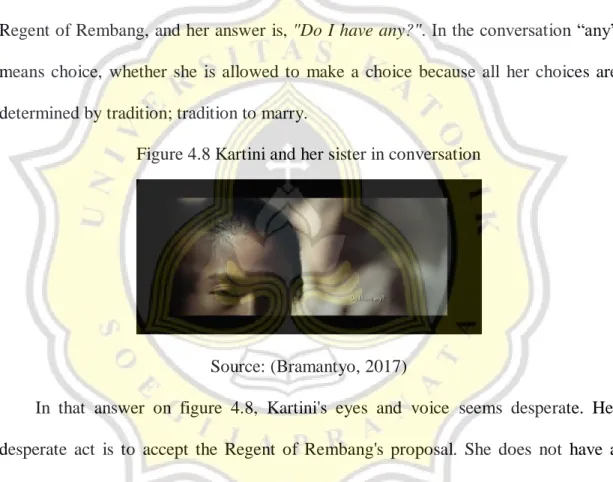
In the film, when Roekmini asks Kartini whether she feels certain to marry the Regent of Rembang, and her answer is, "Do I have any?". In the conversation “any”
means choice, whether she is allowed to make a choice because all her choices are determined by tradition; tradition to marry.
Figure 4.8 Kartini and her sister in conversation
Source: (Bramantyo, 2017)
In that answer on figure 4.8, Kartini's eyes and voice seems desperate. Her desperate act is to accept the Regent of Rembang's proposal. She does not have a choice. Because of their traditions and responsibilities as Javanese women, she had no choice but to accept the proposal. However, she agrees to marry because she follows the traditions for obey to her parents. In terms of marriage, Kartini's obedience to her
30
parents formed a contradiction to Kartini's viewpoint on freedom. It shows that even though wants to be free but she cannot break the Javanese tradition.
4.2 Kardinah/Raden Ajeng Kardinah
Raden Ajeng Kardinah or Kardinah is Kartini's second sister. She was born in Jepara on March the1st, 1881. She married the regent of Pemalang.
Figure 4.9 Kardinah in Kartini
Source: (Bramantyo, 2017)
In the film, Kardinah is represented as a supportive sister. Kardinah and her sisters have the same thought about being free from seclusion, so they always try to do business together. Kardinah also helps her sister establish a school for the native girls at that time. Her desire not to marry follows Kartini and Roekmini’s idea.
31
Figure 4.10 Kardinah asks RM Adipati Aryo Sosroningrat to cancel her wedding
Source: (Bramantyo, 2017)
Even though she is represented as a woman who has a supportive and creative character⎯because she establishes a school with her sisters, she remains a woman who must follows tradition. Figure 4.12 is a scene where Kardinah asks her father to reject a marriage proposal from the Regent of Pemalang. She does not want to get married because the regent already has a wife. The conversation shows that a marriage can occur at the will of each parent, regardless of the child's consent. Kardinah agrees to be married off by the parents, but she is disappointed with the fact that her will be husband has a wife. In the film, Kardinah is depicted as a woman who is obedient to her parents, sisters and her brothers. Therefore, she is left with no choice when her father says that, as a noble, she cannot break his promise to marry her off to the regent of Pemalang.
Her father has promise to Regent of Pemalang, she was matchmaking with the regent before entering seclusion.
32 4.3 Roekmini/Raden Ajeng Roekmini
Raden Ajeng Roekmini was born on 4 July 1880 in Jepara. She was the third sister of Kartini. In the film, like Kardinah, she also desires to be free and does not want to marry anyone. She and her sisters establish a school in Jepara for native girls at that time. Kartini, Kardinah and Roekmini are always together and their thoughts are the same, that’s why people called them cloverleaf or Het klaverblad.
Figure 4.11 Roekmini visualization in Kartini
Source: (Bramantyo, 2017)
Roekmini is very obedient to her mother, Moeriam. However, after meeting Kartini, her view of obedience begins to change. She wants to be an independent and free woman like her sister, Kartini.
33
Figure 4.12 When Roekmini ask her mother to study abroad
Source: (Bramantyo, 2017)
In figure 4.12, Roekmini asks her mother to study abroad. Her mother rejects the idea because in her opinion, women do not need study. Noble women have always had the responsibility of upholding the family's dignity which means noblewoman will be valued with the family she has including the person she married, not her personal achievement through education. Roekmini finally complied with her mother's request.
According to (Yuniarti, 2018), Javanese women follow their tradition such as committed to the responsibility as wives to uphold these family values.
Although represented as an obedient woman, Roekmini also has a rebellious character. There is a scene when Roekmini does not want to leave the room that she shares with Kartini.
34
Figure 4.13 Roekmini refuses to leave the room
Source: (Bramantyo, 2017)
As Roekmini's half-sister, she is close to Roekmini. She is adored by her sister. Kartini gives a lot of advice and ideas on how to become a self-sufficient woman. Kartini’s advice and idea of freedom is considered as bad influence by Moerjam, Roekmini’s mother. As a result, Moerjam asks Roekmini to leave Kartini’s room.
Roekmini refuses to be separated from Kartini until she finally has to be forced by her mother.
4.4 M.A Ngasirah
M.A Ngasirah is a selir, one of the wives of R.M Adipati Ario Sosroningrat, but not the main wife. She is Kartini's mother. Because she is not coming from a noble family, Ngasirah's biological children must call her "Yu", an address usually used for a maid (Marihandono et al., 2016, p. 5). Although, she is the first wife of R.M Adipati Ario Sosroningrat.
35
Figure 4.14 Ngasirah in Kartini
Source: (Bramantyo, 2017)
In the film, Ngasirah is represented as an obedient woman. In figure 4.14, Ngasirah allows her husband to remarry, to do polygamy, for the sake of their children's future.
Her husband’s parents are the ones who force him to marry Moeriam, a woman from a noble family. Noblemen are supposed to marrying noblewomen.
Figure 4.15 When Ngasirah let her husband remarry
Source: (Bramantyo, 2017)
She allows her husband to have another wife, someone who comes from a noble family, not only because she obeys the tradition but also because according to colonial government’s regulation at that time, a man from a noble family could not be a regent if he did not marry a woman from a noble family (soeroto, 2001, as cited in Asmarani,
36
2017). Ngasirah’s adherence to tradition benefits her husband, although it makes her become the victim of injustice.
4.5 Raden Ayu Moerjam
Raden Ayu Moerjam is a wife of R.M Adipati Ario Sosroningrat. She is the main wife (garwa padmi) (Marihandono et al., 2016, p. 3). She holds a position higher than Ngasirah, Sosroningrat’s first wife, who comes from a common family.
Figure 4.16 Ngasirah in Kartini
Source: (Bramantyo, 2017)
Hanung describes Moerjam as an antagonist who forbids and rejects the wishes of Kartini and her sisters to pursue the education. Moerjam is represented as an old- fashioned mother. Even though she seems like a bad mother, she's actually not that bad. She forbids and rejects the wishes of Kartini and her sister because she obeys the tradition that a woman should always stay at home. As the wife of the regent, she must always help her husband remember the traditions. Its meaning refers to the tradition
37
that forbids their daughters as unmarried noblewomen from studying too much and focusing on their main duties as wives.
Figure 4.17 When Moerjam told her feelings to Roekmini
Source: (Bramantyo, 2017)
In Figure 4.17, her daughter, Roekmini, wants to study abroad. Roekmini kneeling and begged her mother to accept her wish. Moerjam strictly forbids her daughter to go.
Moerjam tells Roekmini how she felt. Being a "Raden Ayu," she has to marry someone she does not love.
Figure 4.18 Moerjam see her husband spend the night with Ngasirah
Source: (Bramantyo, 2017)
38
In figure 4.18, Ngasirah, who lived in a different house than Moerjam and Adipati Ario, came into the house one night and said she had called her to come in. Suddenly, her husband exited the room, saying, "Tonight, I want to be with Ngasirah, my dear." The young Moerjam sees her husband choosing Ngasirah to spend the night together. It makes her very heartbroken, because her husband had to spend the night with another woman or Moerjam had to "share" her husband with other wives.
Figure 4.19 Moerjam asks Roekmini to leave the room
Source: (Bramantyo, 2017)
Moerjam is very firm. For example, she tells Kartini firmly to walk, squat walk, and do other activities that female nobles should do while waiting for a proposal from a man. Not only with Kartini, her firmness is also carried out on Roekmini. It is shown in figure 4.19 that she forces Roekmini to move to another bedroom so as not to sleep with Kartini.
39 4.6 Soelastri
Soelastri or Raden Adjeng Soelastri is the first child of Raden Ayu Moerjam and R.M Adipati Ario Sosroningrat. She is Kartini's step-sister. She was married to Raden Tjokrohadisosro, who was Patih Kendal.
Figure 4.20 Soelastri in Wedding Scene
Source: (Bramantyo, 2017)
Soelastri, in the beginning of the film, seems happy because she will marry with patih of Kendal and she will follow and stay in her husband’s kadipaten.
Figure 4.21 When Soelastri cry and kneel on her mother
Source: (Bramantyo, 2017)
40
However, in the last scene, she comes back to the kadipaten. She cries and kneels in front of her mother, while she grabs her mother’s hand. She said that her husband is remarried, and he prefers a clever wife. She cannot do anything because she should obey her husband's wishes in making decisions.