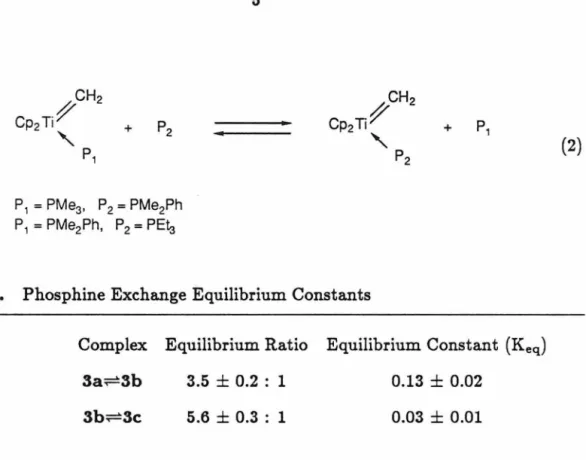
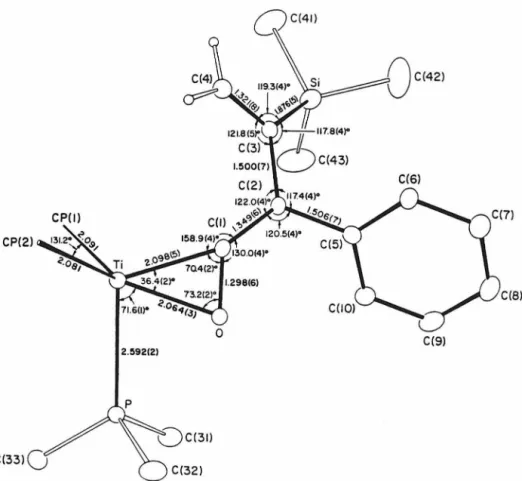
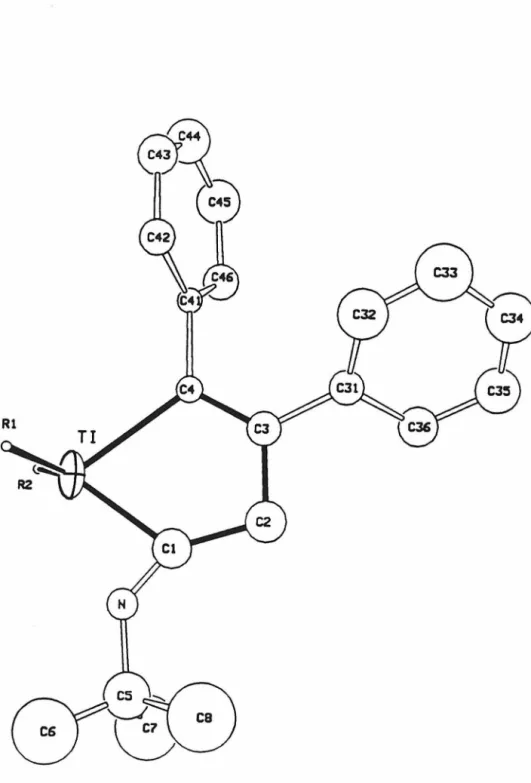
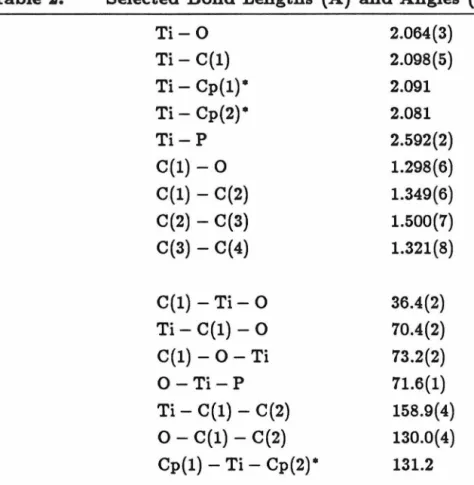
A trimethylphosphine adduct of one of the ketene complexes was characterized by X-ray diffraction techniques. The stability of the various phosphine complexes reflects the size of the phosphine.:n The order of stability is PMe3 > PMe24> >> PEt3. The small Jc–H coupling constant of 3a prompted the synthesis of the H–D-labeled methylene-phosphine complex 3d (Eq. 4).
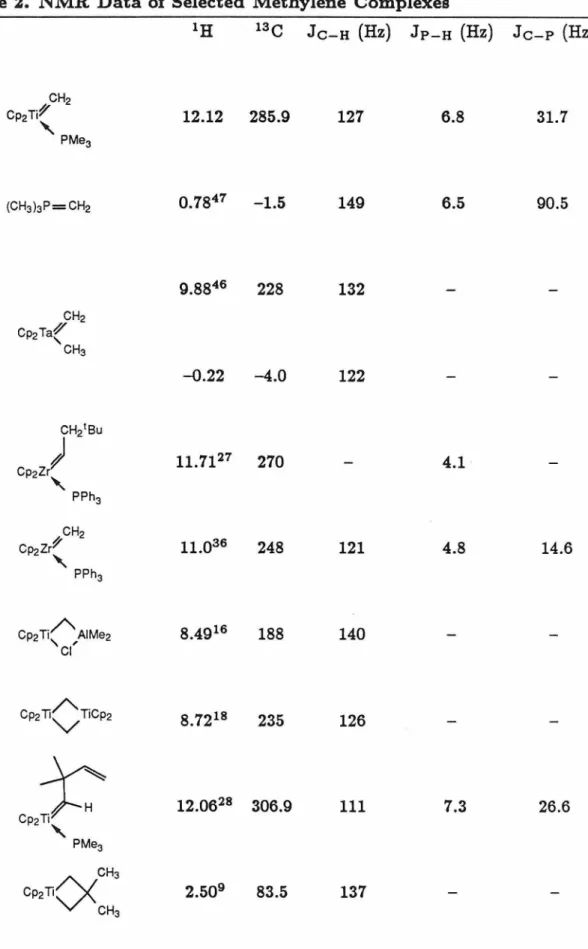
24 Thermolysis of the phosphine-methylene complexes does not yield the same distribution of hydrocarbons as the titanacyclobutanes, 2, or the dimer, 4. Reaction of the phosphine-methylene complex 3a with acetylene results in the formation of polyacetylene (equation 8). Physical and chemical characterization of the phosphine-methylene complexes suggests the presence of a true methylenephosphine complex rather than an ylide complex (Equation 9).
The stability of the complexes reflects the size and basicity of the phosphine as expected for a simple donor interaction. The carbon-hydrogen bond constant of the methylene group (127 Hz) is extremely small for a formally sp2 carbon atom. Metallacyclobutenes are a relatively rare class of compounds and are known for Ir9, Rh10, Pt11, Fe12, Zr13 and Co14• The two most common methods for the synthesis of metallacyclobutenes are 1) addition of alkynes to metal alkylidenes and.
Tiy---Ph
The presence of a phenyl group in the a-position increases the thermal stability of the metal cycle. The a-CH2 group in the metallacycle does not appear to participate in thermal chemistry, although it is allylic. The decomposition products are presumed to be paramagnetic, low-valent titanocene species due to the lack of NMR signals.
The degradation mechanism is likely via bond homolysis or exo-cyclic elimination of the 8-hydrogen. Simple disubstituted alkynes show the expected steric bias by placing the largest group at the .8 position of the metallacycle. One possible explanation for the reactivity is the initiation of the metalcyclobutene - vinyl carbene electrocyclic opening (eq 16).
The oxidative cleavage of the titanacyclobutenes with HCl or bromine results in the formation of the hydrocarbon or dibromide.
Tiy-H
Additional dimethylaluminum chloride - DMAP adduct was removed by schlenk filtration and the filtrate was concentrated in vacuo at room temperature to give a red solid. The mother liquor was removed via cannula, the crystals were washed with cold pentane and dried in vacuo to give 2.4 g (9.74 mmol, 62%) of the product. The precipitate was removed by schlenk filtration and the filtrate was concentrated in vacuo to give a sticky red solid.
Alternatively, the filtrate can be extracted with diethyl ether (8 mL), the extract filtered, triturated with an equal volume of pentane, and cooled to -S0°C to give 1.8 S g (6.00 mmol, 63%) of the product as a soft product. , dark red solid. Immediate precipitation of Cp2TiC12 was observed and the mixture was warmed to room temperature. The mixture was filtered through a frit and the filtrate was concentrated under reduced pressure to give 112 mg of an oil.
The mixture was warmed to room temperature, filtered through a 1-inch plug of silica gel with pet ether, and the filtrate concentrated under reduced pressure to give 121 mg of a clear oil.
TiY-R'
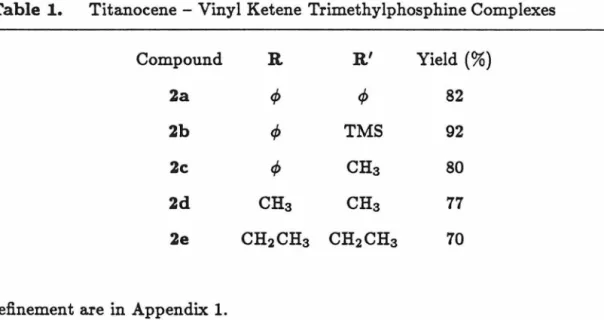
Treatment of a toluene solution of titanacyclobutene, 1, with carbon monoxide in the presence of 1 equivalent of trimethylphosphine (equation 1) produces the 9 titanium vinyl ketene complex, 2. Based on NMR nuclear Overhauser experiments, the isomerization occurs around the carbon-carbon double bond of the ketene (equation 2). Addition of trimethylphosphine to a suspension of the oligomeric ketene complex (vide supra) initially gives one isomer of the complex (1H NMR), but over several hours at room temperature an equilibrium between isomers is established.
Treatment of a solution of titanacyclobutene 2a with one equivalent of t-butylisocyanide yields the iminoacyl complex , 4, quantitatively by NMR.26 The iminoacyl complexes are orange, crystalline compounds and exhibit ffi regions at ,.., 1700 cm-1.
TiY--R'
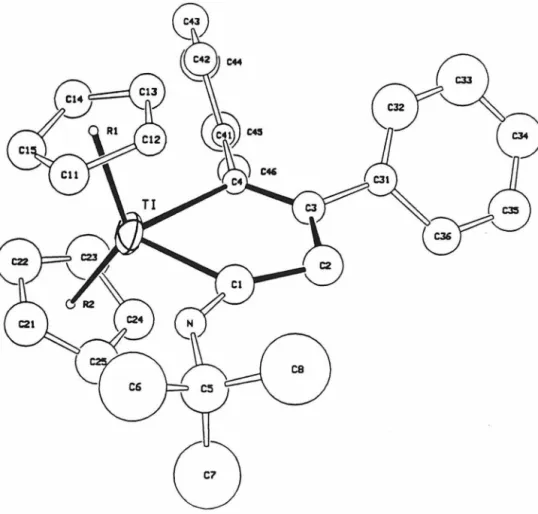
Using low temperature 1H and 13C NMR, 13CO labeling and IR, the intermediate was identified as the tita.nocene acyl complex 5. Only the tita.nacyclobutene ld gives an observable acyl intermediate, although a transient green or brown color is observed during carbonylation to let a.nd let. The intermediate is unstable in solution above -30 °C, but is moderately stable in the solid state at room temperature.
14•15 To establish which side of the metallacycle CO inserts, the acyl intermediate was synthesized with To test for the possibility of a reversible carbonylation of the metallacycle, a toluene solution of acyl 5 was prepared with 13CO (90% 13C) and immediately cooled to -78°C. The high pressure of CO is necessary to obtain 1 equivalent of CO in solution, due to the low solubility of CO in toluene.
18 Loss of the 13C label was observed regardless of the solvent (toluene, diethyl ether, THF) or the addition of trimethylphosphine. Attempts to identify the acyl species by decomposition of intermediate 5 with trifluoroacetic acid or HCl were unsuccessful due to the apparent rapid decarbonylation of the acyl in the absence of excess carbon monoxide. 27 However, if a solution of the acyl in diethyl ether under 100 psi CO is treated with an excess of anhydrous HCl at −78 °C, the corresponding titanocene acyl chloride 6 can be obtained (eq 5). 1H NMR confirms the predicted structure of the acyl chloride obtained from cleavage of the titanium-vinyl bond with one equivalent of HCl.
If the reaction mixture is heated to -20 °C in the presence of excess HCl, the products are titanocene dichloride and 3-methyl-3-pentenal. The aldehyde was very difficult to isolate, so it was transformed to the 2,4-dinitrophenylhydrazone (DNP) derivative. NMR analysis of the DNP derivative showed that the /3 - / double bond migrated in conjugation with the hydrazone.
H3C~CHO
Scheme 2. Mechanism of Carbonylation of 2d
In order for the two acyl species to balance, the CO must migrate to the other side of the metallacycle. The ketene complex, 2b, retains the relative linkage of the carbon skeleton found in the starting titanacyclobutene, 2a. Formation of an acyl alkoxide requires reaction of the ketene complex from the dieolate manifold and a 1,2-addition across the aldehyde (Equation 18).
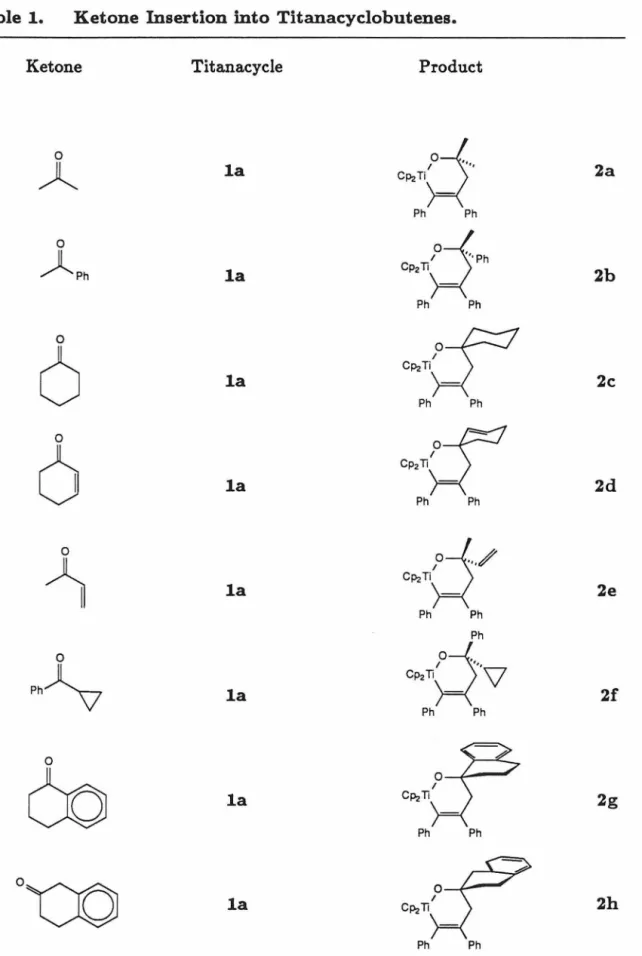
Ketones do not react with the ketene complexes, reflecting the steric constraints of the titanocene system. The aluminum complex formation did not increase the reactivity of the ketene complex towards olefin insertion. The mechanism appears to involve several steps, and one of the intermediates has been isolated.
Elemental analyzes were performed by Dornis and Kolbe, Mulheim, West Germany, and the analytical facility of the California Institute of Technology. A solution of the titanacyclobutene 1 in toluene was transferred into a pressure flask equipped with a stir bar and pressure gauge. A solution of the dimethyl titanacyclobutene (112 mg, 0.455 mmol) and trimethylphosphine (50 µL, 0.493 mmol) in 1 mL of toluene was transferred into a Lab-Glass pressure flask equipped with a stir bar and pressure gauge.
NMR data are reported from closed-tube reactions and in situ intermediate formation. Both samples were simultaneously melted at room temperature, and the progress of the isomerization was followed by 1H NMR integration of the CH3 resonances. A solution of dimethyl titanacyclobutene (100 mg, 0.406 mmol) in 4 mL of diethyl ether was transferred to a Lab-Glass pressure flask equipped with a stirbar and pressure gauge.
The color of the solution immediately changed from purple to orange and the volatiles were removed in vacuo. The orange crystals were isolated, washed twice with 0.5 mL portions of cold pentane, and dried in vacuo to give 112 mg of product. Thermal decomposition or exhaustive carbonylation of vinylketene complexes yields a free vinylketene moiety.
Alkyl and aryl compounds derived from Li, Na, Al and Cd are commonly used in organic synthesis.3 The reactivity of these complexes is usually 1,2-addition to carbonyl groups, with varying selectivity.
Tiy--R
- TI~ CHs Ph Ph
Treatment of a solution of Ia with p-tolualdehyde at room temperature clearly results in the disappearance of the starting material. Attempts to increase diastereoselection by decreasing temperature are impractical because of the slow rate of reaction at room temperature. The NMR data and difference NOE experiments suggest that the metalla cycle contributes to the endo face of the camphor molecule (Equation 10).
If the insertion mechanism involved a one-electron reduction or oxidation of the ketone, the cyclopropylcarbinyl radical could open.11. Unlike ketones, which exhibit an exchanged broadened NMR signal for the ketone during reaction, the NMR signals of the ester remain sharp. A possible explanation for the product distribution is kinetic control of the insertion proceeding through a 1r-bonded aldehyde complex.
21 The NMR results at variable temperature can be explained by a reversible coordination of the carbonyl group in both geometries. Based on Hammond's postulate, an early transition state should be "reactant-like" and not reflect the relative stability of the products. 24 An investigation of the substituent effect of kinetics can provide information about the polarization of the transition state.
The lack of carbonylation is usually explained by invoking the donation of the oxygen lone pair to the LUMO in titanium. A detailed study of the insertion kinetics, including substitution effects, would be helpful to understand the mechanism. A mixed solution or suspension of titanacyclobutene (usually O.S Min toluene) was treated with the ketone.
The extract was red-orange and the residue was dark red. material was a 2:1 ratio of Ti-0 product. The position of the Ti atom was derived from the Patterson map, and the Fourier map phased to the Ti atom revealed the rest of the structure. Oscillation and Weissenberg photographs of the crystal showed only one axis of symmetry, which characterizes monoclinic cells.
The position of the titanium atom was determined from a Patterson map, and the Fourier map phased onto the Ti atom revealed the rest of the structure.