Citation: Hirt, C, S.J. Claessens, T. Fecher, M. Kuhn, R. Pail, M. Rexer (2013), New ultra-high resolution picture of 1
Earth's gravity field, Geophysical Research Letters, Vol 40, doi: 10.1002/grl.50838.
2 3
New ultra-high resolution picture of Earth’s gravity field
4 5
Christian Hirt1*, Sten Claessens1, Thomas Fecher2, Michael Kuhn1, Roland Pail2, Moritz Rexer1, 2 6
1 Western Australian Centre for Geodesy, Curtin University, Perth, Australia 7
2 Institute for Astronomical and Physical Geodesy, Technical University Munich, Germany 8
* E-mail: [email protected] 9
10
Abstract 11
We provide an unprecedented ultra-high resolution picture of Earth’s gravity over all continents 12
and numerous islands within ± 60 degree latitude. This is achieved through augmentation of new 13
satellite and terrestrial gravity with topography data, and use of massive parallel computation 14
techniques, delivering local detail at ~200 m spatial resolution. As such, our work is the first-of- 15
its-kind to model gravity at unprecedented fine scales yet with near-global coverage. The new 16
picture of Earth’s gravity encompasses a suite of gridded estimates of gravity accelerations, 17
radial and horizontal field components and quasigeoid heights at over 3 billion points covering 18
80% of Earth’s land masses. We identify new candidate locations of extreme gravity signals, 19
suggesting that the CODATA standard for peak-to-peak variations in free-fall gravity is too low 20
by about 40%. The new models are beneficial for a wide range of scientific and engineering 21
applications and freely available to the public.
22 23
Keywords 24
Earth’s gravity field, gravity, quasigeoid, vertical deflections, ultra-high resolution 25
26
1 Introduction 27
28
Precise knowledge of the Earth’s gravity field structure with high resolution is essential for a 29
range of disciplines, as diverse as exploration and potential field geophysics[Jakoby and Smilde, 30
2009], climate and sea level change research [Rummel, 2012], surveying and engineering 31
[Featherstone, 2008] and inertial navigation[Grejner-Brzezinska and Wang, 1998]. While there 32
is a strong scientific interest to model Earth’s gravity field with ever-increasing detail, the 33
resolution of today’s gravity models remains limited to spatial scales of mostly 2-10 km globally 34
[Pavlis et al., 2012; Balmino et al., 2012], which is insufficient for local gravity field 35
applications such as modelling of water flow for hydro-engineering, inertial navigation or in-situ 36
reduction of geophysical gravity field surveys. Up until now, gravity models with sub-km 37
resolution are unavailable for large parts of our planet.
38 39
Here we provide an unprecedented ultra-high resolution view of five components of Earth’s 40
gravity field over all continents, coastal zones and numerous islands within ±60 degree latitude.
41
This is achieved through augmentation of new satellite and terrestrial gravity with topography 42
data [e.g., Hirt et al. 2010] and use of massive parallel computation techniques, delivering local 43
detail at 7.2 arc-seconds (~200 m in North-South direction) spatial resolution (Section 2). As 44
such, our work is the first-of-its-kind to model gravity at ultra-fine scales yet with near-global 45
coverage. The new picture of Earth’s gravity encompasses a suite of gridded estimates of gravity 46
accelerations, radial and horizontal field components and quasigeoid heights at over 3 billion 47
points covering 80% of Earth’s land masses and 99.7% of populated areas (Section 3, 4). This 48
considerably extends our current knowledge of the gravity field. The gridded estimates are 49
beneficial for a range of scientific and engineering applications (Section 5) and freely available 50
to the public. Electronic supplementary materials are available providing full detail on the 51
methods applied in this study.
52 53
2 Data and Methods 54
55
Our ultra-high resolution picture of Earth’s gravity field is a combined solution based on the 56
three key constituents GOCE/GRACE satellite gravity (providing the spatial scales of ~10000 57
down to ~100 km), EGM2008 (~100 to ~10 km) and topographic gravity, i.e., the gravitational 58
effect implied by a high-pass filtered terrain model (scales of ~10 km to ~250 m), 59
60
Regarding the satellite component, we use the latest satellite-measured gravity data (release 61
GOCE-TIM4) from the European Space Agency’s GOCE satellite [Drinkwater et al., 2003; Pail 62
et al., 2011], parameterized as coefficients of a spherical harmonic series expansion, that 63
currently provides the highest-resolution picture of Earth’s gravity ever obtained from a space 64
gravity sensor. Resolving gravity field features at spatial scales as short as 80-100 km, GOCE 65
confers new gravity field knowledge, most notably over poorly surveyed regions of Africa, 66
South America and Asia [Pail et al., 2011].
67 68
69
Figure 1. Relative contribution of GOCE/GRACE data per spherical harmonic coefficient in the combination with 70
EGM2008 data (in percent) for the degrees 0 to 250 71
72
Compared to pure GOCE models, complementary GRACE satellite gravity[Mayer Guerr et al., 73
2010] are superior in the spectral range up to degrees 70-80 [Pail et al., 2010]. Therefore, first a 74
combined satellite-only combined solution based on full normal equations of GRACE (up to 75
degree 180) and GOCE (up to degree 250) is computed [see, e.g., Pail et al., 2010]. The 76
GRACE/GOCE combination is then merged with EGM2008 [Pavlis et al., 2012] using the 77
EGM2008 coefficients as pseudo-observations. Since for EGM2008 only the error variances are 78
available, the corresponding normal equations have diagonal structure. In our combination, 79
GRACE/GOCE data have dominant influence in the spectral band of harmonic degrees 0 to 180 80
with EGM2008 information taking over in the spectral range 200 to 2190, leaving the main 81
spectral range of transition from GRACE/GOCE to EGM2008 in spectral band of degrees 181 to 82
200. The relative contributions of EGM2008 and GRACE/GOCE satellite gravity are shown in 83
Fig. 1.
84 85 86 87
The spherical-harmonic coefficients of the combined GRACE/GOCE/EGM2008 (GGE) gravity 88
model were used in the spectral band of degrees 2 to 2190 to synthesize a range of frequently 89
used gravity field functionals at the Earth’s surface. For accurate spherical harmonic synthesis at 90
the Earth’s surface, as represented through the SRTM topography, the gradient approach to fifth- 91
order [Hirt 2012] was applied. This numerically efficient evaluation technique takes into account 92
the effect of gravity attenuation with height. Applying the gradient approach as described in Hirt 93
[2012] yielded numerical estimates for radial derivatives (gravity disturbances) and horizontal 94
derivatives (deflections of the vertical) of the disturbing potential and quasigeoid heights from 95
the GGE data set at 7.2 arc-sec resolution (about 3 billion surface points) within the SRTM data 96
coverage.
97 98
99
Figure 2. Gravity field at different levels of resolution over Mount Everest area. A: satellite-only (free-air) gravity 100
from GOCE and GRACE satellites, B: GGE gravity (satellite gravity combined with EGM2008 gravity), C:
101
GGMplus as composite of satellite gravity, EGM2008 and topographic gravity. Shown is the radial component of 102
the gravity field over a ~400 x 400 km area covering parts of the Southern Himalayas including the Mount Everest 103
summit area (marked), units in 10-5 m s-2. The spatial resolution of the gravity modelling increases from ~100 km 104
(A), ~10 km (B) to ultra-fine ~200 m spatial scales (C).
105 106
For the Mount Everest region, Fig. 2 exemplifies the associated resolution of GOCE/GRACE 107
satellite gravity (A) and their combination with EGM2008 gravity (B). The spatial resolution of 108
the GGE gravity field functionals is limited to about ~10 km (or harmonic degree of 2190) which 109
leaves the problem of modelling the field structures at short scales, down to few 100 m 110
resolution at any of the surface points.
111 112
Because ground gravity measurements at a spatial density commensurate with our model 113
resolution do not exist over most parts of Earth [e.g., Sansò and Sideris, 2013] – and will not 114
become available in the foreseeable future – alternative solutions are required to estimate the 115
gravity field signals at scales shorter than 10 km. High-resolution topography data is widely 116
considered the key to ultra-high resolution gravity modelling and used successfully as effective 117
means to estimate short-scale gravity effects [Sansò and Sideris, 2013; Tziavos and Sideris, 118
2013, Pavlis et al., 2012; Forsberg and Tscherning, 1981]. This is because the short-scale 119
gravity field is dominated by the constituents generated by the visible topographic masses 120
[Forsberg and Tscherning, 1981]. However, forward estimation of the short-scale gravity field 121
constituents from elevation models near-globally at ultra-high (few 100 metres) resolution is 122
computationally demanding. Yet we have accomplished this challenge for the first time through 123
advanced computational resources.
124 125
Massive parallelization and the use of Western Australia’s iVEC/Epic supercomputing facility 126
allowed us to convert topography from the Shuttle Radar Topography Mission (SRTM), cf.
127
Jarvis et al. [2008] – along with bathymetric information along coastlines [Becker et al., 2009]– 128
to topographic gravity at 7.2 arc-sec resolution everywhere on Earth between ± 60° latitude with 129
SRTM data available. Based on non-parallelized standard computation techniques, the 130
calculation of topographic gravity effects would have taken an estimated 20 years, which is why 131
previous efforts were restricted to regional areas [Kuhn et al., 2009; Hirt, 2012].
132 133
The conversion of topography to topographic gravity is based on the residual terrain modelling 134
technique [Forsberg, 1984], with the topography high-pass filtered through subtraction of a 135
spherical harmonic reference surface (of degree and order 2160) prior to the forward-modelling.
136
We treated the ocean water masses and those of the major inland water bodies (Great Lakes, 137
Baikal, Caspian Sea) using a combination of residual terrain modelling with the concept of rock- 138
equivalent topography [Hirt, 2013], whereby the water masses were ‘compressed’ to layers 139
equivalent to topographic rock. These procedures yield short-scale topographic gravity that is 140
suitable for augmentation of degree-2190 spherical harmonic gravity models beyond their 141
associated 10 km resolution, cf. Hirt [2010; 2013]. The topographic gravity is based on a mass- 142
density assumption of 2670 kg m-3 and provides the spatial scales of ~10 km to ~250 m, which is 143
complementary to the GGE gravity (spatial scales from ~10000 km to ~10 km).
144 145
3 Results 146
147
Addition of both components (GGE and topographic gravity) result in the ultra-high resolution 148
model GGMplus (Global Gravity Model, with plus indicating the leap in resolution over 149
previous 10 km resolution global gravity models). The modelled gravity field components and 150
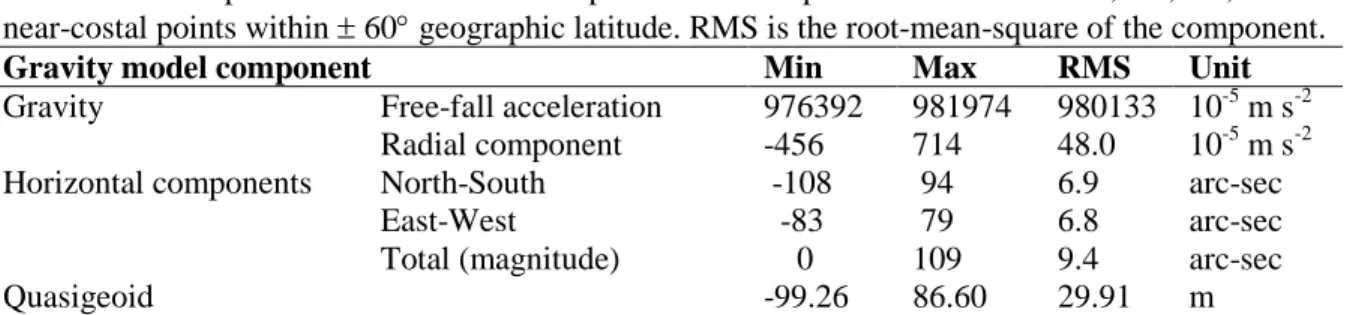
their descriptive statistics are reported in Table 1.
151 152
Table 1. Descriptive statistics of the GGMplus model components calculated at 3,062,677,383 land and 153
near-costal points within ± 60° geographic latitude. RMS is the root-mean-square of the component.
154
Gravity model component Min Max RMS Unit
Gravity Free-fall acceleration 976392 981974 980133 10-5 m s-2 Radial component -456 714 48.0 10-5 m s-2 Horizontal components North-South -108 94 6.9 arc-sec
East-West -83 79 6.8 arc-sec
Total (magnitude) 0 109 9.4 arc-sec
Quasigeoid -99.26 86.60 29.91 m
155
This world-first ultra-high resolution modelling over most of Earth’s land areas delivered us the 156
expected gravity signatures of small-scale topographic features – such as mountain peaks and 157
valleys – which are otherwise masked in 10 km resolution models. This adds much local detail to 158
the gravity maps (compare Figs. 2B and 2C) and yields a spectrally more complete and accurate 159
description of the gravity field [e.g., Hirt, 2012].
160
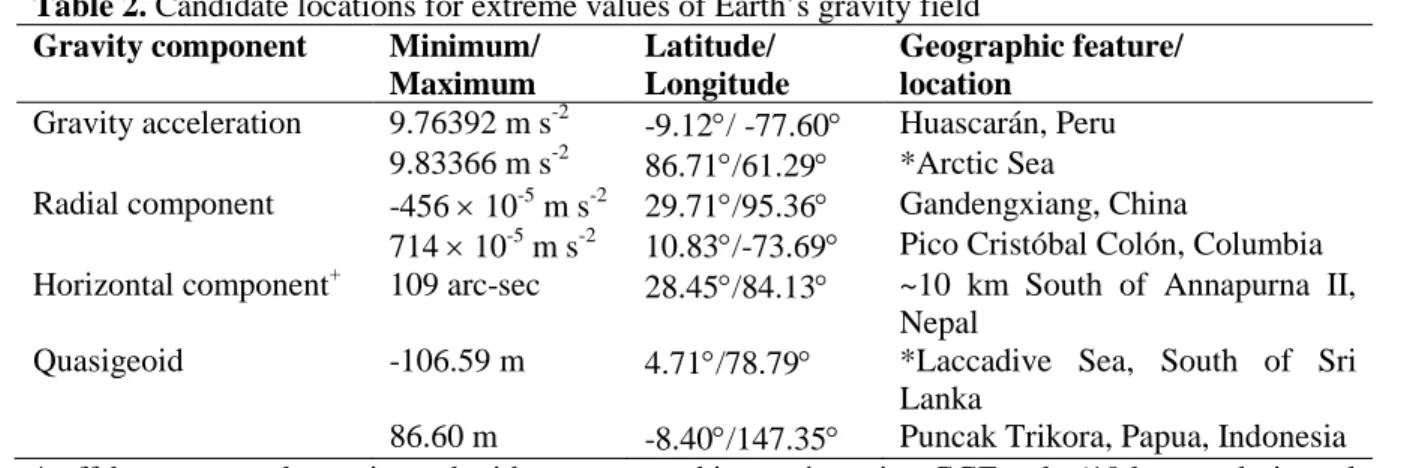
Table 2. Candidate locations for extreme values of Earth’s gravity field 161
Gravity component Minimum/
Maximum
Latitude/
Longitude
Geographic feature/
location
Gravity acceleration 9.76392 m s-2 -9.12°/ -77.60° Huascarán, Peru 9.83366 m s-2 86.71°/61.29° *Arctic Sea
Radial component -456 × 10-5 m s-2 29.71°/95.36° Gandengxiang, China
714 × 10-5 m s-2 10.83°/-73.69° Pico Cristóbal Colón, Columbia Horizontal component+ 109 arc-sec 28.45°/84.13° ~10 km South of Annapurna II,
Nepal
Quasigeoid -106.59 m 4.71°/78.79° *Laccadive Sea, South of Sri Lanka
86.60 m -8.40°/147.35° Puncak Trikora, Papua, Indonesia
* offshore area, value estimated without topographic gravity using GGE-only (10 km resolution, also see 162
electronic supplement) 163
+ total component computed as magnitude from the North-South and East-West components 164
165
166
Figure 3. Candidate locations of some extreme signals in Earth’s gravity in the Andes (A,B) and Himalaya regions 167
(C,D). Top: Topography (A) and free-fall gravity accelerations (B) over the Huascarán region (Peru), where 168
GGMplus gravity accelerations are as small as ~9.764 m s-2 (B). Bottom: Topography (C) and GGMplus total 169
horizontal field component (D) over the Annapurna II region (Nepal). The gravitational attraction of the Annapurna 170
II masses is expected to cause an extreme slope of the quasi/geoid with respect to the Earth ellipsoid of up to ~109 171
arc-seconds (D).
172
Our gridded estimates portray the subtle variations of gravity (Fig. 3) which are known to depend 173
on factors such as location, height and presence of mass-density anomalies. GGMplus reveals a 174
candidate location for the minimum gravity acceleration on Earth: the Nevado Huascarán summit 175
(Peru) with an estimated acceleration of 9.76392 m s-2 (Fig 3A, 3B, and Table 2). A candidate 176
location for Earth’s maximum gravity acceleration was identified - outside the SRTM area, based 177
on GGE-only – in the Arctic sea with an estimated 9.83366 m s-2. This suggests a variation range 178
(peak-to-peak variation) for gravity accelerations on Earth of about ~0.07 m s-2, or 0.7 %, which 179
is about 40 % larger than the variation range of 0.5 % implied by standard models based on a 180
rotating mass-ellipsoid (gravity accelerations are 9.7803 m s-2 (equator) 9.8322 m s-2 (poles) on 181
the mass-ellipsoid, cf. Moritz [2000]). So far such a simplified model is also used by the 182
Committee on Data for Science and Technology (CODATA) to estimate the variation range in 183
free-fall acceleration on Earth [Mohr and Taylor, 2005]. However, due to the inhomogeneous 184
structure of Earth, presence of topographic masses, and decay of gravity with height the actual 185
variations in free-fall accelerations are ~40% larger at the Earth’s surface (Table 2).
186 187
GGMplus free-air gravity – the radial component of Earth’s gravity field – varies within a range 188
of ~0.011 m s-2 (~0.1% of gravity accelerations) with its minimum value of –456 × 10-5 m s-2 189
located in China and its maximum of 714 × 10-5 m s-2 expected for the Pico Cristóbal Colón 190
summit in Colombia. The higher variability of gravity accelerations over free-air gravity reflects 191
the well-known fact that gravity accelerations include the gravitational attraction and centrifugal 192
effect due to Earth rotation.
193 194
The horizontal components of the gravitational field describe in approximation the North-South 195
and East-West inclination of the quasi/geoid with respect to the reference ellipsoid. The variation 196
range of the horizontal field components (also known as deflections of the vertical) is about ~200 197
arc-seconds in North South, and ~160 arc-seconds in East-West, respectively (Table 1).
198
GGMplus reveals a candidate location for Earth’s largest deflection of the vertical: about 10 km 199
South of Annapurna II, Nepal, the plumb line is expected to deviate from the ellipsoid normal by 200
an angle as large as ~109 arc-seconds (Fig. 3C and 3D). This translates into a most extreme 201
quasi/geoid slope of about 0.5 m over 1 km.
202 203
4 Model evaluation 204
205
We have comprehensively compared GGMplus gravity field maps with in-situ (direct) 206
observations of Earth’s gravity field from gravimetry, astronomy, and surveying (see electronic 207
supplementary materials). Over well-surveyed areas of North America, Europe and Australia, 208
the comparisons suggest an accuracy level for free-air gravity and gravity accelerations of ~5 × 209
10-5 m s-2, for horizontal field components of about 1 arc-second, and for quasigeoid heights of 210
0.1 m or better.
211 212
Despite the improvements conferred by recent satellite gravity to our model, the GGMplus 213
accuracy deteriorates by a factor of ~3 to ~5 over Asia, Africa and South America which are 214
regions with limited or very limited ground gravity data availability. Comparisons suggest a 215
decrease in accuracy down to ~20 × 10-5 m s-2 for gravity, ~5 arc-seconds for horizontal field 216
components, and ~0.3 m for quasigeoid heights. The reduced accuracy estimates mainly reflect 217
the limited availability of gravity observations at spatial scales of ~100 to ~10 km. The accuracy 218
of GGMplus gravity accelerations will always be lower than that of free-air gravity. This is 219
because accelerations are directly affected by errors in the elevation data, with an elevation error 220
of 10 m equivalent to about 3 × 10⁻⁵ m s-2. 221
222
Given that any gravity field signals originating from local mass-density variations are not 223
represented by the topographic gravity, our gravity maps cannot provide information on 224
geological units at scales less than 10 km. This is akin to EGM2008 at spatial scales of ~30 to 225
~10 km over many land areas where gravity measurements are unavailable or of proprietary 226
nature [Pavlis et al., 2012]. Any global, regional or local gravity map or quasi/geoid model can 227
only be geologically interpreted down to a resolution commensurate with the gravity 228
observations used to construct the model. Nevertheless, incorporation of topographic gravity to 229
approximate gravity field features at spatial scales of ~10 km to ~250 m significantly improves 230
GGMplus gravity and horizontal components when compared to 10 km-resolution maps.
231
Depending on the terrain ruggedness, the observed improvement rates mostly range between 40 232
to 90% for radial and horizontal field components (Supplementary Tables 6 and 8), while the 233
quasigeoid improvement is best observable over rugged areas (up to 40 % improvement, 234
Supplementary Table 9).
235 236
5 Applications 237
Apart from enhancing our knowledge of Earth’s gravity and its variations, there are several 238
scientific and engineering applications that require high-resolution and largely complete gravity 239
knowledge, which is now available through GGMplus gravity maps.
240 241
The quasi/geoid plays a crucial role in modern determination of topographic heights with Global 242
Navigation Satellite Systems (such as the Global Positioning System GPS), allowing the 243
measurement of heights above mean sea level rather than heights above the ellipsoid [e.g., Meyer 244
et al., 2006; Featherstone, 2008; Hirt et al., 2011]. While several regional-size quasi/geoid 245
models of good quality are available at mostly ~2 km resolution over well-surveyed land areas 246
(e.g., Europe, USA, Australia), GGMplus is capable of providing improved quasi/geoid 247
information over those parts of Asia, Africa and South America, where no other source of high- 248
resolution gravity (e.g., from airborne gravity) is available. The GGMplus quasigeoid can be 249
suitable for water flow modelling (e.g., as required in hydro-engineering), and height transfer 250
with satellite systems, and can be of utility for the determination of offsets among continental 251
height systems (e.g., Australia and Europe) and their unification [e.g., Flury and Rummel, 2005;
252
Rummel, 2012]. This in turn will allow for a more consistent comparison of sea level 253
observations at tide gauges across the oceans. Because of incorporation of newer GOCE and 254
GRACE satellite gravity, the GGMplus quasigeoid confers improvements at ~100 km spatial 255
scales over parts of Asia, South America and Africa, while consideration of short-scale 256
quasigeoid effects from topography data improves the resolution of quasigeoid heights over 257
rugged terrain [Hirt et al., 2010].
258 259
GGMplus gravity accelerations and free-air gravity are a promising data source for screening and 260
outlier-detection of terrestrial gravity databases and aid in planning of local precision gravimetric 261
surveys. Gravity accelerations as provided by our maps are required e.g., as a correction in the 262
context of geodetic height systems [e.g., Meyer et al., 2006], for accurate topographic mapping, 263
in metrology for calibration of precision scales [Torge, 1989] and seismometers, and in 264
observational astronomy for meteorological corrections [Corbard et al., 2013]. For geophysics 265
and the exploration industry, GGMplus may prove beneficial as novel data source for in-situ 266
reduction of detailed gravimetric surveys, revealing locations of interest for mineral prospectivity 267
without the need to calculate and apply further rather time-consuming reductions [Jakoby and 268
Smilde, 2009] Finally, horizontal field components are required to correct the impact of the 269
Earth’s irregular gravity field, e.g., for inertial navigation at or near the Earth’s surface [Grejner- 270
Brzezinska and Wang, 1998], or in the context of civil engineering (e.g., precision surveys for 271
tunnel alignment), Featherstone and Rüeger [2000]. All of these applications require spectrally 272
most complete information on the gravity field.
273 274
6 Conclusions 275
276
GGMplus provides the most complete description of Earth’s gravity at ultra-high resolution and 277
near-global coverage to date. This confers immediate benefits to many applications in 278
engineering, exploration, astronomy, surveying, and potential field geophysics. While GGMplus 279
provides moderate additional information (because of the ultra-high resolution short-scale 280
modelling) over areas with dense coverage of gravity stations (e.g., North America, Europe, 281
Australia), significant improvements are provided over areas with sparse ground gravity 282
coverage (e.g., Asia, Africa, South America). For the latter regions, GGMplus provides for the 283
first time a complete coverage with gravity at ultra-high spatial resolution, thus providing 284
scientific aid to many developing countries. In addition, GGMplus provides crucial information 285
to revise current standards for the maximum range of free-fall gravity accelerations over the 286
Earth’s surface. The computerized GGMplus gravity field maps are freely available for science, 287
education and industry via and http://ddfe.curtin.edu.au/gravitymodels/GGMplus.
288 289
Acknowledgements We are grateful to the Australian Research Council for funding 290
(DP120102441). This work was made feasible through using advanced computational resources 291
of the iVEC/Epic supercomputing facility (Perth, Western Australia). We thank all developers 292
and providers of data used in this study. Full methods, and detailed evaluation results are 293
available in the electronic supplementary information, and information on data access via the 294
project’s website http://geodesy.curtin.edu.au/research/models/GGMplus.
295 296
References 297
Balmino, G., N. Vales, S. Bonvalot and A. Briais (2012), Spherical harmonic modelling to ultra-high degree of 298
Bouguer and isostatic anomalies, J. Geod., 86(7), 499-520, doi: 10.1007/s00190-011-0533-4.
299
Becker, J.J., D.T. Sandwell, W.H.F. Smith, J. Braud, B. Binder, J. Depner, D. Fabre, J. Factor, S. Ingalls, S-H. Kim, 300
R. Ladner, K. Marks, S. Nelson, A. Pharaoh, R. Trimmer, J. Von Rosenberg, G. Wallace and P. Weatherall 301
(2009), Global Bathymetry and Elevation Data at 30 Arc Seconds Resolution: SRTM30_PLUS, Marine 302
Geod., 32(4), 355-371.
303
Corbard T., F. Morand, F. Laclarex, R. Ikhlef, and M. Meftah (2013), On the importance of astronomical refraction 304
for modern Solar astrometric measurements, Astr. Astrophy., April 2, 2013.
305
Drinkwater, M.R., R. Floberghagen, R. Haagmans, D. Muzi, and A. Popescu (2003), GOCE: ESA's first Earth 306
Explorer Core mission, In (eds. Beutler, G.B., M.R. Drinkwater, R. Rummel, and R. von Steiger), Earth 307
Gravity Field from Space - from Sensors to Earth Sciences. In the Space Sciences Series of ISSI, Vol. 18, 308
419-432, Kluwer Academic Publishers, Dordrecht, Netherlands ISBN: 1-4020-1408-2.
309
Featherstone W.E. (2008), GNSS-based heighting in Australia: current, emerging and future issues, J. Spat. Sci. 53, 310
115-133.
311
Featherstone W.E., and J.M. Rüeger (2000), The importance of using deviations of the vertical for the reduction of 312
survey data to a geocentric datum, Australian Surveyor, 45, 46-61.
313
Flury, J., and R. Rummel (2006), Future satellite gravimetry for geodesy, Earth Moon Plan. 94, 13-29.
314
doi:10.1007/s11038-005-3756-7 315
Forsberg R., and C.C. Tscherning (1981), The use of height data in gravity field approximation by collocation, J.
316
Geophys. Res, 86(B9), 7843-7854.
317
Forsberg, R. (1984), A study of terrain reductions, density anomalies and geophysical inversion methods in gravity 318
field modelling, Report 355, Department of Geodetic Science and Surveying, Ohio State University, 319
Columbus.
320
Grejner-Brzezinska, D.A., and J. Wang (1998), Gravity modeling for high-accuracy GPS/INS integration, 321
Navigation, 45, 3, 209-220.
322
Hirt, C. (2010), Prediction of vertical deflections from high-degree spherical harmonic synthesis and residual terrain 323
model data, J. Geod., 84 (3), 179-190. doi:10.1007/s00190-009-0354-x 324
Hirt, C., W.E. Featherstone and U. Marti (2010), Combining EGM2008 and SRTM/DTM2006.0 residual terrain 325
model data to improve quasigeoid computations in mountainous areas devoid of gravity data, J. Geod., 84(9):
326
557-567, DOI: 10.1007/s00190-010-0395-1..
327
Hirt C., Schmitz M., Feldmann-Westendorff U., Wübbena G., Jahn C.-H., and Seeber G. (2011), Mutual validation 328
of GNSS height measurements from high-precision geometric-astronomical levelling, GPS Solutions, 15(2), 329
149-159, DOI 10.1007/s10291-010-0179-3.
330
Hirt, C. (2012), Efficient and accurate high-degree spherical harmonic synthesis of gravity field functionals at the 331
Earth's surface using the gradient approach, J. Geod., 86(9), 729-744, doi: 10.1007/s00190-012-0550-y.
332
Hirt, C. (2013), RTM gravity forward-modeling using topography/bathymetry data to improve high-degree global 333
geopotential models in the coastal zone, Marine Geod., 36(2):1-20, doi:10.1080/01490419.2013.779334.
334
Jacoby, W., and P.L. Smilde (2009), Gravity interpretation, Springer, Berlin, Heidelberg.
335
Jarvis, A., H.I. Reuter, A. Nelson, and E. Guevara (2008), Hole-filled SRTM for the globe Version 4, Available from 336
the CGIAR-SXI SRTM 90m database. Available at: http://srtm.csi.cgiar.org.
337
Kuhn, M., W.E. Featherstone, and J.F. Kirby (2009), Complete spherical Bouguer gravity anomalies over Australia, 338
Australian J. Earth Sci., 56, 213-223.
339
Mohr P. J., and B.N. Taylor (2005), CODATA recommended values of the fundamental physical constants: 2002, 340
Rev. Mod. Phys. 77 (Jan 2005).
341
Moritz, H. (2000), Geodetic Reference System 1980. J. Geod., 74, 128-140.
342
Meyer T.H., D.R. Roman, and D.B. Zilkoski (2006), What Does Height Really Mean? Part IV: GPS Heighting.
343
Surveying Land Inf. Sci. 66, 165-183.
344
Mayer-Gürr, T., E. Kurtenbach, and A. Eicker (2010), ITG-Grace2010 Gravity Field Model. URL:
345
http://www.igg.uni-bonn.de/apmg/index.php?id=itg-grace2010, 2010.
346
Pail, R., Goiginger, H., W.-D. Schuh, E. Höck, J.M. Brockmann, T. Fecher, T. Gruber, T. Mayer-Gürr, J. Kusche, A.
347
Jäggi, and D Rieser (2010), Combined satellite gravity field model GOCO01S derived from GOCE and 348
GRACE, Geophys. Res. Lett. 37, L20314, doi: 10.1029/2010GL044906.
349
Pail, R., S. Bruinsma, F. Migliaccio, C. Förste, H. Goiginger, W.-D. Schuh, E. Höck, M. Reguzzoni, J.M.
350
Brockmann, O. Abrikosov, M. Veicherts, T. Fecher, R. Mayrhofer, I. Krasbutter, F. Sansò, and C.C.
351
Tscherning (2011), First GOCE gravity field models derived by three different approaches, J Geod., 85(11), 352
819-843, doi: 10.1007/s00190-011-0467-x.
353
Pavlis N.K., S.A. Holmes, S.C. Kenyon, and J.K. Factor (2012), The development and evaluation of the Earth 354
Gravitational Model 2008 (EGM2008), J. Geophys. Res., 117, B04406, doi:10.1029/2011JB008916.
355
Rummel, R. (2012), Height unification using GOCE. J. Geod. Sci. 2, 355-362.
356
Sansò F., and M.G. Sideris (2013), The Local Modelling of the Gravity Field: The Terrain Effects. Lecture Notes in 357
Earth System Sciences 110, 169, Springer, Berlin Heidelberg.
358
Tziavos, I.N., and M.G. Sideris (2013), Topographic Reductions in Gravity and Geoid Modeling. Lecture Notes in 359
Earth System Sciences 110, 337-400, Springer, Berlin Heidelberg.
360
Torge W. (1989), Gravimetry, de Gruyter, Berlin, New York.
361 362 363 364 365 366 367 368 369
Electronic supplementary material for 370
371
New ultra-high resolution picture of Earth’s gravity field
372 373
Christian Hirt1*, Sten Claessens1, Thomas Fecher2, Michael Kuhn1, Roland Pail2, Moritz Rexer1,2 374
375
1 Western Australian Centre for Geodesy, Curtin University, Perth, Australia 376
2 Institute for Astronomical and Physical Geodesy, Technical University Munich, Germany 377
378
1 General
379 380
The development of GGMplus was driven by our vision to provide for the first time widely 381
complete gravity field knowledge on a near-global scale to users of the scientific and engineering 382
community as well as for education purposes based on freely-available data sources.
383 384
The model development was facilitated by the availability of new satellite observations of 385
Earth’s gravity field, as well as detailed topographic elevation data (Sect. 2), availability of 386
suitable and efficient methods for highest-resolution gravity modelling (Sect. 3) and, 387
importantly, made possible through advanced supercomputing resources provided by the 388
iVEC/Epic supercomputing centre of Western Australia.
389 390
Coverage 391
392
GGMplus provides computerized gravity field maps at 7.2 arc-seconds (0.002° or ~224 m in 393
latitude direction) resolution for all land areas of Earth within ± 60° geographic latitude (as 394
represented by SRTM, with the exception of the Southern part of Greenland), and an adjoining 395
~10 km marine zone along the coast lines (Fig. 1). The target resolution of GGMplus of 7.2 arc- 396
seconds translates into a total of ~3 billion computation points within our working area. The 397
chosen resolution allows representing the short-scale variations of the radial (gravity) and 398
horizontal field components (deflections of the vertical).
399 400
401
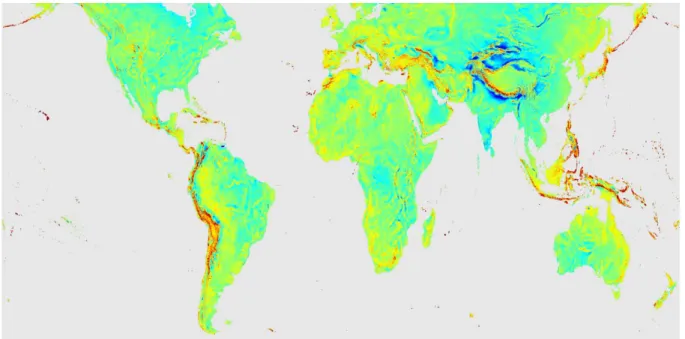
Figure 1. Coverage of GGMplus. Shown are mean values of the radial component of the gravity 402
field over land and near-coastal areas between ± 60° geographic latitude.
403 404
Technical definitions 405
406
The five gravity field functionals provided by GGMplus are 407
408
• Free-fall gravity accelerations (i.e. gravitational plus centrifugal accelerations) 409
• Gravity disturbances (radial derivatives of the disturbing potential), denoted as radial 410
component of the gravity field in the manuscript 411
• North-South deflection of the vertical in Helmert definition (latitudinal derivative of the 412
disturbing potential), denoted as horizontal component of the gravity field in the 413
manuscript 414
• East-West deflection of the vertical in Helmert definition (longitudinal derivative of the 415
disturbing potential), denoted as horizontal component of the gravity field in the 416
manuscript 417
• and Molodenski quasigeoid heights.
418 419
All quantities are given at the Earth’s surface as defined through the SRTM (Shuttle Radar 420
Topography Mission) topography. Users wishing to use geoid heights instead of quasigeoid 421
heights can do so by applying standard conversion as described, e.g., Rapp [1997].
422 423
2 Data sets used
424 425
A complete list of data sets used for the development of GGMplus is given in Table 1. The use of 426
these data is further detailed in Section 3.
427 428
Table 1. Data sets used for the development of GGMplus 429
Dataset Ressource Citation
GRACE satellite gravity model ITG2010s
http://icgem.gfz-potsdam.de/ICGEM Mayer-Gürr et al.
[2010]
GOCE-TIM4 satellite gravity model
http://icgem.gfz-potsdam.de/ICGEM/ Pail et al., [2011]
EGM2008 gravity model
http://earth-info.nga.mil/
GandG/wgs84/gravitymod/egm2008/
Pavlis et al., [2012]
Gridded 250 m SRTM V4.1 release over land
http://srtm.csi.cgiar.org/ Jarvis et al., [2008]
Gridded SRTM30_PLUS V7 bathymetry offshore
http://topex.ucsd.edu/WWW_html/srtm 30_plus.html
Becker et al., [2009]
RET2012 spherical harmonic rock-equivalent topography model
http://www.geodesy.curtin.edu.au/resear ch/models,
file
Earth2012.RET2012.SHCto2160.zip
Hirt et al., [2012]
Earth2012 Topo/Air spherical harmonic model of
Earth’s physical surface
http://www.geodesy.curtin.edu.au/resear ch/models,
file Earth2012.topo_air.SHCto2160.zip
Hirt et al., [2012]
430
3 Methods
431 432
GGMplus is constructed as a composite model of GOCE and GRACE satellite gravity, 433
EGM2008 and topographic gravity in the space domain. The following steps were taken to 434
develop the model:
435
• Combination of GOCE and GRACE satellite gravity (Sect. 3.1) 436
• Combination of GOCE-GRACE combined model with EGM2008 (Sect. 3.2) 437
• Spherical harmonic synthesis of gravity field quantities (Sect. 3.3) 438
• Forward-modelling of gravity field quantities (Sect. 3.4) 439
• Calculation of normal gravity at the Earth’s surface (Sect. 3.5) 440
• Combination of synthesis and forward-modelling results (Sect. 3.6) 441
442
The 250 m resolution SRTM topography [Jarvis et al., 2008] is consistently used to represent 443
Earth’s physical surface in the gravity field synthesis (Sect. 3.3), forward-modelling (Sect. 3.4) 444
and calculation of normal gravity (Sect. 3.4). In approximation, SRTM elevations are physical 445
heights above mean sea level. In processing steps 3.3 and 3.5, heights of the topography above 446
the ellipsoid (ellipsoidal heights) are required. These were obtained in approximation as sum of 447
SRTM and the EGM2008 quasigeoid [Pavlis et al., 2012]. The geoid-quasigeoid separation was 448
not accounted for in the construction of SRTM ellipsoidal heights, because this effect is mostly 449
small (cm-dm-level, up to 1-2 m in the high mountains), which play a neglegible role in 3D 450
spherical harmonic synthesis. The parameters of the GRS80 geodetic reference system [Moritz, 451
2000] were consistently used throughout the GGMplus model development.
452 453
3.1 GOCE TIM4 and GRACE combination 454
455
The satellite-only combination model has been computed by addition of full normal equations of 456
GRACE and GOCE.
457 458 459
4
1 1
, 1
4
1 1
, 1
( ( ) ) ( ) )
( ( ) ) ( ) )
T T
GOCE i GRACE
i
T T
GOCE i GRACE sat sat
i
A l A A l A x
A l l A l l N x n
− −
=
− −
=
Σ + Σ =
Σ + Σ ⇔ =
∑
∑
460 (1)
461 462
The GRACE component consists of ITG-Grace2010s [Mayer-Gürr et al., 2010] up to 463
degree/order 180, which is based on GRACE K-band range rate and kinematic orbit data 464
covering the time span from August 2002 to August 2009. The GOCE component contains 465
reprocessed satellite gravity gradiometry data (main diagonal components VXX, VYY and VZZ and 466
off-diagonal component VXZ of the gravity gradient tensor; summation i = 1, …4 in Eq. (1)) from 467
November 2009 to June 2012, as they have also been used for the 4th release of the GOCE TIM 468
model [Pail et al., 2011]. In Eq. (1), l are the observations, and x the unknown spherical 469
harmonic coefficients (SHC).
470 471
In the frame of the gravity gradient reprocessing, among others an improved algorithm for 472
angular rate reconstruction has been applied [Stummer et al., 2011], leading to a significant 473
improvement of the gravity gradient performance mainly in the low to medium degrees [Pail et 474
al., 2013]. The resulting GOCE gradiometry normal equations are resolved up to degree/order 475
250.
476 477
Special emphasis has been given to realistic stochastic modeling of observation errors as part of 478
the assembling and solution of the individual normal equation systems, yielding realistic 479
variance-covariance information Σ( )l for both GRACE and GOCE. In the case of GOCE, digital 480
auto-regressive moving average (ARMA) filters have been used to set-up the variance- 481
covariance information of the gradient observations [Pail et al., 2011]. Technically, this is done 482
by applying these filters to the full observation equation, i.e., both to the observations and the 483
columns of the Jacobian (design matrix A). Due to the realistic stochastic modeling, the two 484
normal equations could be combined with unit weight. Because of the further combination with 485
EGM2008 as described in section 3.2, regularization has not been applied.
486 487
3.2 GOCE/GRACE and EGM2008 combination 488
489
The combination of the GRACE/GOCE data with EGM2008 is done on the basis of the 490
combined GRACE/GOCE normal equations (see Sect. 3.1). Here the EGM2008 SHCs are 491
treated as a set of a priori known parameters introduced into a least-squares process of the form:
492 493
1 1
1 2 1 2
(w Nsat+ Σw (xEGM) )− x=w nsat + Σw (xEGM)− xEGM (2) 494
495
where x is the optimally combined set of SHCs from GRACE, GOCE and EGM2008. The 496
termsNsat and nsat denote the normal equation system of GRACE/GOCE combination (cf.
497
section 3.1), resolved up to degree/order 250.
498 499
The terms Σ(xEGM)−1 and Σ(xEGM)−1xEGM denote the system of normal equations, which relies 500
exclusively on the EGM2008 coefficients xEGM up to degree/order 360, which are used as 501
pseudo-observations (the Jacobian is in this case an identity matrix). Since for EGM2008 only 502
the variances are available, the variance-covariance matrix Σ(xEGM)−1 has a diagonal structure.
503
The weight for the satellite-only system is w1=1, expressing the fact that we consider the formal 504
errors of this combined model as correctly scaled, and the weight of EGM2008 has been 505
assigned empirically with w2 =0.16, and the EGM2008 formal errors have been down-scaled by 506
a factor of 1 increasing linearly to 10 in range of degrees 180 to 200. In this way, the 507
combination is tuned giving GRACE/GOCE data dominant influence in the degrees 0 to 180 and 508
forcing EGM2008 information to take over in the spectral range 200 to 2190, leaving the main 509
spectral range of transition from GRACE/GOCE to EGM2008, where both components 510
contribute significantly, between degrees 180 to 200. Figure 2 shows the relative contributions of 511
GOCE/GRACE data (red for more than 80% GOCE/GRACE impact) and indirectly the 512
EGM2008 model contribution (blue for more than 80% EGM2008 impact) per spherical 513
harmonic coefficient Cnm/Snm in the combination (for degrees 0 to 250).
514 515
516
Figure 2. Relative contribution of GOCE/GRACE data per spherical harmonic coefficient 517
nm/ nm
C S in the combination with EGM2008 data (in percent) for the degrees 0 to 250 518
519
From Fig. 2, the transition for certain harmonic orders (say -20 < m < +20) is differently than the 520
other orders (say m<-20, m>+20). This is related to the lower accuarcy for the determination of 521
the near-zonal spherical harmonic coefficients using GOCE gradiometry (known as the polar gap 522
problem due to the GOCE satellite’s orbit inclination of 96.6 degrees). he lack of observations in 523
the polar regions worsens the accuracy in the determination of a certain group of spherical 524
harmonic coefficients, which is the near-zonal group (e.g., Sneeuw and Gelderen, 1997).
525
Consequently in the combined solution EGM2008 has a higher influence in for those coefficients 526
where GOCE shows a lower performance (and thus a higher standard deviation).
527 528
The outcome of this processing step is a combined GRACE/GOCE/EGM2008 coefficient data 529
set here denoted as GGE. Figure 3 shows the differences between gravity disturbances from 530
GGE and EGM2008, revealing significant discrepancies at the 10-20 mGal-level over Africa, 531
Asia and South America, while there is agreement in the mGal range over most parts of Europe, 532
Australia and North-America. The larger discrepancies are interpreted as improvements over 533
EGM2008 conferred by recent GRACE and GOCE data to GGMplus, see also Pail et al., [2011]
534
and Hirt et al., [2012].
535 536
537
Figure 3. Gravity disturbance differences between the GRACE/GOCE/EGM2008 merger GGE 538
and EGM2008-only in the spectral band of degrees 2 to 250, units in mGal 539
540
3.3 Synthesis 541
542
The spherical-harmonic coefficients (SHCs) of the combined GGE model were used in the 543
spectral band of degrees 2 to 2190 to synthesize gravity field functionals at the Earth’s surface, 544
as represented through the 3D-coordinates (latitude, longitude, height). Accurate evaluation of 545
the SHCs requires taking into account the ellipsoidal height of the evaluation points which were 546
obtained from SRTM at 7.2 arc-second resolution. The zonal harmonics of the GRS80 normal 547
gravity field were subtracted from the GGE-model SHCs as described in Smith [1998]. The tide 548
system used in the synthesis is zero-tide, which is compatible with GRS80 [Moritz, 2000].
549 550
Spherical harmonic synthesis of gravity field functionals at the Earth’s surface – known as 3D 551
synthesis – is computationally extraordinarily demanding, because efficient SHS operations 552
cannot be used [Holmes, 2003]. Therefore we used the gradient approach to higher order [Hirt, 553
2012] which offers an efficient yet accurate approximate solution for 3D synthesis at densely- 554
spaced surface points, represented through the elevation model. We used a modification of the 555
harmonic_synth software [Holmes and Pavlis, 2008] to synthesize quasigeoid heights, gravity 556
disturbances, North-South and East-West deflections of the vertical at a reference height of 4 km 557
above the GRS80 reference ellipsoid at 1 arc-min resolution. For all four functionals radial 558
derivatives were computed up to 5th-order at the same reference height and resolution. These 559
were bicubically interpolated to 7.2 arc-second resolution and continued from the reference 560
height to the Earth’s surface with 5th-order Taylor series expansions (cf. generic formulations 561
provided in Hirt [2012]), yielding numerical estimates of gravity functionals at 3 billion surface 562
points in the spectral band of degrees 2 to 2190.
563 564
Using the gradient approach as described, the 3D synthesis of the four gravity field functionals 565
took about 6 weeks of computation time using an in-house Sun Ultra 45 workstation. By 566
comparison, 3D synthesis with conventional point-by-point evaluation methods [Holmes, 2003]
567
would have taken an estimated 60 years of computation time. This estimate is based on an 568
observed performance of 100 points/ minute using the same workstation and parameters. The 3D 569
synthesis as applied here is therefore one of the key innovations that made the construction of 570
GGMplus feasible within acceptable computation times.
571 572
We note that the gradient approach is an approximate technique for 3D-SHS, whereby 573
approximation errors decrease with increasing order of the Taylor series applied. From analysis 574
of the 0th to 5th-order contributions over 3 billion points, the contribution made by subsequent 575
orders (e.g., 0th and 1st, 1st and 2nd) differs by a factor of about 4 to 5 (see also Table 2). Given 576
maximum contributions of 2 mm, 0.6 mGal and 0.1 arc-sec for the 5th-order, maximum 577
approximation errors (due to truncation of the Taylor series after the 5th-order) will be generally 578
smaller than 0.6 mm, 0.2 mGal and 0.03 arc-sec anywhere in our working area. Hence, the 579
Taylor series as applied for GGMplus converge sufficiently, and approximation errors are 580
negligible for practical applications.
581 582
Table 2. RMS (root-mean-square) and maximum values of the 4th-order and 5th-order terms of 583
the Taylor expansions used for gravity field continuation to the Earth’s surface. Also given are 584
the estimated RMS and maximum approximation errors. Values reported for the functionals 585
quasigeoid, gravity disturbances and deflections of the vertical.
586
Functional Contribution of 4th –order term
Contribution of 5th –order term
Estimated
approximation error
RMS Max RMS Max RMS Max
Quasigeoid [mm] 0.24 9.88 0.05 2.07 0.01 0.52
Gravity [mGal] 0.06 2.54 0.01 0.59 0.00 0.15
NS deflection of the vertical [arc-sec]
0.01 0.31 0.00 0.08 0.00 0.02
EW deflection of the vertical [arc-sec]
0.01 0.34 0.00 0.08 0.00 0.02
587
For quasigeoid heights, the C1B correction term [Rapp, 1997], see also [Hirt, 2012], was applied 588
to take into account the change in normal gravity with height. For gravity disturbances, the 589
ellipsoidal correction was applied [Claessens, 2006]. For the North-South deflection of the 590
vertical, corrections for the curvature of the plumbline and for the ellipsoidal effect were taken 591
into account as described in [Jekeli, 1999].
592 593 594
3.4. Forward-modelling 595
596
Gravity forward-modelling based on high-resolution topography is a frequently-used technique 597
to derive information on the short-scale gravity field in approximation [Forsberg, 1984; Pavlis et 598
al., 2007; Hirt, 2012]. The short-scale (i.e., 10 km to ~250 m) gravity signals of the GGMplus 599
model are based on forward-modelling using the 7.5 arc-sec resolution (~250m) SRTM V4.1 600
topography [Jarvis et al., 2008] over land and the 30 arc-sec resolution SRTM30_PLUS V7.0 601
bathymetry [Becker et al., 2009] over sea. A small number of bad data areas (about 0.002% of 602
the total area covered by GGMplus as shown in Fig. 1) was identified and removed from both 603
data sets through simple hole-filling.
604 605
The forward-modelling approach applied here follows the description given in Hirt [2013]. In 606
brief, we converted the SRTM30_plus bathymetry to rock-equivalent depths before merging with 607
the 250m SRTM V4.1 topography. The merger was high-pass filtered by subtracting heights 608
from the RET2012 rock-equivalent topography model to degree and order 2160 (publicly 609
available from http://geodesy.curtin.edu.au/research/models/Earth2012/, 610
Earth2012.RET2012.SHCto2160.dat).
611 612
We applied brute-force numerical integration techniques [Forsberg, 1984] to convert the high- 613
pass filtered topography (and rock-equivalent depths over sea) to topography-implied gravity, 614
geoid and vertical deflections. The forward-modelled gravity signals possess spectral energy at 615
spatial scales of ~10 km to ~250 m which augments GGE gravity information beyond 10 km 616
resolution. The numerical integration was accomplished with a variant of the TC software 617
[Forsberg, 1984] and an integration cap radius of 200 km around any of the ~3 billion 618
computation points, and the correction for Earth’s curvature applied, as described in Forsberg 619
[1984]. Given the oscillating nature of the high-pass filtered topography, the effect of remote 620
masses largely cancels out as pointed out by Forsberg and Tscherning [1981]. The integration 621
radius chosen is suitable for forward-modelling of high-frequency gravity effects [Hirt et al., 622
2010; Hirt, 2012].
623 624
The forward-modelling exercise was partitioned into ~19,000 computationally ‘manageable’
625
areas of 1 deg x 1 deg extension covering land areas everywhere on Earth between ± 60°-latitude 626
with SRTM data available. Each 1 deg x 1 deg tile is composed of 625,000 computation points at 627
7.2 arc-seconds resolution. We utilized the iVEC/Epic supercomputing facility 628
(http://www.ivec.org/) along with massive parallelization (simultaneous use of up to 1100 central 629
processing units (CPUs)) to accomplish the forward-modelling for the first time near-globally.
630
Based on non-parallelized standard computation techniques and a single CPU, the calculation of 631
topographic gravity effects had taken an estimated 20 years, which is why all previous efforts 632
were inevitably restricted to regional areas.
633 634