English fricative consonants in the second semester students of the English department at Makassar Muhammadiyah University. Analysis of students' problems in pronouncing the English fricative consonant at the second semester English department of students at Makassar Muhammadiyah University”. This research was conducted among second semester students of the English Department of Makassar Muhammadiyah University.
What are the problems of the students in pronouncing English fricative consonants of the second semester students of English department in Makassar Muhammadiyah University. The students' problems in pronouncing English fricative consonants in second semester students of English department in Makassar Muhammadiyah University. This study was conducted in second semester students from English department in Makassar Muhammadiyah University.

INTRODUCTION
Background
For English learners, speaking skills are very important; especially the accuracy of English pronunciation. These differences can produce the variation of sounds' production especially in the production of English sounds. A good pronunciation of English Fricative consonant is a consonant that pronounces the sounds like a native speaker.
Due to the previous problems, most of the results indicate that the second students of the English Department in Makassar Muhammadiyah University have a low ability to pronounce English Fricative consonants.
Problem Statements
Based on the previous explanation, the researcher is interested in analyzing the students' problems with the pronunciation of English Fricative consonant.
Objectives of The Study
Significance of The Study
Scope of The Study
She found that most of the sounds in the fricative consonant are difficult for the students to pronounce. When learning pronunciation, most students still have a lot of trouble pronouncing English sounds. The researcher classified and identified the students' difficulties and the most incorrect pronunciation of English fricative consonants.
Finally, she recorded the students' pronunciation when pronouncing the sounds of fricative consonants and the interview. The findings of the research present the result of the students' difficulties in pronouncing English Fricative consonants and the most commonly mispronounced by the students. The researcher found that the students usually consult the dictionary to improve their pronunciation, especially in pronouncing Fricative consonant.
Some of the students said that: a) "The cause of the difficulty in pronouncing Fricative consonant, because when we were studied in the Senior High School, we never study about the transcription in pronunciation". The students' survey was identified as the most commonly mispronounced by the students in Fricative consonant. It aims to describe the students' problems with the pronunciation of Fricative consonants and the most commonly mispronounced by the students.
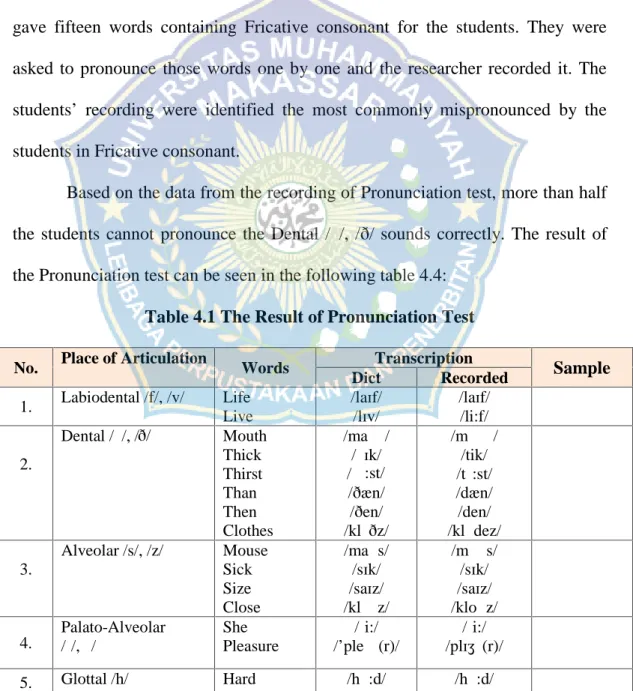
From the results of the interview, more than half of the students answered that they could not pronounce the sounds of fricative consonants. As a result, students were less interested in learning good pronunciation of fricative consonants. From the results of the pronunciation test, the researcher found that most students had difficulty pronouncing the dental sounds /θ/, /ð/.
Most of the students' problems in pronouncing English words, especially in the Fricative consonant, is caused by less concentration in learning pronunciation. Some of the students knew how to pronounce the fricative consonant, but others did not, because they are not focused when learning the pronunciation. Students find it difficult to pronounce Fricative consonant words because they do not say it in everyday conversation.

REVIEW OF RELATED LITERATURE
Previuos Related Research Findings
The Concept of Speaking
Tarigan defined that speaking is a language skill that develops in a child's life, which is created with the ability to listen, and during this period the skill of speaking is learned. Tarigan said that speech is the ability to express, explain and convey thought, feeling and idea. From the above statement, we can conclude that speaking is very important in mastering a foreign language.
From the previous two definitions, the researcher can conclude that speaking ability consists of language performance and language competence.
The Concept of Pronunciation
He feels that way, so he thinks he knows what he wants to say and how to express himself. When we consider the meaning of words, we see how using one sound over another aspect can change the meaning of the word. In addition, O'Connor argued, "Vowels are made of voiced air passing through different mouth shapes; the differences in mouth shape are due to different positions of the tongue and lips".
Furthermore, Dale and Poms (2005: 4) stated: “A vowel is a speech sound produced by the vibration of the vocal cords and the continuous, unrestricted flow of air coming from the mouth”. For example, the tongue is high in the mouth for the vowel [ɪ] as in see, but low in the mouth for the vowel [ɒ] as in hot. A consonant is produced when the tongue is held very close to the sky and a sounding current of air of normal strength is emitted, and the sound of friction is heard in addition to the voice.
Consonants are generally produced by some interference of the vocal organs with the air stream, and are therefore easier to describe and understand. Additionally, Dale and Poms stated, “A voiced consonant is a sound produced when the vocal cords vibrate. It is possible to recognize many pairs of consonants that are essentially the same except for the voicing element (for example [f], as in fan, and [v], as in van).
Learning a foreign language often presents us with the problem of physical unfamiliarity (i.e. it is actually physically difficult to make the sound using certain parts of the mouth, uvula or nasal cavity). Some of us (and many of our students) find it extremely difficult to hear tunes or to identify the different patterns of rising and falling tones.
The Concept of Fricative Consonant
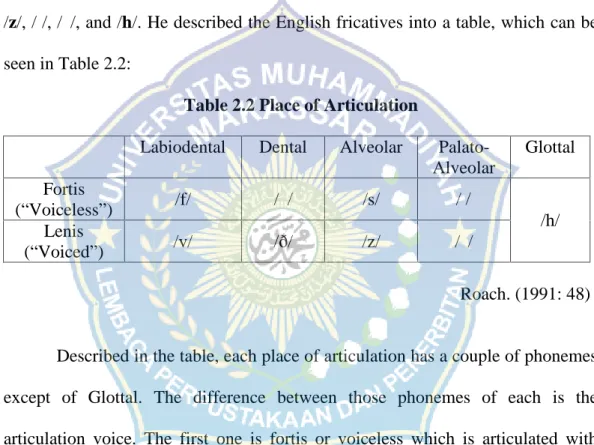
Roach stated that there are nine English fricatives, each fricative phoneme having its own complexity. The second is lenis or voiced, which has less or no friction in final and initial position, but may be voiced between voiced sounds. Examples of /f/ fricative words are 'Phase', 'Suffer', 'Cough', each word leads to the initial, medial and final sound positions of the /f/ fricative and these words are used as research material.
Dental fricative usually places the tip of the tongue between the teeth, and the tip of the tongue should be inside the teeth, touching the inside of the lower incisors, while the blade touches the inside of the upper teeth. Value that each word carries initial, medial and final sound position, and these words are used as material in the research. Examples of words with /s/ fricative are 'Cease', 'Cassette', 'Mess', each word carries initial, medial and final sound position, and these words are used as material in the research.
Other examples of /z/ fricative words are 'Zip', 'Laser', 'Rose', each word leading to an initial, middle and final sound position and these words are also used as research material. The position of the tongue moves back slightly and the airflow escapes through a wider path along the center of the tongue. In fact, /ʒ/ has no English initial vowel position distinct from the /ʃ/ fricative.
Glottal fricative action requires the production of a narrow stream of air with a friction noise between the vocal cords. It's not because it doesn't recognize vocabulary or even grammar, it's because of the strange sounds it makes.
Conceptual Framework
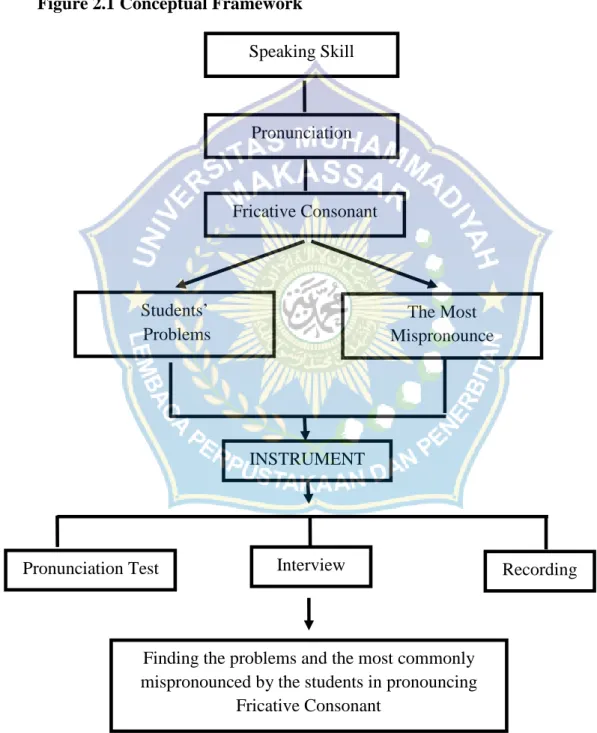
Based on the foregoing, it was explained in Figure 2.1 that the input of this study consisted of pronunciation in fricative consonants, targeting the problems of the students and the most commonly mispronounced by them through the pronunciation test, recording and interview until the researcher reviewed the series of previous found problems. the researcher has already explained this before. When learning the pronunciation, there are some mannerisms and places of articulation that the students should know in order to properly produce the English sounds. In fricative, there are nine places of articulation explained in the previous chapter.
Thus, this research aimed to find out the students' problems in the pronunciation of English sounds, especially in fricative consonants, also the most ill-informed regarding English Fricative consonants. First, the researcher gave the pronunciation test to the students to find out the most frequent mistakes they made. Second, she interviewed the students to find out the students' problem in pronouncing Fricative consonants in English.
RESEARCH METHOD
Research Design
An interview was conducted to find out what problems the students experienced in pronouncing fricative consonants. The students would be interviewed to learn more about their ability, knowledge and difficulty in pronouncing the fricative consonant and to find out the validity of the data obtained from the pronunciation test. When asked to name the type of fricative consonant, most students said that:
Many students strongly agree that the second reason is less concentration when learning pronunciation. In this explanation, the researcher collected recordings of students taking a pronunciation test. According to the data from the recording of the pronunciation test, more than half of the students cannot pronounce the dental sounds /θ/, /ð/ correctly.
Based on the results, the researcher found that most of the students always listen to music and watch the movie to improve their pronunciation. The results showed that most of the students admitted that their problem was caused by less concentration when learning about Pronunciation, including fricative consonant. Most of the students also agreed that their problem because they do not use it in daily conversation.
In this section, we discuss what students most often mispronounce when pronouncing fricative consonants through a pronunciation test. More than half of the students also cannot distinguish the sounds of the dental fricative consonant /θ/, /ð/, which are voiced or voiceless between the two in pronunciation. Students find it difficult to pronounce English words because written and spoken words are different.
Another problem students face in pronouncing fricative consonants is unfamiliar words. Students should increase their knowledge of pronunciation, especially fricative consonants, by concentrating more on learning pronunciation. Students should adjust to listening to as many English words as possible, especially the fricative consonant.