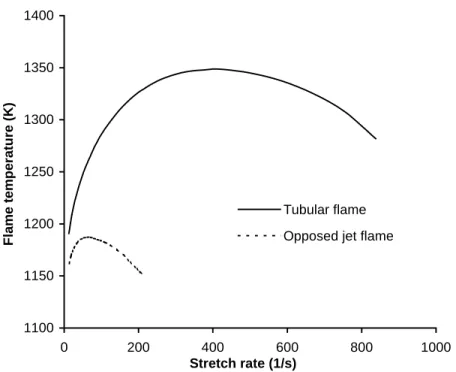
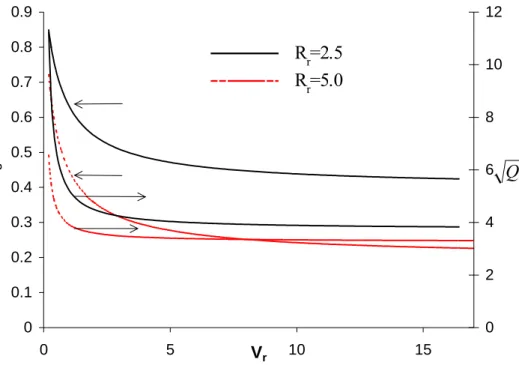
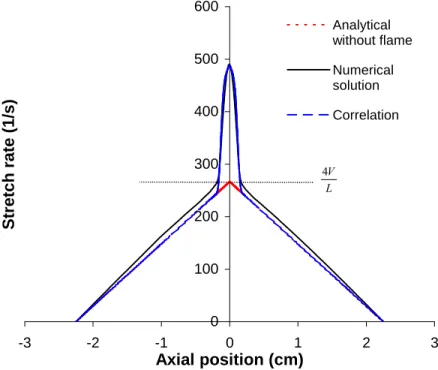
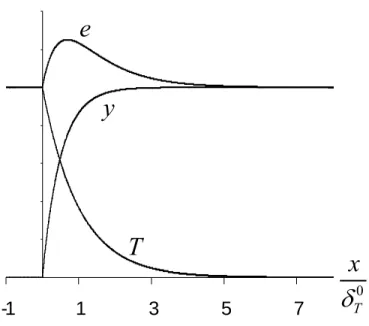
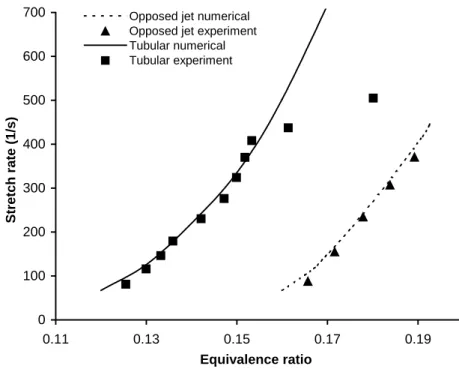
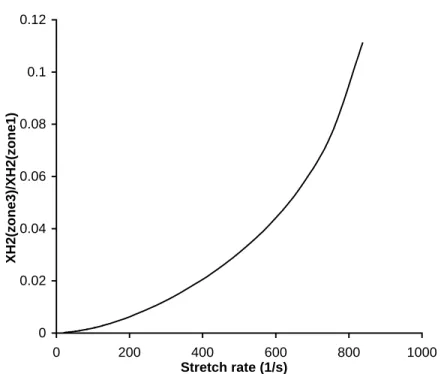
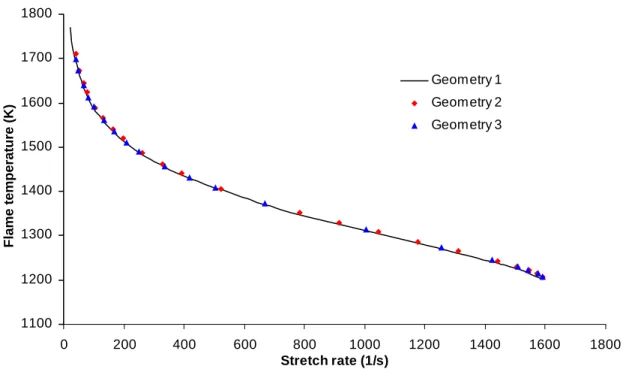
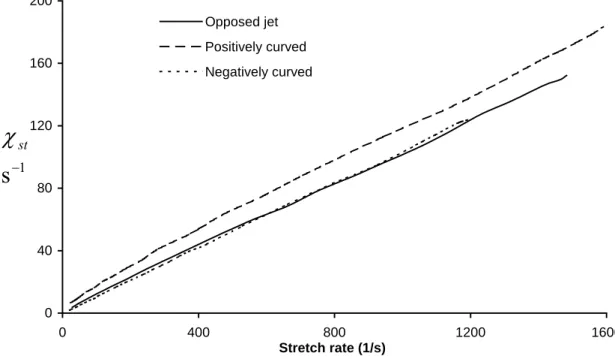
Karlovitz number for the flat and curved flames (lean H2/Air premixed flame with equivalence ratio 0.4). Analytical flame temperature variation with strain rate corrected for the plane and curved flames (rich H2/Air premixed flame with equivalence ratio 4.0). The most elementary premixed flame is the one-dimensional planar premixed flame as shown in Fig.
A further step is the study of the stretched plane flame with the opposite jet burner as shown in fig. The preferential diffusion caused by stretching generates differences in flame temperature from the adiabatic equilibrium value, and the differences depend on the Lewis number, i.e. Le and strain rate (Le=α/D where α is the thermal diffusivity of the mixture and D is the mass diffusivity of the deficient reactant).
Premixed Reactant
For the opposite jet flame, there is no diffusion in the radial direction, but there is convection in this direction, i.e. If Le is less than one, we have e1 > e2 for the one-dimensional planar flame; as the stretching rate increases from 0 to a small value, the flame structure has some variation for stretching; for example, the distributions of temperature and mass fraction are slightly steeper, the average enthalpy of zone 2, i.e. e2 would be different from that of the one-dimensional planar flame e20; however, its value will still be less than e1; to satisfy the energy equation Eq. As the stretch rate continues to increase, the flame pushes toward the stagnation plane, the flow divergence ratio.
When the strain rate is high enough, the flame is pushed to the stagnation plane, m3 is zero and. Here we can see that the preferred diffusion effect and flame temperature are related to the flow divergence ratio m2/m3. Conversely, for Le greater than one, we have Tb < Tb0; as the strain rate increases from 0 to high values (the flame is pushed towards the stagnation plane), m2/m3 keeps increasing and e2 keeps decreasing, but e2 > e1, the product of m2/m3⋅(e1−e2) is negative and its absolute value increases, which means that the flame temperature Tb decreases with the stretching rate continuously.
For the flame speed analysis, with certain premixed reactants, we assume that there is a fixed ignition temperature Ti, above which the chemical reactions begin (i.e. Mallard and Le Chatelier theory. It is suitable for the qualitative analysis) as shown in Fig. For the opposing jet flame, m2i is not zero and neither is the temperature gradient at xi. In general, for any premixed laminar flame, convection in the reaction zone is negligible and chemical heat release is compensated by conduction; thus the following relationship holds (Glassman, 1996).
When Le is less than one, the flame temperature is higher than the adiabatic value; and so do the chemical reaction rate and the temperature gradient at the ignition point. For Le more than one, the temperature gradient at the ignition point is less than the adiabatic value. We can see that the flame speed is also related to the current divergence ratio.
For the opposite jet flame, only when Le is greater than one, increasing the extent of stretching can decrease the flame speed Su. Thus, the Le* transition number (above which increasing stretch will decrease Su flame speed) is greater than that which is consistent with the analysis of Tien and Matalon (1991) and the experimental data of Law et al. 1986) in which the flame speed Su increases with the extension speed for both rich and lean CH4/air and C3H8/air jet flames. If we assume Ti ≈ Tb, then for Le greater than or equal to one, increasing the stretch rate will decrease the Sb flame speed and the Lewis transition number (below which increasing the stretch will increase the Sb flame speed) is less than one which is consistent. with Law and Sung (2000), Clavin and Williams (1982), Matalon and Matkowsky (1982).
From the above analysis, we understand that flame properties such as flame temperature and flame speed depend on the divergence ratio. For the special case of a jet counterflow field, Tien and Matalon (1991) studied the response of the flame speed to the degree of extension. A; the constant A can be used to vary the curvature of the flame while keeping the rate of expansion constant (at r=rs = −2A/(ρuk), u=0; rs is the stagnation radius of the flow field).
For a given fresh mixture, the flame temperature Tb and the flame speed Sb must be a function. The above equations can be used to estimate the flame temperature and flame speed of any curved flame. 4.4, we can see that the five flames have large differences, especially in terms of flame speed.
4.10, the flame speed of the analytical solution is still about 30% higher than that of the numerical solution. Since the flame temperature is related to the preferential diffusion, flame curvature affects flame temperature and extinction strain rate. The preferential diffusion effect is shown to exist on both the fuel side and the oxidizer side of the flame.
For example, when the Lewis number of the fuel or oxygen is less than one, the flame. For the opposite jet flame and positively curved flame, the flame temperature decreases monotonically with the stretch rate; for the negatively curved flame, the flame temperature first increases and then decreases with the stretch rate. It is the natural result that the flame temperature of diffusion flames decreases with the strain rate.
The flame temperature of diffusion flames is determined by two factors: preferential diffusion and the completeness of chemical reactions related to the Damköhler number. As the flame radius decreases, the ratio of flame thickness to flame radius increases; the strengthening and weakening effect of flame bending to preferential diffusion becomes stronger;. With increasing pressure; the flames become thinner; the flame thickness to flame radius ratios are reduced and the flame temperature differences between the counterflow flame and curved flames become smaller.
In a positively curved flame, as the degree of expansion increases, preferential diffusion and incompleteness of chemical reactions cause the flame temperature to decrease monotonically. In a negatively curved flame, as the degree of expansion increases, preferential diffusion tends to increase the flame temperature, while the incompleteness of chemical reactions tends to decrease the flame temperature. For a negatively (positively) curved fuel flow with a Lewis number less than one and a positively (negatively) curved oxidizer flow with a Lewis number greater than one, the curvature weakens (strengthens) the flame on both sides.
An asymptotic analysis is also given for the flame speed and flame temperature of three specific stretched and curved premixed flames: a counterjet flame, a tubular flame, and a spherical flame.