||Volume||5||Issue||1||Pages|| 56 – 76 ||2019||
|P-ISSN: 2460-0938; E-ISSN: 2460-2604|
METAPHORICAL ANALYSIS
OF TEACHERS’ AND STUDENTS’ PERCEPTIONS OF ESP
Cita Nuary Ishak [email protected]
Universitas Negeri Malang, Indonesia Jl. Semarang No. 5, Malang, Indonesia
Article History:
Received:
May 6, 2019
Revised:
May 20, 2019
Accepted:
July 15, 2019
Abstract: Despite the growing interest in English for Specific Purposes, little is known about university teachers‟
and students‟ perceptions towards the subject. The present research aims to investigate teachers‟ and students‟
perceptions towards ESP teaching and learning process in an Indonesian university. Employing metaphorical analysis, fifty students‟ metaphors and thirty teachers‟ metaphors were collected. The analysis of the metaphors revealed that while most students have neutral attitude towards ESP, most teachers experience ambivalences when teaching ESP. The study also found that the teachers conceptualized ESP as a physical activity requiring process, careful measurement, effort, preparation, and time.
Keywords – Metaphorical Analysis, ESP, Perceptions Corresponding Author:
INTRODUCTION
A metaphor is not just a poetic device. In the context of research in English Language Teaching (ELT), metaphors offer a way to observe how learners construct their perceptions and beliefs by referring to an immediate object. Metaphors show how thought and reasoning are processed in human mind (Lakoff & Johnson, 1980). Thus, they function as a powerful tool to undercover ones‟ perceptions and beliefs. Compared to other ways of investigating human minds, metaphors are considerably more effective in revealing
thought processes that may not be easy to be conveyed explicitly (Littlewood, 2012: 33).
Due to their ability to vividly mirror people‟s thoughts and beliefs (Fang, 2015: 63), metaphorical analysis has been used as a method to investigate, for example, beliefs about learning and teaching in ideal situations (Pishghadam, 2011), perceptions about effective and ineffective learning experiences(Ferrante et al, 2008), underlying conceptualizations of
Available online at:http://ejournal.kopertais4.or.id/mataraman/index.php/efi
English as a Foreign Language (EFL) learning process (Bas & Gazegin, 2015), and perceptions of English language course books (Kesen, 2010).
When implemented in the realm of ELT, metaphorical analysis can be used to reveal EFL students‟ inside views of their educational practice. Zhang (2016), for instance, investigated university students‟ conceptualizations about teachers‟ roles through
metaphors that they had created. In addition, metaphorical analysis may also reveal the extent to which a course or a teacher training program is useful. For example, Nagamine (2012) explored the changes of pre-service EFL teachers‟ beliefs about their roles as English teachers in Japan during pre-, mid-, and post-practicum phases. Similarly, Simsek (2014) conducted a metaphorical analysis to investigate sophomores‟ perceptions on the role of ideal teachers before and after taking the course „Approaches to ELT‟. The study found that before taking the class, most students held a common belief that teacher is a
„molder‟ or „knower‟. However, after taking the class, the view changed into teacher as a
„facilitating partner‟. The study suggests the important role of the course in helping
students to construct their views about the role of an ideal EFL teacher. Such finding might be important for teachers in deciding which courses to include in an ELT program.
Metaphorical analysis is also beneficial to give information about students‟
perceptions towards the process of learning a foreign language. Fang (2015) employed metaphorical analysis to investigate college EFL learners‟ perceptions of English learning.
The study found that the learners believed that the road to success of learning a language is not easy and requires hard work, patience, endurance, and positive attitude. However, the perceptions of the learners were found to be significantly different between English and non-English majors, and among different level of proficiency. Apart from the differences across departments and proficiency levels, findings from the study reflect the students‟
awareness of learning efforts that they have to make in order to achieve success in learning a foreign language. Although metaphorical analysis is widely used in the aforementioned studies, it is rare to be found in studies which specifically focus on students or teachers‟
perceptions of English for Specific Purpose (ESP).
In the last decade there have been some studies concerning students‟ perceptions towards ESP program offered in universities. Harrabi (2010), for example, conducted a cross-sectional study to investigate science and technology students‟ perceptions of ESP course. It was found that there was a high unsatisfactory rates among the students. The result of the study indicated the need to change the ESP program to help students in using English effectively in their study and future occupations in science and technology.
Alqahtani (2015) surveyed and interviewed engineering students towards learning ESP to
find out their attitude towards the learning process. The finding was similar to that of Harrabi (2010) in terms of the students‟ negative attitude towards learning ESP, which suggested the need for ESP teachers to motivate the students. The negative attitude among ESP students was probably due to the difficulty in learning specific terms that are used in a particular subject matter. A study conducted by Wu (2014) investigated learning
difficulties among Taiwanese students during ESP learning. Vocabulary abstractness was found to be the difficulty felt by most of the students.
Despite students‟ negative attitude towards ESP as have been found by the previous studies, most students considered the importance of learning ESP (Abdelfateh, 2016).This positive attitude towards the necessity of ESP program was also prevalent among ESP teachers and civil engineering students in Vietnam (Nguyen & Nguyen, 2017).
Even more, Vasbieva & Saienko (2018) found that the majority of ESP students showed positive attitude towards the integration of technology in ESP learning. This suggests for technology-mediated ESP classes which can increase students‟ engagement and their enthusiasm to learn. In Indonesian high school context, Khoirunnisa, Suparno, and Supriyadi (2018) found that both ESP teachers and students of tourism programs shared positive perceptions towards ESP. The students perceived that speaking has a crucial role for their future career.
While there is a growing interest among universities in Indonesia to include ESP as one of the compulsory courses,the research on the area, especially the teachers‟ and students‟ perceptions, including their beliefs and feelings towards learning and teaching ESP are quite limited. The study which was conducted by Poedjiastutie and Oliver (2017) is therefore worth mentioning here. Their study is significant because it offers the most recent picture of ESP teaching and learning in Indonesian higher education. They conducted an ethnographic study involving three cohorts of stakeholders namely employers, teachers, and students and found that all the stakeholders acknowledged the importance of English as an international language that can fulfill their future needs, such as, reading publications, having international collaboration, and opening employment opportunities. Through an ethnographic approach, the study is able to explain in details the needs owned by the students, teachers, and employers and how the information is useful for policy makers, curriculum writers, and ESP teachers.
Besides the study by Poediastutie and Oliver (2007), a study done by Dja‟far, Cahyono, and Basthomi (2016) offered significant information about university students‟
motivation in learning ESP. They examined how EFL teachers perceive university students‟
motivation and ESP learning achievement. Their findings revealed that Indonesian EFL
teachers perceived university students‟ motivations as generally high. They also found that peer pressure and current value as the reasons behind students‟ lack of motivation. The teachers asserted that since the students were still in the transition from senior high school to university, their attitude and behavior were heavily influenced by their friends. The consequences were seen in the classroom where students were likely to delegate their responsibility to their friends during group work and favor doing fun activities instead of learning. The teachers also agreed that the compulsory status of ESP as a requirement for graduation makes it less appreciated by the students.
Completing the abovementioned studies, the present article investigates the perceptions of students and teachers towards ESP by analyzing the metaphors that they produce. Doing a metaphorical analysis may help teachers and educators develop their professional competence, because the findings can uncover the students‟ attitudes towards the language they are learning, the process of learning, and the challenges they have during the language learning process (Bas & Gezegin, 2017). Furthermore, since ESP is strongly dependent on the result of need analysis of the students, the information regarding students‟
perceptions about the subject is vital because the learning strategies, attitudes, and
motivations are affected by the beliefs that they hold. This small-scale study also attempts to investigate ESP teachers‟ beliefs toward the subject to see if their beliefs are in line with the students‟. With this purpose, two research aims were formulated: (1) to reveal the metaphorical conceptualizations do Indonesian students use to describe their ESP learning process at their university; (2) to reveal the metaphorical conceptualizations do Indonesian teachers use to describe their ESP teaching process at their university.
METHOD
Elicited Metaphor Analysis (EMA) is based on Lakoffs‟ (1993) studies of metaphors. One possible way to work with metaphors in qualitative research is to elicit them directly from the research participants themselves (Schmitt, 2005). In this research, metaphors that had been collected were analyzed by following what Cameron and Low (1999: 8) have suggested as follows:
1. Collecting informants‟ metaphorical linguistic expression of the topic 2. Generalizing them to the conceptual metaphors they exemplify
3. Using the results to suggest the understanding or thought patterns which construct or constrain people‟s beliefs or actions.
Since metaphorical analysis is qualitative in nature, the qualitative data were analyzed by using the researcher‟s interpretation. It is because “metaphor analysis uses the researcher‟s
intuition as a means of identifying the metaphors” (Pitcher, 2013: 1). To ensure inter-rater reliability, an independent reviewer was asked to check whether the categorizations of the metaphors are appropriately done and the interpretations are well-justified.
The research was conducted at a university in Indonesia. The university offers ESP program for the first and second semester students. As a compulsory course, ESP is taught for students in all faculties at the university during the first year. The course is divided based on language skills: listening, speaking, reading, and writing. Three groups of students at their second semester in a university in Indonesia were asked to reflect on their ESP learning experiences during their first semester. The first group consisted of 20 students from Electrical Engineering department and the second group consisted of 13 students from Management department. The third group consisted of 17 students from the Accounting department. The students were in the second semester and were taking ESP course during the data collection. The level of English proficiency of both groups varied from beginner to intermediate. The second participants were ESP teachers (N=30). Their ESP teaching experience ranged from two to seven years. The teachers graduated from either English Education or English Literature and Linguistics Program.
The data for analysis in the present research was obtained by asking students to complete a prompt saying “ESP is (like) …, because ….” They were asked to write the metaphor which best describes their experience of learning ESP. Before they completed the prompt, the researcher gave a brief explanation about metaphors and how their answers would be a powerful way to gain insights about their perceptions and beliefs about ESP.
From the data collection, 50students‟ metaphors were grouped based on the attitudes that they elicited, and the types of metaphors that they used to describe their perceptions towards ESP. As for the teachers, the data were collected by asking them to complete a prompt saying “Teaching ESP is (like) …, because ….” A total of 30 ESP teachers‟
metaphors were collected for this study. Similarly, the metaphors were then analyzed based on the attitudes they describe as well as the types of metaphors and their entailment. By doing so, the analysis of the entailments can help researchers clarify meanings and
understand the emotions, learning or teaching journeys, reasons, and learning goals (Jin et al, 2014: 289).
FINDINGS AND DISCUSSIONS Findings
Students’ attitudes towards ESP through metaphors
The metaphors created by ESP students are categorized into the positive, negative, neutral, and ambivalent attitudes indicated by both the metaphors and entailments. From 50 metaphors created by ESP students, it is generally found that most students have neutral attitude towards ESP. However, they also have some ambivalences towards the subject.
Figure 1 shows the attitude of the students from all departments towards ESP which were shown from the metaphors they created.
Figure 1. Students’ attitudes towards ESP
Most students have neutral attitude towards ESP. However, a large majority of the students also have both positive and ambivalent attitudes. This finding indicates that, overall, the students‟ attitudes towards the subject is rather varied, with no significant differences. Specifically, the attitude of the students from each department is shown in Figure 2. Most electrical engineering students have positive attitudes, while most
accounting students have neutral attitudes towards ESP. On the other hand, the number of management students who hold positive, ambivalent, and neutral shows a quite similar proportion.
26% 26% 28%
20%
0%
5%
10%
15%
20%
25%
30%
Positive Ambivalent Neutral Negative
Students' Attitudes towards ESP
Figure 2. Attitudes towards ESP across Departments
Positive metaphors (Example 1) show that the students have pleasant experience in learning ESP. Most of the positive metaphors were conceptualized to their‟ favourite food and hobbies.
Example 1
Metaphor Entailment
Meatball I like it.
McDonald I am loving it.
PUBG (an online game) It makes me happy.
Ambivalent metaphors (Example 2) expresses a dilemma felt by the students when learning ESP. On one hand, the students find ESP to be interesting. On the other hand, they acknowledge that learning ESP is not always easy. The metaphors highlight the challenge of learning ESP and the effort they need to make to achieve success.
Example 2
Swimming We need to practice a lot, because we are going to use the skill every time, especially at the time of emergency.
Coffee It is bitter, but it can still be enjoyed.
Chili The more we eat, the spicier it gets. The more we learn, the more challenging it gets.
35%
25%
15%
25%
31% 31% 31%
7%
12%
23%
41%
23%
0%
10%
20%
30%
40%
50%
Positive Ambivalent Neutral Negative
Attitudes towards ESP across Departments
Electrical Engineering Management Accounting
Neutral metaphors (Example 3) explains students‟ perceptions towards ESP. The metaphors indicate factual information about the learning process. What makes this type different from the others is that both the metaphor and entailment convey a neutral attitude.
The neutral metaphors describe factual information about ESP as perceived by the students, including the importance of ESP and the need to learn it.
Example 3
An IC (integrated circuits) It is the most important component in an electrical component.
Food It must be digested properly.
Bhinneka Tunggal Ika There are different skills to learn in ESP.
Negative metaphors (Example 4) describe students‟ dislike of ESP. The metaphors show that the students feel unhappy, depressed, or burdened. Most negative metaphors were expressed by students from electrical engineering and accounting.
Example 4
A woman It is difficult to understand.
A butterfly It is difficult to catch.
A philosophy book It uses a language that is hard to comprehend.
Types of metaphors created by ESP students
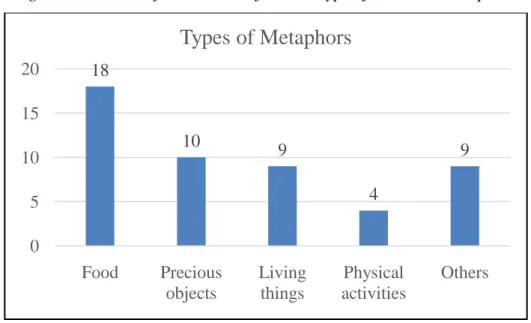
The metaphors created by the students are categorized based on the superordinate category. There are five main types of metaphors and food metaphors have the highest number of occurrences. Figure 3 shows the number of instances for each type of metaphors.
Figure 3. Number of occurrences for each type of students’ metaphors
Food
There were eighteen metaphors given by the students that are related to food, drink, and fruit. The food metaphors reveal the students‟ feelings toward ESP as a subject.
While some of the food metaphors express the students‟ positive feelings, some of them also indicate their conflicting feelings towards the subject.
Example 5
Metaphor Entailment
Le Minerale It is sweet.
McDonald‟s I‟m loving it.
Chocolate It is sweet, but sometimes it is hard to bite.
Chocolate It is bittersweet.
Precious objects
Metaphors related to precious objects had the second highest instances. The metaphors convey the students‟ awareness of the necessity, importance, and use of ESP for their study and for their future.
18
10 9
4
9
0 5 10 15 20
Food Precious objects
Living things
Physical activities
Others
Types of Metaphors
Example 6
A small gem It is precious.
Air It is important. We need it every time.
Clothes We always use it every day. Many people speak English every day.
Living things
Nine out of fifty metaphors created by the students were related to living things.
Interestingly, all of the metaphors reveal students‟ negative feelings for ESP.
Example 7
Women It is difficult to understand women.
A girl It is difficult to understand.
A flower It is difficult to grow. It needs to be watered and fertilized to grow.
Physical activities
Metaphors related to physical activities describe students‟ awareness of the effort they have to make to successfully learn ESP. From this type of metaphors, it can be seen that the students understand that learning ESP requires resilience and hard work.
Example 8
Riding a bike It takes a long time to learn. You have to have high endurance.
Preparing for big events There are many things to prepare before an event. In ESP we learn all the skills and they also need a lot of preparation.
Others
The remaining metaphors are related to vehicle, place, books, movies, and other objects. Each of these metaphors reveal different perceptions that the students have towards learning ESP.
Example 9
Stairs It helps me to reach the top, but I need to go step by step.
A doctor‟s prescription The reading texts in ESP are difficult to comprehend.
An amusement park ESP has various things that are new to me and they are fun to learn.
Teachers’ attitudes towards ESP teaching through metaphors
The metaphors created by ESP teachers are also categorized into positive, ambivalent, neutral, and negative attitudes as indicated by both the metaphors and their entailments. Generally, among 30 metaphors created by ESP teachers, it can be seen that most teachers have ambivalent attitudes towards teaching ESP. However, a large number of them have neutral and negative attitudes as well. Figure 4 presents the metaphors based on the attitude they convey.
Figure 4. Teachers’ attitudes towards teaching ESP in higher education
Positive metaphors (Example 10) describe teachers‟ delightful experience in teaching ESP. Among thirty metaphors created by the teachers, there was only one metaphor eliciting positive attitudes. The metaphor was conceptualized to food.
Example 10
Metaphor Entailment
A cherry on top of a cake Teaching ESP gives you wonderful experiences.
Ambivalent metaphors (Example 11) reveal that ESP teachers have two opposing attitudes towards teaching ESP. The metaphors show that teaching ESP is easy, but is also
3%
37%
30% 30%
0%
5%
10%
15%
20%
25%
30%
35%
40%
Positive Ambivalent Neutral Negative
Teachers' Attitudes towards Teaching ESP
challenging at the same time. This type of metaphors expresses the effort that the teachers have to make in order to deliver the material to students successfully.
Example 11
New years‟ eve You do not know what will surprise you, but it is also fun at the same time.
Making a hot tea It is actually easy, but you need to be careful in pouring the hot water.
A basket of mixed fruit Sometimes you get a sweet one, sometimes you get the sour ones.
Neutral metaphors (Example 12) express teachers‟ knowledge about ESP. Their entailments describe factual information about the process before or during ESP teaching process. This type of metaphors shows a neutral stance of the teachers, by only indicating their view about the process of teaching ESP.
Example 12
Sharing knowledge When I was about to start becoming an ESP lecturer, I realized that I didn‟t know much about specific terms used in a certain department. I share what I knew about English and learn from my students about the specific terms.
Cooking We have to mix many things to help student digest what we serve.
Rainbows You will always find new colours, different shades, tints, and tones.
Negative metaphors (Example 13) has the second highest instances. While metaphors indicating negative attitudes among ESP students express their dislike towards the subject, the metaphors indicating negative attitudes of ESP teachers do not necessarily mean that they dislike teaching the subject. Rather, it shows that to some degree, teaching ESP can be a daunting task for them.
Example 13
Walking to the jungle You never know what you will face in the middle of the jungle.
Doing a quiz Whenever it comes, you need to be always prepared.
Cooking Teaching ESP needs patience, endurance, habits, experience, and preparation of the materials.
Types of metaphors created by ESP teachers
Among thirty metaphors created by the ESP teachers, twenty four (80%) of them were metaphors which are related to physical activities. The similarity among these metaphors (Example 14) is that they convey an activity that requires a process, a careful thought, and a continuous effort.
Example 14
Metaphor Entailment
Vocal rehearsing It takes a lot of trials and errors, adjustment, as well as continuity.
Brewing coffee It has many aspects to consider to make it perfect.
Solving a puzzle We have to think how to make the students enjoy the subject.
Making bread People have special ingredients for making special bread. Teaching ESP also deals with specific purposes.
The remaining metaphors (20%) (Example 15) were related to objects such as rainbows, new years‟ eve, fruit, and a sword.
Example 15
A double-edged sword You cannot be too specific nor too general.
Orange Sometimes it is sweet; sometimes it is sour. You have to deal with both.
Discussion
Students’ Perceptions towards ESP
The present study examines elicited metaphors to reveal students‟ perceptions towards ESP. The study finds that the students were creative and were able to produce various metaphors to relate their ESP learning process with other objects. The types of metaphor collected from the students range from food, previous objects, living things, physical activities to objects such as vehicles and places. Through the types as well as the entailment following the metaphors, students‟ perceptions, including attitudes and feelings, can be revealed.
Generally, most students perceive their ESP learning process with a neutral attitude. This confirms Loan‟s (2017) study which found that students neither favour nor disfavour ESP program. While this may indicate students‟ uncertain feelings in learning ESP, it is also possible that they perceive ESP as a course worth attending to simply fulfil the graduation requirement. Students‟ neutral attitude can be seen from the entailments through which the students describe their understanding of the process of learning ESP by indicating the necessity and the goals in learning the subject. It shows that the students are aware of the important role that ESP has to their life. This is in line with Abdelfateh‟s (2016) study which claimed that most students realize the importance of ESP and the need to learn it. For example, ESP was conceptualized as a key, with an entailment “without a key, we can‟t open the door.” It indicates that, for the students, ESP plays an important role to open more opportunities for jobs and more access to education. The university where the research is conducted has several annual exchange programs which require English
proficiency as the language requirement. This is what drives most students to learn ESP, as they are often inspired by the returning seniors. Although metaphors reflecting the neutral attitude does not evoke specific affective states, they are able to reveal students‟
motivations for learning ESP. For instance, ESP was conceptualized as a tool, with an entailment “it is a tool to explore world”, a plane, with an entailment “it can take me to many places in the world”, and a car, with an entailment “it leads us far.” This finding suggests their motivation of learning ESP to go abroad, either for further study, for work, or travel. This supports the study conducted by Poedjiastutie and Oliver (2017) who found that having international collaboration is one of English learning needs which is voiced by many ESP students.
While most students express their neutral attitudes, a large majority of them show their ambivalences towards ESP. This reflects the students‟ contradicting feelings towards the subject. On one side, due to the familiarity of the topics offered in ESP with the one
they were studying, ESP appeals interesting. On the other hand, learning ESP can be stressful and challenging as the learning process goes on and the material adds up. The need to have a mastery on general English before jumping to a more specific use of English might also contribute to the ambivalence faced by ESP students. They
conceptualized the dilemma through the food metaphors such as chocolate and coffee by highlighting their bittersweet taste. Their ambivalences, to some degree, may affect their motivation to learn. It indicates that during „bitter‟ times, they may tend to be demotivated and during the „sweet‟ times, they may be more motivated to learn. A problem can occur if the students always demand for fun and playful classroom activities and reject a more serious learning process. As has been reported by Dja‟far, Cahyono, and Basthomi (2016), there is a chance where the students of ESP might favour doing fun activities instead of learning.
The same proportion of students have positive attitudes towards ESP learning process. The metaphors that they conceptualized reveal that they enjoy the ESP learning process. This attitude is expressed through food metaphors such as cotton candy, milk, and McDonald‟s. The entailment such as “I like it” and “I‟m loving it” accompanying the food metaphors confirms the positive feeling they have during the learning process. While this positive feeling might arise because their genuine likes towards the subject, it is also
possible that the students are instrumentally motivated to learn ESP. As has been argued by Khoirunnisa, Suparno, and Supriyadi (2018), students shared positive perceptions because they perceive the subject to be crucial for their future career. The same percentage of students who hold an ambivalent attitude and those having a positive attitude shows that in an ESP class the students might be mixed in terms of their attitude. This emphasizes the importance of having a collaborative activities such as group work where students with positive attitude may influence those with ambivalent attitude.
Metaphors eliciting negative attitude have the lowest frequency compared to other attitudes and is voiced mostly by students from electrical engineering. The negative
attitude in learning ESP among electrical engineering students has also been reported by Alqahtani (2015) who argues that there is a need to motivate engineering students to learn ESP because they have negative attitude towards learning the subject. The students who have negative attitude conceptualized ESP as a woman, highlighting their frustration to understand the subject. Some students mentioned that ESP is a butterfly because it is difficult to catch and some others stated that ESP is like a doctor‟s writing and a complicated table, highlighting the difficulty they have to understand materials in ESP.
The finding indicates that for some of them, specific terms related to electrical engineering
such as various kinds of electrical tools, types of wiring, and names of electrical
components are difficult to learn. In fact, vocabulary abstractness has also been found to be the main difficulty felt by Taiwanese students in learning ESP (Wu, 2014). Therefore, there is a need to understand more about the factors that cause the students‟ negative attitude so that the teachers are able to help them solve the problem.
Teachers’ perceptions towards ESP
Most ESP teachers have ambivalent attitude towards teaching ESP. It indicates that teaching ESP course appeal both challenging and burdening. While the challenging side of ESP teaching can encourage teachers to develop their professional competence, the daunting side may lead to teachers‟ frustration. The frustration can be seen from the significant difference between the number of teacher who has positive attitude and those who have negative attitude. One possible factor that makes ESP appears daunting for teachers, as reported by Hoa and Mai (2016), is the lack of specialized knowledge, including the difficulty to understand discipline-specific terminology. Likewise,
Poedjiastutie (2017) found that many English graduates lack of pedagogical knowledge of ESP teaching. Teachers‟ doubts of their efficacy in satisfying students‟ future needs (Attai
& Karrabi, 2015) might also play a part in the ambivalences felt by the teachers.
The ESP teachers conceptualize their experience in teaching ESP at university by using metaphors that are related to physical activities. A striking similarity among the various activities used as the metaphors is that all of them require a process, a careful thought, and a continuous effort. This indicates that teaching ESP is by no means an instant process that can be finished in a short amount of time. ESP requires a different method and approach to use. Consequently, ESP teacher should master subject matters that are far beyond their field of expertise (Falaus, 2017) because they are expected to “make use of a new approach, centring on language communication, that differs from that used in English for General Purposes” (Luo & Garner, 2017:82). Thus, preparation before teaching is crucial to determine the success of ESP instruction. The metaphors produced by the teachers in the present study also hint that there will be some consequences that might occur due to teachers‟ unpreparedness before teaching ESP. This can be seen in Example 16.
Example 16
Metaphor Entailment
Building a skyscraper It needs accurate calculation. The same thing goes with ESP.
Constructing a bridge You need to build a very strong bridge for students to get them across the universal world.
Taking an adventurous trip You must prepare everything beforehand and be prepared for unexpected situations during the trip.
The example above indicates that ESP teachers should be able to predict the possible obstacles and prepare for the solutions to the problems that they might encounter during teaching process. While inaccurate calculation in building a skyscraper may result in a destructive disaster, teachers‟ unpreparedness in teaching ESP may result in failure to deliver the materials well. An interesting point from the example is that an ESP teacher should also be prepared for unexpected situations. Unexpected situations in ESP class might occur when, for instance, there is a need to discuss materials that the teachers have little background knowledge of, which may consist of unfamiliar terms used in a particular specialization. Saliu (2013) found that the main challenge in teaching ESP is the struggle to master both the language and the subject matter. This is also echoed by ESP teachers under this study through metaphors describing the need to prepare (Example 17) and to have sufficient knowledge about the subject matter (Example 18).
Example 17
Moving to a new place You will feel unfamiliar with the surroundings and you need a serious preparation.
Example 18
Giving a medical prescription You have to know the situation of the students to be able to teach them the right discipline- related words.
The metaphors eliciting teachers‟ ambivalent attitude highlights their awareness of efforts needed to achieve success in teaching ESP. The metaphors showing their negative attitude also suggests that an ESP teacher should be resilient in overcoming the problems that may happen during a long process of teaching ESP. This may inform university management to facilitate the teachers in improving their pedagogical competence, especially in increasing the quality of ESP teaching.
CONCLUSION AND SUGGESTION
The study aims to investigate university students‟ and teachers‟ perceptions towards ESP which were reflected by their conceptualization of ESP through the use of metaphors. The study find that most students have neutral attitude, but a large majority of the students also have ambivalent and positive attitude towards ESP learning process. They mostly describe their attitudes of ESP through food metaphors. Food metaphors such as chocolate, rice, vitamins, and McDonald‟s convey students‟ likes and dislikes in learning ESP. One possible way to increase students‟ positive attitude towards learning ESP is by integrating technology to ESP classes (Vasbieva & Saienko, 2018).
The analysis of the teachers‟ metaphors suggests that the largest percentage of the ESP teachers have ambivalences towards ESP teaching process, which indicates that they find ESP to be interesting and challenging at the same time. This ambivalent attitude also shows that, for most ESP teachers, teaching ESP course is both easy and difficult, simple and complicated. Seen from the types of metaphors, most teachers conceptualize ESP as a physical activity requiring process, careful measurement, effort, preparation, and time.
These ambivalent attitude will possibly turn into negative attitude when not given
appropriate concerns. This informs university management to facilitate ESP teachers with workshops or trainings to develop their pedagogical competence. ESP teachers also need to independently improve their knowledge by reading research articles in the various fields of ESP (Javid, 2015).
Lastly, the present study shows that metaphorical analysis may yield interesting data to be researched. The metaphors elicited from the participants can also reveal
students‟ and teachers‟ perceptions, including feelings such as likes and dislikes, attitudes, such as positive, neutral, and negative, as well as motivations to learn ESP. They also reveal the challenges that are often faced by the teachers before and during ESP teaching.
The limitation of the present study is in the small number of participants. Further research could attempt to include more participants to complete the present research.
REFERENCES
Abdelfatteh, H. (2016). Students‟ perceptions of ESP courses: the case of the preparatory institute for engineering studies of Monastir Tunisia. International Journal of English Language Teaching, 4(6), 1-12.
Alqahtani, M. A. (2015). Teaching English for specific purposes: attitudes among Saudi engineering students. English Language Teaching, 8(7), 76-94.
DOI:10.5539/elt.v8n7p76
Atai, M. R. & Karrabi, M. (2015). An exploratory study of teacher efficacy doubts in English for specific academic purposes (ESAP) and English for general purpose (EGP) instruction. Iranian Journal of Applied Linguistics, 18(1), 29- 64.
Bas, M. & Gezegin, B. B. (2015). Language learning as losing weight: Analysing Students‟ Metaphorical Perceptions of English Learning Process. Procedia- Social and Behaviorial Sciences, 199, 317-324.
DOI: https://doi.org/10.1016/j.sbspro.2015.07.554
Bas, M. & Gezegin, B. B. (2017). Metaphors of English as a foreign language. Global Journal of Foreign Language Teaching, 7(1), 2-8.
DOI: 10.18844/gjflt.v7i1.2403
Dja‟far, V. H., Cahyono, B. Y., & Basthomi, Y. (2016). EFL teachers‟ perception of university students‟ motivation and ESP learning achievement. Journal of Education and Practice, 7(14), 28-37.
Falaus, A. (2017). The current challenges of teaching ESP. Innovative Ideas in Science, 200, 1-7.
DOI: 10.1088/1757-899X/200/1/012059
Fang, S. (2015). College EFL learners‟ metaphorical perceptions of English learning. The Journal of Asia TEFL, 12(3), 61-79.
DOI: 10.18823/asiatefl.2015.12.3.3.61
Farjami, H. (2012). EFL learners‟ metaphors and images about foreign language learning.
Studies in Second Language Learning and Teaching, 2(1), 93-109.
DOI: 10.14746/ssllt.2012.2.1.5
Ferrante, K., Olson, K. M., Castor, T., Hoeft, M., Johnson, J. R., & Meyers, R. A. (2008).
Students‟ metaphors as descriptors of effective and ineffective learning Experiences. Practice and Evidence of Scholarship of Teaching and Learning in Higher Education, 3(2), 103-128.
Harrabi, A. (2010). Tunisian science and technology students‟ perceptions of ESP courses:
a step towards a program design. English for Specific Purposes World, 29(9), 1-20.
Hoa, N. T. T. & Mai, P. T. T. (2016). Difficulties in teaching English for specific purposes:
empirical study at Vietnam universities. Higher Education Studies, 6(2), 154- 161.
Javid, C. D. (2015). English for specific purposes: role of learners, teachers and teaching methodologies. European Scientific Journal, 11(20), 17-34.
Jin, L., Liang, X., Jiang, C., Zhang, J., Yuan, Y., & Xie, Q. (2014). Studying the
motivations of Chinese young EFL learners through metaphor analysis. ELT Journal, 68(3), 286-298.
DOI: 10.1093/elt/ccu011
Kesen, A. (2010). Turkish EFL learners‟ metaphors with respect to English language coursebooks. Novitas-ROYAL (Research on Youth and Language), 4(1), 108- 118.
Lakoff, G. 1993. „The contemporary theory of metaphor‟ in A. ORtony (ed.). Metaphor and Thought (second edition). Cambridge: Cambridge University Press.
Lakoff, G. & Johnson, M. (1980). Metaphors We Live By. Chicago: University of Chicago Press.
Littlewood, W. (2012). Learners‟ metaphors stimulate thinking and discussion.Modern English Teacher, 21(4), 12-16.
DOI: http://dx.doi.org/10.18823/asiatefl.2015.12.3.3.61
Loan, T. T. (2017). English performance and students‟ attitude towards ESP: a search for congruence. Asian Journal of Educational Research, 5(4), 72-91.
Luo, J. & Garner, M. (2017). The challenges and opportunities for English teachers in teaching ESP in China. Journal of Language Teaching and Research, 8(1), 81- 86.
Nagamine, T. (2012). A metaphor analysis of preservice EFL teachers‟ beliefs regarding professional identity. The Asian EFL Journal Quarterly, 14(2), 141-171.
Nguyen, H. & Nguyen, T. (2017). English for Specific Purposes (ESP): perceptions of students and teachers of learning needs at a Vietnamese school. International Journal of Advanced Research, 5(4), 793-803.
DOI: 10.21474/IJAR01/3877
Pishghadam, R. & Pourali, S. (2011). Metaphorical analysis of Iranian MA university students‟ beliefs: a qualitative study. Higher Education Studies, 1(1), 27-37.
DOI: 10.5539/hes.v1n1p27
Pitcher, R. (2013). Using metaphor analysis: MIP and beyond. The Qualitative Report, 18(34), 1-8.
Retrieved from https://nsuworks.nova.edu/tqr/vol18/iss34/2
Poedjiastutie, D. (2017). The pedagogical challenges of English for specific purposes (ESP) teaching at the university of Muhamadiyah Malang, Indonesia.
Academic Journals, 12(6), 338-349.
DOI: 10.5897/ERR2016.3125
Poedjiastutie, D. & Oliver, R. (2017). English learning needs of ESP learners: exploring stakeholder perceptions at an Indonesian university. TEFLIN Journal, 28(1), 1- 21.
DOI: http://dx.doi.org/10.15639/teflinjournal.v28i1/1-21
Saliu, B. (2013). Challenges for learners/ teachers in the ESP course for legal studies.
SEEU Review, 9(1), 1-8.
DOI: 10.2478/seeur-2013-0001
Schmitt, R. (2005). Systematic metaphor analysis as a method of qualitative research. The Qualitative Report, 10(2): 358-394.
Retrieved from https://nsuworks.nova.edu/tqr/vol10/iss2/10
Simsek, M. R. (2014). A metaphor analysis of English teacher candidates‟ pre- and post- course beliefs about language and teaching. Dicle Üniversitesi Ziya Gökalp Eğitim Fakültesi Dergisi, 22, 230-247.
Vasbieva, D. G. & Saienko, N. V. (2018). Exploring students‟ perception and efficiency of technology-mediated ESP teaching. XLinguae, 11(1XL), 127-137.
DOI: 10.18355/XL.2018.11.01XL.11
Wu, L. (2014). Technical college students‟ perceptions of English for specific purposes vocabulary learning and teaching. International Journal of English Language Education, 2(1), 176-186.
DOI: https://doi.org/10.5296/ijele.v2i1.4987
Zhang, X. (2016). Examining English language teachers through metaphorical analysis.
Theory and Practice in Language Studies, 6(8), 1659-1664.
DOI: 10.17507/tpls.0608.20
Contributor’s Biodata
Cita Nuary Ishak is a student of graduate program in English Language Teaching, Universitas Negeri Malang, Indonesia. Since 2016, she has been working as an ESP instructor in a university in Indonesia.