Kiblah and Daylight Performance of Soppeng and Bone Traditional House in Somba Opu Fort of Makassar
Dahniar
Department of Architecture, Faculty of Engineering, Hasanuddin University, Makassar, Indonesia
Abstract. This study conducted to identify the level of daylight illumination distribution in Buginese traditional house. The investigation of the daylight performance based on two models of traditional houses located in Somba Opu Fort of Makassar. The data is based on field measurement with light meter and observation in the buildings. The study was perfomed in two different conditions in closed and opened doors and windows, and in six measuring times from morning to afternoon.
Islam influence on Buginese-Makassar result the role that the best orientation of the house faces to “kiblah”
orientation. The result will show the range of light illumination and the data were analysed by comparing the results of measurement with illumination standards for houses. The result show that the different daylight performance based on the shape of window.
Keywords : daylight, daylight performance, traditional house.
Background
From the earliest caves, daylight informed the lives of the inhabitants, initially in the difference between night and day;
but as dwellings became more sophisticated, by means of openings or windows letting in light (Philips and Gardner, 2004).
It is said in Boubekri (2008) that the history of architecture is the history of human beings coping with the
elements, and different civilizations have applied solar principles according to their own environmental and geographical contexts and according to their own knowledge and belief systems. Our interface with the sun and the natural environment can be traced throughout history, sometimes on a mystical or religious level.
Philips and Gardner (2004) wrote that the history of architecture is synonymous with the history of the window and of daylighting from the initial crude openings, letting in light and air, heat and cold. The window is an opening in a wall or side of a building admitting light and often air to the interior.
the window was the vehicle for the introduction of daylight.
The window has developed over the centuries, but its purpose of letting in daylight has remained its primary role; window openings required a suitable infill to modify the external climate.
In Buginese-Makassar society, window and daylighting had a great function to admitting light and air into the traditional house. The function of windows in Buginese- Makassar traditional house wrote in lontara’ Galigo about Latanete palace that had a lot of windows as an effective circulation to light and air (Fauziah, 1998).
Literature Review
Szokolay (2008) said that integration of daylighting with building design can have a decisive influence on the architec tural form. In daylighting design, for the positioning and sizing of apertures, there are three main issues to be considered:
1. to satisfy the visual tasks (provide enough daylight) 2. to create the desired ‘ mood ’ and provide visual focus 3. to integrate daylighting with the architecture.
For the first of these, for quantifying daylight in buildings
will be described in this section. Some of these use luminous quantities (flux, illuminance), others are based on relative quantities: daylight factors. The energy conservation (thus sustainability) requirement would dictate that daylighting be used whenever and as far as possible.
Daylight, windows and Opening
Natural lighting is very influenced by path circle of sun, which affects the ligh condition of ligh dome, indoor condition and sistem of light transmission into window. In tropical region, the position of sun, which always changed, results the various condition of natural light in indoor. Thus, the analyzes on the natural light in indoor is based on the results of field measurement (Egan and David, 1983).
Windows on every orientation can provide useful daylight. However, treat each window orientation differently for best results. North orientation provide high quality consistent daylight with minimal heat gains, but thermal loss during heating conditions and associated comfort problems. Shading possibly needed only for early morning and late afternoon.
South orientation provide good access to strong illumination (the original source), although varies through the day. Shading is “easy”. East and West orientation provide difficult shading.
Shading is critical for comfort on both sides and heat gain too, especially on the west. Windows facing generally north and south create the fewest problems (O’Connor, 1997).
Minimize the size of the east and west sides of the building and maximize the south and north sides of the building. Because of the seasonally varying paths of the sun in the sky, it is difficult to design east- and west-facing windows.
North-facing windows in the northern hemisphere present no solar heating problems, and south-facing windows are the easiest to protect with passive elements like overhangs, awnings, and light shelves (Karlen and Benya, 2004).
Daylight may be introduced into a building using a variety of techniques, side-lighting or top-lighting strategies. Side lighting employs vertical fenestration (usually windows) to introduce natural light. Windows can broadly be divided into two main types, first the window set in the side walls of a building, and second the opening light set into the roof, generally known as rooflights (Philips and Gardner, 2004).
O’Connor (1997) wrote that use horizontal window shapes to provide more even distribution—vertical windows are more likely to create light/dark contrasts, although taller windows mean deeper penetration. Long and wide windows are generally perceived as less glaring than tall and narrow ones of the same area. Strip windows are an easy way for uniform daylighting. Punched windows should be paired with work areas Occupants generally prefer wider openings when the primary views of interest are of nearby objects or activities.
Figure 1 : Strip windows Source : (O’Connor, 1997)
The higher the window, the deeper the daylighting zone.
The practical depth of a daylighted zone is typically limited to
control, the larger the window, the more important glazing selection and shading effectiveness are to control glare and heat gain. Position windows to direct light onto the ceiling, for good distribution, use taller ceilings and high windows. A sloped ceiling (high near the window) is one way to fit a high window within normal floor-to-floor heights (O’Connor, 1997).
Side lighting have the limits of penetration into the space.
Generally, the effect of the daylight is lost at a distance from the windows about 2.5 times the window’s height. For example, in a room with windows having a maximum height of 8', the maximum useful penetration of natural light is about (8 x 2.5) or 20' (assuming, of course, that no walls are in the way). High windows increase the usable daylight area but can introduce glare. The effective daylighted area extends into the building only about 2 times the width of a window and about 2 to 2.5 times its height (Karlen and Benya, 2004).
Illumination level
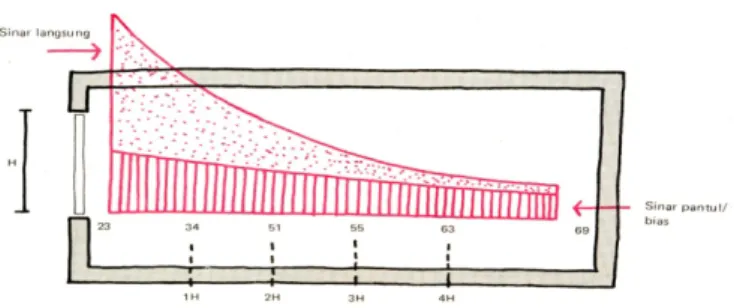
According to Badan Standarisasi Nasional (2000), Illumination can be stated as the quantity of light on work surface, which described in Lumen/ft2 or lux. Illumination is correlated with quantity of light. The depth of the room influence illumination level. More deep the room, the less illumination level will provide on the back of the room (Soepadi, 1997). In side-lit rooms the level of daylighting rapidly drops with the increase of distance from the window. It often happens that daylighting near the window is quite sufficient, but not at the back of the room. The rear part of the room could be used for storage (e.g. filing cabinets) or visually less demanding functions (e.g. tea-making) but work areas may still be left with inadequate daylight (Szokolay, 2008). Daylight penetration from two adjacent side windows (bilateral) allows for more lanaced daylight distribution and less glare (Lechner, 2007).
Figure 2 : The influence of room’s depth to illumination level Source : (Soepadi, 1997)
Every room have ceiling, wall and floor that can influence the room illumination level. The ceiling potentially reflect light from outside to interior. The second is wall, expecially back wall from the light direction. The third is side wall and the last is floor (Soepadu, 1997). Keep the ceiling smooth and light- colored. Introduce more light-colored surfaces for good distribution (O’Connor, 1997).
The need of illumination level based on the room function. Different room function result different illumination level. Lighting design must always focus primarily on human beings, the activities they perform in the room in question and the visual tasks they need to address. Pritchard (1986) wrote that to get good illumination distribution, minimum illumination level not less than 80 % from room’s average illumination level. Indonesian standard (SNI 03-6575-2001) recommended minimum illumination level on every room function in house :
Table 1 : Minimum illumination level for house function that recommended by SNI 03-6575-2001
Room function
Illumination level (lux)
Colour renderation
Terrace 60 1 atau 2
Living room 120 ~ 250 1 atau 2 Dining room 120 ~ 250 1 atau 2
Working room 120 ~ 250 1
Bedroom 120 ~ 250 1 atau 2
Bathroom 250 1 atau 2
Kitchen 250 1 atau 2
Garace 60 3 atau 4
Source : (SNI 03-6575-2001, 2001)
Buginese-Makassar Traditional House
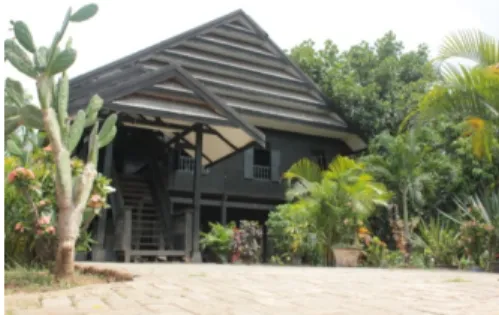
Buginese-Makassar traditional house built on traditional model (panggung house) with wood construction. The house is divided into three parts, roof (top), house body, dan foot (basement). Wooden pile support the main body of structure and have high floor from the ground.
Figure 3 : Traditional house of Buginese-Makassar Source : (Survey data, 2012)
Figure 4 : Three part of traditional house of Buginese-Makassar (Source : Idawarni, 2010)
Buginese-Makassar traditional house can built in every wind orientation (east, west, north and south) that simbolyzed of the belief called “sulapa appa” means shape of the universe is rectangle, so the four orientation had the same meaning and the room always in rectangle form. From that mass order pattern, opening faces on front, side and back orientation of the house (Soeroto, 2003). Abidin (1969) wrote there are three good orientation of the traditional house that based from Buginese-Makassar’s world view and local wisdom :
1. Orientation faces to sunrise, means born or the start of life.
2. Orientation faces to highland, hill or mountain, means higher life meaning of house owner on spiritual and material.
3. Orientation faces to one of the wind orientation.
Islam influence on Buginese-Makassar result the role that the best orientation of the house faces to “kiblah”
orientation. The analysis of orientation are :
1. Orientation faces to sun orientation means that the owner of the house can get more vitamin D from the sun that good for human health. The house that faces to the sun orientation can get daylight directly, so the house will be health and fresh.
2. Orientation faces to highland, hill or mountain, means the house can protect from wind and the sanitation can be efficient on back of the house.
3. Orientation faces to one of the wind orientation will be safe from cross position to the wind.
The window and ventilation of Buginese-Makassar traditional house placed on the wall between two wooden pile.
Window had philosophy about the owner’s social strata.
Buginese-Makassar traditional house that had three windows show the owner from common people and seven windows show the owner from high rank or noble man strata.
Figure 5 : Window’s shape and position in traditional house of Buginese-Makassar
(Source : Survey data, 2012) Methodology
Existing Location
Somba Opu Fort located in the delta of the Jeneberang River, about 7 km south of the centre of Makassar. In 1669 Bugis-Dutch forces destroyed the fort while bringing about the ruin of the powerful Makassar kingdom. Little is left of the once all-important fort, though parts of its western wall have been restored, and can be visited. At present, in the Somba
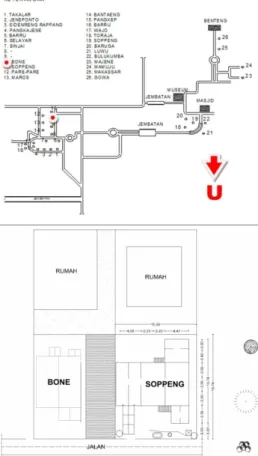
Opu fort there is a cultural center called the Miniature of South Sulawesi. There are various traditional house built to represent ethnics who inhabit the province. Each of the traditional houses is constructed artificially and uniquely which describe the cultural philosophy of each ethnic. Two of that traditional house are Soppeng and Bone that located in east site of the Somba Opu fort. Soppeng and Bone traditional house face to west orientation or face to “kiblah” orientation.
Figure 6 : Location of Soppeng and Bone traditional house Source : (Survey data, 2012)
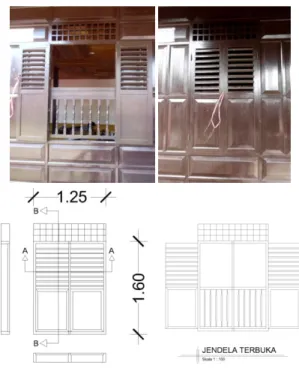
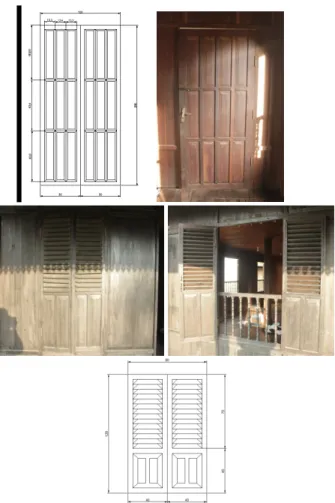
Soppeng traditional house had dimension 7,89 m x 8,93 m for main room, 2,4 m x 4,47 m for kitchen and 2 m x 4,47 m for bathroom. The natural lighting of this room has a source on sky light through projected sash window at east, west, south and north side and door at west and north side. There are ten rectangular windows and its dimension 115 cm x 150 cm and located 60 cm from floor. Half of the window have louvers and above the window, there are rectangular ventilation. There are five rectangular doors, front and back door have dimension 80 cm × 280 cm. Above the door have rectangular ventilation
. Figure 7 : Existing condition of Soppeng and Bone traditional house
Source : (Survey data, 2012)
Bone traditional house had dimension 6 m x 11,2 m for main room and 1,5 m x 2 m for bathroom. The natural lighting of this room has a source on sky light through projected sash window at east, west, south and north side and door at west and east side. There are 14 rectangular windows and its dimension 88 cm x 130 cm and located 60 cm from floor. Half of the window have louvers. There are four rectangular doors, front door have dimension 120 cm × 185 cm and back door have dimension 76 cm x 174 cm. Above the door have rectangular ventilation.
Figure 8 : Openings (door and window) of Soppeng traditional house Source : (Survey data, 2012)
Figure 9 : Openings (door and window) detail of Bone traditional house
Source : (Survey data, 2012) Measurement Instruments
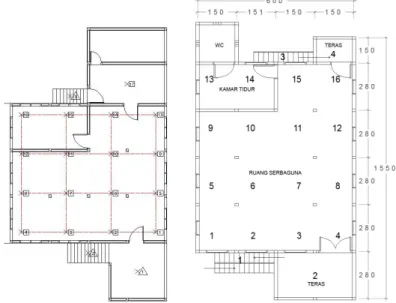
To identify the level of illumination distribution, through coordination and performed of the natural and lighting at Soppeng and Bone traditional house, measurement method is conducted by lux meter. The first stage of this simulation is dividing the room into four line area based on room dimension and get 16 measurement spot. Lux meter is put on the working
measurement spot. The measurement is conducted in two (2) conditions, I.e. :
1. Open the window and door 2. Close the window and door
The time of measurement is divided into five times, I,e,:
08.00 am – 10.00 am and 10.00 am – 12.00 am (in the morning), 12.00 am – 02.00 pm and 02.00 pm - 04.00 pm (daytime), and 04.00 pm – 06.00 pm (in the afternoon). The measurement is conducted, when the room is not used in sky light condition (with out overcast). The average illumination level is compared to identify the difference daylight performance between two condition measurement Soppeng and Bone traditional house in every measurement time.
Maximum value and minimum one is compared to identify the illumination distribution desired. After that data comparing the results of measurement with illumination standards for houses.
Figure 10 : Measurement spot of Soppeng and Bone traditional house Source : (Survey data, 2012)
Results and Discussions
Figure 11 : Comparation of everage ilumination in traditional house of Soppeng between windows-doors opened and closed
Source : (Survey data, 2012)
The measurement with windows and doors opened in Soppeng traditional house identify that the average illumination level increase from morning to afternoon. The maximum illumination level (276 lux) shown in afternoon (16.00-18.00) expecially on 4th measurement spot (1.070 lux) that located on north side and get daylight from two windows at north and west (front) of the house. The measurement with windows and doors closed identify that the average illumination level decrease compared to average illumination of windows and doors opened, about 82,9 - 96,9 %. The maximum illumination level (27 lux) shown in 12.00-14.00 expecially on 7th measurement spot (84 lux).
The measurement with windows and doors opened in Bone traditional house identify that the maximum illumination level (679 lux) shown in afternoon (14.00-16.00) expecially on
08.00-
10.00 10.00-
12.00 12.00-
14.00 14.00-
16.00 16.00- 18.00 Time
Windows and doors
opened 96 111 197 205 276
Windows and doors
closed 13 19 27 23 25
50 0 100 150 200 250 300
Illuina'on (lux)
get daylight from two windows at north and west (front) of the house. Beside that, four other spots that have high illumination level too, there are 5th (1.340 lux), 8th (1.110 lux), 9th (1.020 lux), and 12th (1.330 lux) that located at side (north and south) of the house. The measurement with windows and doors closed identify that the average illumination level decrease dramatically compared to average illumination of windows and doors opened, about 99,7 - 99,9 %. The maximum illumination level (2 lux) shown in 10.00-12.00 expecially on 14th measurement spot (5 lux).
Figure 12 : Comparation of everage ilumination in traditional house of Bone between windows-doors opened and closed
Source : (Survey data, 2012)
If we compare daylight performance when the openings opened, we can identify that Bone traditional house get more daylight than Soppeng traditional house. The difference about 1 : 1,6 to 1 : 8,2 point. It caused by the Bone traditional house have more windows (14 windows) than Soppeng traditional house that just have ten windows. Beside that there are
08.00-
10.00 10.00-
12.00 12.00-
14.00 14.00-
16.00 16.00- 18.00 Time
Windows and doors
opened 550 469 338 679 446
Windows and doors
closed 1 2 1 1 1
100 0 200 300 400 500 600 700 800
Illumina'on (lux)
different depth of room, Soppeng traditional house have 7,89 m and Bone traditional house just have 6 m depth and with window on two side (south and north) can optimize daylighting performance. Daylight at south side blocked by roof of the garace, so daylight penetration into the window can’t optimize at this side.
Figure 13 : Comparation of everage illumination between traditional house of Soppeng and Bone in windows-doors opened condition
Source : (Survey data, 2012)
The result can prove theory that the deeper the room, the less illumination level will provide on the back of the room (Soepadi, 1997). In side-lit rooms the level of daylighting rapidly drops with the increase of distance from the window. It often happens that daylighting near the window is quite sufficient, but not at the back of the room (Szokolay, 2008). Daylight penetration from two adjacent side windows (bilateral) allows for more lanaced daylight distribution and less glare (Lechner, 2007).
If we compare daylight performance when the openings closed, we can get different situation between Soppeng and Bone traditional house. In Soppeng traditional house, only a
08.00-1
0.00 10.00-1
2.00 12.00-1
4.00 14.00-1
6.00 16.00-1 8.00 Time
Soppeng 96 111 197 205 276
Bone 550 469 338 679 446
100 0 200 300 400 500 600 700 800
Illuina'on (lux)
openings closed. But in Bone traditional house the daylight dramatically decrease and just can get 1 – 2 lux. It probably caused by the shape of the window that didn’t have ventilation above, so there is no opening can get daylight into the house when the openings closed.
Figure 14 : Comparation of everage ilumination between traditional house of Soppeng and Bone in windows-doors closed condition
Source : (Survey data, 2012)
The indoor lighting can’t solely depend on the natural lighting, Bone traditional house can achieves the minimum standard lighting 120 - 250 lux for house. In Soppeng traditional house can achieves the minimum standard lighting on time 12.00 to 18.00, but can’t achieve the standard in the morning that just get average illumination level 96 lux (08.00- 10.00) and 111 lux (10.00-12.00).
According to SNI standard to get good illumination distribution, minimum illumination level not less than 80 % from room’s average illumination level or 96 - 200 lux. Bone traditional house can achieve good illumination standard because all measurement spot get illumination level more than 96 lux, but Soppeng traditional house can’t achieve good
08.00-
10.00 10.00-
12.00 12.00-
14.00 14.00-
16.00 16.00- 18.00 Time
Soppeng 13 19 27 23 25
Bone 1 2 1 1 1
0 5 10 15 20 25 30
Illumina'on (lux)
illumination standard because there are measurement spot get illumination level less than 96 lux.
Conclusion
There are significant difference illumination between area near the window and the midle area of room in house. The maximum illumination level shown in afternoon that located on measurement spot at north side that get daylight from two windows at north and west (front) of the house. From daylight performance when the openings opened, we can identify that Bone traditional house get more daylight than Soppeng traditional house. It caused by the Bone traditional house have more windows (14 windows) than Soppeng traditional house that just have ten windows. Beside that there are different depth of room, Soppeng traditional house have 7,89 m and Bone traditional house just have 6 m depth and with window on two side (south and north) can optimize daylighting performance.
Daylight at south side blocked by roof of the garace, so daylight penetration into the window can’t optimize at this side.
Soppeng traditional house only have a little daylight into the house from ventilation when the openings closed. But in Bone traditional house the daylight dramatically decrease and just can get 1 – 2 lux caused by the shape of the window that didn’t have ventilation above, so there is no opening can get daylight into the house when the openings closed. Bone traditional house can achieves the minimum standard lighting 120 - 250 lux for house. In Soppeng traditional house can achieves the minimum standard lighting on time 12.00 to 18.00, but can’t achieve the standard in the morning that just get average illumination level 96 lux (08.00-10.00) and 111 lux (10.00- 12.00). Bone traditional house can achieve good illumination
more than 96 lux, but Soppeng traditional house can’t achieve good illumination standard because there are measurement spot get illumination level less than 96 lux.
Bibliography
Abidin, Z. (1969). Filasafat Hidup Sulapa Appaka Orang-Orang Bugis Makassar (Pandangan Hidup Segi Empat). Bingkisan Budaya Sulawesi Selatan Nomor 12 Tahun II. Agustus.
Ujung Pandang : Yayasan Kebudayaan Sulawesi Selatan dan Tenggara
Badan Standarisasi Nasional (2000), SNI 03-6197-2000, Energy Conservation of Lighting System for Building
Boubekri, M. (2008). Daylighting, Architecture and Health – Buiding Design Strategies. Oxford : Architectural Press
Egan, M, David (1983), Concept in Architectural Lighting, Mc Graw Hill Book, Toronto
Idawarni. (2010). Lifestyle and Its Impact to House Style in Coastal Rural Areas of Makassar (Case Study of Aeng Batu Village Takalar Galesong Sulawesi Selatan, Indonesia). 11th International Conference SENVAR (Sustainable Environmental Architecture). Surabaya : Department of Architecture Faculty of Civil Engineering and Planning Institut Teknologi Sepuluh Nopember
Karlen and Benya. (2004). Lighting Design Basics. Kanada : John Wiley & Sons, Inc
Lechner, N (2007). Heating, Cooling, Lighting. Metode Desain untuk Arsitektur. Jakarta : PT. Rajagrafindo Persada
O’Connor, J. (1997). Tips For Daylighting With Windows – The Integrated Approach. USA : University of California
Philips, D and Gardner, C. (2004). Daylighting – Natural Light in Architecture. Oxford : Architectural Press
Soepadi, S.S. (1997). Anatomi Utilitas. Jakarta : Djambatan Soeroto, M. (2002). Dari Arsitektur Tradisional Menuju Arsitektur
Indonesia. Jakarta : Graha Indonesia
Sumintardja, D.`(2008). Jelajah Arsitektur Tradisional Nusantara dalam Menemukenali Teknologi Berbasis Lokal. Jakarta : Badan Penelitian dan Pengembangan Departemen Pekerjaan Umum
Szokolay, S. (2008). Introduction to Architectural Science : The Basis of Sustainable Design. Oxford : Architectural Press
Tjahjono, G, dkk. (1999). Vernacular Settlement. The Role of Local Knowledge in Built Environment. Jakarta : Fakultas Teknik Universitas Indonesia
Waterson, R. (1990). The Living House. An Anthropology of Architecture in South East Asia. Oxford : Oxford University Press