
He is also a member of the supervisory and advisory boards of several major companies and organizations. Executive Development from IMD presents the latest thinking from the faculty of one of the world's leading business schools.
Acknowledgements
First, our president Peter Lorange, who not only participated as a researcher in IMD's Global Corporate Governance Research Initiative (see Chapter 6: . 'The Role and Responsibilities of the CEO'), but is also responsible, together with Jim Ellert , John Walsh and their teams, for the creative research culture at IMD (including the necessary budgets). Bill George and John Ward were not only valuable contributors to this book (see the case commentary by Bill George and John Ward's contribution 'How Governing Family Businesses is Different'), but helped me better understand the American system so that we can live up to IMD's commitment as a truly global research and learning platform.
Roadmap for the Book
Peter Lorange ("Role and Responsibilities of the CEO") discusses in detail the relationship between the CEO and boards of directors. The conflict between the chairman of the board and the executive director is explored in another case.
Global Corporate Governance – Issues,
Ulrich Steger
Now that Everything is in Place, Does
Therefore, in this chapter of the book we try to adopt a value-added corporate governance focus. In Chapter 5 we look ahead and discuss some of the vexing questions of corporate governance.
How can Corporate Governance Fail?
Corporate governance and the Swissair grounding 1
After a transition, where the chairman of the board also took over the job as managing director. At the ordinary general meeting, seven of the ten board members resigned, and the shareholders voted against the legal discharge of the board.
Lessons from the Swissair case
The four board dilemmas
- Boundary erosion
- Heterarchy
- Transformation of structures
- Factor mobility
- Legitimacy erosion
- Past–future asymmetry
- Variety of options
A competent management can occupy the entire time of the board meeting with compliance issues (and because of the prescriptive nature of regulation, the board often serves only as high-ranking internal auditors). Most importantly, it covers strategy development and the board's monitoring of implementation via the control function.
Corporate governance and the Swissair grounding: an interview with Bill George
- What surprised you most when you read the Swissair case?
- So the board was not sufficiently involved in determining Swiss- air’s strategy?
- But the world is hoping that independent directors on boards will prevent corporate disasters. All of the Swissair Verwaltungsrat were – in
- And what did this mean for the working of the board?
- Is there another area where this working style of the board led to the unchecked development of strategic problems?
On the other hand, the board of directors did not monitor the operation of the strategy and was separated from what was happening. When most of the board resigned in early 2001, they may have been doing just that.
Shedding Some Light into the Black Box
The next wave will most likely be the need for empirical evidence of the impact these measures have on company performance. However, beyond the influence of a corporation's stars, the personal chemistry between board members, senior executives and the chairman is also of great importance.
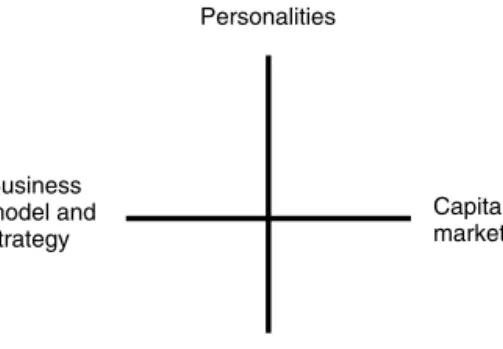
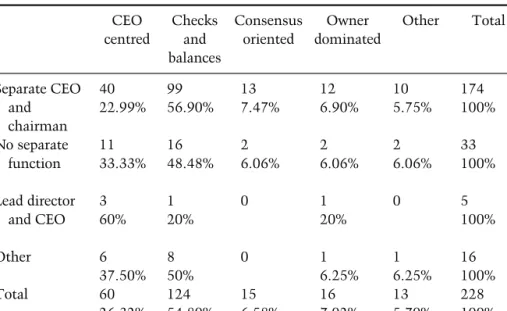
The result: Four distinct corporate governance clusters
However, interviews and other qualitative indicators (including my own board experience) suggest that versions of the consensus-oriented model dominate board reality. There is also a natural disparity between the huge corporate apparatus and the relatively small board of directors.
Are these corporate governance models stable over time?
When considering the perceived gap between European and Anglo-Saxon corporate governance, one would expect a longer tradition of corporate governance in Anglo-Saxon countries and thus a lower rate of change than in other regions. While 37% of respondents did not report any changes in corporate governance at all, among those who did report changes in their approach to corporate governance, board discussions were one of the most frequently cited reasons for such changes.
How involved are boards in practice?
What risks are we taking to get there?' If such questions are thoroughly thought through and honestly answered, the board should be able to recognize the need and strategic value of changing to a different corporate governance model. Finally, integration into the external business environment is increasingly becoming part of the role of boards of directors.
Board committees
Board organization and working processes
While the majority (54%) of Anglo-Saxon boards meet monthly, 47% of Northern European boards meet quarterly. In Anglo-Saxon countries the majority (47%) meet weekly, while in Northern European countries the majority (33%) meet monthly.
Succession planning
However, in Northern European countries, the chairman is more likely to call meetings, while in Anglo-Saxon countries, the CEO tends to perform this task. Formal succession plans for CEOs/chairmen were less common overall (globally 22%), but again found significantly more often in Anglo-Saxon countries (35% vs. 10% . in Northern Europe).
Regular evaluations
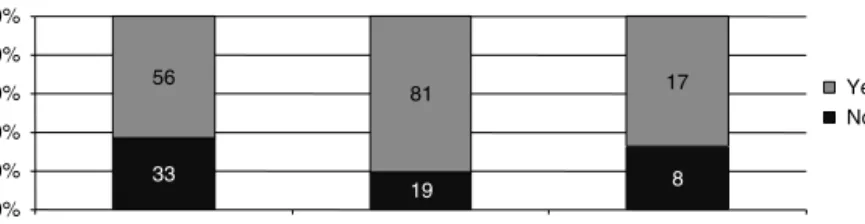
In a quarter of the companies, board members can be re-elected up to six times (on average 2.56 times). As illustrated by Figure 3.4, in all regions, formal procedures for appointing supervisory board members (73%) were more frequent than a set of written criteria for candidates (42%).
External contacts
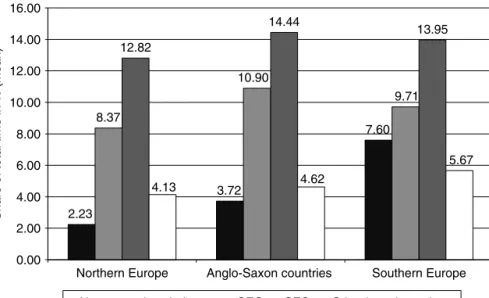
Non-Executive Chairman CEO CFO Other Board Members Figure 3.5 Time spent with members of the financial community, breakdown by region. The willingness to spend time with other opinion leaders appears to be lower in the Anglo-Saxon countries than in the other two regions.
Who influences the board?
However, it indicates that such contacts exist and reiterates the importance of adequate quality and quantity of information, as such contacts contribute to the external image of the company. After looking at the bigger picture and some statistics about how corporate governance might work, we now analyze what the specifics of a global corporate governance system look like.

Managing Complexity in Global Corporate
Governance
Global corporate governance dynamics: the case of DaimlerChrysler (DC) 1
Schrempp Robert Eaton Chairmen's Integration Board Board of Management Chairmen PMI Integration Team Strategy Culture IT Control (MIS) Total: 12−14 employees Total: 24 employees Figure 4.2 DaimlerChrysler's Post-Merger Integration (PMI) Source: Neubauer, StegerandR¨9999 .Copyright 1999 by IMD–International Institute for Management Development, Lausanne, Switzerland. All rights reserved. Not to be used or reproduced without written permission directly from IMD, Lausanne, Switzerland. the financial services arm) after the divestments of the rail, aerospace and other manufacturing divisions of Daimler-Benz, Chrysler and the commercial vehicle division did not turn out to be as strong as expected when the US market stagnated in mid-2000 ( see Figure 4.3). The board is chaired by the CEO J¨urgen Schrempp and consists of six shareholder representatives of the supervisory board (including its chairman, Hilmar Kopper) and five external members who are all either CEOs or chairmen of global companies (including the chairman of Mitsubishi Corporation, still a major shareholder in Mitsubishi Motors).

Lessons learned for global corporate governance
Learn as you go’
The list could go on, but as we have argued at length above, corporate governance is more than compliance with the law. A corporate governance system that serves all three purposes under the conditions of a global company must be designed.
Becoming global – the hour of the executives
For example, the residual values of leasing contracts were estimated to be too high relative to the market price of the used car at the end of the contract, resulting in a loss. Multi-brand risks, whether due to incorrect product positioning or transfer of mishaps from one brand to another.
You cannot be everybody’s darling
Some Nagging Questions
Economists believe, for better or worse, that (most) people act according to the incentives that are set (as the manager's joke goes: 'the bad news is, you get what you pay for'). The second would be to place the structures of corporate governance in the context of the more important questions that need to be addressed.
Three Burning Questions for Boards
The Role and
Responsibilities of the CEO 1
Peter Lorange
Introduction
The key is what the CEO and the board can do as one team for the company. The board must therefore play a proactive role in spotting the CEO's potential lack of performance.
Substantive strategic leadership issues for the CEO
Ultimately, the CEO and board decided to spin off the agri business as a separate entity, focusing the company on two unrelated business platforms rather than three. The board must ensure that the managing director here masters the overall chemistry issues.
Issues a CEO must deal with, as required by law
Also, Royal Caribbean's own board may not have been as eager as its own senior management to give a 'sweet' deal. In general, achieving total clarity regarding stakeholder positions should be an issue for the board in the event of major acquisitions and/or divestitures.
Professional management issues
It is clear that the CEO must proactively respect all the relevant laws and give his/her full support to them. Here, however, it must be clear that it is the board that appoints the new CEO, not the CEO that appoints a successor.
Independence
Needless to say, the board should evaluate the CEO's own performance, again based as much as possible on actual results. The relationship between the way the CEO is promoted and the compensation and bonuses awarded to the rest of the top management in the company must be reasonable.
Evolution
Conclusion
Or to put it another way, to be consistent with what are the key decisions for success that the firm must address. This is what the CEO should be able to focus on and deliver in front of the board and the corporation as a whole.
Performance Evaluation of Corporate Boards and
Boards of Directors
Fred Neubauer and Helga Krapf
Approaches rooted in Anglo-Saxon thinking and experiences
More and more practitioners and researchers find this situation unsatisfactory.1 As the pressure to improve board performance increases, the number of board members willing to entertain the idea of such an assessment is increasing, even among those who have looked askance at performance reviews for years. , appears to be increasing. A widely recognized OECD report on corporate governance and many of the codes of conduct for boards that have emerged in many countries over the past decade recommend such a review.2 Subjecting a board to any kind of assessment is no trifles not.
Why evaluate a board?
In a typical Anglo-Saxon board evaluation scheme, non-executives and executive members are evaluated jointly, but the performance of the latter group is judged only from a corporate governance perspective. However, they left it to the subsequent committee under Gerhard Cromme to formulate requirements for the self-evaluation of boards of directors.3 The German Code of Corporate Governance contains, under provision 5.6, 'Investigation of effectiveness', the requirement that 'the supervisory board shall investigate the effectiveness of its activities at regular intervals'.4 At this stage of the discussion, details of how such a process should be approached are still lacking.
How to evaluate whom?
As the Korn/Ferry analysis shows, 71% of respondents believe that the performance of individual directors should be regularly evaluated.7. In this chapter, we will not limit ourselves to the discussion of internally managed evaluation systems, but will also focus on the evaluation of individual board members.
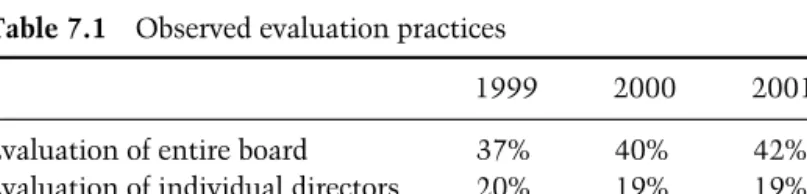
Evaluation of individual board members
As we will show in the discussion of practical evaluation systems below, this danger can be controlled with a carefully thought out process. Why shouldn't mature board members put these opinions on the table for open discussion.
A process involving the whole board in the assessment
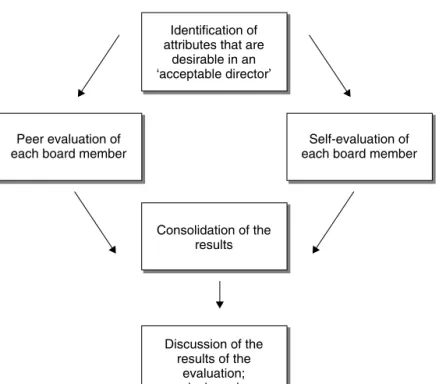
- Identification of desirable attributes
- Peer evaluation
- Self-evaluation
- Consolidation of the results
- Discussion of the results of the evaluation; conclusions drawn
The outcome of the process, of course, is not an objective assessment of a board member's performance. This facilitates the discussion of these results between the chairperson and the board member – a conversation that is the subject of the next step.
Evaluation by a committee of the board
Board members who are eligible for re-election will also undergo an evaluation of their performance by the Corporate Governance Committee. 12. Which of the two approaches is better: evaluation by the entire board or evaluation by committee.
Concluding remarks
The committee for good corporate governance is responsible both for appointing new members to the board and for evaluating current board members. The regularly recurring assessment of board performance (as well as the evidence that the company has freed itself from poor performers at that level) can contribute to this development.
Further Reading
Campbell Soup company board standards
Peer appraisal questionnaire
He/she is well informed about current economic/political/social issues in our main market(s). He/she uses his knowledge and experience to give the board and management new impulses (contributes a creative perspective to the board's work).
How Governing Family Businesses is Different
John Ward
The nature of family ownership
The combination of concentrated economic and emotional investment is the key difference found in family business ownership. Sometimes concern for the family's reputation can seem as important as protecting the collective family business investment.
Business governance in public companies
The governance of public companies reflects this paradigm, with inactive but mobile shareholders creating market pressure for performance. Because of this, the board of directors is the seat of power in the management of public companies.
How governance differs in family companies
Building a clear, shared understanding of the separate functions of ownership, board and management is an important part of effective family business management. It is also the main source of the advantages found in family businesses.
The stages of family business development
However, several see ownership as a collective financial legacy from their family and share ownership of the business between family members. Eventually the involvement of the parents ceases and the siblings come to share the ownership in a spirit of partnership.
The evolution of family business governance
Their ability to respond to these challenges is tested again and again, with each change in the size of the business or family. With each change of generations or change in business scope, family businesses are often faced with the need to recreate business management.
Types of owners and governance
Family business life cycles can lead to fundamental changes in the roles, functions and practices of the management system. Some families respond to these challenges by creating management structures that can 'protect' the business from the family.
The governance practices of mature family business
As family businesses mature, both the family and business sides of the system are changing. Corporate management is responding to the increasingly rigorous functional needs of the company by pursuing increasingly professional practices and competencies.
The special role of the family business board
At a higher level, the board must ensure that ownership and management share the same strategic vision of the company. The board must understand the family's aspirations for the business, as well as the competitive capabilities and market potential of the business.
The role of boards in conflict resolution
Creating adequate, ongoing consultation with ownership is one of the key challenges facing family business boards. This transparency becomes more important as the family business system becomes larger and more complex.
Board composition and director selection
Many mature family businesses have a significant number of independent directors on their boards, and some have a majority of independent, outside directors. Family businesses have the opportunity to add significant value to their management by carefully selecting the right independent directors.
Adapting governance practice in mature family businesses
Equally important are fair processes that enable ongoing consultation throughout the system in decision-making. Active communication that flows freely throughout the system is the most critical component to building fair decision-making processes.
Organizing the family and ownership
In large family groups, the transmission of business values and ownership vision is a key function of family management. In essence, however, the most important function of family management is creation and renewal.
The value added by family governance
Family management can add significant value by actively creating and adapting family and ownership policies over time. It is the family's emotional and financial commitment that enables the special agency found in the family business, and the creation of this vital, abstract asset is the main added value of effective family management.
Summary
This requires constant cooperation within the family, as well as between the family and its business. This collaboration is critical to maintaining the continuity of the family business as the family grows and ownership becomes more dispersed.
Learning from Past Experience
Cobra versus
Commerzbank, War at the Helm of Elicore,
Commented by Bill George
Cobra versus Commerzbank
- For you, what is the main issue of this case?
- What do you think about Cobra and its intentions?
- How can you prevent that?
- You do not seem to believe that every company needs to be big and dominant?
- What could Commerzbank have done better?
- So what do you think of raiders in general?
It was not in the best interest of the bank and he fought them. If you don't have a long-term stake in the stock, then this is the stock for you.
Case study: War at the Helm of Elicore
But the figures will probably not provide a clear picture until the end of the year. Hello, I am eagerly awaiting the new corporate governance proposals that will be discussed at the upcoming board meeting.
Corporate governance at Elicore
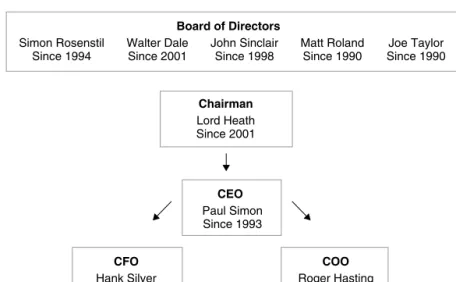
The board of directors, chaired by Heath, had five non-executive members who could be re-elected annually at the annual general meeting (AGM) (see Figure 9.1). He had grown up in a wealthy family, attended top universities, gained significant international experience at a well-known multinational, and even worked for three years in the Ministry of Foreign Affairs.
From bad to worse