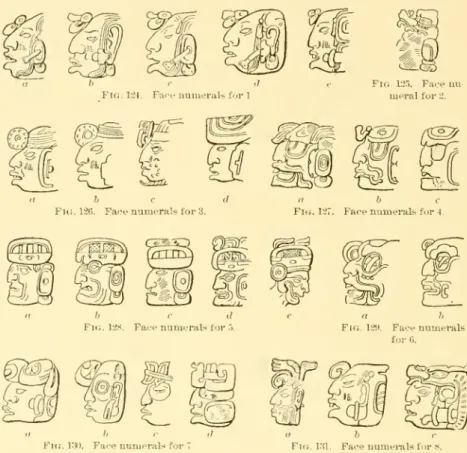
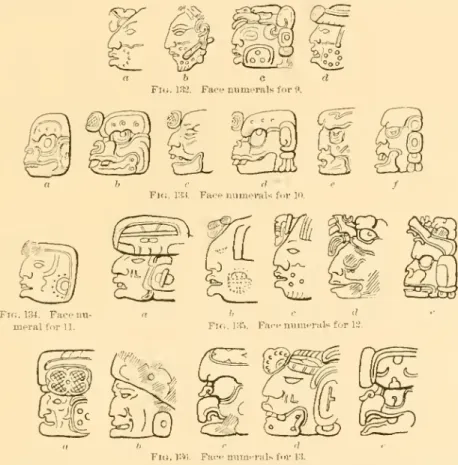
The day vandieluontli enthenioiitli (SZotz) is clear and easily recognizable, tlie iiuniV)erlieing of the usual fornj. THOMAS] SUPPLEMENTARY SERIES OF QUIRIGUA INSCRIPTIONS 215 dotted on the cheek (fig. i;52); two characteristics of the symbol for.

Cumhu we reach 4 Zotz, the first day of his fifty-third great
The first series on Stela D of the Copan inscriptions (Maudslay, plate XLViii, part 2, our plates LXXVi and LXXVii) is peculiar in. It must be admitted, however, that the drawing of the face number before the katun symbol is very doubtful.

PART OF INSCRIPTION ON STELA D, COPAN
PART OF INSCRIPTION ON STELA D, GORAN
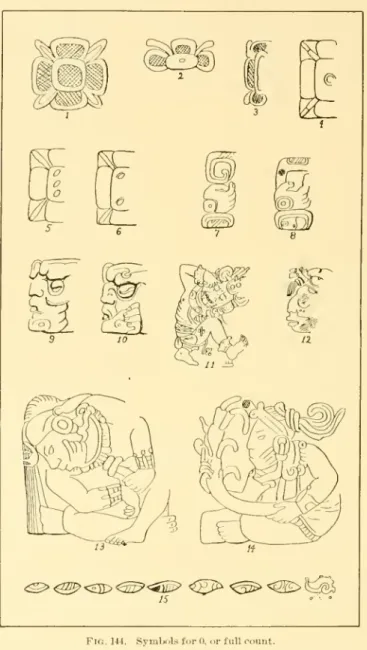
The numbers attached to the cycle, katun, ahau, and chuen symbols are of the ordinary j form; that today the disk and hand type (Figure 144) indicate nothing (0); and that to the day (Ahau) of the end date, the face character r with the ahau headpiece indicates. Since enough of the ]3refix to the chuen symbol j'emains to indicate full count or nothing (0), it may be assumed that the prefix to the daj' .symbol, which there appears to be.

22 ETH— 04 15
It may not be necessary to pursue this subject further, as it is clear that the value of the face symbol and other number symbols can be obtained satisfactorily. Before discussing the numbers of the cycles and major cycles referred to in my previous article, I will note that some of the secondary number series of the Quirigua inscriptions are not included.
SECONDARY NUMERAL SERIES OF THE QUIRIGUA INSCRIPTIONS
226 MAYAN CALENDAR SYSTEMS [eth.ann.22 doubt ;is the value of the face number in front of the Ahau symbol (A2, figures 150 and 151), as it is unusual, being in some respects unlike any other face number that I have observed in the inscriptions. . Uayeb; however, the number attached to the month symbol is certainly 13. The whole inscription, as well as the inset on the front and back of the same monument, is curious, and, as Mill notes further on, shows some of the features of the ChichenItza inscriptions.
THOMAS] SECONDARY SERIES OF QUIRIGUA INSCRIPTIONS 227
Ahau 13 Yax, from this
The figures are different and of the common type, and are correctly represented, as will be seen from the inspection of both the photograph and the drawing. On the other hand, the sequence 9-17-5-0-0 under this system would indicate that the date sought is the first day of the 5th ahau of the 17th katun of the.
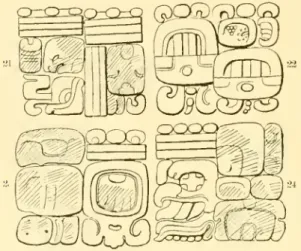
THOMAS] SECONDARY SERIES OF QUIRIGUA INSCRIPTIONS 233 9th cycle, but the symbol 6 Aliau (glyph KJ) denotes, if we have cor-
13 cycles make 1 big cycle days 73 big cycles make 1 big era days This scheme, as explained in my previous paper, is exactly the same as what is generally accepted, as far as the numbers are concerned, until, in ascending scale, the number of cycles, or units of the 5th order, a higher unit of a great cycle, or form a greater cycle, is reached. As the day Ahau has been found to be the first day of several, indeed most, of the initial series of inscriptions, and is adopted by Good-.
THOMAS] NUMBER OF CYCLES IN GREAT CYCLE 235
He bases this, no doubt, on the fact that many of the initial series of the inscriptions survive, as their first day 4 AliaiiS Cumhu, wliichhe assnmes, apparently correctly, is. Since no greater number of major cycles than 14 is recorded, in one of the Copan inscriptions, where G is the highest given in Dres-.
THOMAS) NUMBER OF CYCLES IN GREAT CYCLE 237
This is not correct regarding the number of the day or the month. The same daj^ should be reached, for the number of cycles is the only thing in the series that has changed.
THOMAS] NUMBER OF CYCLES IN GREAT CYCLE 239 Using this remainder and counting forward from !i Kan 12 Kayab
In these cases, Kan 12 Kayab is the first day of the first or more distant of the major cycles counted in the series. Our separation from the great cycles, therefore, is nothing more than the separation of the millions and lower denominations in the expression.
THOMAS] I^^UMBER OF CYCLES IN GKEAT CYCLE 241
Counting forward 7, (528 days from 7 Kan -2 Zae, year 1 Akbal, we arrive at 4: Eb 5 Chen, year 9 Lamat, which is the correct date. Therefore, it seems complete proof that Kau in the cases cited is the first day f)f eacli great cycles. It is also important to note that the numbers of these Kaus follow each other in exactly the same order as those of the Ahaus.
THOMA8] NUMBER OF CYCLES IN GREAT CYCLE 243 of Cfilculating the differences l>et\veeii the series and ijassing- from
If we calculate the series as they appear in the original, counting from the starting date (9 Kan 12 Kayab), we find that none of the dates below will be reached, whether we assume 20 or 13 cycles until the great cycle. THOMAS] NUMBER OF CYCLES IN THE GREAT CYCLE 245 The series apparently requires that the days be the temporal dates.
THOMAS] NUMBER OF CYCLES IN GREAT CYCLE 245 The series evidently requires that the days oi' the teriuiual dates
Ahau 8 Cundiu falls in the year 8 Ben, and 9 Kan 1'2 Kayab in
Therefore, correcting the series, since the dates cannot be changed, involves an outage of 13,459 days, or nearly 37 years. Therefore, while the jjopositions of dates in the text are according to the numerical series.
THOMAS] NUMBEB OF CYCLES IN GREAT CYCLE 247 Suppose, liow-pver, that it was the intention of the aboriginal artist
It must be remembered that this numbering is a sequential numbering, as in daj'sof. 250 MAY K'ALENDAR SYSTEMS [eth.ann.2a iiionth, ami not luiuiberiiig (in series 13) daj' Ahau.
CALENDAR SYSTEM OF YUCATEC INSCRIPTIONS 253 system"? There is iiotliiug in either the Troano or Cortesiaii codex
Chen, which falls in the j'ear 2 Ben. If we count back from
We are therefore of the opinion that the terminal day for the longseries should be 13 Ahau 8 Chen, and that Goodman. Since there are 17 cycles, it seems to prove that the writers of the inscriptions counted 20 cycles for the great cycle, which is consistent with their numbering system.
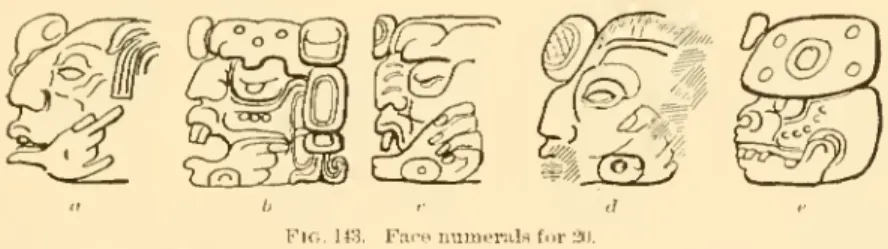
THOMAS] NUMBER OF CYCLES IN GREAT CYCLE 257 lower jaw, usuallj' characterizes the face sign for 20" (page 52), and
Therefore, if thirteen cycles are named here at the beginning of the initial series, nothing else is meant than "periods or epochs in general." And the entire initial batch would consequently yield something like the following. As proof of the latter claim, I refer to the quotation from his article below (page 292).
REAL NATURE OF SO-CALLED TIME PERIODS 259 As ii means of illustratiug the use of uumbers by the Mayas, iu
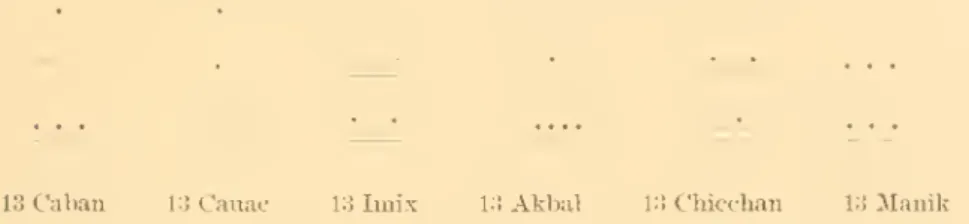
It is also clear that this theory of a Maj'a chronological system differs from the Maj'a calendar system - the Maj'ai method. of niimeration in counting time – and its method of counting 13 . so-called cj'cles after the so-called great cycle and 73 great cycles after its so-called great age are not justified by the facts, nor is his ... method of numbering the cycles, katuns, etc., beginning with and 20, satisfactorily proven; and also that this selection of Ik, Manik, Eb and Cabanas as the dominant days is incorrect, as the real dominant daj'S are Akbal, Lamat, Ben and Ezanab, both in the inscriptions and in the Dresden codex. THOMAS] NUMBERS OF THE SO-CALLED GREAT CYCLES Before we talked about the uiiibers of the great cycles as obtained by a.
THOMAS] NUMBERING OF SO-CALLED GREAT CYCLES 263 Before referring to the uuiiibers of the great cycles as obtained by a
ELEMENTS OF THE GREAT CYCLE SIGN
THOMAS] THE GREAT CYCLE SYMBOL 265 As Goodman admits in the passage quoted, this is true in only three cases.

THOMAS] THE GREAT CYCLE SYMBOL 265 As Goodman admits iii the passage quoted, it is only in tlie three
GREAT CYCLE AND CYCLE SYMBOLS 267 This is an evident appro;u-h tu tlie great-cycle symbol, as may be seen
If it were Kan, it would somewhere exactly correspond to the series of Dresden codes referred to; if. The continuation of the katuns, calculated on this principle, is still to be proved before the imagined discovery can be established by the most important.

THOMAS] THE CAKCHIQUEL CALENDAR 275 modified form, to iudicato the vai-iation of time mimeratiou from the
THE CAKCHIQUEL CALENDAR
Annals; the others given are only those deemed important. hundred days after the death of the kings Hunyg and LahuhNob.there were election questionsCahiImoxenBelehe Qat,on that day1. On the day 4 Qattdrie chiefs^, the king and the next in rank, were burnt alive by Tunatiuh [page177].
THOMAS) THE CAKCHIQUEL CALENDAR 277
THOMAS] THE CAKCHIQUEL CALENDAR 279
Now, the first event of 3 Caok in the 19th year after the Revolt, that is, the year following 9 Ah (the year beginning with 10 Yiz), is 2 months and 6 days after the beginning. A hundred days more bring ns to 12 Caok, the 6th day of the 8th month, or 7 months and G days from the beginning of the year.
THOMAS] THE CAKCHIQUEL CALENDAR 281 In the year following 5 Ah (number o-t), that is to say, the year
Additionally, his station would indicate that he was trained in the study of his clan's chronology. If this view is accepted, it may shed some light on a disturbing feature of the Mayan calendar—the insertion of the multiple number 18 into the month.
MAYA METHOD OF CALCULATION
The writer states that he was a descendant (grandson) of the principal chief of the Cakehiqnels at the time of the arrival of the Spaniards, and was then probably about IG or 18 years of age. It seems possible, if the chronicler corrects himself in his reckoning of time, that a peculiar native calendar came into use somewhat in this way.
THOMAS] MAYA METHOD OF CALCULATION 283 As the differeut kinds of symbols used by the Mayas to express
Since the dates are therefore only eight years apart, they necessarily fall in years having the same dominant day and, therefore, on the same day of the month. Nine cycles and the lower fractional numbers, counting from 4 Ahau 8 Cumhu as initial dates, form the most frequent series of the Copan and Quirigua inscriptions.
OF THE DRESDEN CODEX
THOMAS] MAYA METHOD OF CALCULATION 285 This represents a calendar round or cycle of oi years (18,080 days),
The series is therefore the correct one, formed according to the same plan as that of the Dresden Codex, and without using anything that is not within the reach and understanding of the native artist. The series on plate xxiv of the Dresden codex (our plate Lxxxii) appears to close with a small addition (in the lower left corner) to reach the desired date, just like the theoretical date given above, except that in this case the count is advanced go.
THOMAS] MAYA METHOD OF CALCULATION 287
THOMAS] MAYA MKTHOD OF CALCULATION 289
SIGNIFICATION OF THE NUMERAL SERIES
THOMAS] SIGNIFICATION OF THE NUMERAL SERIES 291
In other words, we must conclude that between the time of the erection of the temples of Palenque and of all the other monuments there lies a period of about 3.1()0 years: that the temples of Palenque are about 3.160 years older are as the monuments of Copan and Quirigua, and as the steps of the tower palace of Palenque not far from the temple. It may be that the end date in the initial series of the temples of Palenque does not represent the date of construction of the temple, but an earlier recognized date determined to bring into view.
THOMAS] SIGNIFICATION OF THE NUMERAL SERIES 293
It is especially noteworthy, however, that the interval between the terminal dates of the earliest and latest of these series is only about 350 years, and, if the number6 be omitted, less than 90 years. Or 1,025 years, 7 months and 15 days from December 25 to Thursday, the 9th day of the 8th month.
THOMAS] SIGNIFICATION OF THE NUMERAL SERIES 295 nized calendar the 1,025 years, etc., may be pushed backward or for-
THOMAS] SIGNIFICANCE OF THE NUMERICAL SERIES 295nized calendar of 1025 years, etc., may be pushed back or for-. As further proof that the series is continuous and is considered to be-. section, we choose at random the third column, counted from the right, the third part from the bottom, for Ahau.
THOMAS) SIGNIFICATION OF THE NUMERAL SERIES 297 Using this remaindei-, wliicli amounts to 1,181,440 days, siibtraetiug
Ahau 8 Cumhu from which the series of in- gripl scriptions are counted? To show that Goodman's cal-
On the other hand, the assumption that it is the opening day of a great cycle, as Seler seems to think, requires the conclusion that the date 3. This is an indication that the conventional tapir head on plate xliii of the Dresden codex is used as a symbol of the great cycle. is dedicated to the center of the three symbols of the great cycle shown in figure 107, that marked o is from the east side of Stela F, Quirigua;.

THOMAS] SIGNIFICATION OB' THE NUMERAL SERIES 299
INSCRIPTION AT XCALITMKIN, YUCATAN
Pos-. Possibly this is intended for ?Ahau 2 Cuniliu, and if so, it would be the second day of the month in Cauacyeaj-s, and in accordance with the Yucatec calendar. If the first or the last are intended for a month symbol, there is still agreement with the Yucatec calendar, since Chiechan is the second day of the month in Kaii years.
INSCRIPTION (IN STELA 6, COPAN 301 INSCRIPTION ON STELA G, COPAN
THE NEPHRITE STONE OF THE LEYDEN MUSEUM
Cumhu ; and the commencement of the 10th (Goodman's 9th) cycle of the 54th great
THOMAS] CALENDAR AND NUMBER TABLES 303 apparent from what lias been sliowii in this paper, is not entirely sat-
CALENDAR AND NUMBER TABLES
THOMAS] NUMBER TABLKS Working tables