Mergers, LBOs, Divestitures, and Holding Companies
O
n January 28, 2005, Procter &Gamble (P&G) bid almost $55 billion to acquire Gillette in a friendly merger. When the deal was com- pleted on October 1, 2005, it created the world’s largest consumer goods company, making the merger the biggest of the year.
Combining Gillette and P&G has already produced several winners. When the deal was announced, Gillette’s shareholders saw the value of their stock rise by more than 17%. One particular winner was Gillette’s largest shareholder, Warren Buffett, who owned roughly 96 million shares. Other winners included Gillette’s senior execu- tives, who saw the value of their stock and stock options increase, and the investment banks that helped put the deal together.
Estimates suggest that Goldman Sachs, Merrill Lynch, and UBS each received
$30 million from the transaction.
While many applauded the deal, others believe that P&G will have to work hard to justify the price it paid for Gillette.
Moreover, as we point out in this chapter, the track record for acquiring firms in large deals has not always been good. As we write this in September 2006, P&G’s stock is up 5.67% since the completion of the merger versus 6.33% for the S&P 500. Eleven months is too soon to evaluate the merger, so it remains to be seen whether the deal truly makes sense for P&G’s shareholders.
Nonetheless, keep the P&G-Gillette merger in mind as you read this chapter.
chapter 25
Most corporate growth occurs by internal expansion, which takes place when a firm’s existing divisions grow through normal capital budgeting activities.
However, the most dramatic examples of growth result from mergers, the first topic covered in this chapter. Leveraged buyouts, or LBOs, occur when a firm’s stock is acquired by a small group of investors rather than by another operat- ing company. Conditions change over time, causing firms to sell off, or divest, major divisions to other firms that can better utilize the divested assets.
Divestitures are also discussed in the chapter. Finally, we discuss the holding companyform of organization, wherein one corporation owns the stock of one or more other companies.
25.1 Rationale for Mergers
Many reasons have been proposed by financial managers and theorists to account for the high level of U.S. merger activity. The primary motives behind corporate mergersare presented in this section.1
Synergy
The primary motivation for most mergers is to increase the value of the combined enterprise. If Companies A and B merge to form Company C, and if C’s value exceeds that of A and B taken separately, then synergyis said to exist, and such a merger should be beneficial to both A’s and B’s stockholders.2Synergistic effects can arise from five sources: (1) operating economies, which result from economies of scale in management, marketing, production, or distribution; (2) financial economies, including lower transaction costs and better coverage by security analysts; (3) tax effects, where the combined enterprise pays less in taxes than the separate firms would pay; (4) differential efficiency, which implies that the management of one firm is more efficient and that the weaker firm’s assets will be more productive after the merger; and (5) increased market power due to reduced competition.
Operating and financial economies are socially desirable, as are mergers that increase managerial efficiency, but mergers that reduce competition are socially undesirable and illegal.3
The 2001 merger of Wachovia and First Union, which created the nation’s fourth largest bank at that time, illustrates the quest for synergies. The banks’
operations overlapped in many parts of the Southeast, so closing neighboring branches could cut costs, and certain “backroom” operations could be consoli- dated to further reduce costs. Obviously, the best people and operations would be retained and those that performed subpar would be let go. Another synergistic
1As we use the term, merger means any combination that forms one economic unit from two or more previous ones.
For legal purposes, there are distinctions among the various ways these combinations can occur, but our focus is on the fundamental economic and financial aspects of mergers.
2If synergy exists, then the whole is greater than the sum of the parts. Synergy is also called the “2 plus 2 equals 5 effect.” The distribution of the synergistic gain between A’s and B’s stockholders is determined by negotiation. This point is discussed later in the chapter.
3In the 1880s and 1890s, many mergers occurred in the United States, and some of them were obviously directed toward gaining market power rather than increasing efficiency. As a result, Congress passed a series of acts designed to ensure that mergers are not used to reduce competition. The principal acts include the Sherman Act (1890), the Clayton Act (1914), and the Celler Act (1950). These acts make it illegal for firms to combine if the com- bination tends to lessen competition. The acts are enforced by the antitrust division of the Justice Department and by the Federal Trade Commission.
The textbook’s Web site contains an Excel file that will guide you through the chapter’s calculations.
The file for this chapter is FM12 Ch 25 Tool Kit.xls, and we encourage you to open the file and fol- low along as you read the chapter.
Rationale for Mergers 883
merger was the 1997 consolidation of Morgan Stanley with Dean Witter. Morgan Stanley was an elite investment bank that specialized in underwriting securities for large corporations, while Dean Witter was a nationwide brokerage house with thousands of sales representatives and 40 million retail customers. Dean Witter had been affiliated with Sears, Roebuck and had sold securities to Sears’s cus- tomers, whereas Morgan Stanley’s relatively few retail customers tended to be millionaires. So, the merger was said to be “uniting Wall Street with Main Street,”
and it meant that Dean Witter’s brokers would have access to IPOs and other securities underwritten by Morgan Stanley and Morgan Stanley would have another channel for new offerings.4
Expected synergies are not always realized. For example, when AOL acquired Time Warner, it believed that Time Warner’s extensive content library could be sold to AOL’s Internet subscribers and that AOL subscribers could be shifted over to Time Warner’s cable system. When the merger was announced, the new management estimated that such synergies would increase operating income by
$1 billion per year. However, things didn’t work out as expected, and the com- bined entity’s market value has fallen sharply since the merger. Note, though, that the real losers were Time Warner’s stockholders, while AOL’s stockholders can count their blessings. The merger was announced in 2000, at the height of the Internet bubble, when AOL’s stock was selling at an all-time record. At the same time, Time Warner was regarded as a stodgy, old-economy company. Therefore, AOL’s stock had a much higher valuation, and its stockholders received the majority of the stock in the consolidated company. Since then, Internet stocks have crashed, but old-economy stocks have held up rather well. Without the merger, Time Warner stockholders would be much wealthier than they are, while AOL’s would be much poorer.
Tax Considerations
Tax considerations have stimulated a number of mergers. For example, a prof- itable firm in the highest tax bracket could acquire a firm with large accumulated tax losses. These losses could then be turned into immediate tax savings rather than carried forward and used in the future.5
Also, mergers can serve as a way of minimizing taxes when disposing of excess cash. For example, if a firm has a shortage of internal investment opportu- nities compared with its free cash flow, it could (1) pay an extra dividend, (2) invest in marketable securities, (3) repurchase its own stock, or (4) purchase another firm. If it pays an extra dividend, its stockholders would have to pay immediate taxes on the distribution. Marketable securities often provide a good temporary parking place for money, but they generally earn a rate of return less than that required by stockholders. A stock repurchase might result in a capital gain for the selling stockholders. However, using surplus cash to acquire another firm would avoid all these problems, and this has motivated a number of mergers.
Still, as we discuss later, the tax savings are often less than the premium paid in the acquisition. Thus, mergers motivated only by tax considerations often reduce the acquiring shareholders’ wealth.
4Interestingly, First Union was much larger than Wachovia, and it was the acquiring company. However, Wachovia had a better reputation in the banking industry, so after the merger, the consolidated company took the Wachovia name. In the Morgan Stanley/Dean Witter case, both companies’ names were used initially, but after a few years the Dean Witter part was dropped, and the company is now Morgan Stanley.
5Mergers undertaken only to use accumulated tax losses would probably be challenged by the IRS. In recent years Congress has made it increasingly difficult for firms to pass along tax savings after mergers.
Purchase of Assets below Their Replacement Cost
Sometimes a firm will be touted as an acquisition candidate because the cost of replacing its assets is considerably higher than its market value. For example, in the early 1980s oil companies could acquire reserves cheaper by buying other oil companies than by doing exploratory drilling. Thus, ChevronTexaco acquired Gulf Oil to augment its reserves. Similarly, in the 1980s several steel company executives stated that it was cheaper to buy an existing steel company than to con- struct a new mill. For example, in 1984 LTV (at the time the fourth largest steel company but now bankrupt and owned by Mittal Steel Co.) acquired Republic Steel (the sixth largest) to create the second largest firm in the industry.
Diversification
Managers often cite diversification as a reason for mergers. They contend that diversification helps stabilize a firm’s earnings and thus benefits its owners.
Stabilization of earnings is certainly beneficial to employees, suppliers, and cus- tomers, but its value to stockholders is less certain. Why should Firm A acquire Firm B to stabilize earnings when stockholders can simply buy the stocks of both firms? Indeed, research suggests that in most cases diversification does not increase the firm’s value. In fact, many studies find that diversified firms are worth significantly less than the sum of their individual parts.6
Of course, if you were the owner-manager of a closely held firm, it might be nearly impossible to sell part of your stock to diversify. Also, selling your stock would probably lead to a large capital gains tax. So, a diversification merger might be the best way to achieve personal diversification for a privately held firm.
Managers’ Personal Incentives
Financial economists like to think that business decisions are based only on eco- nomic considerations, especially maximization of firms’ values. However, many business decisions are based more on managers’ personal motivations than on economic analyses. Business leaders like power, and more power is attached to running a larger corporation than a smaller one. Most likely, no executive would admit that his or her ego was the primary reason behind a merger, but egos do play a prominent role in many mergers.7
It has also been observed that executive salaries are highly correlated with company size—the bigger the company, the higher the salaries of its top officers.
This too could obviously cause unnecessary acquisitions.
Personal considerations deter as well as motivate mergers. After most takeovers, some managers of the acquired companies lose their jobs, or at least their autonomy.
Therefore, managers who own less than 51% of their firms’ stock look to devices that will lessen the chances of a takeover, and a merger can serve as such a device.
For example, in 2005 MCI’s board of directors, over the objection of large share- holders, turned down repeated acquisition offers from Qwest, at the time the nation’s fourth largest local phone company, in favor of substantially smaller
6See, for example, Philip Berger and Eli Ofek, “Diversification’s Effect on Firm Value,” Journal of Financial Economics, 1995, pp. 37–65; and Larry Lang and René Stulz, “Tobin’s Q, Corporate Diversification, and Firm Performance,” Journal of Political Economy, 1994, pp. 1248–1280.
7See Randall Morck, Andrei Shleifer, and Robert W. Vishny, “Do Managerial Objectives Drive Bad Acquisitions?”
Journal of Finance, March 1990, pp. 31–48.
Types of Mergers 885
offers from Verizon, the nation’s largest phone company. MCI’s management viewed Verizon as a stronger, more stable partner than Qwest even though Qwest’s bid was at times 20% higher than Verizon’s bid. In response to manage- ment’s refusal to accept the higher bid, the holders of some 28% of MCI’s stock withheld their votes to re-elect the board of directors in protest. Nonetheless, management proceeded with merger negotiations with Verizon and the two companies merged in June of 2006. In such cases management always argues that synergy, not a desire to protect their own jobs, is the motivation for the choice.
However, it is difficult to rationalize rejecting a 20% larger bid for undocumented synergies, and some observers suspect that this and many mergers were ulti- mately designed to benefit managers rather than shareholders.
Breakup Value
Some takeover specialists estimate a company’s breakup value,which is the value of the individual parts of the firm if they were sold off separately. If this value is higher than the firm’s current market value, then a takeover specialist could acquire the firm at or even above its current market value, sell it off in pieces, and earn a profit.
8For interesting insights into antitrust regulations and mergers, see B. Espen Eckbo, “Mergers and the Value of Antitrust Deterrence,” Journal of Finance, July 1992, pp. 1005–1029.
Define synergy. Is synergy a valid rationale for mergers? Describe several situations that might produce synergistic gains.
Suppose your firm could purchase another firm for only half of its replacement value. Would that be a sufficient justification for the acquisition?
Discuss the pros and cons of diversification as a rationale for mergers.
What is breakup value?
SELF-TEST
25.2 Types of Mergers
Economists classify mergers into four types: (1) horizontal, (2) vertical, (3) con- generic, and (4) conglomerate. Ahorizontal mergeroccurs when one firm com- bines with another in its same line of business—the 2005 Sprint-Nextel merger is an example. An example of a vertical mergerwould be a steel producer’s acqui- sition of one of its own suppliers, such as an iron or coal mining firm, or an oil pro- ducer’s acquisition of a petrochemical firm that uses oil as a raw material.
Congenericmeans “allied in nature or action”; hence a congeneric mergerinvolves related enterprises but not producers of the same product (horizontal) or firms in a producer-supplier relationship (vertical). The AOL and Time Warner merger is an example. Aconglomerate mergeroccurs when unrelated enterprises combine.
Operating economies (and also anticompetitive effects) are at least partially dependent on the type of merger involved. Vertical and horizontal mergers gen- erally provide the greatest synergistic operating benefits, but they are also the ones most likely to be attacked by the Department of Justice as anticompetitive.8 In any event, it is useful to think of these economic classifications when analyzing prospective mergers.
What are the four economic types of mergers?
SELF-TEST
25.3 Level of Merger Activity
Five major “merger waves” have occurred in the United States. The first was in the late 1800s, when consolidations occurred in the oil, steel, tobacco, and other basic industries. The second was in the 1920s, when the stock market boom helped financial promoters consolidate firms in a number of industries, including utili- ties, communications, and autos. The third was in the 1960s, when conglomerate mergers were the rage. The fourth occurred in the 1980s, when LBO firms and others began using junk bonds to finance all manner of acquisitions. The fifth, which involves strategic alliances designed to enable firms to compete better in the global economy, is in progress today.
As can be seen from Table 25-1, some huge mergers have occurred in recent years.9In general, recent mergers have been significantly different from those of the 1980s and 1990s. Most earlier mergers were financial transactions in which buyers sought companies that were selling at less than their true values as a result of incompetent or sluggish management. If a target company could be managed better, if redundant assets could be sold, and if operating and administrative costs could be cut, profits and stock prices would rise. In contrast, most recent mergers have been strategic in nature—companies are merging to gain economies of scale or scope and thus be better able to compete in the world economy. Indeed, many recent mergers have involved companies in the financial, defense, media, computer, telecommunications, and health care industries, all of which are expe- riencing structural changes and intense competition.
9For detailed reviews of the 1980s merger wave, see Andrei Shleifer and Robert W. Vishny, “The Takeover Wave of the 1980s,” Journal of Applied Corporate Finance, Fall 1991, pp. 49–56.
The Ten Largest Completed Mergers Worldwide through December 31, 2005
Table 25-1
Value
Buyer Target Completion Date (Billions, U.S. $)
Vodafone AirTouch Mannesmann April 12, 2000 $161
Pfizer Warner-Lambert June 19, 2000 116
America Online Time Warner January 11, 2001 106
Exxon Mobil November 30, 1999 81
Glaxo Wellcome SmithKline Beecham December 27, 2000 74 Royal Dutch Petroleum Shell Transport and Shareholder approved 74
Trading as of September 2005
SBC Communications Ameritech October 8, 1999 72
VodafoneGroup AirTouch June 30, 1999 69
Sanofi-Syntelabo SA Aventis SA July 30, 2004 60
Bell Atlantic GTE May 30, 2000 60
Sources: “A Look at the Top 10 Global Mergers,” Associated Press Newswires, January 11, 2001; various issues of The Wall Street Journal’s “Year-End Review of Markets and Finance World-Wide Deals.”
Hostile versus Friendly Takeovers 887
Recent deals also differ in the way they are financed and how the target firms’
stockholders are compensated. In the 1980s, cash was the preferred method of payment, because large cash payments could convince even the most reluctant shareholder to approve the deal. Moreover, the cash was generally obtained by borrowing, leaving the consolidated company with a heavy debt burden, which often led to difficulties. In recent years, stock has replaced borrowed cash as the merger currency for two reasons: (1) Many of the 1980s mergers were financed with junk bonds that later went into default. These defaults, along with the demise of Drexel Burnham, the leading junk bond dealer, have made it difficult to arrange debt-financed mergers. (2) Most recent mergers have been strategic—as between AT&T and MediaOne Group and between AOL and Time Warner—
where the companies’ managers realized that they needed one another. Most of these mergers have been friendly, and stock swaps are easier to arrange in friendly mergers than in hostile ones. Also, both sets of managers have been concerned about the post-merger financial strength of the consolidated company, and the surviving company will obviously be stronger if the deal is financed with stock rather than debt.
Although most recent large mergers have generally been stock-for-stock, many of the smaller mergers have been for cash. Even here, though, things have been different. In the 1980s, companies typically borrowed to get the money to finance cash acquisitions. In recent years, corporate cash flows have been very high, so companies have been able to pay for their smaller acquisitions out of cash flow.
There has also been an increase in cross-border mergers. Many of these mergers have been motivated by large shifts in the value of the world’s leading currencies.
For example, in the early 1990s, the dollar was weak relative to the yen and the mark. The decline in the dollar made it easier for Japanese and German acquirers to buy U.S. corporations. For example, in 1998 Daimler-Benz acquired Chrysler.
10However, if a firm is in financial difficulty, if its managers are elderly and do not think that suitable replacements are on hand, or if it needs the support (often the capital) of a larger company, then it may seek to be acquired. Thus, when a number of Texas, Ohio, and Maryland financial institutions were in trouble in the 1980s, they lobbied to get their state legislatures to pass laws that would make it easier for them to be acquired. Out-of-state banks then moved in to help salvage the situation and minimize depositor losses.
What five major “merger waves” have occurred in the United States?
What are some reasons for the current wave?
SELF-TEST
25.4 Hostile versus Friendly Takeovers
In the vast majority of merger situations, one firm (generally the larger of the two) simply decides to buy another company, negotiates a price with the management of the target firm, and then acquires the target company. Occasionally, the acquired firm will initiate the action, but it is much more common for a firm to seek companies to acquire than to seek to be acquired.10Following convention, we call a company that seeks to acquire another firm the acquiring companyand the one that it seeks to acquire the target company.
Once an acquiring company has identified a possible target, it must (1) establish a suitable price, or range of prices, and (2) decide on the terms of payment—will it offer cash, its own common stock, bonds, or some combination? Next, the acquiring firm’s managers must decide how to approach the target company’s managers. If the acquiring firm has reason to believe that the target’s management will approve
the merger, then one CEO will contact the other, propose a merger, and then try to work out suitable terms. If an agreement is reached, the two management groups will issue statements to their stockholders indicating that they approve the merger, and the target firm’s management will recommend to its stockholders that they agree to the merger. Generally, the stockholders are asked to tender(or send in) their shares to a designated financial institution, along with a signed power of attorney that transfers ownership of the shares to the acquiring firm. The target firm’s stock- holders then receive the specified payment, either common stock of the acquiring company (in which case the target company’s stockholders become stockholders of the acquiring company), cash, bonds, or some mix of cash and securities. This is a friendly merger.The P&G-Gillette merger is an example.
Often, however, the target company’s management resists the merger.
Perhaps they feel that the price offered is too low, or perhaps they simply want to keep their jobs. In either case, the acquiring firm’s offer is said to be hostilerather than friendly, and the acquiring firm must make a direct appeal to the target firm’s stockholders. In a hostile merger, the acquiring company will again make a ten- der offer,and again it will ask the stockholders of the target firm to tender their shares in exchange for the offered price. This time, though, the target firm’s man- agers will urge stockholders not to tender their shares, generally stating that the price offered (cash, bonds, or stocks in the acquiring firm) is too low.
While most mergers are friendly, recently there have been a number of inter- esting cases in which high-profile firms have attempted hostile takeovers. For example, Wachovia defeated a hostile bid by Sun Trust and was acquired, instead, by First Union. Looking overseas, Olivetti successfully conducted a hostile takeover of Telecom Italia, and in another hostile telecommunications merger Britain’s Vodafone AirTouch acquired its German rival, Mannesmann AG.
Perhaps not surprisingly, hostile bids often fail. However, an all-cash offer that is high enough will generally overcome any resistance by the target firm’s manage- ment. This appears to be a trend in the current merger wave—strategic buyers often begin the hostile bidding process with a “preemptive” or “blowout” bid. The idea here is to offer such a high premium over the preannouncement price that no other bidders will be willing to jump into the fray, and the target company’s board cannot simply reject the bid. If a hostile bid is eventually accepted by the target’s board, the deal ends up as “friendly,” regardless of the acrimony during the hostile phase.
What is the difference between a hostile and a friendly merger?
SELF-TEST
25.5 Merger Regulation
Prior to the mid-1960s, friendly acquisitions generally took place as simple exchange-of-stock mergers, and a proxy fight was the primary weapon used in hostile control battles. However, in the mid-1960s corporate raiders began to oper- ate differently. First, it took a long time to mount a proxy fight—raiders had to first request a list of the target company’s stockholders, be refused, and then get a court order forcing management to turn over the list. During that time, the target’s man- agement could think through and then implement a strategy to fend off the raider.
As a result, management won most proxy fights.
Then raiders thought, “If we could bring the decision to a head quickly, before management can take countermeasures, that would greatly increase our prob- ability of success.” That led the raiders to turn from proxy fights to tender offers,
Merger Regulation 889
which had a much shorter response time. For example, the stockholders of a company whose stock was selling for $20 might be offered $27 per share and be given 2 weeks to accept. The raider, meanwhile, would have accumulated a sub- stantial block of the shares in open market purchases, and additional shares might have been purchased by institutional friends of the raider who promised to ten- der their shares in exchange for the tip that a raid was to occur.
Faced with a well-planned raid, managements were generally overwhelmed.
The stock might actually be worth more than the offered price, but management simply did not have time to get this message across to stockholders or to find a competing bidder. This situation seemed unfair, so Congress passed the Williams Act in 1968. This law had two main objectives: (1) to regulate the way acquiring firms can structure takeover offers and (2) to force acquiring firms to disclose more information about their offers. Basically, Congress wanted to put target man- agements in a better position to defend against hostile offers. Additionally, Congress believed that shareholders needed easier access to information about tender offers—including information on any securities that might be offered in lieu of cash—in order to make rational tender-versus-don’t-tender decisions.
The Williams Act placed the following four restrictions on acquiring firms:
(1) Acquirers must disclose their current holdings and future intentions within 10 days of amassing at least 5% of a company’s stock. (2) Acquirers must disclose the source of the funds to be used in the acquisition. (3) The target firm’s share- holders must be allowed at least 20 days to tender their shares; that is, the offer must be “open” for at least 20 days. (4) If the acquiring firm increases the offer price during the 20-day open period, all shareholders who tendered prior to the new offer must receive the higher price. In total, these restrictions were intended to reduce the acquiring firm’s ability to surprise management and to stampede target shareholders into accepting an inadequate offer. Prior to the Williams Act, offers were generally made on a first-come, first-served basis, and they were often accompanied by an implicit threat to lower the bid price after 50% of the shares were in hand. The legislation also gave the target more time to mount a defense, and it gave rival bidders and white knights a chance to enter the fray and thus help a target’s stockholders obtain a better price.
Many states have also passed laws designed to protect firms in their states from hostile takeovers. At first, these laws focused on disclosure requirements, but by the late 1970s several states had enacted takeover statutes so restrictive that they virtually precluded hostile takeovers. In 1979, MITE Corporation, a Delaware firm, made a hostile tender offer for Chicago Rivet and Machine Co., a publicly held Illinois corporation. Chicago Rivet sought protection under the Illinois Business Takeover Act. The constitutionality of the Illinois act was contested, and the U.S. Supreme Court found the law unconstitutional. The court ruled that the market for securities is a national market, and even though the issuing firm was incorporated in Illinois, the state of Illinois could not regulate interstate securities transactions.
The Illinois decision effectively eliminated the first generation of state merger regulations. However, the states kept trying to protect their state-headquartered companies, and in 1987 the U.S. Supreme Court upheld an Indiana law that radi- cally changed the rules of the takeover game. Specifically, the Indiana law first defined “control shares” as enough shares to give an investor 20% of the vote. It went on to state that when an investor buys control shares, those shares can be voted only after approval by a majority of “disinterested shareholders,” defined as those who are neither officers nor inside directors of the company, nor associ- ates of the raider. The law also gives the buyer of control shares the right to insist
that a shareholders’ meeting be called within 50 days to decide whether the shares may be voted. The Indiana law dealt a major blow to raiders, mainly because it slows down the action and thus gives the target firm time to mount a defense.
Delaware (the state in which most large companies are incorporated) later passed a similar bill, as did New York and a number of other important states.
The new state laws also have some features that protect target stockholders from their own managers. Included are limits on the use of golden parachutes, onerous debt-financing plans, and some types of takeover defenses. Because these laws do not regulate tender offers per se, but rather govern the practices of firms in the state, they have withstood all legal challenges to date. But when companies such as IBM offer 100% premiums for companies such as Lotus, it is hard for any defense to hold them off.
11See Chapter 8 for an explanation of market multiple analysis.
12For recent survey evidence on merger valuation methods, see Tarun K. Mukherjee, Halil Kiymaz, and H. Kent Baker,
“Merger Motives and Target Valuation: A Survey of Evidence from CFOs,” Journal of Applied Finance, Fall/Winter 2004, pp. 7–23. For evidence on the effectiveness of market multiples and DCF approaches, see S. N. Kaplan and R. S. Ruback, “The Market Pricing of Cash Flow Forecasts: Discounted Cash Flow vs. the Method of ‘Comparables,’”
Journal of Applied Corporate Finance, Winter 1996, pp. 45–60. Also see Samuel C. Weaver, Robert S. Harris, Daniel W. Bielinski, and Kenneth F. MacKenzie, “Merger and Acquisition Valuation,” Financial Management, Summer 1991, pp. 85–96; and Nancy Mohan, M. Fall Ainina, Daniel Kaufman, and Bernard J. Winger, “Acquisition/Divestiture Valuation Practices in Major U.S. Firms,” Financial Practice and Education, Spring 1991, pp. 73–81.
Is there a need to regulate mergers? Explain.
Do the states play a role in merger regulation, or is it all done at the national level? Explain.
SELF-TEST
25.6 Overview of Merger Analysis
An acquiring firm must answer two questions. First, how much would the target be worth after being incorporated into the acquirer? Notice that this may be quite different from the target’s current value, which does not reflect any post-merger synergies or tax benefits. Second, how much should the acquirer offer for the tar- get? Obviously, a low price is better for the acquirer, but the target won’t take the offer if it is too low. Also, a higher offer price might scare off potential rival bid- ders. Later sections discuss setting the offer’s price and structure (cash versus stock), but for now we focus on estimating the post-merger value of the target.
There are two basic approaches used in merger valuation, discounted cash flow techniques (DCF) and market multiple analysis.11 Survey evidence shows that 49.3% of firms use only discounted cash flow techniques, 33.3% use DCF and market multiples, and 12.0% use only market multiples. The market multiple approach assumes that a target is directly comparable to the average firm in its industry. Therefore, this procedure provides at best a ballpark estimate. Because it is less accurate and less frequently used than DCF approaches, we will focus on DCF methods.12
There are three widely used DCF methods: (1) the corporate valuation method, (2) the adjusted present value method, and (3) the equity residual method, which is also called the free cash flow to equity method. Chapter 15 explained the corpo- rate valuation model, Section 25.7 explains the adjusted present value model, and Section 25.8 explains the equity residual model. Section 25.8 also provides a numerical illustration for a company with a constant capital structure and shows that all three models, when properly applied, produce identical valuations if the capital structure is held constant. However, in many situations, there will be
The Adjusted Present Value (APV) Approach 891
a nonconstant capital structure in years immediately following the merger. For example, this often occurs if an acquisition is financed with a temporarily high level of debt that will be reduced to a sustainable level as the merger is digested. In such situations it is extremely difficult to correctly apply the corporate valuation model or the equity residual model because the cost of equity and the cost of capital are changing as the capital structure changes. Fortunately, the adjusted present value model is ideally suited for such situations, as we show in the following section.
13Although some analysts discount the tax shield at the cost of debt or some other rate, we believe that the unlevered cost of equity is the appropriate discount rate for the interest tax savings. See Chapter 17 for a detailed explanation.
What are the two questions an acquirer must answer?
What are four methods for estimating a target’s value?
SELF-TEST
25.7 The Adjusted Present Value (APV) Approach
Recall from Chapter 16 that interest payments are tax deductible. This means that the government receives less tax revenue from a levered firm than from an other- wise identical but unlevered firm, which leaves more money available for the levered firm’s investors. More money for investors increases a firm’s value, all else equal. In other words, the value of a levered firm is equal to the value of an unlev- ered firm plus an adjustmentfor tax savings. The adjusted present value (APV) approachexplicitly employs this concept by expressing the value of operations as the sum of two components: (1) the unlevered value of the firm’s operations (i.e., as though the firm had no debt), plus (2) the present value of the interest tax sav- ings, also known as the interest tax shield:
(25-1) The value of an unlevered firm’s operations is the present value of the firm’s free cash flows discounted at the unlevered cost of equity, and the value of the tax shield is the present value of all of the interest tax savings (TS), discounted at the unlevered cost of equity rsU:13
(25-2)
and
(25-3)
To apply Equations 25-2 and 25-3, the FCF and TS must eventually stabilize at a constant growth rate. When they do so, we can use an approach similar to the ones we used for the nonconstant dividend model in Chapter 8 and the corporate
VTax shield⫽ a
q
t⫽1
TSt 11⫹rsU2t. VUnlevered⫽ a
q
t⫽1
FCFt
11⫹rsU2t VOperations⫽VUnlevered⫹VTax shield.
valuation model in Chapter 15. In those approaches, we explicitly projected the years with nonconstant growth rates, found the horizon value at the end of the nonconstant growth period, and then calculated the present value of the horizon value and the cash flows during the forecast period.
Here is a description of how to apply that approach in the APV model.
1. Calculate the target’s unlevered cost of equity, rsU, based upon its current capital structure at the time of the acquisition. In other words, you “unlever”
the target’s cost of equity. From Chapter 17, Equation 17-17 expresses a firm’s levered cost of equity, rsL, as a function of its unlevered cost of equity, its cost of debt (rd), and the amount of debt (D) and equity (S) in its capital structure:
(25-4)
Because the weights of debt and equity in a capital structure, wdand ws, are defined as D/(D ⫹S) and S/(D ⫹S), the ratio of D/S can be expressed as wd/ws. We make this substitution in Equation 25-4 and solve for the unlev- ered cost of equity:
(25-5)
Keep in mind that rsL, rd, wd, and wsare based upon the target’s capital struc- ture immediately before the acquisition.
2. Project the free cash flows, FCFt, and the annual interest tax savings, TSt. The tax savings are equal to the projected interest payments multiplied by the tax rate:14
(25-6) You must project enough years so that the FCF and the tax savings are expected to grow at a constant rate (g) after the horizon, which is at Year N.
This means that the capital structure must become constant at Year N ⫺1 to ensure that the projected interest payment at year N will grow at a constant rate after year N. See Web Extension 25Afor a detailed explanation of how to project financial statements that reflect a constant capital structure. For the remainder of this chapter, we will assume that your trusty assistant has made such projections.
Notice that the APV approach does not require a constant capital struc- ture in each and every year of the analysis, only that the capital structure must eventually become stable in the post-horizon period.
3. Calculate the horizon value of an unlevered firm at Year N (HVU,N), which is the value of all free cash flows beyond the horizon discounted back to the horizon at the unlevered cost of equity. Also calculate the horizon value of
Tax savings⫽ 1Interest expense2 1Tax rate2.
rsU⫽wsrsL⫹wdrd. rsL⫽rsU⫹ 1rsU⫺rd2 1D>S2.
14The tax shield is based only on interest expense, not the net value of interest expense and interest income. This is because the impact of interest income is taken into account when the value of short-term investments is added later to the value of operations. Including the impact of interest income in the tax shield would be “double counting.” In other words, there are no “side effects” due to owning a short-term investment: The value of the investment to the company is just the reported value. This is in contrast to debt, which does have a “side effect” in the sense that the cost to the company is less than the reported value due to the tax shield provided by the debt.
See Web Extension 25A at the textbook’s Web site.
the tax shield at Year N (HVTS,N), which is the value of all tax shields beyond the horizon discounted back to the horizon at the unlevered cost of equity.
Because FCF and TS are growing at a constant rate of g in the post-horizon period, we can use the constant growth formula:
(25-7)
and
(25-8)
The unlevered horizon value is the horizon value of the company if it had no debt. The tax shield horizon value is the contribution the tax savings after year N make to the horizon value of the levered firm. Therefore the horizon value of the levered firm is the sum of the unlevered horizon value and the tax shield horizon value.
4. Calculate the present value of the free cash flows and their horizon value. This is the value of operations for the unlevered firm, that is, the value it would have if it had no debt. Also calculate the present value of the yearly tax sav- ings during the forecast period and the horizon value of tax savings. This is the value that the interest tax shield contributes to the firm. The sum of the value of unlevered operation and the value of the tax shield is equal to the value of operations for the levered firm.
(25-9)
(25-10) (25-11)
5. To find the total value of the firm, add the value of operations to the value of any nonoperating assets, such as marketable securities. To find the value of equity, subtract the value of the debt before the merger from the total value of the firm.
To find the stock price per share, divide the value of equity by the number of shares.
Value of equity
⫺Value of debt Total value of firm
⫹Value of nonoperating assets Value of operations
⫹Value of tax shield Unlevered value of operations
VOperations⫽VUnlevered⫹VTax shield VTax shield⫽ a
N t⫽1
TSt
11⫹rsU2t ⫹ HVTS,N 11⫹rsU2N VUnlevered⫽ a
N t⫽1
FCFt
11⫹rsU2t ⫹ HVU,N
11⫹rsU2N Horizon value of
tax shield 1HVTS,N2 ⫽ TSN⫹1
rsU⫺g⫽ TSN11⫹g2 rsU⫺g . Horizon value of
unlevered firm 1HVU,N2 ⫽ FCFN⫹1
rsU⫺g ⫽ FCFN11⫹g2 rsU⫺g
The Adjusted Present Value (APV) Approach 893
The APV technique is especially useful in valuing acquisition targets. Many acquisitions are difficult to value using the corporate valuation model because (1) acquiring firms frequently assume the debt of the target firm, so old debt at different coupon rates is often part of the deal, and (2) the acquisition is usually financed partially by new debt that will be paid down rapidly, so the proportion of debt in the capital structure changes during the years immediately following the acquisition. Thus, the debt cost and capital structure associated with a merger are generally more complex than for a typical firm. The easiest way to handle these complexities is to specify each year’s expected interest expense and use the APV method to find the value of the unlevered firm and the interest tax shields separately, and then sum those values.
Why is the adjusted present value approach appropriate for situations with a changing capital structure?
Describe the steps required to apply the APV approach.
SELF-TEST
25.8 The Free Cash Flow to Equity (FCFE) Approach
Free cash flow is the cash flow available for distribution to allinvestors. In con- trast, free cash flow to equity (FCFE)is the cash flow available for distribution to common shareholders. Because FCFE is available for distribution only to shareholders, it should be discounted at the cost of equity. Therefore, the free cash flow to equity approach,also called the equity residual model,discounts the projected FCFEs at the cost of equity to determine the value of the equity from operations.
Because FCFE is the cash flow available for distribution to shareholders, it may be used to pay common dividends, repurchase stock, purchase financial assets, or some combination of these methods. In other words, the uses of FCFE include all those of FCF except for distributions to debtholders. Therefore, one way to calculate FCFE is to start with FCF and reduce it by the net after-tax distributions to debtholders:
Alternatively, the FCFE can be calculated as
Both calculations provide the same value for FCFE, but Equation 25-12 is used more often because analysts don’t always estimate the net income for a target after it has been acquired.
Given projections of FCFE, the value of a firm’s equity due to operations, VFCFE, is
(25-12) ⫽ Free
cash flow⫺ Interest
expense⫹ Interest
tax savings⫹Net change in debt . FCFE⫽ Free
cash flow⫺ After-tax
interest expense⫺ Principal
payments⫹Newly issued debt
(25-12a) FCFE⫽Net income⫺Net investment in
operating capital ⫹Net change in debt .
(25-13)
Assuming constant growth beyond the horizon, the horizon value of the value of equity due to operations (HVFCFE,N) is
(25-14)
The value of equity due to operations is the present value of the horizon value and the FCFE during the forecast period:
(25-15) VFCFE⫽ a
N t⫽1
FCFEt
11⫹rsL2t⫹ HVFCFE,N 11⫹rsL2N. Horizon value of equity
due to operations 1HVFCFE,N2⫽ FCFEN⫹1
rsL⫺g ⫽ FCFEN11⫹g2 rsL⫺g . VFCFE⫽ a
q
t⫽1
FCFEt
11⫹rsL2t.
The Free Cash Flow to Equity (FCFE) Approach 895
Summary of Cash Flow Approaches Table 25-2
Approach Corporate Valuation Free Cash Flow to Equity
Model Model APV Model
Cash flow FCF⫽NOPAT ⫺ FCFE ⫽FCF ⫺Interest (1) FCF
definition: Net investment in expense ⫹Interest tax shield (2) Interest tax savings operating capital ⫹Net change in debt
Discount rate: WACC rsL⫽Cost of equity rsU⫽Unlevered cost of equity
Result of present Value of operations Value of equity due to (1) Value of unlevered
value operations operations
calculation: (2) Value of the tax shield.
Together, these are the value of operations.
How to get Value of operations ⫹ Value of equity due to Value of operations ⫹ equity value: Value of nonoperating operations ⫹Value of Value of nonoperating assets ⫺Value of debt nonoperating assets assets ⫺Value of debt Assumption Capital structure is Capital structure is None
about capital constant. constant.
structure during forecast period:
Requirement for No interest expense Projected interest expense Interest expense analyst to projections needed must be based on the projections are project interest assumed capital structure. unconstrained.
expense:
Assumption at FCF grows at constant FCFE grows at constant FCF and interest tax
horizon: rate g. rate g. savings grow at constant
rate g.
25.9 Illustration of the Three Valuation Approaches for a Constant
Capital Structure
To illustrate the three valuation approaches, consider the analysis performed by Caldwell Inc., a large technology company, as it evaluates the potential acquisition of Tutwiler Controls. Tutwiler currently has a $62.5 million market value of equity and $27 million in debt, for a total market value of $89.5 million. Thus, Tutwiler’s capital structure is comprised of $27/($62.5 ⫹$27) ⫽30.17% debt. Caldwell intends to finance the acquisition with this same proportion of debt and plans to maintain this constant capital structure throughout the projection period and thereafter.
Tutwiler is a publicly traded company, and its market-determined pre-merger beta was 1.20. Given a risk-free rate of 7% and a 5% market risk premium, the Capital Asset Pricing Model produces a pre-merger required rate of return on equity, rsL, of
Tutwiler’s cost of debt is 9%. Its WACC is
How much would Tutwiler be worth to Caldwell after the merger? The fol- lowing sections illustrate the application of the corporate valuation model, the APV model, and the FCFE model. All three models produce an identical value of equity, but keep in mind that this is only because the capital structure is constant.
If the capital structure were to change throughout the projection period before
⫽10.707%.
⫽0.301710.602 19%2⫹0.6983113%2 WACC⫽wd11⫺T2rd⫹wsrsL
rsL⫽7%⫹1.215%2 ⫽13%.
What cash flows are discounted in the FCFE model and what is the discount rate?
How do the FCFE, corporate valuation, and APV models differ? How are they similar?
SELF-TEST
The total value of a company’s equity, S, is the value of the equity from oper- ations plus the value of any nonoperating assets:
(25-16) To get a per share price, simply divide the total value of equity by the shares outstanding.15Like the corporate valuation model, the FCFE model can be applied only when the capital structure is constant.
Table 25-2 summarizes the three cash flow valuation methods and their assumptions.
S⫽VFCFE⫹Nonoperating assets.
15The FCFE model is similar to the dividend growth model in that cash flows are discounted at the cost of equity. The cash flows in the FCFE model are those that are generated from operations, while the cash flows in the dividend growth model (i.e., the dividends) also contain cash flows due to interest earned on nonoperating assets.
Illustration of the Three Valuation Approaches for a Constant Capital Structure 897
becoming stable, then only the APV model could be used. Section 25.11 illustrates the APV in the case of a nonconstant capital structure.
Projecting Post-merger Cash Flows
The first order of business is to estimate the post-merger cash flows that Tutwiler will produce. This is by far the most important task in any merger analysis. In a pure financial merger,defined as one where no operating synergies are expected, the incremental post-merger cash flows are simply the target firm’s expected cash flows.
In an operating merger,where the two firms’ operations are to be integrated, fore- casting future cash flows is obviously more difficult, because potential synergies must be estimated. People from marketing, production, human resources, and accounting play leading roles here, with finance people focusing on financing the acquisition and doing an analysis designed to determine if the projected cash flows are worth the cost. In this chapter, we take the projections as given and concentrate on how they are analyzed. See Web Extension 25A, available at the textbook’s Web site, for a discussion focusing on projecting financial statements in a merger analysis.
Table 25-3 shows Caldwell’s post-merger projections for Tutwiler, taking into account all expected synergies and maintaining a constant capital structure. Both Caldwell and Tutwiler are in the 40% marginal federal-plus-state tax bracket. The cost of debt after the acquisition will remain at 9%. The projections assume that growth in the post-horizon period will be 6%.
Panel A of Table 25-3 shows selected items from the projected financial state- ments. Panel B shows the calculations for free cash flow, which is used in the corporate valuation model. Row 9 shows net operating profit after taxes (NOPAT), which is equal to EBIT(1 ⫺T). Row 10 shows the net investment in operating cap- ital, which is the annual change in the total net operating capital in Row 8. Free cash flow, shown in Row 11, is equal to NOPAT less the net investment in operat- ing capital. Panel C shows the cash flows that will be used in the APV model. In particular, Row 13 shows the annual tax saving, which is equal to the interest expense multiplied by the tax rate. Panel D provides the calculations for FCFE, based upon Equation 25-12.
Of course, the post-merger cash flows are extremely difficult to estimate, and in merger valuations, just as in capital budgeting analysis, sensitivity, scenario, and simulation analyses should be conducted.16Indeed, in a friendly merger the acquiring firm would send a team consisting of literally dozens of financial ana- lysts, accountants, engineers, and so forth, to the target firm’s headquarters. They would go over its books, estimate required maintenance expenditures, set values on assets such as real estate and petroleum reserves, and the like. Such an inves- tigation, which is called due diligence,is an essential part of any merger analysis.
Following are valuations of Tutwiler using all three methods, beginning with the corporate valuation model.
Valuation Using the Corporate Valuation Model
Because Caldwell does not plan on changing Tutwiler’s capital structure, the post- merger WACC will be equal to the premerger WACC of 10.707% that we previ- ously calculated. Tutwiler’s free cash flows are shown in Row 11 of Table 25-3.
16We purposely kept the cash flows simple in order to focus on key analytical issues. In actual merger valuations, the cash flows would be much more complex, normally including such items as tax loss carryforwards, tax effects of plant and equipment valuation adjustments, and cash flows from the sale of some of the subsidiary’s assets.
See FM12 Ch 25 Tool Kit.xlsat the textbook’s Web site for all calcula- tions. Note that rounded intermediate values are shown in the text, but all calculations are per- formed in Excel using non-rounded values.
The horizon value of Tutwiler’s operations as of 2012 can be calculated with the constant growth formula that we used in Chapter 15:
HVOperations,2012⫽ FCF2013
1WACC⫺g2 ⫽ FCF201211⫹g2
1WACC⫺g2
Post-merger Projections for the Tutwiler Subsidiary (Millions of Dollars) Table 25-3
1/1/08 12/31/08 12/31/09 12/31/10 12/31/11 12/31/12 Panel A: Selected Items from
Projected Financial Statementsa
1. Net sales $105.0 $126.0 $151.0 $174.0 $191.0
2. Cost of goods sold 80.0 94.0 113.0 129.3 142.0
3. Selling and administrative 10.0 12.0 13.0 15.0 16.0
expenses
4. Depreciation 8.0 8.0 9.0 9.0 10.0
5. EBIT $ 7.0 $ 12.0 $ 16.0 $ 20.7 $ 23.0
6. Interest expenseb 3.0 3.2 3.5 3.7 3.9
7. Debtc 33.2 35.8 38.7 41.0 43.6 46.2
8. Total net operating capital 116.0 117.0 121.0 125.0 131.0 138.0 Panel B: Corporate Valuation
Model Cash Flows
9. NOPAT ⫽EBIT(1 ⫺T) $ 4.2 $ 7.2 $ 9.6 $ 12.4 $ 13.8
10. Less net investment in 1.0 4.0 4.0 6.0 7.0
operating capital
11. Free cash flow $ 3.2 $ 3.2 $ 5.6 $ 6.4 $ 6.8
Panel C: APV Model Cash Flows
12. Free cash flow $ 3.2 $ 3.2 $ 5.6 $ 6.4 $ 6.8
13. Interest tax saving ⫽Interest(T) $ 1.2 $ 1.3 $ 1.4 $ 1.5 $ 1.6 Panel D: FCFE Model Cash Flows
14. Free cash flow $ 3.2 $ 3.2 $ 5.6 $ 6.4 $ 6.8
15. Less A-T interest ⫽Interest(1 ⫺T) 1.8 1.9 2.1 2.2 2.4
16. Plus change in debtd 6.2 2.6 2.9 2.5 2.5 2.6
17. FCFE $ 6.2 $ 4.0 $ 4.1 $ 6.0 $ 6.7 $ 7.1
Notes:
aRounded figures are presented here, but the full non-rounded values are used in all calculations. The tax rate is 40%.
bInterest payments are based on Tutwiler’s existing debt, new debt to be issued to finance the acquisition, and additional debt required to finance annual growth.
cDebt is existing debt plus additional debt required to maintain a constant capital structure. Caldwell will increase Tutwiler’s debt by
$6.2 million from $27 million to $33.2 million at the time of the acquisition in order to keep the capital structure constant. This increase occurs because the post-merger synergies make Tutwiler more valuable to Caldwell than it was on a stand-alone basis.
Therefore, it can support more dollars of debt and still maintain the constant debt ratio.
dThe increase in debt at the time of acquisition is a source of free cash flow to equity.
Illustration of the Three Valuation Approaches for a Constant Capital Structure 899
The value of operations as of 1/1/2008 is the present value of the cash flows in the forecast period and the horizon value:
There are no nonoperating assets, so the value of equity to Caldwell if Tutwiler is acquired is equal to the value of operations less the value of Tutwiler’s debt:
17
Valuation Using the APV Approach
The APV approach requires an estimate of Tutwiler’s unlevered cost of equity.
Inputting Tutwiler’s capital structure, cost of equity, and cost of debt, Equation 25-5 can be used to estimate the unlevered cost of equity:
In other words, if Tutwiler had no debt, its cost of equity would be 11.793%.
The horizon value of Tutwiler’s unlevered cash flows (HVUL,2012) and tax shield (HVTS,2012) can be calculated using the constant growth formula with the unlevered cost of equity as the discount rate as shown in Equations 25-7 and 25-8:18
The sum of the two horizon values is the horizon value of operations,
$153.1 million, which is the same as the horizon value calculation we reached with the corporate valuation model.
HVTS,2012⫽ TS2013
1rsU⫺g2 ⫽ TS201211⫹g2
1rsU⫺g2 ⫽ $1.5711.062
0.11793⫺0.06⫽$28.7 million.
HVU,2012⫽ FCF2013
1rsU⫺g2 ⫽ FCF201211⫹g2
1rsU⫺g2 ⫽ $6,80011.062
0.11793⫺0.06 ⫽$124.4 million;
⫽11.793%.
⫽0.6983113%2 ⫹0.301719%2 rsU⫽wsrsL⫹wdrd
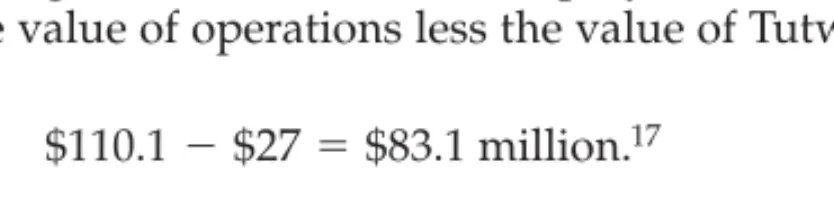
$110.1⫺$27⫽$83.1 million.
⫽$110.1.
⫹ $6.4
11⫹0.1070724⫹ $6.8⫹$153.1 11⫹0.1070725 VOperations⫽ $3.2
11⫹0.107072 ⫹ $3.2
11⫹0.1070722⫹ $5.6 11⫹0.1070723 ⫽ $6.80011.062
0.10707⫺0.006⫽$153.1 million.
17Notice that we subtract the $27 million value of Tutwiler’s debt, not the $33.2 million of debt supported after the merger, since this is the amount that must be paid off or assumed by Caldwell.
18Note that we report two decimal places for the 2012 tax shield even though Table 25-3 reports only one decimal place. All calculations are performed in Excel, which uses the full non-rounded values.
(25-5a)
Row 11 in Table 25-3 shows the projected free cash flows. The unlevered value of operations is calculated as the present value of the free cash flows during the forecast period and the horizon value of the free cash flows:
This shows that Tutwiler’s operations would be worth $88.7 million if it had no debt.
Row 13 shows the yearly interest tax savings. The value of the tax shield is cal- culated as the present value of the yearly tax savings and the horizon value of the tax shield:
Thus, Tutwiler’s operations would be worth only $88.7 million if it had no debt, but its capital structure contributes $21.4 million in value due to the tax deductibility of its interest payments. Since Tutwiler has no nonoperating assets, the total value of the firm is the sum of the unlevered value of operations, $88.7 million, and the value of the tax shield, $21.4 million, for a total of $110.1 million.
The value of the equity is this total value less Tutwiler’s outstanding debt of $27 million: $110.1 ⫺$27 ⫽$83.1 million. This is also the value we obtained using the corporate valuation model.
Valuation Using the FCFE Model
The horizon value of Tutwiler’s free cash flows to equity can be calculated using the constant growth formula of Equation 25-14:19
Notice that this horizon value is different from the APV and corporate valuation horizon values. That is because the FCFE horizon value is only for equity while the other two horizon values are for the total value of operations. If the 2012 debt of $46.2 million shown in Row 7 of Table 25-3 is added to the HVFCFE,2012, the result is the same $153.1 million horizon value of operations obtained with the corporate valuation model and APV model.
HVFCFE,2012⫽ FCF2012˛11⫹g2
1rsL⫺g2 ⫽ $7.0611.062
0.13⫺0.06⫽$106.9 million.
⫽$21.4 million.
⫹ $1.5
11⫹0.1179324⫹ $1.57⫹$28.7 11⫹0.1179325 VTax shield⫽ $1.2
11⫹0.117932 ⫹ $1.3
11⫹0.1179322⫹ $1.4 11⫹0.1179323
⫽$88.7 million.
⫹ $6.4
11⫹0.1179324⫹ $6.8⫹$124.4 11⫹0.1179325 VUnlevered⫽ $3.2
11⫹0.117932 ⫹ $3.2
11⫹0.1179322⫹ $5.6 11⫹0.1179323
19Note that we report two decimal places for the 2012 FCFE even though Table 25-3 reports only one decimal place. All calculations are performed in Excel, which uses the full non-rounded valued.
See FM12 Ch 25 Tool Kit.xlsat the textbook’s Web site for all calcula- tions. Note that rounded intermediate values are shown in the text, but all calculations are performed in Excel using non-rounded values.
Setting the Bid Price 901
Row 17 in Table 25-3 shows the yearly projections of FCFE. When discounted at the 13% cost of equity, the present value of these yearly FCFEs and the horizon value is the value of equity due to operations is:20
If Tutwiler had any nonoperating assets, we would add them to VFCFEto deter- mine the total value of equity. Since Tutwiler has no nonoperating assets, its total equity value is equal to the VFCFE of $83.1 million. Notice that this is the same value given by the corporate valuation model and the APV approach.
All three models agree that estimated equity value is $83.1 million, which is more than the $62.5 million current market value of Tutwiler’s equity, so Tutwiler is more valuable as a part of Caldwell than as a stand-alone corporation being run by its current managers.
⫽$83.1 million
⫹ $6.7
11⫹0.1324⫹ $7.1⫹$106.9 11⫹0.1325 VFCFE⫽$6.2⫹ $4.0
11⫹0.132 ⫹ $4.1
11⫹0.1322⫹ $6.0 11⫹0.1323
20Row 16 in Table 25-3 shows that debt is forecast to increase from its pre-merger $27 million to $33.2 million at the acquisition date. This is because Tutwiler is more valuable after the merger, so it can support more dollars of debt while still maintaining 30% debt in its capital structure. The increase in debt of 33.2 ⫺27 ⫽$6.2 million is a FCFE that is immediately available to Caldwell, and so is not discounted. See FM12 Ch 25 Tool Kit.xlsfor complete calculations and Web Extension 25Afor a more detailed explanation.
Why is the adjusted present value approach appropriate for situations with a changing capital structure?
Describe the steps required to apply the APV approach.
What are the differences among the FCFE, APV, and corporate valuation approaches?
SELF-TEST
25.10 Setting the Bid Price
Under the acquisition plan, Caldwell would assume Tutwiler’s debt, and it would take on additional short-term debt as necessary to complete the purchase. The valuation models show that $83.1 million is the most it should pay for Tutwiler’s stock. If it paid more, then Caldwell’s own value would be diluted. On the other hand, if it could get Tutwiler for less than $83.1 million, Caldwell’s stockholders would gain value. Therefore, Caldwell should bid something less than $83.1 million when it makes an offer for Tutwiler.
Now consider the target company. As stated earlier, Tutwiler’s value of equity as an independent operating company is worth $62.5 million. If Tutwiler were acquired at a price greater than $62.5 mil